Smart Aggregation of Things In Home/Office
Environment Using IOT and Enabling
Technologies
Chaitra D M
Information Science and engineering R V College of Engineering
Bengaluru, India [email protected]
Dr. G. S. Mamatha
Information science and engineering R V College of Engineering
Bengaluru, India
Abstract - Home management is a difficult task nowadays in this busy life. Because of the busy life, people runs to the office in hurry everyday so that they cannot able to balance the home and office at the same time. If any appliances are switched on there is wastage of light and heat energy, if any leakage of gas happens it is so dangerous it may leads to fire accidents, if any intruder tries to enter the home it is so risky. For these problems, there is a solution called ―automation of home‖ using Internet of Things(IoT). Home automation system provides to control the home remotely by the user using android phone.
Smart homes empowered with the IoT aim at providing enhanced user comfort by means of home automation systems such as energy saving system, gas leakage detection system, motion detection system. Using sensors, wireless network, android phone, IoT, machine learning and data analytics, the home automation system is built. Using machine learning algorithm called random forest classifier, the data is trained and based on the trained data the output is generated. The user gets the alerts to his/her mobile phone so that user can easily get to know the status of the house. If any appliances are switched on the user can switch off those appliances easily through the mobile phone from anywhere, if gas leakage happens at home and any unauthorized person tries to enter the home user will get the SMS alerts.
A smart home is so helpful for the people. Home automation saves the costs, moreover it saves the home from over heat, fires accidents and gives security. The technology is included in common people life and it shows technology filled country. In gas detection system the controlling of gas leakage needs to be implemented as future enhancement and automation required for the some more appliances in the home.
Keywords—IoT, cloud, pythonanywhere, sensors
I. INTRODUCTION
In recent years, the IoT has been introduced in which the objects are defined and are connected through Internet, the data is transferred between them.. The internet is connected to a device which is referred as ‗Thing‘ and it is used to transfer the information from one device to other devices. The IoT which is of cloud-based is used to connect many things such as industrial equipment, mobile devices, sensors, vehicles and some manufacturing machines.
In recent days, Artificial intelligence methods plays an important role in various environments including production development, healthcare applications, business monitoring, research and development, business process, industrial applications, weather analysis, share market prediction, environmental monitoring [3].
In future, the IoT and Artificial Intelligence will play a vital role in numerous
ways. The benefits and potential opportunities of Artificial Intelligence and Internet of Things can be practiced when both are combined together, at the server as well as at the devices end [5].
The 21st century homes are becoming more automated and self- controlled due to the comfort it provides. The user can control the electric appliances of any kind using the automation system. Because of this automation system the user can be able to control the home through wireless communication from anywhere in the world. Remotely control of the home using wireless communication is possible.
II. RELATED WORK
Some of the similar work has been made by many people previously. Some of the paper are referred for our work:
monitoring and controlling the home appliances via World Wide Web. Home automation system uses the portable devices as a user interface. They can communicate with home automation network through an Internet gateway, by means of low power communication protocols like Zig bee, Wi-Fi etc. This project aims at controlling home appliances via Smartphone using Wi-Fi as communication protocol and raspberry pi as server system. The user here will move directly with the system through a web-based interface over the web, whereas home appliances like lights, fan and door lock are remotely controlled through easy website and user gets SMS alerts about the status of the home.
The paper [2] surveys several previous works from the security perspective with the purpose of providing the most important approaches in this field. Additionally, this work provides recommendations and best practices from different security perspectives.
The IoT project [4 & 13] focuses on building a smart wireless home security system which sends alerts to the owner by using Internet in case of any trespass and raises an alarm optionally. Besides, the same can also be utilized for home automation by making use of the same set of sensors . The leverage obtained by preferring this system over the similar kinds of existing systems is that the alerts and the status sent by the wifi connected microcontroller managed system can be received by the user on his phone from any distance irrespective of whether his mobile phone is connected to the internet.
The main objective of the work [5,11& 17] is to design Hazardous gas detecting and alerting system. They are working on a project in which wthey are using new technology which is being used to make every existing digital system more smart, Internet of Things. It provides real time information available on internet for faster accessing with a gas sensor that can detect various other hazardous gases.
The paper [6 & 25] presents a cloud centric vision for worldwide implementation of Internet of Things. The key enabling technologies and application domains that are likely to drive IoT research in the near future are discussed.
A smart phone application is used in the suggested system which allows the users to control up to 18 devices including home appliances and sensors using Bluetooth technology [7,21,23& 29]. The system [8] is designed to track the presence of hazardous gases, identify the safety limit and calculate the level in that situation, thereby preventing hazards to human life. It allows
detection of carbon monoxide and methane at the given time, along with their accurate concentration values in ppm. The alert messages are broadcasted using GSM technology and hence, can be used to notify other rescue workers about the potential hazard the worker is facing at the moment.
In this work [9], a sensor senses the status of appliances and updates to web server. If user is far away from home, he can access and change status of appliances i.e. switches it on/off. User can use local PC. This paper will describe approach of controlling home appliances by using web server. The work [11] shows the design and development of a low-cost wireless sensor system for monitoring levels of methane gas could help identify gas leaks and alert third-party groups in a more efficient manner. Furthermore, using a cloud-based data collection, millions of wireless sensors can be accessed through a web interface by geographical area superimposed on an improved gas leak map.
The work [14] presents design and development of the techniques that enable smart human-device interfaces and an appliance usage prediction engine to aid home automation systems. They also present a recommendation system designed especially for smart homes. The appliance usage-prediction engine predicts the status of devices at a given time. Initially, the random forest and gradient boosting methods are used to train the appliance usage prediction engine.
The paper [16] presents the development of a prototype of an autonomous android based mobile robot for gas leak detection and localization in large industrial facilities.
The work [19] proposes a new design for the smart home using the wireless sensor network and the biometric technologies. The proposed system employs the biometric in the authentication for home entrance which enhances home security as well as easiness of home entering process.
The leakage caused by holes on gas pipelines generates economic losses to gas companies and causes risks to the environment and sometimes accidents. In order to detect and locate pipeline rupture immediately, the leakage detection method plays a key role in the overall integrity management in the pipeline system[27].
The paper[30] presents the design and implementation of a Java-based automation system that can monitor and control home appliances via the World Wide Web.
The paper[26] presents the hardware implementation of a multiplatform control system for house automation using LabVIEW.
III. MOTIVATION
The main motivation behind the implementation of home automation systems is convenience. In today‘s world, every second has its own value, everything is moving faster in this technology based world. The technology is been developing day by day. Everyone are making use of technology in their life. Because of the enabling technologies the automation of home can be done to save the time and money of the people.
IV. PROBLEM STATEMENT
Home automation refers to control the house appliances by using the technology of the computer. For example, to reduce the unnecessary wastage of light energy in home/office environment, the system is built to save the light energy when there is no darkness in the home/office environment and for gas leakage detection, the detection sensors are used to sense the gas leakage in the house and alert the user if any leakage in gas and any unnecessary wastage of light, so that user can control both the system using mobile android application from anywhere. Intrusion detection system is built to avoid the unauthorized entry of the person into home.
V. OBJECTIVES
To design and implement the light energy saving system to save the unnecessary wastage of energy at home by remotely controlling the lights from android app
based on the light status alerts to the phone.
To design and implement the gas leakage detection system to avoid the fire accident at home.
To design and develop the intrusion detection system to avoid the unauthorized person to enter the house.
VI. PROPOSED SYSTEM
Design, develop and implement the light energy saving system to reduce the unnecessary wastage of light energy in home/office environment, the automation model is built based on the previous data which is saved in cloud, to save the light energy when there is unnecessary wastage of light in the home/office environment by controlling the light through users mobile phone android app. To design, develop and implement the gas leakage detection system, the methane sensor is used to sense the gas leakage in the house and alert the user if any leakage in gas. Motion detection system is designed and developed to restrict the entry of an unauthorized person to the home.
VII. DESIGN
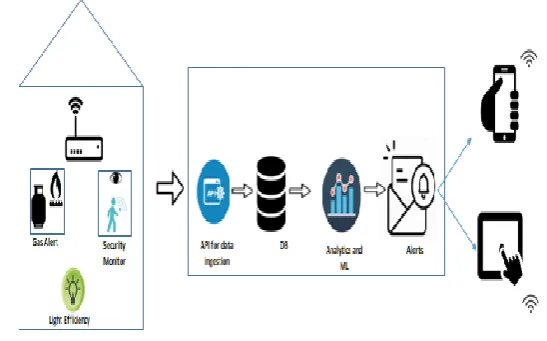
The system architecture of Internet of Things(IoT) analytics based system is as shown in below fig 1. The system architecture shows the components required for this project. The real time home data is read using IoT, which is updated in cloud. Apply machine learning algorithm to classify the data based on different factors such as time, date, status of light. Analysis of data is done and prediction can be done based on the algorithm
[image:3.595.154.428.551.721.2].
The above figure 1 shows the system architecture of the home automation system. To sense the gas leakage sensor is used, based on the previous data if any leakage happens then the user gets the alert to his phone connected through wireless network. To save the light energy sin the home the unnecessary wastage of light can be switched off using automation system, where the data is collected and pushed to cloud based on that data prediction system can predict and send alerts to the user phone so that user can control by switching it of through his cell phone from anywhere through android app. For security system at home user can use the object sensor to sense the person. Based on the previous data the prediction of unauthorized person can be identified and send the alerts to the user.
Methane gas sensor is used for gas detection system
sensor module is use to sense the gas leakage. This module use a gas sensor MQ 6 to perform the leakage detection operation. This is the main component of the whole system. This is a Semiconductor type Gas sensor in which the conductivity increases as the gas concentration increases. SnO2 and Au layer is used to sense the concentration of gases. Controller is used to measure the change i.e, increases conductivity results in decrease in the
Sensor load resistance. Controller receives the signal, if the concentration goes beyond threshold, which sends the alerts to the user[5].
Motion sensor is used for security system
A motion sensor is a device which is used sense the object. Motion sensor is used for studying motions. Data-logger is connected to the motion sensor. The data-logger is connected to a computer. The
computer runs a data-logging program. The computer is connected to a security system and power. Security is one of the major use of the motion sensors.
VIII. ALGORITHM Random Forest Tree Classifier
Wireless systems such as Wi-Fi become common nowadays in home networking. In home and building automation systems, The use of wireless technologies have many advantages in building and home automation that could not be achieved using only a wired network.[1] Figure 2 shows the random forest algorithm steps.
Innovative approach to random forest algorithm
The random forest classifier is used to read status of 5 LED and classify the situation as normal or alert depending upon status of each LED. In a normal home scenario, various types of lights are used. Depending upon the usage of each home member the lights are either ON or OFF at a given time. The pattern in which the lights are used can be collected and used for training the random forest classifier. Considering many features like LED1 as kitchen light, LED2 as hall light, LED3 as room light, LED4 as bath room light, normal day, weekend, holiday, aged person, morning, noon, evening, night, mid night.
Figure 2: Algorithm steps of random forest classifier
VII. EXPERIMENTAL SETUP Raspberry pi connection to Methane sensor and
LED
keyboard, mouse, HDMI, power connection through USB cable. Then pi is connected to the bread board using connected wires, 1K resistors, LED, and methane gas sensor. In this LED represents the device1 i.e hall light. If this LED glows means user gets the SMS alerts to the mobile
[image:5.595.189.421.215.405.2]phone using twilio service, through android application user can switch the light off from his place. For methane gas sensor, senses the gas leakage in the home and sends the SMS alert to the user so that he can control the fire accident in the home.
Figure 3: Raspberry pi connection with LED and methane sensor
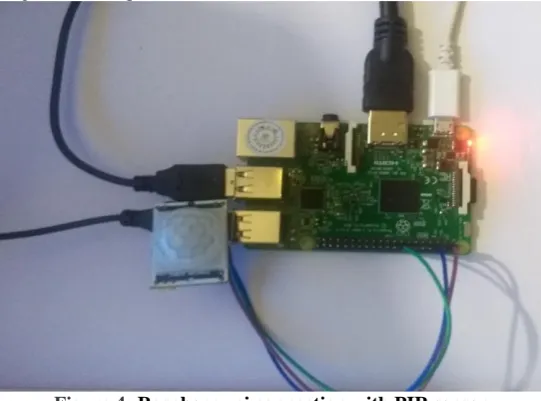
PIR motion sensor connection with Raspberry Pi
The above figure 4 shows the Raspberry Pi connection with PIR sensor to implement the motion detection system. In this the Raspberry Pi is connected to the keyboard, mouse, HDMI, power connection through USB cable. The Raspberry Pi is connected to the PIR sensor using connecting wires. If any motion senses to the PIR sensor the user will alert messages to his/her phone. Motion detection system is designed and implemented to
find any unauthorized person tries to enters the home. Motion detection system is helpful in securing home.
Figure 4: Raspberry pi connection with PIR sensor
IX. RESULTS AND DISCUSSIONS
Results are obtained from the home automation system. The home automation system contains light energy efficiency system, gas leakage detection system and security system.
1. Web app login page of home automation
[image:5.595.162.433.478.678.2]Figure 5: Web app login page of home automation
2. Device details of the home
[image:6.595.155.457.370.433.2]The below figure 6 shows the devices information in this screen which contains the details about the device name and the device code. Device code is unique code where each device is uniquely identified. Device name contains the lights name where it present in home for easy handling while switching on and off easily. Device names such as hall light, kitchen light, bathroom light etc..
Figure 6: Devices information of the home
3. Device status of the home
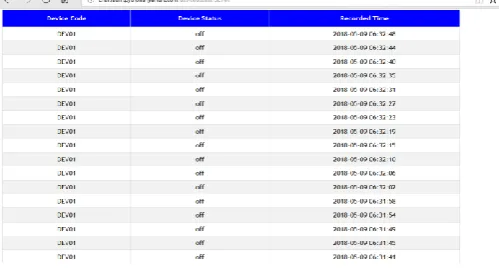
The below figure 7 shows the device status for some particular time and data whether it is on or off in the web app. If the device status is on at some time which is not necessarily on at that time the user gets the SMS alerts saying that ― Alert! A light is switched on at this time‖, so that user can switch it off using android app.
Figure 7: Device status list at some particular time
4. Android app to control the lights in home
[image:6.595.172.422.511.645.2]Figure 8: Android app to control the light
5. SMS alert to user about status of light and gas
The below figure 9 shows the SMS alert messages to the users mobile if any light is switched on in unnecessary time and if any leakage of gas in the home. Using twilio service user can get the messages to his/her cell phone.
Figure 9: SMS alert to the user about status of light and gas
6. User gets alert about the motion detection.
Figure 10: Mail notification to the user about the motion detection.
Advantages of proposed system
Wireless systems such as Wi-Fi become common nowadays in home networking. In home and building automation systems, The use of wireless technologies have many advantages in building and home automation that could not be achieved using only a wired network.[1]
Installation cost is less for wireless networking.
The system is scalable by adding many automation systems for the home.
Mobile devices can be integrated to control the home/office environment
Light energy can be saved in the home/office environment.
Gas leakage alert is sent to the user immediately and can be controlled from anywhere to reduce the risk of gas leakage.
Restrict the unauthorized person to enter the home using motion detection system.
VIII. CONCLUSION AND FUTURE WORK
To solve the problem of management of home in this hectic life, several approach is made, one approach is automating everything in home by using RFA.
In this paper, we propose the RFA to automate the home based on the sensor data. Home management problem can be reduced by this algorithm. In RFA, the data is classified based on many features. The light energy saving system, gas detection and intrusion detection system is implemented. The status of the home is alerted to the user. Light and heat energy can be saved in the home, fire
accidents and theft can controlled. For future enhancement the more updated and accurate technology can be used for more appliances in the home.
Limitations
In home automation, the light energy saving system, gas leakage detection system and motion detection system is implemented.
In light energy saving system, only few lights controlling system is developed.
In gas leakage detection system, only alerting system is developed.
In motion detection system, the person image cannot be identified.
Future Work
In home automation, the light energy saving system, gas leakage detection system and motion detection system is implemented.
In light energy saving system, only few lights controlling system is developed further it can be enhanced for all the lights and all the appliances in the house.
In gas leakage detection system, only alerting system is developed, for future enhancement the controlling of gas leakage can be done.
REFERENCES
[1] Dr. Prakash, ―IoT based monitoring and control system for home automation‖ International Journal of Research, Volume 05 Issue 12 April 2018,pp-122-128.
[2] Jhonattan, Sang Guunyoo, ―Security over smart automation system: A survey‖, Springer International Publishing AG, part of Springer Nature, April 2018.
[3] K.Rithu Hebbar, M.Kiran Kumar, ―Home automation and security using internet of things‖, International Journal of Advanced Research in Computer Engineering & Technology Volume 7, Issue 2, February 2018, pp-189-196.
[4] Ravi kishorekodali, ―IoT based smart security and home automation system‖, International Conference on Computing, Communication and Automation, 2016.
[5] Akship Agrawal, Lalit Kumar, ―IOT based Hazardous Gas Detection System using AVR Microcontroller‖, International Research Journal of Engineering and Technology, Volume: 04,2017,pp-567-573
[6] JayavardhanaGubbi, RajkumarBuyya, SlavenMarusic, MarimuthuPalaniswami, ―Internet of Things (IoT): A Vision, Architectural Elements, and Future Directions‖, a Department of Electrical and Electronic Engineering, The University of Melbourne, Vic - 3010, Australia,2017. [7] Muhammad Asadullah, ―Smart Home
Automation System Using Bluetooth Technology‖, research gate publications, IEEE, 2017.
[8] Ambeth Kumar Devadoss, ―Human life protection in trenches using gas detection system‖, Biomed Res- India, Volume 27,2016, pp-670-675.
[9] DhakadKunal, DhakeTushar, Undegaonkar Pooja, ZopeVaibhav, Vinay Lodha ,‖ Smart Home Automation using IOT‖ , International Journal of Advanced Research in Computer and Communication Engineering Vol. 5, Issue 2, February 2016,pp-344-350.
[10] M.Sathish Kumar, V.Somasundaram, S.S.Ganesh Kumar, M.Sudhakaran, ―Home Automation using PC and Cloud‖, Scope International Journal of Science, Humanities, Management and Technology. Vol.2 ,2016,pp-567-573.
[11] NadimeAzizi, Alecia Copeland, ―Methane Detection and Alerting Using Internet of Things‖, Proceedings of Student-Faculty Research Day, CSIS, Pace University, May 6th, 2016.
[12] Ravi Kishore Kodali, SreeRamyaSoratkal and Lakshmi Boppana, ―IOT based control of Appliances‖, International Conference on Computing, Communication and Automation, 2016.
[13] Ravi Kishore Kodali, Vishal Jain, Suvadeep Bose and Lakshmi Boppana, ―IoT Based Smart Security and Home Automation System‖, International Conference on Computing, Communication and Automation, 2016. [14] MayurBhole, Karan Phull, Arun Jose,
VishwasLakkundi, ―Delivering Analytics Services for Smart Homes‖, 2015 IEEE Conference on Wireless Sensors, IEEE, 2015. [15] Vinay sagar K N, Kusuma S M, ―Home
Automation Using Internet of Things‖, International Research Journal of Engineering and Technology e-ISSN: 2395-0056 Volume: 02 Issue: 03 | Jan-2015,pp-345-350.
[16] Ch.Manohar Raju and N.Sushma Rani, ―An Android based automatic gas detection and indication robot‖, International Journal of Computer Engineering and Applications, Volume VIII, Issue I, Oct 2014,pp-234-230.
[17] HitendraRawat, Ashish Kushwah, Khyati Asthana, AkankshaShivhare, ―LPG Gas Leakage Detection & Control System‖, National Conference on Synergetic Trends in engineering and Technology , International Journal of Engineering and Technical Research,2014.
[18] Vishwajeet H. Bhide, ―A Survey on the Smart Homes using Internet of Things‖, International journal of advance research in computer science and management studies, Volume 2, Issue 12, December 2014,pp-167-173
[19] Basma M. Mohammad, Basioni, Sherine M. Abd El-kader and Mahmoud AbdelmonimFakhreldin, ―Smart Home Design using Wireless Sensor Network and Biometric Technologies‖, International Journal of Application or Innovation in Engineering & Management (IJAIEM) Volume 2, Issue 3, March 2013,pp-1334-1340
[20] CharithPerera, Student Member, IEEE, ArkadyZaslavsky, Member, IEEE, Peter Christen, and DimitriosGeorgakopoulos, Member, IEEE, ―Context Aware Computing for The Internet of Things: A Survey‖ IEEE Communications Surveys & Tutorials, 5 May 2013.
Networks (IJWMN) Vol. 5, No. 1, February 2013,pp-34-40.
[22] Rajeev Piyare , ―Internet of Things: Ubiquitous Home Control and Monitoring System using Android based Smart Phone‖, International Journal of Internet of Things 2013, vol 2(1), pp-5-11.
[23] Rajeev Piyare and Seong Ro Lee, ―Smart Home-Control and Monitoring System Using Smart Phone‖ ICCA 2013, ASTL Vol. 24, pp. 83 – 86.
[24] S.D.T. Kelly, N.K. Suryadevara and S.C. Mukhopadhyay, ―Towards implementation of IoT for Environmental Condition Monitoring in Homes Copyright (c) 2013 IEEE.
[25] Sirsath N. S, Dhole P. S, Mohire N. P, Naik S. C &Ratnaparkhi N.S, ―Home Automation using Cloud Network and Mobile Devices‖ Volume -1, Issue -2, 2013,pp-89-95.
[26] Basil Hamed, ―Design & Implementation of Smart House Control Using LabVIEW‖, International Journal of Soft Computing and Engineering Volume-1, Issue-6, January 2012, pp-56-62.
[27] Zhao Yang, Mingliang Liu, Min Shao, Yingjie Ji, ―Research on Leakage Detection and Analysis of Leakage Point in the Gas Pipeline System‖, Open Journal of Safety Science and Technology, 2011, PP - 94-100.
[28] InderpreetKaur (Asstt. Prof.) Rayat and Bahra Institute of Engineering and Bio-technology, Mohali, India , ―Microcontroller Based Home Automation System With Security‖ , International Journal of Advanced Computer Science and Applications, Vol. 1, No. 6, December 2010 ,pp-189-194.
[29] Muhammad IzharRamli, MohdHelmyAbdWahab, Nabihah, ―Towards smart home: control electrical devices online‖, International Conference on Science and Technology: Application in Industry and Education ,2006.
[30] A R. Al- Ali, ― Java Based Home Automation System‖, IEEE Transactionson
Consumer Electronics, June 2004.