Towards Practical Lattice-Based
One-Time Linkable Ring Signatures
Carsten Baum1?, Huang Lin2, and Sabine Oechsner3 ?? 1
Department of Computer Science, Bar-Ilan University
[email protected] 2 ASTRI Security Lab
3 Department of Computer Science, Aarhus University
Abstract. Ring signatures, as introduced by Rivest, Shamir, and Tau-man (Asiacrypt ’01), allow to generate a signature for a message on be-half of an ad-hoc set of parties. To sign a message, only the public keys must be known and these can be generated independently. It is further-more not possible to identify the actual signer based on the signature. Ring signatures have recently gained attention due to their applicability in the construction of practical anonymous cryptocurrencies, where they are used to secure transactions while hiding the identity of the actual spender. To be applicable in that setting, ring signatures must allow to determine when a party signed multiple transactions, which is done using a property called linkability.
This work presents a linkable ring signature scheme constructed from a lattice-based collision-resistant hash function. We follow the idea of existing schemes which are secure based on the hardness of the discrete logarithm problem, but adapt and optimize ours to the lattice setting. In comparison to other designs for (lattice-based) linkable ring signatures, our approach avoids the standard solution for achieving linkability, which involves proofs about correct evaluation of a pseudorandom function us-ing heavy zero-knowledge machinery.
?Supported by the BIU Center for Research in Applied Cryptography and Cyber
Se-curity in conjunction with the Israel National Cyber Bureau in the Prime Minister’s Office.
??
1
Introduction
Digital signatures are one of the most important concepts in the area of cryp-tography. They permit a party to generate a key pair (SK, P K), give P K to the public and add certain informationΩ - called the signature - to a message m.Ωis derived using the private (or signing) keySKand later allows a verifier, equipped with the public verification keyP K, to attest that the signer indeed generatedΩfor this specific messagem. Verification is done in a way such that only a party who possesses certain secret information that only the signer has, namely the secret signing keySK, can generate a valid signature forP K.
Ring signatures, which were first suggested by Rivest, Shamir, and Tauman [40], relax the condition of having exactly one pair (SK, P K) for signing and verification to a certain extent. They allow a party among a set ofNparticipants to sign a message on behalf of all of them. Here it is crucial that the verifier cannot identify the party that signed the message, while nobody outside of the N participants should be able to sign a message as if he was a participant himself. In comparison to group signatures, the set of parties does not need to be known ahead of time, but only when the signature is generated. Therefore, no key-generation algorithm which generates correlated randomness for all N parties needs to be involved and the rings can be set up ad-hoc4.
For such a ring signature, each signer could issue an arbitrary number of signatures. Fujisaki and Suzuki introduced the notion of traceable ring signatures [17], where the signer signs a message with respect to a list of ring members and a public issue such as an election. There is a public procedure to determine whether two signatures come from one signer, i.e., the signer is linked if a signer signs the same message with respect to the same list of ring member and same issue twice [16]. A related idea is so-called linkable ring signatures, in which case the true signer will be linked when he signs two messages (different or identical) with respect to the same ring. In a more restricted version of linkable ring signatures,one-timelinkable ring signatures, a signer is linked as soon as he reveals two signatures. This property has proven to be vital in the construction of cryptocurrencies, such as to prevent double spending attacks and to preserve the anonymity of a spender since the address or the respective secret key in the design of the anonymous cryptocurrency is supposed to be one-time [37].
1.1 Related Work
Lattice-based Signature Schemes. The line of work on lattice-based signature schemes was, to the best of our knowledge, initiated by Goldreich et al. [19], while the first practical construction was based on NTRU [22]. A scheme that fits into this line of work is the provably secure construction due to Gentry et al., also called hash-and-sign [18]. This approach, where the signing key is a secret trapdoor which is used to sample a short lattice vector, was further developed in
4
[9, 15]. A different direction, called Fiat Shamir with Aborts, was first explored by Lyubashevsky [29, 28]. Very efficient signature schemes such as Tesla [21] and Dilithium [14] have been designed within this framework.
(Linkable) Ring Signature Schemes. There exists a wealth of literature on ring signature and linkable ring signature schemes such as [40, 16, 27, 6, 17] and we only list some of the relevant works here. However, the above mentioned sig-nature schemes have a sigsig-nature size that is linearly dependent on the number of usersN in the ring. The Groth-Kohlweiss framework [20] is based on homo-morphic commitments and provides a ring signature scheme with a logarithmic signature size. Franklin and Zhang [16] propose a general framework for linkable ring signatures. They extend the “PRF made public” paradigm by Bellare and Goldwasser [5] in order to provide linkability by combining a PRF evaluation of the secret key with a NIZK proof of correct evaluation. The smallest ring signa-tures to date have constant signature size and are based on accumulators. The construction by Dodis et al. [13] uses accumulators based on the strong RSA as-sumption, while Nguyen’s [36] relies on pairing-based cryptography. There exists also a linkable version of [13] by Tsang and Wei [42] that retains the constant-sized signatures. There exist candidates for post-quantum ring signature schemes such as hash-based [12, 23] or multi-variate-quadratic-equation based construc-tions [35]. Neither of them provide linkability in their current form, but they can potentially be extended to do so.
Lattice-based Ring Signature Schemes. Lattice-based ring signatures were first introduced explicitly through the work of Brakerski and Tauman-Kalai [10] who proposed a general framework for ring signatures in the standard model and showed how to instantiate it based on the SIS assumption. The resulting sig-natures have sizeO(mN) for message lengthm and ring sizeN. Subsequently, Wang and Sun [43] proposed two ring signatures schemes from the SIS assump-tion in the random oracle and standard model, respectively, both of linear sig-nature size. The first ring sigsig-nature scheme based on the LWE assumption was proposed by Melchor et al. [33] and is an extension of [28] to the ring signature setting. Like the previous schemes, it yields signatures of linear size. Recently, Libert et al. [25] proposed the first lattice-based ring signature scheme with only logarithmic signature size using a Merkle-tree based construction.
Concurrent Work. In concurrent work, Torres et al. [41] present a construction that is very similar to ours. When comparing the actual parameters of both, we have a larger size of the public keys, but compare favorably in the signature size.
1.2 Our Contribution
as good as [25, 12] for comparable security levels for ring sizesN/128 and beats [23] for rings of small size. A comparison can be found in Table 1 below.
[25] [12] Sponge/Davies-Meyer [23] Our work
Size of PK 0.5 KB 32 B 32 B 8 KB
Size (N= 8) 1.44 MB 766/477 KB 148 KB 82.5 KB Size (N= 32) 2.29 MB 1200/719 KB 216 KB 305.7 KB Size (N= 128) 3.14 MB 1.59/0.94 MB 285 KB 1.17 MB
Table 1.Comparison with existing work
.
The authors of [12] present two different, highly optimized constructions of ring signatures in their work. We mention numbers for both to allow for fair comparison (outperforming one of the two forN = 128). We want to stress that using known techniques [14] and by choosing parameters more aggressively it is possible to reduce the public key and signature size in our setting further, but such optimizations are beyond the scope of this work. Furthermore, [12, 25, 23] are not linkable in their current form, so one can expect a further increase in their proof size to compute a linkability tag. Though our work only outperforms [23] for small (N ≤20) ring sizes, this is exactly the range that cryptocurrencies need: the recommended ring size of the most popular cryptocurrency using linkable ring signatures, Monero, at the time of writing wasN = 5. As mentioned before, using [14], would make it possible to reduce the ring signature size further to also outperform [23] forN /64.
1.3 Technical Overview
Since our construction will be based on the (Module-)SIS and (Module-)LWE problem, the public keys of the parties are of the form P K = Ar for secret keyr and public matrixA. Linkability will be ensured by providing linkability tags I = Br for another public matrix B. Interestingly, the reason why our construction achieves only one-time linkability is inherent in this approach: any evaluation Brleaks information about r. If a fresh matrix B is generated for each ring, then a malicious party can receive more leakage onr than intended and hence may be able to recover the signer’s secret key.
In order to obtain more efficient lattice-based (linkable) ring signatures, it may be tempting to try to instantiate current sublinear-size ring signatures in the lattice setting. Note, however, that this is far from trivial, as these solutions are specifically tailored to a certain assumption like Dodis et al.’s accumulator-based ring signatures [13], or suffer from the well-known problem that hard lattice assumptions do not provide enough algebraic structure to support existing sublinear approaches based on homomorphic operations like that of Groth and Kohlweiss [20].
Paper Organization
In Section 2 we will introduce some definitions and lemmas concerning lattice-based constructions which we will need throughout this work. Moreover, we will give definitions for linkable ring signatures (following previous work). Section 3 contains the construction and security statements. The main parts of the proofs are deferred to Appendix A, whereas we discuss the practicality of our scheme in Section 4. In this Section, we also provide a sample parameter set for our construction together with estimates for the size of signatures.
2
Preliminaries
We will use [N] as shorthand for the set {1, . . . , N}. Let R be the cyclotomic ringR=Z[X]/hXν+ 1i, whereν= 2p andp∈N+. Letqbe an odd prime and defineRq =Zq[X]/hXν+ 1i. HereZq denotes the integers moduloq, which will be represented as elements from the interval−q−21,q−21. Forf =P
ifiX i∈R, the norms off are defined as
l1:kfk1= X
i|fi|, l2:kfk2= X
i|fi| 21/2
, l∞:kfk∞= maxi |fi|.
Iff ∈Rq, then we will represent each coset fromZq with its unique represen-tative from the aforementioned interval and consider the norm of the obtained Z-vector. LetSβdenote the set of elements x∈Rwithl∞-norm at mostβ. Let 0v∈Zv×v andIv ∈Zv×v denote the zero and identity matrix overZ.
Remark 1. We use the following standard relations among differentl-norms of a vector inRas defined above:
2. Iff ∈R,g∈Rv satisfy thatkfk
2≤β,kgk∞≤γ, then kfgk2≤
√
vνβγ. We require a subsetD ofRq which consists of short invertible elements such that the difference of any two distinct elements from this set is also invertible. It was shown in [32] that as long asq is a prime that satisfiesq= 17 mod 32 and q > 220, then the set D ={d∈Rq|kdk∞≤1,kdk1≤κ} satisfies this require-ment. We use ¯Dto denote the set of valuesD+D excluding 0.
2.1 Normal Distribution and Rejection Sampling
The continuous normal distribution over Rν centered at u∈
Rν with standard deviationσhas probability density function
ρνu,σ(x) = √1
2πσ ·exp
−||x−u||2 2 2σ2
Thediscrete normal distribution overRv centered atu∈Rv with standard deviationσis given by the distribution function (for allx∈Rv)
Nu,σ(x) =ρvu,σ·ν(x)/ρ v·ν σ (R
v),
where we omit the subscript u when it is zero. We use the following standard tail-bound due to Banaszczyk:
Lemma 1. Let Nu,σ be defined as above. Then
Pr
kzk2>2σ√vν | z← Nv σ
<2−vν
For our ring signature scheme, we use rejection sampling to hide the secret signing key. The basic idea of rejection sampling is to abort the protocol with a certain probability such that the distribution of the response is independent of the secret input. We adopt the rejection sampling lemma from [29]:
Lemma 2. Let V be a subset ofRv in such that all elements havek·k2-norms less than T,σ∈Rsuch thatσ=ω(Tplog(vν)), andh:V →Rbe a probability
distribution. Then there exists anM =O(1)such that the output distribution of the following two algorithmsA,S is within statistical distance2−ω(log(vν))/M:
A:
1. u←h
2. z← Nv u,σ
3. output (u,z)with probability min1 M
Nv σ(z)
Nv
u,σ(z) ,1
S:
1. u←h
2. z← Nv σ
3. output (u,z)with probability 1/M
In [29], the author remarks that ifσ=αT, α >0 andM = exp 12/α+ 1/(2α2) then the output of both algorithms will be within statistical distance 2−100/M and Awill output a value with probability at least 1−2
−100
M . As an example, assume that we want the signing algorithm to succeed in each iteration with probability 1/3, i.e. we want to setM = 3. Then following the reasoning in [29], we can set σ= 11·T. This means that the output of the signing algorithm is indistinguishable from the simulator except with probability ≈2−98, which we deem sufficient for our application.
2.2 Module-SIS and Module-LWE
The security of our linkable ring signature scheme will be based on the hardness of two problems, Module-SIS and Module-LWE [24]. These problems are variants of the well-known SIS [1] and LWE [39] problems, but over modules that are defined over polynomial rings. This is a generalized version of the Ring-SIS and Ring-LWE problems [31, 30, 38]. Using Module-lattice assumptions comes with two advantages: (i) while they are a generalization of ideal-lattice assumptions, they still retain some structure which is necessary to construct a large space of short, invertible elements which is necessary for our construction; and (ii) there is evidence that module lattices of larger rank are less prone to certain attacks than ideal-lattices [8, 3].
The homogeneous Module-SIS problem consists of finding a vectorrof small norm such thatAr= 0 for a given, structured matrixA.
Definition 1. (MSISh,v,t)Given A←Rqh×v, find r∈Rv such that Ar= 0and0<krk2≤t.
Our scheme also uses the Decisional Module-LWE problem. In D-MLWE, the problem consists of distinguishing noisy linear equations from random.
Definition 2. (D-MLWEh,v,β) Let A←Rhq×v. Then distinguish the
distribu-tions
(A,Ar) and (A,u)
wherer←Sv
β andu←Rhq.
Here, we use a special instance of the Module-LWE problem where the secret has the same distribution as the noise5.
If two samples (with different matrices, but same secret vectorr) are issued by the challenger, then this can still be related to aD-MLWEinstance but with different parameters, as the following proposition shows.
5
This equivalent formulation is possible in our setting, as only one LWE sample will be issued per secret. The definition might seem unusual at first, as one regularly defines the LWE distribution asAs1+s2. We can use the following transformation, which is
well-known: note that the given equation is equivalent to writingAs1+Ihs2instead.
By aligning this into a single matrix product ofA0with (s1|s2) and multiplying the
Proposition 1. Let A,B←Rh×v
q ,r←Sβv andc,d←R h q. Then
(A,Ar,B,Br)≈c(A,c,B,d)
given the D-MLWE2h,v,β-problem is hard.
Proof. Consider the matricesE=
A B
, andEr=
Ar Br
. Then distinguishing the above distributions is equivalent to distinguishing
(E,Er)≈c
E,
c d
This is the definition of theD-MLWE2h,v,β problem. ut Our construction will moreover rely on a third problem, namely the Search Module-LWE problem. It can be seen as an inhomogeneousMSISinstance where the target is known to have a short preimage underA.
Definition 3. (S-MLWEh,v,β) Sample r ← Sβv uniformly at random. Given A←Rh×v
q ,s=Ar
find r0 ∈Rv such thatAr0=sand0<kr0k ∞≤β.
Fixing h, v, β of an S-MLWE-instance, it is easy to see that any algorithm
A that solvesS-MLWE-instances can also solve D-MLWE-instances with the same parameters in comparable time and with similar probability. For the con-verse direction, Langlois and Stehl´e [24] showed that, for certain parameter sets,
S-MLWEcan be reduced toD-MLWE.
2.3 Linkable Ring Signatures
The formal syntax and security model of linkable ring signatures, sometimes also called linkable spontaneous anonymous group signatures, can be found in [27, 17]. Definitions of linkable ring signatures with adaptation to the cryptocurrency scenario can be found in [37]. Our definitions are in the spirit of [20, 27, 17].
Definition 4 (Linkable Ring Signature). A linkable ring signature scheme consists of five algorithms:
Setup(1λ): Generates and outputs public parameters PP available to all users.
KGen(P P): Generates a public key P K and a private signing keySK.
SignP P,SK`(m, L): Outputs a signature Ω on the message m ∈ {0,1}? with
respect to the ringL = (P K1, . . . , P KN). Here, (P K`, SK`) is a valid key pair output byKGen(P P), andP K`∈L.
Vfy(m, L, Ω): Verifies a purported ring signatureΩon a messagemwith respect to the ring of public keysL. It outputs a bit b∈ {0,1}.
Link(m1, m2, Ω1, Ω2)6: Takes as inputs two messages m1, m2 as well as two
The above algorithms form a linkable ring signature scheme if the follow-ing definitions of correctness, signer anonymity, linkability and exculpability are fulfilled.
Definition 5 (Correctness). LetN ≥1. Then∀t∈[N], ∀{i1, ..., it} ⊂[N], k∈ {i1, ..., it} and∀m∈ {0,1}∗ it holds that
Pr
Vfy(m, L, Ω) = 0
P P ←Setup(),
{P Ki←KGen(P P)}i∈[N], L= (P Ki1, . . . , P Kit), Ω=SignP P,SKk(m, L)
≤negl(λ)
Signer anonymity captures the intuition that if the targeted signer is not corrupted, then the probability that the adversary can identify him as the true signer among all uncorrupted parties is negligible.
Definition 6 (Signer Anonymity). Let L = (P K1, . . . , P KN) be a list of
public keys and Dt be any set of 0 ≤ t < N signing keys such that ∀SKi ∈ Dt∃P Ki∈L: (P Ki, SKi)is generated by KGen. A ring signature scheme is
signer anonymous if for any P P T algorithm E, on inputs of any message m, sets L, Dt as defined above and any valid signature Ω on L and m generated usingSK`6∈Dt, then
Pr [E(m, L, Dt, Ω) =`]− 1 N−t
≤negl(λ).
LetP P ←Setup(1λ). For the following two definitions we assume the exis-tence of two oracles OK,OS:
Key generation oracle OK: On input of a bit b generate a random keypair (P K, SK)←KGen(P P). Ifb= 0 then outputP K, otherwise (P K, SK).
Signing oracle OS: On input (L, m, i) whereL= (P K1, . . . , P KN) are public keys generated byOK,i∈[N] andOKdid not outputSKiandm∈ {0,1}∗, returnΩ ←SignP P,SKi(m, L). If a key in Lwas not queried before, then output⊥.
The idea behind the Linkability definition is as follows: if the same signer generates two signatures, then the algorithm Linkwill identify this with over-whelming probability. It is important that this not only holds against honest use of the algorithmSign, but arbitrary adversaries.
Definition 7 (Linkability). Let A be a PPT algorithm with oracle access to
OK,OS. A is given 1λ and P P as input. A outputs lists L1, L2 ⊆ L (where L is the set of all keys queried from OK) of length N each, whose intersection
is not empty. Wlog denote by (P K1, . . . , P KN∪) the public keys appearing in
L1 andL2. Furthermore,A outputs N∪+ 1 values {(mi, Ωi, ji)}i∈[N∪+1] where
ji∈ {1,2}. Then the scheme is linkable if, for every suchA,
Pr
∀i∈[N∪+ 1] : Vfy(mi, Lji, Ωi) = 1,
∀i, j∈[N∪+ 1], i6=j: Link(mi, mj, Ωi, Ωj) = 0
The above only talks about the setting of generating signatures without being traceable. Equally important is the setting where signatures are signed by two different parties, where we require that their tags must be distinct. This then, of course, in particular includes the case of theSignalgorithm. This property is important in the setting of cryptocurrencies where one might otherwise be able to issue fake transactions on behalf of another party.
Definition 8 (Exculpability). Let A be a PPT algorithm with oracle access to OK,OS. A is given 1λ and P P as input and outputs two lists L1, L2 ⊆ L
(where L is the set of all keys queried fromOK) of length N together with two
pairs(m1, Ω1),(m2, Ω2)withVfy(m1, L1, Ω1) =Vfy(m2, L2, Ω2) = 1, not both queried to OS. Let M ⊂L1∪L2 be the set ofP Ki for which Adid not obtain SKi from OK. Then
Pr
Link(m1, m2, Ω1, Ω2) = 1
∃P Ki∈M,∃m∈ {0,1}∗,
∃j∈ {1,2}:
Ω←SignP P,SK
i(m, Lj),
Link(m, mj, Ω, Ωj) = 1
≤negl(λ).
Remark 2. In our scheme, we do not give a definition and proof for existential unforgeability. As was observed in [17] the above definitions imply this property, as any algorithm breaking existential unforgeability can be used in a black-box setting to break exculpability (see [17, Theorem 2.6]).
3
Constructing Linkable Ring Signatures
In this section, we will describe our linkable ring signature scheme and prove its security. Our proposed scheme can be considered as an adaption of the linkable ring signature scheme proposed in [27] to the lattice setting. However, while most linkable signature schemes such as the one proposed in [16] require the use of a pseudorandom function to achieve linkability, our scheme demonstrates that the linkability for one-time ring signature schemes can be obtained without using a pseudorandom function to generate the tag.
If a scheme is not one-time, then this PRF is evaluated on the secret (or public) key of the signing party and a description of the actual ring L. In our case, it is not necessary to include the ring L into the tag computation (as the scheme is one-time) and we attach a tag derived from the secret key only. Concretely, each party will have a private key ri together with a public key P Ki=Ari, whereAis a random length-compressing matrix andri is a vector of small norm. Thus, P Ki is an evaluation of the public collision-resistant hash functionfA(·) :x7→Axon the private inputri.
is that they are built simultaneously, using the same challenges and blinding value in each step. For this to be verifiable, the signer must now include hisIiin the signature, which serves the same purpose as the public keyP Ki in the first ring. We will show that the signer is bound to use his own valueIi if he wants to generate a valid signature and will therefore produce a collision if a second signature is revealed.
Let H : {0,1}∗ → D be a cryptographic hash function where D is the
challenge space defined in Section 2. The algorithms of our scheme are defined as follows:
Setup(1λ): Sample two random matricesA,B←Rh×v
q and set P P = (A,B).
KGen(P P) Sample r ← Sβv and then generate the public key P K = Ar as well as the signing keySK=r.
SignP P,SK`(m, L):
1. Compute the tagI`=Br`. 2. Sampleu← Nv
σ and set d`+1←H(L, I`, m,Au,Bu). 3. For eachi=`+ 1, . . . , N,1, . . . , `−1:
(a) Samplerz,i← Nσv.
(b) Setti,1=Arz,i−diP Ki andti,2=Brz,i−diI` as well as d(i modN)+1←H(L, I`, m, ti,1, ti,2).
4. Computerz,`=u+d`r`. 5. Abort with probability 1−min
1, Nσv(rz,`) M·Nv
d`r` ,σ(rz,`)
, otherwise output the
signatureΩ=d1,(rz,i)i∈[N], I`
.
Vfy(m, L, Ω):
1. Fori∈[N], check whetherkrz,ik2≤2σ
√
νv, else output 0.
2. Fori∈[N], computet0i,1=Arz,i−diP Ki,t0i,2=Brz,i−diI` as well as di+1=H L, I`, m, t0i,1, t0i,2
.
3. Ifd1=H L, I`, m, t0N,1, t0N,2=dN+1 then output 1, else output 0.
Link(m1, m2, Ω1, Ω2): Given
Ω1=
d(1)1 ,r(1)z,i i∈[N], I
(1) `
andΩ2=
d(2)1 ,r(2)z,i i∈[N], I
(2) `
,
return 1 ifI`(1)=I`(2) and 0 otherwise.
Correctness can easily be verified using Lemma 1 and Lemma 2.
3.1 Security
Anonymity. We first provide a theorem about signer anonymity. The proof follows a similar structure as [40, 27] and can be found the appendix.
Theorem 1 (Signer Anonymity). The proposed ring signature scheme pro-vides signer anonymity in the (programmable) random oracle model assuming hardness of the D-MLWE2h,v,β-problem.
Proof. See Appendix A.1.
Linkability. The proofs of linkability and exculpability use the Forking Lemma. We separate the rewinding part (as it also rather directly follows from previous work) from the rest and defer the proofs to the appendix.
Lemma 3. Let A be a PPT algorithm with oracle access to OK,OS, H which
queries H at most qH times, OS at most qS times, andOK at most qK times.
Moreover, A on input 1λ, P P outputs L
1, L2 and {(m(i), Ω(i), ji)}i∈[N∪+1] as
defined in Definition 7 with probabilityin time at mosts. Then there exists an algorithmRthat outputs(I,r,ˆr, d,d, πˆ )
– such thatπ∈[N∪],d,dˆ∈D and||r||,||ˆr|| ≤2σ √
νv,
– it holds thatdP Kπ =Ar,dP Kˆ π=Aˆr,dI =BranddIˆ =Brˆ,
– whereI is not a tag for any honestly generatedP Kj fromL1, L2,
– with probability− 1
|D|−qH−N qS 2
/((N∪·(N∪+ 1))qH)2, – in timeO(N∪2·qH·s).
Proof. See Appendix A.2.
Using the above lemma, the proof of linkability now works as follows: We embed aMSIS-instance into the public key and then use the algorithmR. This gives us valuesd,d,ˆr,rˆ which are used to obtain aMSIS-preimage. It remains to show that this preimage is within the bounds of the theorem and non-zero.
Theorem 2 (Linkability). LetAbe defined as in Lemma 3. Then there exists an algorithm Mthat breaks aMSISh,v,t-instance
– with probability− 1
|D|−qH−N qS 2
/(N∪·(N∪+ 1)qH)
2
,
– in timeO(N∪2·qH·s),
– wheret= 4σ√v·ν+ 2·κ·v·ν1.5·β.
For simplicity, we assume in the reduction thatN is fixed.
Proof. Consider the following algorithmM: 1. Query for an MSIS-challenge A∈Rh×v
q . Sample B ←Rhq×v uniformly at random. SetP P = (A,B).
3. RunRfrom Lemma 3 withA.
4. IfRdoes not output⊥then returns= (d−dˆ)rπ−(ˆr−r).
Observe that ifRgenerates output, then we obtaind,d,ˆr,ˆr, π such that
(d−dˆ)P Kπ=A(r−r) and (ˆ d−dˆ)I=B(r−ˆr).
P Kπ was generated honestly byOK and we haverπ such thatP Kπ=Arπ. Rewrite the above as
A(d−dˆ)rπ=A(r−ˆr)
Assume that (d−dˆ)rπ = (r−ˆr) then by the invertibility of (d−dˆ) it holds that
Iπ =Brπ=B
(r−r)ˆ ·(d−dˆ)−1=I
which contradicts the assumption thatI is different from all honestly generated tags. Hence (d−dˆ)rπ = (ˆ6 r−r) and thus s6= 0, while 0 =Aswhich yields a solutionsto theMSIS-instance obtained in Step 1 as required in Definition 1. The runtime of M is clearly dominated by the runtime of R. To give an upper-bound on the size ofs: the vectorrπ was generated honestly as inKGen, therefore||rπ||∞≤β. Usingd,dˆ∈Dwe obtain that||(d−dˆ)rπ||2≤2·κ·β·v·ν1.5. By the triangular inequality, the bound onsfollows. ut
Exculpability. For the exculpability proof, we need a different extractor which is also based on the Forking Lemma. Again, the actual construction can be found in the appendix. In the proof of exculpability, we use the following result:
Lemma 4. Let A be a PPT algorithm with oracle access to OK,OS, H which
queries H at most qH times and OS at most qS times. Moreover, A on
in-put 1λ, P P outputs L1, L2,(m(1), Ω(1)),(m(2), Ω(2)) as defined in Definition 8
with probability in time s. Then there exists an algorithm R0 that outputs
(I,r,rˆ, d,d, πˆ )
– such thatπ∈[N∪],d,dˆ∈D and||r||,||ˆr|| ≤2σ √
νv,
– it holds thatdP Kπ =Ar,dP Kˆ π=Aˆr,dI =BranddIˆ =Brˆ,
– with probability− 1
|D|−qH−N qS 2
/(2·qH·N∪)2, – in timeO(N∪·qH·s).
Proof. See Appendix A.2.
We do not follow the exact same outline as in the proof of Theorem 2, as the same argument that the computedMSIS-solution is non-zero does not hold anymore. We resolve this by having a simulator that - indistinguishably for the adversary Aand the extractorR0 - randomly embeds one out of two possible,
Theorem 3 (Exculpability).Let algorithmAbe defined as in Lemma 4. Then there exists an algorithm M that either breaks an S-MLWE2h,v,β instance or
an MSISh,v,t-instance
– with probability(N−N1)− 1
|D|−qH−N qS 2
/(2·qH·N∪)2, – in timeO(N∪·qH·s),
– wheret= 4σ√v·ν+ 2·κ·v·ν1.5·β.
Proof. The algorithmMwhich we will construct in the course of this proof will either use the matrixAinSetupto implant anMSIS-challenge or alternatively choose A,B from anS-MLWEinstance. Whereas in the former case the proof works as before, in the latter one we use a randomly chosen public key and its corresponding tag to embed an S-MLWEchallenge. This then means that we cannot correctly simulate theOSoracle as we would need the secret key for it -which is the secret we want to extract! Instead, the proof uses a version of the simulatorS from signer anonymity.
With respect to the Link algorithm from our construction, the definition translates into the requirement that the tags I(1), I(2) from Ω
1, Ω2 are equal. Moreover, eachI(i)must be identical to an honestly generated identification tag for one of the public keys inL1∪L2, andAdid not obtain both signatures from
OS and does not possess the secret key for this public key. LetI=I(1) =I(2). The algorithmMwill first fairly flip a bitb← B1/2. Then it does the following, based on the value ofb:
b= 0: M will take a S-MLWE instance (D,t) where D =
A B
∈ R2hq ×v
and t =
t0 t1
∈ R2h
q such that A,B ∈ Rhq×v and t0, t1 ∈ Rhq. Assign P P = (A,B) and choose an indexk∈[2N]. Forj∈[2N] set
(P Kj, SKj) = (
(Arj,(rj,Brj)) ifk6=j and forrj←Sβv (t0,(⊥,t1)) ifk=j
We then set the counterj= 1. WheneverArequests a public key fromOK, then outputP Kjand increasejby 1. Ifj =kandArequests the secret key then abort. WheneverOS is queried, then sign the signature for the queried keyscorrectly if s6=k, otherwise use the back-patching simulator from the Signer Anonymity proof7, but withI
j=t1.
b= 1: M will take a MSIS instance A ∈ Rqh×v as input, sampleB ← Rhq×v uniformly at random and setP P = (A,B). It will additionally choosek∈
[2N] uniformly at random.OK will generate all keys honestly, but abort if
Aqueries SKk.OS will runSign honestly.
7 The anonymity simulation does only provide computational indistinguishability as
it uses Proposition 1. Here the correctly generatedIj is known and the simulation
Assume thatAdoes not query forSKk, then the output ofAwill be independent of the choice of b due to Theorem 1. If b = 0 then A will be stopped if SKk is queried, but observe that this abort probability is the same in case b= 1 as the keyP Kk is perfectly indistinguishable from honestly generated public key P Kj. Moreover, the abort probability in the presence ofOS is identical due to the construction of the oracle, so the probability that A outputs something is independent ofb. This output probability is0=·(2N−1)/2N by the random choice of k.
In the next step, Mnow runs Ausing the algorithm R0 from Lemma 4. If R0 does not output⊥then we obtain valuesd,d,ˆr,ˆr, π such that
(d−dˆ)Arπ = (d−dˆ)P Kπ =A(r−ˆr) and (d−dˆ)I=B(r−r)ˆ
where rπ is the secret key belonging toP Kπ. We might either have that (d− ˆ
d)rπ =r−rˆ or that inequality holds. Now if the values are not equal, then we can use the same argument as in linkability to extract a MSIS solution (this covers the case whenb= 1). But in case of equality the approach does not work - unless we are in the setting where the algorithmMchoseb= 0. Now we know that equality holds andrπ is known to exist as P Kπ is aS-MLWEchallenge, which we can therefore extract.
More formally, ifb= 0 andk=πthenMwill outputrπ= (r−r)ˆ ·(d−dˆ)−1as d−dˆ∈D0. Ifb= 1 then it will instead output (d−dˆ)rπ+ ˆr−r. We now calculate the probability that the algorithmMwill output a correct answer to either of the two challenges. Therefore, denote withX=the event that (d−dˆ)rπ=r−ˆr, and withX6=the opposite event. LetMdenote the event thatMoutputs something. As our goal is to lower-bound the probability that the output of Mis correct, we need to determine
Pr [Mgives correct output] = Pr [X=, b= 0|M] + Pr [X6=, b= 1|M]
Ifb= 0, then by the choice ofk, the probability thatπ=kis at least 1/|L|
and therefore Pr [M|X=, b= 0]≥1/N. Using Bayes’ Theorem, we obtain that
Pr [X=, b= 0|M] =
Pr [M|X=, b= 0]·Pr [X=, b= 0] Pr [M]
≥Pr [M|X=, b= 0]·Pr [X=, b= 0]
≥1/N·Pr [X=]·Pr [b= 0] = 1/2N·Pr [X=] where we use in the last step that the occurrence ofX= is independent ofb.
In case ofb= 1 we always give output, so we have that Pr [M|X6=, b= 1] = 1. Using the same reasoning as above, we obtain that
Pr [X6=, b= 1|M]≥1/2·Pr [X6=]
For the sizetof the extractedMSIS-solution we can use the same argument as in the proof of Theorem 2. The runtime is dominated by the runtime of R0,
except that the success probability ofAis0 instead ofdue to the adjustment
of the oracles. ut
The proof of Theorem 3 can be simplified such as to rely only on the MSIS assumption if one can guarantee that the event X6= will occur with good prob-ability (where multiple solutions for the given MSISinstance exist and therπ used in the signature is hidden). See [28] for details.
4
Discussion
We now discuss questions surrounding the practicality of our scheme and hint at future research directions.
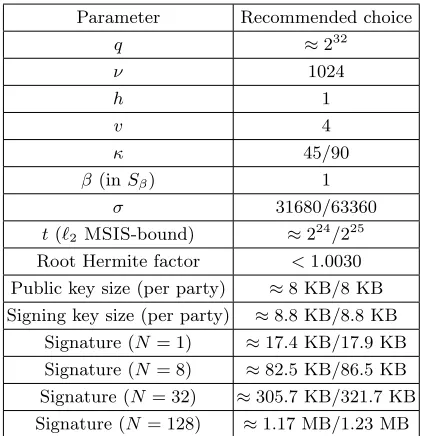
Practical Considerations. The runtime ofVfy is essentially theN-fold runtime of the verification of a regular lattice-based signature scheme. For signing, the computation and sampling of I`,u as well as rr,j,Arz,j,Brz,j for j 6= ` can be done offline. The size of the total signature is approximately the size of N individual lattice-based signatures, as can be seen in Table 2.
As the basis of our construction, we chose a simple signature scheme without optimizations. Following the outline of our algorithms, one can instantiate it with e.g. [14] and then use their key-compression technique: this optimization is important when it comes to signature size.
Parameter Selection. In our construction, the D-MLWE-instance from Theo-rem 1 and theS-MLWE-instance in Theorem 3 have the same dimensions and bounds. Moreover, it was already mentioned in Section 2.2 that any algorithm which solves theS-MLWEproblem in time hwith success probabilitycan be turned into a distinguisher for D-MLWE for the same dimension with essen-tially the same runtime and success probability. It thus suffices in the parameter selection to look at theD-MLWE-instance only.
Unfortunately, it seems like the security reduction cannot be used for the choice of parameters, as it is inherently non-tight: from the proofs in Section 3, we see that the reductions have a huge loss in terms of success probability (both due to the use of the Forking Lemma and because the runtime is proportional to the number of queries of Ato H). If one attempts to obtain a good success probability of the reduction, the estimated runtime gets rather large. We leave a proof with a tighter reduction that can be used to instantiate our construction as an open problem.
Instead, we chose the parameters of our scheme such that theMSIS- and
D-MLWE-problems are hard given that the reduction succeeds (see Table 2).
Parameter Recommended choice
q ≈232
ν 1024
h 1
v 4
κ 45/90
β(inSβ) 1
σ 31680/63360
t(`2 MSIS-bound) ≈224/225
Root Hermite factor <1.0030 Public key size (per party) ≈8 KB/8 KB Signing key size (per party) ≈8.8 KB/8.8 KB
Signature (N= 1) ≈17.4 KB/17.9 KB Signature (N= 8) ≈82.5 KB/86.5 KB Signature (N = 32) ≈305.7 KB/321.7 KB Signature (N= 128) ≈1.17 MB/1.23 MB
Table 2.Parameter settings for our scheme.
the given parameters, the security relies only on Module-SIS/LWE with h= 1 i.e. Ring-SIS/LWE, but increasingh, v, κ and thus decreasingν would allow to base the hardness on Module-SIS/LWE with a larger rank with only a minor increase in the size of the signature.
To choose actual parameters, we use the LWE simulator with sparse secrets from [4, 2] forD-MLWE. Moreover, we use [34] to assess the hardness of our ob-tained SIS instance8. The size estimates in Table 2 are in Kilobytes/Megabytes (as in related work), we bound the size of each coefficient ofrz,i assuming it is within a 6σ-interval.
Post-Quantum Security. It is widely believed that hardness assumptions used in our scheme may offer security in a post-quantum era. On the other hand, it is unlikely that our security proofs carry over to the Quantum Random Oracle Model (QROM, see e.g. [7]): we use adaptive programming of the RO H in Theorem 1, and adaptive rewinding in Theorem 2 and 3. Both of these proof techniques are somewhat inherent to the construction.
8
We note that other candidate constructions in the QROM such as [14, 11] also use a form of RO programming (even though not adaptively). Moreover, though it seems unlikely that the Forking Lemma can be proven in the QROM, there exist no attacks on protocols using these proof techniques which stem from this use of the RO, to the best of our knowledge.
Acknowledgments
We thank the authors of [12] for informing us about a mistake in an earlier version of this work and further helpful comments. The second author thanks Zhicong Huang from EPFL for help with implementation, Harry Wong, Sherman Chow from CUHK for discussion at the very beginning of this project and Hao Chen from MSR Redmond for advice on the parameter selection for implementation.
References
1. Mikl´os Ajtai. Generating hard instances of lattice problems (extended abstract). InSTOC, pages 99–108, 1996.
2. Martin R. Albrecht, Benjamin R. Curtis, Amit Deo, Alex Davidson, Rachel Player, Eamonn W. Postlethwaite, Fernando Virdia, and Thomas Wunderer. Estimate all the LWE, NTRU schemes!, 2018. https://eprint.iacr.org/2018/331.
3. Martin R Albrecht and Amit Deo. Large modulus ring-lwe ≥ module-lwe. In
Asiacrypt 2017, pages 267–296. Springer, 2017.
4. Martin R Albrecht, Rachel Player, and Sam Scott. On the concrete hardness of learning with errors. Journal of Mathematical Cryptology, 9(3):169–203, 2015. 5. Mihir Bellare and Shafi Goldwasser. New paradigms for digital signatures and
mes-sage authentication based on non-interative zero knowledge proofs. In CRYPTO 1989, pages 194–211, 1989.
6. Adam Bender, Jonathan Katz, and Ruggero Morselli. Ring signatures: Stronger definitions, and constructions without random oracles. InTCC, volume 6, pages 60–79. Springer, 2006.
7. Dan Boneh, ¨Ozg¨ur Dagdelen, Marc Fischlin, Anja Lehmann, Christian Schaffner, and Mark Zhandry. Random oracles in a quantum world. In Asiacrypt, volume 7073, pages 41–69. Springer, 2011.
8. Joppe Bos, Lo Ducas, Eike Kiltz, Tancrde Lepoint, Vadim Lyubashevsky, John M. Schanck, Peter Schwabe, and Damien Stehl. Crystals – kyber: a cca-secure module-lattice-based kem, 2017. https://eprint.iacr.org/2017/634.
9. Xavier Boyen. Lattice mixing and vanishing trapdoors: A framework for fully secure short signatures and more. In PKC 2010, volume 6056, pages 499–517. Springer, 2010.
10. Zvika Brakerski and Yael Tauman Kalai. A framework for efficient signatures, ring signatures and identity based encryption in the standard model, 2010. http://eprint.iacr.org/2010/086.
11. Rafa¨el del Pino, Vadim Lyubashevsky, Gregory Neven, and Gregor Seiler. Practical quantum-safe voting from lattices. InCCS 2017, 2017.
13. Yevgeniy Dodis, Aggelos Kiayias, Antonio Nicolosi, and Victor Shoup. Anonymous identification in ad hoc groups. InEUROCRYPT, pages 609–626, 2004.
14. Leo Ducas, Tancrede Lepoint, Vadim Lyubashevsky, Peter Schwabe, Gregor Seiler, and Damien Stehle. Crystals – dilithium: Digital signatures from module lattices, 2017. http://eprint.iacr.org/2017/633.
15. L´eo Ducas and Daniele Micciancio. Improved short lattice signatures in the stan-dard model. InCrypto 2014, pages 335–352. Springer, 2014.
16. Matthew Franklin and Haibin Zhang. A framework for unique ring signatures, 2012. http://eprint.iacr.org/2012/577.
17. Eiichiro Fujisaki and Koutarou Suzuki. Traceable ring signature.PKC 2007, pages 181–200, 2007.
18. Craig Gentry, Chris Peikert, and Vinod Vaikuntanathan. Trapdoors for hard lat-tices and new cryptographic constructions. InSTOC, pages 197–206. ACM, 2008. 19. Oded Goldreich, Shafi Goldwasser, and Shai Halevi. Public-key cryptosystems from lattice reduction problems. InCrypto 1997, pages 112–131. Springer, 1997. 20. Jens Groth and Markulf Kohlweiss. One-out-of-many proofs: Or how to leak a
secret and spend a coin. In EUROCRYPT 2015, volume 9057, pages 253–280. Springer Berlin Heidelberg, 2015.
21. Tim G¨uneysu, Vadim Lyubashevsky, and Thomas P¨oppelmann. Practical lattice-based cryptography: A signature scheme for embedded systems. InCHES, volume 7428, pages 530–547. Springer, 2012.
22. Jeffrey Hoffstein, Jill Pipher, and Joseph Silverman. Nss: An ntru lattice-based signature scheme. Eurocrypt 2001, pages 211–228, 2001.
23. Jonathan Katz, Vladimir Kolesnikov, and Xiao Wang. Improved non-interactive zero knowledge with applications to post-quantum signatures, 2018. https://eprint.iacr.org/2018/475.
24. Adeline Langlois and Damien Stehl´e. Worst-case to average-case reductions for module lattices. Des. Codes Cryptography, 75(3):565–599, 2015.
25. Benoˆıt Libert, San Ling, Khoa Nguyen, and Huaxiong Wang. Zero-knowledge ar-guments for lattice-based accumulators: logarithmic-size ring signatures and group signatures without trapdoors. InEurocrypt 2016, pages 1–31. Springer, 2016. 26. Benoit Libert, San Ling, Khoa Nguyen, and Huaxiong Wang. Zero-knowledge
arguments for lattice-based prfs and applications to e-cash. Asiacrypt 2017, 2017. http://eprint.iacr.org/2017/856.
27. Joseph K Liu, Victor K Wei, and Duncan S Wong. Linkable and anonymous signature for ad hoc groups. In ACISP 2004, LNCS 3108, pp. 325–335. Citeseer, 2004.
28. Vadim Lyubashevsky. Fiat-shamir with aborts: Applications to lattice and factoring-based signatures. InAsiacrypt 2009, pages 598–616. Springer, 2009. 29. Vadim Lyubashevsky. Lattice signatures without trapdoors. InEurocrypt 2012,
pages 738–755. Springer, 2012.
30. Vadim Lyubashevsky and Daniele Micciancio. Generalized compact knapsacks are collision resistant. InICALP, pages 144–155, 2006.
31. Vadim Lyubashevsky, Chris Peikert, and Oded Regev. On ideal lattices and learn-ing with errors over rlearn-ings. InCrypto 2010, pages 1–23. Springer, 2010.
32. Vadim Lyubashevsky and Gregor Seiler. Partially splitting rings for faster lattice-based zero-knowledge proofs. Eurocrypt 2018, 2018. https://eprint.iacr.org/2017/523.
33. Carlos Aguilar Melchor, Slim Bettaieb, Xavier Boyen, Laurent Fousse, and Philippe Gaborit. Adapting lyubashevsky’s signature schemes to the ring signature setting.
34. Daniele Micciancio and Oded Regev. Lattice-based cryptography. InPost-quantum
cryptography, pages 147–191. Springer, 2009.
35. Mohamed Saied Emam Mohamed and Albrecht Petzoldt. Ringrainbow–an efficient multivariate ring signature scheme. In Africacrypt 2017, pages 3–20. Springer, 2017.
36. Lan Nguyen. Accumulators from bilinear pairings and applications. InCT-RSA, pages 275–292, 2005.
37. Shen Noether, Adam Mackenzie, et al. Ring confidential transactions. Ledger, 1:1–18, 2016.
38. Chris Peikert and Alon Rosen. Efficient collision-resistant hashing from worst-case assumptions on cyclic lattices. InTCC 2006, pages 145–166. Springer-Verlag, 2006. 39. Oded Regev. On lattices, learning with errors, random linear codes, and
cryptog-raphy. InSTOC, pages 84–93, 2005.
40. Ronald Rivest, Adi Shamir, and Yael Tauman. How to leak a secret. Advances in
Cryptology - ASIACRYPT 2001, pages 552–565, 2001.
41. Wilson Alberto Torres, Ron Steinfeld, Amin Sakzad, Joseph K. Liu, Veronika Kuchta, Nandita Bhattacharjee, Man Ho Au, and Jacob Cheng. Post-quantum one-time linkable ring signature and application to ring confidential transactions in blockchain (lattice ringct v1.0), 2018. https://eprint.iacr.org/2018/379. 42. Patrick P. Tsang and Victor K. Wei. Short linkable ring signatures for e-voting,
e-cash and attestation. InISPEC, pages 48–60, 2005.
43. Jin Wang and Bo Sun. Ring signature schemes from lattice basis delegation. In
ICICS 2011, pages 15–28, 2011.
Appendix A
Simulation and Knowledge Extraction
In this appendix we explain how to simulate signatures for our scheme and how to extract knowledge from the specific adversaries as is needed in the proofs in Section 3.
A.1 Simulation
The proof of Theorem 1 follows a similar pattern as in [27, 40]. In an honestly generated ring signature (where the secret keySK`is known) theSignalgorithm simulates N −1 individual signatures consecutively for all public keys but the one to which its secret key SK` belongs. For this last public key, it uses the challenge d` that is obtained for the last signature toclose the ring using the secret key SK`. A simulator has no secret key and will instead generate all N individual signatures consecutively this way. To close the ring, it needs to reprogram the random oracleH on the last query to exactly yield the challenge d1 that is necessary to make all tests in Vfy go through. Even though this reprogramming takes place, the challenge d1 that the RO returns will be fixed in the simulation ahead of time but be chosen uniformly at random. This means that the reprogramming is not detectable. Furthermore, Lemma 2 ensures that the simulation of the ring is indistinguishable.
Proof (Theorem 1). We will argue that there exists a simulatorS that outputs signatures for a signer`without knowledge of the secret keySK`=r`of`in the programmable random oracle model. We will then argue that its output distri-bution is computationally indistinguishable from the input to the distinguisher in Definition 6.
The algorithmS obtainsm, L, Dtas input and then does the following: 1. Choose aP K`∈L such that∀SKi∈Dt: (P K`, SKi) is not generated by
KGen.
2. Sample a randomr∈Sβv and computeI`=Br.
3. Use the back-patching approach as in [40, 27] to generated1and answer the relevant random oracle queries toH:
(a) For i∈[N], chooserz,i← Nσv. (b) Sampled1←D uniformly at random.
(c) Fori∈[N] computeti,1=Arz,i−diP Kiandti,2=Brz,i−diI` as well asdi+1=H(L, I`, m, ti,1, ti,2).
(d) Set the output ofH(L, I`, m, tN,1, tN,2) to be d1. 4. Output Ω=d1,(rz,i)i∈[N], I`
.
S does not need to abort the simulation and output this event, as a verifier will never see aborting signatures in practical use cases.
honestly generated signatures) due to Lemma 1. All that remains to show is that the signature follows the right distribution.
In the real signature, d1 is assumed to be uniformly random in D as it is chosen as output of H. The simulator chooses d1 with the same distribution. The real rz,i, i 6=` are drawn from Nv
σ, whereas the final rz,` is computed as u+d`r`. However, Lemma 2 ensures that the distribution ofrz,`is statistically close to Nv
σ. Hence, all simulatedrz,i follow a distribution that is statistically close to the real one.
Finally, we note that here I` is not obtained from the same secret input r` that is used to derive P K` since the simulator does not know SK`. How-ever, an adversary cannot distinguish between I` and the correctly generated counterpart since the D-MLWE2h,v,β assumption of Proposition 1 attests to the indistinguishability of a pair of quadruples: (A,B,A·r,B·r) ∼(A,B, u, v), where u, v are random. One can further reduce the indistinguishability of an-other pair of quadruples: (A,B, u, v)∼(A,B,A·r, v) to D-MLWEh,v,β prob-lem, the hardness of which can be deduced from the larger instance. Based on hybrid argument, the indistinguishability of the following two quadruples (A,B,A·r, v)∼(A,B,A·r,B·r) is reduced to the D-MLWE2h,v,β
assump-tion. ut
If the above simulator is used in an environment where it is queried adaptively and repetitvely (or where P K` is fixed), we store the choiceI`,r in Step 2 in a list to provide signatures that are consistent and linkable if necessary.
A.2 Rewinding
We now give proofs for the Lemmas 3 and 4.
Proof (Lemma 3). By the requirements of Linkability as in Definition 7, each signatureΩ(i)which is generated by the adversary Amust contain an identifi-cation tagI(i) and all these identification tags are different. Therefore, at least one identification tag will not correspond to the public keys from the list ¯L. Our goal is now to extract those values mentioned in the definition of the Lemma.
Assume thatA is run with some certain input and that it generates a set of signatures. A makes queries to both the random oracle H and to the two oraclesOK,OS in order to generate these signatures. We construct an algorithm
Rwhich will run A with multiple inputs and will attempt to rewind it on one of these inputs with different outputs from the random oracle. During a run,A
will be allowed to makeqH queries to the random oracle directly, but alsoOS indirectly9makesN·qS queries toHto generate all the queried signatures. Now for each of the signatures thatAgenerates, we have that such a signatureΩ(i) can be verified by Vfy. In order to do so,Vfy makesN subsequent queries to H, which we denote as
d(i)j+1=HLji, I(i), m(i),Ar (i) z,j−d
(i)
j P Kj,Br (i) z,j−d
(i) j I
(i) forj∈[N] 9
where we additionally must have thatd(i)N+1=d(i)1 . Eachdj from these queries is uniformly random from the set|D|, so an adversary that generates a signature which is accepted by Vfy must either use the random oracle H or guess the output of at least one non-queried input. Therefore, if A generates a forgery with probability, thenAgenerates this forgery while obtaining all the values d(i)j from H with probability at leastµ=− 1
|D|−qH−N·qS .
Now consider an outputτ ofA. For any i, the listLji consists ofN public keysP Kk1, . . . , P KkN with 1≤k1, . . . , kN ≤qK, each corresponding to a query to OK. For the queries thatAmakes to generate the output, we write the first occurrences of theN queries toH forVfyform(i), Ω(i) asX
1, . . . , XN where Xir =H
Lji, I(i), m(i), t (i) j,1, t
(i) j,2
with 1 ≤ i1 < i2 < · · · < iN ≤ qH. Let 1 ≤ π ≤ N∪ be the index of the
public key corresponding to the assumed signer of the ring, i.e. the one for which the last challenge XiN was computed. Moreover, let 1 ≤jπ ≤N be the corresponding index in the list Lji. We call a signature an (`, π)-signature if ` = i1 and π is defined as above. We call an output τ a (`, π, i)-output if its output signatureΩ(i)is an (`, π) signature. For such an (`, π)-signature we must have that Xi1 = H(Lji, I(i), m(i),Ar(i)
z,jπ −d (i)
jπP Kπ,Br (i) z,jπ −d
(i) jπI
(i)) where d(i)jπ =XiN, and the overall goal of rewinding will be to obtain two forgeries for the sameXi1, πandiwhereI
(i)does not belong to a public key, which will allow extraction.
We are now ready to introduce the algorithms R, which iterates over all possible ` ∈ [qH], π ∈[N∪], i ∈ [N∪+ 1] and will first run A so it generates a
well-formed output. If so, then it checks if it is a (`, π, i)-output. In this case, it will rewindA:
1. Fix a key P P according toSetup. For each`∈[qH], π∈[N∪], i∈[N∪+ 1]
do the following:
(a) Sample new randomnessrfor the algorithmA, which includes preparing responses ofOK,OS. Moreover, initialize the random oracleH.
(b) RunA onr, the oracleH and simulate the oracles OK,OS truthfully. This will generate an outputτ.
(c) Add (`, π, i, τ, r) to the listZ if:
– τ = ({Lji,(m(j), Ω(j))}j∈[N∪+1]) and fulfills Definition 7.
– Let I(j) be the identification tag used in Ω(j). Moreover, let F = (I10, . . . , IN0 ) be the honestly generated identification tags belonging toLi = (P Kk1, . . . , P KkN). Add the item to the list ifI(i)6∈F, and ifΩ(i) is a (`, π) signature.
2. For each (`, π, i, τ, r)∈Z, we do the following:
(a) RewindAonruntil right after the`th query toH. Then, for each new query toH sample a new output value.
(b) For the new output ˆτ check if
– τˆ= ({Lji,( ˆm(j),Ωˆ(j))}
– Check if ˆΩ(i)is an (`, π)-signature10.
(c) If the check fails, continue with the next element from Z. Else output (I(i),r(i),ˆr(i), d(i),dˆ(i), π).
3. Output ⊥.
We now examine the probability that Routputs a pair in step 2: there exists (`, π, i) such that the probability thatAgenerates an outputτthat will be added to Z is at least N µ
∪·(N∪+1)·qH. Then by the proof of [27, Theorem 1] and their Rewind-on-Success Lemma we get that R will output (I(i),r(i),ˆr(i)
, d(i),dˆ(i)) with probability at least N µ
∪·(N∪+1)·qH
2
. The runtime of R can be approxi-mated by the number of iterations of its loops, which is 2·N∪·(N∪+1)·qH·s. ut
Proof (Lemma 4). With respect to the Linkalgorithm from our construction, the definition translates into the requirement that the tagsI(1), I(2) fromΩ(1), Ω(2) are equal. Moreover, eachI(i) must be identical to an honestly generated identification tag for one of the public keys inL1∪L2. LetI=I(1)=I(2).
We describe the algorithm now for completeness, but will neither give in-tuition nor analysis of the success probability as it follows directly from the algorithmRfrom the Lemma 3.R0 works as follows:
1. For each`∈[qH], π∈[N∪], i∈ {1,2}do the following:
(a) Run A on fresh randomness r, the oracle H and simulate the oracles
OK,OS usingKGen,Sign. This will generate an outputτ. (b) Add (`, π, i, τ, r) to the listZ if:
– τ = (L1, L2, ,(m(1), Ω(1)),(m(2), Ω(2))) and fulfills Definition 8.
– Ω(i)is a (`, π)-signature,SKi was not queried andΩ(i)was not an output ofOS.
2. For each (`, π, i, τ, r)∈Z, we do the following:
(a) RewindAonruntil right after the`th query toH. Then, for each new query toH sample a new output value.
(b) For the new output ˆτ check if
– τˆ= (L1, L2,( ˆm(1),Ωˆ(1)),( ˆm(2),Ωˆ(2))) and fulfills Definition 8.
– Ωˆ(i)is a (`, π)-signature,SKi was not queried and ˆΩ(i)was not an output ofOS.
(c) If the check fails, continue with the next element from Z. Else output (I,r(i),rˆ(i)
, d(i),dˆ(i), π). 3. Output ⊥.
Using the same argument as in the linkability proof, the probability that R0
succeeds in not outputting ⊥is at least 2·qµ H·N∪
2
for µ =− 1
|D|−qH−N·qS . The runtime ofR0 is dominated by the number of iterations of the inner loops
and can be approximated asO(N∪·qH·s). ut
10This is in fact enough as the input toH for this query will be fixed. This means