Acknowledgements
This case study is based on research conducted in 2013 by A/Prof Kitty te Riele, Dr Dorothy Bottrell and Dr Vicky Plows from The Victoria Institute at Victoria University, for the project Putting the jigsaw together: innovative learning engagement programs in Australia. Luke Swain, Esther Chan and Hendrik Jacobs contributed to preparing the case study reports.
We are grateful for the major funding provided by the Ian Potter Foundation and for the additional support from Dusseldorp Skills Forum, and from The Victoria Institute through the Australian Government’s Collaborative Research Network.
The research would not have been possible without the considerable assistance of coordinating staff in each case study site – and all the staff, students, community stakeholders, and graduates who made us feel welcome and offered us insights into their experiences and viewpoints.
Please note: All individual names are pseudonyms.
Creative Commons Licence
This publication is licensed under a Creative Commons Attribution 3.0 Australia Licence.
Attribution-NonCommercial-No Derivatives CC BY-NC-ND
Creative Commons Attribution 3.0 Australia Licence is a standard form license agreement that allows you to redistribute this publication, provided that you attribute the work. The reference for attribution is below. A summary of the licence terms is available from http://creativecommons.org/ licenses/by-nc-nd/3.0/au/. The full licence terms are available from http://creativecommons.org/ licenses/by-nc-nd/3.0/au/legalcode.
CONTENTS
ACKNOWLEDGEMENTS 2
INTRODUCTION 6
ABOUT TOWNSVILLE FLEXIBLE LEARNING CENTRE:
BACKGROUND AND OVERVIEW 7
Context 7
Program governance and aims 9
Students 9
Staff 9
Curriculum 9
Timetable 10
Facilities 10
Key dimensions 11
VALUED OUTCOMES 14
Personal goals 14
Personal wellbeing 15
Social wellbeing 15
Recognition of achievement 16
Young people’s perspectives – summing up 16
PRINCIPLES 24
Education as human commitment 24
Respect for self and others 25
Authentic and appealing curriculum 26
School as life 26
Genuine support 26
CONDITIONS 27
Being able to be flexible 27
Good facilities and material resources 28
Small size 28
Partnerships and interagency support 29
Committed staff and commitment to staff development 29
SUMMING UP: REMARKABLE AND DISTINCTIVE FEATURES 31
1) The commitment to personalised education 31
2) Principled work 31
3) Community at the centre 32
INTRODUCTION
This case study is based on research conducted in 2013 by A/Prof Kitty te Riele, Dr Dorothy Bottrell and Dr Vicky Plows from The Victoria Institute at Victoria University, for the project Putting the jigsaw together: innovative learning engagement programs in Australia. The project was majority-funded by the Ian Potter Foundation and also supported by Dusseldorp Skills Forum and by The Victoria Institute through the Australian Government’s Collaborative Research Network.
The research project explored options for marginalised young people to complete secondary schooling (Year 9-12 or equivalent) through innovative, flexible and/or alternative learning programs.
PHASE 1 - investigated the provision and diversity of such programs across Australia, with the results (listing over 850 sites) available through the Dusseldorp Forum website1.
PHASE 2 - analysed publicly available documentation from about 20 programs to generate insight in how they work and the outcomes they achieve. Short vignettes of each program are also on the Dusseldorp Forum website2.
PHASE 3 - involved more in-depth research with eight of those ‘vignette’ sites. For each program one member of the research team collected additional documentation and spent 3-4 days on-site to observe activities and interview staff, students, community stakeholders and, where possible, graduates3.
ABOUT TOWNSVILLE
FLEXIBLE LEARNING
CENTRE: BACKGROUND
AND OVERVIEW
Context
Townsville is the key administrative centre in northern Queensland and has a population of about 200,000. Townsville has a larger proportion of Indigenous people than the Australian average (see Figure 1).
Figure 1: Indigenous status, percentage of age group4
Townsville’s economy includes not only tourism (Magnetic Island and the Great Barrier Reef) and heavy industry (including several metals refineries) but also professional and administrative jobs across the many area offices for government state and federal departments. The Army and Royal Australian Air Force (RAAF) have bases at Townsville, and there are three public hospitals in the region. The Townsville labour market offers a more positive picture than the Australian average, although young people still fare worse in terms of unemployment than the general Townsville population (see Figure 2).
Australia
Townsville LGA
All ages 15-19 years old
9.2%
4.2%
6.1%
Figure 2: Labour force status, percentage of age group5
Townsville is relatively well-served by education institutions. James Cook University has its main campus here, as does the Barrier Reef Institute of TAFE. There are more than 60 primary and secondary schools. Year 12 completion among the 20-24 age group is nearly identical in Townsville (70.3 percent) compared to Australia overall (69.9 percent)6. Across all age groups, Indigenous people have higher school qualifications
in Townsville than across Australia, although their school completions still lag behind non-Indigenous locals (see Figure 3).
Figure 3: Highest year of school completed, percentage of Indigenous and non-Indigenous people (all ages) (2011)7
1 2 4 5 6
Australia - All Ages
Townsville LGA All Ages
Australia - 15-24 yrs old
Townsville LGA 15-24 yrs old
ot in La our or e ne loyed
loyed T loyed T
1 2 4 5 6
Australia on- ndigenous Townsville LGA on- ndigenous Australia ndigenous
Program governance and aims
Established in 2006, Townsville Flexible Learning Centre (TFLC) is a co-educational Catholic program located approximately 3 kilometres from the Townsville city centre and is one of 14 sites operated through clusters and networks as an initiative of Edmund Rice Education Australia (EREA) – Youth+. The staff work with particular sensitivity to Indigenous culture and socioeconomic disadvantage and their commitment to educational justice is underpinned by the Edmund Rice notion that education can enable transformation through the reciprocal responsibility of individuals and their community8. TFLC thus aims
to provide educational experiences that enable “personal and communityliberation”9. While there is much
individualised teaching and guidance provided at TFLC, there is equally a heightened awareness of the importance of the individual as a contributing member of the community. Utilising opportunities and learning contexts beyond the Centre environment, TFLC aims to empower young people to participate fully in the community, as part of their education and in future. In addition to the main program, TFLC extends its community reach through two initiatives. A mobile Outreach program and The Bridge program provide flexible learning options in community sites for a small number of young people including young people in out of home care or transitioning from juvenile justice. Teaching, learning and relationships within the main Centre and mobile services are then grounded in a kind of ebb and flow of attention to the personal and communal, the inner and outer communities of the Centre and local area.
Students
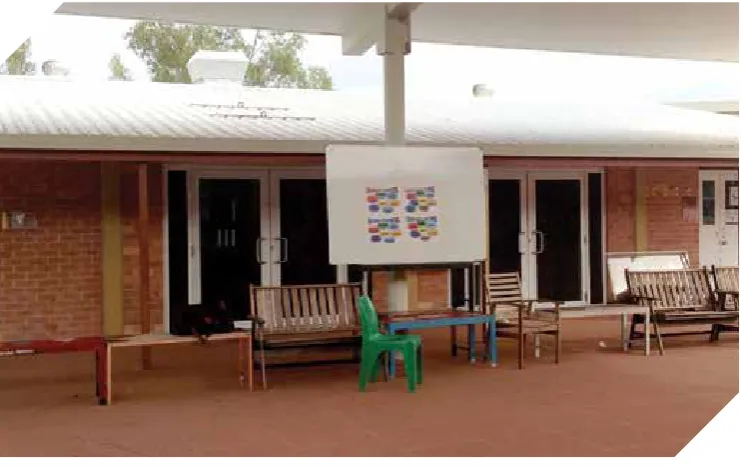
The Flexi-farm and courtyard gathering place at Townsville FlexibleLearning Centre exemplify the different experience of education deliberatively designed for young people who have often been disenfranchised by mainstream schooling. In 2013 there were around 120 students enrolled and many have experienced complex educational and familial situations as well as a range of challenges related to their health and wellbeing. Most of the young people have grown up in socially disadvantaged areas and some have
experienced unstable accommodation or legal difficulties. The young men (two-thirds of the student cohort) and young women come from diverse backgrounds with just over half being Indigenous students.
Staff
TFLC staff includes 7 teachers and 8.5 full-time equivalent support staff. There is a flat leadership structure which includes a Principal who is based off-site, a Head of Campus and Associate Head of Campus. All staff are involved in the pastoral care of young people, with dedicated positions including a part-time Youth Support Coordinator (funded by the Queensland government) and Chaplain. The staff are all well-qualified, tend to stay long term and actively engage in professional development within TFLC, the EREA Youth+ network of schools and services and the educational community more broadly.
Curriculum
TFLC Junior curriculum (Year 8-10) is based on the Learning Areas of the Education Queensland curriculum: The Arts, English, Health and Physical Education, Languages, Mathematics, Science, Studies of Society and Environment, and Technology. Senior students (Year 11-12) undertake nationally accredited Certificate I-II vocational courses and study area specifications to work towards the Queensland Certificate of
indicative of the holistic10 educational focus on literacy, numeracy, relevant life skills, and experiences that
promote confidence, enjoyment of healthy, fulfilling lives and responsible citizenship. Students’ learning and wellbeing are supported through pastoral care, community groups, chaplaincy and inter-agency work. Staff act as mentors and advocates, providing guidance and resources to support students to recognise their potential, achieve their goals, and acquire an optimistic view of their future.
Timetable
Young people attend the Centre Monday to Friday from 9.30am to 2.30pm while the staff day finishes after the daily debrief. The timetable on Tuesday to Thursday consists of three sessions with two lunch breaks. The first two sessions focus on the Core subjects: English, Maths, Information Communication Technology and Sport and Recreation for juniors; and for seniors, English Communication, Prevocational Maths, Society and Community Studies and Recreation Studies. The third session is for electives and project work. On Mondays, the first two sessions run until 12noon and include vocational training, electives and project work; with staff meetings and/or curriculum or professional development held during the final session. Young people participate alongside staff when these sessions are focused on planning and evaluation. The Friday timetable usually includes only two sessions of electives and projects conducted in ‘community groups’ and these may include whole-day off-campus activities.
Facilities
Facing onto the courtyard at the rear is a brick building that twins the front. This building comprises the industry standard kitchen-café and ‘Chill Out Room’, adjacent a new science/multipurpose block of two classrooms. This new block, a state-of-the-art courtyard awning and the covered sports ‘cage’ behind the Centre were constructed in 2011, funded by Education Queensland’s Special Assistance School Building Program. TFLC also provides a daily bus run, transporting approximately three quarters of the young people to and from school. Staff take turns to drive the vans which are also used for outings and camps.
Key dimensions
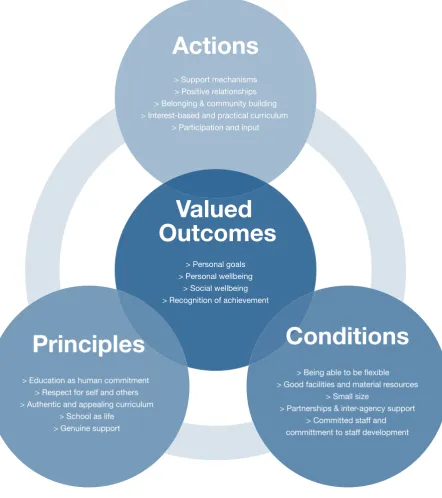
The remainder of this case study will report on four key dimensions of the work of alternative or flexible learning programs: Valued Outcomes, Actions, Principles and Conditions. These dimensions are interrelated, which means some specific aspects (eg. curriculum) may appear in several sections. Figure 4 schematically represents the dimensions.
indicative of the holistic10 educational focus on literacy, numeracy, relevant life skills, and experiences that
promote confidence, enjoyment of healthy, fulfilling lives and responsible citizenship. Students’ learning and wellbeing are supported through pastoral care, community groups, chaplaincy and inter-agency work. Staff act as mentors and advocates, providing guidance and resources to support students to recognise their potential, achieve their goals, and acquire an optimistic view of their future.
Timetable
Young people attend the Centre Monday to Friday from 9.30am to 2.30pm while the staff day finishes after the daily debrief. The timetable on Tuesday to Thursday consists of three sessions with two lunch breaks. The first two sessions focus on the Core subjects: English, Maths, Information Communication Technology and Sport and Recreation for juniors; and for seniors, English Communication, Prevocational Maths, Society and Community Studies and Recreation Studies. The third session is for electives and project work. On Mondays, the first two sessions run until 12noon and include vocational training, electives and project work; with staff meetings and/or curriculum or professional development held during the final session. Young people participate alongside staff when these sessions are focused on planning and evaluation. The Friday timetable usually includes only two sessions of electives and projects conducted in ‘community groups’ and these may include whole-day off-campus activities.
Facilities
Figure 4: Key dimensions – Townsville Flexible Learning Centre
Valued
Outcomes
Conditions
Principles
Actions
> Support mechanisms > Positive relationships > Belonging & community building > Interest-based and practical curriculum
> Participation and input
> Personal goals > Personal wellbeing
> Social wellbeing > Recognition of achievement
> Education as human commitment > Respect for self and others > Authentic and appealing curriculum
> School as life > Genuine support
> Being able to be flexible > Good facilities and material resources
> Small size
> Partnerships & inter-agency support > Committed staff and committment to staff development
These dimensions address aspects that are of relevance across alternative or flexible learning programs for marginalised young people. The specific detail within each dimension varies for each program and case study. The dimensions are:
• Valued outcomes: this addresses outcomes from the program that count as ‘success’ in the perspectives of key stakeholders: students, graduates, staff and community members. Evidence is provided for achieving those outcomes, based on interviews, fieldwork observations, and program documentation.
• Actions: this dimension refers to the actions carried out through the program that support the achievement of the valued outcomes. This offers practical insights in how successes are realised.
• Principles: underpinning the program’s practices are principles that produce a foundation for actions. These principles together form the (implicit or explicit) philosophy or vision of the program.
• Conditions: this dimension includes various conditions that enable or hinder people in a program to act on its principles and achieve valued outcomes.
VALUED OUTCOMES
Rather than pre-determining what counts as success, this section is based on the perspectives of key stakeholders. For Townsville Flexible Learning Centre, valued outcomes include young people’s achievement of personal goals and wellbeing; social wellbeing; and community recognition.
Personal goals
[The] teachers and staff [are] there step-by-step and helping you achieve what you want to achieve and helping you get where you want. (Tara, graduate)
Success means many things at TFLC, from regular attendance for young people who were formerly disengaged from school, to gaining a range of credentials and moving on to employment or further study. For Tara, it is all of these and more. She had not been going to school for around six months before she found TFLC and stayed for four years, successfully completing the Year 12 QCE and gaining employment in the food industry. There were other important gains for Tara. She includes amongst her successes: “Getting out and meeting new people”; getting a driving licence; participating in a week-long mentored camp with Dance North and performing for an audience; and “canoeing in an ocean all the way to Cairns”. Tara says TFLC has helped her to feel more confident and believe in herself. One example of this is in her supervisory
Valued
Outcomes
> Personal goals > Personal wellbeing
As Wendy (staff) points out, settling into a routine of regular attendance may represent huge gains for some individuals in overcoming anxiety and gaining the confidence to set some learning goals for themselves:
Just constant attendance is success for them; acceptance is success for them… Somebody caring about all of them, not just whether they’re achieving marks and stuff like that, because achievement in many areas of their life is a struggle, and it’s about allowing them and showing them how to be productive people, making decisions for their own lives and their own futures, so success here… is many things.
In the longer term young people may choose to focus their learning toward credentials that qualify them for employment or further education. For example, 21 percent of 2012 graduates went into full-time, part-time or casual employment and 4 percent went on to further VET (Vocational Education and Training) Certificate studies, apprenticeships or traineeships. While Pearl (a junior student) thought she might be interested in working in childcare, she is confident of “going all the way to Year 12” and hopes to obtain “a certificate”. Macie, who is in Year 11 and knows that next year she will complete Year 12 and gain the QCE, aims to become a teacher. Vincent who aims to “get as much underneath my belt as possible before I leave”, has already completed a Barista course and Certificate III in Hospitality and aspires to eventually have his own business.
Personal wellbeing
While school completion and credentials are outcomes valued by the young people, for many students the enjoyment of learning in practical ways, life skills and being part of the community are more relevant forms of success. Almost unanimously, the students and staff talk about success in terms of enjoying school and being happy in the flexible learning environment. Young people describe “feeling happier” (Macie, student) and “more comfortable” (Vincent, student) at TFLC than in previous schools and this supports their regular attendance. As Paul (graduate) attests, being happy at school is fundamentally linked to learning: “To be successful just means to be happy… You just need to do what you find is enjoyable, and just focus on it… the Flexi program [TFLC] lets you do that”.
Other markers of achievement in personal growth include confidence, hope and aspiration. Students and graduates describe feeling more confident “that you can do stuff and believe in yourself” (Tara, graduate), though gaining confidence may be a step-by-step prospect. For instance, Paul describes significant changes in his friend who over time gained confidence in communicating with other students whereas at first “he couldn’t string two words together” (Paul, graduate). Other students who had been non-communicative or anxious, with time and support, emerge as people who welcome newcomers and fully enter into the life of the Centre. Having witnessed the change in many young people over several years of her involvement with TFLC, one community member’s insight is that “it’s not just about emerging as an individual but it’s really understanding that you have the potential and the ability to do whatever it is you want to set your mind to” (Liz, community member). It is this mix of feeling confident and discovering one’s capabilities that creates hope, aspiration and for some young people is what they needed in order to take the risk of aiming for their achievement of credentials.
Social wellbeing
that there is no bullying at the Centre and this contrasts with their previous experience in other schools. Close and respectful relationships between students and with staff engender “learning how to trust” (Macie, student) and a sense of belonging to the community (Sue, staff). Relationships are developed through learning experiences in and out of the Centre, enabling young people to understand and recognise that they are “part of an inner community but also a wider community” (Sue, staff).
One outcome of the community focus for building relationships is young people’s sense of expanded horizons. For some students, TFLC’s opportunities to travel out of their area and see new parts of the city, region and country are cherished outcomes. Just “to know that we’ve been there and out of Townsville” (Macie, student) is an achievement; yet it may also be important to strengthen relationships back home because having a break from family can be valuable (Macie) and entitles young people to “skite [or brag] to the other kids” (Donna, community member) when they return. Through community-based learning, TFLC expands students’ social networks to include people they need to know such as health and employment agency personnel; and build significant and positive relationships outside their families through extended contact, for example with volunteers and Indigenous community organisations. For Tara (graduate), “getting out and meeting new people” is valued for socialising as well as the social capital of community networks.
Recognition of achievement
Community recognition of young people’s achievements is a further valued outcome. Internally, certificates and wristbands are awarded for a range of accomplishments including successful camping expeditions, sport and academic work. Young people’s contributions, kindness and putting Centre values into practice are recognised in these ways as much as completion of a project or a win on the football field. Students and graduates also include formal awards in their measures of success, such as the highly prized TFLC graduation certificates and the Defence Force annual leadership award. Yet it is sometimes the ‘small’, everyday forms of recognition that are important to young people. When they have grappled with their schoolwork or managed to deal with mental health issues or not smoke on camp and when these achievements are mentioned by their teachers, it is a source of pride in accomplishment. The greater the challenge, the greater is young people’s sense of pride in doing things “well” (Pearl) - from personal milestones to tackling a five day canoe trip, trekking 40 kilometres, to dancing for the community, and obtaining the Year 12 certificate.
Young people’s perspectives – summing up
their community. As school is engaging, spending time hanging around on the streets loses its priority. When learning and values translate into personal life, “they’re not out there nicking cars, they’re not out there being violent” (Jeff, staff). Combined with the many ways that young people contribute to local causes and cultural events, there are significant benefits to the community.
Adults’ perspectives – summing up
To achieve these valued outcomes, Townsville Flexible Learning Centre uses a range of actions that are familiar from across many alternative and flexible learning programs – although each of these is given its own shape within the program – such as practical and learning support and quality relationships. Other sets of actions are more distinctive about Townsville Flexible Learning Centre, including the emphasis on belonging and community building, interest-based and practical curriculum and student input.
That the success of TFLC derives from the combination of relevant and engaging curriculum and
activities, flexible pedagogy, relationship building and strong support to young people is evident in student perspectives on TFLC. Students appreciate and are motivated by having “lots of things to do” (Macie). This includes spending time on what they enjoy, including sport, practical and outdoor activities like Flexi-farm, landscaping and camps; participating in cultural activities including music, dance, commemorations such as National Sorry Day and celebrations of NAIDOC (National Aboriginal and Islander Day Observance Committee) Week, Reconciliation Day and Health Week; and learning that has practical real-life value such as going for a driving licence, attending a careers expo, cooking and work experience. Looking back on his experience of TFLC, graduate Paul emphasises “learning by doing” as a feature of learning in the classroom, in project work, going out into the community and participating in public activities and events.
Support mechanisms
ACTIONS
Actions
> Support mechanisms > Positive relationships > Belonging & community building > Interest-based and practical curriculum
In Connect, young people are “encouraged to tell their stories”, listen to others’ stories and, for new students, to learn the story of TFLC:
We teach them, and we show them that this is their community now… you’ve chosen for this to be your community… we explore those principles and how they pertain to yourself, through life as well as school, and what would you expect of those things for yourself from other people as well, and that you have the right to be here… It’s about letting them know that they have choices…
(Wendy, staff)
In Connect, young people start to make choices of activities and develop a Personal Learning Plan (PLP), facilitated by staff. Constructing a PLP involves having conversations about the student’s interests,
identifying academic and personal strengths and areas for development, turning those into goal statements and identifying existing support within TFLC, family and community and the additional support that need to be accessed. This process individualises each student’s learning program and kick-starts the arrangement of related support to learning and managing personal matters. Over time, this may include young people accessing agencies like Centrelink, Headspace (youth mental health service) and Townsville Aboriginal and Islander Health Service and getting into work experience and externally provided vocational and skills training through Breakthru (employment and training service) and In-Step (provider of relationships education, driving instruction and other youth programs). The Pastoral Care program links each student with their main class teacher and another staff member and together they belong to a Community Group. Through regular informal conversation and Friday activities, close relationships are developed and pastoral staff guide and monitor the students’ progress, mentor and advocate for them and generally support them to deal with difficult times as well as celebrating their milestones. Pastoral care arrangements are further strengthened by the support of the Chaplain, Youth Support Coordinator and inter-agency partners. Nothing is rushed; rather, it is worked through systematically, over time, according to young people’s readiness and priorities.
Positive relationships
Peer support and accessible, helpful teachers are stand-out enablers of success. Young people help each other in their day-to-day interactions and are encouraged to do so. “Everyone gets in and helps… If one person didn’t know what to do on the computer the other person would come and help or show them what to do. Or if they couldn’t read a book… another person would sit next to them and help.” (Macie, student) Peer support in learning begins in an organic way, as Tara (graduate) describes: “[W]hen they start here they’re normally sitting by themselves or just not talking to people and then you get the odd two or three that would go up, make friends and then it just grows from there”. Making new friends is important to students’ enjoyment of TFLC and brings a sense of belonging that can shift low expectations of schooling into a positive outlook and keenness to be there and be part of it. Having positive relationships with staff is crucial to young people wanting to come to school, discovering and strengthening their capabilities and willingly working not only on what they enjoy but also what they find difficult. Teachers are described by students as kind, caring, accessible and easy to talk to and ask for help: Tara (graduate) says that “teachers are always there to help you”; Ruby (graduate) describes staff-student relationships as “more equal”; Vincent says that because the teachers are kind “it really makes you want to actually do something”; Pearl finds it easy to “just ask the teacher”. Reflecting on these relationships and support, Dean (graduate) says of TFLC: “it’s a very loving place… everyone takes care of each other here”.
communication. In everyday conversation, the staff “constantly check in with kids… How’re you going? How’s soccer going on weekends? How’s Mum and Dad? Constantly doing those chats” (Wendy, staff). Talk is crucial to building relationships, promoting equal and respectful relationships, connecting with young people’s lives and teaching them about the Centre’s four principles of respect, participation, being safe and legal, and honesty, that are touchstone for relationships, pedagogy, life outside the Centre and for the long-term. Jeff (staff) explains:
[W]e’re prepared to have a lot of conversations around [the principles], a lot of meetings – and meetings can be one on one, they can be class meetings, they can be whole school meetings, they can be meetings between adults, meetings between young people and adults, young people with young people. So, having those meetings all the time, reinforcing it, allows it to become part of who a person is, a part of their core values.
Belonging and community building
Building relationships is oriented towards young people experiencing a sense of belonging to the
community, taking responsibility for shaping a healthy Centre community and playing an active role in the broader community. Working agreements are used in every class and are an important way that young people take responsibility for the learning environment and classroom dynamics. The working agreements are created based on the four principles with the class discussing and deciding what those principles should look like in practice. For example, at the commencement of the Parenting elective, the students discuss how they would assign turns to take home the virtual babies and, considering these are expensive resources, how the group as well as individuals would take responsibility for them. They speak at a
graduation. Big Brekkies are monthly social occasions that foster community participation and ongoing relationships. Donna (community member) describes the significance of being welcomed, respected and feeling equal in parent-staff engagement: “the whole staff, even like the office lady, the day I first came in and signed up they were just so, you know, they never pushed you aside… and I was just wow.”
Relationships with external community are strengthened through collaboration on programs and community events. For example, in 2012, Dance North mentored five young people in a week long Small Dancers – Big Stories program, culminating in a showcase of solo performances for the Centre community. Since 2010, groups of eight young people have participated in two, week-long sea kayak journeys per year as part of the Outdoor Education Program in partnership with Northern Outlook. Within these close little extended communities, young people gain a sense of how being part of the community enables personal growth. Young people’s contributions to local community include: marching for Mabo Day, conducting an ANZAC ceremony, representing TFLC at the local Remembrance Day event, participating in fundraisers like Shave/ Colour For A Cure and environmental projects including Clean Up Australia Day and Townsville schools’ tree-planting.
Interest-based and practical curriculum
The curriculum at TFLC is constructed around young people’s interests. Units of study feature topics and events that hold interest and relevance for individuals, particular classes and the community. For example, the work involved in Flexi-farm and the organisation of the Senior students’ graduation is recently documented in two new units of study that integrate the knowledge and skills required in Education
Queensland’s Key Learning Areas and core subjects of secondary education. This kind of project-based learning is purposeful and motivating as it enables young people to “imagine that there’s a product, if you like, at the end of it” (Sue, staff). Additionally, projects lend themselves to differentiation of learning tasks and roles to accommodate young people’s different interests and skills. For example, Flexi-farm includes composting, growing herbs and vegetables, aquaponics and raising chickens. Some students built a worm farm out of an old bath tub and others constructed the aquaponics system: “we cut holes out of the containers for drain and pump pipes and then fed tubes through... We drilled holes in orange tube-like things to make filters for the rocks. Then we shovelled lots of rocks… into the containers and planted silverbeet, mint plants, tomatoes and kang kong.” (Rex and Shaun, students). Learning subject-matter and skills in this practical way, young people are more inclined to ask their own questions and find out for themselves. This is one way that the young people learn “how to think, not what to think, therefore they can make decisions for themselves” (Sue, staff). It is not a matter of learning something first and then applying that knowledge or skill.
The staff devote considerable time and thought to developing curriculum that responds to young people’s interests and their preference for practical, hands-on learning. Staff development days are used for collaborative curriculum review and planning, with staff working in teams and sometimes drawing on the valued input of an academic researcher. A sophisticated and reflexive approach to creating project-based units and honing pedagogy is evident in this work. For example, curriculum evaluation and planning includes scrutinising topics and units for creative problem-solving opportunities, for how they facilitate young people’s connection to community and place and for how they enable students to utilise their cultural capital and build social capital. This involves dialogues based on key questions such as:
• What real-world issues are associated with this topic or unit?
• How are young people encouraged to connect this subject to everyday life?
• How does the topic link to community issues, local resources and facilitate reciprocal responsibility between young people and community?
• In this unit, how does learning enhance young people’s agency and connectedness? • How are diverse worldviews embedded and valued?
• What is the scope for hands-on, practical learning?
• Is the activity adaptable to young people’s ideas and suggestions?
endorsed by staff and the timetable was adjusted. Topics and issues that are raised by young people in ‘non-class’ time and situations are then part of the rich mix of curriculum content. For example, building the new garden and cooking firepit area was initiated, in part, because the Yarning Tree in a paddock adjacent to TFLC had been removed. The tree had been an important place where young people would open up about family and life experience, express loss and pose questions about sex, drugs, work, travel, parenting, spirituality and afterlife. Building a new yarning place accorded respect to young people’s ways of developing their own curriculum. On the new yarning place, a group of young people wrote: “This is our place, a yarn’n place, a safe place. We created this place – a grow’n place.”
The outcomes that are valued and actions taken within Townsville Flexible Learning Centre are underpinned by several principles. These principles are discernable in comments from the members of the Centre community interviewed. All EREA Youth+ Flexible Learning Centres share four explicitly formulated principles that underpin the operation of TFLC: respect, participation, being safe and legal, and honesty. For this case study, we examine principles that were determined through our analysis of the data, ie. interviews with young people and adults, documentation and observation. Although there are some differences between the official TFLC principles and the ones based on our research, there is an overall coherence. We identified five key principles in the work of TFLC, which are discussed below.
Education as human commitment
Education is understood first and foremost as a person-centred human commitment. It is about meeting each young person where they are at, building strong relationships with them and focusing on their personal growth through experiences and learning that are pertinent to their personal goals. Relevant, engaging curriculum is important but made meaningful by reaching each young person: “The teachers are always about the kids… it’s about what’s right for the kids going to Flexi [TFLC] and it’s about what will help them achieve what they want” (Paul, graduate). Each member of the community is valued and all the young people are seen as bringing something unique and significant to TFLC: “these young people have such gifts
PRINCIPLES
Principles
> Education as human commitment > Respect for self and others > Authentic and appealing curriculum
there are no exclusions at TFLC. In these instances, conversations between staff, students, parents and significant others, are guided by the principles to negotiate what will work best to support the young person’s coping, personal growth and maintaining connectedness and sense of belonging in the Centre. Trusting relationships provide the context for ‘getting real’ about what is going on in young people’s lives and helping them to grow through these challenges. Talking through the issues then is a process of finding ‘common ground’ based around the four principles. This is a reciprocal process that involves staff ‘being real’ about how they and the Centre networks may assist and asking “what we can do together to fix that problem” (Wendy, staff).
‘The person’ is understood as always living and learning within a community. The notion that school
is community influences all interaction in TFLC and between the Centre and external community. It is assumed that every young person “wants to feel like they’re learning, contributing, belonging to a place, a community” (Sue, staff) and, in many ways, this is also the basis of building Centre partnerships and agency networks in the local community. The belief that individual and community are interdependent and reciprocally influential underpins approaches to relationships, curriculum and pedagogy.
Respect for self and others
Respect for self and others are the crux of the community building within and beyond TFLC and are tied to the value of school as a safe place. Within the Centre, respect entails freedom of movement and freedom of expression. Being free to move around in classrooms and outdoors is liberating. It supports young people to self-manage according to their need to be physically active, or to take ‘time out’ to attend to difficult things on their minds, or just take some quiet time to ‘chill out’. In these ways, the TFLC program respects different experiences of physicality, time and rhythms of engagement. Respect is shown by staff and young people by appreciating diverse viewpoints. It is fostered through the notion that “there’s no right and wrong” (Macie, student), it is “okay to make mistakes” (Wendy, staff) and by asking, “Is that respectful?” rather than blanket rules or reprimands (Jeff, staff). Respect is then linked to being and encouraging others to be non-judgmental of persons. This applies to everyone equally in the TFLC community and consequently, young people feel physically, emotionally and culturally safe. Respect in terms of these freedoms and
ways of relating is the basis of the absence of shame, stigma, ‘hush-hush’ attitudes around mental health and bullying.
The outcomes that are valued and actions taken within Townsville Flexible Learning Centre are underpinned by several principles. These principles are discernable in comments from the members of the Centre community interviewed. All EREA Youth+ Flexible Learning Centres share four explicitly formulated principles that underpin the operation of TFLC: respect, participation, being safe and legal, and honesty. For this case study, we examine principles that were determined through our analysis of the data, ie. interviews with young people and adults, documentation and observation. Although there are some differences between the official TFLC principles and the ones based on our research, there is an overall coherence. We identified five key principles in the work of TFLC, which are discussed below.
Education as human commitment
Education is understood first and foremost as a person-centred human commitment. It is about meeting each young person where they are at, building strong relationships with them and focusing on their personal growth through experiences and learning that are pertinent to their personal goals. Relevant, engaging curriculum is important but made meaningful by reaching each young person: “The teachers are always about the kids… it’s about what’s right for the kids going to Flexi [TFLC] and it’s about what will help them achieve what they want” (Paul, graduate). Each member of the community is valued and all the young people are seen as bringing something unique and significant to TFLC: “these young people have such gifts to bring” (Sue, staff). It is recognised that “everybody has a story” (Wendy, staff) and that acceptance of the person as they are, with all their history and potential, is the basis of educating. Jeff (staff) describes how this commitment is embedded into Centre structures: “we often talk about radical acceptance, and that’s written in our documentation, our strategic directions and those kinds of things”.
Authentic and appealing curriculum
The principles of authentic and appealing curriculum, school as life and genuine support are closely interrelated. The notion of authentic and appealing curriculum integrates learning and life. It is exemplified in ‘cool’, fun activities and hands-on, practical and project-based learning that appeal to young people, are relevant to their lives and fulfil formal course requirements so that they may achieve socially valued credentials. Authenticity of curriculum relevance and meaningfulness are assured through the rigorous curriculum work of staff and respect for young people’s capacity to identify their own learning goals, with guidance regarding how curriculum options within different pathways will enable them to achieve their goals. Providing choices, responding to young people’s suggestions and interests and building
opportunities to participate in the local community are concerned with young people’s success in education and in life. It is in these terms that graduate Paul sums up the interrelationship of curriculum offerings, personalised learning plans and post-school pathways: “You should know that you’ve done something good. This is successful. This is what part of life is.”
School as life
The principle of school as life means that young people’s priorities are authentically valued. TFLC responds holistically to young people’s personal goals and needs that are often complex matters because life in and out of school is not quarantined. Attending to practical needs of income support, transport, going for a licence, traineeship or job is a mark of respect and genuine support. Young people “are told that they can come to anybody about anything at any time. There’s nothing we can’t do or sort out, and what we can’t do, we get somebody to do it” (Wendy, staff).
Genuine support
CONDITIONS
Several conditions enable (and/or constrain) the ability of Townsville Flexible Learning Centre to undertake the actions outlined above, in order to meet the outcomes that are valued within the program. Some of these conditions are similar to conditions for other alternative learning programs, but others are shaped by the specific context of Townsville Flexible Learning Centre and include: flexibility regarding ‘rules’ and conventions and flexibility of curriculum frameworks, good facilities, material resources, a small school community, community partnerships, staff commitment and a commitment to staff development.
Being able to be flexible
The general principles of engaging the person first and being realistic about what they need in order to come to school and stay engaged with the Centre are reflected in various flexible conventions and also apply to flexibility in curriculum. Flexible conventions include children, parents and other family members being on-site and going to class with the young people and young people being able to complete community service requirements at school. The importance placed on young people’s personal goals is possible because staff work ‘smart’ within official frameworks and requirements to provide engaging curriculum and activities. The Australian Core Skills Framework for junior secondary curriculum particularly lends itself to personalised school-based curriculum development. With its focus on skills, “content wise you have quite a lot of freedom” (Sue, staff). Taking advantage of this flexible model does, however, require considerable time and attention to monitoring and documenting young people’s progress.
Conditions
> Being able to be flexible > Good facilities and material resources
> Small size
Good facilities and material resources
Good facilities and material resources are important to providing flexible learning choices. TFLC has a range of different kinds of learning spaces that accommodate varied groupings for different activities. There are three specific purpose rooms: the music studio, technology workshop and a classroom of computers for information and communication technology studies and general use across curriculum areas. The new science block is designed for multipurpose use and combines large work tables with a casual bean bag corner. The covered ‘sports cage’ at the rear of the Centre enables all-weather activities, while the ‘Chill Out’ room has comfy couches and can be used as a quiet place to get away from the busyness if need be.
Having an industrial standard kitchen with a commercial coffee machine means TFLC can offer Barista training on-site. The kitchen and small attached café introduce a workplace environment yet with a homely feel about it, with beautiful curtains hand-made by students and the framed ‘Nanna’s Kitchen’ invitation to relax. Young people may have their breakfast or lunch there and enjoy the social pleasure of a café setting and conversation (or perhaps none) over breakfast.
Providing material resources is an important aspect of TFLC’s inclusiveness and highly valued by the young people. TFLC provides young people with meals, transport, sometimes clothing and all their program requisites (eg. stationery, use of iPads) and individual program costs, for example driving lessons, licence tests, camps and outings. Funding available to TFLC is therefore very important. While the staff feel that they do well to provide what they do and “do a pretty good job” (Jeff, staff) in terms of young people’s successes, the program can be strengthened in some areas if further funding is available. For example, staff identify the need for stronger support to young people’s transitions out of TFLC.
Partnerships and inter-agency support
The well-established relationships and partnerships with government and community agencies such as Headspace and Townsville Aboriginal and Islander Health Service ensure ready access to the kind of personal support that alleviates the pressure on young people in difficult circumstances, freeing them to focus on other learning. Partnerships with community organisations such as Dance North, The Northern Outlook and Queensland Composite Plastics (QCP) are vital to promoting young people’s personal growth and development of skills. For example in 2012, the QCP partnership introduced fibre-glassing and plastics. Young people and staff built two canoes for use in the outdoor education program. The development of Flexi-farm has included the advice and practical assistance of members of the Townsville Permaculture Society. Other established relationships include those with the Indigenous Coordinating Council, Breakthru People Solutions (employment service), Education Queensland, James Cook University, Queensland Youth Services, Rotary and Townsville City Council. The focus on building relationships with partners has snowball effects in gaining additional support to TFLC. As one community member explains, when community partners get to know the Centre well, they become its champions, seeking to build broad community support as well as program and employment opportunities for young people (Liz, community member).
Committed staff and commitment to staff development
The many successes of hundreds of young people who have been educated at TFLC hinge on thefacilitation, Edgeworks and work shadowing/site visits. Staff development is a condition of responsiveness to young people and curriculum innovation and this is ongoing and requires reflective dialogue on the costs and benefits of change and conserving the integrity of TFLC’s established ethos and educational approach:
SUMMING UP: REMARKABLE
AND DISTINCTIVE FEATURES
The core of each case study report (including this one) focuses on four dimensions that emerged from analysis of all the vignettes and case studies. The starting point is the outcomes that are valued and achieved by alternative learning programs. In order to achieve these outcomes, specific work is done and actions are taken. Underpinning the aims (valued outcomes) and approach (actions) we can discern
principles that inform each program. Finally, certain (external and internal) conditions help or hinder the actions and the achievement of outcomes.
This framework is effective for understanding ‘what works and why’ and resonates with practitioners in alternative learning programs. It helps to highlight commonalities across programs but also permits sensitivity to distinctive features. Some aspects of central significance to a program may be relevant across more than one dimension. A drawback of our framework is that, by discussing these aspects under several headings, this importance may have been concealed. This final section, therefore, sums up the most noteworthy characteristics of the program that help to make it successful.
For Townsville Flexible Learning Centre, the following features are particularly remarkable:
1) The commitment to personalised education.Starting from ‘where students are at’ is a genuine
commitment of staff and built into the structures and processes of Townsville Flexible Learning Centre. Learning programs are negotiated with each young person based on conversations that support them to articulate their educational ‘journeys’ to date, their key concerns for life in and out of school and personal goals. The Connect program is particularly important in ensuring that young people connect into the life of the Centre and understand how their personalised learning plan will enable them to achieve the meaningful developments in their lives they have identified. Flexible structures, including the practical and project-based curriculum, accommodate individuals’ circumstances, embed the development of their interests and skills. These structures and the day-to-day focus on relationships that validate and motivate young people have underpinned the success of so many TFLC students.
2) Principled work. The common ground approach to operating by principles is very important in the work
ENDNOTES
1 http://dusseldorp.org.au/priorities/alternative-learning/program-database/ 2 http://dusseldorp.org.au/priorities/alternative-learning/case-studies/3 This phase of the research was approved by the Victoria University Human Research Ethics Committee
(HRE13-038) and permission was given by each of the programs. All programs agreed to be named.
4 ABS 2011 census, community profiles 5 ABS 2011 census, community profiles 6 ABS 2011 census, community profiles
7 ABS 2011 census, Aboriginal and Torres Strait Islander Peoples (Indigenous) Profiles
8 Edmund Rice Education (2005). ERA Flexible Learning Centres. Occasional Paper Series; Edmund Rice
Education Australia (2011). Charter for Catholic schools in the Edmund Rice tradition
9 http://www.ereflc.org.au/foundation_statement.html 10 http://www.ereflc.org.au/flexible_learning.html
11 Compass is a computer-based assessment tool for literacy and numeracy that is designed for