Normalization of Dutch User-Generated Content
Orph´ee De Clercq1,2, Sarah Schulz3, Bart Desmet1,2, Els Lefever1,2 and V´eronique Hoste1,3
1LT3, Language and Translation Technology Team – University College Ghent
Groot-Brittanni¨elaan 45, 9000 Ghent, Belgium
2Department of Applied Mathematics and Computer Science – Ghent University
Krijgslaan 281 (S9), 9000 Ghent, Belgium 3Department of Lingusitics – Ghent University
Blandijnberg 1, 9000 Ghent, Belgium
Abstract
This paper describes a phrase-based ma-chine translation approach to normalize Dutch user-generated content (UGC). We compiled a corpus of three different so-cial media genres (text messages, message board posts and tweets) to have a sample of this recent domain. We describe the var-ious characteristics of this noisy text ma-terial and explain how it has been man-ually normalized using newly developed guidelines. For the automatic normaliza-tion task we focus on text messages, and find that a cascaded SMT system where a token-based module is followed by a trans-lation at the character level gives the best word error rate reduction. After these ini-tial experiments, we investigate the sys-tem’s robustness on the complete domain of UGC by testing it on the other two so-cial media genres, and find that the cas-caded approach performs best on these genres as well. To our knowledge, we deliver the first proof-of-concept system for Dutch UGC normalization, which can serve as a baseline for future work.
1 Introduction
In the past two decades, many resources have been invested to develop state-of-the-art text processing tools for Dutch1. Similar to other reported lan-guages, these tools, which have all been devel-oped with standard text in mind, show a signif-icant drop in performance when applied to user-generated content (UGC). This is for example the
1Among others, in the framework of the STEVIN
pro-gramme, see Spijns and Odijk (2013) for an overview.
case when applying parsing (Foster et al., 2011) or named entity recognition (Liu et al., 2011b; Ritter et al., 2011) to Twitter data. Typical problems that hinder automatic text processing include the use and productivity of abbreviations, deliberate mis-spellings, phonetic text, colloquial and ungram-matical language use, lack of punctuation and in-consistent capitalization.
No systems currently exist to automatically nor-malize Dutch noisy text into its standard equiva-lent. In order to develop a system which can han-dle different types of user-generated content, we collected and studied three social media genres: text messages, message board posts and tweets. In this paper, we investigate the viability of adopting a character-based machine translation approach to the normalization task. This is different from previous research investigating MT approaches for normalization, which has mainly focused on token-based translation (Aw et al., 2006; Kobus et al., 2008).
For our experiments we first focus on the genre that poses the largest number of normalization challenges in our corpus, namely text messages, in order to have a proof of concept. We will show that a cascaded SMT system with a token-based module followed by a transliteration at the charac-ter level yields the best results, i.e. a 63% drop in word error rate. In this cascade, the first module aims at obtaining high precision, thus presenting high-confidence translations. The second module further improves this output by generalizing over character mappings.
To conclude, we applied this proof-of-concept system tuned for text messages to the other genres and observed similar improvements.
The paper is structured as follows. After the lit-erature overview (Section 2) we discuss the social
Genre # Before After % #INS #DEL #SUB #TRANS
SMS 1000 16630 17194 3.39 3622 338 547 57
SNS 1505 31513 32221 2.25 4165 1500 1692 57
TWE 246 3276 3357 2.47 923 67 127 4
Table 2: Data statistics of the three genres of UGC. The left-hand side shows the number of tokens before and after normalization and the increase in %. The right-hand side visualizes the actual normalization effort expressed in the number of operations.
annotators were asked to indicate the end of a thought (to account for missing punctuation), re-gional words, foreign words and named entities. They could also flag words that are ungrammati-cal, stressed, part of a compound, used as interjec-tions or words that require consecutive normaliza-tion operanormaliza-tions.
To check the reliability of our annotation guide-lines, the two annotators each normalized the 1,000 text messages. We estimated the inter-annotator reliability by computing the word error rate (cf. infra) between the two fully normalized versions. The WER was 0.048, which indicates near-perfect overlap.
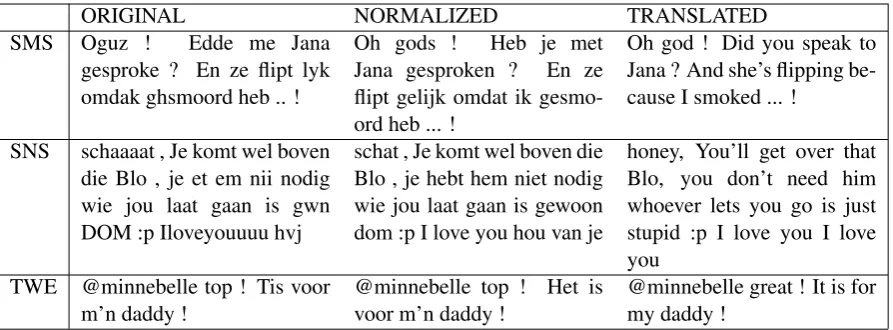
In order to give an idea of the normalization ef-fort required, we present some data statistics for each genre in Table 2. The left-hand side visual-izes the increase in the number of tokens before and after normalization in absolute numbers and percentage-wise. On the right one can see the ac-tual normalization effort, which is expressed by the number of individual operations. The normal-ized versions of the previously mentioned exam-ples can be found in the middle column of Table 1 and their translation to English in the right col-umn.
For the experiments presented in this paper we work with the first part of the manual normaliza-tion (ignoring flagging informanormaliza-tion such as ends of thought). We chose to focus on SMS, because it was the noisiest data in our corpus, with a token increase of 3.39% (see Table 2).
4 System Architecture
Using SMT for noisy text normalization can be done at various levels of granularity. The ad-vantage of working at the token level is that the high-frequency words and abbreviations can be translated in context, which outperforms a simple dictionary look-up (Raghunathan and Krawczyk, 2009). However, working at the character level allows one to generalize over character mappings
which makes the system more robust (Pennell and Liu, 2011).
Prior to any sort of learning, we adapted our to-kenizer to be able to handle emoticons, hyperlinks, hashtags and at-replies. Similar to Beaufort et al. (2010), we devised some rewrite rules: we decided to tackle the flooding of characters before translat-ing in order to avoid too many confoundtranslat-ing fac-tors. Characters and character sequences were al-lowed to occur twice consecutively, at maximum. A higher number of repetitions was reduced to two. The validity of this approach was checked by running the rewrite module on the CELEX database (Baayen et al., 1995), which contains 381,292 valid Dutch words, including inflections. Only two (highly infrequent) entries were changed by the module, which confirms that it virtually does not overnormalize.
After this preliminary preprocessing, the noisy text is processed by two modules. First, the standard phrase-based SMT approach at the to-ken level is used to ensure the translation of the more frequently used abbreviations (such asfbfor
facebookand other highly frequent normalization
problems, e.g.thtforthat). Afterwards, the trans-lated text is split into characters and a translation at the character level takes place. This intuitively makes sense, because transformations at the char-acter level are more likely to be reproduced than a combination of possible transformations at the word level. Trying to generalize such character transformations at the word level would probably fail due to data sparseness. We worked with both character unigram and bigram translation mod-els. Bigrams supposedly have the advantage that one character of context across phrase boundaries is used in the selection of translation alternatives from the phrase table (Tiedemann, 2012). This means that more precise translations will be sug-gested.
SMS genre, after which we test this approach on the other genres to see whether it is possible to cre-ate a robust system that can process all three UGC genres.
To evaluate our approach, both the Word Er-ror Rate (WER) and BLEU scores were calcu-lated. WER, an evaluation metric that is based on edit distance at the word level, is very well suited for the evaluation of NLP tasks where the input and output strings are closely related. As a consequence, the metric is used for the evalua-tion of optical character recognievalua-tion (Kolak et al., 2003), grapheme-to-phoneme conversion (Dem-berg et al., 2007), diacritization (Schlippe et al., 2008) and vocalization of Arabic (K¨ubler and Mo-hamed, 2008). The BLEU metric, which has been specifically designed for measuring machine translation quality, measures the n-gram overlap between the translation being evaluated and a set of target translations. We therefore believe that BLEU is less appropriate for evaluation in the cur-rent set-up, but we include it for comparison’s sake (as other systems mention it such as Aw et al. (2006), Kobus et al. (2008), etc.).
5 Experimental Set-up and Results
For all experiments, we used the Moses SMT sys-tem (Koehn et al., 2007). As a target corpus for our language model, we used the Spoken Dutch Cor-pus (CorCor-pus Gesproken Nederlands, CGN (Oost-dijk, 2000)) since spoken language could better re-flect the language used in UGC. The target train-ing data was also added to the model. All language models were built using the SRILM toolkit (Stol-cke, 2002) with Witten-Bell discounting which has been proven to work well on small data sets (Tiedemann, 2012)
We experimented with different translation models. The token-level translation model was each time built using Moses with standard settings and a 5-gram language model. For the character-level model the same Moses setting was used. For the language model we experimented with differ-ent sizes of n on our training data, 5 - 7 - 10 - 15, and found that a 10-gram language model gave the best results.
For the first set of experiments (Section 5.1), training was performed on the SMS data, which was divided into three data sets: 625 messages for training, 125 for development and 125 for test-ing. In order to estimate the system’s robustness to
unseen genres, the SMS-tuned system was tested on the other two genres, 125 SNS posts and 125 tweets (Section 5.2).
5.1 Results on SMS
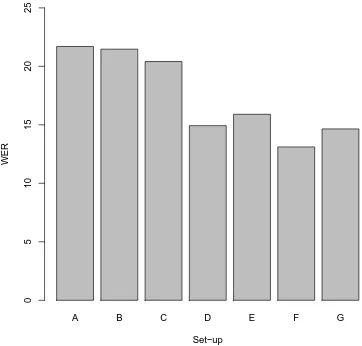
This is, to our knowledge, the first study on Dutch text normalization, so there is no basis for com-parison to other systems. Figure 1 present a visual overview of the different set-ups’ performance on the Dutch SMS data. We start by reporting the dif-ference between the original source and target text (A) as well as a baseline where only the rewrite rules have been applied (B). We see that a moder-ate improvement in WER, from 21.70 to 21.47%, already occurs by eliminating flooding.
A B C D E F G
Set−up
WER
0
5
10
15
20
25
Figure 1: Visualisation of the WER reduction on the SMS data set using our seven different set-ups
In the next step, the various translation models were trained and tested and we clearly see that all the following results outperform the baseline. The token-based model (C) accounts for a mod-erate improvement but clearly the character-based models, both with unigrams (D) and bigrams (E), perform much better. Introducing the unigram and bigram cascaded models leads to the best results (F and G). The best result is reached by the cas-caded unigram model (F). This model has a WER of 13.11 which is a 63% drop in word error rate over the baseline and 56% over the non-cascaded word level SMT.
un-A B C D E F G
Set−up
BLEU
0
20
40
60
80
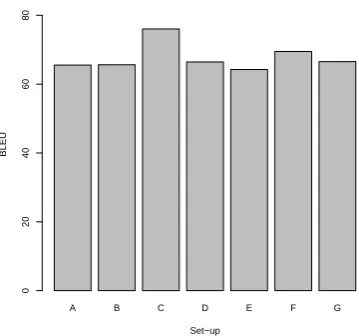
Figure 2: Visualisation of BLEU on the SMS data set using our seven different set-ups
igram model (F) only achieves the second best re-sult. This could be explained by the inherent dif-ferences between the metrics. WER is based on the edit distance whereas BLEU measures n-gram overlap. This means that the output of the uni-gram cascaded model can be closer - but not per-fect - to the reference than the output from the token model. If we consider the example below from our data we see that the token model was not able to find the correct version, whereas the cas-caded unigram output is already a bit closer. If we would then feed this closer version back into our token model it should be able to resolve it cor-rectly2. This insight could be used to improve our system by extending the cascaded unigram mod-ule with another run of the token-based system in future work.
• original:laatk– target:laat ik
• output C:laatk– output F:laat k– output C based on output F:laat ik
All experimental results on the SMS data, ex-pressed both in WER and BLEU, can be found in Table 3.
5.2 Results on three genres of UGC
By testing our translation models tuned for text messages on the other two genres, we aim to ver-ify the robustness of our approach. These results can be found in Table 3.
2Proof of this was found in the output of our token-based
system.
Applying the baseline system with rewrite rules gives the same minor positive effect for SNS as for SMS, compared to the original source and tar-get text. For tweets, on the other hand, no im-provement is noted. Upon closer inspection of the Twitter data, not a single instance of flooding was found, which explains this status quo.
When comparing the other models, the same evolution in word error rate can be observed. For each genre, the best WER reduction over the base-line is reached with the cascaded unigram model, namely 63% for SMS, 39% for SNS and 28% for TWE. For the SNS data, the cascaded unigram and bigram translation models give an equal perfor-mance.
6 Error Analysis
We performed a qualitative error analysis of our best performing set-up, i.e. the cascaded unigram approach (F). After close inspection of the out-put on the SMS test data we learned that the sys-tem was able to locate and resolve 172 of the 320 words requiring normalization. Besides this, the system also generated 51 false positives, which leads to a precision of 77.13%, a recall of 55.66% and thus an overall F-measure of 64.66%.
In order to gain more insights, the instances our system missed were classified in two ways. We first inspected which types of operations seem most difficult to resolve (cf. Section 3.2 ).
Operations Total Absolute Relative required # missed # missed
INS 549 270 49%
DEL 28 20 71%
SUB 55 30 54%
TRANS 11 6 54%
Table 4: Absolute number of the operations missed at the character-level together with the rel-ative number when compared to the total number of operations
Since one word may need multiple or different operations3, this was calculated at the character level. Table 4 presents the number of operations missed by our system both in absolute and relative numbers.
At first sight, especially the deletions seem hard to resolve, followed by the substitutions and
trans-3For example
Training Set-ups Testing
SMS SNS TWE
WER BLEU WER BLEU WER BLEU
A. Original 21.70 65.54 20.41 66.03 13.26 76.10
B. Baseline 21.47 65.64 20.36 65.93 13.26 76.10
C. Token-level only 20.41 76.04 25.03 73.26 19.03 78.32
D. Unigram only 14.93 66.45 15.41 64.02 13.52 66.29
E. Bigram only 15.90 64.26 15.17 63.94 14.08 65.50
F. Cascaded unigram 13.11 69.48 14.59 65.17 10.35 72.25
G. Cascaded bigram 14.65 66.55 14.59 64.79 10.36 72.25
Table 3: Results of the different set-ups on the SMS genre
positions. When taking the absolute numbers into account, however, proportionally these classes are much less frequent than the total number of inser-tions needed (549 to be exact). Apparently our system is able to resolve most of these insertions (i.e. 51%). On closer inspection, however, we found that the system is especially good in nor-malizing shorter words requiring only one or two insertions, such asebforheb,nieforniet, and not in building longer words such asgrforgroetjes. If we extrapolate this finding to the number of inser-tions needed at the word level, we indeed discov-ered that at the word level 60% gets successfully resolved. Another observation at the word level is that words requiring different types of operations are difficult for our system: only 44% is success-fully replaced.
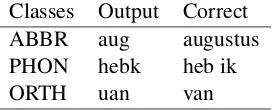
The second error classification consists of a more linguistically motivated subdivision. In-spired by the work of Androutsopoulos (2007), we defined three categories: abbreviation (ABBR), phonetic (PHON) and orthographic (ORTH) is-sues. Examples of some instances our system missed following this classification are presented in Table 5.
Classes Output Correct
ABBR aug augustus
PHON hebk heb ik
ORTH uan van
Table 5: Missed instances according to error clas-sification 2
This classification is visualized in Figure 3, where we see that especially resolving phonetic problems seems difficult for our system, i.e. 103 instances. In order to better grasp this we had a closer look at the various phonetic issues and
ABBR
PHON
ORTH
Figure 3: Pie chart visualizing the number of missed instances according to the second error classification
further classified these into fusions (concatena-tions of words, 25%), omissions (missing char-acters, 43%), equivalents (characters referring to the same sound, 26%) and onomatopoeias (sounds like, 6%). Especially the omission of characters seems problematic, which is consistent with the high number of missed insertions (i.e. 270 charac-ters).
This error analysis indicates that our system might benefit from including other modules be-sides machine translation. The orthographic issues might probably be resolved using a spell checker, whereas the phonetic ones, especially the equiv-alents, might benefit from grapheme-to-phoneme conversion.
Computa-David Vilar, Jan-Thorsten Peter, and Herman Ney. 2007. Can we translate letters? InProceedings of the Second Workshop on Statistical Machine Trans-lation, pages 33–39, Prague, Czech Republic.