Proceedings of the Student Research Workshop associated with RANLP 2017, pages 41–45, Varna, Bulgaria, 4-6 September 2017.1
Gradient Emotional Analysis
Lilia Simeonova
Sofia University “St. Kliment Ohridski”
[email protected]
Abstract
Over the past few years a lot of research has been done on sentiment analysis, however, the emotional analysis, being so subjective, is not a well examined discipline. The main focus of this proposal is to categorize a given sentence in two dimensions - senti-ment and arousal. For this purpose two techniques will be combined – Machine Learning approach and Lexicon-based ap-proach. The first dimension will give the sentiment value – positive versus negative. This will be resolved by using Naïve Bayes Classifier. The second and more interesting dimension will determine the level of arousal. This will be achieved by evaluation of given a phrase or sentence based on lex-icon with affective ratings for 14 thousand English words.
1
Introduction
A lot of papers related to sentiment analysis show very good results, more than 80% accuracy. This kind of analysis determines whether the sentence is positive or negative (on some occasions neutral as well). Such information can be useful in terms of understanding the intentions of a given user.
The proposed research will try to take this knowledge one level deeper. This means that ad-ditional analysis will be made on the level of af-fection of a given sentence. Not only will this pro-gram be able to recognize positive or negative text, but will also determine its arousal level. This project aims to examine the way people’s re-actions are interpreted by machines. Better and more detailed analysis of opinions, reviews, tweets, etc, can be applicable in all kinds of do-mains, such as commercial, retail, politics and psychological research.
2
Related Work
Hasan, Rundensteiner and Ago (2014) proposed in their paper “EMOTEX: Detecting Emotions in Twitter Messages” that twitter hashtags can be used to automatically extract data suitable for train-ing purposes. They retrieve tweets related to four basic groups (shown below) and apply standard Machine Learning Algorithms on this data.
Happy-Active
Happy-Inactive
Unhappy-Active
Unhappy-Inactive
They receive good results, however, often people use misleading hashtags in order to express irony. This can lead to wrong assumptions.
3
Gradient Emotional Analysis
3.1 Circumplex Model of Affect
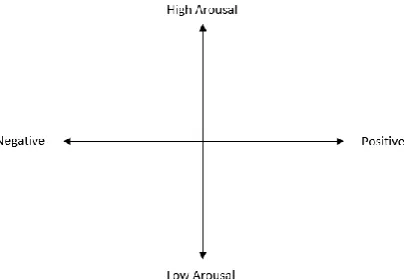
This paper was initially inspired by “The Circum-plex model of affect”. James Russell (1980) showed that emotions can be seen in a two-dimen-sional circular space. This space contains arousal dimension (presented in the vertical axis) and va-lence dimension (presented in the horizontal axis).
A diagram, showing this representation is pro-vided in Figure 1.
The Circumplex model of affect can be applied in this paper as a starting point for more detailed in-vestigation of emotions.
Figure 1: Circumplex model of Affect, made by James Russell.
3.2 Emotional Representation
The main idea behind the proposed paper is to analyze the input based on two different dimen-sions: sentiment and arousal. This is shown in Figure 2 below.
Figure 2: Emotional Analysis Diagram. For example the verb “excite” can be categorized as positive with high arousal level, while “calm” goes under classification of positive with low arousal level.
Similar logic puts the verb “frustrate” under neg-ative classification with high arousal, while “bore” should be negative verb with low level of arousal.
Both of the dimensions will be described in this paper.
4
Sentiment Analysis
The first part of the analysis will be achieved with the Naïve Bayes Classifier. It is one of the sim-plest and most commonly used Machine Learning techniques which is why it will fit perfectly in this solution.
Naïve Bayes is based on the Bayes Theorem showed on Equation 1.
𝑃(𝐴|𝐵) =
𝑃(𝐵|𝐴)𝑃(𝐴)
𝑃(𝐵)
Equation 1: Bayes Theorem.
Feature Selection
Feature selection and extraction is a key element in the Naïve Bayes implementation. After several tests, it has been decided that a NLTK implemen-tation of part-of-speech (POS) Stanford tagger, will be used for this experiment.
The steps performed:
Text Preprocess – tokenization
POS tag in tuples: (word, POS value)
After the part-of-speech tagging, only verbs, ad-jectives and adverbs will be extracted as they bring the most value for sentiment analysis.
5
Level of Arousal/Affect
For determining the level of Affect for a given text the Lexicon-based approach will be used.
Almost the same process is followed as the one in the Sentiment Analysis section but with one major difference.
Text Preprocess – tokenization
POS tag in tuples: (word, POS value)
Exclamation mark (!) is not removed from the tokens. It can give a very good understanding of whether the person who wrote the text is feeling an emotion with high arousal.
Retrieve the arousal value for every tagged word.
Apply equation 2.
𝑎𝑣𝑟𝑔 ( ∑ 𝑇𝑎𝑔𝑔𝑒𝑑 𝑤𝑜𝑟𝑑
𝑎𝑟𝑜𝑢𝑠𝑎𝑙)
Equation 2: Formula to calculate the av-erage arousal level of given text.
6
Experiments and Evaluation
6.1 Data
Three different datasets were used for this exper-iment.
A dataset with 8 885 annotated tweets has been used to train the Naïve Bayes Classifier –3 593 are labeled as positive and 5 292 are labeled as negative.
For the second part of the research – calculating the level of arousal, a lexicon with affective rat-ings has been used. It contains 13 915 annotated English words with a number from 1 to 9. Another dataset has been used to verify the results from arousal level analysis. The number of tweets related with specific emotion are presented in Ta-ble 1.
Enthusiasm + Hate 700 Relief (Happiness) + Sadness 700
Table 1: Number of tweets extracted from Dataset.
6.2 Experiment and Results
Sentiment level – Naïve Bayes Classifier
10-fold cross-validation was used to measure the accuracy of the proposed algorithm. The average result from the 10 folds is 72.8%.
Arousal level
In order to verify the accuracy of the proposed arousal evaluation a training data was used with tweets annotated with words which represent ac-tive and inacac-tive emotions. The result showed 76% accuracy for active tweets and less than 50% accuracy for inactive ones.
This means that the proposed testing approach is not working.
This failure is because the dataset which was used is automatically generated, based on hashtags. For example the following tweet extracted from the testing set is evaluated as #boredom, because the person used it with his hashtag:
“I'm so tired of being sick ALL the time!!!! #boredom”.
The word “boredom” should be classified as inac-tive, however the language used in this tweet is showing immense frustration.
Survey
Another way of evaluating the algorithm is to ask people to evaluate manually the level of arousal. Three people were asked to assign value 0 for in-active tweets and 1 for in-active.
This survey was based on 100 tweets and the av-erage value of the results is showing 63% accu-racy.
The final results are shown in Table 2. Sentiment Analysis 72.8% Arousal Level Analysis 63%
Table 2: Final Results.
7
Future Work
In order to improve the results in the Arousal level analysis other features need to be taken into con-sideration. For example, emoticons can be added in the lexicon. Another thing that might improve the results is capturing tweets written with caps lock.
8
Conclusion
This paper explores the possibilities of developing a system, which can have the capability to
recognize both sentiment and arousal level of a given text. The research is using the Circumplex Model of Affect (1980) where James Russel states that the emotions can be divided in four main cat-egories – positive- active, positive-inactive, nega-tive-active, negative-inactive.
The implementation is based on the idea to com-bine two very well-known approaches – Machine Learning Approach and Lexicon Based Ap-proach.
The first approach is to use already labeled da-taset. Upon training, it can be used to classify the sentiment of an input. For its realization good re-sults were achieved using Naïve Bayes Classifier. For future work another ML algorithm may be used.
The lexicon-based approach is used for the second part of the project. In this case the work is happen-ing only on sentence level where the text is behappen-ing tokenized. This is the moment where it is decided whether every token should be included in the analysis. An interesting part of the research was to determine which parts of the speech are best suited to be analyzed for level of affection. The idea to not exclude exclamation marks also in-creased the correctness of the returned values. Af-ter extracting only the needed values the arousal level is retrieved from the lexicon.
9 References
Warriner, A.B., Kuperman, V., & Brysbaert, M. (2013). Norms of valence, arousal, and dominance for 13,915 English lemmas. Behavior Research Methods, 45, 1191-1207
Russell J., (1980). "A Circumplex Model of Affect". Journal of Personality and Social Psychology. 39: 1161–1178
Twitter Sentiment Analysis Training Data:
http://thinknook.com/twitter-sentiment-analysis- training-corpus-dataset-2012-09-22/
Hasan M., Rundensteiner E., Agu E.,
(2014) EMOTEX: Detecting Emotions in Twitter
Messages, Academy of Science and Engineering
(ASE)
Liu B., Zhang L. (2013), A survey of opinion
mining and sentiment analysis, In Mining Text Data (pp. 415-463). Springer US. DOI: 10.1007/978-1- 4614-3223-4_13
Lowd D, Domingos P. (2005) - Naive Bayes Models for Probability Estimation, Proceeding ICML '05 Proceedings of the 22nd international conference on Machine learning Pages 529-536
Kanayama, H. and T. Nasukawa (2006) Fully automatic lexicon expansion for domain-oriented sentiment analysis. In Proceedings of Conference on Empirical Methods in Natural Language Processing (EMNLP- 2006)
Mohammad, S., C. Dunne., and B. Dorr. (2009) Generating high-coverage semantic orientation lexicons from overly marked words and a Thesaurus. In Proceedings of the Conference on Empirical Methods in Natural Language Processing (EMNLP-2009).
Qiu, L., W. Zhang., C. Hu., and K. Zhao. (2009) SELC: A self-supervised model for sentiment classification. In Proceedings of ACM International Conferenceon Information and knowledge management (CIKM-2009)
Taboada, M., J, Brooke, M. Tofiloski, K. Voll, and M. Stede (2010), Lexicon-based methods for Sentiment analysis. Journal Computational Linguis- tics archive Volume 37 Issue 2, June 2011 Pages 267-307
Pang B., Lee L., Vaithyanathan S (2002) Thumbs up? Sentiment classification using machine learn- ing techniques. In Proceedings of the Conference on Empirical Methods in Natural Language Pro- cessing (EMNLP), pages 79–86, 2002.
Narayanan V., Arora I., Bhatia A. (2013) Fast and Accurate Sentiment Classification Using an Enhanced Naive Bayes Model. In: Yin H. et al. (eds) Intelligent Data Engineering and Automated Learning – IDEAL 2013. IDEAL 2013.
Lecture Notes in Computer Science, vol 8206. Springer, Berlin, Heidelberg
Kristina Toutanova and Christopher D. Manning. 2000. Enriching the Knowledge Sources Used in a Maximum Entropy Part-of-Speech Tagger. In pro- ceedings of the Joint SIGDAT Conference on em- pirical Methods in Natural Language Processing and Very Large Corpora (EMNLP/VLC-2000), pp. 63-70
Hernandez-Farias, DI.; Patti, V.; Rosso, P.
(2016). Irony Detection in Twitter: The Role of Af- fective Content. ACM Transactions on Internet Technology. 16(3):19:1-19:24. doi:
10.1145/2930663.