Version Sentence
Original Ex-Soviet leader Mikhail Gorbachev says Russian authorities must annul the parliamentary vote results and hold a new election.
Simplification (uncorrected) Ex-Soviet leader Mikhail Gorbachev says. Russian authorities must annul the parliamentary vote results. These authorities hold a new election.
Simplification (corrected) Ex-Soviet leader Mikhail Gorbachev saysthatRussian authorities must annul the parliamen-tary vote results. These authoritiesmusthold a new election.
Original A 21-year-old man was arrested on April 30, on suspicion of murder and was released on bail until May 29 pending further enquiries.
Simplification (uncorrected) A 21-year-old man was arrested on April 30, on suspicion of murder. This man wasfollowed
until May 29 pending further enquiries.
Simplification (corrected) A 21-year-old man was arrested on April 30, on suspicion of murder. This man wasreleased
until May 29 pending further enquiries.
Table 1: Two examples of manual corrections performed on the simplified sentences. Differences be-tween the automatically simplified sentences and their manually corrected versions are shown in bold.
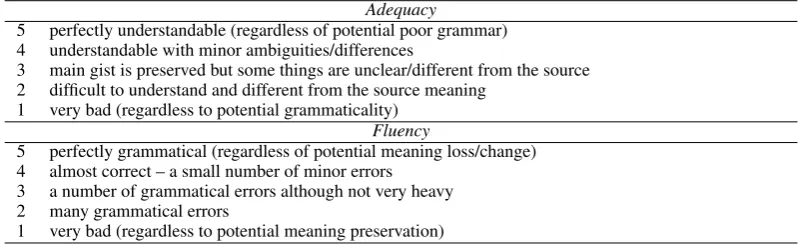
Adequacy
5 perfectly understandable (regardless of potential poor grammar) 4 understandable with minor ambiguities/differences
3 main gist is preserved but some things are unclear/different from the source 2 difficult to understand and different from the source meaning
1 very bad (regardless to potential grammaticality)
Fluency
5 perfectly grammatical (regardless of potential meaning loss/change) 4 almost correct – a small number of minor errors
3 a number of grammatical errors although not very heavy 2 many grammatical errors
1 very bad (regardless to potential meaning preservation)
Table 2: Guidelines for assigning adequacy and fluency scores.
agreement was 0.72 and 0.61 (weighted Cohen’s
κ), for the G and M scores respectively.
In Scenario 1 (Corrected), we used the
man-ual corrections already provided by ˇStajner and
Glavaˇs (2017) for the ten selected articles. Dur-ing manual corrections, only minimal corrections were performed where necessary to restore the original meaning and grammaticality of the sen-tences. As the goal of those correction was not to make any further simplifications, and the mistakes were easy to notice, the corrections were very fast (15.0 seconds per sentence). They did not even require a native speaker or trained annotator, but rather someone with a proficiency level of English (ˇStajner and Glavaˇs, 2017). Several examples of
performed corrections are given in Table1.
3.3 Evaluation of MT Output
All translation outputs (translations of the origi-nal sentences, their raw (uncorrected) automatic simplifications, and their manually corrected au-tomatic simplifications) obtained by the two MT systems (PBMT and NMT), a total of 390 target
sentences, were evaluated with respect to three as-pects:
• adequacy, i.e. how well the sentence
pre-serves the original meaning;
• fluency, i.e. how grammatical the sentence is;
• technical post-editing effort, i.e. the amount
of necessary edit operations to correct the output.
These three evaluation aspects concentrate on three distinct things, which are not necessarily cor-related. For example, if the reference translation is
“We willnotfinish on time.”and the obtained MT
output is “We will finish on time.”, the adequacy
score will be very low (1), fluency perfect (5), and edit distance very low (only one edit).
Each of the tasks has been carried out separately, i.e. the evaluation of adequacy and fluency were carried out in two separate passes, and post-editing was carried out in the third pass.
The guidelines used for assigning adequacy and
(a) PBMT
(b) NMT
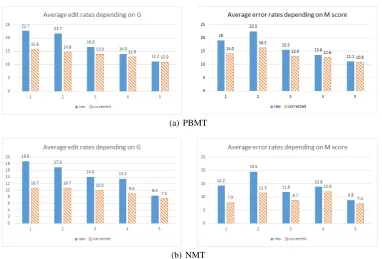
Figure 2: Average edit rates (y-axis) for corrected TS output (blue full) and uncorrected/raw TS output (orange pattern), depending on the grammaticality (G) and meaning preservation (M) scores (x-axis) after PBMT and NMT.
Raw edit counts and edit rates (raw counts nor-malised with the segment length) were calculated
using Hjerson (Popovi´c,2011) for:
• the five classes of edits/errors: inflectional
er-ror, reordering erer-ror, omission, addition and mistranslation
• the sum of edit counts/rates of all classes
Each translated segment was post-edited, and assigned fluency and adequacy scores, while look-ing into the correspondlook-ing source segment, i.e. the English originals were used for evaluating the translations of the originals, while the cor-responding simplified and corrected English sen-tences were used for evaluating the translations of the simplified sentences. This was done to ensure that the change of meaning during ATS (in scenar-ios with filtered and fully automatic ATS) is pe-nalised. Reference translations were not available.
4 Results
We first explored the influence of grammatical-ity (G) and meaning preservation (M) scores of the automatically simplified sentences on the post-editing effort needed to correct their translations
(Figure2).5
We see that the differences in effort needed to post-edit the translations of automatically fied sentences (uncorrected) and corrected simpli-fied sentences (corrected) decrease with the in-crease of grammaticality (G) and meaning preser-vation (M) scores of the uncorrected simplifica-tions. This supports our initial idea that, instead of correcting the automatically simplified sentences
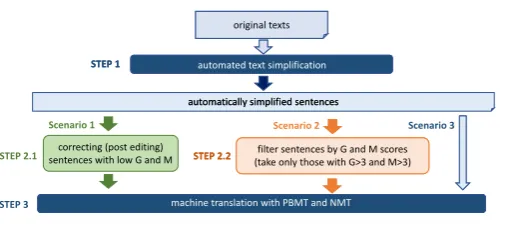
(Scenario 1 in Figure 1), one could filter out the
automatically simplified sentences which did not achieve high enough G and M scores, and instead of those, use the original sentences (Scenario 2 in
Figure 1). This filtering should ideally be done
automatically. Given that here we just look for the proof of concept, we wanted to ensure that we cor-rectly assign G and M scores, and this was thus done manually. However, it is important to note that several systems for automatic assignment of G and M scores to the ATS outputs have been
pro-posed up to date (ˇStajner et al.,2016).
The initial exploration (Figure2) indicated that
a good cut-off point for filtering bad simplifica-tions would be around G = 3 and M = 3.
(a) PBMT
% uncorrected corrected G, M>3 G, M≥3
Σer r.e.c. Σer r.e.c. Σer r.e.c. Σer r.e.c.
better 27.7 21.5 46.2 38.5 20.0 16.9 24.6 21.5
worse 50.8 49.2 27.6 26.2 13.8 12.3 27.7 53.9
same 21.5 29.3 26.2 35.3 66.2 70.8 47.7 24.6
(b) NMT
% uncorrected corrected G, M>3 G, M≥3
Σer r.e.c. Σer r.e.c. Σer r.e.c. Σer r.e.c.
better 13.8 12.3 46.2 36.9 9.2 6.2 13.8 10.8
worse 67.7 64.6 37.5 32.3 27.7 26.2 41.6 40.0
same 18.5 23.1 32.3 30.8 63.1 67.6 44.6 49.2
Table 3: Percentage of raw simplified sentences (uncorrected), corrected simplified sentences (corrected)
and simplified sentences filtered by high grammatical and meaning scores (G, M>3, and G, M≥3) with
better/worse/same translations (in terms of edit rate (Σer) and raw edit counts (r.e.c.)) than their original
counterparts when translated with phrase-based (a) and neural (b) MT system. Those cases in which more sentences improved than deteriorated are shown in bold.
We further investigated how the distribution of sentences with better, worse, and same post-editing effort differs in the two possible cut-offs: (1) where G and M scores are both greater than 3; and (2) where G and M scores are both greater or
equal to 3. The results are presented in Table3,
to-gether with the corresponding results for the fully automated simplification without any filtering (un-corrected) and for the manually corrected simpli-fication output (corrected).
It seems that filtering automatically simplified sentences according to their grammaticality (G) and meaning preservation (M) score can substan-tially decrease the percentage of sentences whose translation is worse (needs more post editing) than the translation of their original counterparts, if the cut-off point is correctly set. This happens in both MT approaches used (PBMT or NMT), but the de-crease is more pronounced in PBMT.
Interestingly, in PBMT, filtering sentences
ac-cording to their G and M scores (with G, M>3)
results in a lower percentage of sentences with de-teriorated translations than correcting the simplifi-cation output before translation (corrected). This happens at the cost of increasing the number of sentences with the same MT post-editing effort re-quired, and decreasing the number of sentences with improved translation.
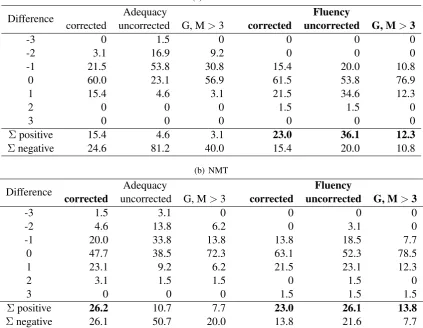
Table4shows the differences in fluency and
ad-equacy scores between the translations of the orig-inal sentences and the translations of the corrected
simplified texts, uncorrected simplified texts, and
the filtered (G, M>3) source sentences.
It can be seen that by using the ATS system in a pre-processing step (marginally) improves the translation adequacy, and only if the simplifica-tions are manually corrected and used in the NMT system.
Using any of the three proposed scenarios (man-ually corrected simplifications, filtered simplifi-cations, or fully automated simplifications) leads to a higher percentage of sentences with im-proved rather than those with deteriorated fluency of translation. Interestingly, the percentage of im-proved sentences is the highest when the uncor-rected simplifications are used, but at the cost of the higher percentage of sentences with deterio-rated translation adequacy (than in the case of us-ing the manually corrected simplifications). Fil-tering automatic simplifications according to their grammaticality and meaning preservation substan-tially decreases the percentage of sentences with both improved and deteriorated translation flu-ency, but still results in substantially higher per-centage of sentences with improved than those with deteriorated fluency.
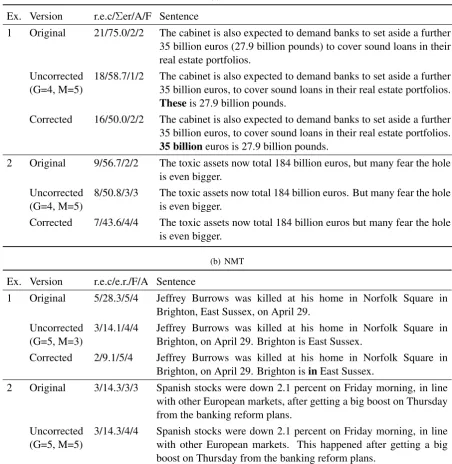
Several examples of the original English sen-tences and their simplified versions, together with the scores for the fluency and adequacy of their
(a) PBMT
Difference Adequacy Fluency
corrected uncorrected G, M>3 corrected uncorrected G, M>3
-3 0 1.5 0 0 0 0
-2 3.1 16.9 9.2 0 0 0
-1 21.5 53.8 30.8 15.4 20.0 10.8
0 60.0 23.1 56.9 61.5 53.8 76.9
1 15.4 4.6 3.1 21.5 34.6 12.3
2 0 0 0 1.5 1.5 0
3 0 0 0 0 0 0
Σpositive 15.4 4.6 3.1 23.0 36.1 12.3
Σnegative 24.6 81.2 40.0 15.4 20.0 10.8
(b) NMT
Difference Adequacy Fluency
corrected uncorrected G, M>3 corrected uncorrected G, M>3
-3 1.5 3.1 0 0 0 0
-2 4.6 13.8 6.2 0 3.1 0
-1 20.0 33.8 13.8 13.8 18.5 7.7
0 47.7 38.5 72.3 63.1 52.3 78.5
1 23.1 9.2 6.2 21.5 23.1 12.3
2 3.1 1.5 1.5 0 1.5 0
3 0 0 0 1.5 1.5 1.5
Σpositive 26.2 10.7 7.7 23.0 26.1 13.8
Σnegative 26.1 50.7 20.0 13.8 21.6 7.7
Table 4: Distribution of differences in adequacy and fluency scores (in terms of percentages) introduced by the manually corrected simplifications, uncorrected simplifications, and by filtering automatic simpli-fications by their meaning preservation and grammaticality scores.
5 Summary and Outlook
Going back to the initial motivation for automatic text simplification, using it as a pre-processing step to improve the performance of machine trans-lation systems, we explored how the current state-of-the-art lexico-syntactic automatic text simplifi-cation system behaves in this role. We investigated three possible scenarios: (1) using the output of the ATS system as it is; (2) filtering out the auto-matic simplifications with low gramauto-maticality and meaning preservation scores and using the origi-nal sentences instead; (3) minimally correcting the ATS output in order to preserve the original mean-ing and the grammaticality of the sentence.
The results of our experiments indicated that:
• The success of the ATS systems depends on
the type of MT system used (phrase-based or neural).
• In the case of NMT, only the manually
cor-rected ATS output can reduce the post-editing
effort, and improve the adequacy scores in translation.
• In the case of PBMT, two scenarios
(man-ual correction of ATS output and maintaining only automatic simplifications with high G and M scores) can reduce the post-editing ef-fort in translation, but none of the three inves-tigated scenarios can improve the adequacy of the translation.
• For both MT approaches, PBMT and NMT,
all three scenarios for using ATS improve the fluency of the translation noticeably.
• The uncorrected ATS output improves the
fluency of the PBMT translation noticeably more than it improves the fluency of the NMT translation.
(a) PBMT
Ex. Version r.e.c/Σer/A/F Sentence
1 Original 21/75.0/2/2 The cabinet is also expected to demand banks to set aside a further
35 billion euros (27.9 billion pounds) to cover sound loans in their real estate portfolios.
Uncorrected (G=4, M=5)
18/58.7/1/2 The cabinet is also expected to demand banks to set aside a further
35 billion euros, to cover sound loans in their real estate portfolios.
Theseis 27.9 billion pounds.
Corrected 16/50.0/2/2 The cabinet is also expected to demand banks to set aside a further
35 billion euros, to cover sound loans in their real estate portfolios.
35 billioneuros is 27.9 billion pounds.
2 Original 9/56.7/2/2 The toxic assets now total 184 billion euros, but many fear the hole
is even bigger. Uncorrected
(G=4, M=5)
8/50.8/3/3 The toxic assets now total 184 billion euros. But many fear the hole
is even bigger.
Corrected 7/43.6/4/4 The toxic assets now total 184 billion euros but many fear the hole
is even bigger.
(b) NMT
Ex. Version r.e.c/e.r./F/A Sentence
1 Original 5/28.3/5/4 Jeffrey Burrows was killed at his home in Norfolk Square in
Brighton, East Sussex, on April 29. Uncorrected
(G=5, M=3)
3/14.1/4/4 Jeffrey Burrows was killed at his home in Norfolk Square in
Brighton, on April 29. Brighton is East Sussex.
Corrected 2/9.1/5/4 Jeffrey Burrows was killed at his home in Norfolk Square in
Brighton, on April 29. Brighton isinEast Sussex.
2 Original 3/14.3/3/3 Spanish stocks were down 2.1 percent on Friday morning, in line
with other European markets, after getting a big boost on Thursday from the banking reform plans.
Uncorrected (G=5, M=5)
3/14.3/4/4 Spanish stocks were down 2.1 percent on Friday morning, in line
with other European markets. This happened after getting a big boost on Thursday from the banking reform plans.
Table 5: Examples of original sentences, automatically simplified sentences (uncorrected), and their manually corrected versions, together with corresponding translation scores in terms of edit operations, adequacy and fluency scores.
25% of the cases), and increases the post-editing effort in translation (in about 26-27% of the cases in PBMT, and about 32-37% of the cases in NMT). This indicates that the general-purpose ATS sys-tems (which were not initially developed for im-proving MT performances) might not be suitable for this task. Depending on the source-target lan-guage combination, it might be better to design a MT-oriented text simplification system, which would target only the sentence structures and
vo-cabulary which poses particular difficulties in that language pair and MT approach.
Shruti Tyagi, Deepti Chopra, and Iti Mathur. 2015. Classifier based text simplification for improved ma-chine translation. In Proceedings of International Conference on Advances in Computer
Engineer-ing and Applications (ICACEA), Ghaziabad, India.
pages 46–50.
Francis M. Tyers and Murat Alperen. 2010. South-East European Times: A parallel corpus of the Balkan languages. InProceedings of the LREC Workshop on Exploitation of Multilingual Resources and Tools for Central and (South-) Eastern European Lan-guages. Valetta, Malta, pages 49–53.
David Vickrey and Daphne Koller. 2008. Sentence simplification for semantic role labeling. In Pro-ceedings of ACL&HLT. volume 344–352.
Sanja ˇStajner and Goran Glavaˇs. 2017. Leveraging event-based semantics for automated text simplifica-tion. Expert Systems with Applications82:383–395.
Sanja ˇStajner and Maja Popovi´c. 2016. Can text sim-plification help machine translation? In Proceed-ings of the 19th Annual Conference of the European
Association for Machine Translation (EAMT 2016).
Riga, Latvia, pages 230–242.