EVALUATION OF HUMAN RESOURCE DEVELOPMENT AND HUMAN RESOURCE MANAGEMENT WITH SPECIAL REFERENCE OF APEX BANK
Miss KalpanaSatnami
Research Scholar, Dept. of commerce Faculty of commerce R.D.V.V. Jabalpur
ABSTRACT
Human resource development (HRD) is an organized learning that provides the possibility of performance change and improvement towards individuals and groups through development of their knowledge, skills and abilities necessary for the successful performance of the organization. Our HRD niche area covers training and development, organizational development, career development and HR practices.Human resources management (HRM) is a management function concerned with hiring, motivating and maintaining people in an organization. It focuses on people in organizations. Human resource management is designing management systems to ensure that human talent is used effectively and efficiently to accomplish organizational goals. HRM is the personnel function which is concerned with procurement, development, compensation, integration and maintenance of the personnel of an organization for the purpose of contributing towards the accomplishments of the organization’s objectives.
This paper is arranged in four section.
Section I – Definition of HRD and HRM Section II- Review of literature
Section III- Analytical part Section IV- Conclusion
INTRODUCTION
In 1937 Ronald Coase, a Noble Prize winning economist, explained how some economic activities are most efficiently coordinated within firms, while others are most efficiently coordinated by markets. ‘Management’ can therefore be defined as the art and science of coordinating activities within a firm, via a process of managerial decision-making, including areas such as finance, operations, sales and marketing, and human resources. HR management can in turn be defined as: ‘The process of analysing and managing an organisation’s human resource needs to ensure satisfaction of its strategic objectives’ (Hellriegel, Jackson, Slocum and Staude, 2009) and ‘The policies and practices involved in carrying out the “people” or human resources aspects of a management position, including recruitment, screening, training and appraising’ (Dessler, 2007). Employees are very important components or assets of an organization and this is the main reason why an organization must do human resource management. They need to be managed successfully needless of the size of the organization because the employees contribute to the delivery of products and services.Human resource development has multiple dimensions, covering educational attainment, workforce skills, population health and the set of employment policies that provide businesses with workers with appropriate skills and the ability to adapt quickly to new challenges.
RESEARCH OBJECTIVE
To find out the opportunity and problems faced by the HRD and HRM. To find out the fund and finance require for the HRD and HRM. To give some suggestion for the betterment of HRD and HRM.
RESEARCH HYPOTHESIS
Satisfaction Index expressed by the employees is dissimilar.
RESEARCH
METHODOLOGY-This study relied on a sample of randomly selected Apex Bank throughout the Bhopal and Jabalpur District. We sampled 60 Respondants exclusively belonging to Apex Bank in Bhopal and Jabalpur district. Out of the 60questionnaire sent out, 60 were received, representing 100%. The survey instruments included open ended and closed ended questionnaires. We also followed up with personal interviews with employees of these banks. The findings are presented by the use of descriptive statistics.
REVIEW OF LITREATURE
job, rather than personally oriented. Training is usually provided to adults and is aimed at producing an improvement in performance at work, by addressing weaknesses in knowledge, skills, or attitudes. It tends to be more practically focussed and can take place in a variety of environments and concerned with the acquisition of knowledge, skills and attitudes.
Data Analysis_
In this section, we present an analysis and discussion of the empirical results.
TABLE-1
Classification on the Basic of Age
Source- Based on Primary data
Source- Based on table-1
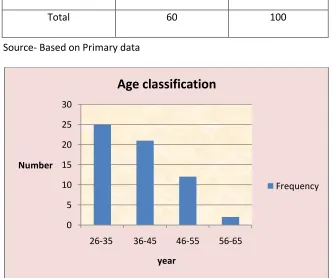
Table -1 clearly indicated that 25 number of respondants belongs to the age group of 26-35 years making the overall percentage to 42%, 21 respondants falls in the group of 36-45 years making them 35% of total distribution.12 respondants make a 20% of total and at the lastly 2 respondants were noticed in the age group of 56-65 years making the percentage 3% of the overall percentage.
0 5 10 15 20 25 30
26-35 36-45 46-55 56-65
Number
year
Age classification
Frequency
years Frequency percentage
26-35 25 42
36-45 21 35
46-55 12 20
56-65 2 3
TABLE 2
Education background of Respondent
Education Frequency Percentage
Primary/Middle 5 8.3
High/Higher secondary 6 10.0
Graduate 25 41.7
Post-Graduate 24 40.0
Total 60 100
Source- Based on survey Method
Table 2 illustrate the background of the employee of Apex bank. As shown in Table 2 41.7% of the Respondents have graduate, 24% have Post graduate and 6% have High/Higher secondary nad lowest percentageofprimar/middle 8.3% in the bank.
Source- Based on table-2
8.3 10
41.7 40
Education background of Respondent
TABLE-3
Funds and Finance Requirement
Source- Based on Primary data
Table-3 shows that 33 respondants feel that more finance/funds is required for good living them 55% of the total distribution and 27 respondants feel that limited finance/funds is required for good living which makes them 45% of the total distribution.
Source- Based on table-3
55
45
M O R E L I M I T E D
FUNDS AND FINANCE FOR HRD AND
HRM
Variable Frequency percentage
More 33 55
Limited 27 45
TABLE – 4
PROBLEMS FACED BY HDR and HRM
Source- Based on Primary data
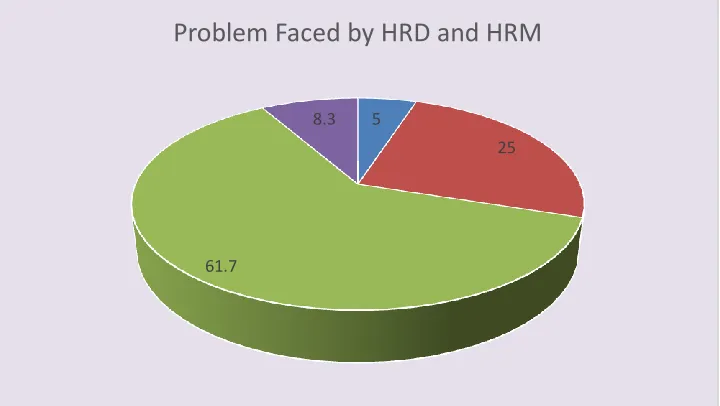
Table 4shows that the nature of problems faced by HRD and HRM. The major problem are faced in Technology up gradation (61.7%), Lack of Fianance (25.0%), Terms of payment (8.3%) and Lack of Education (5.0%).
Source- Based on table-4
5
25
61.7
8.3
Problem Faced by HRD and HRM
Lack of Education Lack of Finance Technology up gradation Terms of payment
Particular Frequency percentage
Lack of Education 3 5.00
Lack of Finance 15 25.0
Technology up gradation 37 61.7
Terms of payment 5 8.3
HYPOTHESIS TESTING
Satisfaction Index expressed by the employees is dissimilar.
𝑯𝟎: 𝒇𝟎 = 𝒇𝒆, 𝑯𝟏: 𝒇𝟎≠ 𝒇𝒆
Table 5 Satisfaction Index
No. SI CV
(Calculated value)
Table Value at 5% level of significance
Degree of freedom
Interpretaion
1 6.0
.9001 12.6 Df =(n-1)
7-1=6
CV<TV 0.9001<12.6
H0 ACCEPTED
2 6.9
3 7.2
4 5.3
5 5.8
6 5.0
7 7.5
Source- Based on Primary data
Where ∝=Constant depending on the value of Df]𝑥2 =Chi-Square Test] Df= Degree of freedom ∝= 0.005] 𝑥2=12.6 (Table Value), Df= 6
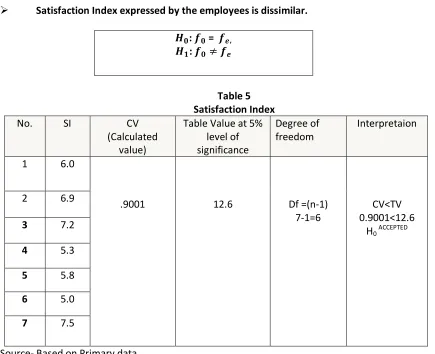
Table 5 indicated that the calculated value of x2 is lower than table value, therefore null hypothesis is accepted and we conclude that satisfaction label are different in the employees.
Conclusion
Human Resource development is the framework for helping employees develop their personal and organizational skills, knowledge and abilities. Good accounting and control systems could assist in evaluating the performance of the organization and its managers.
illustrate the background of the employee of Apex bank. As shown in Table 2 41.7% of the Respondents have graduate, 24% have Post graduate and 6% have High/Higher secondary nad lowest percentageofprimar/middle 8.3% in the bank.Table-3 shows that 33 respondants feel that more finance/funds is required for good living them 55% of the total distribution and 27 respondants feel that limited finance/funds is required for good living which makes them 45% of the total distribution.Table 4shows that the nature of problems faced by HRD and HRM. The major problem are faced in Technology up gradation (61.7%), Lack of Fianance (25.0%), Terms of payment (8.3%) and Lack of Education (5.0%).Table 5 indicated that the calculated value of x2 is lower than table value, therefore null hypothesis is accepted and we conclude that satisfaction label are different in the employees.
REFERENCES
1. Benita Gullkvist: adoption and impact of e-accounting, Frontiers of e-business research 2003.
2. Baker, D. (1999). Strategic human resource management: performance, alignment, management. Library Career Development, 7(5),51–63.
3. Gellatly,I.R.,Hunter,K.H., Currie,L.G., and Irving,P.G. (2009).HRM practices and organizational commitment profiles. The International Journal of Human Resource Management, 20(4), 869– 884.
4. Gooderham,P.,andNordhaug,O.(2010).One European model of HRM? Cranet empirical contributions. Human Resource Management Review ,21 ,27–36.
5. Harris,L.(2007). The changing nature of the HR function in UK local government and its role as “employee champion” .Employee Relations Journal,30(1) , 34-47.
6. Minbaeva,D.,(2008). HRM practices affecting extrinsic and intrinsic motivation of knowledge receivers and their effect on intra-MNC knowledge transfer. International Business Review ,17, 703–713.
7. Zanko,M.,Badham,R.,Couchman,P.,andSchubert,M.(2008). Innovation and HRM: Absences and politics. The International Journal of Human Resource Management, 19(4), 562–581.
8. Granlund, M (2007) on the interface between management accounting and modern information technology : A Literature review and some Empirical Evidence. Working Paper
9. Vinayagamoorthy, (Dr.) A. : A Study on impact of E-Accounting, Indian Journal of Accounring, Dec 2013.
10. IFAC (2002) E-Business and the accountant. March http//www.ifac.org
11. Prasad, Lalan (2007) E-Accounting : Theory and Principles, APH publishing corporation New Delhi.
12. www.e-accounting.4t.com