University of South Carolina
Scholar Commons
Theses and Dissertations
2017
Polynomials Of Small Mahler Measure With no
Newman Multiples
Spencer Victoria Saunders
University of South CarolinaFollow this and additional works at:https://scholarcommons.sc.edu/etd
Part of theMathematics Commons
This Open Access Thesis is brought to you by Scholar Commons. It has been accepted for inclusion in Theses and Dissertations by an authorized administrator of Scholar Commons. For more information, please [email protected].
Recommended Citation
Saunders, S. V.(2017).Polynomials Of Small Mahler Measure With no Newman Multiples.(Master's thesis). Retrieved from
POLYNOMIALS OFSMALL MAHLERMEASURE WITH NONEWMAN MULTIPLES
by
Spencer Victoria Saunders
Bachelor of Science Regent University 2014
Submitted in Partial Fulfillment of the Requirements
for the Degree of Master of Science in
Mathematics
College of Arts and Sciences
University of South Carolina
2017
Accepted by:
Michael Filaseta, Director of Thesis
Ognian Trifonov, Reader
c
A
BSTRACT
A Newman polynomial is a polynomial with coefficients in {0,1}and with constant term 1. It is known that the roots of a Newman polynomial must lie in the slit annulus
{z∈C:φ−1<|z|<φ}\R+whereφ denotes the golden ratio; however, it is not guaranteed that all polynomials whose roots lie in this slit annulus divide a Newman polynomial. The
Mahler measure of a monic polynomial is defined to be the product of the absolute values of
those roots of the polynomial which are greater than 1. K. Hare and M. Mossinghoff have
asked whether there is aσ >1 such that if a polynomial f(z)∈Z[z]has Mahler measure less thanσ and has no nonnegative real roots, then it must divide a Newman polynomial.
In this thesis, we present a new upper bound on such a σ if it exists. We also show that
there are infinitely many monic polynomials that have distinct Mahler measures which all
lie belowφ, have no nonnegative real roots, and have no Newman multiples. Finally, we
consider a more general notion in which multiples of polynomials are considered inR[z]
T
ABLE OF
C
ONTENTS
ABSTRACT . . . iii
LIST OFTABLES . . . vi
LIST OFFIGURES . . . vii
CHAPTER 1 INTRODUCTION . . . 1
CHAPTER 2 ALGORITHMS . . . 10
2.1 Determining when a polynomial does not have a Newman multiple . . . 10
2.2 A new class of polynomials . . . 14
2.3 Generating Infinitely Many Polynomials of Small Measure . . . 22
CHAPTER 3 GENERATINGINFINITELYMANYPOLYNOMIALS WITHOUTNEW -MAN MULTIPLES . . . 24
CHAPTER 4 MINIMIZINGMAHLER MEASURE . . . 47
4.1 Producing polynomials with small measures having no Newman multiples . 47 4.2 Another example of a polynomial with small measure having no New-man multiple . . . 57
CHAPTER 5 BOUNDING THE COEFFICIENTS OF A MULTIPLE OVER THE REALS 58 5.1 Introduction . . . 58
L
IST OF
T
ABLES
Table 1.1 Some polynomials from Hare and Mossinghoff (2014) . . . 6
Table 1.2 Some polynomials from Drungilas, Jankauskas, and Šiurys (2016) of
small measure with with no Newman multiple . . . 7
Table 1.3 Some polynomials of small measure with no Newman multiple . . . 8
Table 4.1 Some polynomials of small measure with no Newman multiple . . . 48
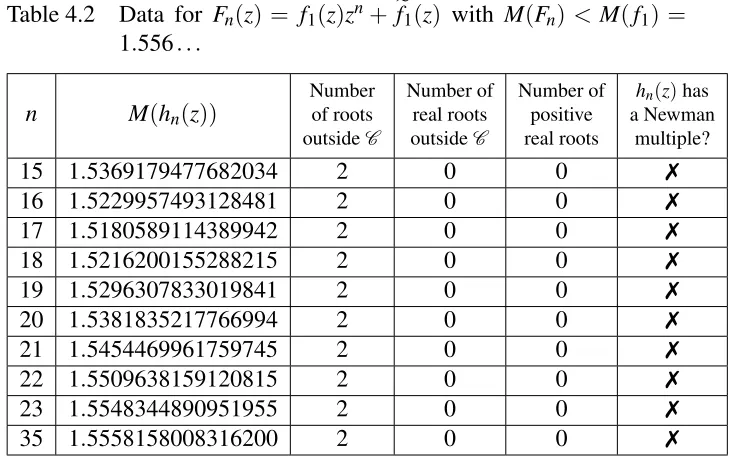
Table 4.2 Data for Fn(z) = f1(z)zn+ fe1(z) with M(Fn) < M(f1) =
1.556. . .
. . . 52
Table 4.3 Data for Fn(z) = f2(z)zn+ fe2(z) with M(Fn) < M(f2) =
1.419. . .
. . . 53
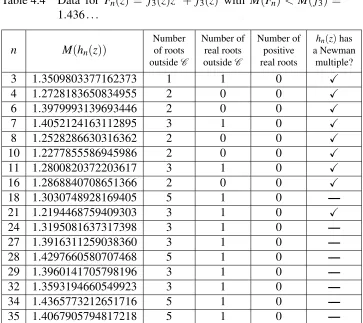
Table 4.4 Data for Fn(z) = f3(z)zn+ fe3(z) with M(Fn) < M(f3) =
1.436. . .
. . . 53
Table 4.5 Data for Fn(z) = f1(z2)zn+ fe1(z2) withM(Fn)<M(f1) =
1.556. . .
. . . 54
Table 4.6 Data for Fn(z) = f2(z2)zn+ fe2(z2) withM(Fn)<M(f2) =
1.419. . .
. . . 54
Table 4.7 Data for Fn(z) = ef3(z)zn+ f3(z) with M(Fn) < M(f3) =
1.436. . .
. . . 55
Table 4.8 Data for Fn(z) = fe3(z2)zn+ f3(z2) withM(Fn)<M(f3) =
1.436. . .
. . . 55
Table 4.9 Data for Fn(z) = f2(z)zn− fe2(z) with M(Fn) < M(f2) =
1.419. . .
L
IST OF
F
IGURES
C
HAPTER
1
I
NTRODUCTION
A 0,1-polynomial is a monic, polynomial with all its coefficients in {0,1}. A Newman polynomialis a univariate 0,1-polynomial with constant term 1. We will denote the set of all Newman polynomials byN . Odlyzko and Poonen (1993) showed that if α ∈Cis a
root of a polynomialF ∈N , thenα lies in the slit annulus
Aφ\R+ ={z∈C:φ−1<|z|<φ} \R+ whereφ = (1+
√
5)/2 denotes the golden ratio.
In this text, we will explore the cases when a given polynomial has or, more
appropri-ately, does not have a multiple that is Newman. It is important to note that a polynomial
with a root outside the annulus Aφ cannot have a Newman multiple. Moreover, we note
that no polynomial with a positive real root can have a Newman multiple.
The following result, due to K. Hare and M. J. Mossinghoff (2014), answers a question
about a particular class of polynomials which satisfy the above conditions.
Theorem 1.1. If a real numberβ∈(−φ,−1)is the only root of a monic polynomial f(z)∈ Z[z]which lies outside the open unit diskD={z∈C:|z|<1}and f(z)has no nonnegative real roots, then there exists a Newman polynomial F(z)with F(β) =0.
Before giving their proof, we will first make a few more observations. In the theorem
above, β represents a real algebraic integer with |β|>1 whose other conjugates all lie in D (that is, having modulus less than 1). A β >0 with this property is called a Pisot
(1992) show that every Pisot number less thanφ may be expressed as a root of one of the
following polynomials for some positive integern:
p2n(z) =z2n+1−z2n−1−z2n−2− · · · −z−1,
q2n+1(z) =z2n+1−z2n−z2n−2− · · · −z2−1,
rn(z) =zn(z2−z−1) +z2−1,
g(z) =z6−2z5+z4−z2+z−1.
Because a Newman polynomial cannot have positive real roots, no Pisot number will
be a root of a Newman polynomial. We sayβ is anegative Pisot numberif−β is a Pisot
number and consider instead such numbers. Observe that Theorem 1.1 is a statement about
negative Pisot numbers.
With the above in mind, we consider similar families of polynomials with negative Pisot
numbers as roots. Specifically, we consider the monic polynomials−p2n(−z),−q2n+1(−z),
r2n(−z),−r2n+1(−z), andg(−z). From the above, it follows that any negative Pisot
num-berβ >−φ occurs as a root of one of these monic polynomials for some n. We proceed now to a proof of Theorem 1.1 based on the work of Hare and Mossinghoff (2014).
Lemma 1.2. For every positive integer n, the polynomial rn(z) has exactly one root β
outside ofD withβ ∈Randβ >1. Furthermore, the polynomial rn(z)is irreducible over Q.
Proof. Forz∈C ={z∈C:|z|=1}, we first observe that by a direct computation we have
|z2−z−1|2= (z2−z−1)(z2−z−1) =3−z2−z2
and
|z2−1|2= (z2−1)(z2−1) =2−z2−z2,
wherezdenote the complex conjugate ofz. In particular, we obtain
Letρn(z) =zn(z2−z−1). From the above, we deduce that forz∈C, we have
|rn(z)−ρn(z)|=|z2−1|<|z2−z−1|=|ρn(z)|.
By Rouché’s Theorem, we see thatrn(z)andρn(z)have the same number of roots, counted
to their multiplicity, inside C. Asz2−z−1 has exactly one root in C, we deduce rn(z)
has exactly n+1 roots inside C and exactly one root outside C. Call this root β. As
rn(1) =−1 andrn(2) =2n+3>0, we obtainβ is a real root in the interval(1,2). Thus, the first statement of the lemma follows.
Observe thatrn(z)is monic. Assumern(z) =u(z)v(z)for some monicu(z)andv(z)in
Z[z]each of degree≥1 withu(β) =0. Sinceβ is the only root ofrn(z)outside ofD, the
roots ofv(z)each have absolute value<1. Since|v(0)|is the absolute value of the product of the roots ofv(z), we obtain|v(0)|<1. Note thatrn(0) =−1 impliesv(0)6=0. We obtain a contradiction as |v(0)| is a non-zero integer <1, which is impossible. We deduce that rn(z)is irreducible, completing the proof.
Proof of Theorem 1.1. Letβ be a real number in(−φ,−1), and let f(z)∈Z[z]be as in the theorem so that f(β) =0. This immediately implies that f(z)is the minimal polynomial of
β. Otherwise, there would exist monicg(z)andh(z)∈Z[z]of degrees≥1 satisfying f(z) =
g(z)h(z),g(β) =0 and all of the roots ofh(z)lie insideD. But this is a contradiction, as
it implies|h(0)|, which is the absolute value of the product of the roots of h(z), is not an
integer.
Now, sinceβ ∈(−φ,−1), we have thatβis a root of one of the polynomials−p2n(−z),
−q2n+1(−z), r2n(−z), −r2n+1(−z), and g(−z) for some positive integer n. Hence, the
minimal polynomial for β, namely f(z), must divide one of these polynomials for some
positive integern. Fix such ann. As a consequence of Lemma 1.2, the polynomialr2n(−z)
is irreducible. Thus, if f(z) divides r2n(−z), then f(z) =r2n(−z). Assume this is the
case. Then f(0) = r2n(0) = −1 and f(1) = r2n(−1) = 1. By the Intermediate Value
of Theorem 1.1. Hence, f(z)does not divider2n(−z). Similarly, one checks thatg(−z)is
irreducible,g(0) =−1, andg(−1) =1, so an analogous argument gives that f(z)does not
divideg(−z). Therefore, f(z)divides one of the polynomials−p2n(−z),−q2n+1(−z), and
−r2n+1(−z).
To finish the proof, it suffices now to show that each of the polynomials −p2n(−z),
−q2n+1(−z), and−r2n+1(−z)divides a Newman polynomial. Observe that
−p2n(−z) z2n+z2n−1+· · ·+z+1
= z2n+1−z2n−1+z2n−2− · · · −z+1 z2n+z2n−1+· · ·+z+1
=z4n+1+z4n+z4n−2+· · ·+z2n+4+z2n+2+z2n−2+z2n−4+· · ·+z2+1,
which is a Newman polynomial. Also, we see immediately that
−q2n+1(−z) =z2n+1+z2n+z2n−2+· · ·+z2+1,
so−q2n+1(−z)is a Newman polynomial. Next, we use that
−r2n+1(−z) z2n+z2n−2+· · ·+z2+1
= z2n+1−1 z2−1+z2n+2 z2n+z2n−2+· · ·+z2+1
= z2n+1−1 z2n+2−1+z2n+2 z2n+z2n−2+· · ·+z2+1
=z4n+3−z2n+1+z2n+2 z2n+z2n−2+· · ·+z2+1.
From this, we see that
−r2n+1(−z) z2n+z2n−2+· · ·+z2+1· z2n+1+1
is a Newman polynomial. Therefore, in any case, we see that f(z)|F(z)for someF(z)∈
N , completing the proof.
TheMahler measureof a polynomial
f(z) =
n
∑
j=0ajzj=an n
∏
k=1for f(z)∈Z[z], is defined to be
M(f) =|an| n
∏
i=1max{1,|βi|}.
Ifαis an algebraic integer, thenM(α)is the Mahler measure of the minimal polynomial of
α. If f(z)is monic, thenM(f)is simply the product of the absolute values of all the roots
of f(z)which lie outside the unit circle C ={z∈C:|z|=1}in the complex plane. We
also note that the Mahler measure of any cyclotomic polynomial or product of cyclotomic
polynomials and a power ofzis exactly 1. Furthermore, if f(z)is the minimal polynomial
of a Pisot numberβ, thenM(f) =|β|.
In 1933, D. H. Lehmer posited that a lower bound greater than 1 for the Mahler measure
of a polynomial f(z)∈Z[z]withM(f)6=1 exists, but this remains an open problem. The
smallest measure greater than 1 he found is 1.17628. . . , occurring for the polynomial
L(z) =z10+z9−z7−z6−z5−z4−z3+z+1.
This is still the smallest known Mahler measure larger than 1 of a polynomial inZ[z].
Hare and Mossinghoff (2014) point out that some interesting results follow when one
attempts to bound the Mahler measure of a polynomial. For instance, Pathiaux (1973)
and Mignotte (1975) showed that ifα is an algebraic number and M(α)<2, then there exists a polynomialF(z)with coefficients from{−1,0,1}such thatF(α) =0. Thus,F(z) has height 1. Moreover, Siegel’s lemma, as referenced by Hare and Mossinghoff (2014),
implies that if f(z)∈Z[z]has M(f)<2, then there exists a polynomialF(z)with height 1 such that f(z)|F(z), even if f(z)is not irreducible. Given their particular interest in the
set of Newman polynomials, Hare and Mossinghoff pose the next natural question (which
would follow if Lehmer’s conjecture is true):
Problem 1. Does there exist a real numberσ>1such that if f(z)∈Z[z]has no nonnega-tive real roots and M(f)<σ, then f(z)|F(z)for some F(z)∈N ?
with f(0)6=0 and f(1)6=0, it can be shown that f(z) has a multiple that is Newman.
Given Theorem 1.1, one might like to immediately take σ to be φ, but Hare and
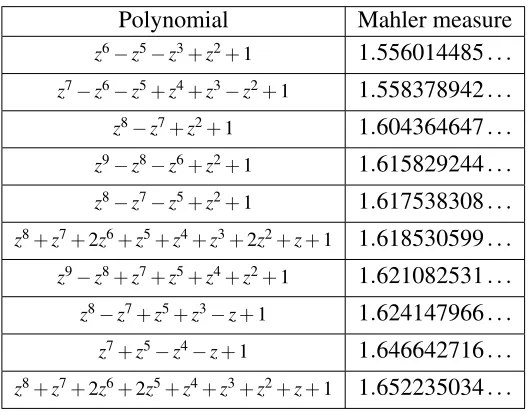
Moss-inghoff (2014) show that if such aσ exists, then σ <φ. The polynomials enumerated in Table 1.1 are among the polynomials they encountered, each having no nonnegative real
roots with Mahler measure less thanφ and which do not divide a Newman polynomial. The
polynomial of smallest measure they discovered like this isz6−z5−z3+z2+1, giving as
an upper bound forσ (assumingσ exists), the value 1.556014485. . ..
Table 1.1 Some polynomials from Hare and Mossinghoff (2014) with small measure and no Newman multiple
Polynomial Mahler measure
z6−z5−z3+z2+1 1.556014485. . .
z7−z6−z5+z4+z3−z2+1 1.558378942. . .
z8−z7+z2+1 1.604364647. . .
z9−z8−z6+z2+1 1.615829244. . .
z8−z7−z5+z2+1 1.617538308. . .
z8+z7+2z6+z5+z4+z3+2z2+z+1 1.618530599. . .
z9−z8+z7+z5+z4+z2+1 1.621082531. . .
z8−z7+z5+z3−z+1 1.624147966. . .
z7+z5−z4−z+1 1.646642716. . .
z8+z7+2z6+2z5+z4+z3+z2+z+1 1.652235034. . .
P. Drungilas, J. Jankauskas, and J. Šiurys (2016) have improved upon this bound. They
found 16 polynomials all of Mahler measure less than 1.55601. . . which do not divide a Newman polynomial, with the ones of smallest Mahler measure listed in Table 1.2.
The one with smallest Mahler measure is z9+z8+z7−z5−z4−z3+1 with measure
1.436632261. . .. This now gives that if such aσ exists, thenσ ≤1.436632261. . ..
Table 1.2 Some polynomials from
Drungilas, Jankauskas, and Šiurys (2016) of small measure with with no Newman multiple
Polynomial Mahler measure
z9+z8+z7−z5−z4−z3+1 1.436632261. . .
z9+z8−z3−z2+1 1.483444878. . .
z9−z7−z5+z3+z+1 1.489581321. . .
z8−z7−z4+z3+1 1.489581321. . .
z8+z7−z3−z2+1 1.518690904. . .
z8+z7+z6−z4−z3−z2+1 1.536566472. . .
z9−z8−z6+z5+1 1.536913983. . .
z9+z5−z3−z2+1 1.550687063. . .
found several more polynomials with no Newman multiple with Mahler measure less than
1.436632261. . .as given by Drungilas, Jankauskas, and Šiurys (2016), but we do not list those here.
We also show that there are infinitely many monic, irreducible polynomials f(z)having
exactly 2 roots outside C ={z∈C :|z|=1} and no nonnegative real roots for which
M(f)<φ and for which f(z) has no Newman multiples. We use the example given by Hare and Mossinghoff (2014),
f(z) =z6−z5−z3+z2+1
withM(f) =1.556014485. . .to construct our infinite list. We define
e
f(z) =zdegff(1/z) (1.2)
to be thereciprocalof f(z)and construct the polynomialFn(z) = f(z)zn+ef(z). A
polyno-mial f(z)∈Z[z]is said to be reciprocal if f(z) =±f˜(z)and non-reciprocal otherwise. The
existence of our infinite list of polynomials as described above is a result of the following
Theorem 1.3. Let f(z)∈Z[z]be monic and such that f(z)has no roots on the unit circle
C. Suppose that f(z) has no positive real roots and exactly two roots outside C, both
non-real and with multiplicity one. Suppose further that gcd(f(z),ef(z)) = 1. For n a
positive integer, define hn(z)as the largest degree monic factor of f(z)zn+ef(z)not divisible
by a cyclotomic polynomial. Then the polynomials hn(z) include infinitely many distinct
irreducible polynomials with distinct Mahler measures approaching the Mahler measure
of f(z) as n tends to infinity. Furthermore, these irreducible hn(z) have no positive real
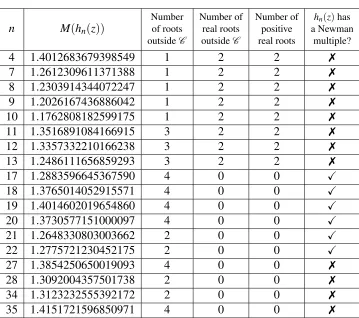
roots and each has exactly two roots outsideC. Also, if β is a root of f(z)with |β|>1 and ifβ is not a root of a Newman polynomial, then for n sufficiently large, no multiple of
hn(z)inZ[z]is a Newman polynomial.
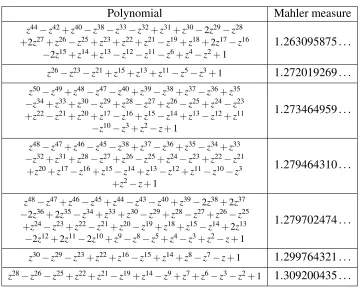
Table 1.3 Some polynomials of small measure with no Newman multiple
Polynomial Mahler measure
z44−z42+z40−z38−z33−z32+z31+z30−2z29−z28 +2z27+z26−z25+z23+z22+z21−z19+z18+2z17−z16
−2z15+z14+z13−z12−z11−z6+z4−z2+1
1.263095875. . .
z26−z23−z21+z15+z13+z11−z5−z3+1 1.272019269. . .
z50−z49+z48−z47−z40+z39−z38+z37−z36+z35
−z34+z33+z30−z29+z28−z27+z26−z25+z24−z23 +z22−z21+z20+z17−z16+z15−z14+z13−z12+z11
−z10−z3+z2−z+1
1.273464959. . .
z48−z47+z46−z45−z38+z37−z36+z35−z34+z33
−z32+z31+z28−z27+z26−z25+z24−z23+z22−z21 +z20+z17−z16+z15−z14+z13−z12+z11−z10−z3
+z2−z+1
1.279464310. . .
z48−z47+z46−z45+z44−z43−z40+z39−2z38+2z37
−2z36+2z35−z34+z33+z30−z29+z28−z27+z26−z25 +z24−z23+z22−z21+z20−z19+z18+z15−z14+2z13
−2z12+2z11−2z10+z9−z8−z5+z4−z3+z2−z+1
1.279702474. . .
z30−z29−z23+z22+z16−z15+z14+z8−z7−z+1 1.299764321. . .
z28−z26−z25+z22+z21−z19+z14−z9+z7+z6−z3−z2+1 1.309200435. . .
We end the thesis by showing that one can strengthen the notion of polynomials not
first polynomial entry in Table 1.3. We show that not only is there no multiple of f(z)in
Z[z]that is Newman, but further there is no multiple of f(z)inR[z]having all nonnegative
coefficients bounded above by 1.5713809. . .. We actually show more, namely that there is a root β of f(z) which cannot be a root of a polynomial having all nonnegative real
C
HAPTER
2
A
LGORITHMS
2.1 DETERMINING WHEN A POLYNOMIAL DOES NOT HAVE ANEWMAN MULTIPLE
Hare and Mossinghoff (2014) outline an algorithm for determining whether a real negative
Pisot numberβ ∈(−φ,−1) is a root of a Newman polynomial. Let f(z) be the minimal polynomial ofβ. Then f(z)divides a Newman polynomialF(z)if and only ifF(β) =0.
If such a Newman polynomial exists, we can construct it by adding powers ofβ to 1 and
checking when this value is 0. LetN0 denote the set of non-zero 0,1-polynomials. For a
nonnegative integerd, set
N 0(
β,d) ={F(β):F∈N0and degF(z)≤d}.
Note thatN 0(β,0) ={1}, and note that with each iteration ofd, we have N 0(
β,d+1) =N 0(β,d)∪ {β α :α ∈N 0(β,d)}
∪ {β α+1 :α∈N 0(β,d)}.
Our goal is either to find an element of N 0(β,d+1) that is equal to 0 or to prove that β is not a root of any Newman polynomial. Unfortunately, afterd iterations, the size of
N 0(β,d)can be as large as 2d which becomes cumbersome to compute. We describe a method next that Hare and Mossinghoff (2014) use to cut down the search space.
Supposeβ ∈(−φ,−1)is root of a Newman polynomial F(z) =
n
∑
j=0withε0=εn=1. ThenF(β) =0, and 0∈N 0(β,n). Ford∈ {0, . . . ,n}, define Fd(z) =
n
∑
j=n−dεjzj
!
/zn−d.
Note thatF0(z) =1,Fn(z) =F(z), andFd(z)∈N 0(β,d). Evaluating these polynomials at β, we see that ford∈ {0, . . . ,n−1}, we haveFd+1(β) =βFd(β)orFd+1(β) =βFd(β) +1. SinceF(β) =0, we deduce
βn−dFd(β) = n
∑
j=n−dεjβj=− n−d−1
∑
j=0εjβj. Dividing byβn−d and recalling thatβ <0, we obtain
Fd(β) =− n−d−1
∑
j=0εjβj−n+d =−εn−d−1
1
β −εn−d−2 1
β2− · · · −ε0 1
βn−d
>− 1
β2− 1
β4− · · ·=− 1 β2 ∞
∑
j=0 1 β2 j= −1
β2−1. Similarly,
Fd(β) =−εn−d−1
1
β −εn−d−2 1
β2− · · · −ε0 1
βn−d
<−1
β − 1
β3− 1
β5− · · ·=− 1 β ∞
∑
j=0 1 β2 j = −ββ2−1.
Hence, ifβ is a root of a Newman polynomialF(z), then for 0≤d≤n, the valueFd(β)∈
N 0(
β,d)must lie in the interval I(β) =
−1
β2−1,
−β
β2−1
.
For each integerd≥0, we define the smaller set
N (β,d) =N 0(β,d)∩I(β).
Thus, for 0≤d≤n, we haveFd(β)∈N (β,d). We also note that the recursive formula N (β,d+1) =N (β,d)∪({β α :α∈N (β,d)} ∩I(β))
holds ford ≥0 and provides a means to constructN (β,d+1)from N (β,d). Observe thatN (β,0)⊆N (β,1)⊆N (β,2)⊆ · · ·.
The algorithm of Hare and Mossinghoff (2014) is to construct N (β,0), N (β,1), N (β,2), . . . using the recursive formula above until we find the first positive integer d for whichN (β,d) satisfies one of two possibilities: (i) 0∈N (β,d), or (ii)N (β,d) = N (β,d−1). Note thatN (β,d)is the set of all 0,1-polynomials of degreed, evaluated at β, restricted to values which lie inI(β). Thus, in the case of (i), we have thatβ is a root
of a Newman polynomial. In the case of (ii), eachβ α orβ α+1, with α ∈N (β,d−1), used in constructingN (β,d)either does not lie in I(β)or is in N (β,d−1). Observe that if we have for somedthatN (β,d−1) =N (β,d), then
N (β,d−1) =N (β,d) =N (β,d+1) =· · ·= [
d0≥0
N (β,d0).
Thus, in the case of (ii) above, where 06∈N (β,d−1), we see that 06∈N (β,d) for all positive integers d. Hence, in this case, β is not a root of a Newman polynomial. We
address next why this algorithm must terminate.
Define
N (β) = [
d≥0
N (β,d).
One can see that N (β,d) =N (β,d+1) for some d ≥0 by a result of A.M. Garsia (1962). Garsia showed that there exists a constant C:=C(β), independent of d, such
that for any two values x,y∈N (β), eitherx=y or|x−y|>C>0. Since the elements are inside a bounded set I(β), the number of distinct elements of N (β) is finite. As
N (β,0)⊆N (β,1)⊆ · · ·, we deduce thatN (β,d) =N (β,d+1)for somed≥0. This justifies then that the algorithm of Hare and Mossinghoff (2014) terminates forβ a negative
Pisot number. This algorithm can also be generalized for any negative algebraic integerβ,
but as Hare and Mossinghoff (2014) note the algorithm is only known to terminate whenβ
We introduce now a variation of the previous algorithm for a complex numberβ.
Sup-poseβ ∈Aφ\Rand let|β|>1. Then, we define IC(β) =
z∈C:|z|< |β|
|β| −1
and
NC(β,d) ={F(β):F ∈N0and deg(F)≤d} ∩IC(β).
IfF ∈N0and|F(β)| ≥ |β|
|β| −1, then
|βF(β)| ≥ |β|
2
|β| −1 ≥
|β|
|β| −1, and
|βF(β) +1| ≥ |βF(β)| −1≥ |β|
2
|β| −1−1=
|β|2− |β|+1
|β| −1
=|β| 2−2|
β|+1+|β|
|β| −1 =
(|β| −1)2+|β|
|β| −1 ≥
|β|
|β| −1. Hence,ifF(β)∈/IC(β), thenβF(β)∈/IC(β), andβF(β) +1∈/IC(β).
As before, we begin with d =0 andN 0C(β,0) ={1}, and with each iteration of d, we generate all 0,1-polynomials of degreed evaluated at β. This is done by taking each element α ∈NC(β,d−1) and applying a simple construction to obtain the new values, β α andβ α+1. For example, the first three iterations ofdmay appear as follows:
d=0: 1
d=1: β, β+1
d=2: β2, β2+β, β2+1, β2+β+1.
Note that doing this for everyα ∈N 0C(β,d−1)will yield all possible valuesF(β)for allF∈N0of degree≤d. The values generated which lie in the intervalIC(β)we denote
by NC(β,d). Recalling that if F(β)∈/ IC(β), thenβF(β)∈/ IC(β) and βF(β) +1∈/ IC(β), we deduce
We use the above to obtain now an algorithm as before that recursively constructsNC(β,d). The algorithm terminates if either (i0) 0∈NC(β,d), or (ii0) NC(β,d) =NC(β,d−1). Observe that in the case of (i0), we haveF(β) =0 for someF ∈N of degree d. In other
words, in this case,β is the root of some Newman polynomial of degreed. If (ii0) occurs,
then NC(β,d−1) =NC(β,d) =NC(β,d+1) =· · ·, and β is not a root of a Newman polynomial.
The above algorithm for complexβ is also described in Hare and Mossinghoff (2014).
Unlike the first algorithm for negative real β, it is unknown whether this algorithm will
always terminate with (i0) or (ii0) occurring. On the other hand, for both algorithms, one
must handle the situation where the sets N (β,d) or NC(β,d) grow in size to a point where computationally it becomes infeasible to continue constructing these sets for larger
d. One can set up bounds for the size of these sets or degree bounds to force the
algo-rithms to terminate, but one then is left without resolving whether or not β is a root of a
Newman polynomial. This situation led us to search for other methods for determining
whether a givenβ is a root of a Newman polynomial. One method is to check for Newman
multiples by multiplying the minimal polynomial forβ by various products of cyclotomic
polynomials. This often led to a quick determination that the minimal polynomials we were
considering had Newman multiples. Yet another approach we used is described in Chapter
5 of this thesis.
2.2 A NEW CLASS OF POLYNOMIALS
In regards to Problem 1, Theorem 1.1 suggests the possibility thatσexists and that perhaps
one can takeσ=φ. Having considered the problem restricted to the class of polynomials
with negative real Pisot numbers as roots, we will introduce a new related class of
polyno-mials.
Then we callβ andβ complex Pisot numbers. Note that if f(z)is the minimal polynomial
of any negative Pisot number β, then f(z2) is the minimal polynomial of ±p|β|i. The fact that f(z2) is irreducible in this situation is due to the observations that ±p
|β|i are
two imaginary conjugates which must be roots of the same minimal polynomial and the
product of the remaining roots of f(z2)has absolute value<1. Since f(z2)is the minimal polynomial of ±p|β|i in this case, we see that if β is a negative Pisot number, then
±p|β|iare two complex Pisot numbers.
One would hope that we are able to classify a number of complex Pisot numbers as was
done for negative real Pisot numbers in the work of Bertin, Decomps-Guilloux,
Grandet-Hugot, Pathiaux-Delefosse, and Schreiber (1992). As a result of an ICERM summer project
by Z. Blumenstein, A. Lamarche, Mossinghoff, and S. Saunders (2014), a few such
poly-nomial families were found, and we discuss these next.
Using the families of polynomials from the work of Bertin, Decomps-Guilloux,
Grandet-Hugot, Pathiaux-Delefosse, and Schreiber (1992) (see the discussion before Lemma 1.2 in
this thesis), we replacezwithz2to obtain
−p2n(−z2) =z4n+2−z4n−2+z4n−4− · · · −z2+1,
−q2n+1(−z2) =z4n+2+z4n+z4n−4+· · ·+z4+1,
r2n(−z2) =z4n(z4+z2−1) +z4−1,
−r2n+1(−z2) =z4n+2(z4+z2−1)−z4+1,
g(−z2) =z12+2z10+z8−z4−z2−1.
Defining
Pn(z) =zn(z4+z2−1) +1,
Qn(z) =zn(z4+z2−1)−1, Rn(z) =zn(z4+z2−1) +z4−1,
Sn(z) =zn(z4+z2−1)−z4+1,
G(z) =z12+2z10+z8−z4−z2−1,
one can check that
−p2n(−z2) = P4n(z)
z2+1, −q2n+1(−z2) = Q4n+2(z)
z4−1 , r2n(−z2) =R4n(z),
−r2n+1(−z2) =S4n+2(z),
g(−z2) =G(z).
As each negative Pisot number in (−φ,−1) is a root of one of −p2n(−z), −q2n+1(−z),
r2n(−z),−r2n+1(−z), andg(−z), the above discussion leads to complex Pisot numbersβ
among the roots of P4n(z), Q4n+2(z), R4n(z), S4n+2(z), and G(z)which satisfy 1<|β|<
√
φ. The idea is to consider instead the larger familiesPn(z),Qn(z),Rn(z),Sn(z), andGn(z)
and to show that these generate even more complex Pisot numbers. There is no reason to
believe that these larger families represent all complex Pisot numbers with modulus less
than φ or
√
φ, but the discussion above implies that every complex Pisot number of the
form±p
|β|iwhereβ is a negative real Pisot number in(−φ,−1)is a root of one of the polynomialsPn(z),Qn(z),Rn(z),Sn(z), andGn(z)for somen.
We make another observation. Recall that each negative real Pisot number in(−φ,−1), having no positive real conjugates, is a root of someF(z)∈N by Theorem 1.1. Hence,
the complex Pisot numbers arising as roots of the polynomials−p2n(−z2), −q2n+1(−z2),
r2n(−z2), −r2n+1(−z2), andg(−z2)discussed above, provided they have no positive real
conjugates, will also be roots of F(z2) for some F(z)∈N . Thus, these complex Pisot
numbers are roots of Newman polynomials. We do not however yet know if the same is
true of all complex Pisot numbers that are roots of the larger familiesPn(z),Qn(z),Rn(z),
Sn(z), andGn(z).
As an indication of the work achieved by Blumenstein, Lamarche, Mossinghoff, and
Theorem 2.1. For every odd n≥3, each of Pn(z), Qn(z), Rn(z), Sn(z), and G(z)has exactly
two roots outsideC ={z∈C:|z|=1}with both roots non-real.
Proof. We begin withPn(z). The reciprocal ofPn(z)isPen(z) =1+z2−z4+zn+4. It suffices to show that Pen(z) contains exactly two non-real roots inside of C, that is with absolute value <1, for every odd n≥3. To show this, we will apply Rouché’s theorem. For odd n≥3, observe thatPn(z)has a root atz=−1. Thus, we will not be able to use C as the
boundary of our region when applying Rouché’s theorem. We will instead use Rouché’s
theorem over a contour which contains part of the unit circle not includingz=−1. To help
motivate the contour we use, we show first that Pn(z)has no roots on C besides z=−1.
We do this by showing thatz+1 is the only irreducible reciprocal factor ofPn(z).
Suppose, by way of contradiction, that Pn(z)has an irreducible reciprocal factor w(z)
withw(z)6=z+1. Then, we must have thatw(z)|Pen(z), and hence,w(z)| Pen(z)−Pn(z)
.
Observe that
e
Pn(z)−Pn(z) =z2−z4+zn−zn+2=z2(1−z2+zn−2−zn) =z2(1−z2)(1+zn−2).
We discard thez2factor sincez-Pn(z). Hence,w(z)|(1−z2)(1+zn−2). Again, we discard
the factor 1−z2 sincew(z)6=z+1 and Pn(1)6=0. Thus, w(z)|(1+zn−2). This implies
thatw(z)divides
e
Pn(z)−z6(1+zn−2) =1+z2−z4−z6= (1+z2)(1−z4).
Asw(z)-(1−z2), we have thatw(z) =1+z2. One checks thatPn(i)6=0 since nis odd,
so we obtain a contradiction. Hence,Pn(z)has no irreducible reciprocal factors other than
z+1.
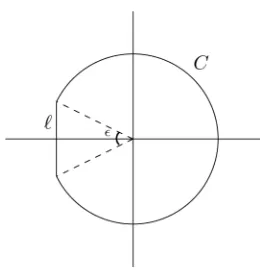
We apply Rouché’s theorem to the contourC0, an arcCand chord`as shown in Figure 2.2. Here, we viewε >0 as some sufficiently small number. First, consider the arcC. Let f(z) =−1−z2+z4, and note that f(z)has exactly two roots inside of the unit circle C.
On the arcC, we have that
Figure 2.1 ContourC0
A direct computation shows that f(eiθ) =u+iv, where
u=8 cos4(θ)−10 cos2(θ) +1 and v=8 cos3(θ)sin(θ)−6 cos(θ)sin(θ). Another direct computation gives
|f(eiθ)|2=u2+v2=−16 cos4(θ) +16 cos2(θ) +1.
Since|cosθ| ≤1 for allθ, we have that cos2(θ)≥cos4(θ). We deduce that forzon the
arcC, we have|f(z)| ≥1. SincePn(z), and hencePen(z), has no root onC besidesz=−1,
we further see that forzon the arcC, we have|Pen(z)|>0. We deduce that
|f(z) +Pen(z)|=1<|f(z)|+|Pen(z)|.
Now, consider the chord`where againε>0 is sufficiently small. Forzon`, we have
|f(z) +Pen(z)|=|zn+4| ≤1.
We wish to show that |f(z)|>1 for such z. For z on `, we see that the real part of z is
−cosε and the imaginary part istsinε for somet∈[−1,1]. We therefore write z=−cos(ε) +itsin(ε) with −1≤t ≤1.
A computation here, shows that the derivative of f(z)f(z)with respect totcan be expressed
with the property that the coefficients oftjfor j∈ {1,2, . . . ,6}approach 0 asεapproaches 0 andg(ε,0)approaches−7 asεapproaches 0. As|t| ≤1, we see that sinceεis sufficiently small, we have g(ε,t)6=0 for |t| ≤1. Furthermore, for sucht, the derivative of f(z)f(z) with respect tot equals 0 only whent=0 and is negative fort<0 and positive fort>0. Thus,|f(z)|2= f(z)f(z)has a minimum att=0. Att=0, we obtain
f(z)f(z) = f(−cosε)2= (cos4ε−cos2ε−1)2.
Sinceε>0 is small, we have 0<cosε<1 so that cos4ε−cos2ε<0. Hence, we see that
|f(z)|>1. Thus, forzon`, we obtain
|f(z) +Pen(z)| ≤1<|f(z)| ≤ |f(z)|+|Pen(z)|.
We now have that|f(z) +Pen(z)|<|f(z)|+|Pen(z)|for allz∈C0. Therefore, by Rouché’s
theorem, we deduce thatPen(z) has two roots insideC0. As we let ε tend to 0, we obtain
thatPen(z)has exactly two roots inside the unit circleC.
Finally, we must show that these two roots are non-real. For z∈(−1,1), we have z2≥z4 so that Pen(z) =1+z2−z4+zn+4≥1+zn+4 >0. We deduce that Pen(z) has no roots in the interval(−1,1). In other words, the two roots ofPen(z)insideC cannot be real. Hence, we can now deduce thatPn(z)has exactly two roots outsideC, both of which are
non-real.
Next, we considerQn(z). Since we are interested in odd n, we observe that for suchn,
we have
Pn(−z) =−zn(z4+z2−1) +1=−Qn(z).
Thus, the roots of Qn(z)are precisely −β where β runs through the roots of Pn(z). We
deduce from the above then thatQn(z)has exactly two roots outsideC, both of which are
non-real.
Next, we consider the familyRn(z). Here, we can proceed like we did in Lemma 1.2.
Replacingzwith−zin (1.1), we obtain that
Now, replacingzwithz2gives
|z4+z2−1|>|z4−1| for allz∈C.
Taking hereρn(z) =zn(z4+z2−1), we see that forz∈C, we have
|Rn(z)−ρn(z)|=|z4−1|<|z4+z2−1|=|ρn(z)|.
From Rouché’s Theorem, we see that Rn(z) and ρn(z) have the same number of roots,
counted to their multiplicity, inside C. As z4+z2−1 has exactly two roots in C, we
deduceRn(z)has exactlyn+2 roots insideC and exactly two roots outsideC. To see that
Rn(z)does not have real roots outside ofC, suppose thatz∈Rand|z|>1. Then
|Rn(z)|=zn(z4+z2−1) +z4−1
≥ |z|n+4+|z|n+2− |z|n− z4−1
=|z|n+4+|z|n+2− |z|n−z4+1= |z|n+2− |z|n
+ |z|n+4−z4+1>1>0.
Thus,Rn(z)has no real roots outside ofC. Hence,Rn(z)has exactly two roots outsideC,
both of which are non-real.
Next, we considerSn(z). Since we are interested in oddn, we observe that for such n,
we have
Rn(−z) =−zn(z4+z2−1) +z4−1=−Sn(z).
Thus, the roots of Sn(z) are precisely −β where β runs through the roots ofRn(z). We
deduce thatSn(z)has exactly two roots outsideC, both of which are non-real.
To finish the proof of the theorem, it remains to note that with a simple computation
one can deduce that G(z)has exactly two complex roots lying outside the unit circle C,
both of which are not only non-real but are in fact purely imaginary.
Now we show how these polynomials factor for all oddn.
Theorem 2.2. For odd n≥3, the polynomial Pn(z)is z+1times an irreducible polynomial,
the polynomial Qn(z)is z−1times an irreducible polynomial, and each of the polynomials
Proof. One checks directly that G(z) is irreducible. So we need now only consider the
polynomialsPn(z),Qn(z),Rn(z), andSn(z).
In the proof of Theroem 2.1, we showed that the only root ofPn(z)on the unit circleC
is−1. In fact, withnodd, we havePn(−1) =0 and
Pn0(−1) = (n+4)(−1)n+3+ (n+2)(−1)n+1−n(−1)n−1=n+66=0.
Thus,Pn(z)/(z+1)is a monic polynomial with no roots onC. In the proof of Theroem 2.1, we also showed that |Rn(z)−ρn(z)|<|ρn(z)| for all z∈ C. Observe that this implies Rn(z)6=0 for all z∈C. Thus,Rn(z)is a monic polynomial with no roots onC. Further,
we showed in the proof of Theroem 2.1 thatPn(−z) =−Qn(z)andRn(−z) =−Sn(z)from
which we deduce thatQn(z)/(z−1)andSn(z)are monic polynomials with no roots onC. Let f(z)be one of the polynomialsPn(z)/(z+1),Qn(z)/(z−1),Rn(z), andSn(z), where n≥3 is odd. Then f(z)is monic inZ[x]and has exactly two roots outside the unit circle
C, both of which are non-real and hence they are complex conjugates. Also, as seen above,
f(z)has no roots on the unit circleC. Now, assume f(z)is reducible. Then f(z) =u(z)v(z)
for some monicu(z) andv(z) inZ[x] with positive degrees and non-zero constant terms.
As the two roots of f(z)outsideC are non-real complex conjugate roots, they must both
be roots ofu(z)or both be roots ofv(z). Without loss of generality, we may suppose they
are roots ofu(z). As the remaining roots of f(z)all have modulus less than 1, the roots of
v(z)all have modulus less than 1. But this is a contradiction since the absolute value of the
product of the roots of v(z)is |v(0)| ≥1. Therefore, f(z) is irreducible, establishing the
2.3 GENERATINGINFINITELYMANYPOLYNOMIALS OFSMALL MEASURE
The polynomials considered in Theorem 2.1 motivated the direction taken in the next
chap-ter. Takingφ(z) =z4+z2−1, we see that
Pn(z) =znφ(z) +1, Qn(z) =znφ(z)−1,
Rn(z) =znφ(z) +z4−1, Sn(z) =znφ(z)−z4+1.
Computationally, these polynomials appear to have Mahler measure very close to the
golden ratioφ asntends to infinity. In fact, we have
φ =1.61803398874989. . . M(P100(z)) =1.61803398873400. . .
M(Q100(z)) =1.61803398876578. . .
M(R100(z)) =1.61803398872418. . .
M(S100(z)) =1.61803398877560. . . .
This observation suggests that maybe by considering more general polynomials of the form
u(z)zn+v(z), one might be able to find some interesting limiting values of Mahler measures
and relate them to our investigations of polynomials which have small Mahler measure and
no Newman multiples.
Let f(z)be a monic irreducible polynomial inZ[z]such that f(z)6= ef(z), where fe(z)
denotes the reciprocal of f(z)defined in (1.2). In the next chapter, we consider
Fn(z) =znf(z) + ef(z), (2.2)
and show that it yields an infinite number of distinct polynomials with Mahler measures
finding an infinite number of complex Pisot numbers which have distinct Mahler measures
<1.56<φ and which are not roots of any Newman polynomial.
We are also able to obtain some computational results by testing other variations of this
construction. For instance, we also considerFn(z) =znf(z)−fe(z),Fn(z) =znf(zk)±ef(zk)
for integersk≥2, Fn(z) =znf(−z)± ef(−z), andFn(z) =znfe(z)±f(z). We will explore
these computational results in Chapter 4. In Chapter 5, we use a polynomial discovered
in the investigations in Chapter 4 to explain another approach to showing that a given
C
HAPTER
3
G
ENERATING
I
NFINITELY
M
ANY
P
OLYNOMIALS WITHOUT
N
EWMAN
M
ULTIPLES
In this chapter, we expound on the constructionFn(z) =znf(z) +ef(z), outlined in the last
chapter. Many of the results here were provided by M. Filaseta.
Lemma 3.1. Let k and`be nonnegative integers. Let u(z)be a polynomial inR[z]having exactly k distinct roots which lie outside the circle C ={z∈C:|z|=1}, and let v(z)be
a polynomial inR[z]having exactly `distinct roots which lie inside C. Let these roots be denotedα1, . . . ,αk andβ1, . . . ,β`, respectively. Let ej denote the multiplicity of the roots αj in u(z), and let e0jdenote the multiplicity of the rootsβjin v(z). Thus,
u(z) = (z−α1)e1· · ·(z−αk)ekw1(z) and v(z) = (z−β1)e 0
1· · ·(z−β
k)e
0
`w
2(z),
where w1(z) and w2(z) necessarily have real coefficients, with the roots of w1(z) on or
inside C, and with the roots of w2(z) on or outside C. For n a positive integer, define
fn(z) =u(z)zn+v(z). Then for everyε>0sufficiently small and every n sufficiently large (n≥N0(ε,u(z),v(z))), each of the following holds:
(i) For each j∈ {1,2, . . . ,k}, the disk{z∈C:|z−αj|<ε}has exactly ejroots of fn(z). (ii) For each j∈ {1,2, . . . , `}, the disk{z∈C:|z−βj|<ε}has exactly e0jroots of fn(z). (iii) The remaining roots of fn(z)all lie in the annulus{z∈C: 1−ε <|z|<1+ε}. Proof. Ifv(0) =0, then it is not difficult to see that, fornsufficiently large, 0 is a root of
the appropriate power ofz, we may therefore consider now only the case thatv(0)6=0 and
do so.
Fixε >0 sufficiently small, in particular so that each closed disk centered at a root of u(z)of radiusε contains only that root ofu(z), so that each closed disk centered at a root of
v(z)of radiusε contains only that root ofv(z), and so that each such disk centered at one
ofα1, . . . ,αkor one ofβ1, . . . ,β`does not intersect the annulus in (iii). Letnbe sufficiently
large. For j∈ {1,2, . . . ,k}, set
Cj={z∈C:|z−αj|=ε} and Dj={z∈C:|z−αj| ≤ε}.
Observe that there is a t1 >0 such that |v(z)| ≤t1 for every z in each Dj. Recall that
u(z) =0 forz∈Dj if and only ifz=αj. Hence, there is at2>0 such that|u(z)| ≥t2for
every z on each circle Cj. Since each Dj lies outside C, there is also at3>0 such that
if z∈D=D1∪ · · · ∪Dk, then |z|>1+t3. We deduce that, for n sufficiently large and
z∈C1∪ · · · ∪Ck, we have
|v(z)| ≤t1<t2(1+t3)n≤ |u(z)zn|.
Setgn(z) =−u(z)zn. Forz∈C1∪ · · · ∪Ckandnsufficiently large, we have
|fn(z) +g(z)|=|v(z)|<|g(z)|.
Thus, by Rouché’s Theorem, we deduce fn(z) has exactly ej roots in Dj for each j ∈
{1,2, . . . ,k}, establishing (i).
By applying (i) to the reciprocal polynomial ˜fn(z) =v˜(z)zn+degu−degv+u˜(z), one can
see that (ii) holds as well.
Now, supposenis sufficiently large and fn(z0) =0 andz0 is not withinε of one of the
αj orβj. We show first that|z0|is bounded above by
B=2+ max
1≤j≤k{|αj|}+max{|β|:β ∈C,
Letadenote the leading coefficient ofu(z)andbdenote the leading coefficient ofv(z). If
|z0|>B, then the distance fromz0to each root ofu(z)orv(z)is at least 2 and no more than 2|z0|. Hence,
|u(z0)| ≥2degua and |v(z0)| ≤(2|z0|)degvb.
Fornsufficiently large, we have
|fn(z0)|=|u(z0)zn0+v(z0)| ≥2degua|z0|n−(2|z0|)degvb
≥ |z0|degv(2n+degu−degva−2degvb)>0,
contradicting that fn(z0) =0. Thus,|z0| ≤B.
Assume now that|z0| ≥1+ε. Sincez06∈Dand all the roots ofu(z)other than theαj
are on or inside C, there is a t4>0, not depending on z0, such that |u(z0)|>t4. Since
|z0| ≤B, there is at5>0 such that|v(z0)| ≤t5. Therefore,
|fn(z0)|=|u(z0)zn0+v(z0)| ≥t4(1+ε)n−t5.
Sincenis sufficiently large, we obtain a contradiction. Hence, we must have|z0|<1+ε.
By again considering the reciprocal polynomial ˜fn(z) =v˜(z)zn+degu−degv+u˜(z), we deduce
that fornsufficiently large, we must also have|z0|>1−ε.
We will want to have some idea of how close the roots of fn(z)are to the roots ofu(z)
in Lemma 3.1. Observe that in the argument for Lemma 3.1, if we decrease the size ofε,
the values oft1andt3can remain constant. Given the factorization ofu(z)in the statement
of Lemma 3.1, we have forz∈Cj that
|u(z)| ≥t6|z−αj|ej =t6εej,
where t6 is a constant depending only on u(z) and ε >0 being sufficiently small. The inequality|v(z)|<|u(z)zn|then follows provided that
Therefore, for the purposes of (i), we can take
ε=t7/(1+t3)n/ej,
for somet7 depending only onu(z) andv(z). Rouché’s Theorem applies, and we deduce
that fn(z)has a root withint7/(1+t3)n/ejof each rootαjin Lemma 3.1. A similar argument applies to the rootsβj and (ii). Thus, we have the following.
Corollary 3.2. In the set-up of Lemma 3.1, let
E=max{e1, . . . ,ek,e01, . . . ,e0`}. For n∈Z+, z
0∈Cand positive real numbers A and B, set
Dn(z0) =Dn(z0,A,B) ={z∈C:|z−z0|<A/(1+B)n/E}.
Then there exist positive constants A=A(u(z),v(z))and B=B(u(z),v(z))such that each of the following holds for n sufficiently large:
(i) For each j∈ {1,2, . . . ,k}, the diskDn(αj)has exactly ej roots of fn(z). (ii) For each j∈ {1,2, . . . , `}, the diskDn(βj)has exactly e0jroots of fn(z).
Next, we turn to obtaining a result for the case where v(z) is the reciprocal of u(z).
Our next lemma will help us to show that, in this case, for nsufficiently large, the roots
described by (iii) of Lemma 3.1 are not only close toC ={z∈C:|z|=1}but actually all
lie onC.
Lemma 3.3. Fix c∈R with c≥1. Let I be an open interval containing c, and let J be
a closed interval. Suppose H(z,t)is a real valued function having continuous first order partial derivatives for z∈I and t ∈J. Suppose further that H(c,t)>0 for all t∈J. For n∈Z+, define F
n(z,t) =z2nH(z,t). Then there exists an n0(H,c)such that
∂Fn(z,t) ∂z
z=c
Proof. First, observe that sinceJ is compact andH(c,t)is a continuous function oft inJ, the functionH(c,t)obtains its minimum inJ. AsH(c,t)>0 for allt∈J, there is anε>0 such thatH(c,t)>ε for allt∈J. Similarly, there is anM>0 such that
∂H(z,t) ∂z
z=c
≤M for allt∈J. (3.1)
Since
∂Fn(z,t) ∂z
z=c
=2nc2n−1H(c,t) +c2n∂H(z,t) ∂z
z=c
=c2n−1
2nH(c,t) +c∂H(z,t) ∂z
z=c
,
the conditionsc≥1,H(c,t)>ε for allt∈J and (3.1) imply ∂Fn(z,t)
∂z
z=c
≥2n0ε−cM≥1
forn≥n0andn0=n0(H,c)sufficiently large. Hence, the lemma follows.
Lemma 3.4. Let f(z) be a polynomial inR[z]which has exactly k roots outside the unit
circle C ={z∈C:|z|=1}and no roots on C. For n sufficiently large, the polynomial
f(z)zn+f˜(z)has exactly k roots outsideC.
Proof. Observe that f(z)having no roots onC implies ˜f(z)has no roots onC. Letz∈C.
Thenzk andz−k are complex conjugates for every positive integerk. Therefore, f(z)and
f(1/z)are complex conjugates and, hence, have the same absolute value. We deduce that
f(z)
˜ f(z)
=
f(z)
zdegff(1/z)
= |f(z)|
|z|degf|f(1/z)|=1 for allz∈C. (3.2) Now, setz=reiθ, wherer≥0 andθ ∈[0,2π). Define
H(r,θ) =|f(z)|
2
|f˜(z)|2=
f(rcosθ+irsinθ)f(rcosθ−irsinθ) ˜
f(rcosθ+irsinθ)f˜(rcosθ−irsinθ)
and Fn(r,θ) =r2nH(r,θ). ThenH(r,θ)and Fn(r,θ)are real-valued rational functions in r with coefficients that are polynomials in cosθ and sinθ. These functions are continuous in r and θ away from
points where the denominator is 0; in particular, since f(z)and ˜f(z)do not have zeroes on
From (3.2), we deduce
H(1,θ) =1 for allθ ∈[0,2π]. From Lemma 3.3, there is anN such thatn≥N implies
∂Fn(r,t) ∂r
r=1
≥1 for allθ ∈[0,2π].
Fixθ0∈[0,2π)andn≥N. By the continuity of ∂Fn(r,θ)/∂r inrandθ around(r,θ) =
(1,θ0), there is an ε(θ0)>0 such that for z=reiθ in the open disk D(θ0) ={z∈C:
|z−eiθ0|<ε(θ
0)}, we have∂Fn(r,θ)/∂r≥1/2.
With n≥N still fixed, we observe that the open disks D(θ) for all θ ∈[0,2π) form an open covering of the compact unit circleC. Hence, there is a finite subcovering of the
unit circle using say D(θ1), . . . ,D(θs) for somes∈Z+ andθj∈[0,2π). By considering the intersection points of the boundaries of overlapping disks and the minimum distance of
these intersection points to the unit circle, we deduce that there is anε>0 such that ∂Fn(r,θ)
∂r ≥1/2 for allre
iθ ∈ |{z∈
C: 1−ε ≤ |z| ≤1+ε}|. (3.3) The significance of (3.3) is the following. For a fixed θ ∈[0,2π), we have that the functionFn(r,θ)is strictly increasing as a function of r∈[1,1+ε]. Further, Fn(1,θ) =1 from (3.2). Hence,Fn(1+ε,θ)>1. We deduce that
|z|n|f(z)|>|f˜(z)| for allz∈Cε={z∈C:|z|=1+ε}. Letg(z) =−f(z)zn. Then
(f(z)zn+f˜(z)) +g(z)
=|f˜(z)|<|z|n|f(z)|=|g(z)| for allz∈Cε. (3.4)
Observe that (3.4) holds for each n ≥N where ε =ε(n). However, in the above, one
may takeε >0 arbitrarily small. We obtain from Rouché’s Theorem and (3.4) that, for n≥N, the polynomials f(z)zn+f˜(z)andg(z)have the same number of roots, counted to
their multiplicity, on the closed unit disk D ={z∈C:|z| ≤1}. As g(z) =−f(z)zn has
Corollary 3.5. Let f(z)be a polynomial inR[z]which has exactly k roots outside the unit
circle C ={z∈C:|z|=1}and no roots on C. For n sufficiently large, the polynomial
f(z)zn+f˜(z)has exactly n+degf−2k roots onC.
Proof. Apply Lemma 3.4 to see that, fornlarge, f(z)zn+f˜(z)has exactlykroots outside
ofC. Since f(z)zn+f˜(z)is reciprocal, we deduce f(z)zn+f˜(z)has exactlykroots inside
C. The corollary follows.
The next lemma follows, for example, from Proposition 11.2.4 in Rahman and
Sch-meisser (2002). We give a proof here.
Lemma 3.6. Let f(z) =∑rj=0ajzdj ∈Z[z]with r≥1, a06=0, and d0=0. Then each root
of f(z)has multiplicity at most r.
Proof. Assume α is a root of f(z) with multiplicity k ≥r+1. Then f(u)(α) = 0 for
0≤u≤rso that
r
∑
j=0ajdj(dj−1)· · ·(dj−u+1)αdj−u=0 for 0≤u≤r.
We claim that this is only possible if eachajequals 0, contradictinga06=0. As the above
r+1 equations in ther+1 numbersajform linear equations in theaj’s, it suffices to show
that detM6=0, whereM= (mi j)is the(r+1)×(r+1)matrix with
mi j =
αdj ifi=0,
dj(dj−1)· · ·(dj−i+1)αdj−i if 0<i≤r,
where for convenience we use subscripts foriand jfrom{0,1, . . . ,r}so that the first row corresponds toi=0 and the first column corresponds to j=0. Note thatα6=0 sincea06=0
andd0=0. We can remove a factor ofαdj from the(j+1)st column and then a factor of
α−ifrom the(i+1)st row to obtain a new(r+1)×(r+1)matrixM0= (m0i j)where
m0i j =
1 ifi=0,
The matrix M0 has the property that detM6=0 if and only if detM06=0. We can further
multiply the(i+1)st row by 1/i! to obtain an(r+1)×(r+1)matrixM00 = (m00i j)where m00i j =
d
j i
.
The matrixM00 similarly satisfies the property that detM6=0 if and only if detM006=0. The
matrixM00 (or the matrix M0) can be computed by connecting it to a Vandermonde matrix
Pólya and Szeg˝o (1976) (see Part V, Problem 96 Solution). We obtain
detM00= ∏0≤i<j≤r(dj−di)
∏0≤i<j≤r(j−i)
6=0.
The lemma follows.
For the results that follow, we will require f(z)∈Z[z] have degree ≥1 and satisfy
gcd(f(z),f˜(z)) =1. We note that for such f(z)∈Z[z], we have as a consequence that f(z)
has no roots on the unit circleC ={z∈C:|z|=1}, as any such root would be a root of
both f(z)and ˜f(z).
Lemma 3.7. Let f(z) =∑rj=0ajzj∈Z[z]with r≥1, ar=1, a06=0andgcd(f(z),f˜(z)) =1.
Then there exists a positive integer M such that for all positive integers n and m satisfying
Φm(z)divides f(z)zn+f˜(z), we have m≤M.
Proof. Forn a positive integer, set Fn(z) = f(z)zn+f˜(z). Suppose m andn are positive
integers for which Φm(z) divides Fn(z). Let ζ =ζm =e2πi/m. Then Fn(ζ) =0, and we
obtain
0= f(ζ)ζn+f˜(ζ) = f(ζ)ζn+ζrf(1/ζ) =⇒ ζn−r =−f(1/ζ)
f(ζ) . (3.5) Sinceζ and 1/ζ are complex conjugates, we deduce f(ζ)and f(1/ζ)are complex con-jugates. Hence,|f(1/ζ)/f(ζ)|=1. The basic idea now is to use thatζ is very close to 1 for largemso that the right-hand side of the last equality in (3.5) is close to−1 and then to
show that the left-hand side of this equation can only be close to−1 formfrom a finite list
The right-hand side of the last equality in (3.5) is
−f(1/ζ)
f(ζ) =−1+η, where η=
f(ζ)−f(1/ζ)
f(ζ) .
Denote the roots of f(z), up to their multiplicities, byα1, . . . ,αr. By the conditions in the statement of the lemma,
τ =minz−αj
: 1≤ j≤r,z∈C = min
1≤j≤r
1− |αj| >0.
We deduce the inequalities
|f(ζ)−f(1/ζ)|=
r
∑
j=0aj(ζj−ζj)
≤ |ζ−ζ| r
∑
j=0|aj|
j−1
∑
k=0ζk(ζ)j−1−k
≤ |ζ−ζ| r
∑
j=0j|aj|,
|ζ−ζ|=2|sin(2π/m)| ≤4π
m,
and
|f(ζ)|=|ar| r
∏
j=1|ζ−αj| ≥ |ar|τr. Thus,
|η| ≤C1
m, where C1= 4π
|ar|τr r
∑
j=0j|aj|.
We now turn to the left-hand side of the last equality in (3.5). Let t be an integer in
[0,m−1]such that n−r≡t (mod m). Thenζn−r =ζt. We treatt ∈(m/4,3m/4) sepa-rately from othert. Fort ∈(m/4,3m/4), we sett0=t−(m/2)∈(−m/4,m/4). Observe that
ζt =ζ22mt =ζ2mmζ2t
0
2m=−ζ2t
0
2m and |2πt0/m|<π/2. Hence,
1+ζt
=
1−ζ2t
0 2m
≥
Im(1−ζ2t
0 2m)
=|sin(2πt0/m)| ≥
2
π· 2π|t0|
m =
4|t0|
m .
We deduce that
From (3.5), we obtain
4|t0|
m ≤
C1
m =⇒ |t
0| ≤C 2=
π
|ar|τr r
∑
j=0j|aj|.
Note thatt0is not necessarily an integer, but the definition oft0implies that 2t0=t00for
somet00∈Z. Thus,
ζn−r=ζt=−ζ2t
0
2m=−ζt
00 2m,
where|t00| ≤2C2. Fixt00∈Zsatisfying|t00| ≤2C2. SinceFn(ζ) =0 andζ=ζ22m, we obtain
f(ζ)ζn+ f˜(ζ) =0 =⇒ f(ζ)ζn−r+f(1/ζ) =0 =⇒ −f(ζ22m)ζt
00
2m+f(1/ζ22m) =0. Clearing denominators in this last equation by multiplying through byζ2r+max{−t
00,0}
2m , we
obtain a polynomial inζ2mwith a non-zero leading coefficient. More precisely, the
poly-nomial
−f(z2)zt00+2r+max{−t00,0}+zmax{−t00,0}f˜(z2) (3.6)
hasζ2mas a root and has leading coefficientc, where
c=
−ar ift00 >−2r
a0 ift00 <−2r
ar−k−ak ift00 =−2r, wherek=max{j: 0≤ j≤r/2,aj6=ar−j}.
Note that such a k exists since gcd(f(z),f˜(z)) =1. As the polynomial in (3.6) only de-pends on f(z)andt00 and|t00| ≤2C2, we see that ast00 varies, there are only finitely many
possibilities for the roots of these polynomials and, hence, for the value of 2m. Thus, if
t ∈(m/4,3m/4), the lemma follows.
In the case thatt∈[0,m−1]withn−r≡t (mod m)andt6∈(m/4,3m/4), we proceed as follows. First, we observe here that ζt =e2πit/m=eθmi for some θm∈[−π/2,π/2]. Hence,
1+ζt
In other words,ζt=−1+η0, where|η0| ≥1. From (3.5), we obtain
1≤ |η0|=|η| ≤C1
m =⇒ m≤C1=
4π
|ar|τr r
∑
j=0j|aj|.
Thus, in this case, we also get thatmis bounded as in the lemma, finishing the proof.
For computational purposes, we made the constants C1 and C2 explicit above. The
proof can therefore be used then to obtain an explicitM as in the statement of the lemma.
We comment, however, that the expression|ar|τr inC1 andC2 creates a less than optimal
bound for|η|and|t0|, and one can replace it with a value closer to|f(1)|.
For the next result, we recall the notationM(f)for the Mahler measure of the
polyno-mial f(z).
Theorem 3.8. Let f(z) =∑rj=0ajzj∈Z[z]with r≥1, ar=1, a06=0andgcd(f(z),f˜(z)) =
1. Suppose f(z)has no positive real roots. Then for everyε>0, there exist infinitely many polynomials h(z)having no positive real roots and no cyclotomic factors such that
M(f)−M(h)
<ε. (3.7)
Furthermore, these h(z)can be chosen so that the number of roots of h(z)outsideC ={z∈
C:|z|=1}is equal to the number of roots of f(z)outsideC.
Proof. Forna positive integer, setFn(z) = f(z)zn+ f˜(z). We take nsufficiently large so
that the following arguments hold.
Letkdenote the number of roots of f(z), counted to their multiplicity, outside ofC. By
Lemma 3.4, the polynomialFn(z)has exactlykroots, counted to their multiplicity, outside
ofC. Furthermore, sincenis sufficiently large, Lemma 3.1 implies that thesekroots are
close to thekroots of f(z)outside ofC in such a way that (3.7) holds withh(z) =Fn(z).
Let hn(z) denote the product of the monic irreducible factors of Fn(z) having roots
thatFn(z)/hn(z)has only roots onC. As cyclotomic polynomials are the only monic irre-ducible polynomials containing every root onC, we deduce thatFn(z)/hn(z)is a product of cyclotomic polynomials.
From Lemma 3.6 and Lemma 3.7, there are positive integersR andMindependent of
nsuch thatFn(z)/hn(z)divides
∏
m≤MΦm(z)R.
Asntends to infinity, this expression is a polynomial of bounded degree and degFntends to
infinity, so we deduce that deghntends to infinity. AsM(hn) =M(Fn), we deduce that there
are infinitely many has in (3.7). Furthermore, since f(z) and hence ˜f(z)has no positive
real roots, Lemma 3.1 and Corollary 3.5 imply hn(z) has no positive real roots off of C.
Sincehn(z)has no cyclotomic factors, we also havehn(1)6=0, sohn(z)has no positive real
roots, completing the proof.
There is a much simpler proof that polynomial h(z) as in (3.7) exist by making use
of f(zn) instead of hn(z). However, we will want to take advantage of the fact that, for
nlarge, the polynomials hn(z) in the proof of Theorem 3.8 each has the same number of
roots outsideC as f(z)and that these roots ofhn(z)are close to the roots of f(z).
We briefly review and partially revise the algorithms discussed in the previous chapter.
Letβ be an algebraic integer in(−τ,−1)whereτ= (1+
√
5)/2. Let I(β) =
−
1
β2−1,
−β
β2−1
.
Observe that this differs fromI(β) only in that we have made this a closed interval for
our purposes here. SetN (β,0) ={1}and, forda positive integer, define
N (β,d) = {β ω:ω ∈N (β,d−1)} ∪ {β ω+1 :ω ∈N (β,d−1)}∩I(β).
This differs from our previous definitions discussed earlier in that we do not necessarily
if and only if there is a positive integerd0=d0(β)such that eitherN (β,d0) = /0 or both
N (β,d0) =N (β,d0−d)for some positive integerd≤d0and 06∈N (β,d0). Note that,
in the caseN (β,d0) = /0, one necessarily has 06∈N (β,d)for alld≤d0.
Similarly, forβ an algebraic integer inCwith|β|>1, we define I0(β) =
z∈C:|z| ≤ |β| |β| −1
,
N 0(
β,0) ={1}, and
N 0(
β,d) = {β ω :ω ∈N 0(β,d)} ∪ {β ω+1 :ω ∈N 0(β,d)}
∩I0(β), ford≥1.
We have here that if there is a positive integer d00 =d00(β) such that N (β,d00) = /0, then β is not a root of a Newman polynomial. As above, in this case, one necessarily has
06∈N (β,d)for alld≤d00. Note that the existence ofd00(β)is not a necessary condition for aβ ∈Cwith|β|>1 to avoid being a root of a Newman polynomial.
Theorem 3.9. Let f(z) =∑rj=0ajzj∈Z[z]with r≥1, ar=1, a06=0andgcd(f(z),f˜(z)) =
1. Suppose f(z)has no positive real roots. Suppose that f(z)has a rootβ ∈Cwith|β|>1
and that the second algorithm described above establishes thatβ is not a root of a Newman
polynomial. Then for everyε >0, there exist infinitely many polynomials h(z)having no positive real roots and no cyclotomic factors such that both
M(f)−M(h)
<ε (3.8)
and no multiple of h(z)inZ[z]is a Newman polynomial. Furthermore, these h(z)can be
chosen so that the number of roots of h(z) outsideC ={z∈C:|z|=1} is equal to the
number of roots of f(z)outsideC.
Before turning to the proof, we note that one can take f(z)in Theorem 3.9 to be f1(z) =
M(f2) =1.419. . .. Thus, there are infinitely many polynomials with no Newman multiples and Mahler measure as close as we want to the Mahler measure of f1(z), and similarly for
f2(z).
Proof. Recall that takingh=hn(z), wherehn(z)is described in the proof of Theorem 3.8,
andnsufficiently large, one obtains (3.8). Further, the set of suchhn(z)is infinite and the
number of roots ofhn(z)outsideC ={z∈C:|z|=1}is equal to the number of roots of
f(z) outsideC. To establish the theorem, we need only now show that forn sufficiently
large, the polynomialhn(z)has no Newman multiple.
Let βn0 be a root of hn(z) that is as close to β as possible. As shown in the proof of
Lemma 3.1, the difference|βn0−β|tends to 0 asntends to infinity. Let d00 =d00(β)be as
defined before the statement of the theorem. Define
N 0(
β) =
[
0≤d≤d0
N 0(
β,d).
One may viewN 0(β)as the expressions
εd0β
d0+ε
d0−1β
d0−1+· · ·+ε
2β2+ε1β+ε0, with eachεj∈ {0,1}, (3.9) which lie inI0(β). Let N 0(β)denote the expressions in (3.9) which do not lie in I0(β).
As this is a finite set disjoint from the closed set I0(β), there is an ε >0 such that each element ofN 0(β)is a distance of at leastε/2 fromI0(β). Asβ is not a root of a Newman polynomial, we may also chooseε so that each expression in (3.9) is a distance of at least
ε/2 from 0. Observe that the endpoints of I0(s) are continuous functions of s∈C in a neighborhood ofβ. Thus, there is aδ >0 such that
I0(γ) =
z∈C:|z| ≤ |γ| |γ| −1
⊆
z∈C:|z| ≤ |β| |β| −1+
ε
4
for |γ−β|<δ. In addition, we may takeδ so that|γ−β|<δ implies
d0
∑
j=0εjγj− d0
∑
j=0εjβj
and, consequently, d0
∑
j=0εjγj
> ε 4, for every choice ofεj∈ {0,1}.
Observe that, still with|γ−β|<δ, if theεj’s are chosen so that z1=εd0γ
d0+ε
d0−1γ
d0−1+· · ·+ε
2γ2+ε1γ+ε0∈I0(γ),
then
z2=εd0β
d0+ε
d0−1β
d0−1+· · ·+ε
2β2+ε1β+ε0
satisfies
|z2| ≤ |z2−z1|+|z1|< ε
4+
|β|
|β| −1+ ε 4 =
|β|
|β| −1+ ε 2.
Thus,|z2|is a distance<ε/2 fromI0(β). By our choice ofε, we deducez2∈I0(β). Thus,
if
εd0γ
d0+
εd0−1γ
d0−1+· · ·+
ε2γ2+ε1γ+ε0
is inI0(γ)for some choice ofεj∈ {0,1}, then it is non-zero and the corresponding element from (3.9) is inI0(β). As a consequence,
(ε0,ε1, . . . ,εd): d
∑
j=0εjγj∈N 0(γ,d),εj∈ {0,1} ∀j
⊆
(ε0,ε1, . . . ,εd): d
∑
j=0εjβj∈N 0(β,d),εj∈ {0,1} ∀j
for each positive integerd≤d0. In particular,N0(γ,d0) =/0 for suchγ.
Recall the definition ofβn0. Fornsufficiently large, we obtain |βn0−β|<δ. Thus, for nsufficiently large, the second algorithm described earlier establishes thathn(z)does not
have a Newman multiple, completing the proof of the theorem.
Theorem 3.10. Let f(z)∈Z[z] be monic and non-reciprocal. Suppose that f(z) has no
positive real roots and exactly two roots outsideC, both non-real and with multiplicity one.