A Bidirectional AC/DC Converter with Feed
Forward Scheme by Using Neural Network
Control in Microgrid System
Kanchan Bala Rai1, Neelesh Kumar2
PG Student, Dept. of EEE, Disha Institute of Management and Technology, Raipur, Chhattisgarh, India1
Assistant professor, Dept. of EEE,Disha Institute of Management and Technology, Raipur, Chhattisgarh, India2
ABSTRACT: This paper present a well-simplified PWM by using neural network control with feedforward scheme for bidirectional ac/dc converter in microgrid system. In this proposed project PI controller is replace by a neural network in feedforward scheme for ac/dc converter. There are many advantages of neural network over PI such as fast switching response, reduce overshoot, undershoot problem due to disturbances. These disturbances such as fault occurrences, system loads and varying environmental condition causes overshoot and undershoot problem. The major problem in PWM bidirectional ac/dc converter is current harmonics, and this disadvantage can be minimizes with the proposed system.
Both, existing controller with PI and modified with neural network controller with feedforward scheme PWM for bidirectional ac/dc converter is compared in THD and magnitude of output dc voltage. It produces large fundamental voltage. Result verified with MATLAB simulink.
KEYWORDS: Bidirectional ac/dc converter, Microgrid, THD, Neural controller, Feedforward control scheme.
I. INTRODUCTION
There are lots of renewable source of energy like solar, wind, tidal and geothermal etc. present on the earth. As there is limited amount of conventional source of energy like coal, diesel and petroleum. So, to utilize these renewable source of energy efficiently a proper channel or medium between these sources and ac grid, a bidirectional ac/dc converter either single or three phase is required. Therefore, a single phase bidirectional ac/dc converter is proposed in this paper. A microgrid consists of distributed energy resources (DERs), ac/dc converter and energy storage system. DERs are connected to dc loads and if there is deficiency of power to supply these loads the bidirectional ac/dc converter can simultaneously change the direction of flow i.e. from ac grid to dc loads. Similarly, if there is any disturbance in ac grid, so at that time power transfer from battery energy system to ac loads. PWM converters provide high dc output voltage and low harmonic ac current. In proposed PWM converter switches operated at higher frequency so as high order harmonics can easily be removed by using simple filter. The existing system have PI controller in feedforward control scheme have some disadvantage like it has slower response during transient condition and hence produces overshoot and undershoot problem in output dc voltage. So to eliminate this problem a proposed bidirectional ac/dc converter PWM with feedforward scheme having neural network controller has used. Until now, several PWM techniques are used like BPWM, UPWM, HPWM and SHEPWM. The proposed project has several advantages over existing such as lower THD, higher fundamental output voltage and low ac line current harmonics. So efficiency get improved.
II. SYSTEM DESCRIPTION
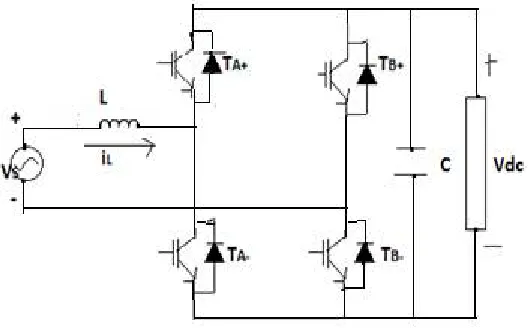
i.e. state of charging (SOC). For single phase bidirectional ac/dc converter for IGBT switches with parallel diodes are used.
Fig 1. Proposed single phase bidirectional ac/dc converter
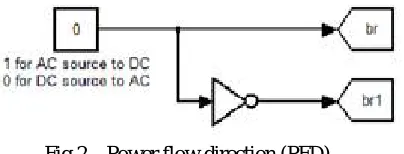
The proposed PWM causes only one switch to active during rectifier or inverter operation of converter and hence reduces switching losses. Battery is in state of discharging during inverter operation i.e. power is transfer from dc grid to ac grid. When power flows from dc to ac the battery get discharged so the state of charge (SOC) is goes to decrease linearly. A power flow direction (PFD) block is used which helps in changing the power flow direction simultaneously. Suppose there is any disturbance on ac grid side and difficulty in supply the power to connected ac load then at that time charged battery supplies the ac load with the help of ac/dc converter.
Fig 2 – Power flow direction (PFD)
In above figure br and br1 is the breakers, ‘0’ shows that power flow from ac source to dc load i.e. rectifier operation and ‘1’ shows that PFD is from DC source to AC load i.e. inverter operation. When power flows from ac source to dc loads breaker one is active and breaker br1 is disable. A simply NOT gate is connected to the input of breaker 1 i.e. when br is ON at that time br1 is OFF and vice- versa. In this project neural network for voltage and current control is applied due to which a minimized THD occurred.
III. PROPOSED SIMPLIFIED PWM STRATEGY
Fig 3 Application of single- phase bidirectional ac/dc converter in renewable energy system
The proposed PWM has good ac current shaping, and good dc voltage regulation and hence reduce harmonic pollution in ac grid shaping. The switching statuses of the proposed PWM for inverter mode are shown in above table 1.
TABLE I
Inverter mode switching combination in the proposed simplified PWM
Consider the ac grid voltage operating in positive half cycle VS>0; at this instant input current is in reverse direction iL<
0. As shown in table both status F and G charges inductor current as voltage across the inductor is positive. Status H discharge the inductor current as voltage across the inductor is negative. Similarly during VS< 0, both status J and K
discharges the inductor current as the voltage across the inductor is positive. There is one thing common in all the status is that only one switch is active during a one cycle, this shows reduced switching stress and hence increase the life of switching device. The ac grid line can be increased or decreased easily in both rectifier mode and inverter mode to obtain bidirectional flow and line current shaping.
IV. INTRODUCTION OF NEURAL NETWORK
The neural network based controller offers very fast implementation of proposed PWM. In this project a multilayer neural network is used The proposed project employs a feedforward neural network, which receives the command voltage and angle information and generate PWM waves for single phase bidirectional ac/dc converter with the help of logic circuits. The data to be used to train it is by back propagation algorithm are generated by the simulation of converter.
Status TA+ TA- TB+ TB- Inductor
status
VS
>0
F OFF OFF ON OFF VL > 0
G OFF OFF OFF ON
H ON OFF OFF ON VL < 0
VS<0
I OFF ON OFF OFF VL < 0
J OFF OFF ON OFF
V. FEEDFORWARD NEURAL NETWORK CONTROL
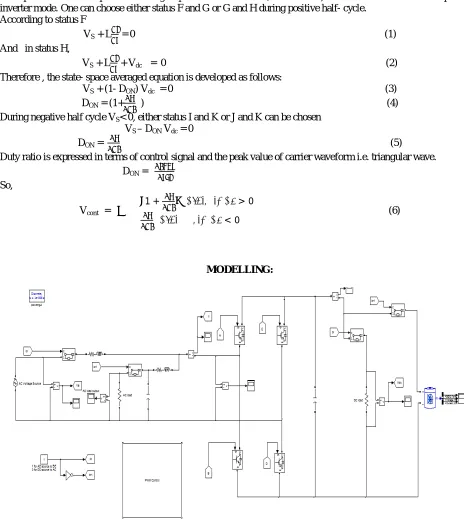
To explain the control operation of single- phase bidirectional ac/dc converter, first assume that converter operate in inverter mode. One can choose either status F and G or G and H during positive half- cycle.
According to status F
VS + L = 0 (1)
And in status H,
VS + L + Vdc = 0 (2)
Therefore , the state- space averaged equation is developed as follows:
VS + (1- DON) Vdc = 0 (3)
DON = (1+ ) (4)
During negative half cycle VS< 0, either status I and K or J and K can be chosen
VS – DON Vdc = 0
DON = (5)
Duty ratio is expressed in terms of control signal and the peak value of carrier waveform i.e. triangular wave. DON =
So,
Vcont =
1 + , > 0
, < 0 (6)
MODELLING:
VI. EXPERIMENTAL RESULT
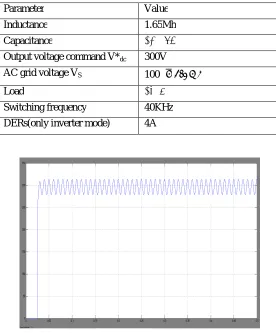
TABLE 2.
SIMULATION PARAMETERS OF THE PROPOSED AC/DC CONVERTER SYSTEM
Parameter Value Inductance 1.65Mh Capacitance 1400μF
Output voltage command V*dc 300V
AC grid voltage VS 100√
Load 150Ω
Switching frequency 40KHz DERs(only inverter mode) 4A
Fig 5 DC output voltage of proposed bidirectional ac/dc PWM converter with feedforward PI control
Fig 6 DC output voltage of existing bidirectional ac/dc PWM converter with feedforward neural network control
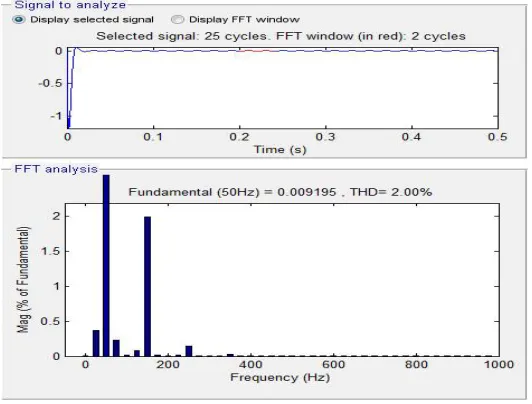
Fig 6 shows the dc output voltage of existing bidirectional ac/dc PWM converter with feedforward neural network control which improves the efficiency of the system by 98% as we see from the waveform the problem of overshoot get reduces. Also THD get decreased.
Fig. 7 FFT analysis of existing bidirectional ac/dc converter with feedforward neural network controller , above- dc output voltage, below- THD
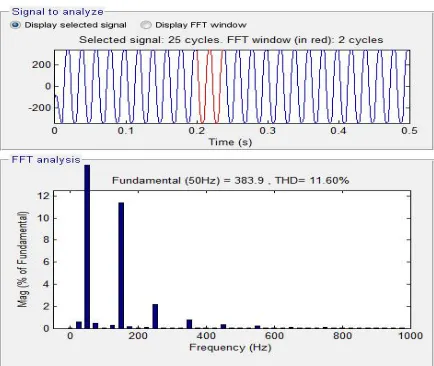
Fig 8 FFT analysis of proposed bidirectional ac/dc converter with feedforward PI controller
In figure 8 FFT analysis of proposed bidirectional ac/dc converter with feedforward PI controller in which THD is 11.06% and hence only 88.94% efficiency. So to improve the efficiency and reducing the harmonics, we proposed a system i.e. bidirectional ac/dc converter with feedforward neural network controller in microgrid system.
VII. CONCLUSION
This paper presented a PWM strategy using feedforward neural- network control in bidirectional ac/dc converter. The total harmonic distortion in existing (PI) model is 11.06 % and 2% in proposed system so we get reduced harmonics in proposed model. In addition, it improves the system efficiency to 98% as well as reduces overshoot and undershoot problem in dc output voltage. So overall, power quality of dc output voltage is enhances. The magnitude of fundamental output voltage is higher than the magnitude of fundamental output voltage of the existing model i.e. with PI controller. Both the simulation and experimental result verify the validity of proposed PWM strategy and control scheme.
REFERENCES
[1] H.Sugimoto, S.Moritoma, and M.Yano, “ A high performance control method of a voltage type PWM converter”, in conference Rec IEEE PESC 88, Apirl 1988, pp.360-368.
[2] S.Fukuda, Y. Iwaji & T.Aoyama,” Modelling & control of sinusoidal PWM rectifiers”.
[3] R. A. Mastromauro, M. Liserre, and A. Dell’Aquila, “Control issues in single-stage photovoltaic systems: MPPT, current and voltage control,”
IEEE Trans. Ind. Informat., vol. 8, no. 2, pp. 241–254, May. 2012.