Recognition and Classification of Object
Images Using Features Extraction
K. C. Chaudhari
1,Dr. A. M. Patil
2PG Student, Dept. of E & TC., JTM College of Engineering, Faizpur, Maharashtra, India1
Professor, Dept. of E & TC., JTM College of Engineering, Faizpur, Maharashtra, India 2
ABSTRACT: This paper presents a recognition and classification of different types of object images based on texture features analysis. We have considered nine different types of object images namely, Ewer, Lamp, Watch, Stapler, Bike, Camera, Scissor, Cup and Headphone. GLCM and wavelet transform methods are used to extract the texture features. For recognition and classification of objects images, a back propagation neural network (BPNN) is used. Experimental result shows that GLCM gives efficient result than wavelet transform method.
KEYWORDS: Features Extraction, Artificial Neural Network.
I. INTRODUCTION
A artificial vision system is extensively used in various application such as biometric systems, face recognition system, identify and categories abnormalities in medical images, recognition and classification of fruits, pests, objects, vehicle parking system and many more machine vision system. Humans are able to tell object identity and category with the simple glance, based on its appearance, on opposite to it machines cannot identify objects because of the variations in the appearance of objects like shape, size, colours, etc. Many repetitive task can be automated if highly standard artificial vision system is created. Therefore, it is natural to study the mechanisms used of biological vision system for recognition and classification of an objects and to examine the applicability of similar processes on artificial computer vision system [1, 2].
II. PROPOSED METHODOLOGY
The present work refers to recognition and classification of objects using texture features extraction. Features are extracted using Gray level co-occurrence matrix (GLCM) and wavelet transform methods. A Back Propagation Neural Network (BPNN) is used as a classifier.
A. Gray Level Co-occurrence Matrix (GLCM)
GLCM contains the second order statistical information of pixels of an image [3]. Many useful textural
properties can be calculated from GLCM matrix to expose details about the image. Haralick et al. first introduced the
use of GLCM for extracting various texture features. Computing the GLCM matrix and calculating texture features
based on GLCM, these two steps are proposed by Haralick [4]. Let I be a given grey scale image. Let N be the total
number of grey levels in the image. The Grey Level Co-occurrence Matrix defined by Haralick is a square matrix P of
order N, where the (i, j) th entry of P represents the number of occasions a pixel with intensity i is adjacent to a pixel
with intensity j. The normalized co-occurrence matrix is obtained by dividing each element of P by the total number of
co-occurrence pairs in P. We have considered seven texture features which are extracted from calculated GLCM, they
are contrast, correlation, homogeneity, energy, standard deviation, dissimilarity and entropy.
B. Wavelet Transform
HH. The LL band gives the approximate image and can be decomposed further. The other three bands are the detail bands and contain information about the directions [5, 6].
C. Features Extraction
We have extracted seven texture features which are as follows: contrast, correlation, homogeneity, energy, standard deviation, dissimilarity, entropy [7].
Contrast= 𝑁𝑔−1𝑛2
𝑛=0 { 𝑝(𝑖, 𝑗)}
𝑁𝑔 𝑗 =1 𝑁𝑔 𝑖=1
Homogeneity= 1
1+ 𝑖−𝑗 2 𝑁𝑔
𝑗 =1 𝑁𝑔
𝑖=1 𝑝 𝑖, 𝑗
Energy= 𝑁𝑔 𝑝 𝑖, 𝑗 2
𝑗 =1 𝑁𝑔 𝑖=1
Dissimilarity= 𝑁𝑔 𝑖 − 𝑗 𝑝(𝑖, 𝑗)
𝑗 =1 𝑁𝑔 𝑖=1
Entropy=− 𝑁𝑖=1𝑔 𝑁𝑗 =1𝑔 𝑝 𝑖, 𝑗 log 𝑝 𝑖, 𝑗
Correlation= 𝑖,𝑗 𝑝 𝑖,𝑗 −µ𝑥
𝑁 𝑔 𝑗 =1 𝑁 𝑔
𝑖=1 µ𝑦
𝜎𝑥𝜎𝑦
Where𝜇𝑥, 𝜇𝑦, 𝜎𝑥 and 𝜎𝑦 are the means and standard deviations of 𝑝𝑥 and 𝑝𝑦.
𝜇𝑥= 𝑖𝑝(𝑖, 𝑗) 𝑁𝑔 𝑗 =1 𝑁𝑔 𝑖=1
𝜇𝑦= 𝑗𝑝(𝑖, 𝑗) 𝑁𝑔
𝑗 =1 𝑁𝑔 𝑖=1
𝜎𝑥= (𝑖 − 𝜇2)𝑝(𝑖, 𝑗) 𝑁𝑔
𝑗 =1 𝑁𝑔 𝑖=1
𝜎𝑦= (𝑗 − 𝜇2)𝑝(𝑖, 𝑗) 𝑁𝑔
𝑗 =1 𝑁𝑔 𝑖=1
D. Artificial Neural Network
Neurons are the simple processing elements of Artificial Neural Networks (ANN). Motivation behind the design of ANNs was a human brain. Artificial neural network with feed-forward topology is called Feed-Forward artificial neural network. BPNN is also a feed-forward neural network and best suited for classification of different objects. Three layers are present in BPNN which are input layer, hidden layer and output layer [8].
E. Algorithm 1: Texture Features Extraction using GLCM
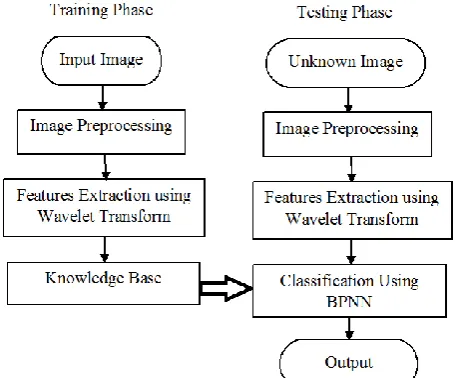
In training phase, BPNN is trained using features which are extracted from calculated GLCM. In testing phase, to test unknown image and classify, first GLCM of unknown image is calculated and texture features are extracted which are listed above. The second step is to train the neural network using extracted features with the desired values and test it to determine the object class of a given unknown image. Figure 1 shows flow diagram of GLCM method.
Algorithm
Step 1: Read the input color image and resize it. Step 2: Image preprocessing is applied.
Step 3: Calculate GLCM of a given input image. Step 4: Extract texture features from calculated GLCM.
Figure 1. Flow Diagram of GLCM Method.
F. Algorithm 2: Texture Features Extraction using Wavelet Transform
In training phase, neural network is trained using features which are extracted from calculated wavelet transform. Wavelet transform technique is used to calculate wavelet decomposition. In testing phase, to test unknown image and classify, first wavelet transform of an unknown image is calculated and texture features are extracted which are listed above. The second step is to train the neural network using extracted features with the desired values and test it to determine the object class of a given unknown image. Figure 2 shows flow diagram of wavelet transform method.
Algorithm
Step 1: Read the input color image and resize it. Step 2: Image preprocessing is applied.
Step 3: Calculate Wavelet Transform of a given input image. Step 4: Extract Texture features from calculated Wavelet Transform. Step 5: For classification, train the BPNN using above extracted features. Step 6: Test the given image.
Stop.
III. RESULTS AND DISCUSSION
In this section, experimental results of developed methodology is given. A comparative study of two methods used in this work is presented. Table 1 shows summarized results of GLCM and wavelet transform technique.
Table1. Summarized Results of GLCM and Wavelet Transform Technique.
Object Class Train
Images
Test
Images Total
Accuracy in %
GLCM Wavelet
Ewer 9 17 26 100 82
Lamp 9 17 26 94 88
Watch 9 17 26 100 82
Stapler 9 17 26 94 88
Bike 9 17 26 94 88
Camera 9 17 26 94 82
Scissor 9 17 26 100 88
Cup 9 17 26 100 88
Headphone 9 17 26 100 82
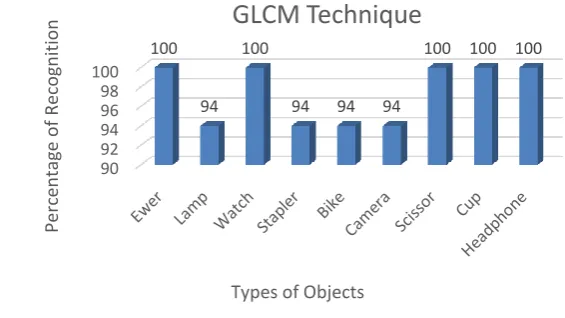
GLCM and wavelet transform techniques are applied on nine object classes which are as follows: Ewer, Lamp, Stapler, Bike, Camera, Scissor, Cup and Headphone. The summarized results of GLCM based recognition and classification is 97%. Figure 3 represents the graph of GLCM technique. It represents that the percentage recognition of Lamp, Stapler, Bike and Camera is 94%. The classification rate of Ewer, Watch, Scissor, Cup and Headphone is 100%.
Figure 3. Summarized Result of GLCM Technique.
Figure 4 shows the summarized results of wavelet transform based recognition and classification and its accuracy is 85%. The graph represents the classification of Ewer, watch, Camera, Headphone is 82%. The classification rate of Lamp, Stapler, Bike, Scissor, and Cup is 88%.
90 92 94 96 98 100
100
94 100
94 94 94
100 100 100
Perc
en
ta
ge
o
f
Re
cogn
itio
n
Types of Objects
Figure 4. Summarized Results of Wavelet Transform Technique.
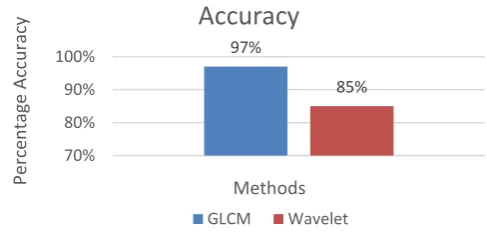
The summarized results of both GLCM and wavelet transform based recognition and classification is shown in figure 5. Accuracy of GLCM is 97% and wavelet transform’s accuracy is 85%.
Figure 5. Accuracy of GLCM and Wavelet Transform.
IV. CONCLUSIONS
We proposed a novel system of texture features extraction using GLCM and wavelet transform technique and BPNN used as a classifier. The proposed system was tested using a various objects datasets. We also conducted comparison experiments with GLCM and wavelet transform techniques. We compared the performance of both the GLCM and wavelet transform in the object verification task. The performance of GLCM based features extraction and classification method in terms of detection accuracy is more efficient as compared to wavelet transform technique as GLCM is best suited for texture features extraction.More powerful visual feature detectors can be used to improve the accuracy of detection.
REFERENCES
1. Tamboli, M. Shah, “A Generic Structure of Object Classification using Genetic Programming,” IEEE CSNT, pp. 723-728, 2011.
2. S. Ullman, E. Sali, “Object Classification Using a Fragment-Based Representation,” BMCV 2000, LNCS 1811, pp. 73-87, 2000. A. Gebejes, R. Huertas, “Texture Characterization based on Grey-Level Co-occurrence Matrix,” ICTIC, pp. 375-378, 2013.
3. R. Haralick, “Statistical and structural approaches to texture,” Proceedings of the IEEE 67, pp. 786-804, 1979.
4. M. Sarawat, A. Goswami, A. Tiwari, “Object recognition Using Texture Based Analysis, ” IJCSIT, Vol. 04, pp. 775-782, 2013. 5. R. Bogush, S. Maltsev, A. Aniskovich, “Object Detection Using Wavelet Transform.”
6. Hwang, K. Lee, “Classification Accuracy of Wavelet-Based Fusion Image with Texture Filtering using High Resolution Satellite Images.” 7. Pratap, N. Agarwal, S. Joshi, S. Gupta, “Development of ANN Based Efficient Fruit Recognition Technique,” GJCST, Vol. 14, Issue 05, pp.
01-06, 2014.
78 80 82 84 86 88
82 88
82
88 88
82
88 88
82
Perc
en
ta
ge
o
f
Re
cogn
itio
n
Types of Objects
Wavelet Transform Technique
97%
85%
70% 80% 90% 100%
Perc
en
ta
ge
Accu
ra
cy
Methods