Implementation of TCSC on a Transmission Line Model to
analyse the variation in Power Transfer Capability
Prof.Sushil Kumar
Electrical and Electronics Deptt
Pragati college of Engg and Management Raipur Email [email protected]
Abstract—
The FACTS controllers clearly enhance
power system performance, improve
quality of supply and also provide an
optimal utilization of the existing
resources. This paper discusses the
development of a Thyristor Controlled
Series Capacitor (TCSC) with open loop
control system. The TCSC circuit and
characteristics are discussed in brief.
Next the determination of TCSC
parameters is discussed. With these
parameters the capacitive mode of
operation of TCSC is simulated and
implemented on a power system model
with 300 km long transmission line.
MATLAB R2006b software had been
used as the simulation tool. Results of
simulation made are discussed.
Significant enhancement in the power
transfer capability of transmission line is
observed with the inclusion of TCSC in
the model.
Keywords:
FACTS, TCSC, power quality, firing angle
1. Introduction:
Facts Definition:
A Flexible Alternating Current Transmission System (FACTS) is a system comprised of static equipment used for the AC transmission of electrical energy. It is meant to enhance controllability and increase power transfer capability of the network. It is generally a power electronics -based device.
system parameters to enhance
controllability and increase power transfer capability."
TCSC:
Thyristor Controlled Series Capacitor (TCSC) is a Flexible AC Transmission Systems (FACTS) device. It has proven to be an excellent solution in controlling the power flow, especially over long transmission lines where the power angle control at either end of the line are constrained. The TCSC can also be used for damping power oscillations and mitigating subsynchronous resonance.
2. Fundamentals:
Series compensation has been utilized for many years with excellent results in AC power transmission in a number of countries all over the world. The usefulness of the concept can be demonstrated by well-known expressions relating to active power transfer and voltages.
Fig. – 1 Series Compensation
X E E
P= 1⋅ 2sinδ
…………..(1)
V = f
(
P,Q)
…………(2)
Here, in fig.1, E1 and E2 denote the voltages at either end of the
interconnection, whereas δ denotes the angular difference of the voltages (E1&E2). X is the reactance of the transmission circuit, while P and Q denote the active and reactive power flow.
From (1) it is evident that the flow of active power can be increased by decreasing the effective series reactance of the line. Similarly it is demonstrated that by introducing a capacitive reactance in the denominator of (1), it is possible to achieve a decrease of the angular separation with power transmission capability unaffected, i.e. an increase of the angular stability of the link.
and phase angle of high voltage AC
transmission lines. Different FACTS devices in the power system are Static Var Compensators (SVC’s), Thyristor controlled series compensators (TCSCs), STATCOMs, Unified Power Flow Controller (UPFC).
In this work, only TCSCs had been used for simulation, study and analysis.
3. Basic Structure of TCSC:
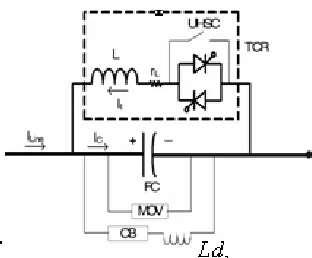
The basic structure of TCSC is shown in Fig.2. It is mainly constituted by four parts: series compensating capacitor C, bypass inductance L, bidirectional thyristor SCR and zinc oxide voltage limiter MOV.
Fig. 2 TCSC Module
The degree of TCSC basic compensation is controlled by the capacity size of capacitor C. The main function of bypass inductance L is to reduce the short circuit current and the energy absorbed by MOV.
Bidirectional thyristor SCR is used to transform the equivalent impedance of TCSC which fulfill the needs in all kinds of power system condition, such as improving the stability, increasing the transmission
capability, restraining
hyposynchronization resonance and so on.
By controlling the trigger pulse, TCSC can transform the trigger angle of thyristor. Subsequently, the current value of inductance subcircuit which controlled by TCSC can be transformed, and then the total equivalent impedance will be changed continuously.
Generally, when the trigger angle is 145 O ~180 o , the equivalent
impedance of TCSC is appeared as capacitance. When the trigger angle is 90o ~140o , the equivalent impedance of
TCSC module to bypass it if a severe
fault or equipment malfunction occurs. A current limiting inductor, Ld, is incorporated in the circuit to restrict both the magnitude and the frequency of the capacitor current during the capacitor bypass operation.
4. E
ffective
reactance of TCSC:
The effective reactance of TCSC is given by equations (3) and (4). Equation (3) assumes that the capacitor voltage is free from harmonics and considers the only the TCR current harmonics.
(
)
(
)
⋅ ⋅ ⋅ = C TCR C TCR TCSC X X j X X X 1 11 ……..(3)
( )
− − − ⋅ ⋅ − ⋅ − ⋅ + ⋅ − = 2 sin 2 2 tan 2 tan 1 2 cos 2 1 2 1 2 2 2 2 2 σ σ σ σ λ λ λ σ λ λ π CTCSC j X
X
……….(4) where
,
( )
− ⋅ ⋅ ⋅ = σ σ π ω sin1 j L
X TCR ………(5)
N
ω ω
λ= 0
…….(6)
C L⋅ = 1
0
ω
…….(7)
In the above equations, σ is the conduction angle, L is the inductance of the TCR inductor, C is the capacitance of the fixed capacitor, ωN is power system frequency in radians per second and ω0 is the resonant frequency of the TCSC circuit. Fig. 3 shows the reactance characteristics of TCSC.
Fig.-3. Reactance Characteristics of
TCSC
5. Simulation of
transmission Line with TCSC:
5.1 Description of the system
model:
A 735 kV, 300 km line is used to transmit power from bus B1 (735 kV equivalent system) to bus B2 where RL load (P=1000MW and Q= 10e3 var) is connected. In order to simplify, only one phase of the system has been represented.
The nominal compensation is 75%, i.e. using only the capacitors (firing angle of 90deg). The natural oscillatory frequency of the TCSC is 150.6 Hz, which is 2.51 times the fundamental frequency
From the simulated model, system performance characteristics had been analysed without a TCSC and with a TCSC is connected at mid point of the transmission line.
5.2 The simulated model:
It is shown in fig. 4 below.
5.3 System Parameters:
Transmission Line Inductive Reactance
( )
XL = 98ΩTCSC Parameters:
Capacitor(C) = 36 Fµ Capacitive Reactance
( )
XC = 73.5 ΩInductor (L) = 31 mH Inductive Reactance
( )
XL = 11.76Ω Resonance Factor (λ) = 2.5Natural Oscillation Frequency of (TCSC):
ω
o = 946 rad/sec.;1 . 0 =
C L
X X
6
f = 150.6 Hz To observe the power transfer
capability of transmission line after using series compensation technique i.e.TCSC in capacitive mode, it was necessary to keep delay angle (firing angle, α) of thyristors between 1450 to
1800 . With different values of α, the
simulations were made. Results with α = 146o has been discussed below.
Simulation with firing angle,
α
=
146
o :Started the simulation and observed the waveforms. At 75% compensation and firing angle, α =146o power transfer is
1540MW. Observed the corresponding TCSC Voltage, Capacitor current (Ic),VB1 (Voltage at B1),VB2(Voltage at B2), TCR current and line current on five scopes.
Waveforms are shown in figure -5 (a), (b), (c), (d) and (e)
Fig.-5. (a) Active, reactive Power at α=146o (b) Vc, Itcr & voltage at B2 at α=146o
(C) Line current (IL) at B2) (d) Capacitor current(Ic)
(e) Waveforms of Iak1, Vak1 , Iline ,Iak2 & Vak2
In the model considered (Fig.4), TCSC is operated in capacitive mode keeping firing angle(delay angle) α = 1460 the corresponding Active/Reactive
power ,capacitor voltage , capacitor current ,TCR current and current at node B2 are given below.
Active power (P) = 1540 MW
Reactive Power(Q) = 150 MVAR
Capacitor voltage (V) = 650 KV
Capacitor current(Ic) = 18 KV
Line current (B2) = 6
KA
6. Conclusion:
It is observed that with the inclusion of TCSC, power transfer capacity increased to 1540 MW. The same power was only 685 MW without any compensation. In simulations, with different firing angles, power level had been varied and the corresponding change in reactive power is also observed.
7. References:
[1] Narain G. Hingorani, Laszlo Gyugyi,
and Understanding FACTS: Concepts
and Technology of FACTS,
Wiley-IEEE Press, and December
1999.
[2] Google search (FACTS Theory) from
Wikipedia, the free encyclopedia
(Wiley- IEEE Press, December
1999 and Modelling and Control,
Springer, March 2006
[3] Thyristor-Controlled Series
Compensation: A state of the art
approach for optimization of
transmission over power links R.
Grünbaum Jacques Pernot, ABB
Power Systems.
[4] Design of TCSC for Classroom and
Research Applications on an Analog
Model Power System Vinod K.
Yedidi, Student Member IEEE, Brian
K Johnson, Member IEEE. 2006
[5] Power Grid Corporation India Limited,
Raipur.
[6] Klaus Habur is Sr. Area Marketing
Manager, Reactive Power
Compensation, Power Transmission
and Distribution Group (EV) of
Siemens AG in Erlanger, Germany.
Donal O’Leary, Sr. Power Engineer of
the World Bank is on assignment with
the Siemens Power Generation Group