Available online:
https://edupediapublications.org/journals/index.php/IJR/
P a g e | 514An Equipped Data Hiding Algorithm Based On Secret Fragment
Visible Mosaic Image For Security in Digital Applications
PA SHNIGA RH RUHEENA BEGUM (PG Scholar) 1 S M SUBA HA N Assistant professor2
Department of ECE, Dr. K V Subba Reddy Institute of Technology, Dupadu, Kurnool-518218, INDIA
[email protected] [email protected]2
Abstract
The digital image transmission has advanced applications in the field of security, such as security related the confidentiality of medical databases, preventing leakages from the military databases, privacy protection the enterprise related documents and online document storage systems. Although a lot of research has been done on secure image transmission, but still it too has some unresolved issues such as leakages while transmissions and the loss of the confidentiality is another drawback. An innovative approach is implemented in this paper and the main idea of the proposed work is to create meaningful secret fragment mosaic imaging system and the important implementation in the proposed work is the secret fragment mosaic image size is same as that of preselected target image which gives scope to provide more payload capacity. The generation of the mosaic image is the resultant of the block fragments of the selected secret image and the mosaic image in the process is looks alike of the target image which is used as the source to hide the secret image by successfully transforming the color characteristics of the secret image similar to the blocks of the target image. Finally the simulation results show the performance in terms of presenting the meaningful, secure image transmission technique for the lossless recovery and the necessary data is
embedded into a mosaic image for the recovery of the
securely transmitted secret image.
Keywords:
Mosaic image, Lossless recovery, Confidentiality, Secret fragment1. INTRODUCTION
Today’s images usually contain private or confidential information so that they should be protected from leakages during transmissions. Recently, many methods have been proposed for securing image transmission such as image encryption and data hiding. Image encryption is a technique that uses to encrypt image into noise form, using high redundancy and strong spatial correlation. The encrypted image is a meaningless file and before encryption, additional information is not provided. Data hiding is alternative for image encryption that hide secret image into a cover image so that no one can realize the existence of the secret data. Large number of data is not hide into a single is the main issue of data hiding. Specifically, if one wants to hide a secret image into a cover image with the same size, the secret image must be highly compressed in
advance.
Available online:
https://edupediapublications.org/journals/index.php/IJR/
P a g e | 515image and target image. Select three images secret image, target image, and mosaic image. After selecting the target image, the given secret image is first divided into number of rectangular fragments called tile images, which then are fit into similar blocks in the target image, called target blocks, according to a comparison of colour transformation. Next, the color characteristic of each tile image is transformed into the other colour, resulting in a mosaic image which looks like the target image. Appropriate schemes are also proposed to conduct nearly lossless recovery of the original secret image from the resulting mosaic image The transmission of
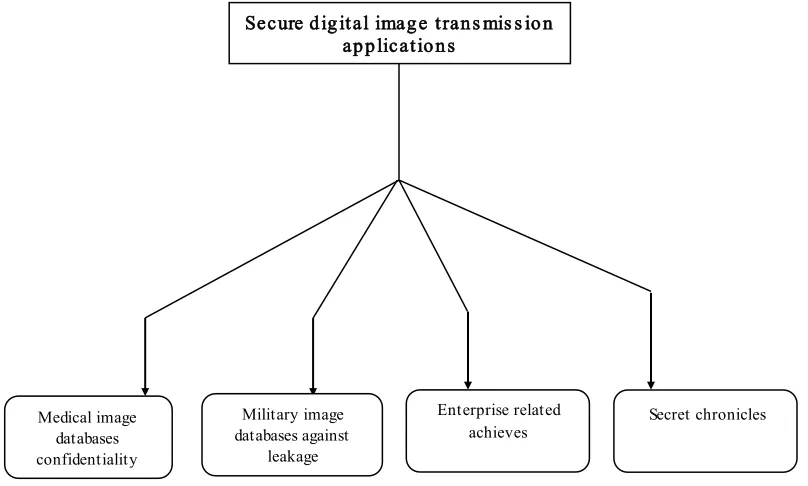
the digital pics thru net as medium has preserve on growing every other day due to the applications primarily based on image transmission has been gambling key position within the area of security. The main advantage of the secure image transmission are lossless recovery at the recovery side and simultaneously providing better confidentiality in terms of protecting the documents related to different fields such as medicine related databases, military related datasets against leakage during transmission. The digital image transmission applications using internet as medium are illustrated in the following
figure 1.1.
Fig.1.1: Digital image transmission applications over internet as channel
The digital images which might be used for transmitting the secured statistics through secure image transmission software must strong against leakages and zero lack of data at the healing quit. In literature survey works are stated on the secure image transmission and after reading all works the
international telecom union authorised two methods
particularly as follows.
A . Dig ital imag e en cry p tio n ap p ro ach
Although first rate development has been remodeled past many years within the field of security nonetheless the transmission of data through internet Secure d ig ital imag e tran s mis s io n
ap p licatio n s
Medical image databases confidentiality
Military image databases against
leakage
Enterprise related
Available online:
https://edupediapublications.org/journals/index.php/IJR/
P a g e | 516as regular technology is changing according to that change the security norms should also change to keep confidentiality while transmission. One such method is image encryption which makes use of properties and characteristics of digital images to meet the realistic requirement in applications related to crucial
fields like medicinal drug and army.
The idea behind the image encryption is to create an image with important hidden information in it but difficult to recognize the mechanism involved in it. The original photo image characteristics are taken into consideration and convert it to the desired protection norms, the reliability of the image encryption method is no authenticated character can ever decrypt the hidden information while not having the authenticated key and having the right knowledge about the preferred security norms. Digital image contains of various properties and the image encryption technique makes use of the a few particular residences of the image to cover the personal data in digital content material in reliable manner. The digital image used in lots of applications must keep the security tiers in accurate manner for you to provide higher protection to the image that's regularly utilized within the digital media in online system. The applications related to the storage and
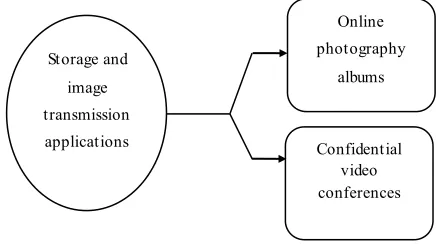
image transmission are shown in following image.
Fig. 1.2: Storage and image transmission applications
If you want to accomplish the mission of encryption in reliable way on online storage applications lot of studies has performed in literature and after having the distinctive analysis on traditional works the encryption technique are classified into three
categories as follows
(a) The encryption algorithm based totally on the
position permutation
(b)The encryption algorithm based totally on valued
transformation
(c) The encryption algorithm based on perceived
data transformation
B. Dig ital imag e co v erin g u p ap p ro ach
The image encryption has limitation of clean prediction then the covering up technique is came up with innovative concept that a mysterious detail is brought into image, so that it will recover the data one should first successfully crack the mysterious element place inside the image which goes to transmission . The disadvantage dealing with in this technique is setting the mysterious element in the
great amount of image is concerned vicinity.
C. Su mmary o f th e two imag e tran s mis s io n
ap p ro ach es
Image encryption is an method which normally uses the image default strategies which includes excessive redundancy and better correlation nature in terms spatial area. The default residences are used for processing are relies upon shannon diffusion and as well as confusion properties. The secret encrypted image is a noisy image and the encrypted image can't be discovered until and except one must have actual Online
photography albums
Confidential video conferences Storage and
Available online:
https://edupediapublications.org/journals/index.php/IJR/
P a g e | 517key. The primary downside in the image encryption
technique it without difficulty draws the
unauthenticated character attention toward it at some point of transmission the use of net as s ource of
medium.
2. PROBLEM STATEMENT AND ITS
PROMINENCE
The secure image transmission application which transmit data from one quit to every other performs an vital position in technologically advanced on-line based totally digital image processing packages which especially relates to the problem of confidentiality and lossless image restoration. The images utilized in on line transmission particularly comprise the private information related to personal records associated with plenty of primary fields
together with navy and medicine.
The protection should be provided against to unauthenticated leakages which are normally occurs particularly due to the accidental/incidental attacks. A preprocessing device is designed in this proposed work that is rather equipped algorithm to technique the colorful images and create the meaningful mosaic
images.
The proposed dissertation approach have reliable can transform a specific secret image by secret fragment
mosaic image method wherein the entire
transformation manner is managed by way of a secret key. The secret key is used later to obtained the hidden content in lossless way from the proposed
mosaic image.
3. LITERATURE SURVEY
(1) An innovative approach for hiding data the data in digital images especially mosaic images for providing robust copy right protection is presented by authors “W . L. Lin and W. H. Ts ai” in the year 2004. The introduction of the boundary stream related to the data embedded is an idea in this approach and this boundary stream related to data are later embedded into mosaic image by detecting the respective boundary regions of preselected mosaic image in the Steganography application.
The copyright protection has been consistent concerned area in field of digital image processing and the respective method in this method helps to protect copyright protection by inserting the meaningful mosaic images into the paper copies. But this method fails when the attacks are done beyond limits.
(2) The generation of the mosaic images for protecting the copyright by using square shape tiles are introduced by S. “C. Hung, T. Y. Liu an d W . H. Ts ai” in the year 2005. The main motto of this work is creating mosaic images to embed more data but the square shape data is not always done in all applications. The mosaic image generation in other shapes can increase embedded capacity in watermarking application.
Available online:
https://edupediapublications.org/journals/index.php/IJR/
P a g e | 518work leaves the future scope for creation of meaningful images in other shapes rather than square to increase the embedding capacity.
(3) A novel idea is proposed by “T. C. Wang and W . H. Ts ai” in the year 2007, the proposed method mainly tends to introduce overlapping of mosaic images in horizontal and vertical tiles for the steganography application. The creation of the hole has been concerned area in the past works and that is resolved in this paper.
Although the algorithm presented in this paper has good applications in real time scenario such as communications in secret way that is technically termed as covert communication. But this work in future can improve by introducing different shapes of tiles to overlap for increasing the data hiding capacity and to create the robustness against attacks.
(4) An high equipped fast processed watermarking scheme based on Reversible contrast mapping has been implanted in the year 2007 by “Din u Coltuc and Jean-Marc Chassery” to resolve two important issues which commonly faced in the past works namely resolving the high complexity issue by resulting low complexity in the results and simultaneously a new to provide robustness against all unnecessary cropping by creating the look up table.
4. PROPOSED METHOD
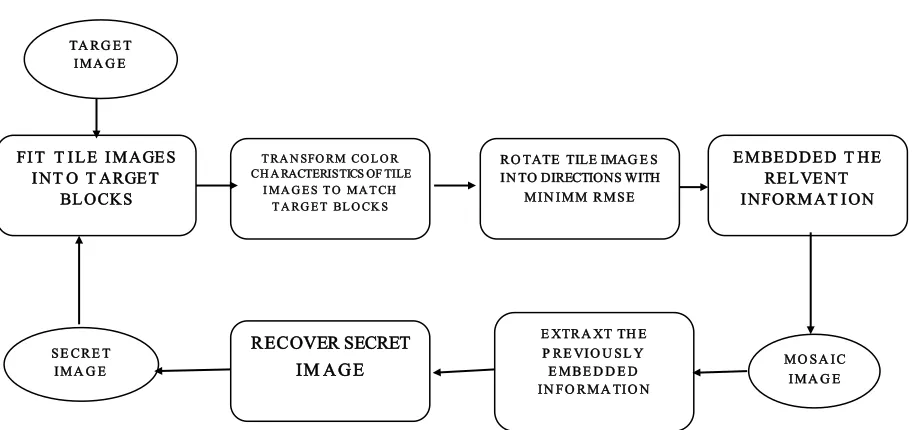
The proposed technique especially contains of essential sections namely (a) generation of the mosaic images and (b) Successful recovery of the secret image. The important steps in the flow chart of the
proposed method are as follows
Figure 4.1: The secret fragment mosaic image generation flow chart
(1) In the initial phase the generation of mosaic images is done in high equipped way where the acquired mosaic images consists of the color
corrected fragments of an input target image.
(2) The proposed approach has for stages as
illustrated below FI T T I L E I MAGE S
I NT O T ARGE T BL OCKS
E XTRA XT TH E P RE VIO U SL Y E MBE D D E D IN FO RMA TIO N
T RA N SFO RM CO L O R CH A RACTERISTICS OF TILE
I MA G E S T O MA T CH T A RG E T BL O CK S
RO TATE TILE IMAG E S IN TO DIRECTIONS WITH
MIN IMM RMSE
E MBE DDE D T HE RE L VE NT I NFORMAT I ON
RECOVER SECRET IM AGE TA RG E T
IMA G E
MO SA IC IMA G E SE CRE T
Available online:
https://edupediapublications.org/journals/index.php/IJR/
P a g e | 519(a) The selection of the different tile images of the preselected secret image and fitting the selected tile images of the target images into the
already generated blocks of the target image.
(b) The main challenging task in the proposed approach is transforming the every color characteristics of each tile image of secret image which corresponds to the every individual block of
the respective target image.
(c) Another novel thing implemented in the proposed work is rotating each and every in the exact direction with as minimum RMSE parameter value
with reference to preselected target image.
(d) The most important step is embedding the confidential information in the already generated mosaic image which is used for further recovery at
the extraction in lossless recovery manner
The second phase of the secretly fragmented mosaic
image includes as follows
In the initial phase of generation of
mosaic image and successful
embedding of the data into mosaic image, in th second stage the extraction secret image from the already generated mosaic image in lossless manner Recovering the information is done by
recovering the secret image which mainly uses the extracted information as
reference.
A . Detailed analysis of proposed work
(1) The tile image generation is most step in the proposed work, first the images are the divided parts
of the secret image, where the secret image is parted into and default shape i.e. rectangular shaped particles which is technically termed as fragments
which are further used to preselected target image.
(2) Based on the color variations in the preselected target the remaining and most vital method is carried on i.e. based on the resultant criteria the acquired tile images are successfully fitted into the block which are generated from the arbitrarily selected target
image in reliable way.
(3) The blocks of the target image and concurrently tile digital content of the respective secret image are colour corrected so that each tile image is efficiently colour converted into those blocks of the target
image.
(4) The condition inserted in the proposed work is that each and every tile image is rotated in four default directions i.e. 0o, 90o, 180o or 270o and the acquired color transformed tile images should have minimum RMSE value with reference to target image
which is already preselected image.
(5) Embedding the most confidential information into mosaic image is one with reference to the RCM
technique.
(6) After performing all tasks successfully an output
image namely mosaic image is generated
successfully with similar to the preselected target
image.
B. A ccurate selection of reliab le targ et b lo cks fo r
each tile imag e
Available online:
https://edupediapublications.org/journals/index.php/IJR/
P a g e | 520performed for getting the better similarity in case of color content. The color similarity is generally obtained between the each secret image tile to corresponding block of the preselected target image. But on what basis an appropriate block B is selected to tile image T is still an issue. The solution is most popular image processing parameter i.e. the standard deviation parameter is used as performance evaluator
to check most B foe each respective T
A sequence is formed based on all tile images formed from the secret image Stile, and simultaneously on the other end all the target blocks to form another sequence Starget, the three colors standard deviation values form some average values and based on that average values the sequence of fitting is implemented as first in Stileinto the first in Starget, fit the second in Stileinto the second in Starget,
and so on.
C. Transformations color ch aracteris tics b etween Blo cks
In the initial approach of the proposed framework, the respective secret image tile are fit into the corresponding block of the target image and the problem arise here is make the color characteristics of two different images contents into similar one. Already many works are reported in the literature but the color transfer scheme implemented in the proposed work is realistic in nature and converts the characteristic of one in lαβ color space on behalf of other content The proposed work is also implemented on three color transform approach i.e. RGB color space instead of lαβ color space ins elected scenarios.
Let Tand Bbe described as two pixel sets { p1, p2, . . . , pn }and { p1', p2', . . . , pn' },respectively.
Let the color of each pibe denoted by ( ri, gi, bi ) and that of each pi' by ( ri', gi', bi' ). At first, we compute the means and standard deviations of T and B, respectively, in each of the three color channels R, G, and B by the following formulas :
µc = 𝟏
𝒏 ∑ 𝐜ᵢ 𝒏 𝒊=𝟏
(1 ) µc'= 𝟏
𝒏 ∑ 𝐜ᵢ 𝒏 𝒊=𝟏 ′
σc = √ 𝟏
𝒏 ∑ (𝐜ᵢ 𝒏
𝒊=𝟏 −µ𝐜)²
(2 )
σc' = √ 𝟏
𝒏 ∑ (𝐜ᵢ 𝒏
𝒊=𝟏 ′−µ𝐜′)²
Where, in which ci and ci' denote the C-channel values of pixels pi and pi', respectively, with c= r, g, or band C = R, G, or B.
Next, we compute new color values ( ri'', gi'', bi'' ) for each piin Tby
ci' ' = qc ( ci - µc) + µc' (3) in which qc= σc'/σcis the standard deviation quotient and c = r, g, or b. It can be verified easily that the new color mean and variance of the resulting tile image T' are equal to those of B, respectively. From this, we must say that the obtained mosaic image is look similar to that of target image.
C. Ro tating blocks to fit better with s maller RM SE
v alu e
Available online:
https://edupediapublications.org/journals/index.php/IJR/
P a g e | 521mean square error (RMSE) value with respect to B among the four directions for final use to fit Tinto B.
D. Emb ed the relevant secret image recovery in fo rmation into obtained mosaic image
In order to recover the secret image from the mosaic image, we have to embed relevant recovery information into the mosaic image. For this, we adopt a technique, the reversible contrast mapping method [2] which applies simple integer transformations to pairs of pixel values. Specifically, the method
conducts forward and backward integer
transformations as follows, respectively, in which (x, y) are a pair of pixel values and (x’, y’) are the transformed ones
x' = 2x-y
(4) y ' = 2y -x
x = ⌈ 𝟐 𝟑 𝐱′ +
𝟏
𝟑 𝐲′ ⌉
(5) y = ⌈ 𝟏
𝟑 𝐱 ′+ 𝟐
𝟑 𝐲
′ ⌉
The method yields high data embedding capacities close to the highest bit rates and has the lowest complexity reported so far.
The information required to recover a tile
image T which is mapped to a target block B
includes: 1) the index of B; 2) the optimal rotation angle of T; 3) the truncated means of T and Band the standard deviation quotients, of all color channels; These data items for recovering a tile image T are integrated as a four-component bit stream of the form M = t1t2...tmr1r2m1m2...m48q1q2...q2 1 (6)
in which the bit segments represent the values of the index of B, the rotation angle of T, the means of T and B, the standard deviation quotients, respectively. E. To tal length of recovery information
The involved mean and standard deviation values are all real numbers, and it is impractical to embed real numbers, each with many digits, in the generated mosaic image. Therefore, we limit the numbers of bits used to represent relevant parameter values. Specifically, for each color channel we allow each of the means of Tand B to have 8 bits with its value in the range of 0 to 255, and the standard deviation quotient qc to have 7 bits with its value in the range of 0.1 to 12.8. That is, each mean is changed to be the closest value in the range of 0 to 255, and each qcis changed to be the closest value in the range of 0.1 to 12.8.
In vast detail description, the numbers of required bits for the four data items in M are discussed below: 1) it needs two bits to represent the rotation angle of T because there are four possible rotation directions; 2) 48 bits are required to
represent the means of Tand Bbecause we use
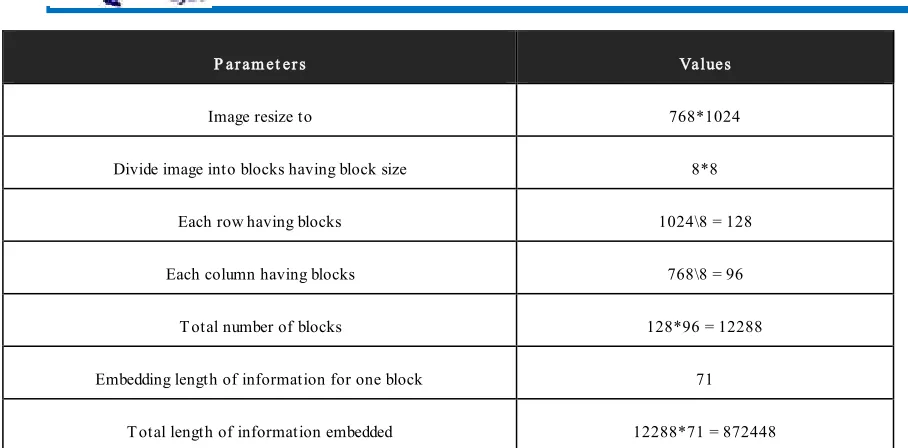
eight bits to represent a mean value in each color channel; 3) it needs 21 bits to represent the quotients of T over Bin the three color channels with each channel requiring 7 bits. Then, the above-defined bit streams of all the tile images are concatenated in order further into a total bit stream Mt for the entire secret image, which is finally embedded into the pixel pairs in the mosaic image using the RCM technique. So, for one tile image we required to embed 71 bit length information. and for entire secret image we requires:
Available online:
https://edupediapublications.org/journals/index.php/IJR/
P a g e | 522P ar am et er s Values
Image resize to 768*1024
Divide image into blocks having block size 8*8
Each row having blocks 1024\8 = 128
Each column having blocks 768\8 = 96
T otal number of blocks 128*96 = 12288
Embedding length of information for one block 71
T otal length of information embedded 12288*71 = 872448 Fig. 5.5 Total length of information embedded
A lg o rith m 1: M o s aic imag e creatio n
In p u t: The input contents necessary for the creation of mosaic images are
(1) A secret image S, (2) A target image T, and (3) A secret key K.
Ou tp u t: The collaboration of all three input contents with necessary processing steps results in generation of a secret-fragment-visible mosaic image F.
Stage 1: Fitting the tile images into the target blocks Step 1: Change the sizes of target image Tand secret image S and make them identical. ( here we resize both to 768*1024); and divide the secret imageinto n tile images as well as the target image into n target blocks with each being of equal size. (Here each block/tile of 8*8 size )
Step 2: Compute the means and the standard deviations of each tile image and each target block for the three color channels, and compute accordingly the average standard deviations for each individual of them.
Step 3: According to values of average standard deviation obtained, keeping it in ascending order, sort
the tile images and the target blocks in separate sets.; map in order the blocks in the sorted tile setto those in the sorted target set in a 1-to-1 manner; and reorder the mappings according to the indices of the target images, new sequence named as L.
Step 4: The final step in the accurate fitting tile in the necessary block target image are done according to the new sequence generated
Stage 2: Performing color conversions b etween th e tile imag es an d th e targ et b lo cks
Step 5: Create a counting table TBwith 256 entries, each with an index corresponding to a residual value (where, each residual value will be in the range of 0 to 255), and assign an initial value of zero to each entry.
Step 6: For each mapping, represent the means of tile image and target block, present at that particular mapping point, respectively, by eight bits; and represent the standard deviation quotient qc by seven bits, where c = r, g, or b.
Available online:
https://edupediapublications.org/journals/index.php/IJR/
P a g e | 523smaller than 255 or if it is not larger than 0, then change ci'' to be 255 or 0, respectively.
Stag e 3: Ro tatin g th e tile imag es
Step 8: Compute the RMSE values of each color transformed tile image Ti in F with respect to its corresponding target block Bji after rotating Ti into each of the directions θ=0o, 90o, 180o and 270o; and fix the rotation of Tiinto the optimal direction θo with the smallest RMSE value.
Stag e 4: Emb ed d in g th e s ecret imag e reco v ery in fo rmatio n .
Step 9: For each tile image Ti in mosaic image F, construct a bit stream Mifor recovering Ti, in the way as described in section 4.4, including the bit-segments which encode the data items of: 1) the index of the corresponding target block Bji; 2) the optimal rotation angle θ° of Ti; 3) the means of Tiand Bjiand the related standard deviation quotients of all three color channels.
Step 10: Concatenate the bit streams Mi of all Tiin F in a raster-scan order to form a total bit stream Mt; use the secret key Kto encrypt Mt into another bit stream Mt'; and embed Mt' into F by the reversible contrast mapping scheme.
Step 11: Obtain the final form of a secret-fragment-visible mosaic image F.
5. RESULTS AND ANALYSIS
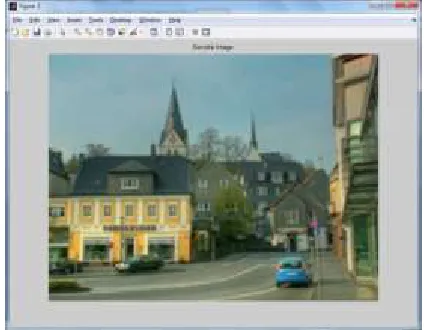
Figure 5.1: Original image
A n aly s is
The original is also termed as target image which performs an important role in generating secure mosaic fragmented image to provide robust secure
image transmission approach
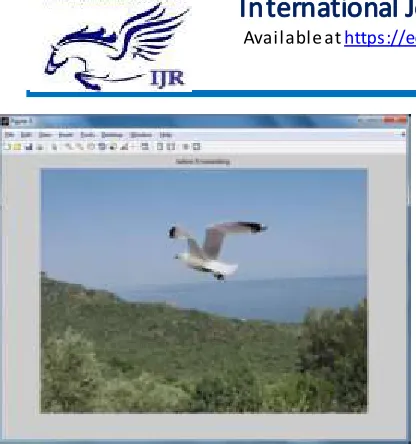
Figure 5.2: Secret image
A n aly s is
The selection of the various tile images of the preselected secret image and fitting the selected tile images of the target images into the already
Available online:
https://edupediapublications.org/journals/index.php/IJR/
P a g e | 524Figure 5.3: Before embedding mosaic image
A n aly s is
The before embedding mosaic image is an image where the confidential data is not embedded it is the
step where the fitting of block and tile happened.
Figure 5.4: After embedding mosaic image
A n aly s is
The after embedding mosaic image is an image where the confidential data is embedded it is the step
where the fitting of block and tile has completed
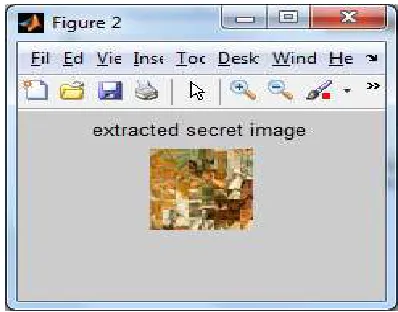
Figure 5.5: Extracted image
A n aly s is
The extraction of the data is done in lossless manner by successfully from the secret fragmented mosaic
image
6. CONCLUSION
The secure image transmission is used to develop the security norms while transmitting the data related confidential filed using internet as source of medium. The proposed secret fragment image algorithm has recorded better advantages over the traditional approaches to protect the secrecy of data while transmission. Although wide research have been made in the past years over data hiding in digital content but still secure image transmission is still concerned as concerned area in the field of digital image processing, as reported in the literature the drawbacks such as low embedding capacity, scope for incidental/ accidental attacks etc. In our proposed method a analytical approach is presented where instead of one secret image one can embed multiple secret images in digital video and the experimental results shows the good performance and better
Available online:
https://edupediapublications.org/journals/index.php/IJR/
P a g e | 525EXTENSION
The proposed method has been written on the digital images, in this work images are used as media to hide the secret image by using the an approach where mosaic image generation has done by parting the secret image into fragments and transforming their respective color characteristics into corresponding blocks of the target image. Usage of the Pixel color transformations helps to yield the lossless recovered image based on the untransformed color space values. So in extension work we did the same algorithm on the digital videos. The approach towards videos are totally different from the images, so algorithm on videos is the contribution to the
proposed work.
Figure 5.6: After retrieving an image from a video.
Figure 5.7: Extracted image from a video.
REFERENCES
[1] E. Reinhard, M. Ashikhmin, B. Gooch, and P.Shirley, “Color transfer between images,” IEEE Comput. Graph. Appl., vol. 21, no. 5, pp. 34–41, Sep.–Oct. 2001.
[2] D. Coltuc and J.-M. Chassery, “Very fast watermarking by reversible contrast mapping,” IEEE Signal Process. Lett., vol. 14, no. 4, pp. 255–258, Apr. 2007.
[3] C. K. Chan and L. M. Cheng, “Hiding data in images by simple LSB substitution,” Pattern Recognit.., vol. 37, pp. 469–474, Mar. 2004.
[4] Z. Ni, Y. Q. Shi, N. Ansari, and W. Su, “Reversible data hiding,” IEEE Trans. Circuits Syst.
Video Technol., vol. 16, no. 3, pp. 354–362, Mar. 2006.
[5] J. Fridrich, “Symmetric ciphers based on two-dimensional chaotic maps,” Int. J. Bifurcat. Chaos, vol. 8, no. 6, pp. 1259–1284, 1998.
[6] G. Chen,Y. Mao, and C. K. Chui, “A symmetric image encryption scheme based on 3D chaotic cat maps,” Chaos Solit. Fract., vol. 21, no. 3, pp. 749– 761, 2004.
Available online:
https://edupediapublications.org/journals/index.php/IJR/
P a g e | 526precision representation,” Chaos Solit. Fract., vol. 32, no. 4, pp. 1518–1529, 2007.
[9] S. Behnia, A. Akhshani, H. Mahmodi, and A. Akhavan, “A novel algorithm for image encryption based on mixture of chaotic maps,” Chaos Solit. Fract., vol. 35, no. 2, pp. 408–419, 2008.