ISSN 2286-4822 www.euacademic.org
Impact Factor: 3.4546 (UIF) DRJI Value: 5.9 (B+)
Evaluating the Impacts of IT Usage on
Organizational Performance
DR. REVENIO C. JALAGAT, JR.
Assistant Professor Al-Zahra College for Women, Sultanate of Oman
NASRA AMUR SAID AL-HABSI
Head, Student Services Section A’Sharqiyah University, Sultanate of Oman
Abstract:
The present study is conducted to primarily determine the relationship between IT usage and organizational performance as applied to the chosen organization, International College of Engineering and Management (ICEM). Specifically, it also investigates which of the IT use variables significantly correlates to organizational performance as well as assessing the impacts or influence of IT use on the college performance according to identified variables. In order to achieve the research objective, in the present study descriptive research design employing the questionnaire survey method. Random sampling method has been used to select 60 participants. According to the samples identified, 60 sets of questionnaires were distributed with the consent of the Dean and the Human Resource Department of the college and all the questionnaires were retrieved after two weeks. To analyze the data, statistical tools were used such as frequencies and tables, weighted mean and standard deviation, correlation, T-Test and regression analysis.
targets achievement, financial performance, accountability, quality service and operational efficiency as evidenced by weighted mean ratings and standard deviation. However; using the correlation and regression analysis; findings showed that there is positive relationship between these two variables: IT use and organizational performance r= 0.637 tested with 0.01 level of significance and with regression analysis, it revealed that, with the IT use variables namely internet applications, mobiles and devices, and data management system vis a vis organizational performance, only the data management system significantly correlates to organizational performance with p-value = 0.000 while the other two variables do not have significant relationship on organizational performance. Furthermore T-test results indicated that there is no significant difference between both respondents’ designation and gender on the extent of usage of IT devices/system in the College. Based on the findings, the college should emphasize on data management system considering that the regression results proves that data management system significantly impacts organizational performance. However, it is also recommended that this study shall be subjected to further studies due to its limitations of scope and other constraints as specified.
Key words: IT Usage, Data Management System, Mobiles and Devices, Internet Applications, Organizational Performance.
1.1. INTRODUCTION
The evolution of technological advances had been noticed since the 20th century when the use of information technology
experienced worldwide recognition. Even many people realized its dynamic development in the mid-18th century which was
where the utilization of computers and communications are widely available, mobile phones, internet, satellite networks, and others that provide the latest trends in communication that are applicable in processing, storing and distributing wide array of reliable information (UNDP, 2001). Moreover, in terms of connectivity worldwide the existence of latest technologies such as optical fiber technology, radio and satellites, microchips have played a big role in electronically connecting thousands and millions of people across the globe through wireless communication. According to Evans and Wurster (1997), the unstoppable changes that happen in the business environment is the important consideration for information technology to take place.
operations. He further stated that even though IT and technologies has to evolve over period of time, its importance should be recognized in the early stages of operation considering that firms who would want to have organized, fast and timely decisions can be addressed with IT in operational aspects of the organization’s existence.
1.1. Research Problem
Attaining organizational performance has always been the focal point of company’s operations and is always significant discussions in management literatures that usually comprise topics related to competitiveness, effectiveness, efficiency, efficacy, financial stability and financial relevance. According to Marmouse (1997), organizations build or developed its objectives primarily to achieve the best organizational performance and direct its operational processes to meet these organizational objectives. Business environmental changes contributes major influences in the way companies manage their workplaces with regards to challenges brought by rapid changes in utilization of internet, globalization, workforce diversity, as well as changing work and family roles, and the operational processes of the service sector.
since 2000 until recently its applicability includes virtual learning environment and many activities thereby recognizing the importance of electronic human resource management as evidenced in the increasing use by companies on a daily basis (Pourmirza, 2006). The application of IT into human resource management can be justified into three main reasons: IT helps organizations to achieve fast, and formalized operational processes; ability of IT to manage complex problems and situations on topics related to human resource management; and the potential capability to evaluate and assess the needs of human resource management and the actual application of such human resource practices.
Pourmirza (2006) who proved that IT use significantly correlates to organizational performance.
In relation to the above-mentioned discussions and findings, related study will be conducted to the chosen organization, the International College of Engineering and Management situated in the capital city of Muscat, Sultanate of Oman. The subject is one of the colleges operating in the Sultanate duly supervised by Ministry of Higher Education. As an educational institution, the utilization of IT has been introduced in classrooms and in the operational aspect of the college. However; the employees were still adamant whether the IT has already been fully utilized or not which will in turn a question that needed to be addressed institution-wide. This is observed as the employees perceived that the IT is still underutilized and the areas needed to be taken due consideration for instance in the registration processes, procurement processes, human resource management, classroom instructions and others. Questions as to whether the college has adopted an IT system that truly reflects the efficiency of its services to their clientele. So, this research is endeavored to assess the impact on the use of IT on the organization’s performance.
1.2. Research Questions
1.2.1. What is the profile of the respondents and their use of information technology?
1.2.2. What is the level of information technology usage at International College of Engineering and Management (ICEM)? 1.2.3. Is there relationship between information technology (IT) usage and the organizational performance at ICEM
1.2.5. Is there significant difference in the extent of usage of IT systems and devices in the College when classified according to respondents’ designation?
1.3. Objectives of the Study
This study attempted to determine the role of information technology on organization performance. The specific objective of this study:
1.3.1. To know the profile of the respondents and their use of information technology.
1.3.2. To determine the level of information technology usage at International College of Engineering and Management (ICEM). 1.3.3. To examine the relationship between information technology usage and the organizational performance at ICEM. 1.3.4. To investigate whether there is significant difference between respondents’ designation and gender to the extent of usage of IT devices/systems in the College.
1.4. Research Hypotheses
Ho1. There is no significant relationship between information technology usage and the organizational performance at ICEM. Ho2. The information technology variables namely: Internet Applications, Mobiles and Devices, and Data Management System do not significantly relate with Organizational Performance
Ho3. There is no significant difference in the extent of usage of IT systems/devices in the College when classified according to gender.
Ho4. There is no significant difference in the extent of usage of IT systems/devices in the College when classified according to respondents’ designation.
1.5. Significance of the Study
as appropriate to improve organizational performance especially in the operational aspects of the organization and achieve effective and efficient conduct of its operations. It can also revitalize and improve its utilization of human resource management practices in an electronically-based operation that would probably boost employee performance thus, organizational performance.
Secondly, the outcome of this study is essential for organizations and businesses to tap and evaluate opportunities for improvement as well as exploit the potentials for optimum utilization of database management system, tools and other resources and better manage the scarce resources by implementing an effective management controls which in turn minimize costs and gain higher returns.
Thirdly, the results of this study will provide benefits the human resource department and teams in developing and change its present system that will integrate in full capacity the IT in evaluating and appraising its human resource and build a viable policy incorporating the importance of integrating the IT that will help organizations achieve productivity, improved operational processes and an efficient operation. Lastly, many researchers around the world may gain benefits on the findings of the study by increasing its knowledge and learning experiences through utilizing this study as input to their studies and a ready references for relating it to their plan or already started projects where this result would be best used as reference. Hence, studies that provide a clear guidelines on determining the relationship between the IT use and organizational performance, this result would give a clear evidence on establishing its relationship in the light of this research.
1.6. Scope of the Study
account on the use of IT in the college in terms of: data management system, performance & target achievement, accountability, and quality of service/service delivery as its measures on organizational performance
2. REVIEW OF RELATED LITERATURES
2.1: Introduction
Various authors and researchers have identified the importance of information technology, the use of this technology and its relevance to organizations and its relationship on organizational performance. This section provides literatures that will describe the variables that will be used in the study and the development of theoretical framework evidencing the flow of the research process.
2.2. Information Technology
Generally, technology refers to a set of methods, processes, tools and techniques, machinery, equipment and skills that can be offered to people through its products and services (Rezaiyan & Taghi zadeh, 2007). Accordingly, data is a set of digital elements in form of letter or symbol that are clear and specific and can be subject to automatic processing (Shamszadeh, 2009). There are also various definitions that defines information technology.
compensation that relates to this shortage (Mehri Nejad, 2002). Several forces enable the development of IT which can comprise of the microprocessor technology computers, communicative network development and the fast development of internet to name some of them (Montazer & Fathian, 2004).
According to Daft (1997), information technology refers to anything that relates to computing technology which encompasses the following: hardware, software, networking, the internet and the people who have the think tank in implementing and managing these technologies. Accordingly, it can be described as a system that emphasizes the utilization of
software, hardware, database management,
telecommunications and information-processing technologies that will be used to store, process and deliver the information through communication (Hacker & Saxton, 2007). Interestingly, IT has been usually utilized by managers and IT specialists to manage their business operations directly controlling its activities, the human resources and other related activities. Overseeing the general operations as being the major responsibility of managers, IT has been very important and useful for managers in allocating its needed resources in coordination with the various departments of the organization to achieve success and completion of various projects. According to Hobday (2000) information technology serve as a central key for innovation and creativity. Peansupap and Walker (2005) stressed that the use of IT is increasingly applied to organizations because these organizations believed that IT facilitates in greater extent effective communication, increase productivity, improve integration and deliver quality products and services (Bjork, 1999).
nowadays maximize the use of IT as an appropriate solution to the growing business challenges and problems in order to come up with improved productivity, product and service quality delivery, enhanced decision making processes and competitiveness to the marketplace including new markets and an attempt to globalize its operation in a global business environment. The linkage between optimum utilization of IT and organizational mission should be taken due consideration by managers and leaders by appreciating the importance and capabilities brought by IT (Hacker & Saxton, 2007).
telephone, email, satellite, blogs, internetworking projects, and others.
processes. Adapting with the business environmental changes is a major issue that management and managers should act upon to make sure that the organization’s survival is assured as well as the growth and development in relation to the adaption of those changes (Parsaei-Manesh, 2014). According to Jalagat (2017), change comes from different dimensions and encompasses a great significance to individuals, groups, organizations, companies and others. Information technology also contributes to the management’s ability to foster effective communication and interactions to solicit timely and immediate feedback that goes through with the organizational structure of companies where this structure is vital to the organization’s communication processes. It also causes speedy delivery of information from the top management down to the lowest level of the organizational structure hierarchy as well as impose virtual networks and processes and works that require enhanced technologies such as the development, distribution and management of knowledge in a cutting-age era or real-time data or information.
2.3. IT and Organizations.
assess themselves on how effective is the utilization of IT particularly in the administration of the institution or the college and the ability of the faculty and staff in deploying and using such technology. According to Nitterhouse (1999) the utilization of IT has been at slow pace especially in the Non-Governmental Organizations (NGO) compared to other business counterparts because of the nature of transactions that emanate from the grassroots level and those beneficiaries are coming remote places where the existence of technology is also less accessible. These hinder the development of the IT utilization which according to Hacker and Saxton (2007) as a secondary priority because more emphasis is on the achievement of organizations mission and goals and its planned activities that can be done in traditional way.
Historically, organizations, specifically Non-Governmental Organizations have been behind their corporate counterparts in adopting IT and have been relatively slow to take advantage of emerging information technology developments Nitterhouse (1999). Most of the NGOs adopt the traditional (manual) methods by using computers for word processing, spreadsheet and accounting applications, and managing a patchwork of old and new elements that often do not work well together. NGOs, unlike their corporate counterparts, face some constraints that inhibit them from adopting IT. These inhibiters include lack of budget to invest in the latest and greatest systems and IT tools, lack of sustainable capital for IT investment, an inability to pay competitive salaries to technical personnel, and inability to build the needed technical skills. Hence, the perceived lack of focus and considerations relative to IT developments have contributed some constraints in business developments and success especially in coming up with time and well-informed economic decisions.
produce benefits and challenges but many studies have found out that the benefits supersedes the disadvantages in the IT use and have proven to address the issues and problems relative to fast and reliable services that saves time and resources, general efficiency, flexible and product and service quality improvements (Brynjolfsson & Hitt, 2006; Henz, 2002). But realizing this may not be possible if the resistance level of the employees are high and that the management’s perception of new technology in IT utilization is confronted with financial difficulties, human resources such as specialist and experts who implement and monitor the extent of application of IT, lack of knowledge and information from the agents and implementers, and less support from the top management.
2.4. IT and Business Processes
Furthermore, the use of technologies currently have provided a wide range of processes and functions that are readily available in firms and the marketplace that includes but not limited to communication with counterparts and clients, business processes and functions, monitoring with external environments and its forces, and interacting with authorities primarily regulatory and government agencies. Example, the widespread application of the e-Commerce has allowed many firms to integrate IT utilization and management with their strategic plans and programs and commitment to provide easy, cost-effective and well-placed solutions to problems in a modernize means which can be called technological solutions like the use websites (Bocij, 2003). It is also evident with the evolution of the mobile and e-commerce technologies that rapidly convert many individuals, industries and organizations into a more informed entities where information is just within rich which also the main considerations for strategic planning and management (Evans & Wurster, 2007).
2.5. The Role and Use of IT in Organizations
valuable information for decision makings between departments as well as from top to bottom management where dissemination of information takes place. Because of this, it will establish good linkage between the organization and its employees, clientele and partners that potentially eliminates the hindrances to an effective sharing of information and in achieving real-time information (Scott, 2001).
According to Diem (2007), IT utilization in an effective way can result to new discoveries of information and enhance creative thinking of new ideas and concepts that will result into meaningful innovative business idea. Hence, the use of IT can transform business leading to an improved operational outcomes and performance, promote company and employee competitiveness, improved brand image and market visibility, enable organizations into an effective communication and sharing of information, increase employee motivation, market and business repositioning to gain advantage over existing and potential competitors (Hagen, 2010).
2.6. Organization Performance
deciding factors for companies to pursue and considering the lack of experts who will manage the investments which precisely the reason why many firms fail as they fail to link IT to business opportunities and profitable endeavors using the IT-based investment.
Several authors and researchers have examined the impacts and or influence of IT use on organization’s performance whether products or service and found out the positive relationship with these two main variables (Beckey, Elliot, & Procket, 1996; McNutt, & Boland, 1999). Accordingly, results also affirmed the relationship by offering recommendations that IT has indeed plays a significant role in the improvement of providing both the quality and quantity of relevant information for decision makings for managers and businesses as well as a baseline for product and service innovations (Mano, 2009). Many companies set aside their budget and resources in accordance with their goals and objectives by maximizing the use of their resources on investing into IT and have been proven through this research to perform better in their workplaces than those that set less investment on IT (McAfee & Brynjolfsson, 2008). In other words, achieving higher performance requires considerable and good IT infrastructure with good management practices in IT utilization (Mwania & Muganda, 2012).
2.7. IT and Organizational Performance
organizational system components (Blili & Raymond, 1993). But even it was utilized the extent of utilization is still subject to improvement and utilization as the application of IT is still used in simple tasks and primary activities that its use is still not reflective in addressing strategic issues and are totally lacking such as applications related to enhancing the organization’s position against competitors, moving into new markets, and providing managers with better information for effective decision making. In other words, it is more applied on basic operations and that is perceived lack in utilizing the full potentials on the IT. According to Bird & Lehrman (1993), the use of technology nowadays especially the IT does not only encompasses a data processing tool but has become a competitive weapon that will be able to transform the structure of industries and as such the rapid technological revolution on the IT or ICT has made the business environment to be competitive that many companies have determined and reassess their own IT application to be consistently aligned with their strategic objectives (Galliers, 1994).
growth in OECD (Organization for Economic Co-operation and Development) countries; they found that the impact of ICT-producer sectors is most significant in Finland, Ireland, and Korea whereas ICT-consumer sectors in some countries, remarkably US and Australia, had an impressive growth in the second half of the 1990s. To validate these findings, analysis was made by Hempell (2004) based on comparable panel of Dutch and German firms particularly in the service sector and the outcome showed that, ICT or IT utilization applied on capital deepening and innovation showed that there is positive impact between It and productivity.
More findings displayed the importance of IT on businesses processes like the use of IT in The Massachusetts Institute of Technology group in 1991 where their study concluded that IT can enhance and coordinate with the many factors of the organization that contributes to the success of the business through fully utilizing the automation of information and electronically transfer those information thereby realizing the benefits it offers to the employees, the management and the organization in general (Morton, 1991; Zuboff, 1988). Many considered IT as an innovative mechanism to enable to finish the job in a creative manner however; although its potentials are huge enough but the extent of application of those benefits vary on how the companies utilize it as to whether fully, half and little utilization such that still it is subject to many researches and discussions by authors, researchers, scholars, IT experts on how it can be best managed and addressed innovation at different levels of the organization which can be done by IT.
level of the various functions concerning the administration and management functions in companies to achieve effectiveness in both managerial and administrative functions. The meeting of the task efficiently and effectively is what takes in adequately applying technology in various organizational activities that can give good and relevant data or information managers for a well-informed decision makings. According to Zuboff (1988), the effective use of IT can create and maintain consistent competitive advantage and competitive edge of organizations over their competitors because it enhance better production and operation processes into variety of industries and are useful in meeting sustainable business landscape.
According to Mitchell & Stone (1992), direct physical measures of outputs and inputs provide an alternative metric that permit process-specific comparisons of manufacturing performance associated with alternative technological choices and organizational designs. Other techniques to measure productivity are the time-based measures for key production operations. They are commonly used by industrial engineers and production managers to plan schedules, to estimate costs, and to monitor machine utilization rates in batch manufacturing processes such as machining (Kelley, 1994). According to Panko (1991), one measure of office productivity is "output per hour". This measure can be calculated by dividing units of output by the number of hours worked to produce them.
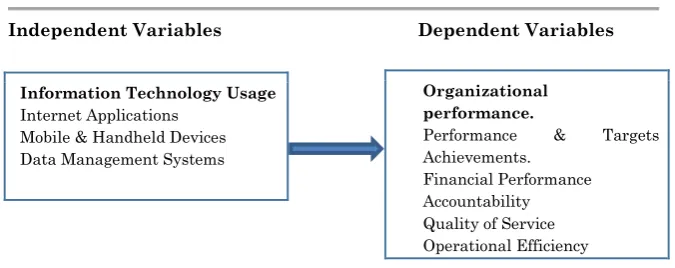
2.9. Conceptual Framework
Independent Variables Dependent Variables
Figure 1. Modified from the work of Kimani (2015). Impact of Information Technology on Organizational Performance: Case of Population Services in Kenya.
3. RESEARCH METHODOLOGY
3.1 Research Design
In this study, the descriptive method of research employing the questionnaire survey as its main data gathering tool has been utilized. The purpose of using descriptive research is to describe the characteristics of variables selected in the study. According to Marsman (1999, p.66), “descriptive design is a purposive process of gathering, analyzing and tabulating data about prevailing conditions, practices, beliefs, processes, trends and cause and effect relationship and then making adequate and accurate interpretation about such data with the aid of some simple percentile and statistical method”. To apply this design in the present study, a cross-sectional study was conducted to describe the population in terms of data and characteristics where the quantitative research approach can be best applied.
3.2 Sample Design
3.2.1. Population
The population targeted for the study comprised of the academic and non-academic staff in ICEM; at the time of the study there were a total of 119 permanent employees.
Information Technology Usage
Internet Applications Mobile & Handheld Devices Data Management Systems
Organizational performance.
Performance & Targets Achievements.
3.2.2. Sample Size
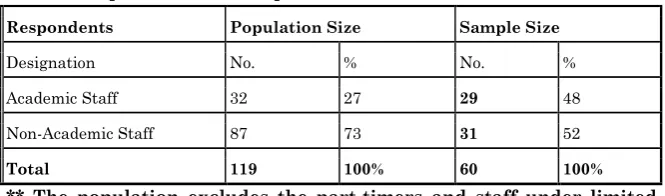
From the total population, the sample was selected using simple random sampling method and was shown in the table 1.
Table 1. Population and Sample Size
Respondents Population Size Sample Size
Designation No. % No. %
Academic Staff 32 27 99 48
Non-Academic Staff 87 73 13 52
Total 119 100% 60 100%
** The population excludes the part-timers and staff under limited contracts.
3.3 Data Collection
In this study, the research questionnaire was developed by the researcher and sent to the adviser for comment and approval before finally sending the questionnaires to the respondents. Upon advice, the letter of consent was sent to the administration of ICEM directed to the Dean of the College to seek permission to distribute the questionnaires related to my research and after approval, appointment was set with the respondents for distributing the questionnaires. The 60 questionnaires were distributed one day after the approval and was retrieved two weeks after. All the questionnaires were retrieved with 100% retrieval ratio.
3.4. The Research Instrument
describes the “Use and Impact of Information Technology” that includes in details the questions on the use of IT, the IT equipment utilize in the college, the extent of usage of IT, IT usage in data management system, performance and targets achievement, financial performance, accountability, quality of service and operational efficiency.
Specifically, to assess the extent of usage of IT in the college the use of Likert scale were utilized will be shown in table 2.
Table 2. Likert Scale to measure the extent of IT use in the college
Value Limits Verbal Interpretation
5 4.21 - 5.00 Very Large Extent
4 3.41 - 4.20 Large Extent
3 2.61 - 3.40 Neutral
2 1.81 - 2.60 Little Extent
1 1.00 - 1.80 Very Little Extent
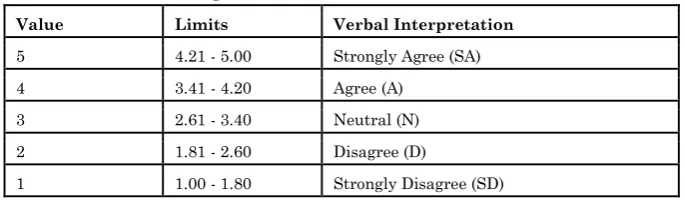
On the other hand, to evaluate the extent on the level of agreement on the use of IT in the college, another Likert scale instrument was used which will be displayed in Table 3.
Table 3. Likert Scale to evaluate the extent on the level of agreement on IT use in the college.
Value Limits Verbal Interpretation
5 4.21 - 5.00 Strongly Agree (SA)
4 3.41 - 4.20 Agree (A)
3 2.61 - 3.40 Neutral (N)
2 1.81 - 2.60 Disagree (D)
1 1.00 - 1.80 Strongly Disagree (SD)
3.5. Data Analysis
Based on the questionnaires, the data has been analyzed and tabulated. Main objective of this research is to determine the relationship between the IT _usage and organizational performance. The data obtained from the questionnaires has been imported to the computer program called the statistical package for social sciences (SPSS) version 21 to calculate frequencies and averages, standard deviation, weighted mean, Independent Sample t-test, Pearson correlation, and regression analysis. Specifically, frequencies and distribution were utilized to analyze the profile and personal information of the respondents while weighted mean and standard deviation were used to analyze part B which is the assess the extent of information technology usage. Independent Sample T-Test was used to test the significant difference respondents’ designation and gender to the extent of usage of IT devices/systems in the College. However; to determine the relationship between IT usage and organizational performance, Pearson Correlation was used while regression analysis was used to find the individual predictors of organizational performance. The statistics used is tested at 0.05 and 0.01 level of significance.
3.6. Research Validity and Reliability
4. DATA ANALYSIS AND INTERPRETATION
This section presents the results obtained from the statistical tests used to analyze the data.
4.1. Designation of the Respondents
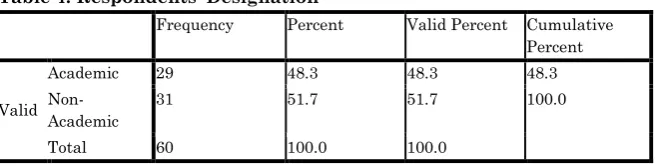
Table 4. Respondents’ Designation
Frequency Percent Valid Percent Cumulative Percent
Valid
Academic 29 48.3 48.3 48.3
Non-Academic
31 51.7 51.7 100.0
Total 60 100.0 100.0
Table 4 shows the frequencies distribution of the respondents according to the designation. The figure shows that non-academic staff accounts for 31 or 51.7% of the total sample while academic staffs corresponds to 29 or 48.3%. This result may not be the same if the total population of the college is taken as sample however; it is safe to assume that the distribution of the respondents according to designation is almost equal.
4.2. Highest Level of Qualification of the Respondents
Table 5. Respondents’ Level of Qualification
Frequency Percent Valid Percent Cumulative Percent
Valid
Secondary 8 13.3 13.3 13.3
Certificate/Diploma 10 16.7 16.7 30.0
Bachelor 13 21.7 21.7 51.7
Masters 25 41.7 41.7 93.3
Doctorate 4 6.7 6.7 100.0
Total 60 100.0 100.0
respondents have acquired master’s degree with numerical number of 25 or 41.7% while those who have acquired bachelors reach to 13 or 21.7%. About 10 out of the 60 respondents have finished certificate/diploma or 16.7% and those secondary level educated with 13.3%. But last in the list is the sample of those staff who have finished the Doctorate degree only 6.7% or equivalent to 4 staffs.
4.3. Years of Service of the Respondents
Table 6. Respondents’ service in years.
Frequency Percent Valid Percent Cumulative Percent
Valid
Less than 5 years 18 30.0 30.0 30.0
5-10 years 21 35.0 35.0 65.0
11-15 years 21 35.0 35.0 100.0
Total 60 100.0 100.0
Table 6 shows the number of years in service of the respondents and findings revealed that most of the respondents are between 5-10 years and 11-15 years respectively with a combined ratio of 70% or equivalent to 70 respondents distributed equally while 18 out of the 60 respondents are below 5 years of experience. However, none of the respondents have experience of 16-20 and more than 20 years respectively.
4.4. Gender of the Respondents
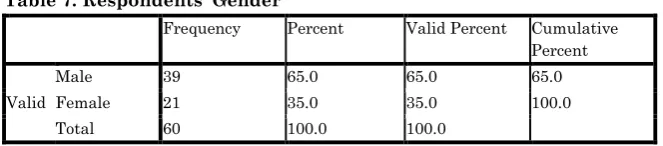
Table 7. Respondents’ Gender
Frequency Percent Valid Percent Cumulative Percent
Valid
Male 39 65.0 65.0 65.0
Female 21 35.0 35.0 100.0
Total 60 100.0 100.0
respondents. While the female staff accounted to only 35% or 21 out of 60 respondents. Considering that the college is also predominantly a male student population, the teachers who are involved in the workforce are mostly male and the courses offered are specialized in engineering and management where many of the teaching staffs are also male based on the nature of the course as well as the job which is fire safety.
4.5. Age of the Respondents
Table 8. Respondents’ Age.
Frequency Percent Valid Percent Cumulative Percent
Valid
Below 20 years
10 16.7 16.7 16.7
21-30 years 16 26.7 26.7 43.3
31-40 years 18 30.0 30.0 73.3
41-50 years 9 15.0 15.0 88.3
Above 50 years
7 11.7 11.7 100.0
Total 60 100.0 100.0
4.6. What IT device/s do you have at your disposal to enable you to perform your duty?
Table 9. IT devices used in the workplace.
Frequency Percent Valid Percent Cumulative Percent
Valid
Mobile Phone 8 13.3 13.3 13.3
Desktop Computer 46 76.7 76.7 90.0
Laptop 4 6.7 6.7 96.7
IPad or Tablet 2 3.3 3.3 100.0
Total 60 100.0 100.0
With reference to Table 9 showing the usability of the IT devices in the college, it can be gleaned that most of the respondents with 46 out of 60 respondents have utilized the desktop computers in their offices or 76.7%. This might imply that, the college is still keen on using desktop which is still conventional way of using the technology. A percentage of 13.3% of the total respondents or 8 out 60 respondents who makes use of mobile phone as devices in the workplace. On the other hand, very few of the staffs have utilized laptops in their offices with only 6.7% or 4 out of 60 respondents and it may also indicate that, these respondents upon their option may bring with them personal laptops as an alternative choices for processing information or data. Lastly, the use of Ipad/Tablet is seldom used in the college and besides no other tools than those previously mentioned had been specifically identified.
4.7. Kindly indicate the extent of usage of the following systems/devices in the College.
Table 10. Extent on the use of IT systems/devices in the College
Systems/Devices Weighted Mean Interpretation
Mobile devices and tablets 3.52 Large Extent
Laptops and Desktops 3.85 Large Extent
The Intranet 3.32 Neutral
Table 10 displays the extent of usage of IT systems and devices in the college. Results revealed that large extent of usage which is the highest can be observed with the laptops and desktops with mean rating of 3.85 and followed by also large extent shown with the use of mobile devices and tablets with 3.52 weighted mean rating. These results are consistent with Table 9 where desktops are most commonly used in the College. All other responses are neutral which might indicate that these systems are still not clear to the respondents and the management may have not utilized these tools at its full extent.
1=SD (1.00-1.80); 2=D (1.81-2.60); 3=N (2.61-3.40); 4=A (3.41-4.20); SA (4.21-5.00)
HR System 2.93 Neutral
Accounting Software and Programs 3.00 Neutral
Office 365 (email/OneDrive/Yammer, etc. 3.07 Neutral
Total 3.23 Neutral
Table 33. Respondents’ Perception on the Usage of IT Data Management System in ICEM.
N Mean Std. Deviation 1. The College use of IT data management system has
improved their services towards stakeholders.
60 3.88 .555 2. The College use of IT data management system
facilitates fast collection of data and information.
60 3.98 .676 3. Using IT data management system helps the
management achieve timely and accurate decisions from top management down to department level.
60 4.00 .759
4. Using IT data management system enable managers and heads to decide quickly and assured of reliable information.
60 4.08 .696
5. The use of IT data management system enhances better knowledge and understanding on how the organization operates and arrives at right decisions.
60 3.98 .701
6. The use of IT data management system helps improve the operational efficiency of the administrative and teaching staffs in the College.
60 4.10 .656
7. Using IT data management system has aided the management in updating its records and organizing large volume of files.
60 4.12 .691
Table 11 shows the perception on the use of IT data management system in ICEM. Specifically, it shows that IT data management system has helped the management in updating its records and organizing large volume of data files as evidenced by mean rating of 4.12. Secondly, IT data management system has aided the administrative and teaching staffs to improve its efficiency in the conduct of its operations with 4.10 mean rating which may indicate that IT should be fully utilized in order to maximize individual and organizational efficiency in the work. The more emphasis on data management system will show favorable results. IT has also enable managers and heads to access reliable information quickly with mean rating of 4.08 which further indicates that with IT data management system well-informed decisions will timely be achieved which further improves the decision-making processes of the college. The use of IT proves to be useful to the management in meeting its requirements on timely dissemination of information to different stakeholders.
operates with better chances of arriving at right decisions and easy to track with if there are deficiencies and troubles while in operation. Lastly, the IT data management system has contributed to the delivery of effective services towards stakeholders such as students, suppliers, government offices, management, etc. as shown with each mean rating of 3.88.
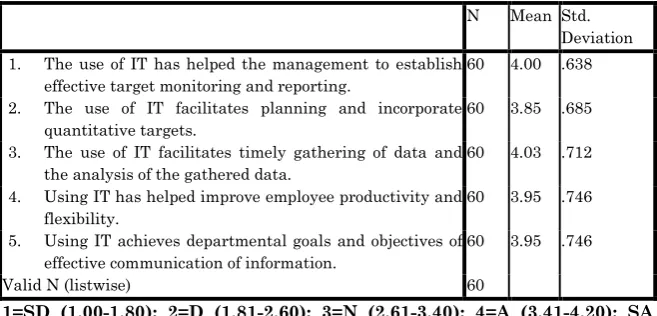
Table 12. Extent of agreement of IT usage on performance & targets achievement in ICEM.
N Mean Std. Deviation 1. The use of IT has helped the management to establish
effective target monitoring and reporting.
60 4.00 .638 2. The use of IT facilitates planning and incorporate
quantitative targets.
60 3.85 .685 3. The use of IT facilitates timely gathering of data and
the analysis of the gathered data.
60 4.03 .712 4. Using IT has helped improve employee productivity and
flexibility.
60 3.95 .746 5. Using IT achieves departmental goals and objectives of
effective communication of information.
60 3.95 .746
Valid N (listwise) 60
1=SD (1.00-1.80); 2=D (1.81-2.60); 3=N (2.61-3.40); 4=A (3.41-4.20); SA (4.21-5.00)
management to be organized with the work as well as monitor the reports from time to time which many may have forgotten to recall and take necessary actions. Responses also shows that, IT has both aided the management in improving the employee and company productivity, flexibility and helped achieves departmental goals and objectives to effectively communicate information respectively with each shared 3.95 mean rating. This might indicates that employees become more productive with the IT use in terms of efficiency and effectiveness in completing their work tasks with ease, quality and reliability since the technology has enabled them to perform corrective measures with the work done through for example application of systems and programs and which in turn improve company productivity.
Table 13.Extent of agreement of IT usage on financial performance in ICEM.
N Mean Std. Deviation 1. Utilizing IT will reduce expenditures such as salary
cost of hiring more employees.
60 3.82 .596 2. The use of IT helped the management developed
profiles of prospective clients and measure sales, profitability as well as customer retention.
60 3.88 .640
3. Investing in IT will improve the business processes and innovative features of service offerings of the College.
60 3.98 .624 4. The use of IT allow access to as many potential
students as possible for more income opportunities.
60 3.93 .710 5. Utilizing IT will increase sales and profitability by
delivering excellent service to clientele.
60 4.05 .534
Valid N (listwise) 60
1=SD (1.00-1.80); 2=D (1.81-2.60); 3=N (2.61-3.40); 4=A (3.41-4.20); SA (4.21-5.00)
the range of 3.41-4.20 indicating “Agree” ratings which is also consistent with the individual ratings. Top among the list expresses that IT use increases sales and profitability through provision of excellent service to the clientele with 4.05 mean ratings which can be interpreted that when the management will be able to utilize IT effectively and efficiently will result to service quality and excellence in both its operations and in the teaching field that will in turn increase its sales with more expected student registrations and increase its profits as well. This result is consistent with the study of Harris and Katz (1991) and Bender (1986) whose findings showed that IT use positively correlates the several performance measures and ratios even though its relationship is considered weak. This is followed by the finding that, investing in IT will improve the business processes and innovative features of service offerings of the College having 3.98 weighted mean rating. Thirdly, responses show that IT can help the management provide access to as many potential students as possible for more income opportunities accounting for 3.93 mean rating which can be interpreted that the college may need to upgrade its present system to encourage more potential students and can accommodate more with the IT use through its database management system.
Table 14.Extent of agreement of IT usage on accountability in ICEM. N Mean Std.
Deviation 1. The use of IT helped the management in evaluating
the budget versus actual on income and expenditures.
60 4.02 .701 2. The use of IT has aided the management to better
serve the students and other outside parties.
60 4.07 .634 3. The use of IT enables the management to develop
formal communication and procedures to be followed by employees.
60 4.02 .701
4. Using IT data management system has established a permanent file of systems and procedures to remind the employees of their responsibilities and accountabilities.
60 4.03 .758
Valid N (listwise) 60
1=SD (1.00-1.80); 2=D (1.81-2.60); 3=N (2.61-3.40); 4=A (3.41-4.20); SA (4.21-5.00)
budgets as evidenced with the 4.05 mean rating which can be interpreted as a good indication of the use of IT in the college.
Thirdly, IT has in fact helped the college in providing better service in the college by actively responding to student complaints and queries and settle it with agreement with not only the students but the other stakeholders. Because of IT utilization, the service provided by the college and its management exceeded its expectations resulting to satisfaction to the stakeholders and most especially the students. Finally, both responses based on the questions provided the same results with both resulting 4.07 respectively recognizing that, IT has aided the management to better serve the students and other outside parties and has established a permanent file of systems and procedures to remind the employees of their responsibilities and accountabilities.
Table 15.Extent of agreement of IT usage on quality service in ICEM. N Mean Std.
Deviation 1. Using IT improves the quality of service delivery to
students and other beneficiaries.
60 3.98 .596 2. Using IT has aided the management to communicate
effectively to its beneficiaries and partners in service delivery.
60 3.97 .581
3. Using IT has facilitated the improvement of management plans and in the implementation of projects and activities in dealing with the students and other parties.
60 3.83 .642
4. Using IT in the area of social media helped the college tapped its beneficiaries and collaborate with partners.
60 3.90 .602
Valid N (listwise) 60
1=SD (1.00-1.80); 2=D (1.81-2.60); 3=N (2.61-3.40); 4=A (3.41-4.20); SA (4.21-5.00)
quality of service delivery to students and other beneficiaries with 3.98 rating and followed by responses that with 3.97, using IT has aided the management to communicate effectively to its beneficiaries and partners in service delivery. It may imply that the management of ICEM have benefited with the use of IT although not experienced sophistication on IT use and has proven that IT improves their quality provision of service to the students and other operational processes and communicate to their stakeholders with ease and less problems. Also, IT enable the management to communicate to the students, partners and counterparts and its suppliers with the use of IT through social networks which in many cases communication through WhatsApp, messenger, mobile services and others. Further, with the mean rating of 3.90, it is agreeable by the respondents that IT has helped greatly in communication the management through its stakeholders with less costs but effective ways of sharing the college information and updates. Last but not the least, IT has facilitated the improvement of management plans and in the implementation of projects and activities in dealing with the students and other parties having mean rating of 3.83 which might mean that IT has become useful in the delivery class instructions and projects whether its student works or collaborative works between the teachers and the students.
Table 16.Extent of agreement of IT usage on operational efficiency in ICEM.
N Mean Std. Deviation 1. Using IT helped the management to deliver the service
efficiently and effectively.
60 3.92 .561 2. The use of IT helped the management provide accurate
financial data.
60 3.88 .555 3. Utilizing IT has enabled the management to finish
business transactions with speed and accuracy.
60 3.95 .565 4. The management has benefited the use of IT by
effectively utilizing their IT equipment for quality service.
60 3.92 .591
1=SD (1.00-1.80); 2=D (1.81-2.60); 3=N (2.61-3.40); 4=A (3.41-4.20); SA (4.21-5.00)
Table 17.Summary of tables on the extent of agreement on IT use on organizational performance.
IT Use Variables Weighted
Mean
Verbal Interpretation
Extent of agreement on IT use on performance &
targets achievement in ICEM. 3.96 Agree
Extent of agreement on IT use on financial
performance in ICEM. 3.93 Agree
Extent of agreement on IT use on accountability in
ICEM. 4.04 Agree
Extent of agreement on IT use on quality service in ICEM.
3.92 Agree
Extent of agreement on IT use on operational efficiency
in ICEM. 3.92 Agree
1=SD (1.00-1.80); 2=D (1.81-2.60); 3=N (2.61-3.40); 4=A (3.41-4.20); SA (4.21-5.00)
In summary, the table above depicts that the extent of agreement on IT use on organizational performance and individually it shows an “agree” response which might mean that IT use influences or impacts favorably on organizational performance in different performance outcomes such as performance and target achievements; financial performance; accountability; quality service and operational efficiency. So, it is undeniable that utilizing IT plays significant role in achieving organizational performance based on the feedback from the respondents in this study and as applied to the college, ICEM.
4.8. Correlation, Regression and T-Test
as cited in the study of Jalagat (2017) suggests that, 0 means no relationship;.30 is considered weak correlation; 0.50 is moderate; and 0.70 is strong correlation. In application, the results of analysis can be drawn from the tabular presentation in Table 18.
Table 18. Correlation between IT Usage and Organizational Performance.
Extent of Use of IT in the College
Organizational Performance
Extent of Use of IT in the College
Pearson Correlation
1 .673**
Sig. (2-tailed) .000
N 60 60
Organizational Performance
Pearson Correlation
.673** 1
Sig. (2-tailed) .000
N 60 60
**. Correlation is significant at the 0.01 level (2-tailed).
evidenced by the results of statistical computation. However, considering the downhill linear correlation of coefficient, it shows that the extent of relationship is moderate which might mean that the results may not be conclusive and thus, are not perfectly correlated.
On the other hand, regression analysis was utilized in order to determine the significant relationship between IT use as expressed in three variables namely: Internet applications; mobiles and devices; and data management system vis a vis the organizational performance. The objective is to evaluate individually which of the independent variables significant relates to organizational performance although in general there is significant relationship between IT use and organizational performance from correlation analysis. The detailed presentation can be seen in Table 19 in the succeeding section as shown.
Table 19. Relationship between IT Usage: Internet Applications, Mobile Devices, Data Management System and Organizational Performance.
Model Summary
Model R R Square
Adjusted R Square
Std. Error of the Estimate
Change Statistics R Square Change
F Change
df1 df2 Sig. F Change 1 .589a .346 .311 .40019 .346 9.895 3 56 .000
a. Predictors: (Constant), Data Management System, Internet Applications, Mobile & Devices
ANOVAa
Model Sum of Squares df Mean Square F Sig.
1
Regression 4.754 3 1.585 9.895 .000b
Residual 8.969 56 .160
Total 13.723 59
a. Dependent Variable: Organizational Performance
b. Predictors: (Constant), Data Management System, Internet Applications, Mobile & Devices
Model Unstandardized Coefficients
Standardized Coefficients
t Sig.
B Std. Error Beta
1
(Constant) 1.938 .391 4.950 .000
Internet Applications .092 .072 .154 1.275 .208 Mobile & Devices .142 .071 .247 1.991 .051 Data Management
System
.301 .108 .346 2.794 .007
a. Dependent Variable: Organizational Performance
management system will enable the management to achieve good performance outcomes.
Table 20. T-Test on the extent of usage of IT Devices/Systems in the College (Gender)
Gender Overall Mean T-Test
@.05
Sig. (2-Tailed)
Decision
Male Female Extent of Use of
IT in the College
3.58 3.72 -1.116 0.269 Ho3, Accepted
*Significant at 0.05 level (2-Tailed)
Table 20 clearly showed that there is no significant difference between the respondents’ gender and the extent of usage of IT devices/systems in the College tested at 0.05 level of significance (p=.269>0.05). Therefore the null hypothesis is accepted. This further entails that the male and female respondents do not vary in their perceptions as supported by the similarity of mean ratings of 3.7176 over 3.5754 respectively.
Table 21. T-Test on the extent of usage of IT Devices/Systems in the College (Designation)
Designation Overall Mean T-Test
@.05 Sig. (2-Tailed)
Decision
Academic Non-Academic Extent of Use of IT in
the College
3.6231 3.6271 -0.029 0.977 Ho4, Accepted
**Significant at 0.05 level (2-Tailed)
5. SUMMARY OF FINDINGS, CONCLUSION & RECOMMENDATIONS
This chapter discusses the summary of findings, conclusion and recommendations. To achieve the research objective, results from the statistical analysis will be summarized as basis for conclusion and recommendations.
5.1. Summary of Findings
Summary shows that, the most of the equipment and IT devices used in the college includes desktop as it accounts for 76.7% while only 3% participants use laptop. Consistently, the results showed that the large extent of its usage is through laptops and desktops with 3.85 and followed by mobile devices and tablets with 3.52 and the rest revealed neutral responses with the intranet, CRM, HR system, accounting software and office 365. This clearly indicates that the college is still not exposed with current systems and programs that can enhanced the processes and are mostly accepted by many business nowadays.
However, assessing in details the significant predictor of organizational performance regression analysis has been used, the results revealed that only the database management system significantly correlates to organizational performance with 0.007 significance while the other variables such as internet applications and mobiles/devices have no significant relationship with p-values 0.208 and 0.051 respectively. This holds the fact that, companies should give emphasis on developing and maintaining a good database management system that is supported by the hypothesis assumed in this study. Utilizing T-Test to test the significant difference using respondents’ gender and designation variables vis a vis the extent of usage of IT devices/systems, findings revealed that both gender and designation have no significant difference on the extent of usage of IT devices/systems with p-values 0.269 and 0.977 respectively.
5.2. Conclusion
results contributes to concluding point that only the database management system significantly correlates to organizational performance. Therefore, more emphasis should be taken into consideration on the systems/applications used in database programs although there is also need to consider the internet applications and the devices in some extent as the case maybe.
5.3.Recommendations
Based on the findings and conclusion, the recommendations can be offered as basis for the college to improve their current operations and gain competitive advantage over their competitors.
1. There is a need for the college to upgrade themselves with the current technologies whether in equipment and in systems and software considering that the results revealed the less utilization of such systems and programs. To be updated and competitive, the college can perform benchmarking with top performing colleges and universities in order to copy those best practices that can be best applied in the college settings.
2. Desktops are considered obsolete nowadays as there are laptops which are handy and in terms of mobility you can work anywhere to deal with transactions and so, if there are possibilities to replace those desktops with laptops and other new devices, it would serve the purpose and provides more benefits to the workers and the entire college as well. With good internet connections and connectivity, the laptop can serve its purpose with convenience rather than maintain desktop computers.
utilization of these systems and programs provides the college with a good database management that proves to impacts positively on organizational performance.
4. Budget allocation and top management support are highly needed in order to attain its objective on revolutionizing advance technology in the college. Since this decision requires large outlay, the IT department should have a convincing and workable plans for the top management to acquire new technological devices and programs that will work for longer period and sustainable system in the long-term operations by the college. Project proposals would be necessary to serve the purpose of advancing in technology. 5. Seminars and workshops should be conducted regularly or
from time to time on the use of latest technologies and systems that will be applied to the college. To achieve IT revolution, the employees should be well-aware whatever advancement in technologies for their efficiency and applications. This also should cater not only to the non-academic staff and to non-academic staff where transfer of learning can be best shared by the teachers especially in the IT department.
6. Top priority on IT use should be done on maintaining good database management system to organize and use in long-term the data or information may it be on registration records, financial records, maintenance records and others for an easy, convenient, fast, reliable and well-informed business decisions or decision making processes of the college. This means that, keeping databases and systems will improve the current operations in the college. Database can be internally or externally sourced based on what is preferable and convenient for the college to utilize or depending on their needs.
present operational system utilized by the college. Notwithstanding, IT equipment can also be requisitioned to replace the old equipment for upgrading.
8. And, coordination with other departments would be necessary in order to upgrade the use of IT and apply college-wide the upgrades of IT utilization for better organizational performance outcomes. Among others, the college should utilize the IT to academic and non-academic related processes such as facility management systems, course timelines, sales applications and others, online registration system, and others.
5.4. Direction for Further Studies
REFERENCES
1. Ahmed, A. (1998). The impact of information technology on
organisations: The case of the Saudi private sector.
(Unpublished master's thesis).The University of St. Andrews, United Kingdom
2. Allen, T., & Morton, M., (2004). Information Technology and
the Corporation of the 1990s. New York: Oxford University
Press.
3. Attewell, P., & Rule, J. (1984). Computing and organizations: What we know and what we don't know. Communication of the ACM 27(12), 1184-1192.
4. Beckey, R., & Elliot, M.A., & Procket, J.M. (1996). Closing
the gap: Information technology and the non-profit sector.
Non-profit world, 14(1), 36-44.
5. Bhattacherjee, A., & Hirschheim, R. (1997). IT and organisational change: Lessons from client/server technology implementation. Journal of General
Management; 23 (2), 31-46.
6. Bird, A., & Lehrman, W. (1993). The effects of major information technology adoption in Japanese corporations.
Japan and the World Economy, 5, 217-242.
7. Bjork, BC. (1999). Information technology in construction: domain definition and research issues.
8. Blili, S., & Raymond, L. (1993). Information technology: Threats opportunities for small and medium-sized enterprises. International Journal of Information
Management, 13(6), 439-448
9. Bocij, P., & Chaffey, D., & Greasley, A. & Hickie, S. (2003).
Business Information Systems: Technology, Development,
and Management for the e-business. 2nd ed., Financial
Times Prentice Hall, Harlow.
10.Brynjolfsson, E., Hitt, L., & Yang, S. (2002) Intangible Assets: Computers and Organizational Capital. Brooking
11.Brynjolfsson, E. (1996). The Contribution of Information Technology to Consumer Welfare Information Systems
Research, 7(3) 281-300.
12.Brynjolfsson, E., & Hitt, L. (1995). IT as a Factor of Production: The Role of Differences among Firms.
Economics of Innovation and New Technology (3) 183- 199.
13.Brynjolfsson, E. & L. Hitt (1996), Paradox Lost? Firm-Level Evidence on the Returns to Information Systems Spending.
Management Science, 42(4), 541-558.
14.Brynjolfsson, E., & Yang, S. (1996). Information technology and productivity: a review of the literature. Advances in
computers, 43, 179-214.
15.Chandler, A. D. (1990). Strategy and structure: Chapters in
the history of the industrial enterprise (Vol. 120). MIT press.
16.Cerere SJ. (1993). Computer applications to office
management; Kenya Institute of Administration.
17.Daft, R. L. (1997). Management. Orlando, FL: The Dryden Press.
18.Davis, F. D. (1989), Perceived usefulness, perceived ease of use, and user acceptance of information technology, MIS
Quarterly 13 (3): 319–340
19.Dennis, E. (2007). Information systems for sustainable competitive advantage. Information and Technology.
20.Dewan, S., & Kraemer, K.L. (2000). Information Technology and Productivity: Evidence from Country-Level Data.
Management Science (46:4) 548-562.
21.Dieweri, W. E., & Smith, A. M. (1994). Productivity measurement for a distribution firm. Journal of
Productivity Analysis, 5(4), 335-347.
22.Evans, P. & Wurster, T. (2007). Strategy and the New Economics of Information. Harvard Business Review, 70-82. 23.Feeny, D. F., & Willcocks, L. P. (1998). Core IS capabilities for exploiting information technology. Sloan Management
24.Gakuo, R., (2011). Impact of Information and Communication Technology Investment on Organizational
Performance: A case study of Nairobi Water Company,
(unpublished Master’s thesis), Strathmore University, Kenya.
25.Galliers, R., Merali, Y., & Spearing, L. (1994). Coping with information technology? How British executives perceive the key information systems management issues in the mid-1990s. Journal of Information Technology, 9, 223-238. 26.Gretton, P., Gali, J. and Parham, D. (2002). Uptake and
Impacts of ICT in the Australian Economy: Evidence from Aggregate, Sectoral and Firm Levels. Paper presented at OECD Workshop on ICT and Business Performance,
Productivity Commission, Canberra, December.
27.Hacker, D., & Saxton, G.D. (2007). The strategic use of information technology by nonprofit organization: Increasing capacity and untapped potential. Public
Administration Review, 67(3), 474-487.
28.Heinz H, (2002). Determinants of the adoption of information and communication technology; An empirical analysis based on firm-level data for the Swiss Business Sector. Journal of Technology 3 125-134.
29.Hempell, T., Van Leeuwen, G. and Van der Wiel, H. (2004)
ICT, Innovation and Business Performance in Services: Evidence for Germany and the Netherlands, in The Economic Impact of ICT Measurement, Evidence, and Implications, OECD Paris. 131 – 152.
30.Hobday, M. (2000) The project-based organisation: an ideal form for managing complex products and systems?.
Research Policy, 29 (7-8), 871-893