The Hummingbird-2 Lightweight
Authenticated Encryption Algorithm
Daniel Engels, Markku-Juhani O. Saarinen, Peter Schweitzer, and Eric M. Smith
REVERESECURITY
4500 Westgrove Drive, Suite 335, Addison, TX 75001, USA.
{daniel.engels,mjos,pater.schweitzer,eric.smith} @reveresecurity.com
Abstract. Hummingbird-2 is an encryption algorithm with a 128-bit secret key and a 64-bit initialization vector. Hummingbird-2 optionally produces an authen-tication tag for each message processed. Like it’s predecessor Hummingbird-1, Hummingbird-2 has been targeted for low-end microcontrollers and for hardware implementation in lightweight devices such as RFID tags and wireless sensors. Compared to the previous version of the cipher, and in response to extensive anal-ysis, the internal state has been increased to 128 bits and a flow of entropy from the state to the mixing function has been improved. In this paper we present the Hummingbird-2 algorithm, its design and security arguments, performance anal-ysis on both software and hardware platforms, and timing analanal-ysis in relation to the ISO 18000-6C protocol.
Keywords: Hummingbird cipher, constrained devices, lightweight cryptogra-phy, ISO 18000-6C.
1 Introduction
Authenticated encryption algorithms provide confidentiality and integrity pro-tection for messages using a single processing step. This results in performance and cost advantages, especially when the algorithm is implemented in hardware. Hummingbird-2 is an authenticating encryption primitive that has been de-signed particularly for resource-constrained devices such as RFID tags, wireless sensors, smart meters and industrial controllers. Hummingbird-2 can be imple-mented with very small hardware or software footprint and is therefore suitable for providing security in low-cost ubiquitous devices.
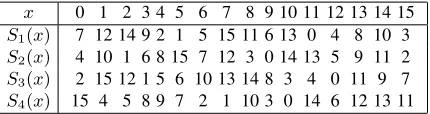
Table 1.S-Boxes used in Hummingbird-2.
x 0 1 2 3 4 5 6 7 8 9 10 11 12 13 14 15 S1(x) 7 12 14 9 2 1 5 15 11 6 13 0 4 8 10 3 S2(x) 4 10 1 6 8 15 7 12 3 0 14 13 5 9 11 2 S3(x) 2 15 12 1 5 6 10 13 14 8 3 4 0 11 9 7 S4(x) 15 4 5 8 9 7 2 1 10 3 0 14 6 12 13 11
The Hummingbird-2 does not directly fall to either traditional stream ci-pher or block cici-pher categories as it inherits properties from both. In this sense Hummingbird-2 resembles the Helix and Phelix proposals [9, 16, 22]. Since Hummingbird-2 operates on 16-bit blocks, more efficiency can be realized in applications that chirp small messages, such as RFID devices or wireless sen-sors. This also makes it easy to layer in security in various protocol schemes.
This paper is structured as follows: A formal description of Hummingbird-2 is contained in Section 2. Section 3 has the preliminary results of cryptanalysis of the cipher. Software and hardware implementations are described in Section 4, together with ISO 18000-6C timing information and comparison in Section 5. Conclusions can be found in Section 6. Appendix A contains a set of imple-mentation test vectors for Hummingbird-2.
2 Description of Hummingbird-2
The Hummingbird-2 cipher has a 128-bit secret key K and a 128-bit internal stateRwhich is initialized using a 64-bit Initialization VectorIV. These vari-ables are accessed as vectors of 16-bit words:
K= (K1, K2, K3, K4, K5, K6, K7, K8),
R= (R1, R2, R3, R4, R5, R6, R7, R8),
IV = (IV1, IV2, IV3, IV4).
Hummingbird-2 is entirely built from operations on 16-bit words: the exclusive-or operation on wexclusive-ords (⊕), addition modulo 65536 () and a nonlinear mixing functionf(x).
2.1 Nonlinear functionsf(x)andWD16(x, a, b, c, d)
The Hummingbird-2 S-Boxes S1, S2, S3 and S4 are given Table 1.1 Let
S(x)denote the computation of four S-Boxes andL(x) the linear transforma-tion which is expressed using the left circular shift (rotatransforma-tion) operator (≪). We may write thef component as
S(x) =S1(x0)|S2(x1)|S3(x2)|S4(x3)
L(x) =x⊕(x≪6)⊕(x≪10)
f(x) =L(S(x)).
We further define a 16-bit keyed permutationWD16usingf as
WD16(x, a, b, c, d) =f(f(f(f(x⊕a)⊕b)⊕c)⊕d). (1)
The inverse off(x)andWD16can be derived in straightforward fashion.
2.2 Initialization
The internal state of Hummingbird-2 is initialized with a four-round procedure using the 64-bit nonceIV. We first set
R(0)= (IV1, IV2, IV3, IV4, IV1, IV2, IV3, IV4) (2)
and then iterate fori= 0,1,2,3the following:
t1 = WD16(R(1i)hii, K1, K2, K3, K4)
t2 = WD16(R(2i)t1, K5, K6, K7, K8)
t3 = WD16(R(3i)t2, K1, K2, K3, K4)
t4 = WD16(R(4i)t3, K5, K6, K7, K8)
R1(i+1) = (R1(i)t4)≪3
R2(i+1) = (R2(i)t1)≫1
R3(i+1) = (R3(i)t2)≪8
R4(i+1) = (R4(i)t3)≪1
R5(i+1) =R5(i)⊕R(1i+1)
R6(i+1) =R6(i)⊕R(2i+1)
R7(i+1) =R7(i)⊕R(3i+1)
R8(i+1) =R8(i)⊕R(4i+1).
1Some early versions of Hummingbird-2 used a different set of S-Boxes from Serpent [1].
The initial state for encrypting the first plaintext word is R(4). Note that the two’s complement numerical value ofi= 0. . .3is used in computation oft1.
2.3 Encryption
Encryption of a single word of plaintextPito ciphertext wordCirequires four
invocations ofWD16.2
t1 = WD16(R(1i)Pi, K1, K2, K3, K4)
t2 = WD16(R(2i)t1, K5⊕R(5i), K6⊕R(6i), K7⊕R7(i), K8⊕R(8i))
t3 = WD16(R
(i)
3 t2, K1⊕R (i)
5 , K2⊕R (i)
6 , K3⊕R (i)
7 , K4⊕R (i) 8 )
Ci = WD16(R(4i)t3, K5, K6, K7, K8)R(1i).
After each encrypted / decrypted word, we perform the following state update:
R1(i+1)=R(1i)t3
R2(i+1)=R(2i)t1
R3(i+1)=R(3i)t2
R4(i+1)=R(4i)R(1i)t3t1
R5(i+1)=R(5i)⊕(R1(i)t3)
R6(i+1)=R(6i)⊕(R2(i)t1)
R7(i+1)=R(7i)⊕(R3(i)t2)
R8(i+1)=R(8i)⊕(R4(i)R(1i)t3t1).
A shorthand of this isC =E(P). The state variableRis stepped by one iter-ation for each invociter-ation ofE. Note that the update function can be simplified since certain terms are re-used.
2.4 Authenticating fixed-length unencrypted associated data
Authenticated Encryption with Associated Data (AEAD) is a method of using Hummingbird that encrypts / decrypts a payload and also authenticates any as-sociated data (AD) that travels alongside the ciphertext such as the nonce and a packet header. AD processing is optional in implementations.
AD processing occurs after the entire encrypted payload has processed. We simply computeE(Ai)but transmitAi itself instead. Note that the size of the
AD must be fixed (known by the recipient).
2Some early versions of this paper had a typographic error here as the final addition ofR(i) 1
2.5 Stream cipher mode: A technique for encoding short fixed-length fields
Sometimes it is desirable to communicate, without message expansion, data-grams which are less than 16 bits in size. We describe an encoding technique which enables this.
Letx be the short message of1 ≤ n ≤ 15 bits. The ciphertext message is derived from thenleast significant bits ofx⊕E(0). If message integrity is required, the state is further updated byE(x). Decoding is straightforward.
Note that encrypting the two words0andxhas exactly the same effect on state and hence special care must be taken to ensure that both parties are in sync. If a protocol requires arbitrary-length authenticated messages, this technique can be used for padding, but the total message length (in bits) must be specified and verified in an unambiguous fixed-length AD field.
2.6 Computing the Message Authentication Code
To compute a message authentication tagT ofn≤8words, we first finalize the message by first stepping the cipher three times without producing any output.
E(IV1R1R3n)
E(IV2R1R3)
E(IV3R1R3).
HereR1andR3denotes the contents of those register words immediately before
each invocation ofE. We then construct the words of the authentication tagT
as follows:
T1=E(IV4R1R3)
Ti=E(R1R3) for i = 2,3, . . . ,n.
2.7 Uniqueness Requirement for IVs and Keys
Hummingbird-2 is an authenticated encryption primitive and may be used in similar fashion as the Galois/Counter Mode (GCM) and GMAC, which are part of NSA “Suite B” algorithms. Implementers would be wise to take similar care in ensuring that keys and IVs are never repeated. We restate the requirement from Section 8 of [7].
Generally speaking, compliance to this requirement is recommended in or-der to mitigate the risk of using Hummingbird-2 in certain applications, and this cipher is not as vulnerable to repeated IV attacks as AES-GCM and should be able to resist many realistic chosen-IV attacks.
Indeed Hummingbird-2 leaks very little information should the nonce be repeated. At most all you get are exact repetitions in the ciphertext where you have exact repetitions in the plaintext.
3 Development and Analysis
The main differences between Hummingbird-1 and Hummingbird-2 are:
– The key size has been set to 128 bits to be commensurable with the actual security of the cipher.
– The state size of the cipher has been increased from 80 bits to 128 bits and the LFSR has been eliminated. The last four new state registersR5,R6,R7,
andR8are called the “accumulator” registers.
– The keyed transform, called the “E Box” in [20] now only has four invo-cations of the S-Boxes, compared to five in Hummingbird-1. This increases the encryption speed of the cipher.
– The authentication mechanism has been improved to thwart a message ex-tension attack.
– Support for authenticating unencrypted associated data has been introduced with the AEAD mode discussed in Section 2.4.
– Recommendations to the reuse of keys and IVs have been introduced.
– An important design criteria was compatibility with the ISO 18000-6C tim-ing requirements as discussed in Section 5.
We note that prior to publication, Hummingbird-2 has been subjected to a significant cryptanalytic security assurance effort. For this, the services of Jim Frazer & Son Cryptography (formerly ISSI) and the U. Waterloo Centre for Ap-plied Cryptography Research were used, in addition to input from public analy-sis of Hummingbird-1. After thousands of hours of cryptanalyanaly-sis, no significant flaws or sub-exhaustive attacks against Hummingbird-2 have been found. We summarize the results of our analysis in the following sections.
3.1 Structure of the Cipher
key is usually loaded into the evolving state registers upon initialization). In Hummingbird-2 the key is kept constant and hence we could say that the state is 128+128=256 bits of which 128 bits is evolving. There is strong experimental and theoretical evidence that the cycle upon constant input words is2127.
The initialization function is one-to-one from the IV to the four state reg-istersR1,R2,R3, and R4. Hence there are no nonce collisions. If more than
264 invocations of the E function is performed under a single key, a birthday condition in the internal state may occur. The usage condition given in Section 2.7 will prevent this. Such a birthday condition has very limited cryptographic implication beyond serving as a distinguisher with that complexity. We note that this is the same bound that can be found for the AES algorithm [17].
3.2 S-Box selection
The S-Box (Table 1 and Section 2.1) selection was based on specific research presented in more detail in [21]. The S-Boxes also belong to the optimal classes discussed in [14].
We performed an exhaustive search through16!possible permutations. The S-Boxes specifically belong to a classes that ideally satisfy the following condi-tions:
– Optimal differential bound p ≤ 1/4, linear bound ≤ 1/4, and branch number 3.
– There is a minimum number of differential characteristics and linear ap-proximations at the bounds.
– All S-boxes belong to a different linear equivalence class.
– The four S-boxes have a large Hamming distance from each other and the identity permutation.
– The algebraic degree of all but one output bit is 3 and each output bit is nonlinearly dependent on a maximum number of input bits.
3.3 Differential cryptanalysis
Hummingbird-2 has been designed to be resistant to Differential Cryptanalysis [3, 4]. The most interesting findings in our research involve the high-bit differ-ential∆ = 8000 which behaves in the same way under modular addition and XOR. Much of the nonlinearity for lower bits comes from interplay of these two operations. The four rotations in the initialization phase were introduced to increase the resistance of the cipher against certain related-key attacks.
of all high-bit differentials in both initialization and actual encryption phases of the cipher.
Differentials in the encryption function LetH=8000denote the high bit dif-ferential andxsome undefined ciphertext differential. We found the following differentials that hold with probability 1.
∆P =0 ∆R= (0 0 0 H 0 0 0 0) ⇒ ∆C =x ∆R= (0 0 0 H 0 0 0 H)
∆P =H ∆R= (H 0 0 0 0 0 0 0) ⇒ ∆C =H ∆R= (H 0 0 H H 0 0 H)
∆P =H ∆R= (H 0 0 H 0 0 0 0) ⇒ ∆C =x ∆R= (H 0 0 0 H 0 0 0)
∆P =0 ∆R= (0 H H 0 H 0 0 0) ⇒ ∆C =0 ∆R= (0 H H 0 H H H 0)
∆P =H ∆R= (H H H 0 H 0 0 0) ⇒ ∆C =H ∆R= (H H H H 0 H H H)
∆P =H ∆R= (H H H H H 0 0 0) ⇒ ∆C =x ∆R= (H H H 0 0 H H 0)
∆P =0 ∆R= (0 H H H H 0 0 0) ⇒ ∆C =x ∆R= (0 H H H H H H H).
It can be observed that these differentials can’t be used to construct an iterative differential.
Related keys in encryption For two related keys we found one iterative dif-ferential which holds with probability one. When the two keys are related by
∆K= (H 0 0 0 H 0 0 0)we have:
∆P =H ∆R= (0 0 0 0 H 0 0 0) ⇒ ∆C =x ∆R= (0 0 0 0 H 0 0 0).
The ciphertext differential∆C =xhas some nontrivial value. We haven’t found a direct way to exploit this related key property in an attack.
3.4 Linear and Algebraic Cryptanalysis
Hummingbird-2 has been designed to be resistant to Linear Cryptanalysis [15]. We performed a search for best linear masks in the mixing functionf. Encryp-tion of a single plaintext word involves sixteen invocaEncryp-tions off, five additions of state words (R1,R2,R3,R4, andR1again) and XOR keying with both static
keys and dynamic accumulator variables.
The algebraic degree and branch number of the S-Boxes alone thwarts most forms of algebraic distinguishing attacks such as Cube Testers [6] andd-monomial distinguisers [19]. A typical black-box chosen-IV scenario is made difficult by the rather complicated initialization routine that has a total of sixteen WD16 invocations.
4 Implementation and Performance
Hummingbird-2 has been implemented in hardware and in software for various microcontroller architectures. Functions were written in assembly language and hand-optimized for all platforms. All library functions are C-callable and many development environments are supported.
4.1 Microcontroller Software Implementations
As Hummingbird-2 algorithm allows for trade-offs between implementation speed and size, we have implemented up to three software implementation pro-files for some microcontroller platforms. Table 2 gives the characteristics of these implementations.
Table 2.Microcontroller software implementations of Hummingbird-2. Encryption and decryp-tion speeds are given in cycles per 16-bit word.
Target Encr. Decr. Size MAC-64 Init. RAM≈ MSP430 “Tiny” 1520 1544 770 10768 5984 50 MSP430 “Fast” 576 729 2518 4101 2187 114 MSP430 “Furious” 359 560 3648 2648 1361 114 AVR “Fast” 745 930 3600 5689 2970 114 AVR “Furious” 574 770 4178 4310 2139 114 AVR “Ultimate” 495 652 3200 3764 1800 1500 PIC24 “Fast” 319 371 2227 2248 1162 114 PIC24 “Furious” 271 362 4959 1897 912 114 ARM Cortex 332 336 2200 2525 1492 116
4.2 Hardware Implementations
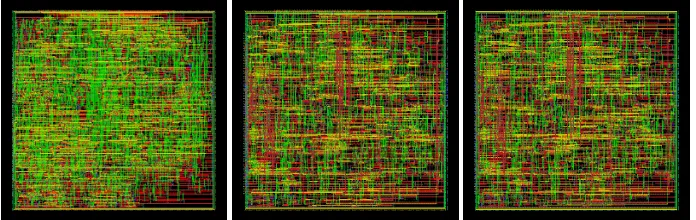
– High Performance Design HB2-ee4c. This 4 clock implementation of Hum-mingbird is targeted at fast encryption (4 clocks) and maximum throughput and bandwidth.
– Low Area and Power Design HB2-ee16c. This 16 clock implementation of Hummingbird is targeted at minimum area and power.
– Ultra Low Area and Power Design HB2-ee20c. This 20 clock implementa-tion of Hummingbird is targeted at ultra low area and power.
The process used was TSMC 0.13µm, operating with 1.2 V. Encryption speed can be derived by dividing the operating frequency by the number of clocks required to encrypt a single word.
Table 3.Hardware implementations of Hummingbird-2. Encryption and decryption speeds are given in cycles per 16-bit word. The library used was TSMC 180nm, 6 level metal, high density. Synopsis synthesis tools were used.
Profile Frequency Clocks per word
Peak pwr (µW)
Leakage (µW)
Area (µm2)
Gate Equiv.
HB2-ee4c 100 kHz 4 1.93 4.17 27381 3220 HB2-ee4c 10 MHz 4 163.1 4.17 27381 3220 HB2-ee16c 100 kHz 16 1.845 2.85 20871 2332 HB2-ee16c 10 MHz 16 156.8 2.85 20871 2332 HB2-ee20c 100 kHz 20 1.73 2.63 19383 2159 HB2-ee20c 10 MHz 20 149.1 2.63 19383 2159
5 HB2 Timing Compatibility with ISO 18000-6C
The ISO 18000-6C protocol [12] is the leading passive UHF RFID protocol in terms of number of tags sold today. The 18000-6C protocol specifies only a 32-bit password for access control and an electronic kill function.
The primary functionality of the 18000-6C protocol is for fast and effi-cient tag identification across a range of operating environments. Consequently, 18000-6C supports a range of data rates at which the interrogator and the tag may communicate. Communications are controlled by the interrogator in a Reader Talks First communication scheme. The interrogator begins a communication sequence by issuing a preamble that defines the length of the logic 0 and logic 1 symbols. The length of the logic 0 symbol is referred to as Tari, which is a fundamental timing parameter for communications.
For all commands except the Write command, the Tari value determines the amount of time the tag has to begin its response to the reader after the reader has completed the last symbol in its command to the tag. This time is referred to as T1 time. Table 4 shows the T1 timing for the minimum Tari value of 6.25
µs, the maximum Tari value of 25µs, and a commonly used Tari value of 12.5
µs.
Table 4.T1 Timing Values and Available Clock Cycles.
Tari (µs) T1 Time (µs) Cycles 1.5 MHz Cycles 2 MHz Cycles 2.5 MHz
6.25 39.06 58 78 97
12.5 78.125 117 156 195
25 187.5 281 375 468
In addition to the T1 timings, Table 4 shows the number of full clock cycles available for computation within T1 for three on tag clock frequencies around 2 MHz, a common on-tag clock frequency.
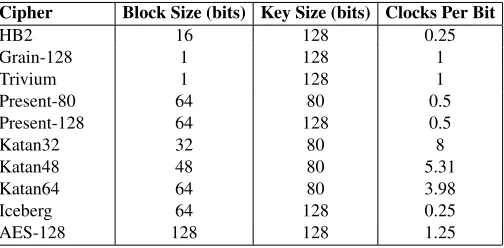
Table 5 compares the clocks per bit required to encrypt a single block for various ciphers that can be implemented with up to approximately three thou-sand gate equivalents and are therefore fit for RFID use. The figures for Katan have been derived from [5], for Present, ICEBERG and AES from [18] and for Trivium and Grain from [13].
Based upon the clocks per bit for each cipher, in Table 6 we compare the number of clocks required to encrypt various amounts of data.
Table 5.Clocks Per Bit.
Cipher Block Size (bits) Key Size (bits) Clocks Per Bit
HB2 16 128 0.25
Grain-128 1 128 1
Trivium 1 128 1
Present-80 64 80 0.5
Present-128 64 128 0.5
Katan32 32 80 8
Katan48 48 80 5.31
Katan64 64 80 3.98
Iceberg 64 128 0.25
AES-128 128 128 1.25
Table 6.Comparison of Clock Cycles to Encrypt. Note that most block ciphers require initializa-tion every time key is changed.
Cipher Init 16 bits 32 bits 48 bits 64 bits 96 bits 128 bits
HB2 16 4 8 12 16 24 32
Grain-128 513 16 32 48 68 96 128
Trivium 1333 16 32 48 68 96 128
Present-80 0∗ 32 32 32 32 64 64 Present-128 0∗ 32 32 32 32 64 64 Katan32 0∗ 256 256 512 512 768 1024 Katan48 0∗ 255 255 255 510 510 765 Katan64 0∗ 255 255 255 255 510 510
Iceberg 0∗ 16 16 16 16 32 32
AES-128 0∗ 160 160 160 160 160 160
considered. This additional processing will require even more overhead. While some operations may be performed in parallel, the command decode and pro-cessing must be performed prior to any cryptographic functions being performed.
In conclusion, HB2 is well suited for use in passive RFID systems due to its low power consumption, which minimally impacts range, and its high speed that enables the tag to continue normal operation within T1 timings.
6 Conclusions
We have also presented results of software and hardware implementations of Hummingbird-2. Hummingbird-2 can be implemented with little more than 2000 gate equivalents, making it well suited for ubiquitous devices such as RFID tags and sensors. Hummingbird-2 has the additional advantage over other lightweight encryption primitives that it produces a message authentication code.
Acknowledgements. In addition to the anonymous RFIDSec ’11 program com-mittee members, we would like to thank Whitfield Diffie (who designed the original WD16 function) and the members of CACR and ISSI teams. Troy Hicks and Ken Lauffenburger were behind the hardware work on Hummingbird-2. Jared Smothermon, Stanford Hudson, and Bob Nimon did the Software imple-mentations on various platforms.
References
1. R. ANDERSON, E. BIHAM ANDL. KNUDSEN. “Serpent: A Proposal for the Advanced Encryption Standard.”http://www.cl.cam.ac.uk/~rja14/Papers/serpent. pdf(1999)
2. A. BIRYUKOV, C.DECANNIÈRE ANDM. QUISQUATER. “On Multiple Linear Approxi-mations.” CRYPTO 2004, LNCS 3152, pp. 1-22. Springer (2004)
3. E. BIHAM ANDA. SHAMIR. “Differential Cryptanalysis of DES-like cryptosystems.” In A. Menezes and S.A. Vanstone (Eds.): CRYPTO 1990. LNCS 537, pp. 2–21. Springer (1990) 4. E. BIHAM ANDA. SHAMIR. “Differential Cryptanalysis of the Data Encryption Standard.”
Springer (1993)
5. C.DECANNIÈRE, O. DUNKELMAN ANDM. KNEŽEVI ´C. “KATAN & KTANTAN – A Family of Small and Efficient Hardware-Oriented Block Ciphers.” CHES 2009, LNCS 5747, pp. 272–288. Springer (2009)
6. I. DINUR ANDA. SHAMIR. “Cube Attacks on Tweakable Black Box Polynomials.” EU-ROCRYPT 2009, LNCS 5479, pp. 278–299. Springer (2009)
7. M. DWORKIN. “Recommendation for Block Cipher Modes of Operation: Galois/Counter Mode (GCM) and GMAC.” NIST Special Publication 800-38D (2007)
8. X. FAN, H. HU, G. GONG, E. M. SMITH AND D. ENGELS. “Lightweight Implementa-tion of Hummingbird Cryptographic Algorithm on 4-Bit Microcontroller.” The 1st Interna-tional Workshop on RFID Security and Cryptography 2009 (RISC’09), pp. 838–84. Springer (2009)
9. N. FERGUSON, D. WHITING, B. SCHNEIER, J. KELSEY, S. LUCKS,ANDT. KOHNO “He-lix: Fast Encryption and Authentication in a Single Cryptographic Primitive.” FSE 2003, LNCS 2887, pp. 330–346. Springer (2003)
10. D. ENGELS, X. FAN, G. GONG, H. HU AND E. M. SMITH. “Ultra-Lightweight Cryp-tography for Low-Cost RFID Tags: Hummingbird Algorithm and Protocol.” Centre for Ap-plied Cryptographic Research (CACR) Technical Reports, CACR-2009-29.http://www. cacr.math.uwaterloo.ca/techreports/2009/cacr2009-29.pdf(2009) 11. D. ENGELS, X. FAN, G. GONG, H. HU AND E. M. SMITH. “Hummingbird:
12. INTERNATIONALSTANDARDIZATIONORGANIZATION. “ISO/IEC 18000-6:2010. Informa-tion technology – Radio frequency identificaInforma-tion for item management – Part 6: Parameters for air interface communications at 860 MHz to 960 MHz.”
13. T. GOOD AND M. BENAISSA. “Hardware results for selected stream cipher candidates.” eStream, ECRYPT Stream Cipher Project Report 2007 / 023. Proceedings of SASC 2007 (2007)
14. G. LEANDER ANDA. POSCHMANN. “On the Classification of 4 Bit S-Boxes.” In C. Carlet and B. Sunar (Eds.): WAIFI 2007, LNCS 4547, pp. 159–176. Springer (2007)
15. M. MATSUI. “Linear cryptoanalysis method for DES cipher.” In T. Helleseth (Ed.): EURO-CRYPT 1993. LNCS 765, pp. 386–397. Springer (1993)
16. F. MULLER. “Differential Attacks against the Helix Stream Cipher.” FSE 2004, LNCS 3017, pp. 94–108. Springer (2004)
17. NATIONALINSTITUTE OFSTANDARDS ANDTECHNOLOGY. “The Advanced Encryption Standard (AES).” FIPS Publication 197, U.S. DoC/NIST (2001)
18. A. POSCHMANN “Lightweight Cryptography - Cryptographic Engineering for a Pervasive World”. PhD Thesis. Europaeischer Universitaetsverlag, in the IT-Security series, no 8. ISBN 978-3899663419. Also available as IACR ePrint 2009/516 (2009)
19. M.-J. O. SAARINEN. “d-Monomial Tests are Effective Against Stream Ciphers.” State of the Art in Stream Ciphers (SASC) 2006. Workshop Record, K.U. Leuven (2006)
20. M.-J. O. SAARINEN. “Cryptanalysis of Hummingbird-1.” FSE 2011, LNCS 6733, 328– 341. Springer (2011)
21. M.-J. O. SAARINEN. “Cryptographic Analysis of All4×4- Bit S-Boxes.” Selected Areas in Cryptography (SAC) 2011. 11-12 August 2011, Toronto, Ontario, Canada, (2011) 22. D. WHITING, B. SCHNEIER, S. LUCKS,ANDF. MULLER. “Phelix – Fast Encryption and
Authentication in a Single Cryptographic Primitive.” ECRYPT Stream Cipher Project Report 2005/027.http://www.schneier.com/paper-phelix.html, 2005.
A Test Vectors
The test data is given as an array of bytes. When using these test vectors, note that Hummingbird-2 processes data in little-endian fashion (this means that the first 16-bit plaintext word in the second test vector is actually0x1100).
Secret key 00 00 00 00 00 00 00 00 00 00 00 00 00 00 00 00 IV / Nonce 00 00 00 00 00 00 00 00
Plaintext 00 00 00 00 00 00 00 00 00 00 00 00 00 00 00 00 Ciphertext C4 EF 87 A8 4F 05 A9 91 57 46 44 81 6E 25 3A CF MAC BA ED 40 F0 67 B0 E1 3C 76 F3 59 41 A2 B2 D1 35
Secret key 01 23 45 67 89 AB CD EF FE DC BA 98 76 54 32 10 IV / Nonce 12 34 56 78 9A BC DE F0
Plaintext 00 11 22 33 44 55 66 77 88 99 AA BB CC DD EE FF Ciphertext 5B D1 F8 AD 23 14 20 F4 BA B1 54 C2 45 29 3D 38 MAC C4 F6 74 C0 F6 4B 21 E7 37 24 DC 76 A6 6C 39 19