Available Online at www.ijcsmc.com
International Journal of Computer Science and Mobile Computing
A Monthly Journal of Computer Science and Information Technology
ISSN 2320–088X
IMPACT FACTOR: 6.017IJCSMC, Vol. 6, Issue. 1, January 2017, pg.221 – 227
Central Local Directional Pattern Value
Flooding Co-occurrence Matrix based
Features for Face Recognition
Dr. P Chandra Sekhar Reddy
Professor, CSE Department, Gokaraju Rangaraju Institute of Engineering and Technology, Hyderabad
Abstract--- In this paper proposed a method for extracting Contrast, Correlation, Energy, and, Local homogeneity features on Central Local Directional Pattern Value Flooding Matrix for face recognition. Local Directional Pattern is computed on the image and then Central Local Directional Pattern Value Flooding Matrix is formed, and on this matrix Contrast, correlation, energy and homogeneity features are evaluated in four directions 0°, 45°, 90° and 135°. Face recognition algorithm is proposed with this feature set. The proposed method has been tested on FGNET and scanned facial images. The results shown that proposed method is superior in recognizing faces compared to the other existing face recognition methods.
Keywords: Face recognition, LDP, Central Local Directional Pattern Value Flood Co-occurrence Matrix
I. INTRODUCTION
II. METHODOLOGY
In this proposed method the color image is converted to gray image, on this image the Local Directional Pattern (LDP) is computed and then Central Local Directional Pattern Value Flood is formed in 3x3 blocks on entire image. Statistical features are evaluated for face recognition. This method is explained in the following sub sections in detail.
Step1: Color image to gray image conversion
The given color image is converted into a grey level image using RGB color quantization method.
Step2: Local Directional Pattern
The present method using a Local Directional Pattern [11], which overcomes the drawbacks of LBP and is more robust for classification. The local descriptor LDP considers the edge response values in all different directions instead of surrounding neighboring pixel intensities. The LDP is an eight bit binary code assigned to each pixel of an input image. This pattern is calculated by comparing the relative edge response value of a pixel in different directions. For this purpose, the present paper evaluates LDP as eight directional edge response value of a particular pixel using Kirsch masks in eight different orientations (M0-M7) centered on its own position. These masks are shown in the Fig.1. By applying eight masks, eight edge response values m0, m1, …, m7 are obtained, each representing the edge significance in its respective direction. The response values are not equally important in all directions. The LDP is formed considering only first three values of sorted edge responses in descending order. This LDP is computed on entire image with 3x3 block sizes.
-3 -3 5 -3 5 5 5 5 5 5 5 -3
-3 0 5 -3 0 5 -3 0 -3 5 0 -3 -3 -3 5 -3 -3 -3 -3 -3 -3 -3 -3 -3
M0 M1 M2 M3
5 -3 -3 -3 -3 -3 -3 -3 -3 -3 -3 -3 5 0 -3 5 0 -3 -3 0 -3 -3 0 5 5 -3 -3 5 5 -3 5 5 5 -3 5 5
M4 M5 M6 M7
Fig.1: Kirsch edge response masks in eight directions.
Step-3: Computing Central Local Directional Pattern Value Flooding Matrix (CLDPVFM)
The central local directional pattern value flooding forms a group of LDP values which have the LDP value as the central LDP over the 3x3 neighborhood. In the 3x3 neighborhood, for all the neighbors which have the same LDP value as the center pixel, then these values are kept unchanged otherwise, it is set to zero. The 3x3 block obtained from this process is called a central ldp value flooding. The CLDPVFM is computed over the whole image is described as follows.
(1) Central ldp value floodings I1(x,y), I2(x,y), I3(x,y) and I4(x,y) are computed starting from position (1,1), (1,2), (2,1) and (2,2) respectively with 3x3 block from left-to-right and top-to-bottom throughout LBP image I(m,n) with a step-length of three along both horizontal and vertical directions.
CLDPVFM (x,y) = p (1)
Where p is avg (or) avg_g
avg= (I1(x,y) +I2(x,y)+ I3(x,y)+ I4(x,y) ) /r , r is the number of non-zero intensity values .
avg_g = a value which is just greater than avg and equal to one of four intensity values I1(x,y), I2(x,y), I3(x,y) and I4(x,y) at position (x,y).
An example of central ldp value flood detection is shown in Fig.2.
6 7 6 6 0 6
6 6 4 6 6 0
5 6 9 0 6 0
(a) 3x3 block with gray values (b) Central ldp value flood
Fig.2. Detection of Central Local Directional Pattern Value Flood
Step 3: Evaluation of Statistical Features on Central Local Directional Pattern Value Flood Co-occurrence Matrix
Grey level co-occurrence matrices (GLCM) introduced by Haralick attempt to describe texture by statistically sampling how certain grey levels occur in relation to other grey levels [23]. The present method evaluates the feature set contrast, correlation, energy, and, local homogeneity on Central Local Directional Pattern Value Flood Co-occurrence matrix. These features are computed using the equations 2 to 5 on CLDPVFM in four directions 0°, 45°, 90° and 135° for face recognition.
∑ ( )
( )
∑ ( ) ( )
∑
( ) ( )
∑
3. RESULTS AND DISCUSSIONS
The proposed method established a database of the 1002 face images collected from FG-NET database and other 600 images collected from the scanned photographs and sample of these images are shown in Fig.3.
Fig. 3: Sample images from FG-NET Database
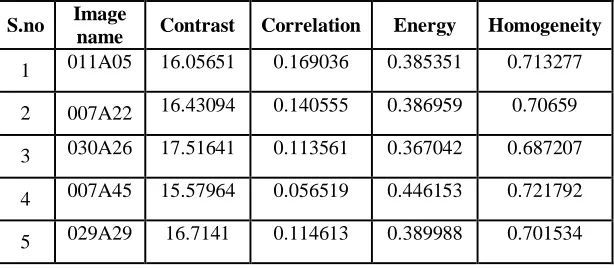
The Haralick features contrast, correlation, energy and homogeneity are extracted on Central Local Directional Pattern Value Flood Co-occurrence matrix of considered face image database and are stored as a feature vector. Feature set leads to representation of the training set for images. Tables 1, 2, 3 and 4 represent the derived four features in four directions with 0° 45°, 90° and 135° orientation of CLDPVFM on 5 facial images. These 16 features are used as feature vector for each face in recognition. The facial recognition algorithm is defined and tested on considered face image database and has shown 98.5 % successful recognition rate.
Table 1: Contrast, Correlation, Energy, and, Local homogeneity features on CLDPVFM 0° of facial images.
S.no Image
name Contrast Correlation Energy Homogeneity
1 011A05 16.05651 0.169036 0.385351 0.713277
2 007A22 16.43094 0.140555 0.386959 0.70659
3 030A26 17.51641 0.113561 0.367042 0.687207
4 007A45 15.57964 0.056519 0.446153 0.721792
5 029A29 16.7141 0.114613 0.389988 0.701534
Table 2: Contrast, Correlation, Energy, and, Local homogeneity features on CLDPVFM 45° of facial images.
Image
name Contrast Correlation Energy Homogeneity
S.no
1 011A05 19.78993 -0.02617 0.365667 0.646608
2 007A22 20.02701 -0.04931 0.368826 0.642375
3 030A26 19.89439 -0.00806 0.356075 0.644743
4 007A45 17.26247 -0.04885 0.43593 0.691742
Table 3: Contrast, Correlation, Energy, and, Local homogeneity features on CLDPVFM 90° of facial images.
Image
name Contrast Correlation Energy Homogeneity
S.no
1 011A05 16.14655 0.162255 0.385722 0.711669
2 007A22 17.04846 0.108652 0.382791 0.695563
3 030A26 17.26153 0.126831 0.368379 0.691758
4 007A45 15.05272 0.088677 0.450089 0.731201
5 029A29 16.5987 0.120315 0.390922 0.703595
Table 4: Contrast, Correlation, Energy, and, Local homogeneity features on CLDPVFM 135° of facial images.
Image
name Contrast Correlation Energy Homogeneity
S.no
1 011A05 19.84542 -0.02905 0.365449 0.645617
2 007A22 19.87251 -0.0412 0.369419 0.645134
3 030A26 19.88025 -0.00734 0.356136 0.644996
4 007A45 17.28273 -0.05006 0.435828 0.69138
5 029A29 18.98252 -0.00477 0.377122 0.661026
Algorithm 1: Face recognition algorithm on CLDPVFM using feature set.
Begin
Input: The test facial Image.
Step1: Convert the given test image into CLDPVFM.
Step2: Evaluate the contrast, correlation, energy and homogeneity features on CLDPVFM of test images.
Step3: Find the difference between test image features with existing feature vector of the feature library.
Step4: If difference is zero or falls within the small range then test image is matching with the database image or the test image is recognized.
End
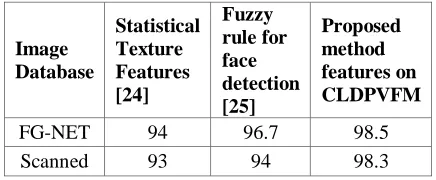
Table 5. The face recognition rate by the proposed and other existing methods.
Image Database
Statistical Texture Features [24]
Fuzzy rule for face detection [25]
Proposed method features on CLDPVFM
FG-NET 94 96.7 98.5
Scanned 93 94 98.3
IV. CONCLUSION
The proposed method CLDPVFM with features gathers local edge directional information of facial image and then the flood of central ldp value is formed on entire image is used to find the features. These features Contrast, Correlation, Energy, and, Local homogeneity are recognizing faces very effectively. This method is very simple and efficient. The proposed method has shown a high recognition rate over the other existing methods.
REFERENCES
[1] Chellappa, R., Wilson, C. L., & Sirohey, S. (1995). Human and machine recognition of faces: a survey. Proceedings of the IEEE, 83(5), 705–741.
[2] Turk M, Pentland A, Eigenfaces for recognition, Journal of Cognitive Neu- roscience 3 (1991) 72–86.
[3] Belhumeur P, Hespanha J, Kriegman D, Eigenfaces vs. fisherfaces: class specific linear projection, IEEE Transactions on Pattern Analysis and Machine Intelligence 19 (7) (1997) 711–720.
[4] Bartlett M, Movellan J, Sejnowski T, “Face recognition by independent component analysis”, IEEE Transactions on Neural Networks 13 (2002) 1450–1464.
[5] Heisele B, Ho Y, Poggio T, Face recognition with support vector machines: global versus component-based approach, in: Proceedings of International Conference on Computer Vision, 2001, pp. 688–694.
[6] Ojala T, Pietikainen M, Harwood D, A comparative study of texture measures with classification based on feature distributions, Pattern Recognition 29 (1996) 51–59.
[7] Ojala T, Pietikainen M, Maenpaa P, Multiresolution grayscale and rotation invariant texture classification with Local Directional Pattern s, IEEE Transactions of Pattern Analysis and Machine Intelligence 24 (7) (2002) 971–977.
[8] Jin H, Liu Q, Lu H, Tong X, Face detection using improved LDP under Bayesian framework, in: Proceeding of Third International Conference on Image and Graphics, 2004, pp. 306–309.
[9] Zhang L, Chu R, Xiang S, Liao S, S.Z. Li, Face detection based on multi-block LDP representation, in: The Second International Conference on Biometrics, 2007, pp. 11–18.
[10]Ahonen T, Hadid A, Pietikainen M, Face description with Local Directional Pattern s: application to face recognition, IEEE Transactions on Pattern Analysis and Machine Intelligence 28 (12) (2006) 2037–2041. [11]Ahonen T, Hadid A, Pietikainen M, Face recognition with Local Directional Pattern s, in: The Eighth
European Conference on Computer Vision, 2004, pp. 469–481.
[12]Lahdenoja O, Laiho M, Paasio A, Reducing the feature vector length in Local Directional Pattern based face recognition, in: IEEE International Conference on Image Processing, 2005, pp. 11–14.
[13]Liao S, Zhu X, Lei Z, Zhang L, Li S Z, Learning multi-scale block Local Directional Pattern s for face recognition, in: The Second International Conference on Biometrics, 2007, pp. 828–837.
[14]Heusch, Rodriguez, Marcel, Local Directional Pattern s as an image preprocessing for face authentication, in: The Seventh International Confer- ence on Automatic Face and Gesture Recognition, 2006, pp. 9–14.
[16]Shan, Gong, McOwan, Facial expression recognition based on Local Directional Pattern s: a comprehensive study, Image and Vision Computing 27 (2009) 803–816.
[17]Kellokumpu, Zhao, Li, Pietikainen, Dynamic texture based gait recognition, in: Lecture Notes in Computer. [18]Takala, Ahonen, Pietikainen, Block-based methods for image retrieval using Local Directional Pattern s, in:
Proceeding of the 14th Scandinavian Conference on Image Analysis, 2005, pp. 882–891.
[19]P.Chandra Sekhar Reddy, B. Eswara Reddy and V. Vijaya Kumar”Texton Based Shape Features on Local Directional Pattern forAge Classification,” International Journal of Image, Graphics and Signal Processing(IJIGSP), Volume4(7), pp.54-60, 2012.
[20]P.Chandra Sekhar Reddy, V.Vijaya Kumar ,and B.Eswara Reddy, ”New Method for Classification of Age Groups Based on Texture Shape Features,” International Journal of Imaging and Robotics, Volume 15(1), pp.19-30, 2015.
[21]P Chandra Sekhar Reddy, Bhanu Sreekar Reddy Karumuri, “Age Classification with Motif Shape Patterns on Local Directional Pattern ”, International Journal of Computer Trends and Technology, Volume 39, Number 3, pp. 134-138, September, 2016.
[22]P Chandra Sekhar Reddy, Bhanu Sreekar Reddy Karumuri, “Age Classification with Shape Patterns derived from Central Pixel Flooding Matrix (CPFM) on Facial Images”, International Journal of Latest Trends in Engineering and Technology, Vol.(7), Issue(4), pp. 205-211, 2016.
[23]Haralick RM , Shanmugan K and Dinstein I, "Textural features for image classification," IEEE Trans. Sysr., Man., Cybern., Vol. SMC-3, pp.610-621, 1973.
[24]Chandra Mohan M, V. Vijaya Kumar, and U S N Raju, “New Face Recognition Method Based on Texture Features using Linear Wavelet Transforms”, IJCSNS International Journal of Computer Science and Network Security, VOL.9 No.12, December 2009.
[25]Payman Moallema, Bibi Somayeh Mousavib, S. Amirhassan Monadjemi , “A novel fuzzy rule base system for pose independent faces detection”, Applied Soft Computing, Vol. 11, pages: 1801–1810, year : 2011.