BRW-polynomial Function
Kaiyan Zheng1,2,3, Peng Wang1,2,3?, and Dingfeng Ye1,2,3 1
State Key Laboratory of Information Security, Institute of Information Engineering, Chinese Academy of Sciences, Beijing 100093, China 2
Data Assurance and Communication Security Research Center, Chinese Academy of Sciences, Beijing 100093, China
3 School of Cyber Security, University of Chinese Academic Science, Beijing 100049, China
[email protected],{wp,ydf}@is.ac.cn
Abstract. BRW-polynomial function is suggested as a preferred alter-native of polynomial function, owing to its high efficiency and seemingly non-existent weak keys. In this paper we investigate the weak-key is-sue of BRW-polynomial function as well as BRW-instantiated crypto-graphic schemes. Though, in BRW-polynomial evaluation, the relation-ship between coefficients and input blocks is indistinct, we give out a recursive algorithm to compute another (2v+1−1)-block message, for any given (2v+1−1)-block message, such that their output-differential through BRW-polynomial evaluation, equals any givens-degree polyno-mial, wherev≥ blog2(s+ 1)c. With such algorithm, we illustrate that any non-empty key subset is a weak-key class in BRW-polynomial func-tion. Moreover any key subset of BRW-polynomial function, consisting of at least 2 keys, is a weak-key class in BRW-instantiated cryptographic schemes like the Wegman-Carter scheme, the UHF-then-PRF scheme, DCT, etc. Especially in the AE scheme DCT, its confidentiality, as well as its integrity, collapses totally, when using weak keys of BRW-polynomial function, which are ubiquitous.
Keywords. Weak key, polynomial evaluation hash, BRW-polynomial, DCT, message authentication code, authenticated encryption.
1
Introduction
Universal hash function. Universal hash functions (short as UHFs) were firstly introduced by Carter and Wegman [8,37], and have become common components in numerous cryptographic constructions, like message authentica-tion code (short as MAC) schemes [13,11,13,7], tweakable enciphering schemes [19,35,10] and authenticated encryption (short as AE) schemes [21,3], etc. A UHF is a keyed function. Compared with other primitives like pseudorandom permu-tations (short as PRPs) and pseudorandom functions (short as PRFs), UHFs
?
have no strength of pseudorandomness. The only requirement is some simple combinatorial properties, which makes UHFs high-performance but brittle and vulnerable to weak-key analyses [14,27,25,39,1] and related-key attacks [34,36].
Weak-key analysis. Handschuh and Preneel [14] initiated the study of the weak-key issue of UHFs, as they pointed out that “in symmetric cryptology, a class of keys is called a weak-key class if for the members of that class the algorithm behaves in an unexpected way and if it is easy to detect whether a particular unknown key belongs to this class. Moreover, if a weak-key class is of sizeC, one requires that identifying that a key belongs to this class requires testing fewer than C keys by exhaustive search and fewer than C verification queries.” Following such definition, they investigated several weak-key classes of UHFs in MACs. Later on the weak-key analyses of UHFs mainly focused on a specific UHF, i.e. polynomial function.
Polynomial function. Polynomial function, which evaluates a polynomial in the key with the data blocks as coefficients, is one of the most widely used UHFs [5,20,17,35,10,4,15]. However the weak-key issue of polynomial function in cryptographic schemes such as MACs was extensively studied and was found unavoidable, especially in the example of GCM/GMAC which uses polynomial function in its authentication component. Saarrinen [27] found that the keys of polynomial function satisfying Kt = K formed a weak-key class in GCM. Procter and Cid [25] found that any subsetW is a weak-key class in GCM and GMAC, if |W| ≥ 3 or |W| ≥ 2 and 0 ∈ W, exploiting the so-called forgery polynomial q(K) =ΣH∈W(K−H). Zhu, Tan and Gong [39] pointed out that
any subsetW consisting of at least 2 keys is a weak-key class. Sun, Wang and Zhang [34] applied the above results to tweakable enciphering schemes based on polynomial function. Abdelraheem, Beelen, Bogdanov and Tischhauser [1] further proposed twisted polynomials from Ore rings to construct sparse forgery polynomials, which greatly facilitate key recovery attacks.
The weak-key issue casts shadow on the further application of polynomial function. For example, during the CAESAR competition, due to the weak-key issue of polynomial function in the AE scheme POET [2], the designers [3] de-cided to abandon the polynomial-function-based POET and retain the four-round-AES-based version.
BRW-polynomial function. Bernstein [6] proposed a variant of polynomial function, after the work of Rabin and Winograd [26], which is named as BRW (short for Bernstein-Rabin-Winograd) in [28]. BRW-polynomial function per-forms more highly-efficient than polynomial function, as it decreases nearly a half of multiplications in polynomial evaluation. BRW-polynomial function is widely-used in lots of cryptographic schemes, including authentication schemes [6,30], tweakable enciphering schemes [28,29,9], authenticated encryption schemes [12], etc.
of weak keys. For example, the designers of DCT, a deterministic authenticated encryption scheme [12], suggested using BRW-polynomial function to instantiate its UHF to avoid the weak-key issue.
Our contributions. This work investigates the weak-key problem of BRW-polynomial function and BRW-instantiated schemes. Unlike BRW-polynomial func-tion, in BRW-polynomial evaluafunc-tion, the relationship between coefficients and input blocks is indistinct owing to its recursive definition. Nevertheless we give out a recursive algorithm -SumBRWpoly- which, for any given (2v+1−1)-block messageM and any givens-degree polynomialq(K) =Q0Ks+Q1Ks−1+· · ·+Qs thatv≥ blog2(s+ 1)c, computes another (2v+1−1)-block messageM0such that
BRWK(M0) =BRWK(M) +q(K).
WithSumBRWpoly, we illustrate that anys-key subsetW ={H0,· · ·, Hs−1} is a weak-key class of BRW-polynomial function. Moreover similar to the case of polynomial function, any W, as long as s ≥ 2, is also a weak-key class in BRW-instantiated schemes, even when padding rules are taken into considera-tion, which negates the suggestion of substituting BRW-polynomial function for polynomial function to mitigate the weak-key threat.
For example, when instantiating with BRW-polynomial, both the Wegman-Carter scheme and the UHF-then-PRF scheme suffer the forgery attack if the UHF key falls intoW, and it is easy to detect if the unknown UHF key belongs to W. Furthermore, the BRW-instantiated DCT, a deterministic AE scheme, suffers both the distinguishing attack and the forgery attack once its UHF key is in W, implying that the confidentiality, as well as the integrity, of DCT totally collapses when using weak keys of BRW-polynomial, which are ubiquitous.
The remaining of the paper is structured as following: after reviewing the weak-key problem of polynomial-based MACs in Section 2, SumBRWpoly is illustrated in Section3, together with ubiquitous weak keys of BRW-polynomial and BRW-instantiated MACs. Section4 discuss weak-key classes of DCT, and Section5 makes a simple conclusion of this work.
2
Preliminaries
2.1 Notations
For a finite setS, letx←− S$ denote selecting an elementxuniformly at random from the set S and #S denote the number of members inS. Let|s|represent the bit length of s. For b ∈ {0,1}, bm denotes m bits of b. Let k denote the concatenation of two bit-strings, and ⇐⇒ means if and only if. For a function H :K × D → R where K is a key space, we often writeH(K, M) asHK(M), where (K, M) ∈ K × D. Without loss of generality, most of operations, such as additions, multiplications, in the remaining are defined over the finite filed
GF(2n). M =M0· · ·Mm−1 is a m-block message where Mi ∈ GF(2n) fori =
2.2 Universal hash functions
Two commonly-used UHFs are universal (AU) hash function and almost-XOR-universal (AXU) hash function. Both UHFs satisfy some simple combina-torial properties forany two different inputs.
For AU hash function, the output-collision probability of any two different inputs is negligible.
Definition 1 (AU [32]).H:K × D → Ris an-almost-universal (-AU) hash function, if for any M, M0∈ D,M 6=M0,
Pr[K←− K$ :HK(M) =HK(M0)] =
#{K∈ K:HK(M) =HK(M0)}
#K ≤.
When is negligible we say that H is AU. Generally, = max
M6=M0Pr[K
$
←− K : HK(M) =HK(M0)].
For AXU hash function, the output-differential distribution of any two dif-ferent inputs is almost uniform.
Definition 2 (AXU [33]). Let (R,+) be an abelian group where the addition
is exclusive-OR (XOR).H :K × D → Ris an-almost-xor-universal (-AXU),
if for anyM, M0 ∈ D,M 6=M0, and any C∈ R,
Pr[K←− K$ :HK(M)+HK(M0) =C] =
#{K∈ K:HK(M)+HK(M0) =C}
#K ≤.
Whenis negligible we say thatH is AXU. Generally,= max
M6=M0,CPr[K
$
←− K: HK(M) +HK(M0) =C].
Clearly, ifH is -AXU, it is also-AU, for -AU is a special case of-AXU whenC= 0.
2.3 UHF-based MACs
One popular design of UHF-based MACs is to firstly compress the variable-length input message into a fixed-variable-length digest by a UHF and secondly encrypt it into a tag. For example, the Wegman-Carter scheme [37,18,31] masks the digest with the keystream of a block-cipher, while the UHF-then-PRF scheme [31] maps the digest into a tag by a PRF.
More specifically, letH :K × D → Rbe a UHF andE :K0× R → R be a
secure block-cipher. Two common UHF-based MACs are as following:
– The Wegman-Carter scheme WC : (K × K0)× N × D → R, forM ∈ D, N ∈ N andK←− K$ , K0←− K$ 0,
– The UHF-Then-PRF scheme UTP : (K × K0)× D → R, for M ∈ D and
K←− K$ , K0←− K$ 0,
UTPK,K0(M) =EK0(HK(M)).
In the Wegman-Carter scheme, N denotes a non-repeated Nonce which is re-quired fresh in each computation.
The Security of MACs. Without loss of generality, assuming that the key is uniform-randomly chosen, i.e. K ←− K$ , K0 ←− K$ 0, the MAC scheme O often
consists of two algorithms: (letO ∈ {WC,UTP})
– Tag-generationTO: WhenO= WC, on the input (N, M) where N is
non-repeated nonce, calculate T = WCK,K0(N, M); otherwise on the input M,
calculateT = UTPK,K0(M). ReturnT.
– Verification VO: When O = WC, on the input (N, M, T), compute T0 =
WCK,K0(N, M); otherwise on the input (M, T) computeT0 = UTPK,K0(M).
IfT0 =T, return 1; else return 0.
During the communication between two parties who have shared a secret key (K, K0), the sender generates tags of his messages by the tag-generation algorithmTO and transmits the message-tag pairs, while the receiver validates
the received message-tag pairs when the verification algorithmVO returns 1.
The security goal of MACs is to resist the forgery attack. More specifically, any adversary who has access to both the tag-generation oracle TO and the
verification oracleVO, is said to have made a successful forgery, once it outputs a new message-tag pair, i.e. a triple (N, M, T) whenO= WC or a duplet (M, T) whenO= UTP, which is not produced byTO but is validated byVO.
It has been proved that the Wegman-Carter scheme is secure ifH is an AXU and E is a PRP [18], and that the UHF-then-PRF scheme is secure ifH is an AU andE is a PRP [31].
2.4 Weak keys of polynomial function and polynomial-based MACs
Polynomial function.Polynomial function is defined as P olyK(M) =M0Km−1+M1Km−2+· · ·+Mm−1
whereK∈GF(2n),M =M0M1· · ·Mm−1,Mi∈GF(2n) fori= 0,1,· · · , m−1.
ObviouslyP olyK(M) determines a polynomial inGF(2n)[K].
It is easy to deduce thatP olyK(·) is a (m−1)/2n-AU, and thatK·P olyK(·) is a m/2n-AXU. Because for any distinct M, M0 and any C ∈
GF(2n), the
equation P olyK(M0) =P olyK(M) has at most (m−1) roots inGF(2n), while
the equationK·P olyK(M) +K·P olyK(M0) =C has at mostmroots.
For any key subsetW ={H0, H1,· · · , Hs−1}thats≥2, define
q(K) = (K−H0)(K−H1)· · ·(K−Hs−1) =Q0Ks+Q1Ks−1+· · ·+Qs, whereQ0= 1. It is obvious that
K∈ W ⇐⇒ q(K) = 0. (1)
In polynomial function, each coefficient corresponds exactly each input block, and it is easy to find message pairs whose output-differential after polynomial evaluating equalsq(K). Specifically, for arbitrarym-blockM thatm > s, com-pute
P olyK(M) +q(K) =M00K
m−1+M0
1K
m−2+· · ·+M0
m−1, K·P olyK(M) +q(K) =K· M000Km−1+M100Km−2+· · ·+Mm00−1
+Qs. LetM0=M00M10· · ·Mm0 −1 andM00=M000M100· · ·Mm00−1, and by (1),
K∈ W ⇐⇒ P olyK(M) =P olyK(M0), (2)
K∈ W ⇐⇒ K·P olyK(M) =K·P olyK(M00) +Qs. (3)
By (2) (3), it is trivial that PrhK←− W$ :P olyK(M) =P olyK(M0) i
= 1 and PrhK←− W$ :K·P olyK(M) =K·P olyK(M00) +Qs
i
= 1, which implies that the AU property of P olyK(·), as well as the AXU property of K ·P olyK(·), totally disappears in the key subset W.
Furthermore, once the key ofP oly falls into W, the security of P oly-based schemes also collapses, and it is easy to detect whether the unknown key of P oly belongs to W. Thus W (|W| ≥ 2) is a weak-key class of P oly in P oly-based schemes. Take two common P oly-based MACs, i.e. UTP and WC, as examples, that is, UTPK,K0(M) = EK0(P olyK(M)), and WCK,K0(N, M) =
EK0(N) +K·P olyK(M). SinceEK0 is a PRP, according to (2) (3), it is easy to
deduce that
K∈ W ⇐⇒ UTPK,K0(M) = UTPK,K0(M0), (4)
K∈ W ⇐⇒ WCK,K0(N, M) = WCK,K0(N, M00) +Qs, (5)
which means that 1) whenK∈ W, neither UTP nor WC can resist the forgery attack, and 2) by verifying if the UTP tags betweenM andM0 or the WC tags between (N, M) and (N, M00) are equal, it is able to detect ifKbelongs toW.
3
Weak keys of BRW-polynomial function and
BRW-instantiated MACs
3.1 The description of BRW-polynomial function
BRW-polynomial function [6,23] is defined recursively, just as follows:
– BRWK(ε) = 0n;
– BRWK(M0) =M0;
– BRWK(M0M1) =M0K+M1;
– BRWK(M0M1M2) = (M0+K)(M1+K2) +M2;
– BRWK(M0· · ·Mm−1) =BRWK(M0· · ·Mt−2)(Kt+Mt−1)+BRWK(Mt· · ·Mm−1) fort∈ {4,8,16,32,· · · }andt≤m <2t (i.e.t= 2blog2mc);
where ε is an empty string, K ∈ GF(2n), M
i ∈ GF(2n) for i = 0,· · · , m−1.
Whenm≥3, lett= 2blog2mc,BRWK(·) is a monic polynomial with the degree
of (2t−1). And it is easy to conclude that BRWK(·) is (2t−1)/2n-AU and K·BRWK(·) is 2t/2n-AXU [28].
Unlike the case of polynomial function, in BRW-polynomial evaluation, each input block may affect multiple coefficients in the meantime, and its difficult to track the coefficients after modifying input blocks. However, even though the relationship between input blocks and coefficients is not so obvious as that in polynomial function, there are efficient methods to find message pairs whose output-differential after BRW-polynomial evaluating equals some given mial, and BRW-polynomial function suffers the same weak-key issue as polyno-mial function.
In the following, we firstly give out a recursive algorithm, SumBRWpoly in Algorithm 1, which finds another new (2v+1 −1)-block message for any given (2v+1−1)-block message such that their output-differential after BRW-polynomial evaluating equals any givens-degree polynomial, wherev≥ blog2(s+ 1)c. Secondly, we study the weak-key problem of BRW-polynomial function and BRW-instantiated MACs, i.e. BRW-based UTP and WC, with the recursive algorithm.
3.2 The description of SumBRWpoly.
Given any s-degree polynomial q(K) = Q0Ks+Q1Ks−1+· · ·+Qs and any m-block message M that m= 2v+1−1 andv ≥ blog
2(s+ 1)c, SumBRWpoly, exploiting the observations about the BRW-polynomial evaluation of the specific (2v+1−1)-block inputs, computes another new m-block message M0 such that
BRWK(M0) is exactly the sum ofBRWK(M) andq(K).
In this section, we first introduce the observations about the BRW-polynomial evaluation of (2v+1−1)-block inputs, and then explain howSumBRWpolyworks, wherev≥2.
BRW-polynomial evaluation of (2v+1−1)-block inputs.Whenv≥2, let m= 2v+1−1 andt= 2blog2(m)c = 2v. To anm-block messageM,
BRWK(M0· · ·Mt−2Mt−1Mt· · ·M2t−2) =
and the observations exploited inSumBRWpoly are as following:
(1) BRWK(M) is a monic polynomial with the degree of (2t−1), i.e. m or 2v+1−1;
(2) BothBRWK(M0· · ·Mt−2) andBRWK(Mt· · ·M2t−2) are monic polynomials with the degree of (t−1), i.e. (2v−1), and thus the coefficient of Kt−1 is (Mt−1+ 1);
(3) The last (t−1) blocks ofM, i.e.Mt· · ·M2t−2, only affect the terms with a degree lower than (t−1);
(4) Only the first (t−1) blocks ofM, i.e.M0· · ·Mt−2, affect the terms with a degree greater thant.
(5) The last block of M, i.e. M2t−2, only affects the constant term, and the constant term inBRWK(M0· · ·Mt−2) (if any) turns out to be the coefficient ofKt.
Note that whenv= 0,1 andm= 1,3 respectively, the evaluation ofBRWK(M) is simple.
HowSumBRWpolyworks.The description ofSumBRWpolyis shown in Algo-rithm1. It is required thatm > s. Otherwise there is no suchm-block message pairM, M0satisfyingBRWK(M0) =BRWK(M)+q(K) since bothBRWK(M0) andBRWK(M) are monic polynomials with the degree of m. By 2v+1−1> s, letv ≥ blog2(s+ 1)cfor simplicity. Besides,m is often expected to be as small as possible to make the attacks efficient. For anys, the shortest messages dealt bySumBRWpoly ismmin= 2blog2(s+1)c+1−1, i.e.s < mmin≤(2s+ 1).
Whens= 0.Note that whens= 0,W=∅, which is actually insignificant, and this case is given to complete the recursive algorithm. And v = 0 is included in this case. Let q(K) = Q0 that Q0 ∈ GF(2n). To be simple, let Mm0 −1 = Mm−1+Q0, as the last block of the (2v+1−1)-block message only affect the constant term in BRW-polynomial evaluation forv≥0.
Whenv= 1ands= 1,2.In this case, the specific message thatSumBRWpoly processes is of 3 blocks, i.em= 3. According to
BRWK(M00M10M20) =K3+M00K2+M10K+M00M10 +M20 BRWK(M0M1M2) =K3+M0K2+M1K+M0M1+M2 ,
it is easy to defineM0 satisfyingBRWK(M0) =BRWK(M) +q(K) fors= 1,2. One simple way to defineM0 is given in Algorithm 1.
When v ≥ 2. In this case,SumBRWpoly runs in a recursive way by exploit-ing the observations about the BRW-polynomial evaluation of (2v+1−1)-block inputs. Lett= 2v (see Algorithm1).
If s < t−1, because the last (t−1) input blocks only affect the terms with the degree lower than (t−1) in BRW-polynomial evaluation, to be simple, SumBRWpoly(q(K), M) keeps the first t blocks ofM0 the same as that of M, and computes the remaining (t−1) blocks of M0 by making a recursive call of SumBRWpoly(q(K), Mt· · ·M2t−2). That is,
Algorithm 1: The description ofSumBRWpoly
Input:q(K) =Q0Ks+Q1Ks−1+· · ·+Qs,M =M0· · ·Mm−1, where m= 2v+1−1 andv≥ blog
2(s+ 1)c.
Output:M0=M00· · ·Mm−10 .
if s= 0then
M00· · ·Mm−20 =M0· · ·Mm−2; Mm−10 =Mm−1+Qs;
else
v=blog2mc; t= 2v;
if v= 1then if s= 1then
M00 =M0; M10 =M1+Q0;
M20 =M2+Q1+M0Q0;
if s= 2then
M00 =M0+Q0; M10 =M1+Q1;
M20 =M2+Q2+M0Q1+M1Q0+Q0Q1;
else
if s < t−1then
M00· · ·M 0
t−1=M0· · ·Mt−1; Mt0· · ·M
0
2t−2=SumBRWpoly(q(K), Mt· · ·M2t−2);
if s≥t−1then if s≥tthen
q1(K) =Ps−ti=0Qs−t−iKi; M00· · ·M
0
t−2=SumBRWpoly(q1(K), M0· · ·Mt−2);
else
q1(K) =ε; M00· · ·M
0
t−2=M0· · ·Mt−2; Mt−10 =Mt−1+Qs−t+1;
q2(K) =Pt−2i=0Qs−iKi+Qs−t+1· BRWK(M0· · ·Mt−2) +Kt−1+ (Mt−1+Qs−t+1)·q1(K);
Mt0· · ·M2t−20 =SumBRWpoly(q2(K), Mt· · ·M2t−2);
Note that in this specific cases < t−1 andv≥ blog2(s+1)c, thusv−1≥ blog2(s+ 1)cwhich means that the recursive call ofSumBRWpoly(q(K), Mt· · ·M2t−2) is reasonable.
However whens≥t−1, the problem is a bit complex. Rewrite the terms of q(K) into three parts as following:
q(K) = Q0Ks+· · ·+Qs−tKt
+Qs−t+1Kt−1+ Qs−t+2Kt−2+· · ·+Qs
=q1(K)·Kt+Qs−t+1Kt−1+ Qs−t+2Kt−2+· · ·+Qs, (6) where whens≥t,q1(K) =Q0Ks−t+Q1Ks−t−1+· · ·+Qs−t, and whens=t−1,
q1(K) =ε.
Whens≥t, because only the first (t−1) input blocks affect the terms whose degree is greater thantin BRW-polynomial evaluation,SumBRWpoly(q(K), M) first calls SumBRWpoly(q1(K), M0· · ·Mt−2) to computes M00· · ·Mt0−2. The re-cursive call is reasonable, sinceM0· · ·Mt−2 is a (2(v−1)+1−1)-block input and the relationship between (v−1) and the degree of q1(K), i.e. (s−t), satis-fies the requirement of SumBRWpoly. Due to the property of floor number, (s+ 1)≤22blog2(s+1)c−1+ 2blog2(s+1)c−1fors≥1, and
s−t+ 1 =s−2v+ 1≤s+ 1−2blog2(s+1)c≤2blog2(s+1)c−1.
Sincev−1≥ blog2(s+ 1)c −1, it is easy to deduce thatv−1≥ blog2(s−t+ 1)c. Otherwise whens=t−1, since q1(K) =ε, letM00· · ·Mt0−2=M0· · ·Mt−2.
After thatSumBRWpoly figures out howq1(K) affects the remaining lower-degree terms. Moreover letMt0−1=Mt−1+Qs−t+1, and then
BRWK(M00· · ·Mt0−2)· Kt+Mt0−1
(7) = (BRWK(M0· · ·Mt−2) +q1(K))· Kt+Mt−1+Qs−t+1
=BRWK(M0· · ·Mt−2)· Kt+Mt−1
+q1(K)·Kt
+ (Mt−1+Qs−t+1)·q1(K) +Qs−t+1·BRWK(M0· · ·Mt−2) =BRWK(M0· · ·Mt−2)· Kt+Mt−1
+q1(K)·Kt+Qs−t+1Kt−1
+ (Mt−1+Qs−t+1)·q1(K) +Qs−t+1· BRWK(M0· · ·Mt−2) +Kt−1
.
To deal with the lower-degree terms, by (6) (7), let q2(K) =Qs−t+2Kt−2+· · ·+Qs
+ (Mt−1+Qs−t+1)·q1(K) +Qs−t+1· BRWK(M0· · ·Mt−2) +Kt−1
,
and the degree ofq2(K) is either smaller than (t−1) or equal to that ofq1(K), and thus satisfies the requirement to call SumBRWpoly(q2(K), Mt· · ·M2t−2).
That is, the remaining blocksMt0· · ·M20t−2 can be computed by making an-other recursive call ofSumBRWpoly(q2(K), Mt· · ·M2t−2), and then
Therefore whens≥t−1, by (7) (8), BRWK(M00· · ·Mt0−2Mt0−1Mt0· · ·M20t−2) =BRWK(M00· · ·Mt0−2)· K
t+M0
t−1
+BRWK(Mt0· · ·M20t−2) =BRWK(M0· · ·Mt−2)· Kt+Mt−1
+BRWK(Mt· · ·M2t−2) +q1(K)·Kt+Qs−t+1Kt−1+q2(K)
+ (Mt−1+Qs−t+1)·q1(K) +Qs−t+1· BRWK(M0· · ·Mt−2) +Kt−1 =BRWK(M0· · ·Mt−2Mt−1Mt· · ·M2t−2) +q(K).
3.3 Weak keys of BRW-polynomial in MACs
Weak keys in BRW-polynomial function are found ubiquitous, which also threats based schemes. In this section, we explain how a key subset of BRW-polynomial function turns out to be a weak-key class, and then briefly discuss the weak-key issue of BRW-instantiated MACs.
For any key subsetW ={H0, H1,· · · , Hs−1}thats≥1, define
q(K) = (K−H0)(K−H1)· · ·(K−Hs−1) =Q0Ks+Q1Ks−1+· · ·+Qs where Q0 = 1, similarly. Moreover letq(K) =Q0Ks−1+Q1Ks−2+· · ·+Qs−1 and thenq(K) =K·q(K) +Qs.
Choose arbitrarym-block messageM wherem= 2v+1−1 andv=blog 2(s+ 1)c, i.e.s < m≤(2s+ 1). ComputeM0 andM00 by callingSumBRWpoly, that isM0 =SumBRWpoly(q(K), M) andM00=SumBRWpoly(q(K), M). By
BRWK(M0) =BRWK(M) +q(K), K·BRWK(M00) =K·BRWK(M) +K·q(K), it is obvious that
K∈ W ⇐⇒ BRWK(M0) =BRWK(M), (9)
K∈ W ⇐⇒ K·BRWK(M00) =K·BRWK(M) +Qs. (10) Thus the AU property ofBRWK(·), as well as the AXU property ofK·BRWK(·), totally disappears inW, as PrhK←− W$ :BRWK(M) =BRWK(M0)i= 1 and PrhK←− W$ :K·BRWK(M) =K·BRWK(M00) +Qsi= 1.
Besides, once the key ofBRW falls intoW, the security of theBRW-based scheme also collapses, and it is easy to detect whether the unknown key ofBRW belongs toW. SoW is a weak-key class ofBRW in the BRW-based schemes.
Take two BRW-instantiated MACs, i.e. UTP and WC, as examples, anyW
is a weak-key class, as long as|W| ≥2, because that:
– UTPK,K0(M) =EK0(BRWK(M))
1) Forgery attack. Make a single tag-generation query ofM and get its tag T. OnceK∈ W, (M0, T) is a successful forgery, sinceEK0 is a PRP and
2) Detection. Simply make a tag-generation query ofM to get its tagT, and one more verification query of (M0, T). If 1 is returned, BRWK(M) = BRWK(M0) since EK0 is a PRP, and thus K ∈ W according to (9),
otherwiseK /∈ W.
– WCK,K0(N, M) =EK0(N) +K·BRWK(M)
1) Forgery attack. Make a single tag-generation query of (N, M) and get its tag T. Once K ∈ W, (N, M00, T +Qs) is a successful forgery, since T+Qs=EK0(N) +K·BRWK(M) +Qs=EK0(N) +K·BRWK(M00)
according to (10).
2) Detection. Make a single tag-generation query of (N, M) to get itsT, and one more verification query of (N, M00, T+Qs). If 1 is returned,K∈ W
according to (10), otherwiseK /∈ W.
Both forgery attack and detection given above require at least 1 tag-generation query and 1 verification query, and to avoid non-sense weak-key classes, it is re-quired that|W| ≥2. In real applications, inputs are often padded firstly to deal with variable-length inputs. However even when padding rules are taken into consideration,SumBRWpolystill works by some tricks, such as the one used in the weak-key discussion of DCT (Section4.2), and more refer to [27,25,39,1].
4
Weak keys of BRW-polynomial in DCT
DCT [12], short for Deterministic Counter in Tweak, is a Beyond-Birthday-Bound-secure AE scheme, which is constructed from an efficient UHF, a CCA-secure PRP and a Beyond-Birthday-Bound-CCA-secure encryption scheme. Forler et al., the designers of DCT, suggest instantiating the underlying UHF with BRW-polynomial function, rather than BRW-polynomial function, to avoid the weak-key issue. However BRW-polynomial function suffers the same weak-key problem, which can be extended to DCT when instantiating with BRW-polynomial func-tion.
4.1 A brief introduction to DCT.
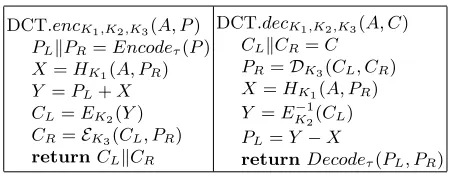
The encryption of DCT takes the input (A, P), whereA is the associated data and P is the plaintext, and outputs the ciphertextC. The decryption of DCT takes the input (A, C), and outputs the plaintextP if the verification is passed. The encryption and decryption of DCT are illustrated in Table1. The block length isn-bit.Encodeτ(P) puts 0τ on the left ofP and then partitions the data into two part PLkPR where |PL| = n. E is a block cipher. E is an encryption scheme andDis its inverse. If the leftτ bits ofPL are zeroes,Decodeτ(PL, PR) deletes the zeroes and returns the rest bits ofPLkPR, otherwiseDecodeτreturns
⊥indicating the verification is failed.
DCT.encK1,K2,K3(A, P)
PLkPR=Encodeτ(P) X=HK1(A, PR)
Y =PL+X CL=EK2(Y)
CR=EK3(CL, PR)
returnCLkCR
DCT.decK1,K2,K3(A, C)
CLkCR=C PR=DK3(CL, CR)
X =HK1(A, PR)
Y =EK−12(CL) PL=Y −X
returnDecodeτ(PL, PR)
Table 1.The encryption and decryption of DCT.
then
(
EK3(CL, PR) =PR+CT RT.GenK3(CL,|PR|) DK3(CL, CR) =CR+CT RT.GenK3(CL,|CR|)
.
The underlying UHF is defined as
HK1(A, PR) =K1·BRWK1(pad(A)kpad(PR)kL)
where the functionpad(X) padsX with the minimal number of trailing zeroes such that its length after padding are multiples ofn, L=len(A)klen(PR) that len(X) is an (n/2)-bit variable representing the bit length ofX. Note that the UHF description here is a bit different from the original design in [12], but it doesn’t affect the weak-key discussion in the following.
4.2 Weak keys of BRW-polynomial function in DCT.
When instantiating with BRW-polynomial function, which is suggested by its designers, DCT suffers the unavoidable weak-key problem, owing to ubiquitous weak keys of its BRW-polynomial UHF component, and the details are given out in the following.
AE schemes are designed to provide both the confidentiality of plaintexts and the integrity of plaintexts and associated data. However when weak keys are used, at least one of the security goal is broken. For example, GCM, one of the standardized AE schemes, fails to provide the integrity when using weak keys of its polynomial-function UHF, which is proved by the forgery attacks given in [14,27,25,39,1]. Another example is the robust AE scheme AEZ [16], which, when using weak keys given in [22], fails to offer the confidentiality, as its ciphertexts can be distinguished from random bits efficiently. As for BRW-instantiated DCT, both its confidentiality and integrity collapse, when using weak keys of BRW-polynomial. Besides it is easy to detect if the unknown key of BRW-polynomial belongs to some weak-key class.
Construct message pairs.The crux is how to construct distinct message pairs, say (A, P),(A0, P0), for any W, satisfying that
K1∈ W ⇐⇒ HK1(A 0, P0
R) =HK1(A, PR).
In the following, we explain how to find such pairs with SumBRWpoly and a little trick to deal with the padding rule.
For any s-key subsetW, let m = 2v+1−1 and v = blog2(s+ 1)c, i.e. s < m≤(2s+ 1). LetAbe arbitrarym-block message, i.e. A=M0· · ·Mm−1 where Mi∈ {0,1}n for i= 0,· · · , m−1. Letq(K1) = (K1−H0)· · ·(K1−Hs−1) and A0 =M0
0· · ·Mm0 −1=SumBRWpoly(q(K1), M0· · ·Mm−1), thus
BRWK1(M00· · ·Mm0 −1) =BRWK1(M0· · ·Mm−1) +q(K1). (11)
Besides, letPR=PR0 = 0nkU whereU ∈S(m−2)n l=0 {0,1}
l, and (
pad(A)kpad(PR)kL = M0· · ·Mm−1 k 0nkpad(U)kL pad(A0)kpad(PR0)kL0 = M00· · ·Mm0 −1 k 0nkpad(U)kL0
(12)
where L = len(A)klen(PR), L0 = len(A0)klen(PR0) and L = L0. Obviously, (m+ 2)n ≤| pad(A)kpad(PR)kL |≤ 2mn, i.e. at most 2(2s+ 2) blocks, and
|pad(A)kpad(PR)kL|=|pad(A0)kpad(PR0)kL|. Therefore, by (11)(12),
BRWK1(pad(A
0)kpad(P0
R)kL0) =BRWK1(pad(A0)kpad(PR0)kL) =BRWK1(M
0
0· · ·Mm0 −1)· K m+1 1 + 0
n
+BRWK1(pad(U)kL)
= (BRWK1(M0· · ·Mm−1) +q(K1))· K
m+1 1 + 0
n
+BRWK1(pad(U)kL)
=BRWK1(M0· · ·Mm−1)· K1m+1+ 0 n
+BRWK1(pad(U)kL) +q(K1)·K1m+1 =BRWK1(pad(A)kpad(PR)kL) +q(K1)·K
m+1 1 ,
and thus
K1∈ W [
{0} ⇐⇒ HK1(A0, PR0) =HK1(A, PR). (13) Moreover, with HK1(A0, PR0) = HK1(A, PR), let P = VkPR, P0 = VkPR0 whereV ∈ {0,1}n−τ, and thus
CL0 =CL, (14)
whereCL0kCR0 = DCT.encK1,K2,K3(A
0, P0),C
LkCR= DCT.encK1,K2,K3(A, P).
– Distinguishing attack. Make two encryption queries of (A, P),(A0, P0), and denote the ciphertexts as CLkCR, CL0kCR0 respectively. According to (14),CL=CL0 is always true in DCT, while happens with the small proba-bility of 2−n in the random case.
– Forgery attack.Make a single encryption query of (A, P) to get its cipher-text CLkCR, and forge the ciphertext of (A0, P0) as CLk(PR0 +PR+CR), wherePR+CR is the keystream which is produced by the CTRT encryption componentE, i.e.PR+CR=CT RT.GenK3(CL,|PR|).
More specifically, letCL0kCR0 = DCT.encK1,K2,K3(A
0, P0). By (14),C0
L=CL, and then CT RT.GenK3(CL0,|PR0|) = CT RT.GenK3(CL,|PR|) since |PR| =
|PR0|. ThusCR0 =PR0 +CT RT.GenK3(CL0,|PR0|) =PR0 +PR+CR.
Moreover it is easy to detect whetherK1 ∈ WS{0}. Simply make two en-cryption queries of (A, P),(A0, P0) and denote the ciphertexts asCLkCR, CL0kCR0 respectively. OnceCL0 =CL,HK1(A0, PR0) =HK1(A, PR) as the block-cipherE is a PRP, and by (13),K1∈ W.
Besides, ifK1 = 0, the UHF outputs 0 for arbitrary input, and thus when 0 ∈ W/ , by 1 more encryption query, it is able to detect either K1 = 0 or K1∈ W. That is, make a encryption query of some input (A00, P00) for anyA00 andP00=VkPR00, and observe if its firstn-bit ciphertext equalsCL.
Thus, any key subset W of BRW-polynomial function that |W| ≥ 2 is a weak-key class in BRW-instantiated DCT. Again, |W| ≥2 is required to avoid non-sense weak-key classes.
5
Conclusions
This work studies the weak-key problem of polynomial function and BRW-instantiated schemes. It is found that weak keys in BRW-polynomial function are ubiquitous, and that any key subset of BRW-polynomial which consists of at least 2 keys is a weak-key class in BRW-based cryptographic schemes like the Wegman-Carter scheme, the UHF-then-PRF scheme, DCT, etc. Similar weak-key classes also exist in more BRW-instantiated schemes [6,30,28,29,9]. Although the weak-key attack seems impossible to break the provable security of these schemes, the ubiquity of weak keys is a potential security risk.
Acknowledgements
The authors would like to thank the anonymous reviewers for their helpful com-ments and suggestions. The work of this paper is supported by the National Key Basic Research Program of China (2014CB340603) and the National Natural Science Foundation of China (Grants 61472415, 61732021, 61772519).
References
in Cryptology - EUROCRYPT 2015, Proceedings, Part I. Lecture Notes in Com-puter Science, vol. 9056, pp. 762–786. Springer (2015), http://dx.doi.org/10. 1007/978-3-662-46800-5_29 2,6,12,13
2. Abdelraheem, M.A., Bogdanov, A., Tischhauser, E.: Weak-key analysis of poet. Cryptology ePrint Archive, Report 2014/226 (2014), http://eprint.iacr.org/ 2014/226 2
3. Abed, F., Fluhrer, S., Foley, J., Forler, C., List, E., Lucks, S., McGrew, D., , Wenzel, J.: The POET family of on-line authenticated encryption schemes (2014), http://competitions.cr.yp.to/caesar-submissions.html 1,2
4. Andreeva, E., Bogdanov, A., Lauridsen, M.M., Luykx, A., Mennink, B., Tis-chhauser, E., Yasuda, K.: AES-COBRA (2014),http://competitions.cr.yp.to/ caesar-submissions.html 2
5. Bernstein, D.J.: The poly1305-AES message-authentication code. In: Gilbert, H., Handschuh, H. (eds.) FSE 2005, Revised Selected Papers. Lecture Notes in Com-puter Science, vol. 3557, pp. 32–49. Springer (2005),http://dx.doi.org/10.1007/ 11502760_3 2
6. Bernstein, D.J.: Polynomial evaluation and message authentication (2011),http: //cr.yp.to/papers.html#pema 2,7,15
7. Black, J., Halevi, S., Krawczyk, H., Krovetz, T., Rogaway, P.: UMAC: fast and secure message authentication. In: Wiener [38], pp. 216–233,http://dx.doi.org/ 10.1007/3-540-48405-1_14 1
8. Carter, L., Wegman, M.N.: Universal classes of hash functions. J. Comput. Syst. Sci. 18(2), 143–154 (1979) 1
9. Chakraborty, D., Mancillas-L´opez, C.: Double ciphertext mode: a proposal for secure backup. IJACT 2(3), 271–287 (2012),http://dx.doi.org/10.1504/IJACT. 2012.045588 2,15
10. Chakraborty, D., Sarkar, P.: HCH: A new tweakable enciphering scheme using the hash-encrypt-hash approach. In: Barua, R., Lange, T. (eds.) Progress in Cryptology - INDOCRYPT 2006. Lecture Notes in Computer Science, vol. 4329, pp. 287–302. Springer (2006),http://dx.doi.org/10.1007/11941378_21 1,2
11. Etzel, M., Patel, S., Ramzan, Z.: SQUARE hash: fast message authenication via optimized universal hash functions. In: Wiener [38], pp. 234–251,http://dx.doi. org/10.1007/3-540-48405-1_15 1
12. Forler, C., List, E., Lucks, S., Wenzel, J.: Efficient beyond-birthday-bound-secure deterministic authenticated encryption with minimal stretch. In: Liu, J.K., Ste-infeld, R. (eds.) Information Security and Privacy - 21st Australasian Confer-ence, ACISP 2016, Melbourne, VIC, Australia, July 4-6, 2016, Proceedings, Part II. Lecture Notes in Computer Science, vol. 9723, pp. 317–332. Springer (2016), http://dx.doi.org/10.1007/978-3-319-40367-0_20 2,3,12,13
13. Halevi, S., Krawczyk, H.: MMH: software message authentication in the gbit/sec-ond rates. In: Biham, E. (ed.) Fast Software Encryption 1997. Lecture Notes in Computer Science, vol. 1267, pp. 172–189. Springer (1997), http://dx.doi.org/ 10.1007/BFb0052345 1
14. Handschuh, H., Preneel, B.: Key-recovery attacks on universal hash function based MAC algorithms. In: Wagner, D. (ed.) CRYPTO. Lecture Notes in Computer Science, vol. 5157, pp. 144–161. Springer (2008) 2,5,13
15. Harris, S.: The Enchilada authenticated ciphers (2014),http://competitions.cr. yp.to/caesar-submissions.html 2
Cryptology - EUROCRYPT 2015 - 34th Annual International Conference on the Theory and Applications of Cryptographic Techniques, Sofia, Bulgaria, April 26-30, 2015, Proceedings, Part I. Lecture Notes in Computer Science, vol. 9056, pp. 15–44. Springer (2015),https://doi.org/10.1007/978-3-662-46800-5_2 13 17. IEEE Std 1619.2-2010: IEEE standard for wide-block encryption for shared storage
media (2011) 2
18. Krawczyk, H.: LFSR-based hashing and authentication. In: Desmedt, Y. (ed.) Ad-vances in Cryptology - CRYPTO ’94. Lecture Notes in Computer Science, vol. 839, pp. 129–139. Springer (1994),http://dx.doi.org/10.1007/3-540-48658-5_154, 5
19. McGrew, D.A., Fluhrer, S.R.: The extended codebook (XCB) mode of opera-tion. IACR Cryptology ePrint Archive 2004, 278 (2004), http://eprint.iacr. org/2004/278 1
20. McGrew, D.A., Viega, J.: The Galois/Counter mode of operation (GCM) (2004), http://csrc.nist.gov/groups/ST/toolkit/BCM/ 2
21. McGrew, D.A., Viega, J.: The security and performance of the Galois/Counter mode of operation (full version). IACR Cryptology ePrint Archive 2004, 193 (2004), http://eprint.iacr.org/2004/193 1
22. Mennink, B.: Weak keys for aez, and the external key padding attack. In: Hand-schuh, H. (ed.) Topics in Cryptology - CT-RSA 2017 - The Cryptographers’ Track at the RSA Conference 2017, San Francisco, CA, USA, February 14-17, 2017, Pro-ceedings. Lecture Notes in Computer Science, vol. 10159, pp. 223–237. Springer (2017),https://doi.org/10.1007/978-3-319-52153-4_13 13
23. Morales-Luna, G.: On formal expressions of BRW-polynomials. IACR Cryptology ePrint Archive 2013, 3 (2013),http://eprint.iacr.org/2013/003 7
24. Peyrin, T., Seurin, Y.: Counter-in-tweak: Authenticated encryption modes for tweakable block ciphers. In: Robshaw, M., Katz, J. (eds.) Advances in Cryptol-ogy - CRYPTO 2016 - 36th Annual International CryptolCryptol-ogy Conference, Santa Barbara, CA, USA, August 14-18, 2016, Proceedings, Part I. Lecture Notes in Computer Science, vol. 9814, pp. 33–63. Springer (2016),http://dx.doi.org/10. 1007/978-3-662-53018-4_2 12
25. Procter, G., Cid, C.: On weak keys and forgery attacks against polynomial-based MAC schemes. In: Moriai, S. (ed.) Fast Software Encryption - 20th International Workshop, FSE 2013. Lecture Notes in Computer Science, vol. 8424, pp. 287–304. Springer (2013),http://dx.doi.org/10.1007/978-3-662-43933-3_152,5,6,12, 13
26. Rabin, M.O., Winograd, S.: Fast evaluation of polynomials by rational preparation. Communications on Pure and Applied Mathematics 25(4), 433–458 (1972) 2 27. Saarinen, M.O.: Cycling attacks on GCM, GHASH and other polynomial MACs
and Hashes. In: Canteaut, A. (ed.) Fast Software Encryption - 19th International Workshop, FSE 2012. Lecture Notes in Computer Science, vol. 7549, pp. 216–225. Springer (2012), http://dx.doi.org/10.1007/978-3-642-34047-5_13 2, 6, 12, 13
28. Sarkar, P.: Efficient tweakable enciphering schemes from (block-wise) universal hash functions. IEEE Trans. Information Theory 55(10), 4749–4760 (2009),http: //dx.doi.org/10.1109/TIT.2009.2027487 2,7,15
30. Sarkar, P.: Modes of operations for encryption and authentication using stream ciphers supporting an initialisation vector. Cryptography and Communications 6(3), 189–231 (2014),http://dx.doi.org/10.1007/s12095-013-0097-7 2,15 31. Shoup, V.: Sequences of games: a tool for taming complexity in security proofs.
IACR Cryptology ePrint Archive 2004, 332 (2004), http://eprint.iacr.org/ 2004/332 4,5
32. Stinson, D.R.: Universal hashing and authentication codes. In: Feigenbaum, J. (ed.) Advances in Cryptology - CRYPTO ’91. Lecture Notes in Computer Science, vol. 576, pp. 74–85. Springer (1991),http://dx.doi.org/10.1007/3-540-46766-1_5 4
33. Stinson, D.R.: On the connections between universal hashing, combinatorial de-signs and error-correcting codes. Electronic Colloquium on Computational Com-plexity (ECCC) 2(52) (1995), http://eccc.hpi-web.de/eccc-reports/1995/ TR95-052/index.html 4
34. Sun, Z., Wang, P., Zhang, L.: Weak-key and related-key analysis of hash-counter-hash tweakable enciphering schemes. In: Foo, E., Stebila, D. (eds.) ACISP 2015. Lecture Notes in Computer Science, vol. 9144, pp. 3–19. Springer (2015), http: //dx.doi.org/10.1007/978-3-319-19962-7_1 2,5
35. Wang, P., Feng, D., Wu, W.: HCTR: A variable-input-length enciphering mode. In: Feng, D., Lin, D., Yung, M. (eds.) Information Security and Cryptology, CISC 2005. Lecture Notes in Computer Science, vol. 3822, pp. 175–188. Springer (2005), http://dx.doi.org/10.1007/11599548_15 1,2
36. Wang, P., Li, Y., Zhang, L., Zheng, K.: Related-key almost universal hash func-tions: definitions, constructions and applications. In: Peyrin, T. (ed.) Fast Software Encryption - 23rd International Conference, FSE 2016. Lecture Notes in Computer Science, vol. 9783, pp. 514–532. Springer (2016), http://dx.doi.org/10.1007/ 978-3-662-52993-5_26 2
37. Wegman, M.N., Carter, L.: New hash functions and their use in authentication and set equality. J. Comput. Syst. Sci. 22(3), 265–279 (1981) 1,4
38. Wiener, M.J. (ed.): Advances in Cryptology - CRYPTO ’99, Lecture Notes in Computer Science, vol. 1666. Springer (1999) 16