Available Online at www.ijcsmc.com
International Journal of Computer Science and Mobile Computing
A Monthly Journal of Computer Science and Information Technology
ISSN 2320–088X
IMPACT FACTOR: 6.017
IJCSMC, Vol. 6, Issue. 7, July 2017, pg.114 – 120
Improved Artificial Potential Field Based
Ant Colony Optimization for Path Planning
Azal H.Nazzal
Computer Science Department, University of Thi Qar, Iraq
Abstract- Path planning field for mobile robot is an important problem that involves finding free path from initial position to goal position .in this paper we introduce an improved artificial potential field based on ant colony optimization .which can obtain additional attractive force to prevent artificial potential field from local minimum .and use ant colony optimization to determine the location of goal in the environment .we develop ant colony optimization to optimize planned path .we do not use the pheromone in all the path from initial position to goal position. We use pheromone in the goal position only. After that the proposed algorithm applied in a laptop computing equipped with 1.80GHz Intel core CPU, 2.5GB memory with 2014 MATLAB in Windows 8.1 Operating System.The simulation results confirm that the proposed algorithm could always find shortest path in less time. The comparison between ant colony optimization and genetic algorithm was also made in this paper.
Keyword: path planning, ant colony optimization, artificial potential field, motion planning, multi robot.
I. INTRODUCTION
attractive force .the pheromone information generated from ACO is used to prevent (APF) from falling into local minimum.The remainder of this paper is structured as follows.In section 2 displays ant colony optimization. Section 3 displays artificial potential field. In section 4 displays the proposed algorithm. Section 5 discusses the simulation and result for this paper and finally 6 the conclusion for this paper.
II. ANT COLONY OPTIMIZATION
Ant Colony Optimization is a meta-heuristic for solving problems which need optimization. The idea of Ant colony Optimization was taking from the natural behaviour of ants in finding their short road from their living place (nest) to food.The unique feature in the ant colony is that, it finds the shortest path from the nest to the food resource without any direct communication between the ants. This is the basic idea of swarm intelligence that is noted not only in ants, it can be noted in birds, fishes, etc. The communication between the ants is based on the amount of the pheromone through their path. The difference in the amount of pheromone putted in the path taken by ants will shows the quality of the route selected to reach the food. [11]
A. Improvedant colony optimization
Original ant colony optimization (ACO) contains some limitations, such as occupy long time, getting into local minimum if the size of the problem is large. In original ant colony (ACO), the amount of pheromone of all elements are same started. So all the solutions are started blindly in the beginning of evolution phase, and it would occupy a long time to find a short path from many paths. So we should improve the ACO. We don’t need to put the pheromone in all the length of the path. We want to increase the attractive force to prevent the (APF) from local minimum. Therefore the robot moves in the environment to explore the entire environment because the robots don't have any information about the environment and determine the goal and obstacles locations by the pheromone putting in the position of the goal and the obstacles only. Amount the pheromone differ between the goals and obstacles location. Amount of pheromone in the goals location is very much while in the obstacles locations is little.
III.ARTIFICIAL POTENTIAL FIELD
APF mainly contains from two force vectors, caused by the obstacles and goals positions. The goal position generate the attractive forces to attract the robot to the goal while the obstacle position generate repulsive force to repel the robot from the obstacle .sum of these forces is controlling on the movement of the robot. [12]
A. Attractive and repulsive force
In artificial potential field, the goal position has attractive force on robots, and when the distance between the robots and goals increases, the attractive force increases. Position of robots in its work space referred to asq
x yT. The attractive field created by the goal is given by:
1
2
1
2
1
2 2q
kp
q
q
U
att
g
goalWhere k is a positive coefficient for APF, qg
xg,yg
T is the location of goal.Pgoal
q //qqg // Is thedistance from the location of robot to the position of goal. The attractive force is calculated by the negative gradient of the attractive potential and given the following form:
22
1 2
g goal
att
att q U q k p q kq q
qFatt is a vector directed toward qg with magnitude linearly related to the distance from q to qg. The
repulsive force has the form:
3 , , 0 , 1 1 2 1 0 0 2 0 p q q p p q p p q p q U ob rep Where is a positive scaling factor, let q0
x0,y0
be unique configuration in obstacle closest to q.p
q qq0 is the shortest distance between robot and obstacle. p0is the largest impact distance of single obstacle. The repulsive force is calculated by the negative gradient of the repulsive potential and given the following form:
4 , 0 , 1 1 1 0 0 2 0 p q p p q p q p q p p q p q U q Frep rep
The total artificial force is calculated:
q
F
attF
rep
5
F
WhereF
q is artificial force, Fattis attractive force andFrepis repulsive force. When the environment hasmulti obstacles, the total repulsive potential field is the sum of all obstacles' repulsive potential field. The total potential field can be expressed as:
61
n i repatt q F q
F q F
Where n: is the number of obstacle
IV.THE PROPOSED ALGORITHM
This paper improved artificial potential field by using the pheromone that generated from ant colony optimization (ACO) as additional force to increase the attractive forces that attract the robot which the robot will not fall into local minimum .the work of ant colony optimization is exploring all the environment when it find the goal the robot put pheromone in the goal location (the amount of pheromone is very much )while putting the little pheromone in obstacles location when it find obstacles . The pheromone amount in obstacle location is very little and does not affect at the total forces .the total attractive force that it attracts the robot is:
7p att
att F F
TF
Where TFattis the total attractive force,Fatt is attractive force that generate from goal position, Fpis the pheromone force. Now each robot is driving by the composition of three forces:
8rep att
t TF F
F
Where Ftthe total force is driving the robots,TFatt is the total attractive force, Frep repulsive force. The entire algorithm of our proposed method is as follow:
1. Select one robot randomly from multi robot.
2. The robot moves in the environment to explore the environment.
3. When it find goal, it puts the pheromone in the goal location.
4. When it finds obstacles, it puts the pheromone in the obstacles location but the amount of pheromone is very
little.
6. Compute the artificial potential force at current configuration under our proposed improved artificial potential field.
7. Move all robots to the environment.
8. Each robot has repulsive force with other robot to avoid the collision.
9. Each robot reaches to the goal without any collision with obstacles.
The robot is starting the movement from the first point of the environment to explore the environment according to the path planned by global planner .when it find goals in the path of robot it put some pheromone in the location of goals. The amount of pheromone in the location of goals is very much .When the robot finds the obstacle in the environment; it also put the pheromone in the location of obstacles. The amount of pheromone in the location of obstacle is little. In this paper are used multi robot, multi obstacle and one goal. The goal of the paper at first exploration the entire environment after that each robot must be reaches to the goal in the environment and avoids the collision with obstacles.
V. SIMULATION AND THE RESULT
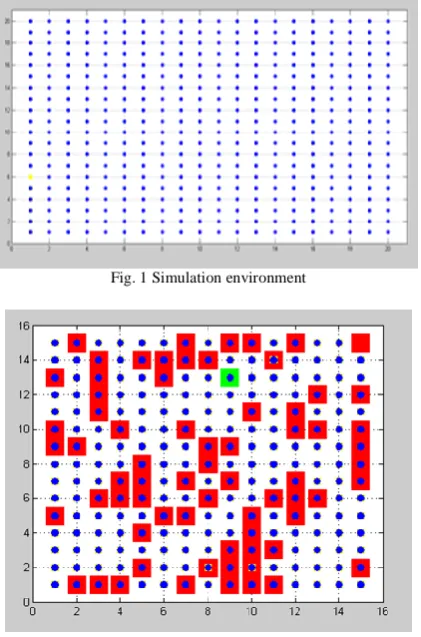
Some simulation experiments are carried out for validing the proposed algorithm using MATLAB. We used ant colony optimization to explore the environment by one robot. The environment is setting as square which shown in Fig.1. The paper has used different types of environments. Some environments were simple (number of obstacles is few and size of the environment is small). And some of them were very complex (number obstacles is too many and size of the environment is big). When the robot find goal it puts the green box in the location of goal and when it finds the obstacles it put the red box in the location of obstacles .Fig. 2 shows that:
Fig. 1 Simulation environment
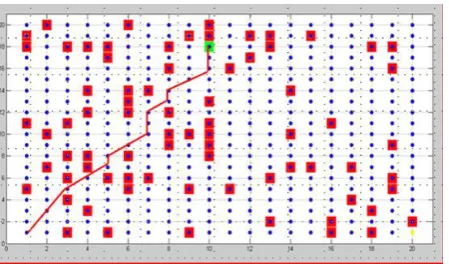
After that the robots calculate the (APF) and start to move to the goal. The simulation results shown in the figures, the green box and red box represent the goal and the obstacles position respectively, the red line represents the path of the robot to reach to the goal .Fig.3 to Fig.5 display the path of robot to reach the goal in different environments.
Then we used three robots all of them are moving at the same time without collision between each other. Each robot must be reach to the goal in the environment. In Fig.6 black box represents the first robot, Purple box represents the second robot and Turquoise box represents the third robot.
Fig. 3 displays path of robot in environment 20*20
Fig. 4 displays path of robot in environment 18*18
Environment
18*18 No. obstacles :70
20*20 No.
obstacles:78
25*25 No.
obstacles:80
Time (s) 15.9125 17.6281 26.6541
Distance (m)
24 29 33
"Table I" represents the results for the proposed algorithm. We also compare the performance of the proposed algorithm and that of GA in [13].we use the same environment that they used with GA. From "Table II", we can see that the performance of the proposed work better than the GA in the time and distance.
Distance (m)
Time (s)
The proposed algorithm
18*18
No. obstacles :78
16.7541 25
25*25
No.obstacles:80
26.6541 33
15*15
No. obstacles :70
13.9082 19
GA Iteration 20 737473 78403 Iteration 10 238.84 33.77 Iteration 5 970411 77431 Iteration 4 999473 73413
Fig. 6 movement of multi robot
TABLE I
THE RESULTS OF PROPOSED ALGORITHM
TABLE II
VI. CONCLUSION
Path planning problem is one of the most important robotic problems for mobile robot to accomplish given tasks. An improved artificial potential field ant colony optimization was proposed to obtain shortest path in less time without local minimum in unknown and static environment. Additional attractive force are utilized to eliminate local minimum caused by traditional APF when the composition of attractive force and repulsive force becomes zero. Exploration problem was solved by using the pheromone to determine the goal and obstacles position. This algorithm has been successfully applied through the MATLAB program without any problem. The paper tested the algorithm on a simple environments and complex environment. We use the environment with 3 robots, number of obstacles and one goal. The last work, the paper compares the performance of the proposed algorithm and that of GA. we see that the performance of the proposed work overmatches that of GA obviously as shown in "Table II".
REFERENCES
[1] Q.Aao, Y.Huan and Zhou,AN evolutionary artificial potential field algorithm for dynamic path planning of mobile robot, International conference proceedings on intelligent robots and system, pages 3331-3336,2006.
[2] O. Aichholzer, M. Cetina, R. Fabila-Monroy, J. Lea˜nos and J. Urrutia, Convexifying monotone polygons while maintaining internal visibility , XIV Spanish Meeting on Computational Geometry,2011.
[3] C.O Dunlaing and C.Yap. , Are traction method for planning the motion of a disc , journal of algorithms ,vol. 6,pages 104-111, 1982.
[4] D.Payton, J.Rosenblatt and D.Keirsey, Grid based mapping for autonomous mobile robot , Robotics and Autonomous systems, vol. 11, pages 13-21,1993.
[5] C. H. Cai and S. Ferrai,Information-driven Sensor Path Planning by Approximate Cell Decomposition , IEEE Trans on Systems, Man, and Cybernetics, Part B: Cybernetics, Vol.39, No.3, pp.672-689,2009.
[6] Tamilselvi , Mercy shalinie , Hariharasudan,2011, Optimal Path Selection for Mobile Robot Navigation Using Genetic Algorithm ,International Journal of Computer Science Issues, Vol. 8, Issue 4, No 1,2011.
[7]GUO Yu, LI Shi-yong.,Path Planning for Robot Based on Improved Ant Colony Algorithm, Computer Measurement and Control, 17(1), pp.187-190,2009.
[8] Mrs. Anita Gutta, Dr. Priti Srinivas Sajja,2013 , Fuzzy Logic based Intelligent Farming Multi Agent System ,Anita Gutta et al ,Int.J.Computer Technology & Applications, , Vol 4, pages28-32,2013.
[9] Youssef Bassil, 2012, Neural Network Model for Path-Planning Of Robotic Rover Systems , International Journal of Science and Technology, Vol. 2, No. 2,2012.
[10] Micael S. Couceiro, Rui P. Rocha and Nuno M. F. Ferreira, A Novel Multi-Robot Exploration Approach based on Particle Swarm Optimization Algorithms, IEEE International Symposium on Safety, Security and Rescue Robotics,2011.
[11] GUO Yu, LI Shi-yong,Path Planning for Robot Based on Improved Ant Colony Algorithm, Computer Measurement and Control, 17(1):pp.187-190,2009.
[12] Guanghui Li, Atsushi Yamashita and Hajime Asama, Yusuke Tamura, An Efficient Improved Artificial Potential Field Based Regression Search Method for Robot Path Planning, IEEE International Conference on Mechatronics and Automation2012.