A Generic Strategy for Cold-Start Rating
Prediction Problem Using RAPARE
Vijayalakshmi S 1, Ramya J 2
P.G. Student, Department of Computer Science And Engineering, K.Ramakrishnan College of Engineering,
Samayapuram, Trichy, Tamilnadu, India1
Assistant Professor, Department of Computer Science And Engineering, K.Ramakrishnan College of Engineering,
Samayapuram,Trichy, Tamilnadu, India2
ABSTRACT: Recommender system is one of indispensable components in many e-commerce websites. One of the major challenges that largely remain open is the cold-start problem, which can be viewed as a barrier that keeps the cold-start users/items away from the existing ones. In this paper, we aim to break through this barrier for cold-start users/items by the assistance of existing ones. In particular, inspired by the classic Elo Rating System, which has been widely adopted in chess tournaments, to propose a novel rating comparison strategy (RAPARE) to learn the latent profiles of cold-start users/items. The centre piece of our RAPARE is to provide a fine-grained calibration on the latent profiles of cold-start users/items by exploring the differences between cold-start and existing users/items. As a generic strategy, our proposed strategy can be instantiated into existing methods in recommender systems. To reveal the capability of RAPARE strategy, we instantiate our strategy on two prevalent methods in recommender systems, i.e., the matrix factorization based and neighbourhood based collaborative filtering
KEYWORDS: Recommender systems, cold-start problem, rating comparison strategy
I. INTRODUCTION
Despite the success of existing recommender systems all over the world, the cold-start problem, i.e., how to make proper recommendations for cold-start users or cold-start items, largely remains a daunting dilemma. On one hand, cold-start users (e.g., who have rated no more than10 items) and cold-start items (e.g., which have received no more than 10 ratings) occupy a large proportion in many real applications such as Netflix.
On the other hand, the effectiveness of the existing recommendation approaches (e.g., collaborative filtering) largely depends on the sufficient amount of historical ratings, and hence these approaches might quickly become ineffective for cold-start users/items that only have few ratings. To date, many collaborative filtering methods have been proposed to mitigate the cold-start problem, and these efforts can be divided into three classes.
RAPARE compare differences between existing users and cold start users.RAPARE uses two methods for comparison. Matrix Factorization (MF) andCollaborative Filtering (CF).RAPARE strategy is inspired by Elo Rating System.Matrix Factorization assumes that user’s opinions to items are based on the latent profiles for both users and items.
With this assumption, MF projects for both users and items into a joint latent factor space. The latent factors in the latent space can be seen as the latent profiles for users/items.CF consists of a combination of records and filter those records based on RAPARE.
II. RELATED WORK
In [2] authors used a well designed interview process is introduced for cold-start users [10]. During this interview
information such as the user/ item attributes [11] and social relationships [12] for the coldstart problem. The advantage is that these methods could be applicable for a new user/item with not rating at all. However,
they rely on the access of such side information. These methods are inapplicable when the information is not available due to some reasons (e.g., privacy issue, user’s social network structure not existing [12]), and has a higher computational cost compared with its side information free counterpart. In the third class, the cold-start problem is tackled in a dynamic manner. The intuition is that, compared to existing users/items, ratings for cold-start users/items may be more valuable to improve the accuracy of recommendation for these cold-start users/items; consequently, methods in this class aim to provide fast recommendations for cold-start users/items specifically, and then dynamically and efficiently adjust their latent profiles as they give/receive new ratings. Existing methods in this class include the incremental singular value decomposition (iSVD) method [13] and the incremental matrix factorization (MF) method [14], [15], etc.
III. PROPOSED SYSTEM
A novel rating comparison strategy (RAPARE) to learn the latent profiles of cold-start users/items. The center-piece of our RAPAREis to provide a fine-grained calibration on the latent profiles of cold-start users/items by exploring the differences between cold-start and existing users/items. The proposed system is aimed at eliminating the inactive products from recommendation system and makes every product active with the help of proposed RAPARE strategy. The RAPARE strategy overcomes the inactive products by proposing theELO rating system. If a product is cold product the admin will rate the product by giving a review, now the product will activated and it will flow into the recommendation system.
The project has modules like
• Dataset Fetching
• RAPARE
• Recommendation
• Prediction Accuracy
A. Dataset Fetching
First of all we have to load our dataset for our entire process. Initially we load the Link Dataset which contain the movie id , Imbed and Tmdb Id Next we load the Movie Information. It Contains the User id , Movie Id.
B. RAPARE
RAPARE is a generic rating comparison strategy (RAPARE) to make proper recommendations for cold-start problem. In particular, the RAPARE strategy provides a special, fine-grained treatment for cold-cold-start users and cold-start items.
C. Recommendation
The action of recommending something or someone. It seeks to predict the"rating" or "preference" that user would give to an item
D. Prediction Accuracy
Prediction accuracy is one of finding frequent measurements calculations using user ratings and reviews. In this recommendatory processing data user has given levels of items and its feedbacks through precision and recall
measurements also finding. Accuracy and performance. Prediction can be applied to the prediction of continuous values by taking the average value of each prediction for a given test tuple.
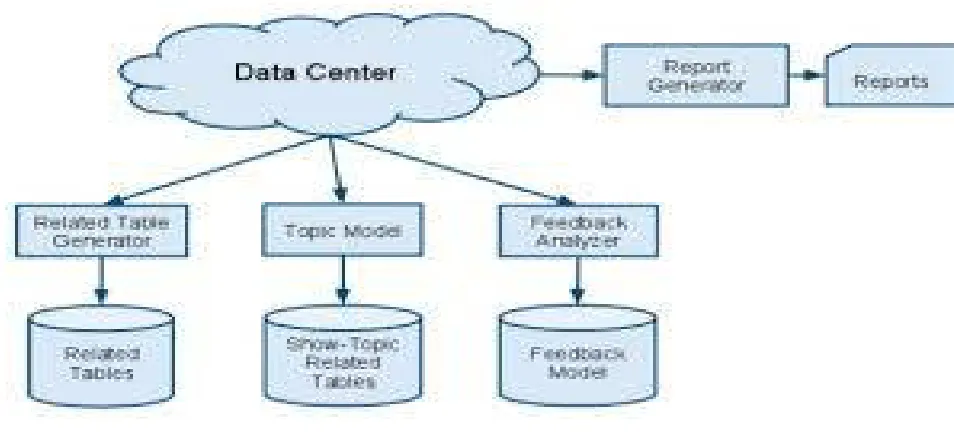
IV.SYSTEM ARCHITECTURE
development, then design is the act of taking the marketing information and creating the design of the product to be manufactured.
Fig 1.SYSTEM ARCHITECTURE
V.RESULT AND OUTCOME
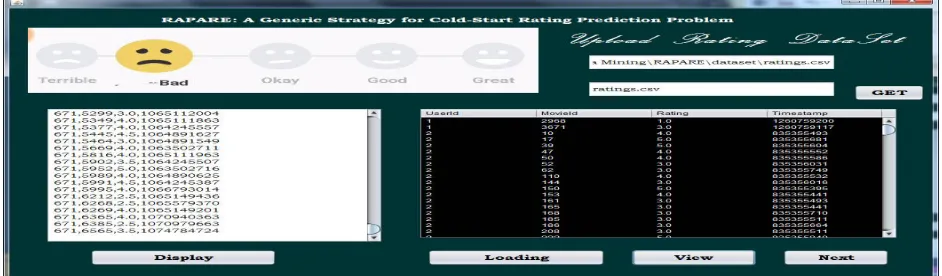
This shows the home page of RAPARE.
This page shows the loading of dataset.
Fig.3 LINK DATASET
This page shows the movie dataset.
Fig.4 MOVIE DATASET
VI.CONCLUSION AND FUTURE WORK
A generic rating comparison strategy (RAPARE) has been proposed to make proper recommendations for
cold-start problem. In particular, the RAPARE strategy provides a special, fine-grained treatment for cold-start users and cold-start items. This generic strategy can be instantiated to many existing methods for recommender systems. RAPARE-MF (instantiating with matrix factorization method) and RAPARE-KNN (instantiating with nearest neighborhood method) models as well as algorithms were proposed to solve cold start problems.
REFERENCES
1. Das S., Datar M., Garg A. and Rajaram S. “Google news personalization: scalable online collaborative filtering,” in WWW.ACM,pp. 271–280,
2007
2. Davidson J., Liebald B., Liu J., Nandy P., Van Vleet T., Gargi U., Gupta S., Lambert M. and Livingstonet al B. “The youtube video recommendation system,” in RecSys. ACM, pp. 293–296, 2010
3. Lin J., Sugiyama K., Kan M.Y and Chua T.S. “Addressing cold-start in app recommendation: latent user models constructed from twitter followers,” in SIGIR. ACM, pp. 283–292, 2010
4. Linden G., Smith B. and York J. “Amazon. com recommendations: Item-to-item collaborative filtering,” Internet Computing, IEEE, vol. 7, no.
1, pp. 76–80, 2003
5. MereAcela and Aslant A. “A collaborative filtering methodbased on artificial immune network,” Expert Systems with Applications, vol. 36,
no. 4, pp. 8324–8332, 2009
6. ocher T., Jared M. and Bell R. M. “The big chaos solution to the Netflix grand prize,” Netflix prize documentation, 2009
7. Rashid M., Albert I., Cosley D., Lam S.K., McNee S.M., Konstan J.A. and Riedl J. “Getting to know you: learning new user preferences in
recommender systems,” in IUI. ACM, pp.127–134, 2002
8. Resnick P. and Varian H. R. “Recommender systems,” Communications of the ACM, vol. 40, no. 3, pp. 56–58, 1997
9. Sarkar, Karis G., Konstanz J. and Riel J. “Application of dimensionality reduction in recommender system-a case study,” DTIC Document,
Tech. Rep, 2000
10. Sarwar, Karypis G., Konstan J. and Riedl J. “Incremental singular value decomposition algorithms for highly scalable recommender systems,”
in Fifth International Conference on Computer and Information Science. Citeseer, pp. 27–28, 2002
11. Schafer J.B, Frankowski D., Herlocker J. and Sen S. “Collaborative filtering recommender systems,” in the adaptive web. Springer, pp. 291–
324, 2007
12. Xu J., Yao Y., Tong H., Tao X. and Lu J. "RAPARE: A Generic Strategy for Cold-Start Rating Prediction Problem ", 2017
13. .Zhang M., Tang J., Zhang X. and Xue X. “Addressing cold start in