Fall Detection for Elderly People in Homes
using Kinect Sensor
Disha Pathak1, V. K. Bhosale2
M.E Student, Dept. of Electronics and Telecommunication, DIEMS, Aurangabad, MS, India1 Associate Professor, Dept. of Electronics and Telecommunication, DIEMS, Aurangabad, MS, India2
ABSTRACT: All over the globe, the population of elderly people has been steadily increasing. Fall events are a foremost reason of fatal injury for them. The immediate detection of fall events can decrease the death risk. Thus it is very important to detect fall events as soon as possible, so that immediate assistance may be provided. Computer vision-based system offers low-cost and satisfactory results for fall detection. In this paper, a method for detecting falls for elderly people in homes is proposed, by analyzing the tracked key joints of the human body using the Microsoft Kinect. In contrast to other fall detection methods that rely on the RGB inputs, the proposed system is independent of illumination of the lighting conditions and can work even in a complete darkroom. Using depth images obtained by Kinect sensor could bring innovative ways to build smart fall detection systems that could use to observe the elderly people at homes, and notify the caretakers by raising an alarm in case of falling events. In this paper, an algorithmic method of fall detection system is proposed, that runs in a real time scenario based on skeleton extraction of a human figure with the help of Kinect depth sensor. Once a fall event is encountered an alert is sent to the particular elderly person’s caretaker using SIM900A GSM modem. Based on a data set of 50 people, experimental results validates that the proposed method accomplishes near 94.65% frame accuracy in a real home environment.
KEYWORDS: Fall detection, Microsoft Kinect, Depth image, Skeleton extraction, GSM SIM900A
I. INTRODUCTION
Fall of frail people is both a medical and a social issue. Falls and their consequences, such as bone fractures, tissue injuries, lacerations, joint dislocations, bone fractures and head trauma are a major risk for elderly people especially who live alone where instant help is needed. According to [1], falls are the sixth most common reason of fatality for people above the age of 65. Moreover, it is the second most common cause of fatality for people between the age of 65 and 75, and the most common cause for people over 75. As per World Health Organization [2] approximately 28-35% of people aged 65 and over fall each year increasing to 32-42% for those over 70 years of age. The occurrence of fall increases with age and frailty level and often results in severe physical and psychosomatic consequences. Immediate fall detection can thus decrease the mortality risk and raises the possibility to survive the incident and return back to independent living [3]. Therefore, automatically detecting falls at home has become a major attention in research. Many approaches and algorithms have been developed by researchers all over the world for reporting or detecting falls among elderly people. These consist of wearable devices that allow an individual to manually press a button in the event of fall, as well as wearable devices such as wristwatches and necklaces that automatically detect fall events with the help of sensors such as accelerometers. However studies have indicated elderly people prefer nonwearable sensors. A number of researchers have also looked at the use of environmentally mounted sensors for fall detection, such as floor
vibration sensors, passive infrared sensors, acoustic sensors, and video-based sensors. Considering all the above aspects proposed system is designed that uses vision-based approach and which utilizes the skeleton tracking of a human being. This paper presents a method for detecting fall events using a depth imaging sensor i.e Microsoft Kinect. As soon as a fall is detected a SMS message is sent on a predefined person’s number using GSM modem. Other benefits of the proposed method, with respect to traditional video-based ones are as follows:
Does not depends on lighting conditions
Need of a single camera to obtain 3D information
II. RELATED WORK
Various methods have been proposed for detecting fall events and are mainly divided into two categories: Non computer vision based and computer vision-based methods.
Non computer vision based methods
There are a variety ofnon-computer vision-based methods for fall detection. In these methods various sensors (acoustic, acceleration and floor vibration sensors) are used to acquire the sound, vibration, and human body movement data and the collected information is then analyzed to determine a fall. Non computer vision based methods can be performed either of the two ways :
Wearable sensor methods
Ambient/Fusion based method
Various fall detection techniques uses accelerometers, gyroscopes, or both. However these techniques have a major disadvantage that the person have to wear these devices throughout the day. Also the usage of button is ineffective in case of devices requiring actions on the part of wearer due to loss of consciousness of the wearer following a fall event [4-7].
Fig. 1. Classification of Fall detection methods
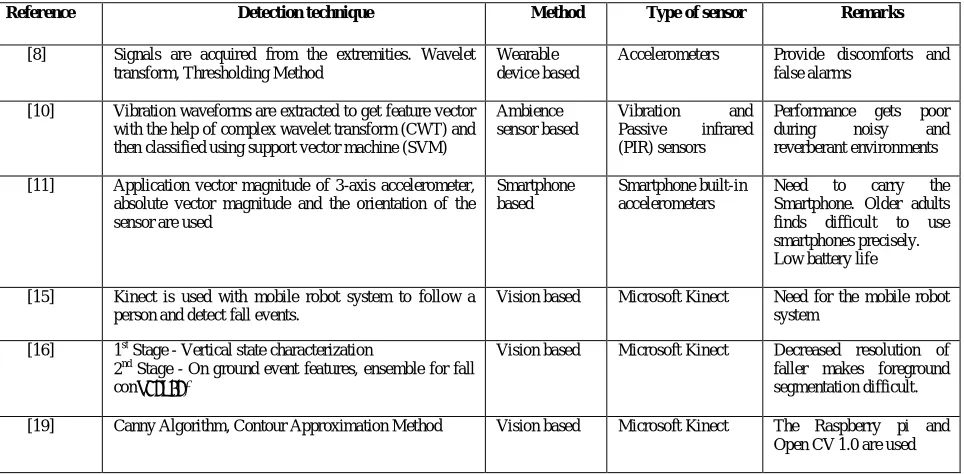
Using MEMS accelerometers a fall detection method is presented in [8].Acoustic sensor based systems make use of sound volume from microphone to detect fall events. Khan [9] proposed an unsupervised fall detection system that uses acoustic signals (footstep sound signals) and then used them to differentiate falls from non falls events. An additional approach is the floor vibration detectors that are based on floor dynamics. In 2014, Yahar [10] presented a method for detecting falls using vibration and passive infrared (PIR) sensors. Smartphone based fall detection system are another unobtrusive method widely used these days. Suryadevara [11] proposed an android based fall detection system. These smartphones has an inbuilt GPS, accelerometers, microphone camera, digital compass and gyroscope. However major drawback of this approach is low battery life of smart phones and handling smartphones precisely.
Computer vision based methods
These systems have a foremost benefit over non vision system. In these methods it is not mandatory to wear any devices. Here one or more cameras is used to track people. They can be performed either of the three ways :
Methods using a single RGB camera
3D- based methods using multiple cameras
3D- based methods that use depth cameras
Various algorithms for fall detection have been developed so far. Kępski [12], detected fall events by tracking of
person’s head in depth maps. However this method is not robust since there is a large contrast between the fall like event and an actual fall. Using 3D data a fuzzy logic based fall detection algorithm is proposed in [13]. An another approach in detecting the fall events is proposed by Feng [14], which gives detection by extracting foreground human silhouette via background modeling. Sumiya [15] used well defined skeleton tracking feature to track the person. In this
Fall Detection
Wearable sensor Ambient/Fusion
Vision Accelerometer
Inactivity Posture Vibration
Audio & Video
Body Shape
Posture/ Inactivity
3D Head change
work, the Kinect device is used along with a mobile robot to accomplish fall detection. An improvement of 80% in fall detection rate in comparison to conventional monitoring technique using position fixed sensors is obtained. Stone [16] proposed a two-stage approach using Microsoft Kinect sensor for detecting fall events. Here depth map of the person is used for segmenting the spectral intensities of varied body depths. In [17], depth map estimation of 3D bounding boxes are formed for the relevant targets and fall detection is done. Bevilacqua [18] proposed a system based on assessing the contraction and the expansion speed of the width, height and depth of the 3D human bounding box. In [19] another kinect based method using raspberry pi and Open Cv is used.
TABLE I : Comparison of Few Different Approaches
Reference Detection technique Method Type of sensor Remarks
[8] Signals are acquired from the extremities. Wavelet transform, Thresholding Method
Wearable device based
Accelerometers Provide discomforts and false alarms
[10] Vibration waveforms are extracted to get feature vector with the help of complex wavelet transform (CWT) and then classified using support vector machine (SVM)
Ambience sensor based
Vibration and Passive infrared (PIR) sensors
Performance gets poor during noisy and reverberant environments
[11] Application vector magnitude of 3-axis accelerometer, absolute vector magnitude and the orientation of the sensor are used
Smartphone based
Smartphone built-in accelerometers
Need to carry the Smartphone. Older adults finds difficult to use smartphones precisely. Low battery life
[15] Kinect is used with mobile robot system to follow a person and detect fall events.
Vision based Microsoft Kinect Need for the mobile robot system
[16] 1st Stage - Vertical state characterization
2nd Stage - On ground event features, ensemble for fall confidence.
Vision based Microsoft Kinect Decreased resolution of faller makes foreground segmentation difficult.
[19] Canny Algorithm, Contour Approximation Method Vision based Microsoft Kinect The Raspberry pi and Open CV 1.0 are used
III.SYSTEM DEVELOPMENT
In the proposed method Kinect studio version 1.8.0 is installed to grab and access the depth data from Kinect sensor. For this Matlab Software is adopted. Here MATLAB R2013 version is used. With the aid of image processing toolbox, detection of fall events is made. Fig. 2 shows the proposed fall detection system.
Fig. 2. Proposed Fall Detection system Kinect
Sensor
Live video stream
Computer system with
Matlab tool
Serial to USB converterr
A. MICROSOFT KINECT
Microsoft Kinect is essentially a set of sensors that was formerly developed as an input tool for the Xbox 360 and Xbox One gaming console. It comprise of the infrared projector, IR camera which is utilized for getting precise depth maps, a RGB color camera , a four-microphone array and a motorized tilt. Image streams at 30 frames per second (fps) are produced in both cameras. The IR camera can capture 3D video data under any ambient light conditions with the help of structured light technology. The depth values depict the distance not to the focal point but to the imaginary image plane. The IR projector shoots an irregular pattern of dots with a wavelength comprising of 700nm to 1mm.Thus this pattern of dots is invisible to humans. Besides providing depth images, an additional feature of the Kinect sensor is a skeletal tracker. The Kinect for Windows SDK provides a skeleton-tracking feature which allows developers to recognize people and track their actions. With the help of depth sensors, Kinect can recognize up to six users standing from 0.8 to 4.0 meters (i.e 2.6 to 13.1 feet). Furthermore two of the detected skeleton can also be tracked in aspect with twenty joint positions. Each skeleton joint is calculated in a three dimensional (X, Y, Z) plane. The X – axis will vary when the joints move from the right side to the left side or vice versa, while the Y axis will vary when the joints move either in the upwards or downwards direction. Similarly, Z axis will vary when the joint is moved back and forth in relation to the Kinect sensor.
B. SIM 900A GSM MODEM
SIM900A is an ultra compact and reliable wireless module. It delivers GSM/GPRS 900/1800MHz performance for voice, SMS, Data, and Fax. SIM900A GSM modem is regulated by the AT (ATtention) command and is set to the SMS text mode to send an SMS message. Few of SIM900A features are as follows:
Dual band GSM/GPRS 900/1800MHz.
Configurable baud rate
SIM card holder
Low power consumption: 1.5mA (sleep mode)
C. PROPOSED ALGORITHM
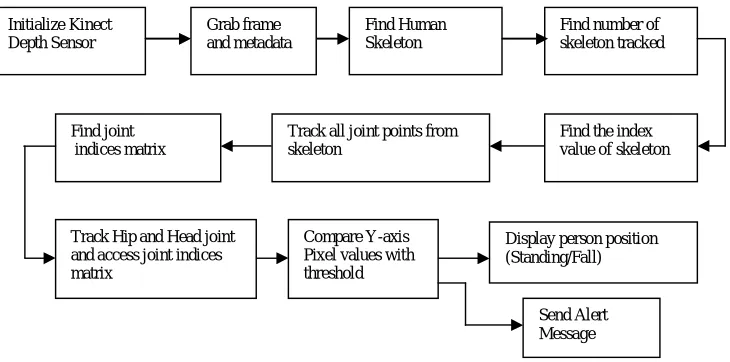
The proposed algorithm is based on depth map and makes use of a Microsoft Kinect device. Here system will detect the skeletal data to recognize elderly people and track their actions. In this work it is assumed that the elderly person is completely perceptible and do not have any occlusions. The Kinect sensor is steady and the movement of the subject along the sensor is restrained to a range. An overview of the proposed fall detection method is as shown. The logical steps on which the proposed system is built are as follows:
Fig. 3. Data Flow of Proposed Fall Detection system Initialize Kinect
Depth Sensor
Grab frame and metadata
Find Human Skeleton
Find number of skeleton tracked
Find the index value of skeleton Track all joint points from
skeleton Find joint
indices matrix
Track Hip and Head joint and access joint indices matrix
Compare Y-axis Pixel values with threshold
Display person position (Standing/Fall)
1. Initialize Depth Sensor
In the proposed method, this block helps to acquire the live depth image from Kinect sensor using Image Acquisition Toolbox.
2. Grab Frames and Metadata
Following initialization of the depth sensor, the next step is to trigger the depth sensor to start grabbing the frames and the related metadata.
3. Human Skeletons
Extricate skeleton diagram of the human body which is in vicinity of the Kinect sensor irrespective to other objects in the frame. Thereafter the number of skeleton tracked and its index value is calculated.
4. Joint Indices Matrix
For each tracked skeleton 20 joint points are obtained. This is a 20 x 2 double matrix of x-and y-coordinates for 20 joints in pixels relative to the depth image.
5. Access Hip and Head Joint Points
After obtaining the joint indices matrix (20X2), the indices values related to hip joint and head joint is found and accessed. Store the y- axis pixel values of the hip and head joint in predefined variables.
6. Compare Pixel Values with Threshold
Compare the y axis pixel values of the hip and head joint with a threshold and compute the person’s position (Standing/ Fall).
7. Alert SMS Message
As soon as a fall is detected, the system starts its timer and waits for 10sec to send an alert sms message to a predefined mobile number. If the person is still in fallen condition after the given delay of 10sec then system sends the text message. Otherwise no alert message is sent.
IV.RESULTS
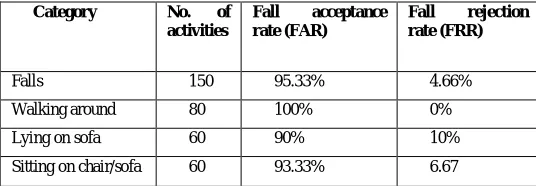
The proposed method is implemented in MATLAB R2013 using the Open Kinect libraries and has been tested at different time and lighting conditions on a 50 person dataset of different height, weight and age.
TABLE II : Percentage Success of different positions
Category No. of activities
Fall acceptance rate (FAR)
Fall rejection rate (FRR)
Falls 150 95.33% 4.66%
Walking around 80 100% 0%
Lying on sofa 60 90% 10%
Sitting on chair/sofa 60 93.33% 6.67
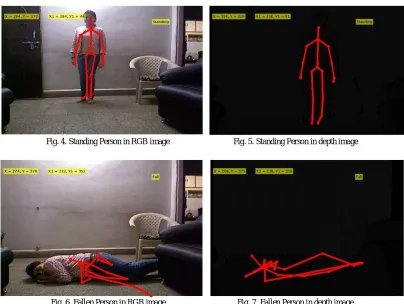
The proposed fall detection algorithm is implemented with MATLAB. Figures (4-7) shows RGB and depth image of captured data with skeleton tracking. The live images are captured and featured by the fall detection algorithm, the y axis pixel values of the hip and the head joint is extracted and compared with their respective thresholds. The images are taken for testing and the following result is displayed.
the y axis values i.e Y and Y1 are greater than the predefined threshold value the output is Fall. Based on depth image sequence, by extracting and tracking the joints of the human body as well as investigating the joints’ behaviour after fall, the proposed algorithm can detect and confirm the human fall accurately.
Fig. 4. Standing Person in RGB image Fig. 5. Standing Person in depth image
Fig. 6. Fallen Person in RGB image Fig. 7. Fallen Person in depth image
The distance of the Kinect sensor has been varied from 0.8m to 4.5m, which is technically its sensing range. The realization of the proposed fall detection algorithm is dependent upon the tracked key joints of the human body acquired from the Kinect sensor. Two parameters are extracted, by comparing these values with the threshold, the system judges whether human falls down. The results are summarized in Figure 7. Here the y axis represents the fall detection rate (%), whereas the x-axis denotes the distance between the sensor and subject in meters.
Fig. 4. Fall detection rate
0 20 40 60 80 100
0.8 1.5 2 2.5 3 3.5 4 4.5
Fall detection rate (%)
V. CONCLUSION AND FUTURE WORK
In this paper, a fall detection method for elderly people based on the skeleton extraction using Kinect sensor is presented. The system is highly reliable and vigorous since it works on the real time data instead of database. The proposed fall detection approach uses the infrared based depth camera, so the system can operate even in the dark condition. It can be used in homes, hospitals and recreation centres for the elderly. Significant innovation of the proposed method is its independence from the direction of the fall, in contrast to other approaches in which fall is usually identified only as a rapid vertical motion.
The experimental results based on 50 people demonstrates that proposed fall detection system attains a high fall detection rate near 94.65%. The use of skeleton tracking for fall detection was quite satisfactory, but future work requires an additional upgrading in the fall detection methodology. Also future work include to enlarge the coverage area, advance the minor movement tracking of elderly people and update the status to the caretakers using cloud services, and to develop an IOT application of the same.
REFERENCES
1. Mundher, Zaid A., and Jiaofei Zhong. "A real-time fall detection system in elderly care using mobile robot and kinect sensor." International Journal of Materials, Mechanics and Manufacturing 2.2 (2014): 133-138.
2. Igual, Raul, Carlos Medrano, and Inmaculada Plaza. "Challenges, issues and trends in fall detection systems." Biomedical engineering online 12.1 (2013): 1.
3. Yang, Lei, Yanyun Ren, and Wenqiang Zhang. "3D depth image analysis for indoor fall detection of elderly people." Digital Communications
and Networks2.1 (2016): 24-34.
4. Jagtap, Arti, et al. "Fall Detection and Alerting System using Kinect Sensor and GSM." International Journal of Engineering Science 7069 (2016).
5. Garripoli, Carmine, et al. "Embedded DSP-based telehealth radar system for remote in-door fall detection." IEEE journal of biomedical and health informatics 19.1 (2015): 92-101.
6. Delahoz, Yueng Santiago, and Miguel Angel Labrador. "Survey on fall detection and fall prevention using wearable and external
sensors." Sensors14.10 (2014): 19806-19842.
7. Mubashir, Muhammad, Ling Shao, and Luke Seed. "A survey on fall detection: Principles and approaches." Neurocomputing 100 (2013):
144-152.
8. Prince PGK, Hemamalini R, Rajkumar RI. LabVIEW based abnormal muscular movement and fall detection using MEMS Accelerometer
during the occurrence of seizure. Indian Journal of Science and Technology. 2014; 7(10):1625–31.
9. Khan, Muhammad Salman, et al. "An unsupervised acoustic fall detection system using source separation for sound interference
suppression." Signal processing 110 (2015): 199-210.
10. Yazar, Ahmet, Fatih Erden, and A. Enis Cetin. "Multi-sensor ambient assisted living system for fall detection." Proceedings of the IEEE International Conference on Acoustics, Speech, and Signal Processing (ICASSP’14). 2014.
11. Suryadevara, Vinay Kumar, and Maher Rizkalla. "Smartphone Based Fall Detection and Logic Testing Application Using Android
SDK." Journal of Biomedical Science and Engineering 8.09 (2015): 616.
12. Kępski, Michał, and Bogdan Kwolek. "Person detection and head tracking to detect falls in depth maps."International Conference on Computer Vision and Graphics. Springer International Publishing,
13. Planinc, Rainer, and Martin Kampel. "Robust fall detection by combining 3D data and fuzzy logic." Asian Conference on Computer Vision. Springer Berlin Heidelberg, 2012.
14. Feng, Weiguo, Rui Liu, and Ming Zhu. "Fall detection for elderly person care in a vision-based home surveillance environment using a
monocular camera." Signal, Image and Video Processing 8.6 (2014): 1129-1138.
15. Sumiya, Takuma, et al. "A mobile robot for fall detection for elderly-care." Procedia Computer Science 60 (2015): 870-880.
16. Stone, Erik E., and Marjorie Skubic. "Fall detection in homes of older adults using the Microsoft Kinect." IEEE journal of biomedical and health informatics 19.1 (2015): 290-301.
17. Mastorakis, Georgios, and Dimitrios Makris. "Fall detection system using Kinect’s infrared sensor." Journal of Real-Time Image
Processing 9.4 (2014): 635-646
18. Bevilacqua, Vitoantonio, et al. "Fall detection in indoor environment with kinect sensor." Innovations in Intelligent Systems and Applications (INISTA) Proceedings, 2014 IEEE International Symposium on. IEEE, 2014.