Slykhuis, David A. The Efficacy of World Wide Web-Mediated Microcomputer-Based Laboratory Activities in the High School Physics Classroom. (Under the direction of Dr. John C. Park)
Dedication
Biography
David was born in Iowa and raised there in a small Dutch community. He attended the University of Northern Iowa as an undergraduate where his career path was influenced by Dr. Roy Unruh and Dr. Amy Phelps. At UNI, he completed a BA with an All-Science Teaching major and a Coaching minor. While at UNI, David married his high school sweetheart, Julie.
From UNI, David spent five wonderful years in Pana, Illinois. There he taught high school physical science, biology, chemistry, advanced chemistry, and physics. He also served in a variety of extra curricular activities including girls golf coach, freshman boys basketball coach, academic bowl sponsor, science fair, and class sponsor.
While in Illinois, David began attending Eastern Illinois University during the summers. After three years, David received his Master of Science in Education with an Emphasis in Physical Science from EIU. This degree allowed him to teach night classes in chemistry for Lakeland Community College. While living in Pana, David’s first daughter, Hollyn, was born.
Acknowledgements
First, I would like to thank the Lord for giving me the opportunity, means, and ability to complete this dissertation and degree. Second, I would like to thank my wife for both her skills as an editor for this dissertation and as a mother while I have been working long hours.
I would like to thank all my current and former committee members, Dr. John Park, Dr. Glenda Carter, Dr. Gail Jones, Dr. David Haase, Dr. Susan Butler, and Dr. Leigh Ann Haefner for their time and effort to help this project reach completion. Special thanks go to Dr. Park for his guidance and direction on this project and for providing the materials necessary for this research project. I would also like to thank Dr. Wiebe for his assistance and collaboration.
A special thanks to the teachers in whose classrooms this project was
completed and without whose help this would have been impossible. Mike Welter, Lou Foley, Bob Quakenbush, Lisa Edwards, and Shawna Young all graciously opened their classrooms to me and worked hard to facilitate this research project.
Table of Contents
List of Tables………..………ix
List of Figures……….………..…….………xi
Chapter 1- Introduction………... 1
Problem………...2
Resource…….…...………..4
Theoretical Framework…..……….………...5
Research Questions…….…………...………...…….8
Limitations………..……9
References……….12
Chapter 2- Literature Review……….……15
Introduction……….…….16
1920’s-1950’s Educational Philosophy- Progressivism………..…….17
1950’s-1980’s Educational Philosophy- Behaviorism……….19
1980’s –Today Educational Philosophy- Constructivism………..…22
Technology and Progressivism- 1920’s-1950’s……….…...24
Technology and Behaviorism- 1950’s-1980’s……….………..28
Technology and Constructivism- 1980’s-Today……….……….32
The World Wide Web and the Internet………...….36
The Standards……….….……….38
The Role of Science Education………..…….………39
Conclusion………..………..43
References………...…..47
Chapter 3- Methodology……….55
Role of Researcher………...………56
Data Collection………...…………..58
Data Analysis………61
Ethics………..……62
Generalizability………...……….63
References………...…..65
Chapter 4- The Efficacy of Online MBL Activities………..………66
Introduction……….……….67
Literature Review……….….……..67
Research Questions……….….…………73
Population……….75
Treatments………...………….76
Pre- and Post-Test………78
Results………..…….79
Discussion………...….………….87
References……….……90
Chapter 5- Correlates of Achievement with Online and Classroom-based MBL Activities………...………..….…….96
Introduction………..…97
Review of Literature………...…….97
Research Questions……….….……..103
Population……….….…….104
Method………...…….107
Results………...…..111
Discussion………..….……116
Chapter 6- Summary of and Changes in Student Attitudes and Views towards
Physics during a Computer-based Unit………...………..123
Introduction………...…….124
Review of Literature……….…….124
Research Questions………...…….129
Population………..….……130
Method………..…..130
Instruments………..………...131
Attitude Results………...………..133
VASS Results……….….137
Discussion………..………….…146
References……….…..……150
Chapter 7- High School Physics Students’ Conceptions of Position, Velocity, and Acceleration during a Computer-based Unit on Kinematics……….…….…154
Introduction………..………..155
Literature Review……….……….155
Research Questions………...……….162
Population……….……..162
Method………163
Instrument………..….……165
Results……….166
Discussion………...170
References……….………..176
Appendix A………..……..181
Test of Understanding Graphics- Kinematics………..…….182
Appendix B………..…..…….190
Appendix C……….195
Fysics Is Fun Pre-Unit Survey………...….………..196
Appendix D……….….………..197
Fysics Is Fun Post-Unit Survey- Classroom Group………..198
List of Tables
Table 3.1 Population Description………..58
Table 3.2 Data Collection for Research Questions………..…………59
Table 4.1 Comparison of Pre- and Post-Test Test Scores of the Online Group (n=55)……….…..79
Table 4.2 Comparison of Pre- and Post-Test Scores of the Classroom Group (n=95)………82
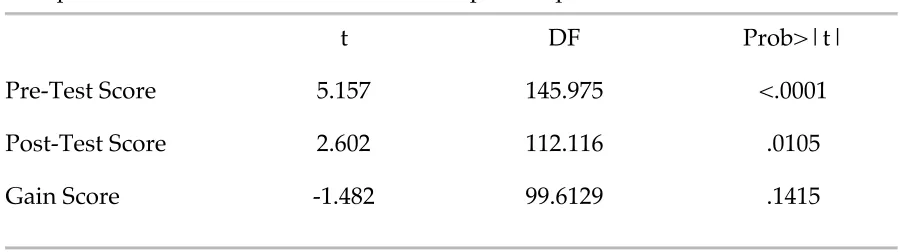
Table 4.3 Comparison of Online and Classroom Groups (unequal variances)………..82
Table 4.4 ANCOVA of Post-test on Pre-test and Group………84
Table 4.5 ANCOVA of Post-Test on Pre-Test and School………..……85
Table 4.6 t-Test of Gender (with unequal variance)………86
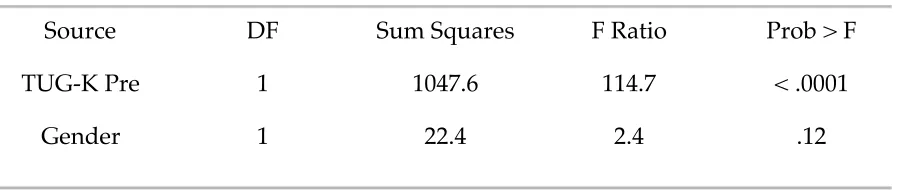
Table 4.7 ANCOVA of Post-Test on Pre-Test and Gender………...…….86
Table 5.1 Correlation of independent variables………....110
Table 5.2 Correlates with Post-Test for all Students………...………..112
Table 5.3 Correlates with Post-Test for the Online Group……….…..113
Table 5.4 Correlates with Post-Test for the Classroom Group………..…..114
Table 5.5 Correlates with Post-Test for Female Students……….115
Table 5.6 Correlates with Post-Test for Male Students………..…..116
Table 6.1 Summary of Means for Groups………..……….136
Table 6.2 Summary of Wilcoxon Signed Rank Tests………..…..142
Table 6.4 ANCOVA of Post-TUG-K on Pre-TUG-K and Post-VASS…………...…..143 Table 6.5 Summary of ANCOVA Results of Post-TUG-K on Pre-TUG-K
List of Figures
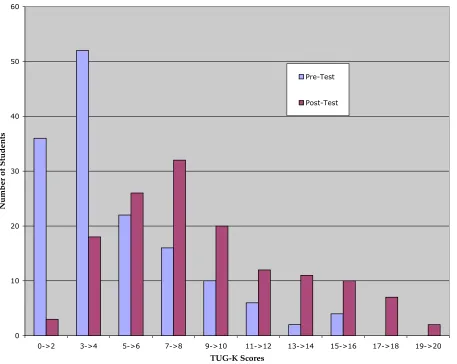
Figure 4.1- Combined Groups Distribution of Pre- and Post-Test Scores…………...81
Figure 4.2- Mean TUG-K Scores by Group…….……….…83
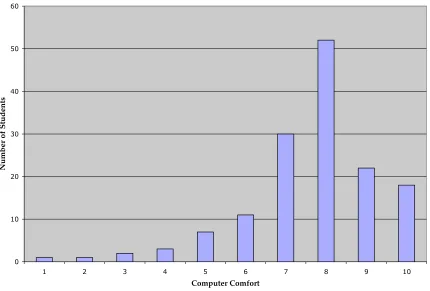
Figure 5.1- Distribution of student responses to computer comfort……….….105
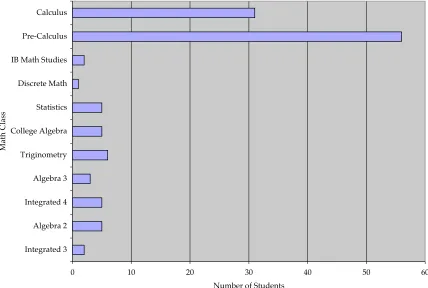
Figure 5.2- Distribution of students’ current math class………..……106
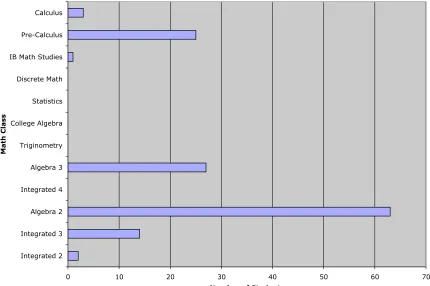
Figure 5.3- Distribution of students’ last completed math class………...…..107
Figure 6.1 Distribution of Student Responses to Level of Enjoyment of Unit….….134 Figure 6.2 Distribution of Pre- and Post-Unit VASS Profiles for All Students….…138 Figure 6.3 Distribution of Pre- and Post Unit VASS Profiles for the Classroom Group……….……140
Figure 6.4 Distribution of Pre- and Post Unit VASS Profiles for the Online Group………..………..141
Figure 6.5 Mean Post-TUG-K Score by Post-Unit VASS Profile……….144
Chapter 1
Problem
The nation is suffering from a teacher shortage. This generalized statement is only partly true. The nation is suffering from a shortage of teachers only in certain content areas and/or only in certain parts of the nation. For example,
according to the North Carolina Education Research Council, North Carolina needs about 11,600 new teachers annually. North Carolina’s teacher education programs only provide 3,600 new graduates each year. North Carolina is forced to make up the deficit, about 8,000 teachers, through lateral entry programs and hiring out-of-state teachers, or teachers returning to the profession (Teacher Demand, Supply, and Quality: An Analytical Approach). In an effort to combat this problem, North Carolina has invested more than $14 million that has helped to raise enrollment in teacher education programs by more than 14% (Recruiting Teachers for Hard-to-Staff Schools Solutions for the Southeast & the Nation, 2002).
Members of industry, businessmen and women, and military personal have all been recruited, especially during down economic times, into trying the teaching profession. Teach for America is probably the largest and most visible of these alternative training programs. Teach for America takes college graduates and after a single summer session places them in high need classrooms (Tell, 2001).
While these methods have been partially successful, they have not succeeded in solving the problem. Physics is one of the areas where there has traditionally been one of the largest shortages of qualified teachers. In a survey of schools in 1993-94 by the US Department of Education, 18.4% of schools with a vacancy in physical science found the position difficult or impossible to fill (Henke, Choy, Geis, & Broughman, 1996).
One method used by school districts to combat the lack of physics teachers is by putting an under qualified teacher in the classroom. This teacher is typically from either mathematics or another content area of science and is asked to teach physics. According to Ingersoll (2001) over half of all secondary students enrolled in any given physical science class are being taught by a teacher who does not have the equivalent of at least a college minor in the subject. His analysis of US
teacher. They have not been given the pedagogy for teaching this subject and are therefore disadvantaged before they even begin.
Resource
Over the course of the last 10-15 years, the Internet has exploded into society and become nearly ubiquitous. Applications for the Internet have run the gamut from over-hyped under-producing commercial ventures to simple postings about one’s own family. Nearly every sector of the economy now incorporates some application of the Internet. Education is not an exception. It is used as a content resource and a means of collaboration among teachers and students.
Within the last few years instead of using the Internet in the classroom, the Internet has begun to become the classroom itself. Many universities have been putting classes online to allow for students to access them wherever, and to some extent, whenever they want to. There has been a great deal of research concerning how students in these classes perform and the pedagogy necessary to teach them. For example, in a study by Yazon, Mayer-Smith, and Redfield ( 2002) over 500 undergraduates used the web to replace the traditional lecture section portion of an undergraduate genetics course. Eighty-five percent of these students felt that the web-based course was more interactive than the traditional lecture class and gave them greater control of their own learning. Sixty-seven percent of these students felt that the web-based course promoted greater understanding than rote learning.
Students facing the demands of needing continuing education for
full time often turn to distance education as an alternative (Lemckert & Florance, 2002). Lemckert and Florance (2002) suggest that in their field, engineering, real-time web-mediated laboratory experiments serve as the next best thing to the students being in the laboratory itself. In this case, the students use their web-browser to manipulate an experiment that is being carried out in a laboratory and observed through the use of web-cam.
Theoretical Framework
The basis for this study was rooted in constructivism. Constructivism is simply the belief that students learn by constructing their own knowledge. They are presented with something that contradicts their prior knowledge and in their current social setting they form new ideas or knowledge. Constructivism is widely believed to be rooted in the works of Piaget, Dewey and Vygotsky (Dalgarno, 2001; Ramos, 1999; Terwel, 1999).
an Internet connection can open up the entire world as their classroom. Together, these two things, constructivism and technology, are where the hopes and dollars of the educational system are currently being placed (Lunenburg, 1998).
Unfortunately there is often a wide gap between what these programs call for in terms of constructivist practice and what is actually taking place in the classroom. In the Netherlands, the Dutch National Curriculum is based on constructivist ideas but the practice of Dutch teachers is observed to be far from constructivist (Terwel, 1999). Teachers in the US profess that they would like to be teaching with constructivist methods but cite such issues as time, availability of resources, administration pressure, and classroom management for reasons as to why they still teach in a traditional manner (Ramos, 1999).
Constructivism is not without detractors. Some feel that constructivist principles in the classroom have only been shown to succeed in ideal situations and do not work in the ‘real’ world. There is also a feeling that no education system should rely entirely on one philosophical viewpoint. This would inherently
prevent some students from being provided their best opportunity to learn (Terwel, 1999). Therefore to best reach each student, this study was grounded in
constructivism but is not necessarily limited to that viewpoint.
certain text materials or media. Constructivism supports the idea that the learner is at least partially in control of the sequence and selection of content. In many web-based tutorials the student can choose to delve into any one area as much as they choose. This power rests with them. Constructivism suggests that students need to be assisted with their own metacognition. This can be achieved with the use of concept maps that can be made so easily on the computer (Dalgarno, 2001). This often aids students in allowing them to link concepts as they see them in their mind. Lastly, constructivism states that learning is a social interaction. This can easily be achieved in an online environment through the use of asynchronous discussion tools such as email or message boards, or synchronous discussion such as chat rooms, and instant messaging.
Constructivist theory contends that the optimal learning environment for students allows them to actually manipulate the material for themselves, both tactilely and conceptually, and create their own knowledge. This theory is widely regarded throughout science education as the best method to teach science.
Students need to be able to experience certain phenomena and relationships
themselves (Lord, 1998). This will allow them to form deeper and more permanent understanding of the science concepts. For example, a study by Lord (1999)
discussion format. The second group significantly out performed the first group on exams and rated the course more favorably.
Unfortunately, many science teachers are not using this model. This may be due to that fact that constructivist teaching is not always intuitive. It may be easier for teachers to revert to teaching methods, such as lecture, which they are familiar with from their own successfully completed schooling. Constructivism requires a teacher be willing to become a facilitator of knowledge rather than a transmitter of knowledge. A teacher must be prepared to allow the students to work in groups and help to provide the means necessary for that student to formulate their own truth about the topic (Hand & Vance, 1995). I contend that the likelihood of a teacher to abandon constructivist philosophy will increase when teachers are
teaching outside of their comfort area. Therefore, while schools will put a variety of people in the classroom to teach physics, it may not be taught in what is generally thought to be the best possible method.
Research Questions
online. The classroom supervisor would need only to manage the classroom and be a technical advisor and materials provider.
The essential question is; can a hands-on online physics unit be developed for high school physics students that is comparable to a hands-on physics unit taught by qualified physics teachers?
As a part of this study, three additional questions were answered. First, were there factors that were not physics related such as computer skill or familiarity with computers that were predictors of success in the online physics unit? Second, what were students’ attitudes and views about physics during the computer-based physics unit, and did these views change? What level of conceptual understanding of physics did these students possess, and was there evidence of any conceptual change?
Limitations
The sample of students that was chosen for this project was not chosen randomly. Instead they were chosen because when contacted, their teachers agreed to volunteer for this project. These students came from diverse backgrounds
including three counties in North Carolina that are not near each other
While the long-term goal for this research project is to determine if a hands-on hands-online physics course could be appropriate for schools without qualified physics teachers, it was not tested in schools without qualified physics teachers. The classes that completed the online unit did so during their physics classes. Their physics teachers were asked to reduce their role as an instructor and be available only for technical assistance and classroom management during the unit.
The teachers who taught the unit in their classrooms in a more traditional manner were given lesson plans for completing the same material as the online group. There was variation among these teachers as to exactly how they completed these lesson plans. They brought their own individual styles and interpretations to the lessons. The lessons were reviewed in person with the teachers prior to the beginning of the unit in an effort to control this variation.
While there were certainly limitations to the study, this was a special situation that merited this research. The ability to do hands-on online classroom work has been studied very little, if at all. Also, the population of physics students is very homogenous thereby reducing the impact of the participants being non-randomly selected. In fact, in the last five years only between 3.4-4.2% of high school students in North Carolina have enrolled in a physics class (The North
Carolina Statistical Profile, 2003). Lastly, this research project examined the impact of a hands-on online physics unit from several perspectives. Not only was the
References
Dalgarno, B. (2001). Interpretations of Constructivism and Consequences for Computer Assisted Learning. British Journal of Educational Technology, 32(2), 183-194.
Hand, B., & Vance, K. (1995). Implementation of Constructivist Approaches Within the Science Classroom. Australian Science Teachers Journal, 41(4), 37-43.
Henke, R. R., Choy, S. P., Geis, S., & Broughman, S. P. (1996). Schools and Staffing in the United States: A Statistical Profile, 1993-94 (No. NCES 96-124).
Washington, D.C.: U.S. Department of Education. National Center for Education Statistics.
Ingersoll, R. M. (2001). The Realities of Out-of-Field Teaching. Educational Leadership, 58(8), 42-45.
Lemckert, C., & Florance, J. (2002). Real-Time Internet Mediated Laboratory Experiments for Distance Education Students. British Journal of Educational Technology, 33(1), 99-102.
Lord, T. R. (1998). How to Build Better Mousetrap: Changing the Way Science is Taught Though Constructivism. Contemporary Education, 69(3), 134-137. Lord, T. R. (1999). A Comparison between Traditional and Constructivist Teaching
Lunenburg, F. C. (1998). Constructivism and Technology: Instructional Designs for Successful Education Reform. Journal of Instructional Psychology, 25(2), 75-81.
The North Carolina Statistical Profile. (2003). Retrieved 10/6/2003, 2003, from http://www.ncpublicschools.org/fbs/stats/
Ramos, E. (1999). Teaching Science Constructively: Examining Teacher's Issues When Teaching Science.
Recruiting Teachers for Hard-to-Staff Schools Solutions for the Southeast & the Nation. (Policy Brief)(2002). Chapel Hill, NC: The Southeast Center for Teaching Quality.
Survey and Analysis of Teacher Salary Trends 2001. (2001). Retrieved April 7, 2003
Teacher Demand, Supply, and Quality: An Analytical Approach. Chapel Hill, NC: The North Carolina Education Research Council.
Tell, C. (2001). Making Room for Alternative Routes. Educational Leadership, 58(8), 38-41.
Chapter 2
Introduction
This dissertation research project examined how effective a new technology can be at delivering physics curriculum to the high school classroom within the framework of constructivist philosophies. This is certainly not the first time that new technology and philosophy have been wedded to herald improvement and change. Educational history is ripe with examples of new technology and the ‘progress’ that they can bring to the classroom. This literature review will examine these technologies and the philosophies in which they were framed.
How can new technologies best be integrated with existing institutions of instruction? Most change is evolutionary rather than revolutionary, and technology-based approaches to instruction seem no different, despite the immense changes they may ultimately engender (Fletcher, 2003, p.96). Usually when people speak of the changes that are being brought about in education by technology, they speak of the ‘technological revolution’. This is true whether they are talking about the introduction of the personal computer or the growth of the Internet and World Wide Web. This is also true if one looks further back in the annals of American education at the advent of the film projector, radio and TV. Because each of these technologies, as well as others, entailed its own mini-revolution, it is perhaps better to look at the development of technology in the classroom from an evolutionary lens. Looking back and investigating how
One hopes that the best current educational philosophy is what drives the technology that is used in the classroom and not vice versa. With that in mind, it will be most useful to begin this perusal of history with how the prevalent
educational philosophy has shifted through the years. This paper will arbitrarily use 1920 as a beginning point to examine the evolution of technology and its uses in the American classroom.
1920’s-1950’s Educational Philosophy- Progressivism
Progressivism- An educational theory that emphasizes that ideas should be tested by experimentation and that learning is rooted in answering questions developed by the learner. Progressivism was a contemporary American educational theory. From its establishment in the mid-1920’s through the mid-1950’s, progressivism was the most influential educational view in America (Corey, 2003, p.2).
The progressive movement that became the dominate educational
Around 1900, John Dewy moved to Chicago and established his own school. This was the first laboratory school with the express purpose of studying teaching and learning. His attempts to scientifically study the best methods for teaching and learning guided his belief that educational reform was necessary. He conceived that students needed to be the center of the classroom working on problems and not listening to authoritarian teachers (Cremin, 1961; Zilversmit, 1993).
In the era following WWI, the educational system grew and consolidated throughout the country. Enrollments in schools nearly doubled, while the number of school districts declined as the one room schoolhouse gave way to increasingly larger school systems. The notion of schooling was further centralized through the increasing efforts of the United States Office of Education as well as by a tenfold increase in national organizations such as the National Educators Association (Cremin, 1961). All of these national influences and transformations in the school system left the system ready for change and that change appeared in the form of progressivism.
The founding of the Progressive Education Association in 1919 signified that this movement had truly arrived and was now at the forefront of American
education. The first act of this group was to devise a statement of seven principles. They were as follows (Cremin, 1961):
1. Freedom to develop naturally 2. Interest the motive of all work
5. Greater attention to all that affects the child’s physical development 6. Co-operation between school and home to meet the needs of the child-life 7. The progressive school a leader in educational movements.
While Dewey is largely responsible for many of the beliefs held by progressivists in education, he often did not agree with the cause that the
organizations were pursuing. Often he believed progressivists were simply anti-establishment and anti-school and had little in mind for how to effectively reform the schools (Gutek, 1997).
Despite the best efforts of the progressivists to enact school reform, Cuban (1984) estimates that between 1920 and 1940 fewer than one-fourth of any of the classrooms in a given district were using progressivism principles. Even in school districts where progressivism was widely encouraged by administrations, such as in New York and Denver, he estimates that no more than half of the classrooms were truly progressive. Cuban points out the fact that most of the progressivism that was in practice was in a hybrid form where teachers mixed bits and pieces of the progressivism ideals with their traditional practices.
1950’s-1980’s Educational Philosophy- Behaviorism
Behaviorism- A psychological theory that asserts that behavior represents the essence of a person. Behaviorists contend that all behavior can be
semblance of control have us caught in an inflexible web. Whatever else we may be, we are not the captains of our fate or the masters of our soul.” John B. Watson (1878-1958) was the principal originator of behaviorist psychology and B. F. Skinner (1904-1990) its best known promoter ( Corey, 2003, p.2). Despite excellent intentions, progressivism manifested itself poorly in the schools and was falling out of favor as the prevalent educational philosophy in the 1950’s. B. F. Skinner was ready to fill in the void with his brand of behaviorism. His impact on educational philosophy can hardly be understated. During the writing of one of his last pieces on education, he said “ During the past 30 years, for example, I have published 25 papers or chapters in books on education” (Skinner, 1989, p.85).
Behaviorism, or at least Skinner’s brand of it, was built on the works of John B. Watson as well as Ivan Pavlov (Nye, 1992). Skinner’s fundamental premise is that organisms, including humans, have certain behaviors and these behaviors have certain consequences determined by the physical and social environment.
Depending on the consequence, the organisms will be more or less likely to repeat the behavior (Nye, 1992).
As nearly everyone who has taken an educational psychology class can attest, Skinner’s theories use positive reinforcement, negative reinforcement, and punishment. As schools have changed and issues of the behavior of students arose, these ideas gained widespread popularity for controlling students’ actions. If a teacher sees a behavior they want to encourage they can give a positive
encouraged through the use of negative reinforcement, which will remove an adverse consequence if the proper behavior is followed. Punishment, on the other hand, is used to discourage any behavior. The probability of a behavior being repeated can be reduced either by adding an adverse consequence or removing a favorable consequence (Nye, 1992).
His impact on teaching was not limited to behavior management. He also forwarded a method of teaching that called for daily measurement of student performance, the graphing of these results, and analysis of behavior (Hawkins, 1990). He also championed programmed learning either through the use of teaching machines, which will be visited in greater detail later in this paper, or books such as The Analysis of Behavior (Holland & Skinner, 1961) that a student would complete as a self-guided type of workbook.
Skinner and his behaviorism has not been without its critics. One of the main criticisms of his work is that he essentially ignores any physiological or mental processes in determining how someone will behave. His concern is only with the outward manifestations of behavior and consequences (Simon, 1988). Another major criticism of Skinner is his willingness to apply his conditioning of rats and pigeons so freely to people with little regard for the human ability of free choice (Moravcsik, 1988; Nelson, 1988).
then follow a set of programmed instruction on this topic. Teachers will become more like counselors and stay in contact with students for several years. Through the use of his programmed instruction “…we can teach twice as much as is now taught in the classroom in the same time and with the same effort” (p. 96).
1980’s –Today Educational Philosophy- Constructivism
Constructivism- An educational theory that emphasizes hands-on, activity-based teaching and learning during which students develop their own frames of thought. Piaget concludes, “It is assumed that learners have to construct their own knowledge, individually and collectively. Each learner has a toolkit of conceptions and skills with which he or she must construct knowledge to solve problems presented by the environment. The role of the community, other learners and teacher, is to provide the setting, pose the challenges, and offer the support that will encourage construction” (Corey, 2003, p.1)
quickest to acquire this philosophy, incorporate it into their pedagogy, and research its effectiveness (Vanderstraeten & Biesta, 1998).
Besides Piaget, many of the ideas of constructivism are attributed to Lev Semenovich Vygotsky. Vygotsky (1997) said, “in education it is much far more important to teach the child how to think than to communicate various bits of knowledge to him” (p. 175). One of Vygotsky’s tenets is that learning would be most meaningful to students if they were given the opportunity to construct knowledge and discover new ideas for themselves (Wink & Putney, 2002). While both Piaget and Vygotsky are often mentioned together in discussions of
constructivism, they did have some philosophical differences as well. Piaget believed that learning followed development and Vygotsky believed that development followed learning (Wink & Putney, 2002).
The social context of learning is vital to a constructivist. The mind is not an isolated storage facility for facts. Instead, meaning making is accomplished within a context of peers, relationships, and the environment (Garrison, 1998). This typically will manifest itself, for the constructivist, as the need for learners to work in group settings. In these settings, individuals will be co-constructing knowledge. They need not always reach consensus as long as they are able to help each other construct, or reconstruct as necessary, the new knowledge (Pepin, 1998).
Many pre-service teaching programs are now preparing beginning
Second, groupings are made so that the social structures and group interactions will foster learning. Thirdly, and perhaps most importantly, bridges are built between students’ past knowledge and new knowledge. Next, prompting questions are posed to the students to continue and extend the investigation. Then students are asked to exhibit and share with their peers what they have learned. Lastly, the students and the teacher reflect on the collective learning experience. While many new teachers may be learning how to follow these practices, Marlowe and Page (1998) caution that new teachers may experience stiff resistance to these ideas from veteran teachers. In their book, Creating and Sustaining the Constructivist Classroom, they offer practical suggestions for successfully implementing constructivist ideals despite this resistance.
Technology and Progressivism- 1920’s – 1950’s
A few years ago, while researching how teachers taught in the 1920’s, I came across a 1927 National Archives photograph of a Los Angeles teacher in the midst of a geography lesson in the cabin of an airplane. Here was an aerial classroom of students viewing urban geography firsthand; this was to demonstrate clearly how progressive education had influenced the city’s teacher corps (Cuban, 1986, p.1).
educational film. Thomas Edison is quoted as saying (Cuban, 1986, p.9) “I should say that on the average we get about two percent of efficiency out of
schoolbooks…The future of education, as I see it, will be conducted through the medium of the motion picture …where it will be possible to obtain one hundred percent efficiency.” Thomas Edison further proclaimed (Saettler, 1990, p. 98) “Books will soon be obsolete in the schools. …It is possible to teach every branch of human knowledge with the motion picture. Our school system will be completely changed in ten years.”
While Edison’s view of the future school may not have been accurate, similar sounding rhetoric has been heard with the advent of nearly every new technology. That is not to say that the film did not influence American education. During this time educators were interested in supplementing their classrooms with visual aids. To illustrate the importance visual instruction was being given between 1919 and 1923, five national organizations of visual instruction were formed during this four year period (Saettler, 1990).
Visual instruction was to take many forms, as motion pictures, both silent and with sound, to many varieties of still projection such as the filmstrip, slides, and eventually overhead projectors. Teachers desired at this time to be able to show students exactly what they were learning. Though films, both silent and sound, garner many of the headlines through this time period, forms of still projection were low cost alternatives that were sought by many schools. Because of the
It was estimated that by 1962 there were 200,000 pieces of still projection equipment in schools throughout the United States. While that may seem to be a sizeable amount, these were to service over 100,000 schools and 36 million students (Finn et al., 1962).
The sound film, or 16mm sound motion picture, was the technology most adored and promoted by progressivists during this time period. This was a technology that could engage students and transport their mind’s eye out of the classroom to stimulate thinking and learning. During this time, research was
conducted with control groups (no films) and experimental groups (with films) that showed the classes with films achieving the same or higher test scores and greater motivation (Cuban, 1984).
While highly touted, one of the biggest obstacles to 16mm sound films actually being used in schools was the ability to purchase and maintain the
equipment. The number of projectors in the schools went from well less than 1 per 100 teachers at the beginning of this time period to about 5 per 100 teachers by 1950. By 1960, this number had only increased to almost 10 per 100 teachers (Finn et al., 1962). Another barrier to the widespread use of the 16mm sound film was the production and distribution of quality educational films. Numerous companies went into the business of educational films with mostly poor returns on their investments. By the end of the 1940’s most film production had been centralized either to textbook companies or universities (Saettler, 1990).
Depression was responsible for the merger and folding of many of the film making companies as well as projection manufacturers. Despite the effects of the
depression, visual instruction continued to grow, as measured by the number of units purchased in schools, albeit very slowly (Reiser, 2001b). During WWII, American armed forces made extensive use of the film as a training tool. It was estimated that the Air Force alone produced over 400 films and 600 filmstrips in just two years. It was projected that the military showed over 4 million films or
filmstrips as part of its intensive training programs (Reiser, 2001b). This extensive use of films by the military monopolized the market and made it difficult for schools to purchase equipment during this time (Finn et al., 1962).
Survey data compiled by the National Education Association is reported in Cuban (1986) and indicates that in 1946, 69.6% of elementary teachers and 49.9% of high school teachers frequently or occasionally used films in class. In 1954, the survey was repeated and 75% of elementary teachers and 56% of high school teachers reported frequent or occasional use of films. In his search of the then current literature for explanations for why these numbers weren’t higher, Cuban found the following four reasons as the primary obstacles to the use of film in the classroom (p.18):
• Teachers’ lack of skills in using equipment and film
• Cost of films, equipment, and upkeep
• Inaccessibility of equipment when it is needed
During this time period there was another technology that was growing besides film; educational radio. Educational radio began in the 1920’s and 1930’s but there was not a steep increase in the number of radios in the classroom until after WWII when radios became inexpensive and mass produced (Finn et al., 1962). Educational radio programming first began on commercial stations and then
moved largely to universities and their Schools of the Air (Cuban, 1986; Saettler, 1990).
In 1935 and 1936, the U.S. Office of Education ran a very successful Radio Education Project, however, funding for the project was cut by Congress in 1940 (Saettler, 1990). Throughout this time it was very difficult to assess the number of schools or students that were regularly using educational radio. Depending on the survey and its methods, estimates for educational radio usage could vary by
500,000 to 1 million students when describing the same area. Clearly though, educational radio never had the revolutionary effect that some dreamed it could. By the 1950’s educational radio was already being phased out and the transition away from radio was accelerated by the advent of the television (Cuban, 1986).
Technology and Behaviorism- 1950’s – 1980’s
reserved for educational use. A few leaders, however, were quick to point this out and in 1952 the FCC reserved 242 television stations for educational use (Reiser, 2001b; Saettler, 1990). Educators promptly seized this opportunity and by 1955, there were 17 educational stations across the country, and by 1960 there were more than 50 stations (Reiser, 2001b).
Television was also the first major technology to receive heavy doses of funding that were not part of a normal school budget. It is estimated that the Ford Foundation spent in excess of $170 million on educational television between 1950 and 1970 (Reiser, 2001b). Federal funding was also available for educational television including $32 million appropriated by the Communications Act of 1962.
It is important to note a distinction that became inevitable as the medium of television grew; the difference between educational television and instructional television. Educational television is programming that has broad ideals that may be to teach or to enlighten the viewer. Instructional television is designed to
specifically teach or relate concepts of a specific subject matter as part of a course of study (Saettler, 1990). Educational television would eventually evolve into public television and was formally established in 1967 with the Public Broadcasting Act.
television was used in the classroom only as a supplement to regular instruction or as a teaching aid. Only in American Samoa did instructional television provide the content of the school system (Cuban, 1986).
The most extensive study of the use of instructional television was done by Dirr and Pedone in 1976-1977 and was reported by both Cuban (1986) and Saettler (1990). This study found that 72% of teachers had instructional programming available to them. Of this set only 46% watched at least one series regularly. Only one-third of the respondents indicated that they had viewed at least one
instructional television program in the last four weeks. The amount of television viewed varied from about 60 minutes per week in the elementary classroom, to about 45 minutes a week in the junior high classroom.
While television once again failed to create the revolution that its supporters had hoped for, there was another technology emerging simultaneously that was directly tied to the current prevalent behaviorist theory. This was the teaching machine. Fry (1959) espouses the virtues of the teaching machine in this
“…headlong technological age” (p. 28). According to Fry, teaching machines will be able to remove the “teacher variable” (p. 31) from classroom studies, act as tutors for gifted children, provide additional course offerings for small schools, and raise minimal curriculum standards for a district or a state. Once again, a new
technology was being heralded as a revolution of the classroom.
This machine must be able to lead a student through a series of small sequential steps (Skinner, 1968). Such a machine was a direct application of behaviorism because each time a student’s answer matched the revealed correct answer it provided positive reinforcement and increased the likelihood that this behavior would be repeated (Reiser, 2001a).
Skinner’s requirements for what a teaching machine must consist of usually manifested itself in some sort of mechanical device. This device would only reveal a small amount of text at a time, usually in the form of a fill in the blank statement. The student was then required to write his/her answer in the designated space. If the answer was correct, the statement was typically notched or punched by the machine so it would not be revisited during the session. Depending on the sophistication of the machine, information about why an answer was right or wrong may also be revealed. The machine then moves to the next statement or question in the sequence of instruction (Day, 1959). The teaching machines varied in price from simple $50 models to sophisticated models that could incorporate film for approximately $5000. Typical machines fell somewhere in the $200-$1000 range ("How Machines Do Teaching Job," 1960).
The interest in and use of teaching machines and programmed instruction enjoyed a peculiarly rapid rise and decline. In an annotated bibliography,
Willerding (1961) published over 100 references to teaching machines, their use, and their theoretical underpinnings, almost all of which appeared after 1958. By the late 1960’s, however, programmed instruction and teaching machines were
were out of the business of producing teaching machines and programmed materials (Saettler, 1990).
Technology and Constructivism- 1980’s – Today
Information-processing technologies and constructivism, separately and often together, have remade substantially our conception of the challenges of learning. Apart from the practical applications to education, information-processing technologies have spawned the computer metaphor of the mind as an information processor. (Perkins, 1992)
This period in education was dominated, and continues to be dominated, by a single technology; the computer. Since 1951 and the development of the first commercial computer, UNIVAC I, the inclination has been for computers to become smaller, more reliable, faster, and less expensive (Saettler, 1990). There have been other new technologies introduced and used in teaching, such as the VCR. Its primary role, however, was to replace the film projector as a method of showing instructional movies and added relatively little in the way of new instructional techniques. While an early computer could be seen simply as an extension of a teaching machine, it quickly became obvious that computers had much more to offer the classroom.
million (Saettler, 1990). By the year 2000, 84% of teachers reported that they had computers available in their classrooms (Baule, 2001). Cuban (1986) notes, “As with film, radio, and instructional television, predictions of computers reshaping how school will be organized, how teachers will teach, and how students will learn surface repeatedly” (p. 73).
By the mid-1980’s simple drill and practice or remediation dominated the use of computers in the classroom (Saettler, 1990). As the computer advanced and developed, drill and practice software evolved first into tutorial software, and then simulation software, and finally problem solving software. The computer was also used as a tool in education by both students and teachers with the development of word-processing, database, spreadsheet, and graphics applications (Bozeman, 1999).
One of the advances that proved to be particularly effective and fitting for constructivists was the development of hypertext. Hypertext allowed the computer to have greater flexibility and non-linearity than any system prior to it. This
While more and more high quality educational software was being
developed and marketed, especially at the elementary level, the next evolution in education with the computer happened even faster than the spread of the computer itself. This was the rise of the Internet and the World Wide Web. The Internet was born in 1969 as a military system called APRANET. The original ARPANET started with 4 hosts (a computer with a registered IP address). By 1980 the Internet had grown to about 200 hosts, and by 1990 this had increased to over 300,000 hosts. Then, Tim Berners-Lee invented the World Wide Web and in 1991 physicist Paul Kunz demonstrated the WWW’s ability to utilize the Internet. This sparked interest in the Internet and by the year 2000 there were nearly 100 million hosts (Festa, 2001; Zakon, 2003).
Constructivist uses of the computer and its related technology, whether it is from out-of-the-box software or from WWW sites, almost always follow a few of the same guiding principles as mentioned above. Further advances in computing have added the ability to incorporate simulations of increasing complexity and modeling using virtual reality. These uses have many advantages. First, students enjoy them. They also are usually of lower cost and often more safe and practical than carrying out the actual activity. The flexibility built into these programs allows the user to feel less threatened and they can actually encourage socialization and collaboration as the students work on the projects in groups (Maddux, Johnson, & Willis, 2001).
The World Wide Web and the Internet
With the continued growth and development of the WWW and the Internet, it has not only become a key feature in the classroom, in many cases it has become the classroom itself. Leading the charge in using the Internet as the classroom have been colleges and universities. One of the most visible leaders has been the
University of Phoenix with its frequent ad banners on the Internet. According to their own web site (University of Phoenix, 2001) you can,
• Take classes at your convenience -- all from your computer
• Earn one of the most current and relevant degrees offered in the areas of
Business, Technology, Education, and Nursing
• Complete your degree in only 2-3 years, in most cases -- faster than many
traditional universities (p.1)
More traditional institutions have also joined the on-line market as Harvard, Columbia, and The Chicago School of Business, just to name a few, all offer on-line courses and degrees (Smith & Broom, 2003).
One of the significant features that separates the Internet as a means to both facilitate and lead learning is its ability to accommodate computer mediated
communication (CMC). This can take many different forms that may include; email, group conferencing systems such as bulletin boards, mediated and non-mediated chat rooms or groups, and instant messaging (Santoro, 1995).
Communication via the Internet is dissimilar from face-to-face communications in several ways. First, many of the subtle clues from body language and facial
expressions are lost. This can result in confusion from written communications, especially in email. CMC also has the ability to be asynchronous and can offer users some degree of anonymity. Lastly, a message delivered by some form of CMC has the potential to reach a greater audience than face-to-face
communications (Weller, 2002).
the requirements so that communications are maximized. Lastly, a consistent moderating style needs to be established to structure the communications and guidelines need to be specified concerning the degree of online decorum that is expected.
Why would teachers and schools turn to computer technology to assist in instruction? One reason is students can progress at their own pace and use any amount of time necessary for them to understand the material. Because of this, it appears fewer students are left behind. Studies in the military have also shown instructional time can be reduced anywhere from 20-80%. Technology based instruction is also more cost effective than tutoring, reducing class size, or increasing instruction time. Lastly, and certainly not least, students prefer technology-based instruction (Fletcher, 2003).
The Standards
educational system progressed from traditional ‘chalk and talk’ methods and how teachers are under increased pressure to learn and model technology use.
The International Technology Education Association has published two sets of standards. The first, Standards for Technological Literacy- Content for the Study of Technology (2000), is a document that describes what students should know about technology and its relationship to society at different grade levels. The second,
Advancing Excellence in Technological Literacy: Student Assessment, Professional Development, and Program Standards (2003), describes how teachers are to assess if the content standards are being achieved. It also proposes methods for teachers to receive professional development on technology, and suggests how teachers and administrators together can create guidelines to establish a successful technology education program.
Technology and science have become intertwined to such a degree that specific references to and goals about technology have been integrated into both of the standards documents for science education. Benchmarks for Scientific Literacy,
(1994) devotes section three to the Nature of Technology and sets benchmarks for three different aspects of technology at all grade levels. The National Science Education Standards, (1996) has a section relating science and technology in each of its levels of content standards.
The Role of Science Education
after the conception of the personal computer, science teachers were quick to realize their potential in the classroom. Science teachers built numerous devices that could interface with the computer, especially the Apple Computer, and were used to collect data for science experiments. This would eventually evolve into a large industry with companies of nearly all sizes offering teachers ready-made interfaces, probes, and curriculum to do real-time data collection on science experiments. Anecdotally, it seems that often the science departments are one of the most involved in new technology and its uses in a school system.
Science education has also been the discipline to quickly embrace
constructivism and to heavily research its effectiveness. For example, a study by Lord (1999) used two classes of traditional lecture based environmental science compared to two classes of small group, question-discussion based environmental science. He found the students in the class with the constructivist principals performed higher on exams, rated the class higher, and were more likely to take part in out of class activities. Also, Yager and Weld (1999) reported on a project with 20 school districts in Iowa to infuse the Scope, Sequence, and Coordination approach, which relies heavily on constructivist principles, into science
departments. Their results indicated students’ achievement scores increased versus those in traditional textbook classes and low ability students and females were particularly aided by these methods.
in groups. This helped science teachers to simply modify some of their pedagogy instead of needing to completely start over to gain a more constructivist
perspective. That is not to say science teachers won’t have to alter how they teach. Science teachers need to be more flexible in their planning, and able to quickly react to new situations when allowing students to complete open ended projects. They should also incrementally add changes as they become more confident in the constructivist style (Hand & Vance, 1995). Some of the modifications teachers can make include:
• Provide lab activities before discussing the results students are expected to
find;
• Discuss labs before lecturing on the topics;
• Remove lab data tables so that students generate or organize information;
• Change tests to require more concept application by students;
• Use a questioning strategy that encourages students to reveal what they’re
thinking;
• Have students invent the procedure to answer a lab question; and
• Put students into situations where groups debate, discuss, research, and
share (Colburn, 2000, p.4).
Science education has also been willing to embrace the computer as a means of enhancing instruction, either through tutorials and simulations, integrating the World Wide Web into the curriculum, or using the power of the Internet to deliver online courses. A study of 10th grade students who worked in pairs using computer
were able to work collaboratively and demonstrate gains in their conceptual understanding of mechanics (Tao & Gunstone, 1999).
Persin (2002) used web-assisted instruction to incorporate the World Wide Web into the curriculum and to improve achievement scores in his high school physics class. Student scores in his physics classes had fallen off of previous levels when his school switched to block four scheduling. To offset the drop in scores, he designed a class web site that provided the students with lecture notes,
assignments, and provided links to other sites to investigate the physics topics. This allowed him to devote more class time to activities and consequently the students’ achievement scores were increased.
In a more extreme example of using the power of the Internet to teach an online course, Lemckert and Florance (2002) were faced with the problem of incorporating a laboratory component into a distance education class. Their solution was to develop a solution they called Real-Time Internet Mediated Laboratory Experiments. In these, students used their Internet connection to manipulate a camera and an experiment in the science laboratory of the school. Although this does not provide the opportunity for the learner to gain experience with the apparatus itself, this method did provide the greatest amount of flexibility. The instructors believed it was superior to other methods of experiments in
Conclusion
Each new educational philosophy and each new technology desired to transform the lumbering behemoth that is education. Unfortunately, an institution as large as education has a tremendous amount of inertia preventing this change. The progressivists on the 1920’s-1950’s desired to move students out of desks that were bolted to the floor in rows and have them become more involved in a student-centered curriculum. They hoped that new technology such as the film projector would help transport students out of their traditional classrooms. Unfortunately, their accomplishments fell far short of their dreams.
The behaviorists of the 1950’s through 1980’s began where the progressivists left off, arguing for their own set of changes. They felt teaching and learning
should be prescribed and by reinforcing the proper behaviors, learning could be improved. The behaviorists favored heavy use of the teaching machine to facilitate student learning. This panacea could provide the individual paced instruction that was impossible in the typical large group setting of a classroom. The teaching machine was afforded a meteoric rise in popularity followed by precipitous decline as it quickly faded from the favor of the educational establishment. This time period also oversaw the advent of the television as an educational medium. Once again, however, after a surge in popularity, instructional television began to fade rapidly.
improved in classrooms where the teacher guided them and they were allowed to make meaning of the concepts for themselves. This era has seen the advent of new technologies to replace old ones, such as the VCR replacing the film projector, and has seen the growth of the single largest educational technology to date, the
computer. As the computer has progressed, it has changed from a glorified teaching machine into a powerful educational tool capable of delivering entire degree programs. Each of the previously discussed eras lasted about 30 years, which would put constructivism and the computer on the downward swing from a historical trend point of view. It seems, however, that constructivism and especially the computer are still on the rise and will continue to be for the foreseeable future.
As for the future of the educational technology, most who glimpse into their crystal ball show the computer playing a prominent role. One vision of the future includes an increase in the amount of educational content that is provided via the WWW. This will coincide with increased broadband access to the Internet,
particularly in homes (Smith & Broom, 2003; Weller, 2002). This will allow future online courses to “…evolve from ‘talking heads’ into more elaborate and interesting mixtures of lecturers, graphics, photos, demonstrations, video, and interactive problem solving” (Smith & Broom, 2003, p. 16).
hardware, wiring, and software, there has been little to no measurable return on this investment. Although he does concede that if present trends continue they “…will eventually yield exactly what promoters have sought: every student, like every worker, will eventually have a personal computer” (p. 196).
Most experts (Maddux et al., 2001; Smith & Broom, 2003; Weller, 2002) agree that there will be a continued trend to increase the number and availability of courses online. Weller (2002) argues that this will be analogous to the ability to watch movies at home on a VCR. As movies became available on tape, and now DVD, the movie industry has actually seen an increase, not a decrease, in ticket sales at theatres. So to will schools actually see an increase in enrollment on campus as students have greater access and ability to take courses online.
As for what educational technologies will lead the way into the next decade and beyond, my observations and research lead me to believe computing will move away from the desktop and toward a more mobile version. This may take the form of a traditional laptop computer, a version of the new tablet computer, or some form of a PDA (personal digital assistant). New technologies will need to have the ability to communicate wirelessly with networks at home and at schools or
businesses. Traditional classroom barriers will continue to crumble as students and teachers begin to have the ability to communicate 24/7 with instant messaging, email, text messaging, and posting on class or personal websites.
thing’ it is not guaranteed longevity or success in the classroom. The computer and its related technology of the Internet and the World Wide Web may break this trend. As the evolution of educational technology continues to accelerate we must keep in mind that “These changes call for new research on the effectiveness of technology (Tally, 1998), new research questions and new assessment instruments, and at a general level, new model(s) of research that can keep pace with the rate of technological change” (Perez & Bridgewater, 2003, p. 122).
This explicit call for additional research is another reason why it was important that this study be completed. While the Internet and constructivism seem to have more staying power than some of the past movements and
References
Baule, S. M. (2001). Technology Planning for Effective Teaching and Learning 2nd Edition. Worthington, OH: Linworth Publishing.
Bozeman, W. (1999). Educational Technology Best Practices from America's Schools Second Edition. Gardiner, NY: Eye on Education.
Chipman, S. F. (2003). Gazing Yet Again Into the Silicon Chip: The Future of Computers in Education. In H. F. J. O'Neil & R. S. Perez (Eds.), Technology Applications in Education A Learning View (pp. 31-54). Mahwah, NJ: Lawrence Erlbaum Associates.
Colburn, A. (2000). Constructivism: Science Education's "Grand Unifying Theory."
Clearing House, 74(1), 9-12.
Corey, N. (2003). Edu. Philosophies. Retrieved 6/9/2003, 2003, from soe.indstate.edu/cimt770/Education%20Philosophy.htm
Cremin, L. A. (1961). The Transformation of the School: Progressivism in American Education, 1876-1957. New York, NY: Vintage Books.
Crowther, D. T. (1997). The Constructivist Zone. Electronic Journal of Science Education, 2(2).
Cuban, L. (1986). Teachers and Machines The Classroom Use of Technology Since 1920. New York, NY: Teachers College Press.
Cuban, L. (2001). Oversold and Underused Computers in the Classroom. Cambridge, MA: Harvard University Press.
Day, J. H. (1959). Teaching Machines. Journal of Chemical Education, 36(12), 591-595. Festa, P. (2001, 12/10/2001). Turning on the World Wide Web. Retrieved 5/30/2003,
2003, from news.com.com/2008-1082-276771.html?legacy=cnet
Finn, J. D., Perrin, D. G., & Campion, L. E. (1962). Studies in the Growth of
Instructional Technology, I: Audio-Visual Instrumentation for Instruction in the Public Schools, 1930-1960 A Basis for Take-Off. Los Angeles, CA: Technological Development Project of the National Education Association of the United States.
Fletcher, J. D. (2003). Evidence for Learning From Technology-Assisted Instruction. In H. F. O'Neil, Jr. & R. S. Perez (Eds.), Technology Applications in Education: A Learning View (pp. 79-99). Mahwah, New Jersey: Lawrence Erlbaum
Associates.
Fry, E. (1959). Teaching Machines: The Coming Automation. Phi Delta Kappan, 41, 28-31.
Garrison, J. (1998). Toward a Pragmatic Social Constructivism. In M. Larochelle, N. Bednarz & J. Garrison (Eds.), Constructivism and Education (pp. 43-60). New York, NY: Cambridge University Press.
Gooden, S. J., & Carlson, R. L. (1997). Achieving Quality Schools Through
Technology Change. In M. D. Richardson, R. L. Blackbourn, C. Ruhl-Smith & J. A. Haynes (Eds.), The Pursuit of Continuous Improvement in Educational Organizations (pp. 195-205). New York, NY: University Press of America. Gutek, G. L. (1997). Philosophical and ideological perspectives on education. Needham
Heights, MA: Allyn & Bacon.
Hand, B., & Vance, K. (1995). Implementation of Constructivist Approaches Within the Science Classroom. Australian Science Teachers Journal, 41(4), 37-43.
Hawkins, R. P. (1990). The Life and Contributions of Burrhus Frederick Skinner.
Education and Treatment of Children, 13(3), 258-263.
Holland, J. G., & Skinner, B. F. (1961). The Analysis of Behavior. New York: McGraw-Hill Book Company, Inc.
How Machines Do Teaching Job. (1960, Sept. 17, 1960). Business Week, 111-114. Johnston, M., & Cooley, N. (2001). Supporting New Models of Teaching and Learning
Through Technology. Arlington, VA: Educational Research Service. Jonassen, D. H., Peck, K. L., & Wilson, B. G. (1999). Learning with Technology: A
Lemckert, C., & Florance, J. (2002). Real-time Internet mediated laboratory experiments for distance education students. British Journal of Educational Technology, 33(1), 99-102.
Lord, T. R. (1999). A Comparison between Traditional and Constructivist Teaching in Environmental Science. Journal of Environmental Education, 30(3), 2-27. Maddux, C. D., Johnson, D. L., & Willis, J. W. (2001). Educational Computing Learning
with Tomorrow's Technologies (Third ed.). Needham Heights, MA: Allyn & Bacon.
Marlowe, B. A., & Page, M. L. (1998). Creating and Sustaining the Constructivist Classroom. Thousand Oaks, CA: Corwin Press.
Moravcsik, J. M. E. (1988). Should we return to the laboratory to find out about learning? In A. C. Cantania & S. Harnad (Eds.), The selection of behavior: The operant behaviorism of B.F. Skinner: Comments and consequences (pp. 118-121). New York, NY: Cambridge University Press.
National Research Council. (1996). National Science Education Standards. Washington, D.C.: National Academy of the Sciences.
Nelson, R. J. (1988). Skinner's philosophy of method. In A. C. Cantania & S. Harnad (Eds.), The selection of behavior: The operant behaviorism of B.F. Skinner:
Nye, R. D. (1992). Legacy of B.F. Skinner: Concepts and Perspectives, Controversies and Misunderstandings. Pacific Grove, CA: Brooks/Cole Publishing Company. Pepin, E. (1998). Practical Knowledge and School Knowledge: A Constructivist
Representation of Education. In M. Larochelle, N. Bednarz & J. Garrison (Eds.), Constructivism and Education (pp. 173-192). New York, NY: Cambridge University Press.
Perez, R. S., & Bridgewater, G. (2003). Presidential Technology Initiative (PTI): A Model for the Integration of Technology in a K-12 Curriculum. In H. F. J. O'Neil & R. S. Perez (Eds.), Technology Applications in Education A Learning View (pp. 101-123). Mahwah, NJ: Lawrence Erlbaum Associates.
Perkins, D. N. (1992). Technology Meets Constructivism: Do They Make a Marriage? In T. M. Duffy & D. H. Jonassen (Eds.), Constructivism and the Technology of Instruction: A Conversation (pp. 45-55). Hillsdale, NJ: Lawrence Erlbaum Associates.
Persin, R. (2002). Web-Assisted Instruction in Physics: An Enhancement To Block Scheduling. American Secondary Education, 30(3), 61-69.
Petraglia, J. (1998). Reality by Design The Rhetoric and Technology of Authenticity in Education. Mahwah, NJ: Lawrence Erlbaum Associates.
Reiser, R. A. (2001a). A History of Instructional Design and Technology: Part II: A History of Instructional Design. Educational Technology Research and
Development, 49(2), 57-67.
Reiser, R. A. (2001b). A History of Instructional Design and Technology: Part I: A History of Instructional Media. Educational Technology Research and
Development, 49(1), 53-64.
Saettler, P. (1990). The Evolution of American Educational Technology. Englewood, CO: Libraries Unlimited.
Santoro, G. M. (1995). What is Computer-Mediated Communication. In Z. L. Berge & M. P. Collins (Eds.), Computer Mediated Communication and the Online Classroom (Vol. One: Overview and Perspectives, pp. 11-28). Cresskill, NJ: Hampton Press.
Simon, M. A. (1988). Explaining behavior Skinner's way. In A. C. Cantania & S. Harnad (Eds.), The Selection of behavior: The operant behaviorism of B.F. Skinner: Comments and consequences (pp. 358-360). New York, NY: Cambridge
University Press.
Skinner, B. F. (1968). The Technology of Teaching. New York, NY: Appleton-Century-Crofts.
Smith, M. S., & Broom, M. (2003). The Landscape and Future of the Use of Technology in K-12 Education. In H. F. J. O'Neil & R. S. Perez (Eds.),
Technology Applications in Education A Learning View (pp. 3-30). Mahwah, NJ: Lawrence Erlbaum Associates.
Spiro, R. J., Feltovich, P. J., Jacobson, M. J., & Coulson, R. L. (1992). Cognitive Flexibility, Constructivism, and Hypertext: Random Access Instruction for Advanced Knowledge Acquisition in Ill-Structured Domains. In T. M. Duffy & D. H. Jonassen (Eds.), Constructivism and the Technology of Instruction: A Conversation (pp. 57-75). Hillsdale, New Jersey: Lawrence Erlbaum
Associates.
Tao, P.-K., & Gunstone, R. F. (1999). Conceptual change in science through collaborative learning at the computer. International Journal of Science Education, 21(1), 39-57.
Technology for All Americans Project. (2000). Standards for Technological Literacy Content for the Study of Technology. Reston, VA: International Technology Education Association.
Technology for All Americans Project. (2003). Advancing Excellence in Technological Literacy: Student Assessment, Professional Development, and Program Standards. Reston, VA: International Technology Education Association.