An Information Framework for Creation
Smart City through Internet of Things
Karimunnisa Begum1, Sunanda Dixit2
M.Tech Student, Department of Information Science and Engineering , Dayananda Sagar College of Engineering,
Bangalore , India1
Associate Professor, Department of Information Science and Engineering, Dayananda Sagar College of Engineering,
Bangalore , India2
ABSTRACT: For inception of smart city with advanced sensing and computation capabilities, data are gathered and evaluated in real time to recognize the information, which furthermore converted to possible knowledge. This will gain the decision making of city administration and citizens to turn the city smart. In this paper temperature mapping is taken as example for smart city creation.
KEYWORD: internet of thing(IOT).
I. INTRODUCTION
The 70% of world’s public, around six billion people, will reside in cities and surrounding regions at 2050. So, cities require to be smart, then only to survive as platforms that suggest economic, urban, and environmental well-being. Few municipalities have platforms or systems consistently used approach is data aggregation, offline experiment, and action .So we try internet of things, different application of IOT infrastructure made this process to occur by including disclosure processing and management, actuation and analytics. Advanced sensing and computational capabilities data is united and evaluated in real time to recognize the information, which eventually converted into knowledge. It will recover the decision making of city administration and citizens to turn city smart. Here we are using environmental monitoring application where temperature mapping is taken as example to measure its merits[1].
II. RELATEDWORK
In [2] authors proposed the use of a combination of magnetic and ultrasonic sensors for accurate and reliable detection of vehicles in a parking lot. And a modified version of the minmax algorithm for detection of vehicles using magnetometers, and also an algorithm for ultrasonic sensors. In [3] authors intends to close this gap and foster collaboration by offering a detailed introduction to WSNs and their properties. An extensive survey of CI applications to various problems in WSNs from various research areas and publication venues is presented in the paper. Besides, a discussion on advantages and disadvantages of CI algorithms over traditional WSN solutions is offered. In addition, a general evaluation of CI algorithms is presented, which will serve as a guide for using CI algorithms for WSNs. In [4] authors proposed a new architecture for noise monitoring in urban environments. The architecture is scalable and applicable for sensors required for city management. In addition to this noise monitoring new hardware platform is reported and visualization of the data is presented. In [5] authors given four different IoT network architectures spanning various smart city applications are presented and their corresponding network Quality of Service (QoS) requirements are defined. In [6] authors shows, utility max-min fairness is achieved among upper-layer cluster heads, whereas utility proportional fairness is achieved within each lower-layer cluster. The proposed architecture is to be applied to a real marine sensor network on the Great Barrier Reef. In [7] authors analyses commercially (and research prototypes) available
ISSN(Online): 2320 - 9801 ISSN (Print) : 2320 - 9798
I
nternational
J
ournal of
I
nnovative
R
esearch in
C
omputer
and
C
ommunication
E
ngineering
(An ISO 3297: 2007 Certified Organization)
Vol. 4, Issue 6, June 2016
network virtualization environment. In [10] authors present experimentations on streaming encoded acoustic data on low resources devices. In [11] authors show that the architecture is expressive enough to accommodate typical sensor network protocols. Measurements show that the increase in execution time over a non-adaptive architecture is small.
III. PROPOSED SYSTEM
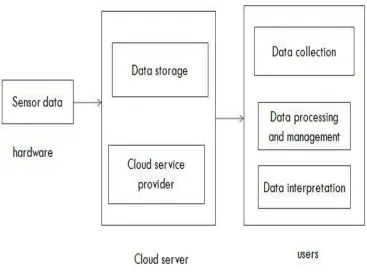
The below figure 1 shows the architecture of proposed system.
Fig 1. Architecture for smart city with the help of IoT.
Where using hardware data will be gathered and united in cloud server to what place analytic tool developers can provide their software tools; and computational stuff experts can provide their data mining and machine learning tools satisfying in converting idea to knowledge.
A generalized context for data aggregation is established to effectively exploit spatial and worldly characteristics of the data, both in the sensing habitat and associated transform domains. The word have to be brought together and used intelligently and energy- efficiently. For capable city applications, visualization is consistent for data representation in user-understandable constitute, allowing definition by the users.
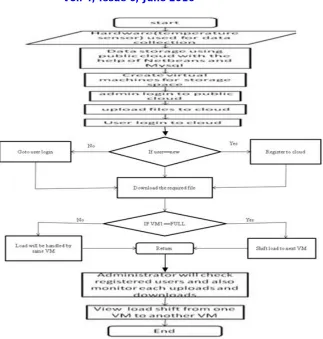
Fig 2. Flowchart for proposed system.
IV. IMPLEMENTATION
There are four modules in the proposed system those are:
Cloud-centric IoT
In this module, sensing enrollment providers can tie the network and try their data using a storage Cloud; analytic tool developers can provide their software tools; and computational intelligence experts can provide their word mining and material learning tools convenient in converting idea to knowledge. Cloud computing is experienced to try these services as infrastructures, platforms, or software. Specifically, the data generated, tools used, and algorithms developed generally disappear directed toward the background, with attract given to various application domains of IoT. According to our invention for Cloud-centric IoT the Cloud integrates all facets of throughout computing by providing scalable storage and computational resources to build trendy businesses. Moreover, the core objective of the Cloud to efficiently model cost based on provide and charge offers a unique opportunity to construct an feasible IoT business model.
Data collection
ISSN(Online): 2320 - 9801 ISSN (Print) : 2320 - 9798
I
nternational
J
ournal of
I
nnovative
R
esearch in
C
omputer
and
C
ommunication
E
ngineering
(An ISO 3297: 2007 Certified Organization)
Vol. 4, Issue 6, June 2016
the sensing domain and associated rebuild domains. We have marked a metric to manage the status of data contributed over participatory sensing. At the same time, systems for ensuring privacy and investment trust are sooner or later to be reasonably addressed.
Data collection and processing
Extraction of meaningful evidence from polar data is nontrivial. It consistently involves pre-processing and event detection. Events prefer to be detected in long multivariate time-series data. For a capable city, adaptability and robustness of algorithms to compare data at no end in sight scales of time and space are essential—this is data-to-information analytics. To further the way one sees it sense of the data-to-information and shift it into development, state-of-the-art computational stuff techniques a well known as genetic algorithms, evolutionary algorithms, and neural networks are necessary. They will help advance automated decision making and provide convenient policy. Meanwhile, right to the unprecedented approach of data accessible, storage, ownership, and expiry of them adopt critical issues. The data have to be brought together and used intelligently and energy- efficiently.
Data interpretation
For efficient city applications, visualization is suited for data representation in user-understandable constitute, allowing definition by the users. It is literally challenging to envision heterogeneous sensory data in a temporally varying 3-D landscape. New feature technologies accelerate creative visualization. For instance, the adaptation from monitor (CRT) to plasma, liquid crystal disclose (LCD), light-emitting diode (LED), and active-matrix bio logical light-emitting diode (AMOLED) displays have given acquire to highly feasible data representation (using touch interface) by the whole of the user soon better suited to navigate data. Moreover, visualization schemes perhaps improved by plugging into contrasting Geographic Information System (GIS) platforms and integrating geo-related information.
V. EXPERIMENTAL RESULTS
The followings figures shows the experimental results of proposed model that is smart city creation using internet of things for storing temperature data in cloud.
Figure (a) front end of the project. Figure (b) shows created virtual machines.
Figure (c) login page. Figure (d) upload file page.
The above figures shows the login page and file upload page for cloud administrator.
Figure (e) shows load details. Figure (f) shows user details.
The above figures shows virtual machine load details and user registered details.
Figure (g) shows login for user. Figure (h) shows download page.
ISSN(Online): 2320 - 9801 ISSN (Print) : 2320 - 9798
I
nternational
J
ournal of
I
nnovative
R
esearch in
C
omputer
and
C
ommunication
E
ngineering
(An ISO 3297: 2007 Certified Organization)
Vol. 4, Issue 6, June 2016
VI. CONCLUSION AND FUTURE WORK
This paper provides the creation of smart city with the help of internet of things for temperature data. Using this model we can share data globally.
And also With the help of this information in future we can develop a hardware device to control temperature remotely.
REFERENCES
1. Jiong Jin, Jayavardhana Gubbi, Slaven Marusic, and Marimuthu Palaniswami “An Information Framework for Creating a Smart City Through Internet of Things” IEEE internet of things journal, vol. 1, no. 2, april 2014.
2. Sangwon Lee, Dukhee Yoon, and Amitabha Ghosh “Intelligent Parking Lot Application UsingWireless Sensor Networks” IEEE 2008. 3. Raghavendra V. Kulkarni, Anna Förster, and Ganesh Kumar Venayagamoorthy “Computational Intelligence in Wireless Sensor Networks: A
Survey” IEEE communications surveys & tutorials, vol. 13, no. 1, first quarter 2011.
4. Jayavardhana Gubbi, slaven marusic, aravinda s. rao, yee wei law and marimuthu palaniswami “A pilot study of urban noise monitoring architecture using wireless sensor networks” International Conference on Advances in Computing, Communications and Informatics (ICACCI) 2013.
5. Jiong Jin, Jayavardhana Gubbi, Tie Luo and Marimuthu Palaniswami “Network Architecture and QoS Issues in the Internet of Things for a Smart City” International Symposium on Communications and Information Technologies (ISCIT) 2012.
6. Jiong Jin, Yee Wei Law, Wei-Hua Wang, and Marimuthu Palaniswami “A Hierarchical Transport Architecture for Wireless Sensor Networks” IEEE 2008.
7. Vidyasagar Potdar, Atif Sharif, and Elizabeth Chang “Wireless Sensor Networks: A Survey” International Conference on Advanced Information Networking and Applications Workshops 2009.
8. Fabiano Salvadori, Maurício de Campos, Paulo Sérgio Sausen, Robinson Figueiredo de Camargo, Camila Gehrke, Cassiano Rech, Marco Aurélio Spohn, and Alexandre Cunha Oliveira “Monitoring in Industrial Systems Using Wireless Sensor Network With Dynamic Power Management” IEEE transactions on instrumentation and measurement, vol. 58, no. 9, september 2009.
9. N. M. Mosharaf Kabir Chowdhury and Raouf Boutaba “Network Virtualization:State of the Art and Research Challenges” IEEE Communications Magazine July 2009.
10. Congduc Pham, Philippe Cousin “Streaming the Sound of Smart Cities:Experimentations on the SmartSantander test-bed” IEEE International Conference on Green Computing and Communications and IEEE Internet of Things and IEEE Cyber,Physical and Social Computing 2013. 11. Adam Dunkels , Fredrik Osterlind and Zhitao He “An Adaptive Communication Architecture for Wireless Sensor Networks”ACM 2007.
BIOGRAPHY
Karimunnisa begum: M.Tech( computer science and engineering) student at dayananda sagar college of engineering Bangalore , interested in Internet of Things technology.