Skyrme tensor force in the collision
16O+
40Ca
LuGuo1,,ChongYu1,LongShi1, andCédricSimenel2
1School of Physics, University of Chinese Academy of Sciences, Beijing 100049, China 2Department of Nuclear Physics, RSPE, Australian National University, Canberra, Australia
Abstract.The role of tensor force is investigated by using the time-dependent Hartree-Fock (TDHF) theory in the collision16O+40Ca. The full tensor force is incorporated in our TDHF implementation. The calculations are performed in three-dimensional Cartesian coordinate without any symmetry restrictions. We study the effect of tensor force on Coulomb barrier, upper fusion threshold energy, and energy contribution of the time-odd and tensor terms in Skyrme energy functional. The Coulomb barrier obtained from the energy functional with frozen density approximation is compared with the available experimental data. We find that the tensor force may change the upper fusion threshold energy in the order of a few MeV for the collision16O+40Ca. The tensor force has a non-negligible effect in heavy-ion collisions.
1 Introduction
The microscopic description of heavy-ion collisions such as time-dependent Hartree-Fock (TDHF) theory provides a useful foundation for a fully microscopic many-body theory. The dynamical and quantum effects have been
au-tomatically taken into account in TDHF theory. It has wide applications in fusion [1–10], fission [11–16], transfer re-action [17–21], deep inelastic collisions [22–28], quasi-fission [21, 29–33], and giant resonances [34–41]. For a review, see Refs. [42, 43].
TDHF theory was proposed by Dirac in 1930 [44] and was first applied in nuclear physics in 1976 [45]. After the first application, many groups in the late 70s and 80s per-formed more extensive calculations in nuclear large ampli-tude collective motion [46]. However, at that time, limited computer capacity restricted most calculations with many approximations. For instance, the reaction was assumed to be in an axial symmetric plane and a simplified Skyrme force with the omission of spin-orbit coupling was used. These approximations turned out to be a hindrance for the theoretical development. For example, TDHF calculations predicted that for16O+16O reaction atE
c.m.=34 MeV the partial wavesL ≤ 6 do not lead to fusion and the corre-sponding deep inelastic cross section was expected to be 132 mb [47]. According to TDHF prediction, an exper-iment to search for a fusion L window was carried out. However, experimentally there is no evidence for the oc-currence of such phenomenon predicted by TDHF calcu-lations [47]. This conflict between TDHF prediction and experimental observations is called the puzzle of small fu-sion window, and promotes the theoretical development.
A few years later in 1986, Umar et. al included the time-even terms of spin-orbit force in TDHF
e-mail: [email protected]
lations [48], and found the upper fusion threshold en-ergy was increased by more than two times. This in-dicates that earlier TDHF calculations without spin-orbit coupling underestimated the energy dissipation from the collective kinetic energy into the internal excitations so that the energy window of fusion reactions was too small in comparison with the experiments. After including the spin-orbit coupling, more intrinsic degrees of freedom is accessable and the dissipation is enhanced. The inclu-sion of time-even spin-orbit force in TDHF solved the puzzle of small fusion window. However, a meaningful collision theory should satisfy Galilean invariance which guarantees the calculation results will not depend on the choice of the frame of reference. This invariance is par-ticularly important for reaction dynamics so that both the time-even and time-odd terms of spin-orbit force should be included simultaneously. In recent years, TDHF cal-culations with the full spin-orbit force become possible thanks to the development of computational power. The strong spin-excitation was shown in spin-saturated system 16O+16O [22]. The full spin-orbit force was found to con-tribute about 40%∼65% of the total dissipation depending on the different Skyrme parameters and bombarding
ener-gies [26].
time-even spin-current tensor was shown to become im-portant as the increase of the mass of colliding systems. The role of time-even tensor force in the dissipation dy-namics in deep-inelastic collisions has been explored in Ref. [26]. Recently the full tensor force was shown to play a non-negligible effect in 16O+16O inelastic
colli-sions [9, 28].
The article is organized as follows. Section 2 will present the TDHF theory with the full version of Skyrme interaction and energy density functional including the tensor force. In Sec. 3 we illustrate the role of tensor force in the asymmetric reaction16O+40Ca. A summary is given in Sec. 4.
2 Theoretical method
Starting from the time-dependent action
S =
t2
t1
dtΨ(r,t)|H−i∂t|Ψ(r,t), (1)
and applying the variational principalδS=0 with respect
to the many-body wave-functionΨ(r,t), one may obtain the time evolution of mean-field
i∂tφλ=hˆφλ. (2)
In the above TDHF equation, the many-body wave-function has been approximated as the Slater determinant composed by the single-particle statesφλ
Ψ(r,t)= √1
N!det{φλ(r,t)}. (3) The initial wave-functions in dynamical evolution em-ploy the nuclear ground state obtained from HF equation
ˆ
hϕλ(r)=λϕλ(r). (4)
The time evolution of single-particle states is expressed as
φλ(r,t+ ∆t)=e−iˆh∆t/φλ(r,t), (5)
with ˆhthe single-particle Hamiltonian. Hererdenotes the three-dimensional Cartesian coordinate and the spin of nu-cleon.
We employ the Skyrme effective interaction in our
TDHF calculation
v(r1,r2)=t0(1+x0Pˆσ)δ(r1−r2)
+1
2t1(1+x1Pˆσ)[k2δ(r1−r2)+δ(r1−r2)k2]
+t2(1+x2Pˆσ)kδ(r1−r2)k
+1
6t3(1+x3Pˆσ)ρα(r1
+r2
2 )δ(r1−r2)
+iW0(σ1+σ2)·k×δ(r1−r2)k
+te
2 3(σ
1·k)(σ2·k)−(σ1·σ2)k2δ(r1−r2)
+δ(r1−r2)3(σ1·k)(σ2·k)−(σ1·σ2)k2
+to
3(σ1·k)δ(r1−r2)(σ2·k)−(σ1·σ2)k
δ(r1−r2)k
, (6)
whereti,xj(i,j=0, ...,3),W0,α,te, andtoare the Skyrme parameters. In the above equation, from the sixth to ninth line represents the tensor force, in which the coupling con-stantsteandtodenote the strength of the triplet-even and triplet-odd tensor interactions, respectively. The operator k=21i(∇1−∇2) acts on the right ,k=−21i(∇1−∇2) acts on
the left. The spin exchange operator isPσ=12(1+σ1σ2). It is natural to express the Skyrme interaction with the energy density functional (EDF)
E=
d3rH(ρ, τ,j,s,T,J;r). (7)
In above equation, the number densityρ, kinetic density τ, current densityj, spin densitys, spin-kinetic densityT, and spin-current pseudotensor densityJare defined as
ρq(r)=ρq(r,r)|r=r =
σ
ρq(rσ,rσ),
sq(r)=sq(r,r)|r=r =
σσ
ρq(rσ,rσ)σ|σˆ|σ,
τq(r)=∇ · ∇ρq(r,r)|r=r,
jq(r)=−2i(∇ − ∇)ρq(r,r)|r=r,
Jq,µν(r)=− i
2(∇µ− ∇µ)sq,ν(r,r)|r=r, Tq,µ(r)=∇ · ∇sq,µ(r,r)|r=r,
Fq,µ(r)=
1 2
z
ν=x
(∇µ∇ν+∇µ∇ν)sν(r,r)|r=r. (8)
Here,q=n(p) stands for neutron (proton).
From these densities, one can define the isoscalar (t=
0) and isovector (t=1) densities and currents as
ρ0(r)=ρn(r)+ρp(r),
ρ1(r)=ρn(r)−ρp(r). (9)
With the above definitions, the full version of Skyrme energy functional is expressed as
H=H0+
t=0,1
As ts2t +
A∆s
t +B∆ts
st·∆st+B∇ts(∇ ·st)2
+(ATt +BTt)
st·Tt−
z
µ,ν=x
Jt,µνJt,µν
+BFt
st· Ft−12
z
µ=x Jt,µµ
2
−12
z
µ,ν=x Jt,µνJt,νµ
,
(10)
time-even spin-current tensor was shown to become im-portant as the increase of the mass of colliding systems. The role of time-even tensor force in the dissipation dy-namics in deep-inelastic collisions has been explored in Ref. [26]. Recently the full tensor force was shown to play a non-negligible effect in 16O+16O inelastic
colli-sions [9, 28].
The article is organized as follows. Section 2 will present the TDHF theory with the full version of Skyrme interaction and energy density functional including the tensor force. In Sec. 3 we illustrate the role of tensor force in the asymmetric reaction16O+40Ca. A summary is given in Sec. 4.
2 Theoretical method
Starting from the time-dependent action
S =
t2
t1
dtΨ(r,t)|H−i∂t|Ψ(r,t), (1)
and applying the variational principalδS=0 with respect
to the many-body wave-functionΨ(r,t), one may obtain the time evolution of mean-field
i∂tφλ=hˆφλ. (2)
In the above TDHF equation, the many-body wave-function has been approximated as the Slater determinant composed by the single-particle statesφλ
Ψ(r,t)= √1
N!det{φλ(r,t)}. (3) The initial wave-functions in dynamical evolution em-ploy the nuclear ground state obtained from HF equation
ˆ
hϕλ(r)=λϕλ(r). (4)
The time evolution of single-particle states is expressed as
φλ(r,t+ ∆t)=e−ihˆ∆t/φλ(r,t), (5)
with ˆhthe single-particle Hamiltonian. Hererdenotes the three-dimensional Cartesian coordinate and the spin of nu-cleon.
We employ the Skyrme effective interaction in our
TDHF calculation
v(r1,r2)=t0(1+x0Pˆσ)δ(r1−r2)
+1
2t1(1+x1Pˆσ)[k2δ(r1−r2)+δ(r1−r2)k2]
+t2(1+x2Pˆσ)kδ(r1−r2)k
+1
6t3(1+x3Pˆσ)ρα(r1
+r2
2 )δ(r1−r2)
+iW0(σ1+σ2)·k×δ(r1−r2)k
+te
2 3(σ
1·k)(σ2·k)−(σ1·σ2)k2δ(r1−r2)
+δ(r1−r2)3(σ1·k)(σ2·k)−(σ1·σ2)k2
+to
3(σ1·k)δ(r1−r2)(σ2·k)−(σ1·σ2)k
δ(r1−r2)k
, (6)
whereti,xj(i,j=0, ...,3),W0,α,te, andtoare the Skyrme parameters. In the above equation, from the sixth to ninth line represents the tensor force, in which the coupling con-stantsteandtodenote the strength of the triplet-even and triplet-odd tensor interactions, respectively. The operator k=21i(∇1−∇2) acts on the right ,k=−21i(∇1−∇2) acts on
the left. The spin exchange operator isPσ=12(1+σ1σ2). It is natural to express the Skyrme interaction with the energy density functional (EDF)
E=
d3rH(ρ, τ,j,s,T,J;r). (7)
In above equation, the number densityρ, kinetic density τ, current densityj, spin densitys, spin-kinetic densityT, and spin-current pseudotensor densityJare defined as
ρq(r)=ρq(r,r)|r=r =
σ
ρq(rσ,rσ),
sq(r)=sq(r,r)|r=r =
σσ
ρq(rσ,rσ)σ|σˆ|σ,
τq(r)=∇ · ∇ρq(r,r)|r=r,
jq(r)=−2i(∇ − ∇)ρq(r,r)|r=r,
Jq,µν(r)=− i
2(∇µ− ∇µ)sq,ν(r,r)|r=r, Tq,µ(r)=∇ · ∇sq,µ(r,r)|r=r,
Fq,µ(r)=
1 2
z
ν=x
(∇µ∇ν+∇µ∇ν)sν(r,r)|r=r. (8)
Here,q=n(p) stands for neutron (proton).
From these densities, one can define the isoscalar (t=
0) and isovector (t=1) densities and currents as
ρ0(r)=ρn(r)+ρp(r),
ρ1(r)=ρn(r)−ρp(r). (9)
With the above definitions, the full version of Skyrme energy functional is expressed as
H =H0+
t=0,1
As ts2t +
A∆s
t +B∆ts
st·∆st+B∇ts(∇ ·st)2
+(ATt +BTt)
st·Tt−
z
µ,ν=x
Jt,µνJt,µν
+BFt
st· Ft−12
z
µ=x Jt,µµ
2
−12
z
µ,ν=x Jt,µνJt,νµ
,
(10)
whereH0 is the basic Skyrme functional used in Sky3D code [56] and most TDHF calculations. In our code, we incorporated the full version of Skyrme energy functional as shown in Eq. (10), including all the terms from cen-tral, spin-orbit and tensor forces. These new terms have been clarified to be especially important in the studies of nuclear structure. The basic functionalH0used in Sky3D
code [56] is expressed as
H0=
t=0,1
Aρ
tρ2t +A∆tρρt∆ρt+Aτt
ρtτt−j2t
+A∇tJρt∇ ·Jt+A∇tJst· ∇ ×jt
. (11)
The coupling constantsAandBappearing in Eqs. (10) and (11) have been defined in Refs. [51, 57]. Some authors used the coupling constantsCwhich is the sum of param-eters AandB,C = A+B. The terms with the coupling
constantsAcome from the Skyrme central and spin-orbit forces, while those with theBparameters are from the ten-sor force. In the calculations, we set C∇S
t = C∆S = 0 because the terms containing the gradient of spin-density may cause the spin instability both in nuclear structure and reaction studies as pointed out in Refs. [28, 51].
In the energy functional Eq. (10), the spin-current pseudotensor densityJis expressed in its Cartesian com-ponents Jµν. In Ref. [58] the spin-current density has been decomposed into pseudoscalar, (antisymmetric) vec-tor, and (symmetric) traceless pseudotensor components as
Jµν(r)= 1
3δµνJ(0)(r)+ 1 2
z
k=x
εµνkJk(1)(r)+Jµν(2)(r). (12)
Here δµν is the Kronecker symbol and εµνk is the Levi-Civita tensor. The pseudoscalarJ(0), vectorJ(1), and pseu-dotensorJ(2)components are given in terms of the Carte-sian form
J(0)(r)=z µ=x
Jµµ(r),
J(1)k (r)=
z
µν=x
εkµνJµν(r),
J(2) µν(r)=
1
2[Jµν(r)+Jνµ(r)]−1 3δµν
z
k=x
Jkk(r). (13)
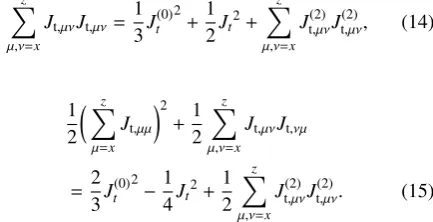
The vector spin-current density J(1)(r) ≡ J(r) is often called spin-orbit current, as it enters the spin-orbit func-tional in Eq. (11). The terms of energy funcfunc-tional involv-ing the spin-current density in Eq. (10) can be instead ex-pressed as
z
µ,ν=x
Jt,µνJt,µν=1 3Jt(0)
2
+1
2Jt2+ z
µ,ν=x
Jt(2),µνJt(2),µν, (14)
1 2
z
µ=x
Jt,µµ 2
+1
2 z
µ,ν=x
Jt,µνJt,νµ
=2
3Jt(0) 2
−14Jt2+1 2
z
µ,ν=x
Jt(2),µνJ(2)t,µν. (15)
To test the accuracy of numerical calculations, the energy functional involving the spin-current density has been im-plemented by using the above two approaches in our code.
Table 1.Isoscalar and isovector tensor coupling constants CJ
0 =AJ0+BJ0andC1J=AJ1+B1J(in MeV·fm5) for the five sets of Skyrme parametrizations.
Force CJ
0 C1J
SLy5 0.0 60.0
SLy5t -20.0 -65.0
T22 0.0 0.0
T26 120.0 120.0
T44 120.0 0.0
In the next section, we will show the energy contributions with this two approaches are identical, as they should be.
The set of nonlinear TDHF equations has been solved on a three-dimensional Cartesian coordinate and without any symmetry restrictions. We calculate the ground state of16O and40Ca in a numerical box of 24×24×24 fm3. For the dynamical evolution of reaction16O+40Ca, we used a box with 32×24×32 fm3grid points and grid spacing 1.0 fm. The initial distance between the projectile and target is taken to be 20 fm. From infinity to initial distance the nucleus was assumed to move on a pure Rutherford trajec-tory so that the initial boost are properly treated in TDHF evolution. We expand the Taylor expansion up to the sixth order and employ a time step∆t=0.2 fm/c in the
dynam-ical evolution. The choice of these parameters guarantees a good numerical accuracy during the dynamical evolution for all the cases studied here. The total TDHF energy and particle number have been well conserved and shifted less than 0.1 MeV and 0.01, respectively.
3 Results and discussions
We employ the full version of Skyrme energy functional as shown in Eq. (10) in our calculations. The static properties and reaction dynamics are treated with the same energy density functional and a unified theoretical framework. To examine the accuracy of our code, we compared our re-sults with those obtained by other code in three aspects. First, we have reproduced the upper fusion threshold en-ergy in the collision16O+16O reported in Ref. [28] within the accuracy of 1 MeV by our code. Second, we calcu-lated the energy contribution from the new terms as a func-tion of time, and our results reproduced those reported in Ref. [28] within a negligible discrepancy. Third, we im-plemented the energy functional involving the spin-current density in two approaches as shown in Eqs. (14) and (15) in our code, and found that the results with two approaches are identical as they should be and also reproduced those shown in Ref. [28].
In present work, we employ the five sets of Skyrme parametrizations SLy5 [60, 61], SLy5t [50], and T22,T26 and T44 [51] to study the effect of tensor force in the
collision dynamics of16O+40Ca reaction. The isoscalar and isovector tensor coupling constantsCJ
0 =A0J+B0Jand
CJ
Table 2.Energy (in MeV) and radii (in fm) of the Coulomb barrier obtained with the frozen density approximation for the five sets of Skyrme parametrizations and experimental data [59]
in the collisions16O+40Ca.
Force V(MeV) R(fm)
SLy5 23.36 9.20
SLy5t 23.36 9.20
T22 23.34 9.21
T26 23.33 9.21
T44 23.21 9.25
Expt. 23.06 9.21
Table 3.Upper fusion threshold energies (in MeV) for the five sets of Skyrme parametrizations in the collisions16O+40Ca.
Force Threshold (MeV)
SLy5 142
SLy5t 145
T22 138
T26 143
T44 140
on the existing Skyrme force, e.g., SLy5 plus tensor force denoted as SLy5t. The other is to fit all the Skyrme param-eters on the same footing, e.g., the set of TIJ parametriza-tions with a wide range of isoscalar and isovector tensor couplings. With such fitting procedure, one may draw a different physical scenario. The effect of pure tensor force
can be clarified by comparing the results with SLy5 and SLy5t. For the TIJparametrizations, the calculations can figure out the role of isoscalar and isovector tensor terms in collision dynamics.
The energy and radii of Coulomb barrier are listed in Tab. 2 for16O+40Ca with the five sets of forces and the experimental data [59]. Here the Coulomb barrier is ob-tained by the frozen density (FD) approximation within the EDF theory [62–64]. The interaction potential in the approaching phase can be expressed as
VFD(R)=E[ρ
P+T](R)−E[ρT]−E[ρP]. (16)
ρP+T=ρP+ρTis the sum of ground state density of projec-tile and target at the relative distanceR, andE[ρP+T](R) is
the Skyrme EDF as shown in Eq (10). Note that the Pauli principle and the coupling between the collective motion and intrinsic states have been neglected in FD approxima-tion. When the overlap of two densities is small, e.g., at the position of Coulomb barrier, EDF with FD approxima-tion is a good tool to estimate the Coulomb barrier. How-ever, at the smaller relative distance, since the Pauli effect
is strong, FD approximation will not properly account for the interaction potential [65].
The energy and radii of Coulomb barrier with SLy5t are observed to be exactly same as those with SLy5 for 16O+40Ca, as expected, because the tensor force has no contribution to the ground state EDF for the spin-saturated nuclei16O and40Ca. There exist some differences among the T22,T26 and T44 parameter sets. These differences,
for the spin-saturated system, come from the
rearrange-Figure 1. Energy contributions from the terms involving time-odd densities and currents for head-on collisions16O+40Ca with SLy5 and SLy5t parametrizations atEc.m.=170 MeV.
ment of other terms of Skyrme EDF in the fit of the parametrizations. Note that the structure of16O and40Ca, for instance, matter and charge radii, has small difference
for T22,T26 and T44 parameters, which may cause a slight change of the barrier height. The Coulomb barrier with FD-EDF overestimates the experimental data due to its omission of the coupling between the collective motion and single particle degrees of freedom [66].
The upper fusion threshold is quite sensitive to the de-tails of Skyrme EDF as reported in Ref. [3]. The inclusion of pure tensor force SLy5t increased the upper threshold by 3 MeV. The SLy5 and T22 have the same isoscalar cou-pling constants, and the upper fusion threshold is found to reduce as the decrease of isovector coupling. The same trend is also observed for T26 and T44. By comparing T22 and T44 with the same isovector coupling, the increase of isoscalar coupling increases the upper fusion threshold. Our results in16O+40Ca are consistent with the findings in Ref. [28] for16O+16O.
The energy contributions from the terms involving time-odd densities and currents (a) s·F, (b) s·T, (c)
s2witht0parameter, and (d)s2witht3parameter are ex-amined for 16O+40Ca head-on collisions with SLy5 and SLy5t parametrizations atEc.m. = 170 MeV. The results are shown in Fig. 1. This is deep-inelastic collisions as seen from Tab. 3. These terms were not included in Sky3D code [56]. At the initial time, the energy contribution from these terms both for SLy5 and SLy5t are zero, as ex-pected, because these time-odd terms contribute zero for the ground state of even-even nuclei. Since the term s·F
Table 2.Energy (in MeV) and radii (in fm) of the Coulomb barrier obtained with the frozen density approximation for the five sets of Skyrme parametrizations and experimental data [59]
in the collisions16O+40Ca.
Force V(MeV) R(fm)
SLy5 23.36 9.20
SLy5t 23.36 9.20
T22 23.34 9.21
T26 23.33 9.21
T44 23.21 9.25
Expt. 23.06 9.21
Table 3.Upper fusion threshold energies (in MeV) for the five sets of Skyrme parametrizations in the collisions16O+40Ca.
Force Threshold (MeV)
SLy5 142
SLy5t 145
T22 138
T26 143
T44 140
on the existing Skyrme force, e.g., SLy5 plus tensor force denoted as SLy5t. The other is to fit all the Skyrme param-eters on the same footing, e.g., the set of TIJ parametriza-tions with a wide range of isoscalar and isovector tensor couplings. With such fitting procedure, one may draw a different physical scenario. The effect of pure tensor force
can be clarified by comparing the results with SLy5 and SLy5t. For the TIJparametrizations, the calculations can figure out the role of isoscalar and isovector tensor terms in collision dynamics.
The energy and radii of Coulomb barrier are listed in Tab. 2 for16O+40Ca with the five sets of forces and the experimental data [59]. Here the Coulomb barrier is ob-tained by the frozen density (FD) approximation within the EDF theory [62–64]. The interaction potential in the approaching phase can be expressed as
VFD(R)=E[ρ
P+T](R)−E[ρT]−E[ρP]. (16)
ρP+T=ρP+ρTis the sum of ground state density of projec-tile and target at the relative distanceR, andE[ρP+T](R) is
the Skyrme EDF as shown in Eq (10). Note that the Pauli principle and the coupling between the collective motion and intrinsic states have been neglected in FD approxima-tion. When the overlap of two densities is small, e.g., at the position of Coulomb barrier, EDF with FD approxima-tion is a good tool to estimate the Coulomb barrier. How-ever, at the smaller relative distance, since the Pauli effect
is strong, FD approximation will not properly account for the interaction potential [65].
The energy and radii of Coulomb barrier with SLy5t are observed to be exactly same as those with SLy5 for 16O+40Ca, as expected, because the tensor force has no contribution to the ground state EDF for the spin-saturated nuclei16O and40Ca. There exist some differences among the T22,T26 and T44 parameter sets. These differences,
for the spin-saturated system, come from the
rearrange-Figure 1. Energy contributions from the terms involving time-odd densities and currents for head-on collisions16O+40Ca with SLy5 and SLy5t parametrizations atEc.m.=170 MeV.
ment of other terms of Skyrme EDF in the fit of the parametrizations. Note that the structure of16O and40Ca, for instance, matter and charge radii, has small difference
for T22,T26 and T44 parameters, which may cause a slight change of the barrier height. The Coulomb barrier with FD-EDF overestimates the experimental data due to its omission of the coupling between the collective motion and single particle degrees of freedom [66].
The upper fusion threshold is quite sensitive to the de-tails of Skyrme EDF as reported in Ref. [3]. The inclusion of pure tensor force SLy5t increased the upper threshold by 3 MeV. The SLy5 and T22 have the same isoscalar cou-pling constants, and the upper fusion threshold is found to reduce as the decrease of isovector coupling. The same trend is also observed for T26 and T44. By comparing T22 and T44 with the same isovector coupling, the increase of isoscalar coupling increases the upper fusion threshold. Our results in16O+40Ca are consistent with the findings in Ref. [28] for16O+16O.
The energy contributions from the terms involving time-odd densities and currents (a) s·F, (b) s·T, (c)
s2witht0parameter, and (d)s2 witht3parameter are ex-amined for 16O+40Ca head-on collisions with SLy5 and SLy5t parametrizations at Ec.m. = 170 MeV. The results are shown in Fig. 1. This is deep-inelastic collisions as seen from Tab. 3. These terms were not included in Sky3D code [56]. At the initial time, the energy contribution from these terms both for SLy5 and SLy5t are zero, as ex-pected, because these time-odd terms contribute zero for the ground state of even-even nuclei. Since the term s·F
comes from the pure tensor force, its energy with SLy5 re-mains zero during the time evolution. For SLy5t because
Figure 2.The energy contribution from the time-even terms in head-on collisions16O+40Ca atE
c.m.=170 MeV.
the inclusion of tensor force changes the time-dependent mean-field and hence the densities sandFitself, the en-ergy contribution keeps to be zero in the early stage and then starts to oscillate. Since s·T term comes from both the central and tensor forces, its energy with SLy5 evolves with time, while for SLy5t the more pronounced effect
ap-pears compared with SLy5. Thes2terms from the central force are found to have similar trends.
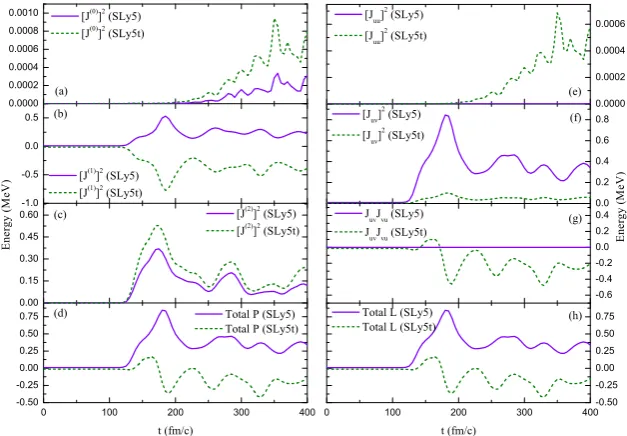
In order to test the numerical realization of our code and understand the contribution of tensor force in energy functional, we calculate the energy contribution from the
J2 terms both in its coupled form and Cartesian form as given in Eqs. (14) and (15). The left column in Fig. 2(a-d) shows the energy contribution of scalar, vector, and tensor components ofJ2, and the summation of these three terms, while the right column in Fig. 2(e-h) is the contribution from the diagonal, symetric and anti-symetric components and also the corresponding summation. The total contribu-tion calculated with two approaches are exactly identical shown in Fig. 2(d) and (h), as they should be.
We also check the final kinetic energy of the fragments for the case of Ec.m.=170 MeV, which is 28.1 MeV and 26.3 MeV for SLy5 and SLy5t, respectively. This energy provides the amount of energy transferred from relative motion to internal degrees of freedom, and could be a di-rect measure of the energy dissipation.
The contribution to the total energy from J2 term is shown in Fig. 3 for the five sets of Skyrme parameters in the collisions 16O+40Ca at E
c.m. = 46.5 MeV and
b=5.0 fm. In the early stage of dynamical evolution, the
energy fromJ2keeps constant as that in the ground state. As time evolves, these terms are highly excited in the dy-namic process and present an evident effect in heavy-ion
collisions of spin-saturated system16O+40Ca , while they have negligible effect in the ground state of spin-saturated
nucleus. The perturbative addition of tensor terms with SLy5t has an opposite sign with respect to the other four
forces. The TIJforces contribute to the energy up to a few MeV.
Figure 3.The energy contribution from theJ2terms in the col-lisions16O+40Ca atE
c.m.=46.5 MeV andb=5.0 fm.
4 Conclusion
We study the role of tensor force within the TDHF the-ory for the collision 16O+40Ca. The full tensor force is incorporated in our TDHF implementation. The calcula-tions are carried out in three-dimensional and symmetry unrestricted Cartesian coordinate. We employ the five sets of Skyrme parametrizations SLy5, SLy5t, T22, T26 and T44 with a wide range of isoscalar and isovector tensor coupling to study the role of tensor force in heavy-ion col-lision dynamics. The tensor force is found to change the upper fusion threshold energy in the order of a few MeV in the spin-saturated system16O+40Ca. The time-odd and tensor terms in Skyrme energy functional show an evident effect in the dynamical evolution. The tensor force plays a
5 Acknowledgments
This work is partly supported by the Natural Science Foundation of China under Grants Nos. 11175252 and 11575189, President Fund of UCAS, the NSFC-JSPS international cooperation program under Grant No. 11711540016, and the Australian Research Council Grants Nos. FT120100760 and DP160101254. The com-putation of this work was performed in the Tianhe-1A su-percomputer located in the Chinese National Supercom-puter Center.
References
[1] C. Simenelet al., Phys. Rev. Lett.86, 2971 (2001) [2] C. Simeneet al., Phys. Rev. Lett.93, 102701 (2004) [3] A.S. Umar, V.E. Oberacker, Phys. Rev. C73, 054607
(2006)
[4] K. Washiyama, D. Lacroix, Phys. Rev. C78, 024610 (2008)
[5] L. Guo, T. Nakatsukasa, EPJ WEB of CONFER-ENCE38, 09003 (2012)
[6] C. Simenelet al., Phys. Rev. C88, 024617 (2013) [7] K. Washiyama, Phys. Rev. C91, 064607 (2015) [8] M. Tohyama, A.S. Umar, Phys. Rev. C93, 034607
(2016)
[9] G.L. SHI Long, Nuclear Physics Review34, 41 ( 4) (2017)
[10] K. Godbeyet al., Phys. Rev. C95, 011601(R) (2017) [11] C. Simenel, A.S. Umar, Phys. Rev. C 89, 031601
(2014)
[12] G. Scampset al., Phys. Rev. C92, 011602 (2015) [13] P. Goddardet al., Phys. Rev. C92, 054610 (2015) [14] P.M. Goddardet al., Phys. Rev. C93, 014620 (2016) [15] A. Bulgacet al., Phys. Rev. Lett.116, 122504 (2016) [16] Y. Tanimura et al., Phys. Rev. Lett. 118, 152501
(2017)
[17] C. Simenel, Phys. Rev. Lett.105, 192701 (2010) [18] G. Scamps, D. Lacroix, Phys. Rev. C 87, 014605
(2013)
[19] K. Sekizawa, K. Yabana, Phys. Rev. C88, 014614 (2013)
[20] N. Wang, L. Guo, Physics Letters B760, 236 (2016) [21] K. Sekizawa, K. Yabana, Phys. Rev. C93, 054616
(2016)
[22] J.A. Maruhnet al., Phys. Rev. C74, 027601 (2006) [23] L. Guoet al., Phys. Rev. C76, 014601 (2007) [24] L. Guoet al., Phys. Rev. C77, 041301(R) (2008) [25] C. Simenel, Phys. Rev. Lett.106, 112502 (2011) [26] G.F. Daiet al., Phys. Rev. C90, 044609 (2014) [27] G.F. Daiet al., Sci. China-Phys. Mech. Astron. 57,
1618 (2014)
[28] P.D. Stevensonet al., Phys. Rev. C93, 054617 (2016)
[29] C. Golabek, C. Simenel, Phys. Rev. Lett. 103, 042701 (2009)
[30] A. Wakhleet al., Phys. Rev. Lett.113, 182502 (2014) [31] V.E. Oberacker et al., Phys. Rev. C 90, 054605
(2014)
[32] A.S. Umaret al., Phys. Rev. C92, 024621 (2015) [33] A.S. Umaret al., Phys. Rev. C94, 024605 (2016) [34] C. Simenel, P. Chomaz, Phys. Rev. C 68, 024302
(2003)
[35] J.A. Maruhnet al., Phys. Rev. C71, 064328 (2005) [36] T. Nakatsukasa, K. Yabana, Phys. Rev. C71, 024301
(2005)
[37] A.S. Umar, V.E. Oberacker, Phys. Rev. C71, 034314 (2005)
[38] P.G. Reinhardet al., Eur. Phys. J. A32, 19 (2007) [39] C. Simenel, P. Chomaz, Phys. Rev. C 80, 064309
(2009)
[40] B. Avez, C. Simenel, Eur. Phys. J. A49, 76 (2013) [41] S. Fracassoet al., Phys. Rev. C86, 044303 (2012) [42] C. Simenel, Eur. Phys. J. A48, 152 (2012)
[43] T. Nakatsukasaet al., Rev. Mod. Phys.88, 045004 (2016)
[44] P.A.M. Dirac, Proc. Cambridge Phil. Soc. 26, 376 (1930)
[45] P. Boncheet al., Phys. Rev. C13, 1226 (1976) [46] J.W. Negele, Rev. Mod. Phys.54, 913 (1982) [47] A. Lazzariniet al., Phys. Rev. C24, 309 (1981) [48] A.S. Umaret al., Phys. Rev. Lett.56, 2793 (1986) [49] T. Otsukaet al., Phys. Rev. Lett.95, 232502 (2005) [50] G. Colòet al., Phys. Lett. B646, 227 (2007) [51] T. Lesinskiet al., Phys. Rev. C76, 014312 (2007) [52] M. Benderet al., Phys. Rev. C80, 064302 (2009) [53] V. Hellemanset al., Phys. Rev. C85, 014326 (2012) [54] C.L. Baiet al., Phys. Rev. Lett.105, 072501 (2010) [55] Y. Iwata, J.A. Maruhn, Phys. Rev. C 84, 014616
(2011)
[56] J. Maruhnet al., Comput. Phys. Commun.185, 2195 (2014)
[57] D. Davesneet al., Phys. Rev. C80, 024314 (2009) [58] E. Perli´nskaet al., Phys. Rev. C69, 014316 (2004) [59] L.C. Vazet al., Physics Reports69, 373 (1981) [60] E. Chabanatet al., Nucl. Phys. A635, 231 (1998) [61] E. Chabanatet al., Nucl. Phys. A643, 441 (1998) [62] K.A. Brueckneret al., Phys. Rev.173, 944 (1968) [63] C. Simenel, B. Avez, Intl. J. Mod. Phys. E 17, 31
(2008)
[64] K. Washiyama, D. Lacroix, Phys. Rev. C78, 024610 (2008)
[65] C. Simenel, et al., Phys. Rev. C 95, 031601(R) (2017)
![Table 2. Energy (in MeV) and radii (in fm) of the Coulombfive sets of Skyrme parametrizations and experimental data [59]barrier obtained with the frozen density approximation for thein the collisions 16O+40Ca.](https://thumb-us.123doks.com/thumbv2/123dok_us/8123777.1353595/4.595.332.513.78.333/coulombve-skyrme-parametrizations-experimental-obtained-density-approximation-collisions.webp)