Hybrid SWOT-AHP Analysis of ICT Enabled Control
System in the Process Industry - A Case Study
Jayalakshmi.B
, Research scholar,Mechanical Department, Karpagam University, Coimbatore,
Tamil Nadu,India (Associate Professor,
Instrumentation and Control Engineering Dept, NSS College of Engineering,
Palakkad, Kerala, India)
Pramod.V.R
Associate Professor,
Department of Mechanical Engineering NSS College of Engineering,
Palakkad-8, Kerala, India
ABSTRACT
With current increased applications of web-based management systems, the number of fatalities occasioned by human error in industrial plants has significantly reduced. Distributed control system used in industries for monitoring and control techniques offers reprieve to plant managers by offsetting the number of threats to plant operations through early detections and interventions. Even though open loop wireless control systems are used in modern industries, wireless technologies for closed loop control systems are not yet implemented in industries. The present study aims to analyze the possibility of implementing wireless remote control system in industries with the help of SWOT AHP. Appropriate SWOT analysis results in the formulation of suitable policies by the process industry to build up its strengths, eradicate its weakness and exploit its opportunities to pawn the threats. Analytical Hierarchy process (AHP) is an ideal tool for strategy preparation in many organizations. The proposed SWOT-AHP framework was implemented and evaluated for a water and sewerage plant. The study concludes that SWOT-AHP methodology is a viable and effective tool in evaluating complex decision making on the suitability of implementing ICT enabled wireless control system in a plant.
Key words
Control valve, ICT, AHP, SWOT, Case study
1. INTRODUCTION
Implementation of ICT based control systems in management of plant operations is the fastest growing and most dynamic ventures in the industry today. Organizations that have implemented ICT based control systems are able to identify and mitigate risks to plant operations well in advance to avert disasters [15].In addition, an organization is able to identify opportunities for investment and formulation of strategies that would improve the organizational performance. In recent times, majority of industries have adopted certain protocols that facilitate data access from remote subunits via wireless technologies. Control systems based on internet applications have been widely adopted in this respect by combining both internet and wireless communication technologies for monitoring and controlling plant operation processes [14]. However, Web based applications are prone to connectivity delays and data loss through hacking among other challenges[13]. To overcome such challenges, Information
Communication Technology (ICT) has emerged as a mature technology in remote control of valves in plant operations. Despite the achievements of ICT use in information control, the notion of implementing ICT based process control system in industry is shrouded by diverse and unforeseeable internal and external environmental conditions and requires feasibility studies to identify environmental factors specific for each industry [2].
Within the present study perspectives, application of ICT has expanded beyond exchange of tacit knowledge and social interaction. The technology currently has the capacity of remote monitoring and control of operations between systems and equipment.ICT enabled control valve, being a wireless control system, consumes only a lesser space and not concerned about distance between control room and process. Other advantages of offering ICT based control valves are real time operation, greater flexibility and mobility for users, cheap installation & maintenance cost, better efficiency, user friendly, enhancement of production, reliability and high speed of response. With the introduction of a highly secure system, hacking can be reduced to a notable extent when compared to Internet based process control systems. Controlling an industrial process from geographical diverse location is a great process industrial development using ICT. Adoption of such a technology can be a shot in the arm for modern industry. However, very little research work has been done to date aimed at developing systematic design methods using this technology or for the design of ICT based wireless process control systems. The lack of implementation of ICT based remote control in the industries prompted the authors to propose the present work.
strategies for implementation of ICT based process control system in remote monitoring and control of plants. In this work, a model case study of a water and sewerage plant is used to illustrate the role of ICT control wireless systems in water metering control and management to avoid wastages and improve efficiency [1].The present study deduced that the implementation of ICT based process control system in a plant has a greater probability of success. Findings from this study also revealed that a hybrid SWOT-AHP analysis framework is an effective decision support methodology by empowering the decision maker in thinking over the weights of SWOT factors.
2. Materials and methods: SWOT AHP
Methodology
SWOT analysis as a tool is commonly used for analysis of external and internal environments with aim of achieving a systematic approach of decision making from the prevailing conditions. External environment refers to conditions under which the organization operates including threats and opportunities. Internal environment refers to strengths and weakness of the organization within its business operations. Combined analysis of external and internal environment accounts for the organization’s scale of values simply denoted as SWOT (Strengths, Weaknesses, Opportunities, and threats) factors [6].
A SWOT-AHP hybrid framework allows for systematic evaluation of SWOT factors depending on their intensities thus adding value to SWOT analysis. The value added is obtained from pair-wise comparisons between SWOT factors utilizing Eigen value calculation technique. The Eigen values offer appropriate means of examining, prevailing and predictive situations in a more comprehensive manner [11]. SWOT-AHP analysis has been successfully implemented in areas such as evaluation of investment opportunities [3], allocation of appropriate service concepts to various segments of IT market [7], optimizations of research and development (R&D) projects [5], in the evaluation of ERP systems [12], and to choose the best strategies for the successful implementation of e-government in Saudi Arabia [17]. AHP and ANP methods are used for the prioritization and comparison of SWOT factors [16]. The model case study reported in the present work details the application of SWOT-AHP hybrid model for the implementation of remote monitoring and control of plant using ICT. The combined methodology facilitates the generation of priorities among identified SWOT factors and decision alternatives.
2.1
Case study
XYZ is a water and sewerage plant situated in Mysore, India. It was incorporated in 2001. Wired systems are used for monitoring and controlling the process, thus consume more space. The XYZ plant officials have an idea to innovate the plant to get enough space, better control and efficiency, greater flexibility and optimum plant operation. When the authors approached plant officials with their proposal, they instantly arranged for a model case study as a prerequisite for the implementation of the proposal. The plant officialsof XYZ are tasked with multi-criteria decision-making scenarios for selecting the best approach of implementing remote monitoring and control of plant operations using ICT. Our study proposes a systematic approach that presents judgment on the best implementation strategy. To implement the project, data on user perspectives have to be generated.
2.1.1
Data collection
We identified ten experts with rich experience and deep knowledge in the XYZ plant management for the study. Their perspectives were collected using a semi-structured questionnaire concerning implementation of ICT based process control system. From their opinions, a SWOT matrix was developed outlining key internal and external environment factors (see Appendix A). To pair the comparisons, the questions were designed requiring the selected respondents to: 1) compare two factors in respect to implementation of ICT based control systems, 2) rate each individual factor on the basis of strength and opportunity or weakness and threat[10]. The rating scale generates relative weights of each SWOT factor with comparisons as the input followed by calculation of Eigen-values in order to obtain global priorities for each paired SWOT factor [8].
2.1.2 Prioritization of SWOT factors
Calculation of global priority of SWOT is as follows: Gi = SiOi/ WiTi Where: Gi = Overall priority for strategy i
Si,Oi, WiandTi = Eigen values for Strengths, Opportunities, Weaknesses, and Threats for strategy i driven by SWOT factors To calculate SWOT factor intensities, a rating scale is assigned for ranking/hierarchy of strategies [9] and the desirability index (Di) computed as follows: 𝐷𝑖= 𝑛𝑗 =𝑖𝐺𝑗𝑅𝑖𝑗 , Where Gj is the Global weight for jth SWOT factor
Rij – the degree of interrelationships between ith strategy andjth SWOT factor, n – no. of SWOT factors. Synthesis of the global priorities involves multiplication of criteria-specific priorities with criterion weight followed by summing up the results in order to obtain the overall global priority.
3. SWOT-AHP HIERARCHY ANALYSIS
Table 1.Analytical Hierarchy Process Analysis of Strengths of ICT based process control system
Strengths S1 S2 S3 S4 S5 Eigen
value
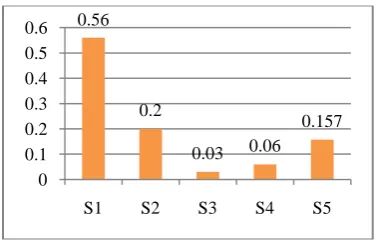
S1 1 5 9 7 5 0.56
S2 1/5 1 7 7 1 0.20
S3 1/9 1/7 1 1/3 1/7 0.03
S4 1/7 1/7 3 1 1/3 0.06
S5 1/5 1 7 3 1 0.157
.The Eigen value is calculated by dividing each of the elements in the row by the sum of the corresponding column in the matrix. The results are graphically plotted as shown in chart 1.
Chart 1 Eigen values for Strengths
Table 2: Analytical Hierarchy Process Analysis of Weaknesses of ICT based process control system
.
Weaknesses W1 W2 W3 W4 W5 W6 Eigen value
W1 1 1/5 1/7 1 3 1/5 0.06
W2 5 1 3 7 7 3 0.41
W3 7 1/3 1 5 5 3 0.27
W4 1 1/7 1/5 1 3 1/3 0.06
W5 1/3 1/7 1/5 1/3 1 1/5 0.03
W6 5 1/3 1/3 3 5 1 0.16
[image:3.595.314.519.310.448.2]Chart 2: Eigen values of Weaknesses
Table 3Analytical HierarchyProcess Analysis of Opportunitiesof ICT based process control system.
Opportunities O1 O2 O3 O4 O5 Eigen value
O1 1 1/3 3 1/5 1 0.12
O2 3 1 5 1 3 0.33
O3 1/3 1/5 1 1/5 1 0.07
O4 5 1 5 1 5 0.41
O5 1 1/3 1 1/5 1 0.09
Chart 3: Eigen values of Opportunities
0.56
0.2
0.03 0.06 0.157
0 0.1 0.2 0.3 0.4 0.5 0.6
S1 S2 S3 S4 S5
0.06 0.41
0.27
0.06 0.03
0.16
0 0.05 0.1 0.15 0.2 0.25 0.3 0.35 0.4 0.45
W1 W2 W3 W4 W5 W6
0.12 0.33
0.07 0.41
0.09
0 0.1 0.2 0.3 0.4 0.5
[image:3.595.54.243.318.440.2]Table 4: Analytical Hierarchy Process Analysis of Threats of ICT enabled Process control system
Threats T1 T2 T3 T4 T5 Eigen
value
T1 1 1/5 5 7 1 0.19
T2 5 1 9 9 1 0.45
T3 1/5 1/9 1 2 1/9 0.04
T4 1/7 1/9 1/2 1 1/7 0.03
T5 1 1 9 7 1 0.29
Chart 4: Eigen values of Threats
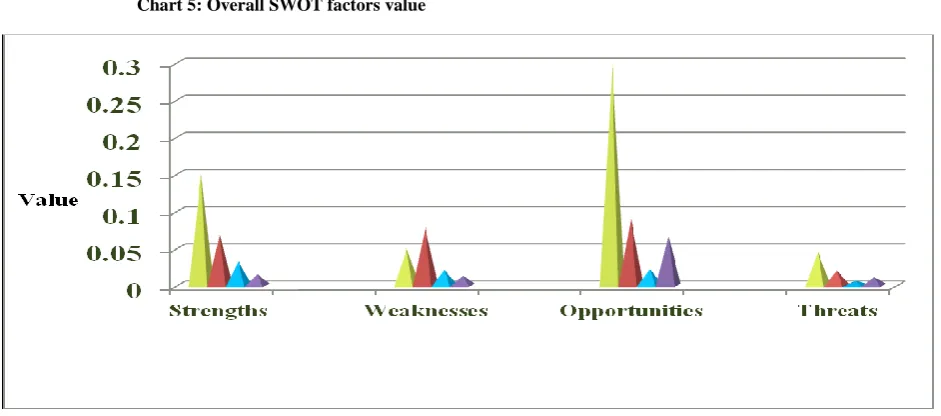
After calculation and totalizing the Eigenvectors, evaluation of the SWOT group intensities based on the last weight comparisons reflects the value of greater importance in respect to the overall aim at the top of the hierarchy. Global priority can be evaluated using the equation stated for prioritization of SWOT factors.
Table 5 Factor intensity
SWOT factors Effective Implementation of ICT based process control system.
User perspectives
Global priority
Strengths 0.16 0.26 0.22
Weaknesses 0.26 0.16 0.26
Opportunities 0.26 0.26 0.30
Threats 0.16 0.26 0.22
Intensities key: 0.42 (Very High); 0.26 (High); 0.16 (Medium); 0.10 (Low); 0.06 (Very Low)
Chart 5: Overall SWOT factors value
0.19 0.45
0.04 0.03 0.29
0 0.1 0.2 0.3 0.4 0.5
[image:4.595.65.536.466.674.2]4.
RESULTS AND DISCUSSION
Based on the identified SWOT factors and their global priority index, we proposed three strategies are as follows:
ST1 - Design and Implementation of ICT based wireless process
control system for remote monitoring and control. From Figure 3, it is clearly evident that both Opportunities and Strengths outweigh Threats and Weaknesses. It was also observed from Eigen vector calculations that strengths are the most valuable factors in implementation of the ICT-based control valve system for monitoring and control of water metering. The combined success factors for ST1 are (S1, S2, O2, O4, W1, W5,
and T3). Strength 1 and 2 particularly renders the remote controlled metering process cost-effective and sustainable by the plant in management of offsite subunits. The opportunity factors O2 and O4 significantly favor implementation of ICT-based process control system in the plant in order to realize the proposed objective.
4.1
Decision alternatives
ST2 – Consolidation of existing IT/IS technologies in order to
improve the exchange of tacit knowledge in the plant processes. This strategic decision is only viable for the water and Sewerage Company if Weakness 3 and Threat 3 (W3, T3) remain low with respect to the study objective in order to compliment benefits from Strength 5 (S5) and opportunities1 and 4 (O1, O4). Alternatively the organization can outsource the metering services to a third party and ST3 – Tendering
management of water metering in a remote location to a thirty party (S1, W2, T1, T2), however, threat factor 2 (T2) with over 40% Eigen value poses the greatest challenge to implementation of this strategic decision.
As Figure 3 illustrates, clearly there exists greater strength and opportunity factors with significantly fewer threats and weakness that can contribute to failure of ST1. Therefore, the
present study deduced that the proposed implementation of ICT-based process control system in a plant has a greater probability of success. Findings from this study also revealed that a hybrid SWOT-AHP analysis framework is an effective decision support methodology by empowering the decision maker in thinking over the weights of SWOT factors.
5.
CONCLUSION AND SUGGESTIONS
FOR FUTURE WORK
The importance of implementing ICT based wireless process control systems in industrial plant is evident. Without ICT advancement, very few structural changes would have been witnessed in corporate organizational management..The systematic SWOT-AHP analysis approach proposed herein on the role of ICT based wireless control systems encourage broad scale adoption of the technology in remote monitoring and control of plants. It is clear that there exist greater strength and opportunity factors with significantly fewer threats and weakness that can contribute to failure of ST1. Therefore, the
present study deduced that the proposed implementation of ICT-based control system in a plant has a greater probability of success. The population sample was drawn from localized settings. Therefore future research is suggested to cover multi-sector analysis for implementation of ICT-based wireless process control systems.
6. REFERENCE
[1] Hill, T and Westbrook, R. “SWOT analysis: it’s time for a product recall”,Long Range Planning, 1997,30.1, 46-52.
[2]Iraj, Hamed, Mohammad, MP and
Armaghan,Heidarzade.“Applying Multi-Criteria Decision Methods and SWOT Factors to Analyze the Role of Information Technology in Industry Development in Iran”,Journal of Applied Sciences, 2008:8, 2983-2990.
[3] Kengpol, A and O'Brien, C. “An Analytical Network Process for the Evaluation of Investment in Time Compression Technology”,Proceedings of the 11th Annual Meeting of Production and Operations Management Society, San Antonio; 2000.
[4] Masozera, MK, Alavalapati, JRR, Jacobson, SK and Shrestha, RK. “Assessing the suitability of community-based management for theNyungwe Forest Reserve, Rwanda”,Forest Policy and Economics, (2006): 8, 206-216.
[5] Meade, LM and Presley, A. “R&D Project Selection Using the Analytic Network Process”,IEEE Transactions on Engineering Management, (2002):49, 59-67.
[6] Pasonen, M, Kurttila, M, Kangas, J, Kajanus, M and Heinonen, P. “Assessing the priorities using A’WOT among resource management strategies at the Finnish forest and park service”, Forest Science, (2000):47.4, 534-541.
[7] Partovi, FY. “An analytic model to quantify strategic service vision,” International Journal of Service Industry Management, (2001):12,476-499.
[8] Saaty, T.L.The Analytic Hierarchy Process: Planning, Priority Setting, Resource Allocation, McGraw-Hill, Inc., 1980. [9] Saaty, T.L.Theory and Applications of the Analytic Network Process: Decision Making with Benefits, Opportunities, Costs, and Risks. Pittsburgh: RWS Publications, 2005.
[10] Saaty, TL.“Decision making with the analytic hierarchy process”, International Journal of [ Services Sciences (IJSSCI), (2008):1.1, 83–98.
[11]Shrestha, RK, Alavalapti, JRR and Kalmbacher, RS. “Exploring the potential for silvopasture adoption in south-central Florida: an application of SWOT-AHP method,” AgricultureSystems,(2004):81,185-199.
12].Shyur, H. “A Semi-Structured Process for ERP Systems Evaluation: Applying Analytic Network Process”,Journal of e-Business, (2003):5, 1:33-49
[13]Syed, M. Ahsan, AmjadFarooq, M. Shahbaz, M. JunaidArshad, M. Aslam. “Scaling Technique for Web Based Management Systems in Bioinformatics”, Life Science Journal,(2012):9,3, 1-5.
[14].Thompson, HA. “Wireless and Internet communications technologies for monitoring and control”, Control Engineering Practice,(2004):12.6, 781–791.
[16] Ali GÖRENER,“Comparing AHP and ANP: An
Application of Strategic Decisions Making in a Manufacturing Company”,International Journal of Business and Social Science(2012),Vol. 3 No. 11;pg 194-208.
[17]SalehAlshomrani and ShahzadQamar.: Hybrid SWOT-AHP Analysis of Saudi Arabia E-Government. International Journal of Computer Applications 48(2):1-7, June 2012.
Appendix A: SWOT analysis matrix
StrengthsS1 Hazard free operations. S2 Employee satisfaction S3 Better control. S4 Low maintenance cost.
S5 Increased efficiency in plant operations
Weakness
W1 Narrow band of operating frequency spectrum
W2 Increased adaptation and administrative costs
W3 Initial investment is high.
W4 Competition from the conventional methods of control
W5.Information Security is a problem. W6. control action delay
Opportunities
S1 High innovation leads to business expansion
S2 Optimum plant operation.
S3 Intelligent Automation &Information Management systems
S4 Dynamic and Reliable Technology. S5 Profit margins will be high.
Threats
T1 Resistance to change .
T2 Fear of information system break down. T3 Any problem to the central server may cause loss of data resulting in closure of all operations, until the problem is rectified.
T5 Lack of funds.