Journal of Chemical and Pharmaceutical Research, 2015, 7(1):823-828
Research Article
CODEN(USA) : JCPRC5
ISSN : 0975-7384
Efficient synthetic method for β-enaminones using SbCl
3/Al
2O
3as catalyst
under solvent-free conditions
Mohd. Yaseen Sirwal
1, Rajan Kumar Sharma
2and Kamal K. Kapoor
21
Govt. Degree College, Kishtwar, Jammu and Kashmir, India
2
Department of Chemistry, University of Jammu, Jammu, India
_____________________________________________________________________________________________
ABSTRACT
Antimony trichloride is found to catalyze efficiently the synthesis of β-enaminones on grinding under solvent-free conditions in excellent yields. The use of antimony trichloride on grinding makes this method simple, convenient, eco-friendly and cost-effective.
O O SbCl O N
3 / Al2O3 (2 mol% )
Grinding, RT
Ar-NH2
Ar H
Keywords: SbCl3/Al2O3; β-enaminones; solvent-free; grinding.
_____________________________________________________________________________________________
INTRODUCTION
Enaminones are known to possess a variety of medicinal properties[1]including anticonvulsant, malarial,
anti-inflammatory and cardiovascular properties.[2]The β-enaminones are important precursors for the synthesis of a
variety of heterocycles[3]with high pharmaceutical significance. They serve as building blocks for the synthesis of
amino esters, amino acids, amino alcohols, peptides and alkaloids.[4] The enamination of 1,3-dicarbonyl compounds
to form β-enaminones is an important and widely used transformation in organic chemistry. Several methods are
known in the literature for the preparation of β-enaminones. Among them the most commonly used methods involve
condensation of 1,3-dicarbonyls with aliphatic and aromatic amines using Sc(OTf)3,[5] Bi(OTf)3,[6] Au,[7]
Zn(OAc)2.2H2O,[8] silica[9]etc.
Keeping in view the biological importance[1],[2]of β-enaminones, we present here antimony (III) chloride adsorbed
on alumina catalyzed mild, efficient and inexpensive procedure for the preparation of β-enaminones from
acetylacetone and aromatic amines in solvent-free conditions. A remarkable catalytic effect of antimony (III) chloride was disclosed by Cho’s group[10] in hydrophenylation of α,β-unsaturated ketones and aldehydes
(Michael-type conjugate addition) with sodium tetraphenylborate in acetic acid. SbCl3 has been found to catalyze efficiently
the synthesis of 1,2-di-substituted benzimidazoles,[11] benzo[b]-1,4-diazepines,[12] tetra-substituted
imidazoles,[13] bis(indolyl)methanes and tris(indolyl)alkanes,[14] α-aminophosphonates,[15] dihydro
environmentally hazardous conditions by avoiding use of harmful solvents, time and energy efficiency, low capital outlay for scale up, reduction in the waste produced and by products and formation of cleaner products.
EXPERIMENTAL SECTION
General
All experiments were performed in oven dried glass apparatus. Melting points were measured in open capillaries on Perfit melting point apparatus and are uncorrected. The progress of the reaction was monitored by TLC using silica gel precoated aluminium sheets. Visualization of spots was effected by exposure to iodine vapours and Draggendroff reagent. Column chromatography was performed on silica gel (60-120 mesh) and compounds were eluted with graded solvent systems of petroleum ether and ethyl acetate. Recrystallization was achieved with ethyl acetate-petroleum ether (60-80) solvent system. IR spectra on KBr were recorded on Perkin-Elmer FTIR
spectrophotometer. NMR (1H and 13C broadband decoupled) and ESIMS spectra were recorded on Brucker Ac-500
(500 & 125 MHz respectively) spectrometer and Micro Mass VG-7070H mass spectrometer respectively. Elemental
analysis was performed on Leco CHNS 932 analyzer. 1H chemical shifts are reported in parts per million (ppm)
from tetra methyl silane (TMS) as internal standard. The abbreviations s, brs, d, dd, t, q, b, m in 1H NMR spectra
refer to singlet, broad singlet, doublet, double doublet, triplet, quartet, broad and multiplet respectively.
Preparation of catalyst (SbCl3 / Al2O3)[16]
To an antimony (III) chloride (2.28gm, 10 mmol) solution in 100ml of distilled ethanol was added 60 gm of neutral alumina. The mixture was stirred at room temperature for one hour followed by removal of solvent under reduced
pressure on rotavapour. The resultant free flowing powder was then activated at 110oC in an oven for two hours and
was used throughout the experimentation.
General procedure for the synthesis of β-enaminones(3a-3f)
A mixture of acetylacetone (5 mmol), aniline 2a-2f (5.5 mmol) and 2 mol% SbCl3/Al2O3 (0.25 mmol, 0.62g) was
grinded using pestle and mortar at room temperature till the completion of reaction (TLC). The reaction mixture was diluted with ethyl acetate (30 ml), washed with water (2 x 10 ml) and brine (1 x 10 ml). The organic layer was dried
over anhydrous Na2SO4, followed by the removal of ethylacetate under reduced pressure. The residue upon column
chromatography gave corresponding β-enaminones 3a-3f (85-93% yield).
RESULTS AND DISCUSSION
We herein report an efficient, simple and eco-friendly method for the preparation of β-enaminones by condensation
of acetylacetone and aromatic amines in presence of SbCl3/Al2O3 on grinding under solvent-free conditions
(Scheme 1).
O O SbCl3 / Al2O3 (2 mol% ) O N
Grinding, rt Ar-NH2
Ar H
1 2a-2f 3a-3f
Scheme 1: SbCl3/Al2O3 catalyzed solvent-free synthesis of β-enaminones on grinding
For optimization of reaction conditions a mixture of acetylacetone (5 mmol, 0.50g), aniline (5.5 mmol, 0.51g) and 5 mol% SbCl3/Al2O3 as catalyst was heated at 100°C under solvent-free conditions for 2 hours and the yield of the
product was 55%. Few other methodologies were also employed like microwave irradiation, stirring, grinding and ultrasonication and the best results were obtained in case of grinding with 82% yield of the product.
In order to obtain the optimum concentration of catalyst a set of experiments were performed employing different
concentrations of SbCl3/Al2O3 for a reaction between 5 mmol acetylacetone and 5.5mmol of aniline and it was
observed that 2mol% of catalyst was required to obtain the optimum yield (92%) of the product after one hour of
grinding as shown in the Table 1. It has also been observed in one of the experiment devoid of SbCl3/Al2O3, that the
Table 1 : Optimization of amount of SbCl3/Al2O3 for synthesis of β-enaminones under solvent-free conditions.b
Entry Catalyst amount (mol%) Time(mins)c Yield(%)d
1 0 60 20
2 2 60 92
3 5 60 91
4 7 60 90
5 9 60 92
b reaction conditions: acetylacetone (5 mmol), aniline (5.5 mmol) and SbCl
3/Al2O3, grinding, 60 minutes. cas revealed by TLC.
d isolated yield.
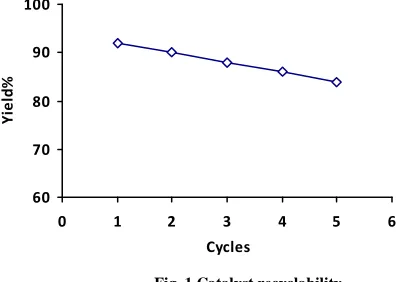
In order to investigate the recyclability, SbCl3/Al2O3 was recovered, activated at 110°C in an oven and reused 5
[image:3.595.182.380.264.405.2]times, successfully for the reaction of acetylacetone and aniline, no significant decrease in its activity was noticed (Fig.1).
Fig. 1 Catalyst recyclability
The condensation of acetylacetone (5 mmol, 0.50g) with aniline, (5.5 mmol, 0.51g) was carried out by grinding using pestle and mortar at room temperature under solvent-free conditions with 2 mol% SbCl3/Al2O3 as catalyst.
The product 3a was characterized by 1H NMR spectrum [1.99 (s, 3H, -CH3), 2.10 (s,3H, -CH3), 5.19 (s, 1H,
C=C-H), 7.09-7.31 (m, 5H, Ar-C=C-H), 12.49 (br s, 1H, NH)] and supported by IR and Mass data. A characteristic singlet for one alkenic hydrogen at δ 5.19 arising due to the formation of 4-(phenylamino)–pent–3–en–2–one 3a.A variety of anilines 2a-2f were employed with acetylacetone 1 under the same reaction conditions (Scheme 1) and the results are depicted in Table 2.
Table 2. Substrate scope for the SbCl3/Al2O3 catalyzed preparation of β-enaminones on grinding under solvent-free conditions.a
Entry Ar-NH2 β-enaminoketonesb Time (min.)c Yield (%)d M.pt(°C) Obs. Litt.e
1
NH2
2a
N H O
3a
55 92 Oily Oily[18]
2
NH2
OCH3
2b
N H
O OCH
3
3b
53 93 Oily Oily[18]
60 70 80 90 100
0 1 2 3 4 5 6
Cycles
Y
ie
ld
[image:3.595.97.520.525.713.2]Entry Ar-NH2 β-enaminoketonesb Time (min.)c Yield (%)d
M.pt(°C) Obs. Litt.e
3
NH2
CH3
2c
N H
O CH
3
3c
62 93 66-68 65-67[19]
4
NH2
F 2d
N H
O F
3d
70 86 Oily Oily[18]
5
NH2
Cl 2e
N H
O Cl
3e
68 90 61-62 60-62[18]
6
NH2
Br
2f
N H
O Br
3f
65 88 59-60 --
areaction conditions: acetylacetone (5 mmol), aniline (5.5 mmol) and SbCl
3/Al2O3, grinding, 60 minutes. ball the products were characterized by their physical and spectral data.
cas revealed by TLC disolated yields. e
literature reference of melting point.
To explain the formation of desired product following plausible mechanism is proposed. The formation of
β-enaminones simply involves the formation of imine by the condensation of amino group and carbonyl group of
different reactants followed by 1,3 H-shift leading to the formation of more stabilized β-enaminones due to
intramolecular H-bonding as shown in Scheme-2.
O O
SbCl3/Al2O3
O N Ar
H
N H
O Ar
Ketoimine Enaminones
H2N-Ar..
Hydrogen bonding
Spectroscopic data of some β-enaminones (3a-3f) 4-(Phenylamino)-pent-3-en-2-one (3a)
Viscous oil, Pale yellow, 92% yield, M. pt. Oil [lit.[18] oil]. 1H NMR (500 MHz, CDCl3) : 1.99 (s, 3H, -CH3), 2.10
(s, 3H, -CH3), 5.19 (s, 1H, C=C-H), 7.09-7.31 (m, 5H, Ar-H), 12.49 (br s, 1H, NH). 13C NMR (125 MHz, CDCl3):
19.5, 29.0, 126.2, 126.3, 130.7, 133.7, 137.5, 161.1,196.0. IR KBr; υmax , cm-1: 3442, 2997, 1595, 1572, 1509, 1437,
1356,1281, 1190, 1019, 905, 749, 695. Anal. Calcd for C11H13NO : C, 75.21; H, 7.65; N, 8.31 Found: C, 75.42; H,
7.42; N,8.00. ESI-MS: m/z = 176 (M+H)+.
4-( p-Methoxyphenylamino)-pent-3-en-2-one (3b)
Viscous oil, Pale yellow, 93% yield, M. pt. Oil [lit.[18] oil] 1H NMR (500 MHz, CDCl3) :1.90 (s, 3H, -CH3), 2.08
(s, 3H, -CH3 ), 3.80 (s, 3H, -OCH3), 5.15 (s, 1H, C=C-H), 6.86 (d, J = 8.7 Hz, 2H, Ar-H), 7.04 (d, J = 8.7 Hz, 2H,
Ar-H), 12.35 (br s, 1H, NH). 13C NMR (125 MHz, CDCl3) : 20.6, 50.1, 55.4, 84.3, 114.2, 126.5, 132.0, 156.5,
161.1, 170.9. IR KBr; υmax ,cm-1: 3430, 3000, 2829, 1601, 1568, 1355, 1279, 1243, 1194, 1035, 921, 835, 763.
Anal. Calcd for C12H15NO2 : C, 70.11 ; H , 7.52 ; N ,6.99. Found : C,70.24 ;H, 7.30 ; N,6.80. ESI-MS: m/z = 206
(M+H)+.
4-(p-Tolylamino)-pent-3-en-2-one (3c)
Solid, Pale yellow, M. pt. 66-68 ºC (lit.[19] 65-67 ºC). 1HNMR (500 MHz, CDCl3) : 1.96 (s, 3H, -CH3), 2.09 (s,
3H, -CH3), 2.34 (s, 3H, Ar.-CH3), 5.16 (s, 1H, C=C-H), 6.99 (d, J =8.7 Hz, 2H, H), 7.14 (d, J = 8.7 Hz, 2H,
Ar-H), 12.39 (br s, 1H, NH). 13C NMR (125 MHz, CDCl3): 19.9, 29.1, 36.2, 97.8, 120.3, 125.9, 128.4, 151.9.160.0,
195.5.IR KBr; υmax, cm-1: 3424, 3026, 1609, 1565, 1519, 1355, 1282, 1186, 1017, 942, 762. Anal. Calcd for
C12H15NO : C, 76.01 ; H , 8.11 ; N, 7.59 Found : C, 76.19; H, 7.93 ; N,7.40. ESI-MS: m/z = 190 (M+ H)+.
4-( p-Fluorophenylamino)-pent-3-en-2-one(3d)
Viscous oil, Pale yellow, M. pt. Oil [lit.[18] oil], 1H NMR (500 MHz, CDCl3) :1.98 (s, 3H, -CH3), 2.10 (s, 3H,
-CH3), 5.20 (s, 1H, C=C-H), 7.10 (d, J = 8.7 Hz, 2H, Ar-H), 7.40 (d, J = 8.7 Hz, 2H, Ar-H), 12.43 (br s, 1H, NH). 13C
NMR (125 MHz, CDCl3) : 22.1, 52.6, 87.4, 126.6, 130.1, 138.9, 158.5, 164.3, 173.0. IR KBr; υmax /cm
-1
: 3457,
2995, 1614, 1568, 1504, 1434, 1279,1189, 1090, 1011, 916, 841, 756. Anal. Calcd for C11H12NOF : C, 68.23; H,
6.43 ; N, 7.47. Found : C, 68.39; H, 6.21; N,7.25. ESI-MS: m/z = 194 (M+H)+.
4-( p-Chlorophenylamino)-pent-3-en-2-one (3e)
Solid, Pale yellow, M.pt. 61-62 ºC (lit.[18] 60-62 ºC). 1HNMR (500 MHz, CDCl3) :1.98 (s, 3H, -CH3 ), 2.10 (s, 3H,
-CH3), 5.20 (s, 1H, C=C-H), 7.03 (d, J = 8.7 Hz, 2H, Ar-H), 7.30 (d, J = 8.7 Hz, 2H, Ar-H), 12.43 (br s, 1H, NH).
13C NMR (125 MHz, CDCl
3) : 21.1, 50.6, 86.4, 125.6, 129.1, 137.9, 158.5, 162.3, 171.0. IR KBr; υmax , cm-1: 3456,
2994, 1613, 1567, 1503, 1434, 1278, 1189, 1090, 1011, 915, 840, 755. Anal. Calcd for C11H12NOCl : C, 62.75; H,
5.92 ; N, 6.91. Found : C, 63.00; H, 5.73; N,6.68. ESI-MS: m/z = 212(M+2), 210 (M+H)+ .
4-( p- bromophenylamino)-pent-3-en-2-one (3f)
Solid, Pale yellow. M. pt.59-60 ºC, 1HNMR (500 MHz, CDCl3) :1.96 (s, 3H, -CH3 ), 2.09 (s, 3H, -CH3), 5.18 (s,
1H, C=C-H), 7.01 (d, J = 8.3 Hz, 2H, Ar-H), 7.29 (d, J = 8.3 Hz, 2H, Ar-H), 12.42 (br s, 1H, NH). 13C NMR (125
MHz, CDCl3) : 21.0, 50.4, 86.3, 125.3, 129.0, 137.6, 158.2, 162.1, 170.0.IR(KBr)υmax /cm-1: 3457, 2997, 1617,
1569, 1506, 1437, 1280, 1191, 1093, 1014, 918, 843, 756. Anal. Calcd for C11H12NOBr : C, 51.99; H, 4.76 ; N,
5.51. Found : C, 50.73; H, 4.19; N, 4.95. ESI-MS: m/z = 256(M+2), 254 (M+H)+.
CONCLUSION
In summary we developed an efficient and solvent free synthesis of β-enaminones catalysed by SbCl3/Al2O3.
Acknowledgements
The authors are grateful to the Department of Science and Technology, GOI, New Delhi for funding (Project No. SR/S1/OC-38/2010) and the NMR facility under PURSE. Mohd. Yaseen Sirwal is also thankful to UGC for fellowship.
REFERENCES
[4](a) K Singh; J Singh; H Singh. Tetrahedron 1998,54, 935. (b) G Palmieri; C Cimarelli. J. Org. Chem. 1996, 61, 5557. (c) D Potin; F Dumas; J Angelo. J. Am. Chem. Soc. 1990, 12, 3483. (d) C Cimarelli; G Palmieri; E Volpini.
Synth. Commun. 2001, 31, 2943. (e) LG Beholz; P Benovsky; DL Ward; NS Barta; JR Stille. J. Org. Chem. 1997, 62, 1033. (f) G Bartoli; C Cimarelli; E Marcantoni; G Palmieri; M Petrini. J. Org. Chem.1994, 59, 5328.
[5]JS Yadav; VN Kumar; RS Rao; AD Priyadarshini; PP Rao; BVS Reddy; K Nagaiah; Journal of Molecular
Catalysis, 2006, 256, 234-237.
[6]AR Khosropour; MM Khodaei; M Kookhazadeh. Tetrahedron Lett.2004, 45, 1725-1728.
[7]A Arcadi; G Bianchi; SD Giuseppe; F Marinelli. Green Chemistry, 2003, 5, 64-67.
[8]RK Vohra; JL Renaud; C Bruneau. Synthesis, 2007, 5, 0731-0738.
[9]B Rechsteiner; TB Francoise; J Hamelin. Tetrahedron Lett.,1993, 34, 5071- 5074.
[10]CS Cho.; S Motofusa; S Uemura. Tetrahedron Lett.,35,1739.
[11]A Kumar; KK Kapoor. J. Chem. Pharm., 2011, 3, 369-374.
[12]BA Ganai; S Kumar; CS Andotra; KK Kapoor. Synthetic comm., 2006, 36, 803-807.
[13]J Safari; SG Ravandi; S Naseh. J. Chem. Sci., 2013, 125, 827-833.
[14]P Kundu; G Maiti. Ind. J. Chem., 2008, 47B, 1402-1406.
[15]Ambica, S Kumar; SC Taneja; MS Hundal; KK Kapoor. Tetrahedron Lett.,2008, 49, 2208-2212.
[16]KK Kapoor; BA Ganai; S Kumar; CS Andotra. Can J. Chem, 2006, 84, 433-437.
[17]K Tanaka; F Toda. Chem. Rev. 2000, 100,1025.
[18]HL Yale; ER Spitzmiller. J. Heterocyclic Chem, 1977, 14, 1419-1421.
[19]T Potesil. J. Chromatogr 1984, 3122, 387-393.