Journal of Chemical and Pharmaceutical Research, 2014, 6(7):1206-1215
Research Article
CODEN(USA) : JCPRC5
ISSN : 0975-7384
Edge collapse improved model-based three dimensional surface
model data compression algorithm
Renshang Zhang
Shanxi University of Finance and Economics, Taiyuan, Shanxi, China
_____________________________________________________________________________________________
ABSTRACT
With computer technology and three-dimensional imaging software and hardware technology rapidly development, three-dimensional digital technology is more and more concerned and applied by people. But limit graphics card handling ability and network bandwidth seriously affect such media transmission, simply rely on increasing hardware equipment input is not enough to solve problems, it should adopt corresponding algorithms to compress three-dimensional surface model data so that can fundamentally solve the drawback. Though some common used compression algorithms and tools can be used to reduce three-dimensional geometric data sizes, efficiency is not ideal or it is improper for some specific applications, three-dimensional model and previous voice frequency( one-dimensional), image( two-dimensional), video( two-dimensional+time) the three kinds of medias types are different, three-dimensional network model also reflects as random crook, complex and lacking of continuous natural parameterization features, and each kind of attributes that are defined in model surface is non-regular sampled, which let classic orthogonal analysis tools cannot be directly used to handle 3D geometric signal. Therefore, look for new algorithms to effective express three-dimensional model is imperative. The paper based on Garland proposed surface model compression algorithm, it puts forward a kind of edge collapse-based surface data compression algorithm, the algorithm calculates edge collapse cost and defines each edge collapse order according to quadric error measure criterion, judges shrinkage legality according to half-space test method, by the algorithm, it implements surface model boundary zone and interior zone synchronization compression, it not only can ensure original model geometric features on the condition of high compression ratio, but also can effective ensure compression model quality.
Key words: Edge collapse, compression algorithm, three-dimensional surface, quadric error, half-space test
_____________________________________________________________________________________________
INTRODUCTION
researching on surface expression, surface intersection and surface joining to surface deforming, surface reconstruction, surface simplification, surface transformation and surface potential difference, surface reconstruction needs to collect lots of data, the established model is generally very complicated [9, 10].
Lots of domestic and foreign scholars have made widely and deepen researches on three-dimensional surface model data compression method, from which the representative were: Schroeder and others put forward vertex deletion-based surface model data compression algorithm [1]; Garland proposed edge collapse-based surface model data compression method [2]; Hamann put forward triangle contracted-based surface model data compression method [3]; Turk put forward network redistributed-based surface model data compression method [4]; Hoppe and others proposed overall gridding optimization criterion-based surface model data compression method [5]. Its research result was well applied, which provided well theoretical basis for the technology development. In addition:Xu Min and Zhang Yong-Sheng from School of Geodesy and Geomatics, University of information engineering in “Three-dimensional model data compression technical analysis”, they introduced three-dimensional model data compression algorithms classification, and then combined with different classification status, made comparative analysis of some representative kinds of compression algorithms, and put forward summary and expectation in some aspects on the technique development [6]; Zhejiang University’s CAD& Wang Peng-Jie ,Pan Zhi-Geng as well as CG national key laboratory’s Liu Yong-Kui in “Point-based three-dimensional model
compression technique research progress”, they summarized point model compression flow, and provided point
model compression algorithm classification principle, and then took single resolution ratio algorithm and progressive algorithm as main line to detailed introduce point model compressed latest research progress, analyzed and compared corresponding key technologies [7]; Southeast University’s geographic information engineering department’s Cai Xian-Hua and Zheng Tian-Dong in “Digital elevation model data compression algorithm research” proposed DEM data compression, DEM terrain compression error concepts, on this basis, suggested a kind of qualification selection data compression method that based on DEM terrain compression error influence, and utilized the method could provide a kind of technical way for DEM digital integration, reduced DEM storage data sizes, and improved DEM subsequent handling speed [8]; Ocean University of China’s College of information engineering, department of computer science’s Ma Ping and University of science and technology of Qing Dao’s Institution of Qing Dao’s Jia Jian-Feng in “ Three-dimensional surface texture image compression”, started from wavelet analysis-based image compression, systematically introduced wavelet analysis and researched on two-dimensional wavelet analysis application in image compression, in the paper, it introduced three-dimensional surface texture theory frame, on the basis of the frame, it carried out wavelet analysis applied research on three-dimensional surface texture compression, expanded wavelet analysis in image compression field, and verified method validness with experiment and data [9]. By far the uppermost of gridding model compression is topology compression method, the paper studies and analyzes edge collapse principle, and applies it into three-dimensional surface model data compression, which provides theoretical basis for the algorithm implementation.
EDGE COLLAPSE ALGORITHM PRINCIPLE
Variable definition and theorem
As Figure 1shows, surface model sampling point set
{
}
n n n
sub v v v v v
V = 0, 1, 1, 2,...., 8
, is composed TIN sampling point
[image:2.595.219.390.573.647.2]itself that is a partial triangulation network of TIN composed of
V
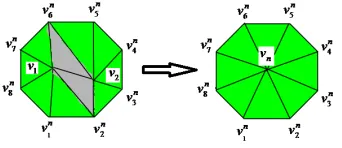
sub. In order to easy to describe, it makes following definitions:Figure 1: Edge collapse operation schematic diagram
Definition 1 A connected, node interlinked entity surface TIN model is a limited triangle sequence; the sequence meets following five conditions:
In surface model, every edge is shared by two triangles at most:
If triangle
T
ione vertex is simultaneously shared by another triangleT
j, and then the vertex is also the vertex oftriangle
T
j;Triangle is complemented and overlapped.
Definition 2 For connected, node interlinked surface model, define edge
E
i correlated triangle templateP
i as alland edge
E
i at least one vertex shared triangleT
i set.Definition 3 Call triangle
P
i vertex set( not including contracted two vertexesv
1, v
2) as boundary vertex set. By boundary vertex set paired order ( clockwise or anticlockwise ) connection composed polygon is called boundary polygon.Definition 4 Edge collapse is the process that surface combines requested two vertexes into one vertex and deletes degenerated triangle during surface data compression process.
Figure 1 provided edge collapse operation process: simplify edge
( )
v
1, v
2 into a new vertexv
n, and let each vertex that connects to the edge terminal vertex to connect with new vertex, and meanwhile delete all degenerated edges and surfaces.There are two strategies for new vertex selection after edge collapsing: one is optimization selection method, that is
to calculate space position
v
n, let collapsing caused error cost to be minimum, it can lookv
n in two pointsconnection line, and can also look for
v
n in total space; Another is sub set selection method, that is to select edge vertexesv
1 andv
2, one of them that let collapsing cost to be minimum is new vertex position. The second algorithm not only has advantages in complexity aspect but also is beneficial to form into progressive mesh by comparing to the first algorithm.Quadric error measurement
Whether one edge can be collapsed or not is decided by its cost size, and cost value is got form edge surrounding information through error measuring. Use quadric error measurement to measures edge collapse cost, allocate every vertex an error measurement matrix, and calculate after edge collapsing generated new vertex error matrix and error value by the matrix, constantly collapse current model’s minimum error cost edge to simplify model, till it meets model simplification requests.
Set
v
is one point in two-dimensional space, coordinate is[
]
T z y x v v
v, , ,1
;
p
represents one plane in space, its equation is as formula (1) shows:0
= + +
+by cz d
ax (1)
In formula (1), each coefficient meetsa2+b2+c2 =1, then the plane is recorded as
[
]
T
d c b a
p= , , , , point
v
toplane
p
distance square is as formula (2) shows:( )
p v v( )
pp v v K vv
d2 = T 2= T T = T p
) (
(2)
In formula (2),
K
p represents 4×4 matrix as formula (3) shows:
= =
2 2 2 2
d cd bd ad
cd c bc ac
bd bc b ab
ad ac ab a
pp
K T
p
(3)
v K v v K v v d v v planes p p T v planes p p T v planes p = = = ∆′
∑
∑
∑
∈ ∈ ∈ () () () 2 ) ( ) ( ) ( (4)To make formula (4) expressing easy and simple, let in
∑
∈ = ′ planes p p K vQ( )
, and use
Q
′
(v
)
to represent vertexv
quadric error measure matrix, it is four orders matrix that is used to measure edge collapsing costs. When edge( )
v ,
iv
j collapses to new vertexv
, then collapse cost is as formula (5) shows:( )
v
=
v
T(
Q
i′
+
Q
′
j)
v
∆′
(5)
In formula (5),
Q
i′
+
Q
′
jrepresents new vertexv
quadric error measure, intuitionally, pointv
and edge( )
v
i,
v
j correlated triangle plane distance gets further, its cost will also get larger, so is the practice.New vertex position defining theorem
For assigned edge collapse as Figure 1shows:
(
v
1,
v
2)
→
v
n, it needs to definev
n position according to certainrules, in order to compress model features, selection of new vertex
v
n is crucial.Due to
∆′
( )
v
n is a quadratic equation, looking for∆′
( )
v
n=
min
condition becomes solving new vertex’sequivalence problem, and because
v
n is solution of formula (6) equation, it can utilize the equation as constraintcondition to solve
∆′
( )
v
n minimum value.( )
( )
( )
=
0
∂
∆′
∂
=
∂
∆′
∂
=
∂
∆′
∂
z
v
y
v
x
v
n n n(6)
Formula (6) applies matrix attribute can be expressed as formula (7) form:
= 1 0 0 0 1 1 0 0 0 4 , 3 3 , 3 2 , 3 1 , 1 4 , 2 3 , 2 2 , 2 1 , 2 4 , 1 3 , 1 2 , 1 1 , 1 z y x v v v q q q q q q q q q q q q (7)
By formula (7), it can get formula (8):
0 3 , 3 2 , 3 1 , 1 3 , 2 2 , 2 1 , 2 3 , 1 2 , 1 1 , 1 = z y x v v v q q q q q q q q q (8)
Let
Q
′
to represent formula (8) three-order matrix,[
]
T z y x
n v v v
v =
, L=
[
q1,4 q2,4 q3,4]
, it can get formula (9)expression by formula (7):
0
=
+
′
v
L
Q
n (9)If matrix
Q
′
is reversible, then can get new vertex as formula (10) shows:L
Q
v
n=
−
′
−1(10)
If matrix
Q
′
isn’t reversible, then can take the second best and select 2,
, 1 2
2 1 v v v v +
let
∆′
( )
v
n to take its minimum value, as formula (11) shows:( )
( ) ( )
+
∆′
∆′
∆′
=
∆′
2
,
,
min
1 2In order to effective implement error transmission, it needs to calculate new vertex area error matrix, and further
define its quadric error as formula (5)calculation rule, define
∆′
( )
v
n as to be collapsed edge> − − − − −
2 1
v
v
cost of edgecollapsing, and according to this, rank all edges that to be collapsed to define contraction order.
Half-space test
In model compression process, in order to effective avoid compression result TIN surface patches’ space self intersection, it should adopt proper algorithms to carry out judgment test on edge collapsing operation legality. For
specific edge collapsing operation
(
v
1,
v
2)
→
v
n, adopt half-space test method to do judgment test on legality, its test flow is as following shows:For assigned edge collapse
(
v
1,
v
2)
→
v
n, according to section 2.3 computational method to work outv
n, andaccording to vertex
(
v
1, v
2)
surrounding vertexes and new vertexv
n to reconstruct triangle sequenceT
;According to reconstructed triangle sequence
T
, solve equation of passing new vertexv
n average planep
, expression is as formula (12) shows:0
=
+
+
+
By
Cz
D
Ax
(12)Individual variable coefficient needs to meet formula (13):
0
2 2
2
+
+
=
C
B
A
(13)Average plane
p
passes through new vertexv
n, and its normal vector→
n
can utilize formula (14) to solve:→ → →
=
N
N
n
(14)
In formula (14),
→
N
is as formula (15) shows:∑
∑
→→
=
ii i
A
A
n
N
(15)
In formula (15),
n ,
iA
i→
respectively represents each item diamond triangle patch normal vector and normal area. Average plane normal vector is as Figure 2 shows:
Figure 2: Average plane normal schematic diagram
In average plane
p
, establish a two-dimensional partial orthogonal coordinate system, the coordinate system’s(
)
(
)
(
)
≠ + − ≠ + − ≠ + − = 0 , ) ( , , 0 , ), ( , 0 , , ), ( z z y x z z y y y z x y x x x x z y n n n n n n n n n n n n n n n n n n a (16)Unit vector
b
1 is expressed as formula (17):a a a a a
b1= , = •
(17)
Unit vector
b
2 is as formula:b2 =n×b1Calculate
(
v
1, v
2)
corresponding boundary vertex to average planep
directed distanced
j(
j
=
0
,
1
,...,
n
i)
, distance computation method is as formula (18) shows:2 2 2 ) , ( C B A D Cz By Ax p y dist
dj j j j j
+ + + + + = = (18)
And due to formula (13),
d
j value and formula (18) numerator value are the same, and it changes into formula (19): D Cz By Ax p y distdj = ( j, )= j+ j+ j+
(19)
Project
(
v
1, v
2)
corresponding boundary vertex to planep
, and calculatev
1, v
2 coordinates in defined coordinate system, the location distribution is as Figure 3shows.Figure 3: Half-space test
If project all boundary vertexes into average plane
p
, then projection coordinate computational method is as formula (20) shows:n
•
−
=
j jp
j
y
d
y
(20)
In formula (20), p j
y
superscript represents projected, transform p j
y
into partial coordinate system; transformation equation is as formula (21) shows:
(
u
j,
v
j) (
=
d
j•
b
1,
d
j•
b
2)
(21)Calculate to be collapsed edge
> − − − − − 2 1
v
v
corresponding boundary polygon’s each edge linear equationL
j in partial coordinate system, as formula (22) shows:( )
,
=
−
∆′
j(
−
j)
+
∆′
j(
−
j)
=
0
j
u
v
v
u
u
u
v
v
L
(22)
−
=
∆′
−
=
∆′
+ +
+ +
j n j j
j n
j j
v
v
v
u
u
u
j j
) 1 mod( ) 1 (
) 1 mod( ) 1 (
(23)
If
v
n meets formula (24) then it showsv
n lies inL
j positive half-space, it can affirm edge collapsing operation legality, otherwise it cannot collapse the edge.j
j
j
n
L
(
0
,
0
)
>
0
,
=
0
,
1
,...,
(24)
IMPROVE ALGORITHM
Improved algorithm principle
In computer graphics, three-dimensional grid model most common attributes are color, texture and normal, in order to let model after compressing has good similarity as initial model, it should ensure model geometric information and meanwhile reserve these attributes, due to point to plane distance considers edge collapsing operation effects on vertex surrounding region attributes value changes, it can relative correct describe partial attributes error, and meanwhile is simpler and faster than distance calculation between points and surfaces or surfaces to surfaces. Therefore, adopt distance from point to plane as attribute error measure; apply quadric error measure into attribute error calculation.
Grid model every vertex except for space coordinate, it also has values to describe its attributes, in grid model triangle plane, attributes values are got according to geometric location’s interpolation. Therefore, triangle plane attributes values are continuous, and two attributes values distance is measured by Euclidean distance.
Color attribute can use trivector
[
]
Tb
g
r
,
,
to express, from which(
0
≤
r
,
g
,
b
≤
1
)
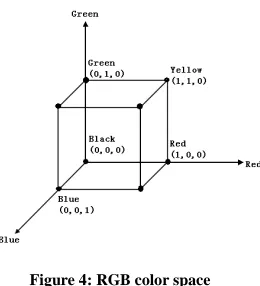
, all color vectors arecomposed RGB color space, as Figure 4shows, in RGB color space, point to plane distance square similarly can use
[image:7.595.246.376.454.597.2]quadric error
Q
( )
v
to calculate, when new vertex after edge collapsing adopts sub set selection method, no need to recalculate new vertex space position and attribute value, when calculate error, no need to consider space coordinate and attribute value correlations, only need to respectively establish geometry quadric error measure and attribute quadric error measure, and calculate geometry and attribute errors.Figure 4: RGB color space
In algorithm description, it adopts triangle grid model with color attribute, grid models with other attributes can
similarly deduced. Triangle grid model every vertex
v
has two vectors[
]
T g x y z
v , ,
andv
[
r,g,b] (
0≤r,g,b≤1)
T c
to represent geometry and color information, establish geometry quadric error measure
Q
fg and color attributequadric error
Q
fc each vertex quadric error measure is equal to its adjacent triangle surface quadric error measure sum for every triangle surface, as formula (25) shows:
=
=
∑
∑
∈ ∈
) (
) (
f v fc vc
f v fg vg
Q
Q
Q
Q
When collapse edge
( )
v
i,
v
j,
j
≠
i
to vertexv
, total quadric error measure is as formula (26) shows:
+
=
+
=
vjc vic c
vjg vig g
Q
Q
Q
Q
Q
Q
(26)
Therefore edge collapsing caused geometric error
E
g=
Q
g( )
v
g , color attribute errorE
c=
Q
c( )
v
c , then total edge collapsing cost is as formula (27) shows:c
g
E
E
Cost
=
+
α
(27)
In formula (26),
α
represents color attribute error influence coefficient in total cost, it can adjust according to practical demands.When calculate edge collapsing cost, it needs to focus on two aspects’ problems:one is vertex set coordinate value
range is
(
−
∞
,
+∞
)
, and color component value range is[ ]
0
,
1
, so it should make preprocessing with vertex geometric position data, let the two range to be the same, so as to ensureE
gandE
c effects onCost
are equivalent; the other is it will appear triangle surface three vertexes color vectors are the same, in such case three color vectors cannot compose plane but degenerate into a point, therefore it should calculate and let color vectors quadric error to met formula (28):( ) (
)
2ic c c
fc
v
v
v
Q
=
−
(28)
In formula (27),
v
ic represents the triangle surface any one color vector.Algorithm flow
Figure 5: Edge collapsing algorithm flow
Edge collapsing algorithm basic thought is taking edge as deleted basic geometric element in every simplification operation, and increasing new vertex, all points that connect with deleted edges should connect with the new vertex, and let model to still keep as triangle grid, after carrying out multiple times selective edge collapsing, model can be simplified into requested extent. Algorithm flow is as Figure 5 shows:
Algorithm basic steps:
Step1: Read initial grid model data, and make preprocessing with it, mark boundary edge and feature edge; Step2: Calculate initial grid every triangle surface geometric and color attributes quadric error measure values; Step3: Calculate every vertex geometry and color attributes quadric error measure values;
test on edge collapsing;
Step5: All edges that meet legality judgment compose a candidate edge set, rank the set edges according to edge collapsing cost;
Step6: Select minimum collapsing cost edge from candidate set to execute collapsing operation, and update all relative information;
Step7: If candidate set is empty or triangles numbers already arrive at users’ demands, then end, otherwise transfer to Step6.
Algorithm performance analysis
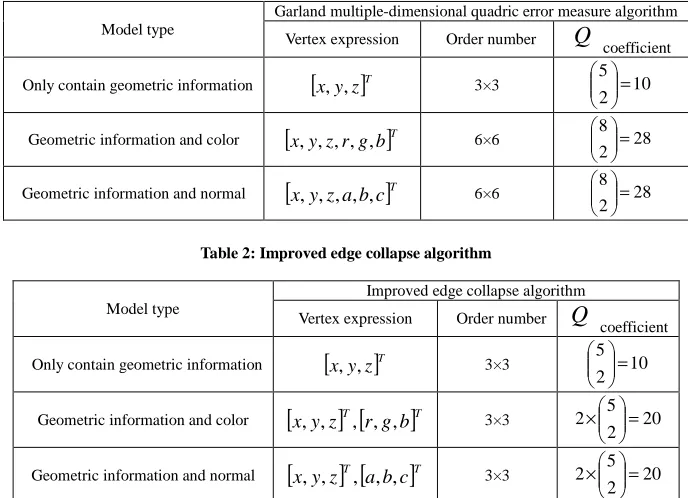
For storage space perspective, the algorithm with respect to Garland multiple dimensional quadric error measure algorithm, it needs fewer coefficients to save quadric error measure, and no need to save new vertex information
[image:9.595.133.477.246.495.2]after edge collapsing operating every time, storage
Q
required coefficients are as Table 1 and Table 2 show:Table 1: Garland multiple-dimensional quadric error measure algorithm
Model type
Garland multiple-dimensional quadric error measure algorithm
Vertex expression Order number
Q
coefficientOnly contain geometric information
[
x,y,z]
T 3×3 10 2 5=
Geometric information and color
[
x,y,z,r,g,b]
T 6×6 28 2 8=
Geometric information and normal
[
x,y,z,a,b,c]
T 6×6 28 2 8=
Table 2: Improved edge collapse algorithm
Model type
Improved edge collapse algorithm Vertex expression Order number
Q
coefficient
Only contain geometric information
[
x,y,z]
T 3×3 10 2 5=
Geometric information and color
[
x,y,z] [
T,r,g,b]
T 3×3 20 2 5 2 =
×
Geometric information and normal
[
x,y,z] [
T,a,b,c]
T 3×3 20 2 5 2 =
×
By Table 1 and Table 2, it is clear that improved algorithm is superior to Garland multiple-dimensional quadric error measure algorithm in the perspective of storage.
CONCLUSION
It is very necessary to make reasonable, effective compression on three-dimensional surface model, compression algorithm merits has deeply effects on space target surface modeling development; the paper proposes edge collapse-based three-dimensional surface compression algorithm, firstly according to quadric error measure criterion, it defines collapsed edges orders, and then utilizes half-space test algorithm to judge edge collapsing legality so as to implement surface model boundary zone and interior zone synchronization compression; it puts forward researching image compression algorithm, and meanwhile it should understand image attributes, from which it contains geometric attributes, color attributes and normal attributes, then integration compression processing on three-dimensional images can better and faster meet users’ demands; by algorithm performance analysis, it is clear that improved algorithm is superior to other algorithms in coefficient storage aspect.
REFERENCES
[1] Liu Xiao-lan. China Sport Science and Technology. 1984, 29(13), 46-49.
[2] Luo Yang-chun. Journal of Shanghai Physical Education Institute. 1994, 23(12), 46-47.
[3] Wan Hua-zhe. journal Of Nanchang Junior College. 2010, 3, 154-156.
[4] Li Ke. Journal of Shenyang Sport University. 2012, 31(2), 111-113.