© 2016, IRJET | Impact Factor value: 4.45 | ISO 9001:2008 Certified Journal | Page 1303
Analysis of Various Single Frame Super Resolution Techniques for
better PSNR
Sweta Patel
1, Karshan Kandoriya
21Student, Dept. of Computer Science and Engineering, Parul Institute of Engineering and Technology, Gujarat,
India
2Ass. Professor, Dept. Of Computer Science and Engineering, Parul Institute of Engineering and Technology,
Gujarat, India
---***---Abstract –
Single-frame Super-Resolution generate high resolution image from single degraded image or low resolution image. In single frame SR technique, the missing high frequency information in the LR image is estimated from large number of training set images and added to the LR image. It require only one LR image for reconstruction so it has more practical value for various applications. In this paper, we are going to review different Super Resolution methods which generate high resolution image from one or more low resolution image.Key Words: Spatial Resolution, Single frame, Super-Resolution, Interpolation, Restoration
1. INTRODUCTION
In recent decades, Image Super-Resolution [1] is broadly used research area and it solve the resolution enhancement problem by quality of its optics, sensor and display components. But, high resolution improve by hardware is usually expensive and/or time consuming. Therefore, we can increase the resolution in two ways either by increase the pixel numbers or by increase chip size. But it can degrade the acquisition time and quality of image. So there is alternative approach to enhance resolution of the image. Super resolution is process of obtaining high quality of image via single low resolution image or numerous. It can be used in security surveillance, biomedical applications, remote sensing, enlarging photograph for high quality etc. Super resolution techniques can be classified into two major parts: Frequency domain and spatial domain approach. Frequency domain approach can perform Fourier transform of an image. These methods have low computational complexity, simple and more suitable for removing aliasing than spatial domain. This method is popular but expensive. Spatial domain approach allow more flexibility in incorporating a priori constraints, noise models, and spatially varying
degradation models. Technical implementation of super resolution can be done in two ways: single-frame and multi-frame Super-Resolution. Single-frame super-resolution methods generate high super-resolution image from single degraded noisy image.
[image:1.595.309.555.447.552.2]There are many methods proposed for single image super resolution. These methods can be summarized as methods based on reconstruction based approach and learning based approaches. In this paper brief description of these methods has been given. In section 2 introduction of each method is given. Next, section 3 gives comparison of these methods. Final section concludes the paper.
Fig-1: Example of Single image Super Resolution
1.2 Basic Architecture of Super Resolution
In Single-frame imaging [1], performing the observed LR image from HR image is modeled by:
=D x + , k=1,…,n
Where is a warp matrix, including the global or local translation, rotation etc., represents a blur matrix, D is a sub sampling matrix, x is an original image and represents a noise vector.
© 2016, IRJET | Impact Factor value: 4.45 | ISO 9001:2008 Certified Journal | Page 1304
reference LR image with sub-pixel accuracy, Non-uniform interpolation is to produce an improved resolution image and image restoration is applied to the up-sampled image to remove blurring and noise. Before apply any technique on image, preprocessing is
carried out on image to remove noise or to convert image into gray scale image. There are many techniques for super resolution such as MAP estimation approach, IBP estimation approach, Markov Network, sparse representation, Manifold approach, etc.
Fig-2: Basic Steps of Super resolution
2. SUPER RESOLUTION METHODS
Super Resolution methods are mainly categorized in reconstruction based approach and learning based approach. These approaches are briefly described as below:
2.1 Reconstruction based Approach
In Reconstructed based approach, incorporate the prior knowledge to model a regularized cost function. The image priors include the gradient prior, non-local self-similarity and the sparsity priors. These prior characterize different and complementary aspects of natural image feature. Therefore combinational on of multiple image prior for SR model may be beneficial to improvement of performance.
Primal sketches Method
Primal sketches [3] were used as the a priori. The primal sketches is the hallucination algorithm is applied only to the primitives like edges, ridges, corners, T-junctions, and terminations but not to the non-primitive parts of the image. Having an LR input image they first it to the target resolution, then for every primitive point a 9×9 patch is considered. Then, based on the primal sketch prior and using a Markov chain inference, the corresponding HR patch for every LR patch is found and replaced. This actually hallucinates the high-frequency complement of the primitives.
Gradient profile prior Method
A gradient profile-based [4] methods learn the similarity between the shape statistics of the LR and HR images in a training step. This learned information will be used to apply a gradient based constraint to the reconstruction process. The distribution of this gradient profile prior is defined by a general exponential family distribution.
IBP Estimation Approach
The IBP reconstruction [8] process is to estimate an HR image as an initial solution first and then use formula to calculate its simulative LR image
according to system model,
= +
If equals to the original HR image accurately, at the same time when simulating the imaging process in conform to the actual situation, then the simulated LR image should be the same as the observation LR image y, but when the two vectors are different, project
the error y- onto the reversely and
make correct further by using formula , = + (y- )
© 2016, IRJET | Impact Factor value: 4.45 | ISO 9001:2008 Certified Journal | Page 1305
MAP Estimation Approach
Maximum A-Posteriori (MAP) approach [8], is popular because it provides a flexible and convenient way to include an a priori information and builds a strong relationship between the LR images and the unknown HR image. It is the basic idea of MAP estimation approach to treat the HR image and observation LR images as two different stochastic process, to regard the SR reconstruction problem as a statistical estimation problem, to make the HR image reaching MAP on the premise of known LR image sequence. So MAP estimator of the ideal HR image x is to maximize a posteriori probability density function.
P (x| , , ..., )
Regularization Estimation Approach
Regularization method [8] is to use the solution of prior information, convert ill-posed problems to well-conditioned. Such as to minimize Lagrange equation with constrained least square method by formula
min 2 + 2
Where C is a high-pass filter, which can eliminate the influence of small singular values appearing in high frequency, is referred to as the regularization parameter, which can balance the relationship between smoothness and validity of the solution. A observation model, which fuses together optical system prior knowledge, use the iterative registration algorithm based on gradient, and consider the optimization process of gradient descent method and conjugate gradient method to minimize cost function.
2.2 Learning based Approach
Learning-based or Hallucination algorithms were first introduced in which a neural network was used to improve the resolution of fingerprint images. These algorithms contain a training step in which the relationship between some HR examples (from a specific class like face images, fingerprints, etc.) and their LR counterparts is learned. This learned knowledge is then incorporated into the a priori term of the reconstruction. The training database of learning-based SR algorithms needs to have a proper generalization capability.
Markov Network based Approach
Markov network [8] to model the space relationship of image from the perspective of probability for the first time, divide image into small blocks, assume that each image block is corresponding to a node on the Markov network, and acquire transition probability matrix for adjacent HR image block and transition probability matrix Φ between HR image block and LR image block through learning. The Markov network model can be expressed by,
P(x ׀ y) = ( ) ( )
where y is input LR image, x is the HR image to estimate, Z is the normalized parameter, and are local adjacent image block in the HR image, is the LR image block corresponding to
Manifold-based method
In Manifold-based approach [7], HR and LR images form manifolds with similar local geometries in two distinct feature spaces. This method is also used for dimensionality reduction. It Find itsk-nearest neighbor representation in low dimensional manifold for each image block in the test samples and use these k-nearest neighbors to calculate weighted coefficient and then use the weights and neighbors to find the corresponding objects in the HR manifold to reconstruct the HR patch. In this situation, each HR image block is related to its corresponding LR image block which determine the reconstruction accuracy and maintain some kind of connection among its neighborhood block which decide the local preserving feature and smoothness of the reconstruction image.
Sparse Representation Approach
© 2016, IRJET | Impact Factor value: 4.45 | ISO 9001:2008 Certified Journal | Page 1306 blurred and then used in training LR dictionary. Once
two dictionaries are obtained up-scaling of LR image and calculate representation co-efficient using LR dictionary by employing vector selection algorithm. Then invoking assumption that representation co-efficient of the desired HR patch array are the same HR patch array is reconstructed.
[image:4.595.57.536.257.698.2]Then the feature extraction is done using high pass filtering operations.
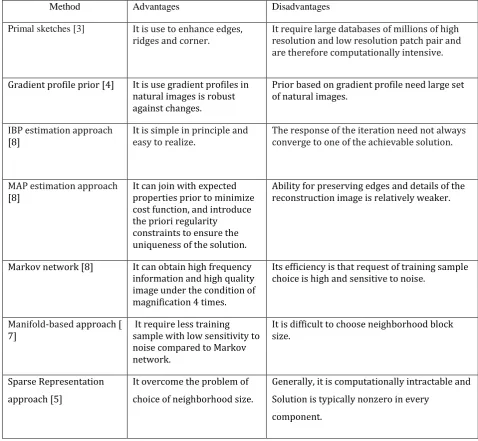
Table -1: Comparison of various super resolution methods
3. COMPARATIVE STUDY OF DIFFERENT METHODS
Table 1 shows the comparison among the different methods used for the detection of defects in images.
Method Advantages Disadvantages
Primal sketches [3] It is use to enhance edges,
ridges and corner. It require large databases of millions of high resolution and low resolution patch pair and are therefore computationally intensive.
Gradient profile prior [4] It is use gradient profiles in natural images is robust against changes.
Prior based on gradient profile need large set of natural images.
IBP estimation approach
[8] It easy to realizeis simple in principle and . The response of the iteration need not always converge to one of the achievable solution.
MAP estimation approach
[8] It can join with expected properties prior to minimize cost function, and introduce the priori regularity
constraints to ensure the uniqueness of the solution.
Ability for preserving edges and details of the reconstruction image is relatively weaker.
Markov network [8] It can obtain high frequency information and high quality image under the condition of magnification 4 times.
Its efficiency is that request of training sample choice is high and sensitive to noise.
Manifold-based approach [
7] It require less training sample with low sensitivity to noise compared to Markov network.
It is difficult to choose neighborhood block size.
Sparse Representation approach [5]
It overcome the problem of choice of neighborhood size.
Generally, it is computationally intractable and Solution is typically nonzero in every
© 2016, IRJET | Impact Factor value: 4.45 | ISO 9001:2008 Certified Journal | Page 1307 4. CONCLUSIONS
In this paper, survey of various methodologies for super resolution is presented. These methods can be classified into two categories: reconstruction and learning based approach. A brief description of these method including advantages and disadvantages is given wherever known. So the combination of these approaches can give better result instead of using individual approach.
REFERENCES
[1] S. Park, M. Park, and M. G. Kang, “Super-resolution image reconstruction: A technical overview,” IEEE Signal Process. Mag., vol. 20, no. 3, pp. 21–36, May (2003).
[2] Z. Wang, A. C. brans.ovik, H. R. Sheikh and E. P. Simoncelli, “Image quality assessment: From error visibility to structural similarity, IEEE Image Process .,vol. 13, no. 4, pp,600-612,2004.
[3] Sun, J., Zhang, N.N., Tao, H., Shum, H.Y.: Image hallucination with primal sketch priors. Proceedings of IEEE Conference on Computer Vision and Pattern Recognition 2, 729–736 (2003).
[4] Sun, J., Sun, J., Xx, Z.B., Shum, H.Y.: Image super-resolution using gradient profile prior. In: Proceedings of IEEE International Conference on Computer Vision and Pattern Recognition, USA (2008).
[5] Yang, J., Wright, J., Huang, T., Ma, Y, ” Image super-resolution via sparse representation “, IEEE ICIP, 2010.
[6] Kamal Nasrollahi, Thomas B. Moeslund: Super-resolution: a comprehensive survey ,Springer Machine Vision and Applications (2014) 25:1423–1468.
[7] Chang H, Yeung DY, Xiong Y. Super-resolution through neighbor embedding. In: IEEE computer society conference computer via pattern recognition; 2004. p. I-275–I-282.