IJPSR (2016), Vol. 7, Issue 3 (Research Article)
Received on 16 September, 2015; received in revised form, 05 December, 2015; accepted, 05 January, 2016; published 01 March, 2016
DEVELOPMENT AND VALIDATION OF ANALYTICAL METHOD FOR DETERMINATION OF MICAFUNGIN AND ITS RELATED SUBSTANCES IN BULK BY RP-UPLC
Smita Joshi *1, Falguni Majmudar 2 and Nirav Vyas 3
Department of Pharmaceutical Chemistry 1, K. B. Raval College of Pharmacy, Gandhinagar, Gujarat, India
Department of Pharmacology 2, Smt. N.H.L. Municipal Medical College, Ahmedabad, Gujarat, India
Analytical Research development 3, Amneal Pharmaceuticals Pvt. Ltd., Ahmedabad, Gujarat, India
ABSTRACT: A gradient reverse phase Ultra Performance Liquid
Chromatographic (RP-UPLC) method was developed and validated for determination of Micafungin sodium and its synthetic impurities. The successful separation of Micafungin sodium and its synthetic impurities was achieved using Phenomenax Aeris peptide XB C18 (150×2.1 mm i.d., 1.7 µ particle size) column maintained at 45 °C temperature with mobile phase consisting 0.01 M phosphate buffer pH 2.9 and acetonitrile in a gradient programme. The mobile phase flow rate was 0.3 ml/min and the detection wavelength was 279 nm. The retention time in developed method is comparatively less than the reported HPLC methods for determination of Micafungin sodium offering less time consuming and fast analytical method. The developed RP-UPLC method was validated according to ICH guidelines with respect to linearity, accuracy, precision, specificity and
robustness and also the LOD and LOQ values were determined.
INTRODUCTION: Micafungin is a semi synthetic compound, belonging to a newer class of antifungal agents, echinocandinslipopeptides. It is synthesized by chemical modification of a
fermentation product from coleophoma empetri 1.
Micafungin selectively inhibit 1,3-β-D-glucan, which is required for fungal cell wall synthesis. It has been approved for the treatment of esophageal candidiasis and for prophylaxis of Candida and Aspergillus infections in patients undergoing
hematopoietic stem cell transplantation 2, 3.
QUICK RESPONSE CODE
DOI:
10.13040/IJPSR.0975-8232.7(3).1211-18
Article can be accessed online on:
www.ijpsr.com
DOI link: http://dx.doi.org/10.13040/IJPSR.0975-8232.7 (3).1211-18
The chemical structure of Micafungin sodium, impurity A, impurity B, impurity C and impurity D are shown in figure 1, the molecular weight of the compound is 1292.26 gm/mol and the empirical
formula is C56H70N9O23S 4. The drug was first
launched in Japan in December 2002 and then also approved by US food and drug administration in
March 2005 5, 6.
The quality and safety of drug product can be significantly affected by the presence of impurities and therefore it is important to study the impurity
profile of drug substance 7. Ultra performance
liquid chromatography (UPLC) is relatively novel technique with new possibilities in liquid chromatography, focusing on decrease of analysis
time and solvent consumption 8. UPLC systems can
withstand high system back pressure and comprising special analytical columns with sub 2
Key words:
Micafungin sodium, RP-UPLC, related substances, impurities
Correspondence to Author: Smita Joshi
Department of Pharmaceutical Chemistry, K. B. Raval College of Pharmacy, Gandhinagar, Gujarat, India.
µm particles. UPLC system allows shortening analysis time up to nine times compared to
conventional HPLC system 9.
Few HPLC methods have been reported in the literature for quantification of Micafungin in
plasma 10-13. Shengsheng et al reported stability
indicating HPLC method for determination of
Micafungin and related substances 14. To the best
of our knowledge no UPLC method has been reported for the estimation of Micafungin with its related substances. The aim of this work was to develop a rapid, simple, precise, accurate and validated UPLC method for determination of Micafungin and its related substances.
1(a)
N OH
O NH2
O
NH H2N
O
O
NH O
N
OH
O
HN OH
O
N HO
OH
N O O
O O3SONa
HO
OH HO
HO
N O
NH
H2N O
O
NH O N
OH O HN
OH O HN
N O O
O
O3SONa
HO
OH HO
HO
HN HO
OH
O OH
1(c)
N
O
NH
H2N
O
O
NH O N
OH O HN
OH O HN
N O O
O
O3SONa
HO
OH HO
HO
HN HO
OH
O OH
1(d)
N
O
NH
H2N
O
O
NH O N
OH O HN
OH O HN
N O O
O
HO
HO
OH HO
HO
HN HO
OH
O OH
(1e)
Experimental:
Chemicals and Instrumentation:
Samples of Micafungin and its four impurities were
receivedas gift sample from Amneal
Pharmaceuticals. Specification levels for Impurity A, Impurity B, Impurity C and Impurity D
was≤0.5%, ≤ 0.15%, ≤ 0.15% and ≤
0.15%respectively. The UPLC systems, (Shimadzu, Nexesa system) consist of autoinjector with PDA detector. The analytical column, Phenomenax Aerispeptide XB C18 (150*2.1 mm i.d., 1.7 µ particle size), was operated at 45 °C temperature. The gradient Programme consists of 0.01 M phosphate buffer, pH 2.9 was adjusted with 85 % orthophosphoric acid solution in water and acetonitrile (HPLC grade).
Stock and working standard solutions:
Accurately weighed quantity of Micafungin, 50 mg was transferred into separate 50 ml volumetric flask, dissolved and diluted up to mark with diluent (Phosphate buffer: Acetonitrile 95:5 v/v) to prepare 1000μg/ml of stock solution. A stock solution of impurities (Mixture of imp-A, imp-B, imp-C and imp-D) were also prepared in the diluent.
Method Validation:
After method development, validation of the chromatographic method for Micafungin was
performed in accordance with ICH guidelines 15.
Linearity and Range:
Linearity is the ability of a method to elicit test results that are directly proportional to analyte concentration within a given range. Range is the interval between the upper and lower levels of analyte that have been demonstrated to be determined with precision, accuracy and linearity. Linearity of the method was checked at seven different concentrations. Linearity solutions of 50, 100, 150, 200, 250, 300 and 350μg/ml were prepared by transferring 0.5, 1, 1.5, 2, 2.5, 3 and 3.5 ml of stock solution to 10 ml of volumetric flask and volume was adjusted with diluent. Linearity solutions for impurity were prepared at 150, 100, 75, 50 and 25 % specification level for each impurity.
Specificity:
Specificity is the ability of the method to measure the analyte response in the presence of its potential
impurities. The specificity of the developed method for Micafungin was carried out in the presence of its impurities namely, A, B, C and imp-D.
Accuracy:
Accuracy of analytical method is the closeness of test results to the true value. Accuracy was determined over the range from 50 % as lowest sample concentration to 150 % as highest sample concentration. Triplicate preparations for each level were prepared and injected in presence of spiked impurities to their 100 % specification level. The mean recovery should be within 100±2 % at each concentration over the range of 50-150 % of concentration. Accuracy was demonstrated at 50 %, 100 % and 150 % level with respect to specification limit spiked with API for each impurity. Recovery was determined in triplicates and reported.
Precision:
The precision of the method was evaluated by carrying out six independent assays of Micafungin test samples and calculating the % relative standard deviation (RSD) of the assay. Precision with related substances was determined by spiking the impurities with Micafungin sodium (300μg/ml) at 100 % specification level of each impurity (six replicates). % RSD of area of each imp-A, imp-B, imp-C and imp-D was calculated. Intraday and interday precision was carried out and % RSD was determined.
Limit of Detection and Limit of Quantification:
The limit of detection and limit of quantification were evaluated by serial dilutions of Micafungin sodium, Impurity A, Impurity B, Impurity C and Impurity D stock solutions in order to obtain signal to noise ratio of 3:1 for LOD and 10:1 for LOQ.
Robustness study:
Robustness study was carrying out by changing the
minor parameters of the chromatographic
RESULT AND DISCUSSION:
Optimization of Chromatographic conditions:
The main objective of the chromatographic method development was to separate Micafungin sodium from the imp-A, imp-B, imp-C and imp-D. Several trials were carried out for accurate and precise method development and impurities were coeluted. After using several columns and buffers, suitable column chemistry and good peak shape were
[image:5.612.59.540.196.282.2]obtained with Phenomenax Aeris peptide XB C18 (150×2.1 mm i.d., 1.7 µ particle size), column temperature was adjusted at 45 °C, with gradient mobile phase system consisting Mobile phase A as 0.01M phosphate buffer and Mobile phase B as Acetonitrile. The best separation of Micafungin from the impurities was achieved with a gradient program as follows:
TABLE 1: GRADIENT PROGRAM IN OPTIMIZED CHROMATOGRAPHIC CONDITIONS
Time (minutes) Flow rate (ml/min) % of Mobile phase A % of Mobile phase B
0 0.3 80 20
5 0.3 80 20
10 0.3 60 40
15 0.3 20 80
20 0.3 80 20
25 0.3 80 20
Where, Mobile phase A is 0.01M phosphate buffer and Mobile phase B is Acetonitrile
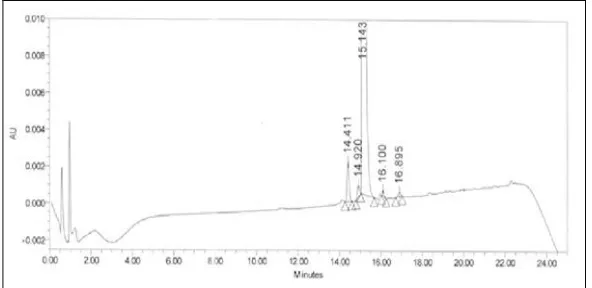
The flow rate was 0.3 ml/min. The injection volume was 5 µl. Depending on peak absorption maxima and peak purity index, 279 nm was selected for detection. The sample temperature was kept at 5 °C. In optimized chromatographic conditions, Micafungin, imp-A, imp-B, imp-C and imp-D were separated with good resolution, typical
retention time were 15.14, 14.41, 14.92, 16.10 and
16.89 min respectively (Fig. 2). The system
suitability results are given in Table and the developed method was found to be specific for Micafungin and its known impurities namely imp-A, imp-B, imp-C and imp-D.
[image:5.612.159.455.416.560.2]FIG.2: CHROMATOGRAM OF MICAFUNGIN SODIUM (RT-15.14 Min), IMPURITY A (Rt-14.41), IMPURITY B (Rt-14.92), IMPURITY C (RT-16.10) AND IMPURITY D (Rt-16.89) IN THE OPTIMIZED CHROMATOGRAPHIC CONDITIONS
[image:5.612.158.452.595.737.2]Linearity and Range: Linearity of the method was evaluated at seven different concentrations, at 50, 100, 150, 200, 250, 300 and 350μg/ml. The peak area was recorded and plotted versus standard concentrations. Results shown that the method was linear as straight line equation, y =24242.71x - 11003.7, was obtained, where y indicates peak area and x indicates concentration of Micafungin over the
specified range with R2 of 0.9999 (Table 2 and Fig.
4). For imp-A, imp-B, imp-C and imp-D, 0.9995,
[image:6.612.43.302.225.505.2]0.9995, 0.9999 and 0.9996 R2 value was obtained.
TABLE 2: LINEARITY DATA FOR MICAFUNGIN SODIUM
Concentration
(μg/ml) Mean area %RSD
50 1208143 0.179
100 2407086 0.258
150 3633700 0.187
200 4829775 0.156
250 6040062 0.059
300 7259917 0.075
350 8484064 0.092
FIG. 4: CALIBRATION CURVE OF MICAFUNGIN SODIUM (50-350 μg/ml)
Specificity
The developed analytical method was found to be specific as the peak purity index for Micafungin sodium was 999.11 in presence of all the spiked impurities i.e. Impurity A, Impurity B, Impurity C and Impurity D; and also the resolution was more than 1.5 between each peaks.
Accuracy
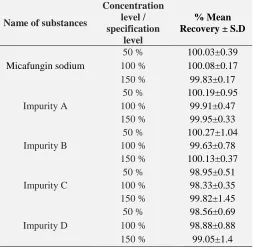
% Recovery for Micafungin sodium at 50 %, 100 % and 150 % concentration level was found to be
100.03, 100.08 and 99.83 respectively. % Recovery
for Impurity A, Impurity B, Impurity C and
Impurity D at 50 %, 100 % and 150 % specification level was found to be between 98-102 %, within the acceptance criteria, so the method is accurate for determination of Micafungin sodium and its
impurities (Table 3)
TABLE 3: ACCURACY RESULTS FOR MICAFUNGIN SODIUM AND ITS IMPURITIES
Name of substances
Concentration level / specification
level
% Mean Recovery ± S.D
Micafungin sodium
50 % 100.03±0.39
100 % 100.08±0.17
150 % 99.83±0.17
Impurity A
50 % 100.19±0.95
100 % 99.91±0.47
150 % 99.95±0.33
Impurity B
50 % 100.27±1.04
100 % 99.63±0.78
150 % 100.13±0.37
Impurity C
50 % 98.95±0.51
100 % 98.33±0.35
150 % 99.82±1.45
Impurity D
50 % 98.56±0.69
100 % 98.88±0.88
150 % 99.05±1.4
Precision:
The relative standard deviation was found to be 0.083, 0.575, 0.817, 0.954 and 0.809 for Micafungin sodium, imp-A, imp-B, imp-C and imp-D respectively in the repeatability study. % RSD of peak area is less than 2.0 %, for all impurities and Micafungin sodium in the
repeatability study (Table 4). Intraday and interday
precision also exhibited % RSD less than 2 (Table
[image:6.612.317.570.228.478.2]5). So the developed method is precise for its use.
TABLE 4: PRECISION (REPEATABILITY) DATA FOR MICAFUNGIN SODIUM, IMPURITY A, IMPURITY B, IMPURITY C AND IMPURITY D.
Result Micafungin
sodium Impurity A Impurity B Impurity C Impurity D
Mean Area 7259209 19587.170 7022.667 1975.833 2378.333
[image:6.612.54.564.685.737.2]TABLE 5: INTRADAY AND INTERDAY PRECISION FOR MICAFUNGIN SODIUM
Intraday precision Interday precision
Conc. (µg/ml)
Area
Mean % R.S.D
Conc. (µg/ml)
Area
Mean % R.S.D
200 4835775 0.138 200 4831040 0.169
250 6040462 0.086 250 6042476 0.119
300 7259727 0.119 300 7263306 0.112
Limit of Detection and Limit Quantitative
The LOD and LOQ values for Micafungin sodium was found to be 0.02 and 0.05 μg/ml. LOQ value was precised by six replicate injections with % RSD of 0.364 and checked for linear response with respect to other linearity levels by extending
linearity curve upto LOQ level, with R2 of 0.9999.
The chromatogram of Micafungin sodium at LOQ
level is shown in Fig. 5.
FIG.5: CHROMATOGRAM OF MICAFUNGIN SODIUM AT LOQ (0.05 μg/ml) LEVEL
Robustness study:
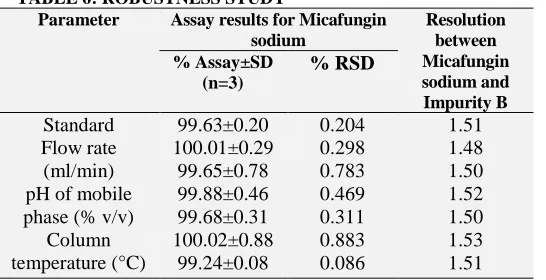
With the minor modifications in the
chromatographic conditions i.e. Flow rate, pH of mobile phase and temperature of column, the % assay was not affected and % RSD was found to be less than 2 % and the resolution between Micafungin sodium and Impurity B was not
significantly affected (Table 6). Also with these
minor modifications, System suitability parameters were also not affected and hence, the developed analytical method is robust.
TABLE 6: ROBUSTNESS STUDY
Parameter Assay results for Micafungin sodium Resolution between Micafungin sodium and Impurity B % Assay±SD (n=3) % RSD
Standard 99.63±0.20 0.204 1.51
Flow rate (ml/min)
100.01±0.29 0.298 1.48
99.65±0.78 0.783 1.50
pH of mobile phase (% v/v)
99.88±0.46 0.469 1.52
99.68±0.31 0.311 1.50
Column temperature (°C)
100.02±0.88 0.883 1.53
99.24±0.08 0.086 1.51
System suitability:
System suitability parameters were calculated at the start of study of each validation parameter. The values of system suitability results obtained during the entire study are recorded. System Suitability values are from the first injection of six replicates of standard and are derived from Empower 3
software (Table 7).
TABLE 7: SYSTEM SUITABILITY DATA
Compound (n=6) Retention time (minutes) USP tailing USP resolution USP plate count
Impurity A 14.411 1.13 - 106883 Impurity B 14.920 0.93 2.63 77306 Micafungin
sodium 15.143 1.41 1.52 146955 Impurity C 16.100 1.67 6.07 159026 Impurity D 16.895 0.89 4.34 131548
CONCLUSION: A novel, reverse phase liquid chromatographic method has been developed and validated for the estimation of Micafungin sodium and its impurities namely impurity A, impurity B, impurity Candimpurity D with a very recent and advanced UPLC method. The proposed method is found to be simple, accurate, precise, sensitive, specific and robust. Hence, it can be successfully used for the routine analysis of Micafungin sodium in pharmaceutical dosage forms and can be also successfully utilized for estimation of Micafungin sodium and its related substances in bulk and in dosage form.
ACKNOWLEDGEMENT: The authors are thankful to Amneal Pharmaceuticals Pvt. Ltd., for providing the use of instruments and materials.
REFERENCES:
1. Tawara S, Ikeda F, Maki K, Morishita Y, Otomo K, Teratani N, Goto T, Tomishima M, Ohki H, Yamada A: In vitro activities of a new lipopeptide antifungal agent, FK463, against a variety of clinically important fungi. Antimicrob. Agentschemother. 2000; 44:57-62.
[image:7.612.46.300.286.395.2] [image:7.612.40.313.603.743.2]3. Hatano K, Morishita Y, Nakai T, Ikeda F: Antifungal mechanism of FK463 against Candida albicans and Aspergillus fumigatus. J. Antibiot. 2002;55:219-222 4. Veherschild JJ, Cornely OA: Micafungin sodium, the
second of the echinocandin class of antifungals: Theory and practice. Future Microbiol. 2006;1:161-170
5. Carver PL: Micafungin. Ann. Pharmacother. 2004;38:1707-21
6. Zaas AK, Steinbach WJ: Micafungin: The US perspective. Expert Rev. Anti-infect. Ther. 2005;3:183-190
7. Bakshi M, Singh S: Development of validated stability-indicating assay methods-Critical review. J. Pharm. Biomed. Anal. 2002;28:1011-1040
8. Novakova L, Matysova L, Solich P: Advantages of application of UPLC in pharmaceutical analysis. Talanta 2006;68:908-918
9. Michael ES: UPLC: An introduction and review. J Liq. Chromatogr. Rel. techno. 2005;28:1253-1263
10. Noda K, Yokoyama T, Ankiyama Y, Tadano K: A liquid chromatographic method for quantifying unbound micafungin in human plasma and the relationship between the concentrations of unbound and total micafungin in plasma. Yakugaku Zasshi 2013;133:397-404
11. Nakagawa S., Kuwabara N., Kobayashi H.,Shimoeda S., Ohta S., Yamato S: Simple column-switching HPLC method for determining levels of the antifungal agent micafungin in human plasma and application to patient samples. Biomed. Chromatogr. 2013;27:551–555
12. Martens-Lobenhoffer J., Rupprecht V., Bode-Boger S.M: Determination of micafungin and anidulafungin in human plasma: UV- or mass spectrometric quantification? J. Chromatogr. B. 2011;879:2051–2056
13. Uranishi H., Nakamura M., Nakamura H., Ikeda Y.,Otsuka M., Kato Z., Tsuchiya T: Direct-injection HPLC method of measuring micafungin in human plasma using a novel hydrophobic/hydrophilic hybrid ODS column. J. Chromatogr. B. 2011;879:1029–1032
14. Shengsheng Z, Xiang M, Xin S, Yongwei L, Zuyue S: Development and Validation of a Stability-Indicating High Performance Liquid Chromatographic (HPLC) method for the determination of related Substances of Micafungin Sodium in drug substances. Int J Mol Sci 2013; 14(11):21202–21214
15. ICH, Q2 (R1), Validation of Analytical Procedures: Text and Methodology: 2005
All © 2013 are reserved by International Journal of Pharmaceutical Sciences and Research. This Journal licensed under a Creative Commons Attribution-NonCommercial-ShareAlike 3.0 Unported License.
This article can be downloaded to ANDROID OS based mobile. Scan QR Code using Code/Bar Scanner from your mobile. (Scanners are available on Google Playstore)
How to cite this article: