IJPSR (2017), Volume 8, Issue 10 (Research Article)
Received on 22 February, 2017; received in revised form, 12 April, 2017; accepted, 17 April, 2017; published 01 October, 2017
DEVELOPMENT AND VALIDATION OF STABILITY INDICATING HPTLC ASSAY METHOD FOR ESTIMATION OF SITAGLIPTIN PHOSPHATE
Amit S. Tapkir*, Shital M. Biradar and Pravin D. Chaudhari
Department of Pharmaceutical Chemistry, Progressive Education Society’s, Modern College of Pharmacy, Sector no. 21, Yamuna Nagar, Nigdi, Pune - 411044, Maharashtra, India.
ABSTRACT: An Accurate, sensitive, precise and stability indicating
high performance thin layer chromatographic (HPTLC) method has been developed and validated for the estimation of SITA-P. The method was developed using TLC aluminium plates precoated with silica gel 60F254 as the stationary phase using ethyl acetate: methanol: formic acid (8.5:1:0.5 v/v/v) as mobile phase. Densitometric analysis of SITA-P was carried out in the absorbance mode at 265 nm. The retention factor for SITA-P was found to be 0.50 ± 0.04. Linearity was found to be 500 - 2500 ng/band for SITA-P. The method was found to be accurate, precise, and robust according to acceptance criteria. The limit of detection (LOD) and (LOQ) was found to be 124.36 ng/band and 376.87 ng/band for SITA-P respectively. The drug was subjected to stress condition. The method was validated for different parameters as per the International Conference for Harmonization guidelines (ICH). This HPTLC method can be used for the determination for the stability indicating assay methods for bulk drug and its formulations.
INTRODUCTION: SITA-P previously identified as MK-0431 and marketed as the phosphate salt under the trade name Januvia) is an oral anti-hyperglycemic (antidiabetic drug) of the dipeptidyl peptidase - 4 (DPP - 4) inhibitor class. It was developed, and is marketed, by Merck and Co. This enzyme-inhibiting drug is used either alone or in combination with other oral antihyperglycemic agents (such as metformin or a thiazolidinedione) for treatment of diabetes mellitus type 2 12. The drug works to competitively inhibit a protein / enzyme,
QUICK RESPONSE CODE
DOI:
10.13040/IJPSR.0975-8232.8(10).4454-60
Article can be accessed online on:
www.ijpsr.com
DOI link: http://dx.doi.org/10.13040/IJPSR.0975-8232.8 (10).4454-60
dipeptidyl peptidase 4 (DPP-4), that results in an increased amount of active incretins (GLP-1 and GIP), reduced amount of release of glucagon (diminishes its release) and increased release of insulin 13. SITA - P has been shown to lower haemoglobin (a blood pigment that carries oxygen) HbA1c level by about 0.7% points versus placebo. It is slightly less active than Metformin when used as a monotherapy. It does not cause weight gain and has less hypoglycemia compared to sulfonylureas. SITA-P is mentioned as a second line drug (in combination with other drugs) after the blend of diet/exercise and metformin fails.
Various functional groups in structure of the drug makes it susceptible to degradation due to chemical reactivities of these groups under hydrolytic, oxidative, and photolytic environments, which will ultimately produce varied impurities or degradation products.
Keywords: SITA-P, HPTLC, SIAMs, Validation Correspondence to Author: Amit S. Tapkir
Assistant Professor,
Department of Pharmaceutical Chemistry, Modern College of Pharmacy, Sector no. 21, Yamuna Nagar, Nigdi, Pune - 411044, Maharashtra, India.
Hence, the present study is undertaken to conduct ICH prescribed systematic forced degradation study on SITA-P to identify its potential degradation products and to develop and validate a SIAM by using RP-HPLC and HPTLC for accurate determination of SITA-P in the presence of its impurities and degradation products. The aim is to provide new and prove the present data on impurities and determination methods. Chemical structure of SITA-P as shown in Fig. 1.
FIG. 1: SITA-P
MATERIALS AND METHODS:
Material: Pharmaceutical grade Sitagliptin phosphate (SITA-P) working standard was kindly supplied by Mylan Pvt. Ltd., (Nashik, India). The pharmaceutical dosage form used in this study was Januvia tablets (MSD Pharmaceuticals Ltd., Italy) labelled to contain 50 mg of SITA-P was procured
from the local market. Toluene (AR grade), Ethyl acetate and Formic acid (AR grade), Methanol (HPLC grade) was purchased from Merck specialties Pvt. Ltd., (Mumbai, India).
Equipment: Camag HPTLC system consisting Linomat 5 applicator, camag TLC scanner 3 and Win CATS software V-1.4.2 was used for chromatographic separation. Spotting of samples was done by using Hamilton microliter syringe.
Methods:
Preparation of Standard Stock Solution: Working standard stock solution was prepared by dissolving 50 mg of drug in 10 ml methanol to get concentration of 5 mg/ml from which 1 ml was further diluted to 10 ml to get standard stock solution of 500 ng/µl.
Validation of Analytical Method:
Linearity: Standard stock solution of SITA-P (500 ng µl-1) was applied by on the TLC plates in range of 1, 2, 3, 4 and 5 µl using semiautomatic spotter under nitrogen stream. TLC plates were dried, developed and densitometrically analyzed as described earlier. The linear regression data for calibration curves (n = 6) showed good linear relationship over a concentration range of 500 -2500 ng/band Fig. 2.
FIG. 2: CALIBRATION CURVE FOR SITA-P
Precision: The precision of the method was demonstrated by intra-day and inter-day variation studies. Intra-day precision was determined by analyzing the standard solutions of SITA-P (1000, 1500, 2000 ng/band) in linearity range at three different time intervals on same day.
[image:2.612.126.489.453.649.2]FIG 3: 3D SPECTRA OF LINEARITY OF SITA-P (500 - 2500 ng/band)
TABLE 1: INTRA-DAY PRECISION STUDIES FOR SITA - P
Concentration (ng/band) Average Area Amount recovered (ng/band) S. D. % RSD
1000 2500.09 1000.44 15.70 1.57
1500 3270.71 1503.46 17.10 1.13
2000 4027.65 1997.54 14.01 0.70
TABLE 2: INTER-DAY PRECISION STUDIES FOR SITA - P
Concentration (ng/band) Average Area Amount recovered (ng/band) S. D. % RSD
1000 2514.33 1009.74 18.33 1.81
1500 3277.65 1507.99 15.83 1.04
2000 4021.75 1993.70 14.85 0.74
Accuracy: Accuracy was determined at three different level 80%, 100% and 120% of the target concentration 1000 ng/band of SITA-P in triplicate.
[image:3.612.50.562.478.539.2]The results obtained for SITA-P are shown in Table 3.
TABLE 3: RECOVERY STUDIES FOR SITA-P
Drug Amount taken
(ng/band)
Amount added (ng/band)
Total amount found (ng/band)
% Recovery S. D. % R.S.D.*
SITA-P 1000 800 1796.49 99.80 13.95 0.77
1000 1000 2001.70 100.08 9.38 0.46
1000 1200 2203.96 100.17 15.49 0.69
Limit of Detection and Limit of Quantification: LOD and LOQ of the drug were derived by calculating the signal-to-noise (i.e. 3.3 for LOD and 10 for LOQ) ratio using the following equations as per ICH guideline.
LOD = 3.3 × σ/S LOQ = 10 × σ/S
Where, σ = the standard deviation of the response. S = slope of the calibration curve.
Robustness: The effect of small, deliberate variation of the analytical conditions on the peak areas of the drugs was examined. Change in chamber saturation time and change in volume of mobile phase were investigated and % RSD was calculated.
Stress Degradation Studies:
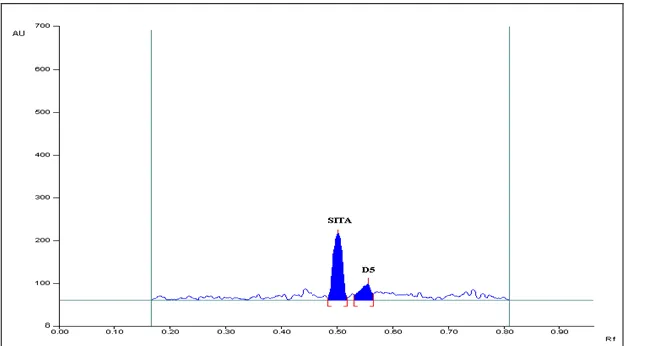
FIG. 4: DENSITOGRAM OF WORKING STANDARD SOLUTIONS OF SITA - P (1500 ng/band)
Stress Degradation in Acidic Condition: Initially degradation study perform by keeping drug in 0.1N, 0.5N, 1N, 1.5N hydrochloric acid solution and kept at RT for 3 hours along these solutions degradation was found at 1N hydrochloric acid. 1 mL working standard solution of SITA-P (5000 ng
µL-1) was mixed with 1 mL of 1 N HCl and 8 mL of methanol. Solution was kept at room temperature for 1 h. The 3 µL volume of resulting solution was applied on TLC plate and developed under optimized chromatographic conditions Fig. 5.
FIG. 5: DENSITOGRAM OF SITA - P AND ITS DEGRADATION PRODUCTS IN 1N HCl AT ROOM TEMPERATURE FOR 1 hr
[image:4.612.143.474.54.233.2] [image:4.612.55.549.351.721.2]Stress Degradation in Basic Condition: Initially degradation study perform by keeping drug in 0.1N, 1N, 1.5N, 2N, 2.5N, 3N sodium hydroxide solution kept at RT for 3 hours along these solutions degradation was found in 1N sodium hydroxide. Therefore 1 mL working standard solution of SITA-P (5000 ng µL-1), 1 ml of 1 N NaOH and 8 mL of methanol was added. Solution was kept at room temperature for 2 h. 3 µL volume of resulting solution was applied on TLC plate and
developed under optimized chromatographic conditions Fig. 6.
Stress Degradation in Photolytic Condition: The photochemical stability of the drug was studied by exposing the drug sample to UV light up to 200 watt hour square meter-1. Sample was weighed, dissolved in methanol to get concentration of 500 ng µL-1. 3 µL of the resulting solution was applied to HPTLC Fig.7.
FIG. 7: DENSITOGRAM OF SITA – P AND ITS DEGRADATION PRODUCTS IN UV LIGHT UP TO 200 watt hr SQUARE METER
Stress Degradation in Oxidative Condition: 1 mL working standard solution of SITA-P (5000 ng µL-1) was mixed with 1 mL of 6 % solution of H2O2 and the volume was made with solvent.
[image:5.612.148.469.202.381.2]Solution was kept at room temperature for 30 min. The 6 µL of resulting solution was applied on TLC plate and developed under optimized chromato-graphic condition Fig. 8.
FIG. 8: DENSITOGRAM OF SITA - P AND ITS DEGRADATION PRODUCTS IN 6% HYDROGEN PEROXIDE AT ROOM TEMPERATURE FOR 30 min
Stress Degradation in Thermal Condition: Dry heat studies were performed by keeping drug sample in oven at 80 °C for a period of 24 hours. A sample was withdrawn at appropriate times,
[image:5.612.150.466.485.666.2]FIG. 9: DENSITOGRAM OF SITA - P AND ITS DEGRADATION PRODUCTS IN DRY HEAT 80 °C FOR 24 HOURS
RESULTS AND DISCUSSION: HPTLC method was validated as per ICH guidelines. The developed method was found to be linear within the range of 500 - 2500 ng/band with R2 = 0.994 for SITA-P. The accuracy of method was determined at 80%, 100%, 120% level. The % recoveries were found to be 98% - 102% for SITA-P. The LOD for SITA-P was found to be 124.36 ng/band and LOQ was found to be 376.87 ng/band. The developed method was found to be precise as the % RSD
values for intra-day and inter-day were found to be less than 2%. The method was also found to be robustness indicated by the % RSD values which are less than 2%. The summary of validation parameters of proposed HPTLC method is shown in Table 4. The stress degradation studies were carried out for the drug in acid, base, photolytic, oxidation and thermal conditions. Summary of the results of stress degradation studies of SITA - P shown in Table 5.
TABLE 4: SUMMARY OF VALIDATION PARAMETERS
Sr. no. Validation Parameters SITA-P
1. Linearity Equation Y=1.532x+967.4
R2 =0.994
2. Accuracy (% mean recovery) 99.80-100.17%
3. LOD 124.36ng/band
4. LOQ 376.87ng/band
5. Precision (% RSD) Intra-day; Inter-day 1.13%; 1.19%
[image:6.612.150.476.53.226.2]6. Roubustness (% RSD) 0.66%, 0.94%
TABLE 5: SUMMARY OF STRESS DEGRADATION STUDIES FOR SITA-P
Sr. no. Stress degradation parameter Peak Area % degradation Rf of degraded of Product
1. 1500 ng/band 3268 0.00% 0.50
2. Acidic /1 N HCl / Kept at room temperature for1h
2784 20.06% 0.35, 0.30
3. Alkaline / 1 N NaOH / Kept at room temperature for 2h
2867 17.45% 0.20
4. Oxidative / 6% H2O2 / Kept at room temperature for 30 min
2895 16.12% …..
5. Dry heat / 80 ºC / 24 h 2941 14.12% 0.54
6. Photo degradation 2983 12.29% …..
CONCLUSION: The proposed methods are precise, specific, accurate, robust and stability-indicating ones. SITA-P was found to be unstable in acidic, alkaline and oxidative condition and stable in photo and thermal conditions. Keep this medication in the container it came in, tightly closed. Store it at room temperature and away from
excess heat and moisture. SITA - P can be determined in bulk and pharmaceutical formulation and percentage degradation.
ACKNOWLEDGEMENT: All authors are thankful to University Grants Commission for providing grant for minor research project. Authors are thankful to Mylan Pharma Pvt. Ltd., Nashik, for providing pure gift sample of SITA-P for our research work.
CONFLICT OF INTEREST: None. REFERENCES:
1. Disha N: Spectrophotometric determination of Sitagliptin phosphate in bulk and pharmaceutical formulations. International Journal of Innovative science Engineering and Technology 2015; 2(7): 702-709.
2. Reichal C: Simultaneous estimation of Gliclazide and Sitagliptin phosphate monohydrate by Q-analysis method. Journal of Chemical and Pharmaceutical Research 2015, 7(5): 630-635.
3. Ravishankar P: A simple validated UV spectrophotometric method for quantitative analysis of Sitagliptin phosphate in pharmaceutical dosage forms. Journal of Chemical and Pharmaceutical sciences 2014; 7(3): 254-258.
4. Chavhan V: Development and validation of economic UV spectrophotometric method for simultaneous estimation of Sitagliptin phosphate and Simvastatin in bulk and tablet
dosage form by absorption ratio method. Journal of Pharmacy and Phytotherapeutics 2013; 1(6): 5-10. 5. Veronica N: Development and validation of a new simple
RP-HPLC method for estimation of Metformin HCl and Sitagliptin phosphate simultaneously in bulk and dosage forms. International Journal of Advanced Pharmaceutical Genuine Research 2013; 2(1): 1-14.
6. Loni A: Simultaneous UV spectrophotometric method for estimation of Sitagliptin phosphate and metformin HCl in bulk and tablet dosage form 2012; 2(8): 854-859.
7. Jain P: Development and validation of first order derivative UV spectrophotometric method for determination of sitagliptin phosphate in bulk and in formulation. International Journal of Drug Development and Research 2011; 3(4): 194-199.
8. ICH Q2A: Text on validation of analytical procedure: International conference on harmonization; Geneva 1994; 1-5.
9. ICH Q2B: Validation of analytical procedure; methodology; International conference on harmonization; Geneva 1996; 1-8.
10. ICH Q1B: Photostability Testing of New Drug Substances and Products 1996; 1-12.
11. International Conference on Harmonization Q1A (R2). Stability Testing of New Drug Substances and Products 1996; 1-24.
12. https://en.wikipedia.org/wiki/SITA-P 13. https://www.drugbank.ca/drugs/DB01261
All © 2013 are reserved by International Journal of Pharmaceutical Sciences and Research. This Journal licensed under a Creative Commons Attribution-NonCommercial-ShareAlike 3.0 Unported License. This article can be downloaded to ANDROID OS based mobile. Scan QR Code using Code/Bar Scanner from your mobile. (Scanners are available on Google Playstore)
How to cite this article: