5940
THE ASSESSMENT MODEL OF LEGACY INFORMATION
SYSTEM FOR PUBLIC SECTOR
1HUMAIRATH KM ABU BAKAR, 2ROZILAWATI RAZALI, 3FATIN FILZAHTI ISMAIL 1Centre of Software Technology and Management, Faculty of Information Science and Technology
Universiti Kebangsaan Malaysia, 43600 UKM Bangi, Selangor, Malaysia. E-mail: 1[email protected], 2[email protected], 3[email protected]
ABSTRACT
Over the last decade, the rapid development of the information and communications technology (ICT) has increased the use of information systems in the public sector. In a fast pace, the ICT technology has evolved and switched to more advanced setting to fulfill the system’s intricate demand. Apparently, some agencies in public sector are recognized to still be using an old and outdated information system supposedly for the reason it brings high business value. System with such circumstances is known as Legacy Information System (LIS). However, maintaining LIS involves such significant technical problems. Legacy systems are hard to maintain. There are only a few experts who understand the system, with no much proper documentation prepared, requiring high maintenance costs. This triggered the agencies to come with a decision in determining the appropriate action towards the LIS implementation. This paper therefore aims to address this concern by providing guidance in assessing the LIS and suggesting the befitting response in a form of a model based on the identified evaluation factors. This study adopted qualitative approach, which incorporates the theoretical and empirical phase. The theoretical phase is conducted by analysing existing literature of the information system assessment models and methods which are the ISO 25010, ISO 25012, Hierarchical Model and Renaissance Method. The empirical is conducted by employing interviews with informants that involved in the use of LIS. Data from the theoretical and empirical study were analysed using content analysis. The model then was validated by selected experts that are experienced in the business and technical of the public sector. The model combines three aspects; namely the business-value, technical quality and organisational aspects. This model contributes as references for the management people in assessing the LIS for the public sector.
Keywords: Legacy Information Systems; Legacy Information Systems Evaluation Models; Legacy Information Systems Evolution
1. INTRODUCTION
The ICT plays an important role in providing competitiveness in an organisation’s business [1]. It highly influences the daily business operation and execution, and many organisations are willing to spend a great amount of money to implement the services. In order to benefit from the investment, the ICT’s software and hardware involved will be used for a long time until it is categorised as Legacy Information System (LIS).
LIS could be identified through several features or definitions. For an instance, it is an old information system, contains a lack or no documentation ,requires time-consuming maintenance and is costly, proven implemented correctly in the production environment for a long time and system that does not fit the organisation’s future ICT strategy [2], [3], [4].
In the public sector, there are some agencies that are still using LIS to support the government service delivery. Even though the LIS has undergone many changes from time to time, it is still being used as it brings value to the business and support service delivery to the customer and stakeholders. Moreover, most LIS stores the business functions and the data required by the public sector over the years [5]. LIS became an important contributor to the unification of the agencies’ business information [6].
However, rapid technological advances make LIS usage in the public sector increasingly challenging [7]. LIS is unable to meet the obligation in accessing the public sector’s information that is currently required to occur across the agencies and country borders [8].
5941 solution for its implementation to support the service delivery. The effort can be made through determining the best evolution strategies that are relevant to the LIS [9]. The alternatives of the evolution strategies are to continue maintenance, implement re-engineering, replace the LIS with a new system or discontinue its use [3],[10]. In order to select the best evolution strategy, the agency needs to conduct a comprehensive LIS assessment that takes into account the technical quality of the system, its business value as well as the organisational aspect [11].
This paper addresses the above-mentioned concerns by identifying the factors for the LIS assessments. The factors are then incorporated and presented in the form of LIS assessment model specific for the public sector. This paper is organised as follows: Section 2 discusses the existing literature review of the LIS assessment model. Section 3 explains the methodology used in the study. Section 4 presents the LIS evaluation model developed. Finally, Section 5 concludes the paper and outlines the future work.
2. RELATED WORK
In the area of LIS assessment, there are several methods and models that have been developed or used by previous studies [3],[11],[12],[13]. Some studies have introduced new frameworks or models, and there were also some studies that extend or validate the existing models in assisting the public sector in evaluating the success of information systems used [14],[15],[16],[17],[18],[19]. Narrowing to the context of LIS assessment for the public sector, the studies are more focused on the issues of information sharing, integration, business transformation and LIS technical assessments [8],[20],[21],[22],[23],[24].
In order to identify the evaluation factors, this paper has selected four evaluation models and methods of the information system. The first is the International Organization for Standardization 25010 (ISO 25010) [25] the second is the International Organization for Standardization 25010 (ISO 25012) [26], the third is the Hierarchical Model [3] and the fourth is the Renaissance Method [11][12].
The ISO 25010 and ISO 25012 models are selected as they are the international standards for assessment of information systems and contain data set by the accredited bodies. This ISO model covers most of the assessment features of other relevant models. Moreover, the ISO model is more complete and addresses the weaknesses of other information systems evaluation [27]. Since the LIS is also an
information system, the ISO evaluation model can also be used to evaluate LIS. The Hierarchical Model and the Renaissance Method are chosen as they place a special emphasis on LIS assessments. Although there are several other models related to LIS assessments, only the Hierarchical Model and the Renaissance Method that present the details of LIS assessment clearly.
Besides that, the above-mentioned models and methods have been referenced by some previous studies. Among them, the ISO 25010 and ISO 25012 models have been adapted and expanded with new features to form a more flexible framework for web application assessment [25] [26][28]. The Hierarchical Model and the Renaissance Method were used in several studies related to the evaluation and evolution of LIS [3] [11] [12].
The next section discusses the characteristics of the selected models and method referred.
2.1 International Organization for Standardization 25010 (ISO 25010)
This international standard is the revision of the ISO 9126 model with some amendments. The ISO 25010 model can be used to support software evaluation from different perspectives including those that are related to procurement, development, maintenance, and software audit and quality assurance [26]. This model consists of quality of use and product quality.
The quality of use of this model is related to the product interaction and usage results in a particular context. This model covers standards regarding human interaction and computer systems including the software that is used. It consists of five product use interacting features of effectiveness, efficiency, satisfaction, free from risk and context coverage.
Product quality outlines the standards for the static nature of software and the dynamic nature of computer systems. It can be used for both computer software and systems. There are eight features identified from this standard. The features are functional suitability, performance efficiency, compatibility, usability, reliability, security, maintenance and portability.
2.2 International Organization for Standardization 25010 (ISO 25012)
5942 and the second is the data quality of system dependency.
The data quality of data exists is referring to the quality of data that has its own potential when it is used according to the specified conditions in fulfilling the actual and implied requirement. The features of data quality exist include the accuracy, completeness, consistency, credibility and currentness.
The data quality of system dependency is the quality of data that is obtained and protected according to certain conditions based on the use of computer systems. The quality of this data depends on the technology domain where the data is used and achieved through the capabilities of computer system components [26]. The highlighted features are availability, portability and recoverability. In addition, there are some features of the data quality that are identified in both categories. The features are accessibility, compliance, confidentiality, efficiency, accuracy, detection ability and learnability.
2.3 Hierarchical Model
The Hierarchical Model has been developed to assess the LIS [29]. This model is derived from a pioneering project of an international software company. This model provides guidance for obtaining information on existing LIS and implementing the best evolutionary decisions for LIS. This model consists of two attributes which are business value and technical quality that are significant in the LIS valuation. To measure both attributes, some representations called variables have been provided.
Business value depends on LIS’s efficiency and effectiveness in benefiting the stakeholders in the organisation. The business value variables comprise of economic values, data values, uses and specialisations. On the other side, technical value depends on the features of the software, hardware and organisational infrastructure components. Its variables include the maintenance, degradation, deterioration and obsolescence. To measure each variable, this Hierarchical Model provides a definition of the operation that defines one or more metrics and measurement techniques.
2.4 Renaissance Method
The Renaissance method was introduced through the RENAISSANCE Project that was funded by the European Commission [30]. The main objective of the project is to increase the return on software asset investment and to improve the ability in offering profitable system evolution
services. The Renaissance method was introduced to enhance the understanding of LIS and improve the organisations’ performance that uses them. The aspects that are considered for LIS assessments are business value, technical and organisational aspect. The LIS assessment features specified in this method includes maintenance costs, failure rates, age, ability to perform functions, documentation, data, security, quality of support staff and external dependencies.
In general, the above-mentioned studies outlined factors that are significant in developing the decision framework. The LIS decision framework is identified emerged from two aspects; the business and the technical. Besides that, the organisational aspect also should be considered in the evaluation, as it will also affect LIS’s evolutionary decisions [11]. The factors and measurements identified for each aspect are however incomplete. Additionally, those models only focus on the profit-based sector instead of the public sector [31]. Addressing to all the above concerns, there is a need to develop a model that is capable to attend to the issue of the LIS's assessment of the public sector.
3. METHODOLOGY
The purpose of this paper is to present an assessment model for the legacy system of the public sector. In general, this study aims to answer the following research questions (RQ):
RQ1: What are the factors and measurements for public sector LIS assessments?
RQ2: How can these factors be combined to form an assessment model for the legacy system of the public sector?
5943
3.1 Theoretical Study
The theoretical study is conducted based on the published documents and the unpublished documents; for example journals and proceeding papers. This phase reviewed the available LIS evaluation models as well as comprehending how the models support the LIS evaluation. The output from this intention was reported in [33].
In order to gather the information, the locations of the search were done in the following databases: ACM, IEEE Xplore, Springer and ISI Web of Science Proceedings. The keyword used for the searching were “information systems evaluation”, “legacy systems”, “legacy systems evaluation OR assessment” and “traditional systems evaluation OR assessment”.
For unpublished documents, the materials consist of the public sector documents such as the guidelines, references books and annual year reports. Besides that, the snowball technique is also used in order to expand the search based on the already acquired materials.
3.2 Empirical Study
The empirical study involves data collection from agencies that applying the LIS. This phase is important in order to confirm the findings gathered from the theoretical study as well as to obtain new factors.
3.2.1 Sampling
During this phase, seven informants have been selected based on their experience in using or involving in the LIS assessment and were interviewed. In order to select those informants, purposive sampling approach has been used, where this approach purposely choose informants that have the capability in answering the research
questions [34]. The sample used in this phase is only a few, due to qualitative research studies is not focusing on abundance information. Instead, the aim is to acquire quality information from smaller sample [35].
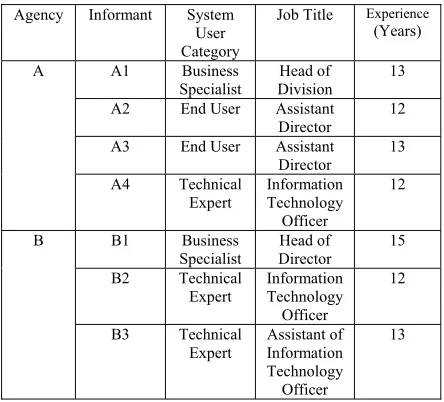
Two public sector agencies that were still using the LIS were chosen, with at least three informants from each agency. The informants were categorized into the following, based on their field of expertise. Table 1 shows brief information of selected informants:
Business Specialist: This role requires a deep understanding of the business process and the ability to determine current and future business needs. The senior officer with more than 10 years experienced in LIS operating is the chosen candidate.
Technical Expert: Individuals with experience in development and maintenance and have a deep understanding of LIS. An Information Technology Officer with over 8 years of experience in developing and maintaining LIS is selected as a technical expert.
[image:4.612.123.240.115.249.2] End User: Individuals who use and understand how LIS supports its usage. Candidates for this role are employees who have been using LIS for more than 5 years.
Table 1: Information of selected informants
Agency Informant System
User Category
Job Title Experience
(Years)
A A1 Business
Specialist
Head of Division
13
A2 End User Assistant
Director 12
A3 End User Assistant
Director
13
A4 Technical
Expert
Information Technology Officer
12
B B1 Business
Specialist
Head of Director
15
B2 Technical
Expert
Information Technology Officer
12
B3 Technical
Expert
Assistant of Information Technology Officer
13
3.2.2 Interview Protocol
The interview protocol is a rule provided in order to conduct the interview sessions. It involves certain steps in which the researcher discloses the Theoretical Study
Empirical Study
Model Development
Model Validation
[image:4.612.307.529.472.673.2]5944 objective and purpose of the study to the informant prior to the interview. This is to ensure that interview sessions are carried out more thoroughly and beneficially. The protocol starts by getting the approval from the selected informants. Once their consent has been acquired, the date and time are set by the researchers with the informant’s agreement. This is followed by an application letters for data collection purpose to the informants which is sent via email. The experts are interviewed individually at their respective workplace within 60 to 90 minutes. Besides that, for referral purposes the interview sessions are audio recorded with the informant’s consent. Data from the interviews are then transcribed into text format and analysed for interpretation.
3.2.3 Instrument
In this study, semi-structured interviews that incorporate structured and unstructured questions have been used [36]. Interview questions are provided based on the preliminary review conducted earlier, aiming to answer the research’s problem statements [31]. The interview question is divided into four sections. Questions in section A are related to informant’s information including agency’s name, position, experience and a brief description of the LIS used. Questions in this part were addressed to all informants. Section B and C are the questions related to the LIS evaluation factor. Section B consists of questions for evaluation factors based on business value aspects, for instance the economic value, LIS use, specialisation and data value. The questions in Section B are presented to the business experts of public sector agencies.
Next, Section C consists of the question for LIS evaluation factor that is based on technical quality aspects of functionality, reliability, usability, efficiency, maintenance, compatibility, portability and security. The questions in Section C are submitted to technical experts and end users of the public sector agencies. Section D contains the question regarding the aspect of an organisation related to the LIS assessment that is asked towards the agencies business experts.
3.3 Model Development
In this phase, the factors of LIS for the public sector were identified based on the content analysis data from theoretical phase and interview data from the empirical phase. The interview data is transcribed into text for the analysis process. Data analysis contains steps such as reviewing, categorizing, compiling and collecting the
information to achieve the research objective [37]. The factors were then combined in the form of a model.
In order to combine and form the model, the content analysis method is used to analyse the acquired data. Generally, the content analysis method involves three main concepts namely data reduction, data display and data presentation [38]. Content analysis categorizes data as text, images and expressions in order to explain its meaning. Content analysis also involves categorising data by its frequency [39]. Therefore, the content analysis method has been chosen because it is a systematic method for categorizing text in certain concepts and codes.
The result of this analysis is the proposed LIS assessment model for the public sector. This proposed model is subsequently verified through expert validation which described in the next section.
3.4 Model Validation
The model validation is done by the selected experts to verify the accuracy and validity of the proposed model. The appraisals were done towards the model’s conceptual accuracy, the suitability of element’s selection as well as the relationship used in the model [40].
A total of two experienced experts in LIS assessments have been interviewed. The experts were selected based on their experiences, which are more than 20 years in the public sector LIS implementation and evaluation field. Besides that, the experts were chosen for their credibility as ICT consultant particularly in the System Development track. Based on the feedback from the experts, the proposed LIS assessment model has been improved. The result is discussed in the next section.
4. RESULT AND DISCUSSION
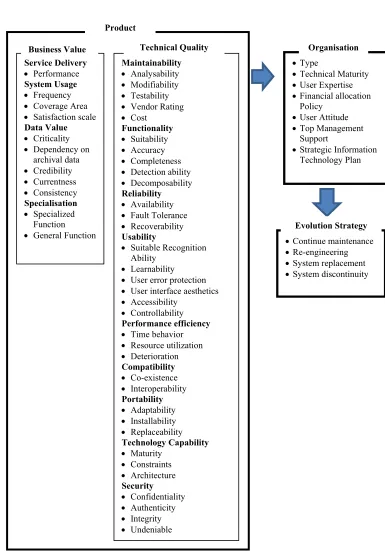
The LIS assessment model for the public sector that has been verified by the experts is shown in Figure 2. This model is developed based on theoretical studies, empirical studies and expert assessment. This model is basically comprised of three aspects namely the business value, technical quality and organisation aspect. Each aspect has several factors that are relevant in its classification. Basically, the experts have agreed with all the proposed factors, with modification done toward some particular factors as stated below.
5945 and specialisation. Service delivery factor has been added to replace the economic values factor that does not coincide with the public sector. The specialisation factor is not agreed upon by informants in empirical studies. However, this factor is reconsidered in the model after the expert expressed its importance to be included in the model.
The technical quality consists of nine factors, such as maintenance, functionality, reliability, usability, performance efficiency, compatibility, portability, technological and security capabilities. Technology capability is a new factor derived from empirical studies and verified by the experts.
For organisational aspect, five factors are derived from theoretical research, namely type, technical maturity, consumer expertise and consumer attitude. Factors were confirmed in empirical studies with the addition of four new public sectors related factors namely financial allocation, policy, top management support and Strategic Information Technology Plan.
Consumer behavior factor is not agreed upon in an empirical study but it is not supported by experts that state it should be considered in the LIS assessment model for the public sector. The product evaluation which is based on the technical quality and business value should be done to determine the existing LIS capabilities.
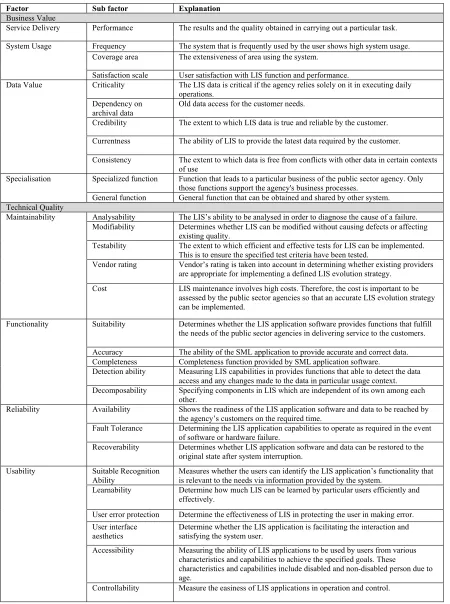
After evaluating these two aspects, the organisational aspect needs to be taken into account before the LIS evolution strategy can be determined. The evolution strategies to be considered are among these four options which are to continue the maintenance, to do re-engineering, to do replacement or to discontinue the LIS’s use. Table 2 lists the brief description of the evaluation factors identified.
4. CONCLUSION AND FUTURE WORK
This paper provides a specific LIS assessment model for the public sector. This model provides a holistic focus towards the business value, technical as well as the organisational aspect before the evolution strategies can be determined.
This qualitative study involves four phases namely theoretical studies, empirical studies, model development and model validation. Through the theoretical study, four LIS evaluation models namely the International Organization for Standardization 25010 (ISO 25010), ISO 25012, Hierarchical Model and Renaissance Methods have been analysed.
The deficiencies inherent in each model are overcome by combining these four models. Factors derived from previous models through theoretical studies were later confirmed in the empirical phase by the selected informant, which are the business specialist, technical expert and end user from the public sector agencies. The findings of theoretical studies and empirical studies were then analysed by using content analysis method to develop an LIS assessment model for the public sector. The model was subsequently tested by the experts who are recognized to have an extensive experience in the information system development for the public sector. Overall, the experts have accepted the proposed model with some improvements to certain factors.
5946
Continue maintenance
Re-engineering
System replacement
[image:7.612.130.515.107.658.2] System discontinuity Evolution Strategy
Figure 2: The Assessment Model of Legacy Information System for Public Sector Type
Technical Maturity
User Expertise
Financial allocation Policy
User Attitude
Top Management Support
Strategic Information Technology Plan
Organisation Product
Maintainability
Analysability
Modifiability
Testability
Vendor Rating
Cost Functionality
Suitability
Accuracy
Completeness
Detection ability
Decomposability Reliability
Availability
Fault Tolerance
Recoverability Usability
Suitable Recognition Ability
Learnability
User error protection
User interface aesthetics
Accessibility
Controllability Performance efficiency
Time behavior
Resource utilization
Deterioration Compatibility
Co-existence
Interoperability Portability
Adaptability
Installability
Replaceability Technology Capability
Maturity
Constraints
Architecture Security
Confidentiality
Authenticity
Integrity
Undeniable
Technical Quality Service Delivery
Performance System Usage
Frequency
Coverage Area
Satisfaction scale Data Value
Criticality
Dependency on archival data
Credibility
Currentness
Consistency Specialisation
Specialized Function
5947
Factor Sub factor Explanation
Business Value
Service Delivery Performance The results and the quality obtained in carrying out a particular task.
System Usage Frequency The system that is frequently used by the user shows high system usage.
Coverage area The extensiveness of area using the system.
Satisfaction scale User satisfaction with LIS function and performance.
Data Value Criticality The LIS data is critical if the agency relies solely on it in executing daily operations.
Dependency on archival data
Old data access for the customer needs.
Credibility The extent to which LIS data is true and reliable by the customer.
Currentness The ability of LIS to provide the latest data required by the customer.
Consistency The extent to which data is free from conflicts with other data in certain contexts of use
Specialisation Specialized function Function that leads to a particular business of the public sector agency. Only those functions support the agency's business processes.
General function General function that can be obtained and shared by other system. Technical Quality
Maintainability Analysability The LIS’s ability to be analysed in order to diagnose the cause of a failure. Modifiability Determines whether LIS can be modified without causing defects or affecting
existing quality.
Testability The extent to which efficient and effective tests for LIS can be implemented. This is to ensure the specified test criteria have been tested.
Vendor rating Vendor’s rating is taken into account in determining whether existing providers are appropriate for implementing a defined LIS evolution strategy.
Cost LIS maintenance involves high costs. Therefore, the cost is important to be assessed by the public sector agencies so that an accurate LIS evolution strategy can be implemented.
Functionality Suitability Determines whether the LIS application software provides functions that fulfill the needs of the public sector agencies in delivering service to the customers.
Accuracy The ability of the SML application to provide accurate and correct data. Completeness Completeness function provided by SML application software.
Detection ability Measuring LIS capabilities in provides functions that able to detect the data access and any changes made to the data in particular usage context. Decomposability Specifying components in LIS which are independent of its own among each
other.
Reliability Availability Shows the readiness of the LIS application software and data to be reached by the agency’s customers on the required time.
Fault Tolerance Determining the LIS application capabilities to operate as required in the event of software or hardware failure.
Recoverability Determines whether LIS application software and data can be restored to the original state after system interruption.
Usability Suitable Recognition
Ability
Measures whether the users can identify the LIS application’s functionality that is relevant to the needs via information provided by the system.
Learnability Determine how much LIS can be learned by particular users efficiently and effectively.
User error protection Determine the effectiveness of LIS in protecting the user in making error. User interface
aesthetics
Determine whether the LIS application is facilitating the interaction and satisfying the system user.
Accessibility Measuring the ability of LIS applications to be used by users from various characteristics and capabilities to achieve the specified goals. These
characteristics and capabilities include disabled and non-disabled person due to age.
[image:8.612.84.534.125.729.2]Controllability Measure the easiness of LIS applications in operation and control.
5948
Performance efficiency Time behavior Determines the response time required to perform the function of LIS application.
Resource utilization The use of manpower and database storage space used by the LIS in performing the required functions.
Deterioration Evaluate problems associated with LIS aging as a result of the ongoing changes. Compatibility Co-existence Determines whether the LIS can perform the required function efficiently by
sharing environment with other systems without affecting any product. Interoperability Measuring the effectiveness of LIS in changing and using the information that
has been changed.
Portability Adaptability Determining the efficiency and effectiveness of the LIS applications to be customized using environments of other hardware and software. Installability Evaluate the efficiency and effectiveness of the LIS to be installed in the
environment.
Replaceability Evaluate whether the LIS application can be replaced with other software that is required for the same purpose in the same environment.
Technology Capability Maturity Evaluate the increase age of LIS which affecting the technological capabilities used in performing the agency tasks.
Constraints Improvements on the LIS that cannot be done due to the technology limitations used.
Architecture The method used by the LIS application in servicing customers is assessed by determining the extent to which it has affected the daily activities of the agency.
Security Confidentiality Determine the information in LIS application is not disclosed arbitrarily and only be accessed by the authorized users.
Authenticity Assess the ability of LIS to prove the correct subject’s identity.
Integrity Determines whether the LIS is protected from any unauthorized access for data updates or programs.
Undeniable Measures the extent to which the LIS activities performed within the system can be proven and undeniable.
Organisation
Factor Explanation
Type Revenue generator agency or vice versa.
Technical maturity Refers to the information technology department of the agency and its staff. User expertise Skilled users can assist in the LIS redevelopment or business re-engineering if needed
Financial allocation The evolution strategy involving costs to the public sector agencies requires the financial allocation that must be approved by the relevant ministry.
Policy Officially agreed actions and rules as the basis for implementing a decision which is often referred as the government policy.
User attitude Positive users of the changes to be made will provide the necessary cooperation and ensure the evolution strategy goes smoothly.
Top management support
Top management support is required from the beginning of project implementation until the project is completed.
Strategic Information Technology Plan
5949
REFRENCES:
[1] S. I. Mahdzur and J. Salim, “Information Systems Integration Factors in Organization: Towards Government Information Systems Sustainability,” J. Theor. Appl. Inf. Technol., vol. 71, no. 2, pp. 235 – 250, 2015.
[2] I. Al-Azzoni, L.Zhang, and D.G.Down, “Performance evaluation for software
migration,” Proceeding Second Jt.
WOSP/SIPEW Int. Conf. Perform. Eng. - ICPE ’11, p. 323, 2011.
[3] E. P. A.De Lucia, A.R.Fasolino, “A decisional framework for legacy system management,” Proc. IEEE Int. Conf. Softw. Maint. (ICSM
2001), IEEE Comput. Soc. Press, pp. 642–651,
2001.
[4] R. Khadka, B. V. Batlajery, A. M. Saeidi, S. Jansen, and J. Hage, “How do professionals perceive legacy systems and software modernization?,” Proc. 36th Int. Conf. Softw. Eng. - ICSE 2014, pp. 36–47, 2014.
[5] Y. C. and J. P. F. Lampathaki, N. Kroustalias, S. Koussouris, “Implementing Interoperability Infrastructures: Issues and Challenges from the Citizens Base Registry in Greece,” Hawaii Int. Conf. Syst. Sci., pp. 1–10, 2010.
[6] A.Rodríguez, A.Caro, and E.Fernández-Medina, “Towards framework definition to obtain secure business process from legacy information systems,” Proceeding first Int. Work. Model driven Serv. Eng. data Qual. Secur., p. 17, 2009.
[7] A. Alexandrova, L. Rapanotti, and I. Horrocks, “The legacy problem in government agencies.,” Proc. 16th Annu. Int. Conf. Digit. Gov. Res., pp. 150–159, 2015.
[8] Y. G. Kook, J.Lee, and J. S. Kim, “E-Government Grid System Based on Multi-agent for Interoperability,” Int. Conf. Innov. Manag., pp. 7–10, 2009.
[9] B. Y. Alkazemi, “A framework to assess legacy software systems,” J. Softw., vol. 9, no. 1, pp. 111–115, 2014.
[10] I. Sommerville, Software Engineering Ninth Edition. Boston, 2009.
[11] J.Ransom and I.Warren, “Renaissance: a method to support software system evolution,” Proc. 26th Annu. Int. Comput. Softw. Appl., pp. 415–420, 2002.
[12] J.Ransom, I.Sommerville, and I.Warren, “A Method for Assessing Legacy Systems for Evolution,” Proc. Second Euromicro Conf.
Softw. Maint. Reengineering, pp. 128–134,
1998.
[13] M. G. Ismail, M. M. Yusof, and U. A. Mokhtar, “Evaluation of User Satisfaction on Pharmacy Information Systems in Government Hospital,” Int. J. Sci. Appl. Technol., vol. 2, no. 1, pp. 1–6, 2017.
[14] N. Fazidah, “Measuring the Impact of Information Systems in Malaysia,” Proc. Int. Conf. Adv. Sci. Eng. Inf. Technol., vol. 1, no. 2, pp. 206–211., 2011.
[15] W. Chutimaskul, S. Funilkul, and V. Chongsuphajaisiddhi, “The quality framework of e-government development,” Proc. 2nd Int. Conf. Theory Pract. Electron. Gov. - ICEGOV ’08, 2008.
[16] H. Ramlah and N. Shahriza, “The Influence of Organizational Factors on Information systems,” Electron. J. Inf. Syst. Dev. Ctries., pp. 1–17, 2007.
[17] A.N.H.Zaied, “An Integrated Success Model for Evaluating Information System in Public Sectors,” J. Emerg. Trends Comput. Inf. Sci., vol. 3, pp. 814–825, 2012.
[18] M. M. Yusof and K. A. Aziz, “Evaluation of Organizational Readiness in Information Systems Adoption : a Case Study,” Asia-Pacific J. Inf. Technol. Multimed., vol. 4, no. 2, pp. 69–86, 2015.
[19] S. A. Mohammed and M. M. Yusof, “Towards an evaluation framework for information quality management (IQM) practices for health information systems - Evaluation criteria for effective IQM practices,” J. Eval. Clin. Pract., vol. 19, no. 2, pp. 379–387, 2013.
[20] A. Alexandrova, “Business requirements analysis and development for legacy system replacement projects in government organizations,” 20th IEEE Int. Requir. Eng. Conf., pp. 337–340, 2012.
[21] S.Baire, “E-Government : The Need for Effective Process Management in the Public Sector,” Proc. 39th Hawaii Int. Conf. Syst. Sci., pp. 1–10, 2006.
[22] G. M. Bryan, C. Mcgregor, D. Holdsworth, and R. Sharply, “Using XML to facilitate information management across multiple local government agencies,” Proc. 35th Hawaii Int. Conf. Syst. Sci., pp. 1–10, 2002.
5950 [24] Z. Wu, D.Qian, Y.Wang, Y. Wang, and
D.Yang, “An Available Service Intermediator for E-government,” Int. Conf. Wirel. Commun.
Netw. Mob. Comput., pp. 3504–3507, 2007.
[25] P.Lew, L.Olsina, and L.Zhang, “Quality,Quality in Use,Actual Usability and User Experience as Key Drivers for Web Application Evaluation,” Int. Conf. Web Eng., pp. 218–232, 2010.
[26] I. Rafique, P.Lew, M.Q.Abbasi, and Z. Li, “Information Quality Evaluation Framework: Extending ISO 25012 Data Quality Model,”
World Acad. Sci. Eng. Technol. 65, pp. 523–
528, 2012.
[27] B.Behkamal, M.Kahani, and M. . Akbari, “Customizing ISO 9126 quality model for evaluation of B2B applications,” Inf. Softw. Technol. 51, pp. 599–609, 2009.
[28] J. L. González, R. García, J. M. Brunetti, R.Gil, and J. . Gimeno, “SWET-QUM : A Quality in Use Extension Model for Semantic Web Exploration Tools,” Proc. 13th Int. Conf. Interacción Pers., 2012.
[29] D. Fronckowiak, “Extending the Life of Legacy Software Systems:A Decision Process Model,” Proc. Student-Faculty Res. Day, CSIS, Pace Univ., pp. 1–8, 2008.
[30] R. Consortium, “Renaissance method and tool support for the evolution and re-engineering of legacy systems Evolution planning,” 1998. [31] R. Razali and B. H.K.A, “A Preliminary
Review of Legacy Information Systems Evaluation Models,” 3rd Int. Conf. Res. Innov. Inf. Syst. – 2013, pp. 314 –318, 2013.
[32] U. Flick, An Introduction To Qualitative
Research, Fourth Edi. London: SAGE
Publications Ltd, 2010.
[33] B. HK and R. R., “A preliminary review of legacy information systems evaluation models,” 2013 Int. Conf. Res. Innov. Inf. Syst., pp. 314–318, 2013.
[34] M. N. Marshall, “Sampling for qualitative research. Family practice,” vol. 13, no. 6, pp. 522–525, 1996.
[35] H. Azizah, “Kaedah kualitatif Dalam Penyelidikan Sosiobudaya,” J. Pengaj. Media Malaysia, vol. 6, no. 1, 2004.
[36] J. P. Y. Rogers, H.Sharp, “Interaction Design,” 2011.
[37] R. K. Yin, Case study Research : Design and
Methods, 3rd Edition. Thousand Oaks,
California: Sage Publications, 2003.
[38] M. Miles and M. Huberman, Qualitative data
analysis (2nd edition). Sage Publications,
1994.
[39] K. Krippendorf, Content Analysis: An
introduction to its methodology. CA:
Thousands Oak, 2004.
[40] M. A. N. Hapiza, CRM-i Kerangka Kerja Strategik Pengurusan Perhubungan Pelanggan