International Journal of Emerging Technology and Advanced Engineering
Website: www.ijetae.com (ISSN 2250-2459,ISO 9001:2008 Certified Journal, Volume 4, Issue 2, February 2014)
885
Fast Convergent Differential Evolution Algorithm
Amrata Pupneja
1, Chakradhar Verma
21
Amrata Pupneja
, M.Tech. Student, Gurukul Institute of Engineering & Technology, Kota, Rajasthan, IndiaE-mail: [email protected]
2
Chakradhar Verma
, M.Tech. Incharge & Guide, Gurukul Institute of Engineering & Technology, Kota, Rajasthan, India. E-mail: [email protected]Abstract—Differential Evolution (DE) algorithmis a well known population based stochastic algorithm used to solve optimization problems. But, DE, like other nature inspired algorithms, sometimes stuck in local optima and also suffers from the problem of stagnation. To resolve these issues and improving the convergence speed of DE algorithm, Artificial Bee Colony algorithm’s fitness based position update strategy is incorporated with it. In the proposed algorithm, first all the
solutions are updated their positions using the DE algorithm than the ABC search strategy is applied to improve the convergence speed of the search process. The proposed strategy is named as Fast Convergent Differential Evolution algorithm (FCDE). To prove efficiency and accuracy of FCDE, it is tested over 20 well known optimization problems. A comparative analysis has also been carried out among proposed FCDE, basic DE and Simulated Annealing Differential Evolution (SADE).
Keywords— Artificial Bee Colony · Differential Evolution · Evolutionary Algorithm
I. INTRODUCTION
Differential Evolution (DE) scheme is relatively a simple, fast and population based stochastic search technique, proposed by Storn and Price [12]. DE falls under the category of Evolutionary Algorithms (EAs). But in some sense it differs significantly from EAs, e.g. trial vector generation process uses the information of distance and direction from current population to generate a new trial vector. Furthermore, in EAs, crossover is applied first to generate a trial vector, which is then used within the mutation operation to produce one offspring while, in DE, Mutation is applied first and then crossover [3].
Researchers are continuously working to improve the performance of DE. Some of the recently developed versions of DE with appropriate applications can be found in [1]. In the literature [16], it has been shown that for many times DE performs better than the Genetic Algorithm (GA) [5] or the Particle Swarm Optimization (PSO) [7].
DE has successfully been applied to various areas of science and technology, such as chemical engineering [9], signal processing [2], mechanical engineering design [14], machine intelligence, and pattern recognition [11]. Re-cently, machine intelligence and cybernetics are most well-liked field in which DE algorithm has become a popular strategy.
There are two fundamental processes which drive the evolution of a DE population: the variation process,which enables exploring different areas of the search space, and the selection process, which ensures the exploitation of the previous experience. However, it has been shown that DE may occasionally stop proceeding towards the global optimum even though the population has not converged to a local optimum [8]. Therefore, to maintain the proper balance between exploration and exploitation behavior of DE, a new position update process is introduced based on the fitness of the solution. The position update takes place in two phases in the proposed strategy. In the first phase, the basic DE is used to generate the new solutions and in the second phase each solution is updated based on its fitness. The proposed update process is inspired from onlooker bee phase of Artificial Bee Colony algorithm (ABC) [6]. In this process, better candidate gets more chance to update its position. Further, the solution updates only in single dimension in each chance, hence generates the new solution in the neighbourhood of the old one and in this way exploits the search space.
International Journal of Emerging Technology and Advanced Engineering
Website: www.ijetae.com (ISSN 2250-2459,ISO 9001:2008 Certified Journal, Volume 4, Issue 2, February 2014)
886
II. FAST CONVERGENT DIFFERENTIAL EVOLUTION
ALGORITHM
Exploration of the whole search space and exploitation of the near optimal solution region may be balanced by maintaining the diversity in early and later iterations of
any random number based search algorithm. DE explores the search space based on the value of CR and F. In DE, exploration and exploitation of the search space depend on the value of CR and F i.e. for high value of CR and F exploration will be high and for low value, exploitation. In this paper, we are proposing a new probability phase, which balances the exploration and exploitation of the search space. The position update process is inspired from the Artificial Bee Colony (ABC) algorithm’s onlooker bee phase [6]. In employed bee phase of ABC, all the employed bees search the food source and calculate their fitness using equation (1):
(1)
and then in the onlooker bee phase, Onlooker bees analyze the available information and select a solution with a probability, probi, related to its fitness. The probability probi may be
calculated using equation (2) (there may be some other but must be a function of fitness):
= + 0.1
(2)
where G is the iteration counter, fitnessi(G) is the fitness value
of ith solution and maxfit(G) is the maximum fitness of the solutions in Gth iteration. Position update equation of ABC is shown in equation (3):
= + ɸij ( - ) + Ψij ( - )
(3)
where k ϵ {1, 2, ...,NP}, j ϵ {1, 2, ...,D} are randomly chosen indices, k must be different from i, ɸij is a random number between [-1, 1] and xkj is a random individual in the current
population and Ψij is a uniform random number in [0,C],
where C is a non-negative constant. For details description refer to [19]. In the basic ABC, at any given time, only one dimension is updated in employed or
onlooker bee phase. In onlooker bee phase this update takes place based on a probability which is a function of fitness.
The proposed strategy FCDE, in this paper, is inspired from ABC’s onlooker bee phase discussed above. In FCDE, Algorithm 1 is applied after basic DE operators. The insertion of Algorithm1 makes FCDE more capable of exploitation in the better search regions. It is expected because in FCDE after applying basic DE operators, better candidate solutions are offered to update themselves more
times than worse candidates. The pseudo-code of the proposed position update process which works after DE operators is shown in Algorithm 1.
Algorithm 1 Fitness based search strategy inspired from ABC:
for each individual, do
if > rand(0, 1) then
= + ɸij ( - ) + Ψij ( - )
Calculate fitness of
Apply greedy selection between and ,
end if
end for
III. EXPERIMENTALRESULTSANDDISCUSSION
A. Test Problems under consideration
International Journal of Emerging Technology and Advanced Engineering
Website: www.ijetae.com (ISSN 2250-2459,ISO 9001:2008 Certified Journal, Volume 4, Issue 2, February 2014)
International Journal of Emerging Technology and Advanced Engineering
Website: www.ijetae.com (ISSN 2250-2459,ISO 9001:2008 Certified Journal, Volume 4, Issue 2, February 2014)
888
B. Experimental setting
To prove the efficiency of FCDE algorithm, it is compared with three variantsof DE, namely, DE/rand/bin/1 (usually known as basic DE) [12] and Simulated Annealing Differential Evolution (SADE) [18].
The comparative analysis has been carried out through reliability (due to success rate (SR)), efficiency (due to average number of function evaluations (AFE)) and accuracy (due to mean error (ME)). After calculating SR, AFE and ME, statistical analyses based on Acceleration Rate (AR) [13] and Boxplot have been carried out. In order to show the superiority of proposed algorithm from different point of view, these intensive statistical analysis have been carried out.
To test DE or DE variants over test problems, following experimental setting is adopted:
– Parameters for the basic DE are CR = 0.8, F = 0.5 [12, 15, 4].
– The value of F and CR for SADE are kept same as suggested by their respective authors [18, 10].
– Population size NP=50.
– The stopping criteria is either maximum number of function evaluations (which is set to be 2.0 × 10⁵) is reached or the corresponding acceptable error (mentioned in Table I) has been achieved.
– The number of simulations/run =100.
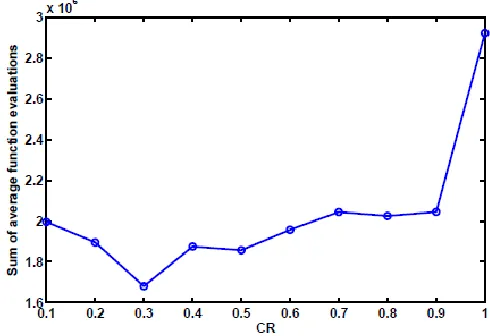
– In order to investigate the effect of the parameter CR on the performance of FCDE, its sensitivity with different values of CR in the range [0.1, 1], is examined in Figure I. This figure shows the graph between different values of CR and corresponding sum of average number of function evaluations for 22 problems in meeting the termination criteria for FCDE. It is clear from Figure I that FCDE is very sensitive for CR and the value 0.3 gives comparatively better results. Therefore CR = 0.3 is selected for the experiments in this paper.
– C = 1.5 [19];
C. Results & Discussions
In this subsection, a comparison among FCDE, DE/rand/bin/1 and SADE is carried out. Numerical results with experimental settings of subsection 3.2, are given in Table II. In Table II, success rate (SR) which is the measure of reliability, mean error (ME) which is a measure of accuracy, average function evaluations (AFE) which is a measure of efficiency and standard deviation (SD) are reported.
[image:4.612.326.571.193.361.2]Table II shows that most of the time FCDE improves the reliability, efficiency and accuracy. Some more intensive statistical analyses based on Acceleration Rate (AR) [13] and Boxplot have been carried out for results of basic FCDE, DE and SADE.
Fig. I: Effect of parameter CR on Average Function Evaluations
TABLE II:COMPARISON OF THE RESULTS OF FCDE,DE AND SADE
PROBLEMS
[image:4.612.322.571.430.674.2]International Journal of Emerging Technology and Advanced Engineering
Website: www.ijetae.com (ISSN 2250-2459,ISO 9001:2008 Certified Journal, Volume 4, Issue 2, February 2014)
889
I): Statistical Analysis
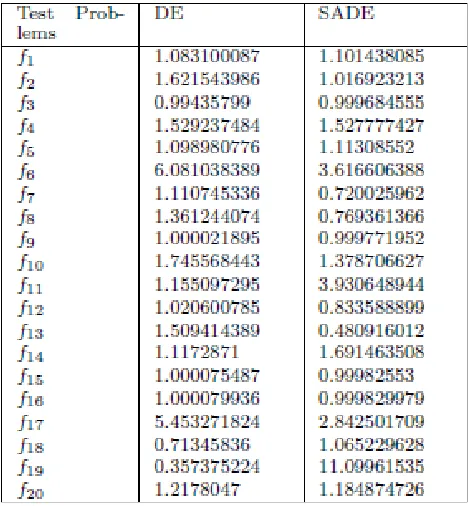
TABLE III:ACCELERATION RATE (AR) OF FCDE COMPARE TO THE BASIC
DE AND SADE
A comparison is made on the basis of convergence speed of the considered algorithms by measuring the average function evaluations (AFEs). A smaller AFEs means higher convergence speed. In order to minimize the effect of the stochastic nature of the algorithms, the reported function evaluations for each test problem is the average over 100 runs. In order to compare convergence speeds, we use AR which is defined as follows, based on the AFEs for the two algorithms ALGO and FCDE:
AR = AFEALGO /AFEFCDE, (4)
where, ALGO ϵ {DE, SADE} and AR > 1 means FCDE converges faster. Table III shows a clear comparison between FCDE - DE and FCDE - SADE in terms of AR. It is clear from Table that, for most of the test problems, convergence speed of FCDE is faster among all the considered algorithms.
[image:5.612.52.301.125.350.2]For the purpose of comparison in terms of performance, boxplot analysis is carried out for all the considered algorithms. The empirical distribution of data is efficiently represented graphically by the boxplot analysis tool [17]. Analysis of univariate expression, where the variability of measurements may be affected many parameters, is effectively done by the boxplot tool. Degree of dispersion and skewness in the data are easily analyzed by measuring the spacings between the different parts of the box. The boxplots for comparison among FCDE, DE and SADE based on AFE are shown in Figure II. It is clear from this figure that FCDE is best among all considered strategies as Interquartile Range and Median are low for FCDE.
[image:5.612.49.284.435.688.2] [image:5.612.328.571.507.666.2]International Journal of Emerging Technology and Advanced Engineering
Website: www.ijetae.com (ISSN 2250-2459,ISO 9001:2008 Certified Journal, Volume 4, Issue 2, February 2014)
890
IV. CONCLUSION
In this paper, FCDE is proposed, analyzed and validated with the help of test problems. In FCDE, the solution search strategy of DE algorithm is modified and fitness based position update strategy is incorporated with it. In the proposed strategy, first all the solutions are modified using the basic DE algorithms than the modified solutions improve their positions on the basis of their respective fitness. Through intensive experiments it is shown that FCDE perform better than DE and its recent variant SADE in terms of reliability, efficiency and accuracy. Overall, authors recommend FCDE as a better candidate in the field of nature inspired algorithms to solve an engineering optimization problem.
The future scope of this work is the implementation of the proposed strategy to other nature inspired algorithms.
REFERENCES
[1] U.K. Chakraborty. Advances in differential evolution. Springer Verlag, 2008.
[2] S. Das and A. Konar. Two-dimensional IIR filter design with modern search heuristics: A comparative study. International Journal of Computational Intelligence and Applications, 6:329–355, 2006.
[3] A.P. Engelbrecht. Computational intelligence: an introduction. Wiley, 2007.
[4] R. Gamperle, S.D. Muller, and A. Koumoutsakos. A parameter study for differential evolution. Advances in Intelligent Systems, Fuzzy Systems, Evolutionary Computation, 10:293–298, 2002. [5] J.H. Holland. Adaptation in natural and artificial systems. University
of Michigan press, 1975.
[6] D. Karaboga and B. Akay. A modified artificial bee colony (abc) algorithm for constrained optimization problems. Applied Soft Computing, 11:3021–3031, 2011.
[7] J. Kennedy and R. Eberhart. Particle swarm optimization. In IEEE International Conference on Neural Networks, 1995. Proceedings., volume 4, pages 942–1948. IEEE, 1995.
[8] J Lampinen and I. Zelinka. On stagnation of the differential evolution algorithm. In Proceedings of MENDEL 2000 6th International Mendel Conference on Soft Computing, pages 76–83, 2000.
[9] P.K. Liu and F.S. Wang. Inverse problems of biological systems using multiobjective optimization. Journal of the Chinese Institute of Chemical Engineers, 39:399–406, 2008.
[10] F. Neri and V. Tirronen. Scale factor local search in differential evolution.Memetic Computing, Springer, 1:153–171, 2009. [11] M.G.H. Omran, A.P. Engelbrecht, and A. Salman. Differential
evolution methods for unsupervised image classification. In Evolutionary Computation, 2005.The 2005 IEEE Congress on, volume 2, pages 966–973. IEEE, 2005.
[12] K.V. Price. Differential evolution: a fast and simple numerical optimizer. InFuzzy Information Processing Society, 1996. NAFIPS. 1996 Biennial Conference of the North American, pages 524–527. IEEE, 1996.
[13] S. Rahnamayan, H.R. Tizhoosh, and M.M.A. Salama. Opposition-based differential evolution. Evolutionary Computation, IEEE Transactions on, 12:64–79,2008.
[14] T. Rogalsky, S. Kocabiyik, and RW Derksen. Differential evolution in aerodynamic optimization. Canadian Aeronautics and Space Journal, 46:183–190,2000.
[15] R. Storn and K. Price. Differential evolution-a simple and efficient adaptive scheme for global optimization over continuous spaces. J. Global Optimiz,11:341–359, 1997.
[16] J. Vesterstrom and R. Thomsen. A comparative study of differential evolution,particle swarm optimization, and evolutionary algorithms on numerical benchmark problems. In Evolutionary Computation, 2004. CEC2004. Congress on,volume 2, pages 1980–1987. IEEE, 2004.
[17] D.F. Williamson, R.A. Parker, and J.S. Kendrick. The box plot: a simple visual method to interpret data. Annals of internal medicine, 110:916, 1989.
[18] J.Y. Yan, Q. Ling, and D.M. Sun. A differential evolution with simulated annealing updating method. In International Conference on Machine Learning and Cybernetics, pages 2103–2106. IEEE, 2006.