ISSN 2250-3153
www.ijsrp.org
PERFORMANCE APPRAISAL USING BASIC
T-NORMS BY SOFTWARE FUZZY ALGORITHM
Dr. G.Nirmala*, G.Suvitha**
*
Principal, Government Arts and sciencs College, Peravurani,Thanjavur- 614804, Tamil Nadu, India. Email ID: [email protected]
**Assistant Professor, Department of Mathematics (science & Humanities), Sri Sai Ram Institute of Technology, West Tambaram, Chennai-600044.Tamil Nadu, India. Email Id: [email protected]
Abstract - Performance Appraisal is the systematic evaluation of the performance of an employee under certain aspects of consideration and to understand the potential of a person for further growth and development of an employee in an organization with specific ratings. This paper presents a design and implementation of a performance appraisal system using the fuzzy logic. It extracts the performance of an employee at each level, thereby generating the ratings automatically with respect to the satisfactory level of the target criteria attained by them. An automated employee rating system based on IBM Lotus Software fuzzy algorithm is used for this purpose to track the employee work performance. The performance will be measured based on certain factors such as Work Achievement, Continual Learning and Communication Skills etc. Based on these attributes, it automatically separates them into five levels of ratings.
Index Terms- Performance appraisal, Fuzzy inference system, Fuzzy Rules, Defuzzification, Triangular Fuzzy Number.
I. INTRODUCTION
any companies, institutions and organizations use performance appraisal system to evaluate the employee’s performance. The performance of an employee is very important for the progress of the company. Also performance appraisal is a vital part of employee’s career development. Various decisions like promotions, terminations, banding depends upon the performance evaluation. Many Companies or organizations has its own process of employee’s performance appraisal system. It is actually a systematic and periodic process that assesse an individual employee’s performance and the productivity. Most of the companies include crisp and uncertain values to evaluate the employee’s performance. There are many traditional ways to measure performance of an employee. In the recent inventions, more effective and efficient ways for performance measurement are available. Researchers all over the world are trying to use fuzzy inference techniques to improve the effectiveness of performance appraisal. It is not only applied for the evaluation of performance of an employee, it is also applied in the field of teacher’s performance and also in the performance of students to provide their internal marks. In this work, we have proposed to evaluate employee’s performance on the basis of different factors, by applying the compositional rule of inference using fuzzy Logic. The present work intends to approach their problem by taking the advantages of fuzzy inference technique in order to improve the employee incentives according to the level of their performance.
Performance appraisal can be defined as a structured formal interaction between a subordinate and his/her immediate supervisor. It usually has a periodic review, in which the work performance of the subordinate is examined and discussed. The appraisal also identifies the weaknesses and strengths as well as opportunities for self-improvement and skills development. In most cases, performance appraisal system is used by managers to evaluate the effectiveness and efficiency of employees and/or other resources within the organization. And also, the appraisal focuses upon the integration and achievement of individual targets, behaviour and performance at work as compared to the goals of the organization.
Performance appraisals are mainly used for judgmental and developmental purposes in order to make good administrative decisions. Performance measures are meant to provide more complete information about an individual’s performance. Organizations depends on supervisors to sort out how well individuals under their supervisions perform. The hope is that supervisors can sort out the effects of job changes, collective action, their own likes and dislikes, to make an accurate judgment of how well individuals have performed over a period of time. However, this hope is rarely realized, the supervisors bring their own biases and information-processing problems to the task of performance appraisal, thus the appraisal are often defective. Therefore, the evaluation given may involve information of uncertainty and subjectivity.
In most performance evaluation, the process usually involves awarding numerical values or linguistic labels to employee performance. These values and labels are used to represent the employee’s achievement by reasoning using arithmetical or statistical methods. In general, those methods can be classified using numerical score. These numerical scores may refer to another numerical interval-value that refers to a certain category of achievement, which is equivalent to 100 percent value. However, in most cases, the evaluation of employee performance may be influenced by the supervisor’s experience, sensitivity
www.ijsrp.org
and standard. Thus, the scores awarded by the supervisor are only approximations and there is an inherent vagueness in the evaluation. However, if we looked into the evaluation using fuzzy logic approach, the performance of the employee involves the measurement of ability, competence and skills, which are fuzzy concepts that may be captured in fuzzy terms. Consequently, fuzzy logic approach can be implemented to manage the uncertainty information involved in performance evaluation.
II. FUZZY LOGIC –AN OVERVIEW:
Fuzzy set was proposed by Dr.Lofti Zadeh, a professor of Mathematics from University of California Berkley. According to him the human mind is to effectively employ modes of reasoning that are approximate rather than exact. Fuzzy logic is based on fuzzy set theory which is the extension of classical set theory where elements have varying degrees of membership. Sometimes in human reasoning, a logic based on two truth values i.e. true and false is inadequate. Where Fuzzy uses entire interval between 0 (false) and 1(true) to describe human reasoning. Basically fuzzy logic is a multivalued logic. It is a powerful problem-solving methodology which is a myriad of application in embedded control and information processing. Fuzzy provides a remarkably simple way to draw definite conclusion from vague, ambiguous or imprecise information. In a sense, fuzzy logic resembles human decision making with its ability to work from approximate data and find precise solution.
III. THE CONCEPT OF FUZZY IN PERFORMANCE EVALUATION OF AN EMPLOYEE:
According to professor Zadeh , “Words” or “Sentences” used in day to day conversation can be looked upon as the “linguistic variable” and can be assigned with “Linguistic values”. These values represent the gradual transition from high to low, true to false are called fuzzy variables. A set containing such variables is known as “Fuzzy Set”. The use of linguistic terms in assessing performance has been the main reason for researchers for applying Fuzzy Techniques in the process of employee performance. It has been argued that one of the most appropriate ways of handling multiple variables that contain imprecise data is to use Fuzzy logic reasoning which reflects the way of human thinking. Many researchers have reported work on the applications of Fuzzy logic in Education and Companies. They have presents a Fuzzy rule-based approach for aggregation of employee performance. A suitable fuzzy inference system and related rule has been discussed in this work. It provides the principle behind Fuzzy logic and gives how these principles could be applied by HR or managers to evaluate the employee’s performance.
In general, performance evaluation for employee involves several criteria. Grades accumulated from those criteria can then be judged into single decision. In this work, several linguistic labels for each criterion are proposed. This study explores the evaluation process using more than one attributes.
However, the success of the system especially on the fuzzy inference engine depends much on the experience of selecting membership function and mainly the fuzzy knowledge base. The more expert knowledge involved and validated the rules and membership function, then the more reliable its end result. Thus, as expert systems rely on expert knowledge, fuzzy system also needs expert experience to strengthen the decision rules and capable to handle imprecise value in its reasoning
IV. FUZZY INFERENCE SYSTEM:
Fuzzy inference system (FIS) are also known as a Fuzzy rule-based systems, Fuzzy model, Fuzzy Expert System. This is a main part of fuzzy Logic system. The decision making is an important part of the whole system. The FIS considers suitable rules and based upon the rules the decision is made. This is mainly based on the concept of Fuzzy If-Then rules and fuzzy reasoning. FIS uses “If-Then “statements and the connectors present in the rule “OR” and “AND” to make the decision rules. Here the max-min composition rule of inference is used to get the outputs.
ISSN 2250-3153
[image:3.595.163.434.56.241.2]www.ijsrp.org
Figure 1: Fuzzy Logic Controller
V. METHODOLOGY:
Structure of a fuzzy logic controller:
In this work we have used the Mamdani model which is one of the most common fuzzy inference techniques. It takes crisp inputs and produces crisp outputs. The philosophy behind using a Mamdani rule base to model crisp system behaviour is that the rules for many systems can be easily described by humans in terms of fuzzy linguistic values. Thus we can effectively model a complex non-linear system, with common-sense rules with fuzzy variables. Below are the main steps in this model:
Step 1: Fuzzification - The first step is to take the crisp inputs and determine the degree to which these inputs belong to each of the appropriate fuzzy linguistic values.
Step 2: Rules evaluation - The fuzzified inputs are applied to the antecedents of the fuzzy rules. If a given fuzzy rule has multiple antecedents, the fuzzy operator (AND or OR) is used to obtain a single number that represents the result of the antecedent evaluation. The rules are formulated by calculating relation between the antecedents using MIN Operator ie. By Mamdami method. And outputs are obtained using Sup-Min method.
Step 3: Aggregation of the rule outputs - The membership functions of all rule consequents previously clipped or scaled are combined into a single fuzzy set.
Step 4: Defuzzification - The last step is to convert the fuzzy outputs in to crisp values. Here we have applied the most popular and accurate defuzzification method, the centroid technique.
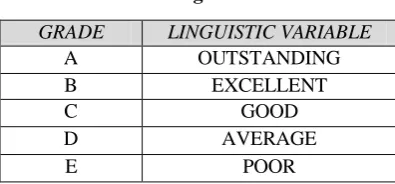
The linguistic values as shown below:
Table 1: Linguistic Values
GRADE LINGUISTIC VARIABLE
A OUTSTANDING
B EXCELLENT
C GOOD
D AVERAGE
E POOR
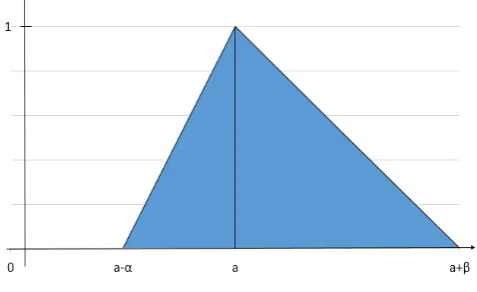
As per step 1, this crisp values are converted into degree of membership (fuzzy values) and for this triangular membership function method is used. A fuzzy set A is called triangular fuzzy number with peak a, left width α > 0 and right with β > 0 if its membership function has the following form,
𝐴(𝑥) =�
1 −𝑎−𝑥𝛼 𝑖𝑓𝑎 − 𝛼 ≤ 𝑥 ≤ 𝑎
1 −𝑎−𝑥𝛽 𝑖𝑓𝑎 ≤ 𝑥 ≤ 𝑎+𝛽
0 𝑜𝑡ℎ𝑒𝑟𝑤𝑖𝑠𝑒
[image:3.595.198.396.534.626.2]
www.ijsrp.org
Figure 2: Triangular Fuzzy Number
[image:4.595.66.532.287.413.2]Linguistic values represented in table 1 is converted into fuzzy values by applying the above mentioned triangular membership function method. The scale is taken from 0 to 100 with fizzy values ranges from 0 to 1 where 1 as peak or center value. Table 2 represents triangular membership function values for the performance grade.
Table 2: Membership Function
Scale 0 5 10 15 20 25 30 35 40 45 50 55 60 65 70 75 80 85 90 95 100
A 0 0 0 0 0 0 0 0 0 0 0 0 0 0 0 0 .2 .4 .6 .8 1
B 0 0 0 0 0 0 0 0 0 0 0 .2 .4 .6 .8 1 .8 .6 .4 .2 0
C 0 0 0 0 0 0 .2 .4 .6 .8 1 .8 .6 .4 .2 0 0 0 0 0 0
D 0 .2 .4 .6 .8 1 .8 .6 .4 .2 0 0 0 0 0 0 0 0 0 0 0
E 1 .8 .6 .4 .2 0 0 0 0 0 0 0 0 0 0 0 0 0 0 0 0
[image:4.595.71.535.450.616.2]The membership degree graph is shown as:
Figure 3: Linguistic Values
After reviewing evaluation criteria of various multinational companies and performance appraisal reports of different organizations evaluation parameters shown in Table 3 have been considered. The evaluation criteria are further split into goal measures to make the evaluation process simple and easy for the evaluator. Those goal measures are represented as antecedents in the fuzzy inference system.
Table 3: Goal criteria and measures
Criteria ID Criteria Name Goal Measure1 Goal Measure 2
1 Leadership Skill Extracting Work Dividing Work among People
2 Customer Satisfaction Appreciations Feedback
3 Following Process Applying Standards Complying with Policies
1 0.8
0.6 0.4
0.2
0 0 0 0 0 0 0 0 0 0 0 0 0 0 0 0 0 0.2 0.4 0.6 0.8 1 0.8 0.6 0.4 0.2
0 0 0 0 0 0 0 0 0 0 0 0 0 0 0 0 0
0.2 0.4 0.6 0.8 1 0.8 0.6 0.4 0.2
0 0 0 0 0 0 0 0 0 0 0 0 0 0 0 0 0
0.2 0.4 0.6 0.8 1 0.8 0.6 0.4 0.2 0 0 0 0 0 0 0 0 0 0 0 0 0 0 0 0 0
0.2 0.4 0.6 0.8 1 0 0.2 0.4 0.6 0.8 1 1.2
0 5 10 15 20 25 30 35 40 45 50 55 60 65 70 75 80 85 90 95 100
ISSN 2250-3153
www.ijsrp.org
4 Work Achievement Achieving Work Target Contribution to Teamwork
5 Communication Skills Negotiation Skills Positive Approach
6 Continual Learning Attending Trainings Obtaining Certificates
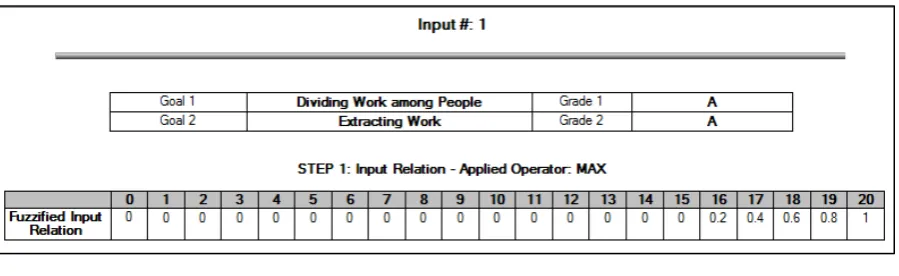
Then multiple antecedents are combined to single input by using OR (MAX) operator. From the employee performance evaluation sheet result criteria “Leadership Skill” is taken here for which employee goal “Dividing Work among People” is taken as Antecedent 1 (AN1) and employee goal “Extracting Work” is taken as Antecedent 2 (AN2)
[image:5.595.74.530.55.103.2]Antecedent 1 and Antecedent 2 are combined to form a single input criteria as shown below:
Figure 3: Input Relation for Input 1
Input relation for different set of antecedents are calculated and shown below.
Figure 4: Input relation for set for inputs
[image:5.595.41.491.181.319.2]www.ijsrp.org
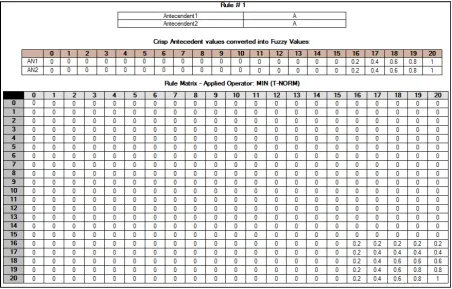
Figure 5: Rule matrix for Rule # 1
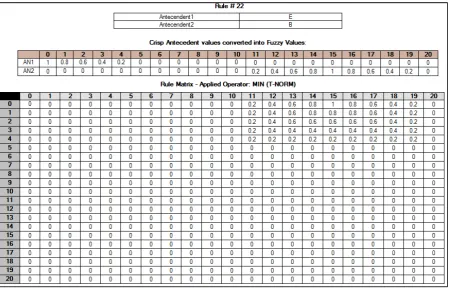
Rule relation matrix for different set of antecedent values shown in figure 6 and 7.
ISSN 2250-3153
[image:7.595.41.493.53.342.2]www.ijsrp.org
Figure 7: Rule matrix for Rule # 22
An algorithm is scripted using IBM Lotus script, which would automatically calculate the results of (Input o Relation) for all the 25 rules using Sup-Min method. The outputs obtained from Sup-Min operation for all the rules are then aggregated by Max operator. Then it is de-fuzzified using centroid method. The final output is obtained as below:
Table 4: Fuzzy Output
Output # Result Criteria Result Grade Rating
Y1 Leadership Skill 4.666666667
Y2 Customer Satisfaction 4.044117647
Y3 Following Process 3.3125
Y4 Work Achievement 2.53125
Y5 Communication Skills 2.5
Y6 Continual Learning 4.044117647
Y Rating Summary 3.516441993
VI. CONCLUSION:
This study focuses on the implementation of fuzzy logic approach in the employee appraisal system. It emphasizes on the mapping of uncertainty data in performance measurement system into fuzzy values which consist of labels and confidence values. IBM Notes software is used to build the entire system. Here performance appraisal result is obtained for one employee by taking multiple goal criteria with two goal measures for each goal criteria. The obtained performance result which adds more value to the output instead of giving simple grading. It is important to point out that the aim of the proposed system is not to replace the current system of evaluating performance but it may be used to strengthen and improve the present system of evaluation by providing additional information for appraiser to make decision in performance evaluation and management of resources in an organization.
[image:7.595.158.439.426.560.2]www.ijsrp.org [2] Shruti S Jamsandekar, R.R Mudholkar, “Performance Evaluation by Fuzzy Inference Technique”, International Journal of Soft Computing and Engineering
(IJSCE) ISSN: 2231-2307, Volume-3, Issue-2, May 2013
[3] Nisha Macwan1, Dr.Priti Srinivas Sajja2, “Performance Appraisal using Fuzzy Evaluation Methodology”, International Journal of Engineering and Innovative Technology (IJEIT) Volume 3, Issue 3, September 2013
[4] Amy H.I.Lee a, Wen-Chin Chen b,*, Ching-Jan Chang, “A fuzzy AHP and BSC approach for Evaluating performance of IT department in the manufacturing industry in Taiwan “, Expert Systems With Applications 34 (2008) 96–107
[5] Rafikul Islama and Shuib bin Mohd Rasad b, “Employee performance evaluation by AHP: A case study”, Asia Pacific Management Review (2006) 11(3), 163-176
[6] Adnan Shaout, Minwir Al-Shammari,“Fuzzy logic modelling for performance appraisal sysytems Aframework for empirical evaluation”, Expert Systems with Applications 14 (1998) 323-328.
[7] E.H Mamadani and S. Assilian, “An experiment in linguistic synthesis with fuzzy logic controller”, International Journal of Machine Studies, Vol. 7, No. 1, 1975
[8] Dr.G.Nirmala, G.Suvitha “Implication relations in Fuzzy Propositions” in Aryabhatta Journal of Mathematics & Informatics Vol.6, No.1, Jan-July, 2014. [9] Dr.G.Nirmala, G.Suvitha “Comparision of 3 valued Logic using Fuzzy Rules”, in International Journal of Scientific and Research Publications,Vol.3,Issue.8,
August- 2013. (ISSN 2250- 3153)
[10] Dr.G.Nirmala, G.Suvitha “Fuzzy Logic Gates in Electronic Circuits”, in International Journal of Scientific and Research Publications, Vol.3, Issue.1, January- 2013. (ISSN 2250- 3153).
[11] Dr.G.Nirmala, G.Suvitha “Performance Appraisal Using Fuzzy Rules and Fuzzy Logic ”, in National Conference at Government Arts College, Mellur Madurai on 07.08.2015.
AUTHORS
First Author - Dr. G. Nirmala, Principal, Government Arts and sciencs College, Peravurani,Thanjavur- 614804, Tamil Nadu, India. Email Id: [email protected]