HYBRID GENETIC ALGORITHM AND GREEDY
RANDOMIZED ADAPTIVE SEARCH PROCEDURE FOR
SOLVING A NURSE SCHEDULING PROBLEM
1CHEBIHI FAYCAL, 2MOHAMMED ESSAID RIFFI, 3BELAID AHIOD
1
Research Scholar, Department of Mathematics & Computer Science, faculty of sciences Chouaib
Doukkali University, El Jadida, Morocco 2
Professor, Department of Mathematics & Computer Science, faculty of sciences Chouaib Doukkali
University, El Jadida, Morocco
3
Professor, Department of Computer Science, faculty of sciences Mohammed
V
University, Agdal,Morocco
E-mail: [email protected], [email protected], [email protected]
ABSTRACT
In this research, we will address a new hybrid approach to solve a Nurse Scheduling Problem (NSP) at a hospital. This is an NP-hard scheduling problem as it aims to find a satisfactory schedule for nurses, while taking into account a variety of interfering objectives between hospital constraints and nurse preferences. Although classical genetic algorithms (GAs) have been successfully used for similar problems, the main objective of this research is to investigate a new combined method between GA and Greedy Randomized Adaptive Search Procedure (GRASP) to significant better result, not only compared to a classical genetic algorithm but also to all other metaheuristic methods. This study is based on a real benchmark dataset and a multi-objective programming model with binary variables, while the objective function is represented by a vector of soft constraints.
Keywords: Nurse Scheduling Problem, NP-hard, genetic algorithms, Greedy Randomized Adaptive Search, Metaheuristics
1. INTRODUCTION
The purpose of this article is to solve the problem of Duty roaster scheduling in a hospital while taking to consideration nurses requests and hotels constraints. In the same time, that will save time and money for the department’s heads that have the challenge of dealing with changes and requests from each one of their team. For that we separate those requests and constraints to two types: Hard constraints: are constraints that should be taken in consideration for the schedule to be accepted. Soft constraints: are constraints that could be ignored in order to achieve a suitable employment to all the team. The NSP is an NP-hard, combinatorial optimization problems, therefor we have to use Meta -heuristics methods to achieve satisfactory results within reasonable time.
To do that we propose two approaches:
GRASP approach which is a meta-heuristic algorithm that combines two techniques widely used in combinatorial optimization starting with the Wolverine (Greedy) algorithm which allows to build some initial solutions, respecting the rigid constraints of the problem followed by a local search method to find the best solution to the vicinity of each of those selected after the construction phase in order to find a global optimum from a set of local goals. Genetic algorithm approach which is one of the most used approaches to solve this kind problem, the idea is simple, from an initial population that respects the rigid constraints, and this population will pass through different genetic operators to find the optimum.
phase of the 2nd approach get better results than the 2nd phase of the first approach. Therefor we will hybridize the two approaches by starting with the creation of the initial population using the solutions occur in the construction phase of the GRASP method and ending with the switch to different genetic operators to produce a good results.
In the literature, several heuristics, local search and evolutionary algorithms have also been proposed to solve this problem, for example, [1] Smith and Wiggins (1977) we divide the problem into three category approach cyclic scheduling, heuristic approach and mathematical programming approach in this work March 12, 2013 we are interested in the mathematical programming approach [2] (Michalewicz and Fogel (2004)) have focused on the importance of constraints in genetic algorithms. [3] Wright (1991) and [4] Abramson (1991) have been observed by [5] (Aickelin and Dowsland (2004), Zhu and Lim (2006) and Lim et al. (2006)) which showed that the problem remains relevant. In some cases, it may not be practical to limit the solution space to the set of feasible than simply finding a feasible solution and apply operations to obtain more solutions. In other cases, limit the search to feasible solutions can result in a very small space solution, which may affect the ability of research to find high quality solutions. [6] (Thompson and Dowsland 1996 Dowsland 1998).
In the following Section 2 and Section 3 we will introduce the GRASP approach and genetic algorithm. Section 4, we will present the hybridization of the two methods. Section 5, presentation of results and statistics. In this section we will be based on instances introduced by [7] (B.Ahiod et al. 1998), the conclusion is discussed in Section 5.3.
2. GREEDY RANDOMIZED ADAPTIVE
SEARCH PROCEDURE (GRASP)
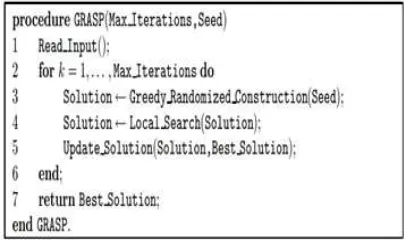
GRASP is introduced by [10] (Feo et al., 1994), it can be considered as a research approach local multi boot in which the initial solutions are generated by a random construction phase. The GRASP is to the repetition of two phases: construction and local search. The construction phase is the phase of generation of solutions one by one with the random function. Each solution build in the construction phase is related to an objective function which will determine who will go to the next phase based on the score obtained by this function. There are several strategy to complete the construction phase, the most popular is to select the N best items from all the elements create and
choose items has passed in a random way. The selection is done in General by using the method of the roulette which each item is selected with a probability associated with the score obtained by the objective function. The phase of local search or even the one of the improvements is to improve the solutions obtained in the phase of construction with using methods of local search as a neighborhood algorithms in order to get the best solutions of excellent quality. From the initial implementations of the GRASP have been published, the researchers suggest several ways to improve these performances. Some have concentrated their work to improve the solutions obtained by the construction phase [8] (Laguna and Marti (2001)), others have focused on the quality of the solutions obtained by the construction phase [9] (Fleurent and Glover (1999)).
[image:2.595.305.507.419.539.2]Our objective in this work is to improve the solutions obtained by the construction phase by proposing different procedures based on our problem that will be detailed in the next section so in part improvements we have proposed local search optimized to improve the quality of the solution and minimized the time of executions.
Figure 1: Pseudo-code of GRASP meta-heuristics
3. GENETIC ALGORITHM
using some measures of fitness. To create the next generation, new chromosomes, called offspring, are formed by either merging two chromosomes from current generation using a crossover operator or modifying a chromosome using a mutation operator. A new generation is formed by selection, according to the fitness values, some of the parents and offspring, and rejecting others so as to keep the population size constant. Fitter chromosomes have higher probabilities of being selected. After several generations, the algorithms converge to the best chromosome, which hopefully represents the optimum or suboptimal solution to the problem.
General Structure of a Genetic Algorithm: i. A genetic representation of potential
solutions to the problem.
ii. A way to create a population (an initial set of potential solutions).
iii. An evaluation function rating solutions in terms of their fitness.
iv. Genetic operators that alter the genetic composition of offspring (Crossover, mutation, selection, etc.).
v. Parameter values that genetic algorithm uses (population size, probabilities of applying genetic operators, etc.).
4. HYBRID GENETIC ALGORITHM AND
GREEDY RANDOMIZED ADAPTIVE
SEARCH PROCEDURE TO SOLVE NSP 4.1 The application of GRASP to solve NSP
Given the complexity of the problem and confliction constraints, producing some feasible solution will be difficult. The construction phase will be to generate feasible solutions and infeasible to ensure the diversity of all, the improvement phase applies an optimized local search on all products in the construction phase, in order to improve the results.
The algorithm starts with the construction phase, in which solutions are generated by following a strategy of creating which diversifies the set of solutions generated during this phase, the strategy is to generate a set of solutions that satisfy the objective and repeat this procedure for all the goals of the problem, and also we did not forget to meet the objectives and some rigid constraints to generate all the solutions possible to ensure the best quality ,at the end of the generation, the best solutions are selected to move to the next phase,
t
he selection is done by calculating the objective function of each solution and to give it a round then select the probability with accounting the best round of solutions occur.Step 1: Ensemble ܴ+ = ∅
Step 3: select the best solutions using the selection "roulette". Defining L as the ensemble of solutions Step 4: add the selected solutions to the ensemble
ܴ+= ܴ+ ∪ܵ
Step 5: if ܴ+ ≠ ܴ (All selected solutions) return to step 2
The improvement phase as part of producing excellence solutions from those products in the construction phase, during this phase all selected solutions go through a process of personalized local search as:
Step 1: Selected S ∈ R (the areas of product solutions in the construction phase)
Step 2: Search S ' neighbor solutions to S such that f (S') f (S) (the neighborhood search with personalized is as to seek the best solutions possible 2-opt a neighborhood as soon as possible)
Step 3: S ' selected in the step 2 constituting the new ensemble R
Step 4: As we have not completed a number of iterations N return to step 1
In this phase, the choice of a specific search algorithm to the problem is very important for studying the diversity of search algorithms available, in our article we chose to work with the 2-opt method see improved after checking the quality of other methods not available that give the best results.
4.2 The application of GA to solve NSP
We will choose a binary matrix representation in two dimensions. Is a matrix X
with:
Where:
Where | I | denotes the cardinal of I all employees of a given succession
• Initial population :
We propose two procedures to randomly generate an initial solution, each used N times to generate an initial population size N. The first procedure determines the schedule of each employee by randomly assigning these days of work and leave. The second procedure determines the schedule which is randomly selecting an employee and exchanging a random day off with a day of work in a given week.
The evaluation of solutions is done by calculating the adaptation value of each solution, this value will be based on violations made by each objective, considering that all the objectives have the same priorities, so we say that a solution X is better than Y solution if:
∀ ݅,݂݅(ݔ)≤݂݅(ݕ) With at least a i such that:
݂݅(ݔ)<݂݅(ݕ)
So the evaluation of solutions shall be made in accordance with the concept of Pareto dominance sense.
• Selection of Parents :
For our adaptation we chose a selection technique tournament is to choose randomly T the best individuals of the current population of individuals is chosen as the first parent process which is repeated a second time to select the second parent and so Following up last individuals of the population.
• Genetic Operations : Crossing operation:
We use three types of crossover operator: crossover point, two-point and uniform. The crosses are on the lines of each solution rather than columns. A cross on columns usually leads to a violation of the rigid constraint governing the number of days required for each employee. Note that by crossing line can cause an imbalance of the daily demand for personnel.
Mutation operation:
We use a simple mutation of exchanging, where possible, a day of work and leave of an employee randomly selected in the same week. This exchange may possibly disrupt the balance of the solution in this week. In this case, we apply the algorithm to repair.
Pseudo code of the algorithm GA (NSP) for all members of population
sum += fitness of this individual end for
for all members of population
probability = sum of probabilities + (fitness / sum)
sum of probabilities += probability end for
loop until new population is full do this twice
number = Random between 0 and 1 for all members of population
if number > probability but less than next probability
then you have been selected end for
end
end loop
After adjustments for the two proposed approach GRASP and genetic algorithm this step is to combine the two in order to obtain more interesting results. The principle is to start with the creation of the initial population with using the GRASP algorithm specifically the construction phase which gives us good solutions entertained, and ending with the application of genetic operators of the genetic algorithm in order to obtain better results. The weak point of the GRASP algorithm is the improvement brought by the phase of local search which is not very interesting. By cons in the genetic algorithm to improve the initial population by genetic operators which is very promising.
The algorithm for the hybrid method is:
Step 1: generating an ensemble of solutions by the method of building the algorithm GRASP
Step 2: Select the starting population which is using the selection operations proposed in the genetic algorithm
Step 3: Apply operations crossover and mutation in the genetic algorithm proposed
Step 4: Repeat step 4 until we do not have the optimum or reached the maximum number of iterations
5. NUMIRICAL TESTS
5.1 The data of the problem:
The actual data used in our tests are from the intensive care unit and the emergency unit of the “Hotel-Dieu” Hospital in Montreal. We are interested in the development of hourly employees each shift in both units for a period of two weeks. We identify six categories of test problem corresponds to the above-mentioned period we denote by Ci (1≤ i ≤6). Each category represents a new generation (Day, Evening and Night) of the two units for the six periods of time. It follows 36 scheduling problems develop [7]. In order to facilitate interpretation of results, we classify the categories Ci in ascending order according to the size of problems describe in [7].
The objectives considered in our tests are defined as follows:
O1: The lack or surplus staff should be distributed evenly on each week
O2: The number of consecutive days shall not exceed a fixed number SuccMax
O3: The number of consecutive working days must be at least equal to 2.
O4: The number of consecutive working days must be at least equal to two.
O5: The daily demand for personnel of the same substitution group must be satisfied.
O6: Special requests for weekly holidays and / or days of work must be met
O7: The daily demand for staff every Monday and Friday should be satisfied
The priority given to these objectives, selected for testing, is as follows:
O1 > O6 > O7 > O4 > O2 > O3 > O5. It is important to note that except for the Objective O1 should remain the first priority, all other objectives may even their priorities changed. This will cause other types of problems [16].In order to evaluate the solution produced by the GRASP algorithm we present some methodologies of tests present by [11] (Berrada et al. 1996):
CPUT: total execution time (in Seconds) required by the algorithms
Vmoy: Average violation of the given solution described by:
5.2 Results:
TABLE 1:NIGHT SHIFT PROBLEM OF THE EMERGENCY UNIT
TABLE 2:NIGHT SHIFT PROBLEM OF THE INTENSIVE UNIT
TABLE 3:EVENING SHIFT PROBLEM OF THE INTENSIVE CARE UNIT
TABLE 4:DAY SHIFT PROBLEM OF THE INTENSIVE CARE UNIT
TABLE 5:EVENING SHIFT PROBLEM OF THE EMERGENCY UNIT
TABLE 6:DAY SHIFT PROBLEM OF THE EMERGENCY UNIT Category
C1
Initial solution
Final
Solution CPU
Vmoy Vmoy
0.32 0.10 22.14
0.46 0.071 20.52
0.20 0.035 33.20
0.32 0.071 20.58
0.66 0 30.02
0.33 0.035 24.63
Average 0.38 0.052 25.18
Category C2
Initial solution
Final
Solution CPU
Vmoy Vmoy
0.39 0.28 13.99
0.10 0.035 15.03
0.17 0.10 11.68
0.35 0.35 10.75
0.50 0.39 12.34
0.35 0.10 11.24
Average 0.31 0.20 12.50
Category C3
Initial solution
Final
Solution CPU
Vmoy Vmoy
0.28 0.17 13.33
0.25 0.14 12.02
0.17 0.10 11.37
0.25 0.14 11.68
0.32 0.21 12.43
0.25 0.14 12.72
Average 0.25 0.15 12.25
Category C4
Initial solution
Final
Solution CPU
Vmoy Vmoy
0.10 0.035 14.36
0.10 0.00 10.88
0.32 0.00 11.94
0.10 -0.71 13.37
0.24 -0.10 8.47
0.10 -0.17 10.36
Average 0.16 -0.15 11.56
Category C5
Initial solution
Final
Solution CPU
Vmoy Vmoy
2.00 1.42 15.56
1.94 1.24 14.87
0.35 0.14 12.63
0.10 -0.85 13.60
1.82 1.25 14.21
1.32 0.62 11.36
Average 1.25 0.63 13.70
Category C6
Initial solution
Final
Solution CPU
Vmoy Vmoy
2.82 0.92 21.98
1.85 0.17 17.54
1.02 0.35 20.68
1.62 0.85 22.02
0.98 0.17 18.05
1.25 0.35 20.52
TABLE 7:COMPARISON OF RESULTS OF THE ALGORITHMS
GA&GRASP,BCO,MOACO
Catego ry
GA&GRASP BCO MOACO
Initial solution
Final Solution
%
IM CPU
Initial solution
Final Solution
%
IM CPU
Initial solution
Final Solution
% IM CPU
Vmoy Vmoy Vmoy Vmoy Vmoy Vmoy
0.38 0.052 86 25.1
8
0.71 0.040 94 49.43 0.25 0.011 96 48.74
0.31 0.20 35 12.5
0
0.88 0.30 65 63.64 1.41 0.33 77 55.7
0.25 0.15 40 12.2
5
0.98 0.17 82 59.10 1.68 0.31 82 60.07
0.16 -0.15 100 11.5
6
0.84 0.082 90 53.99 1.9 0.27 86 54.2
1.25 0.63 49 13.7
0
0.73 0.023 96 64.49 2.43 0.33 86 66.13
1.59 0.46 71 20.1
3
1.53 0.43 71 65.13 2.54 0.84 45 67
0,38 0,31
0,25 0,16
1,25
1,59
0,71 0,88
0,98
0,84 0,73
1,53
0,25
1,41
1,68 1,9
2,43 2,54
0 0,5 1 1,5 2 2,5 3
P1 P2 P3 P4 P5 P6
V
m
o
y
(I
n
it
ia
l
s
o
lu
ti
o
n
s)
Category
Average violation of the initial solution
GA & GRASP BCO MOACO
0,052
0,2
0,15
-0,15
0,63
0,46
0,04
0,3
0,17
0,082
0,023
0,43
0,011
0,33 0,31
0,27
0,33
0,84
-0,2 0 0,2 0,4 0,6 0,8 1
P1 P2 P3 P4 P5 P6
V
m
o
y
(
F
in
a
l
S
o
lu
ti
o
n
s
)
Category
Average of the final solution
5.3 Discussion of results:
The results obtained shows that by using of the hybridization method of the genetic algorithm and the GRASP method we do save considerable time compared to BCO algorithms and MOACO addition as good results as the two methods at small data and slightly worse results at the big data, but always with a faster turnaround time.
So it is clear that the use of hybridization gives us a considerable advantage in terms of execution time and this can be explained by the quality of the initial solution generated by the construction phase of the GRASP method which converges easily when using genetic operations proposed by the genetic algorithm
REFRENCES:
[1] L. D. Smith and A. Wiggins. “A computer based nurse scheduling system”, Computer O. R. 4, 195-212 (1977).
[2] Michalewicz, Z. and D. B. Fogel. (2004). “Howto Solve It: Modern Heuristics” Springer Verlag (Berlin and Heidelberg). [3] Wright, M. B. (1991). “Scheduling cricket
umpires”, J. Oper. Res. Soc. 42, 447-452
.
[4] Abramson, D. (1991). “Constructing schooltimetables using simulated annealing: sequential
[5] Aickelin, U. and K. A.
Dowsland(2000).“Exploiting problem structure in a genetic algorithm approach to a nurse rostering problem,” J. Sched., 3, 139-153 [6] Thompson, J. M. and K. A. Dowsland
(1996).“Variants of simulated annealing for the examinationtimetabling problem”, Annals of Oper. Res., 63, 637-648.
[7] B. Ahiod, I. Berrada and I. Kassou, “Deux Méthodes de RechercheLocale pour Résoudre un problème d’Horaire du Personnel Infirmier dans un Etablissement Hospitalier”, Investigacion Operativa 1998.
[8] Laguna, M. and R. Martí(2001). “A GRASP for coloring sparse graphs”, Computational Optimization and Applications 19, 165-178. [9] Fleurent, C. and F. Glover (1999). “Improved
constructive multistart strategies for the quadratic assignment problem using adaptive memory” INFORMS J. Computing, 11, 198-204.
[10]T. Feo and M. Resende, Greedy randomized adaptive search procedures, Journal of Global Optimization, 6 (1995), pp. 109–133.
[11]Berrada, J.A.Ferland and P.Michelon, "A Multi-ob jective Approach for Nurse Scheduling with both Hard and Soft Constraints".SocioEcon. Plann. Sci., 30, p. 183-193, (1996).
25,18
12,5 12,25 11,56 13,7
20,13 49,43
63,64
59,1
53,99
64,49 65,13
48,74
55,7 60,07 54,2
66,13 67
0 10 20 30 40 50 60 70 80
P1 P2 P3 P4 P5 P6
CP
U
Category