VAX 9000 Series
Digital Technical Journal
Digital Equipment CorporationCover Design
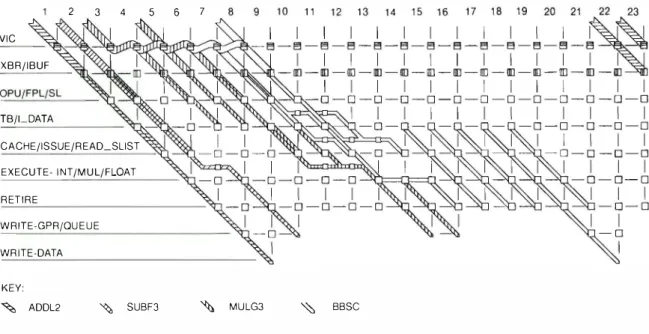
Digital s VAX 9000 mainframe system is the theme of this issue. Our cover depicts several simple instructions flowing through the VAX 9000 instruction execution pipeline. High performance was achieved by breaking the VAX instructions into small simple tasks that could be pipelined efficiently. Concurrent operation on up to six instructions simultaneously resulted in a execution rate of one simple VAX instntction per clock period.
Gloria Monroy of the High Performance Systems Group designed the cover graphic, which was implemented in cooperation with David Comberg of the Corporate Design Group.
Circulation
Catherine M. Phillips, AdministratOr Suzanne J. Babineau, Secretary Production
Helen L. Patterson, Production Editor Nancy jones, Typographer
Peter Woodbury, IllustratOr and Designer Advisory Board
Samuel H. Fuller, Chairman Richard W. Beane Robert M. Glorioso john W. McCredie Mahendra R. Patel F. Grant Saviers
Robert K. Spitz Victor A. Vyssotsky
The Digital Technicaljoumal is published quarterly by Digital Equipment Corporation, 146 Main Street MLO I-31B68, Maynard, Massachusetts 01754-2571. Subscriptions tO the journal are S40.00 for four issues and must be prepaid in u.s. funds. University and college professors and Ph. D. students in the electrical engineering and computer science fields receive complimentary subscriptions upon request. Orders, inquiries, and address changes should be sent 10 The Digital Tecbnicaljournal at the published-by address. Inquiries can also be sent electronically 10 D'I:[email protected] Single copies and back issues are available for $16.00 each from Digital Press of Digital Equipment Corporation, 12 Crosby Drive, Bedford, MA 01730-1493.
Digital employees may send subscription orders on the ENET to RDVAX::JOURNALor by interoffice mail to mailstop MLO I -3/B68. Orders should include badge number, cost center, site location code and address. U.S. engineers in Engineering and Manufacturing receive complimentary subscriptions; engineers in these organiza tions in countries outside the u.s. should contact the journal office to receive their complimentary subscriptions. All employees must advise of changes of address.
Comments on the content of any paper are welcomed and may be sent to the editOr at the published-by or network address.
Copyright ll:J 1990 Digital Equipment Corporation. Copying without fee is permitted provided that such copies are made for use in educational institutions by faculty members and are not distributed for commercial advantage. Abstracting with credit of Digital Equipment Corporation ·s authorship is permitted. AU rights reserved.
The information in this Journal is subject 10 change without notice and should not be construed as a commitment by Digital Equipment Corporation. Digital Equipment Corporation assumes no responsibility for any errors that may appear in
this journal.
ISSN 0898-901 X
Documentation Number EY-E762 E-DP
The following are trademarks of Digital Equipment Corporation: Cl, DECsystem-10, DECSYSTEM-20, Digital, the Digital logo, HDSC, MC!J, Micro VAX, Nl, PDP-I, Ul;fRIX, VAX, VAX-11/780, VAX 6000, VAX 8000, VAX 8600, VAX 8650, VAX 9000, VAXBI, VMS, X MI.
IBM is a registered trademark of International Business Machines Corporation.
Kapton is a trademark of E. I. duPont de Nemours & Company.
MOSAIC 111 is a trademark of Motorola Corporation.
Micromaster Plus is a registered trademark of t.:rx Company.
I Contents
11 Foreword Carl S. Gibson
13 Design Strategy for the VAX 9000 System
David B. Fite Jr. , Tryggve Fossum, and Dwight Manley
25 VAX Instructions That Illustrate the Architectural Features of the VAX 9000 CPU
John E. Murray, R icky C. Hetherington, and Ronald M. Salett
VAX 9000 Series
43 Semiconductor Technology in a High-peiformance VAX System Matthew J Adiletta, Richard L. Doucette, John H. Hackenberg,
Dale H. Leuthold, and Dennis M. Litwinetz
61 Vector Processing on the VAX 9000 System
Richard A. Brunner, Oileep P. B handarkar, Francis X. McKeen, Bimal Patel, William). Rogers Jr., and Gregory L. Yoder
80 HDSC and Multichip Unit Design and Manufacture Peter B. Dunbeck, Richard). Dischler, James B. McElroy, and Frank J. Swiatowiec
90 The VAX 9000 Service Processor Unit
Matthew S. Goldman, Paul H. Dormitzer, and Paul A. Leveille
102 The Unique Features of the VAX 9000 Power System Design Derrick). Chin, Barry G. Brown, Charles F. Butala, Luke L. Chang,
Steven). Chenetz, Gerald E. Cotter, BrianT. Lynch, Thiagarajan Natarajan, and Leonard J. Salafia
118 Synthesis in the CAD System Used to Design the VAX 9000 System Donald F. Hooper and John C. Eck
130 Hierarchical Fault Detection and Isolation Strategy for the VAX 9000 System
I
Editor's Introduction
jane C. Blake Editor
The VAX 9000, Digital's first mainframe computer, is the topic of papers in this issue of the D(f.{ital Technical journal. As engineers writing for this issue relate, the primary goal of the project from the initial product strategy through manufacture was to design and build a very high-performance, highly reliable VAX system.
Design engineers applied both crsc and R!SC techniques to achieve high levels of performance for this rightly coupled multiprocessor system. In the opening paper, Dave Fire, Tryggve Fossum, and Dwight Manley explain the strategy behind the design. They begin with an overview of the system, the technology, and CAD tools, and then describe the redesign of VAX instructions into small tasks which can be efficiently pipe lined. The authors also touch upon three additional aspects of the VAX 9000 system: the integration of vector process ing into the VAX architecture, new error handling techniques, and performance modeling.
One measure of performance is the number of instructions processed per cycle. The average num ber of cycles per instruction is less than five, which is nearly half the instruction execution rate of pre vious VAX systems. To illustrate the architectural features that enable this level of performance, John Murray, Rick Hetherington, and Ron Salett have selected a small sample of VAX instructions. They describe the instruction flow through the pipeline, how instruction features combine to work on a sin gle macro, and how stages of the pipeline interact.
ln addition to the architectural improvements, machine performance is enhanced at the semi conductor level by a new generation of semicustom and custom integrated circuits that support a low c ycle time. Matt Acliletta, Dick Doucette, John Hackenberg, Dale Leuthold, and Dennis Litwinetz give an overview of the bipolar technology used in the system. They then describe the methods used to
2
implement the 77 different gate array chips, the five custom chips, and the self-timed RAM architecture.
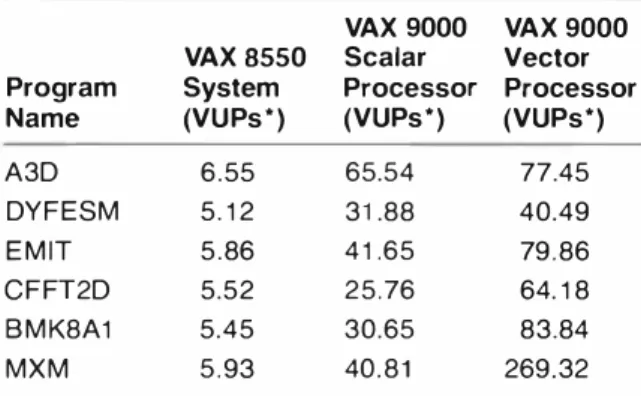
An additional performance improvement for numeric computations is the VAX vector architec ture and is treated in the paper by Rich Brunner, Dileep Bhandarkar, Frank McKeen, Bimal Patel, Rill Rogers, and Greg Yoder. They discuss the architec tural model and particulars of the VAX 9000 imple mentation, which affords numerically intensive applications performance four to five times greater than can be achieved by the scalar processor.
To ensure that the system performance gains at the semiconductor level were not diminished but were instead enhanced by packaging and inter connects, engineers developed several technologies unique in the industry. The technology behind the high-density signal carrier and the multichip unit are explained in the paper by Pete Dunbeck, Rich Dischler, Jim i'vlcEiroy, and Frank Swiatowiec.
Equally important to performance in the new 9000 is system reliability as e\'idenced by the intro duction of the service processor unit. In their paper about the service processor, Matt Goldman, Paul Dormitzer, and Paul Leveille relate how the MicroVAX-based system embedded within the 9000 detects, isolates, and corrects problems without interrupting the system .
High system availability \Vas also one impetus in the design of the power system . Some of the unique features of the power system, such as redundant regulators, improved load sharing and simula tion, are discussed by Derrick Chin, Barry Brown, Charles Butala, Luke Chang, Steve Chenetz, Jerry Cotter, Brian Lynch, Raj Natarajan, and Len Salafia.
The two papers that close this issue address the topics of CAD methodology and system diagnosis. Don Hooper and John Eck describe a CA D method ology that combines advanced rule-based A! tech niques with an object-oriented database. The new methodology saves logic designers significant time and reduces errors. A complex system such as the VAX 9000 requires improved system diagnosis capa bilities to achieve the desired high system availabil ity. Karen Barnard and Rob Harokopus demonstrate how a new scan system, in combination with scan pattern testing, and symptom-directed diagnosis achieve this necessary diagnosis capability.
Biographies
Matthew J. Adiletta Matthew Adiletta is currently contributing to the implementation of a new processor architecture and performing a technology evaluation to determine the technology for the implementation. He joined Digital in 1985 to work on a high-performance RISC architecture. Matt was not only the architect for the VAX 9000 system, but he also implemented the integer and floating point multiply and divide units and developed an ECL custom chip process. He holds one patent and has several patents pending. Man received a B . S . E . E. (honors, 1985) from the University of Connecticut.
Karen E. Barnard A senior software engineer with the High Power Business Unit CPU Development Group, Karen Barnard wrote the read-only memory based diagnostic for the VAX 9000 service processor unit's scan control module and developed the scan pattern diagnostic for the VAX 9000 CPU and SCU. Karen also worked on the debugging structural test process for the VAX 9000 kernel environment. Prior to joining Digital in 1986, Karen was with Data General Corporation. She received a B . S . ( 1983) in computer science from the Worcester Polytechnicallnstitute.
Dileep P. Bhandarkar As technical director for RlSC systems, Dileep 13handarkar is responsible for leading the architectural direction of RlSC prod ucts. He joined Digital in 1978 and was responsible for managing the evolution of the VAX architecture. Dileep was the chief architect for VAX vector processing and coarchitect of Digital's RISC architecture. He holds one patent for his work at Digital and has several patents pending. His degrees in electrical engineering include a 13achelor of Technology from the Indian Institute of Technology and an M.S . and a Ph. D. from Carnegie-Mellon University.
Barry G. Brown The concept of designing DC-to-DC converters as system elements rather than individual "power supplies" was introduced into the high power systems products by Barry Brown. He created and developed a highly tlexible, high-reliability DC-to-DC conversion system for the VAX 9000 series. Barry designed, implemented, and verified the power system for the VAX 9000 Model 200 systems. He was a principal engineer for the Codex Corporation before coming to Digital in 1984. Barry is a graduate of Woolwich Polytechnic and Harlow Technical College.
I
4
Richard A. Brunner As 3 principal engineer, Richard Brunner is the architect c u rrently responsible for the engineering refinement and control of both the VAX and VAX vector architectures. He is the editor of the VAX Architecture Reference Manual and coauthor of the VAX Vector Handbook and several papers on the VAX vector 3rchitecture. He received a B.S. (high honors, 19R4) in elec trical e ngineering from Case Western Reserve U n i versity and an M . S . (1987) i n computer engineering from Rensselaer Polytechnic Institute. H e i s a member of JEEF. and Tau Beta Pi .
Charles F. Butala Presently responsible for the power system design and architecrure of rhe VAX 9000 Model 4 00 systems, Charles Butala is a consulting engineer in the Information Systems Business Unit Power Systems Group. Since he joined Digital in 1976, he has been responsible for several power system design projects, including the VAX H600 system. He is a member of I EEE and Tau Beta P i , and holds honorary society membership i n Eta Kappa Nu. Charles received a R.S.E.E. (1968) from I l l inois Institute of Technology and an M. S . E .E. from Norrhe3stern University.
Luke L. Chang A fter receiving his M.S. in electrical engineering from Virginia Polytechnic lnstirute and Stare University in 1988, Luke Chang joined the Power
Sysrems Technology and Regulations Group. He is currently a hardware engineer and is responsible for developing simulation tools to perform h igh-quality software design verification tests for the next generation DC-to-DC power con verters. Luke's previous responsibilities include transient analysis :md testing of the VAX 9000 memory power distribution sysrem, 3nd power system cost reduc tion studies.
Steven ). Chenetz As a principal engineer in the Information Systems Busi ness Unit Power Systems Group, Steven Chenetz is currently working on the H7390 for a high-power VAX system. He previously was a member of the design and development te3ms for the H7380 of the VAX 9000 system, the H71HH envi ronmental monitoring module for the VAX 8600 power system, the VAX 8600 clock distribution system, and signal integrity for the VAX 8600 system. Steve joined D igital upon gr3cluation from Rensselaer Polytechnic Institute i n 19RI. He has 3n M.S . E. E. from Northeastern University (19H7).
Gerald E. Cotter Principal engineer Gerald Corter is a member of the Infor mation Systems Business Unit Power Systems Group. He was the project engineer and coarchitect of the VAX 9000 power control system (PCS). Jerry was the PCS interface to Customer Service and Support Engineering, Manufacturing, and Service Processor Unit Groups. He participated in development of the PCS and power system test strategies and the initial design of the T01060 power and envi ronmental monitor module. His previous work includes the VAX 8600 system's power and control subsystem.
Richardj. Dischler In his position of systems engineer for the High Perfor nunce Systems Group, Richard Dischler worked on the VAX 9000 signal integrity project. He also was a member of the project team for the electrical design of
HDSC and micropackaging for multichip units, planar boards, and connectors for the VAX 9000 system. Rich held similar responsibil ities in the development of the
VAX 8600 system. He joined Digital in 1982, and his previous experience was at Applied Research Laboratories. He holds a B . S .E.E . (1982) from Pennsylvania State University.
Paul H. Dormitzer A s an undergraduate at Harvard University, Pau l Dormitzer gained experience with the UNIX operating system b y working as a programmer and operator. Upon receiving his B . A . in computer science in 1987, he joined D igital's H igh Performance Systems Group. He is currently an engineer in the High Performance Business Unit CPU Engineering Group. Paul's primary responsibilities are in the development of error recovery processes for high power systems, such as the VAX 9000 system.
Richard L. Doucette Since joining Digital in 1979, Richard Doucette has been a member of severa l high-performance systems project teams. As a senior engi· neer on the VAX 8600 team, he helped introduce the Motorola Macrocell Array I (MCA I ) technology into D igital and was responsible for its design analysis and characterization in the system. As engineering manager on the VAX 9000 team, he was responsible for the incorporation of MCA 3 technology, custom chips, and self-timed RAM components in the system. He holds a B . S .E.E. (1973) from the University of Maine.
Peter B. Dunbeck Peter D unbeck is an engineering manager in the H igh Performance Business Unit Technology Research and Engineering Group. He held various positions on the VAX 9000 program between 1985 and 1990, includ ing technology program manager and design engineering manager for the multi chip unit. Before joining Digital in 1984 as a manufacturing engineer, Peter developed energy conservation programs for Thermo Electron. He holds a B . S . ( 1977) i n mechanical engineering from Virginia Tech and a n s. M . ( 1979) i n aero nautics and astronautics from MIT.
I
John C. Eck The dcvdopment of rhe majority of the physical design CAD tools
used in rhe VAX 9000 system was managed by John Eck. He is a software engi
neer manager in the High Performance Systems CAD and Diagnostics Group. John was employed as the manager of the Automated Design Department of Badger Company before coming ro Digital in 1984. He holds a BS (1964) in
physics and an JYI.S. ( 1966) in aeronautics and astronau t ics from MIT, and an M.B. A . (highest honors, 198--i) from Babson CoJiege.
David B. Fite Jr. Consultant engineer David Fire was a member of rhe initial architecture team for the VAX 9000 system. He developed the architecture for the branch prediction, instruction fetch, and instruction decode for the VAX 9000. His previous work includes responsibility for prototype debugging on the VAX 8600 system . D:IVe joined Digital in 1982. He has one patent and several patent applications pending. He is a graduate of Worcester Polytechnic Institute with a B . S. (honors) in electrical engineering.
Tryggve Fossum Tryggve Fossum is rhe system architect of rhe VAX 9000 sys tem . He received a B.S. ( 1968) from the University of Oslo and earned his Ph. D. ( 1972) from the University of I l linois. Tryggve joined D igital in 1973 and worked on the design of high-end computers, notably the VAX -11/780 system. As a pro ject leader on the VAX 8600 team, he guided the design of the t1oating point accel erator. He has also worked on several research projects, including an early raster scan graphics workstation, and a workstation with an integrated disk system.
Matthew S. Goldman As a senior engineer on the VAX 9000 project team, Matthew Goldman designed the scan control chip, which contains the control logic for the VAX 9000 scan system. He was also the responsible engineer for all VAX 9000 service processor h:trdware. Prior to joining Digital's H igh Perfor mance Systems CPU Group in 1986 , Matt was a design engineer for Raytheon Company. He is a member of Tau Beta P i and Eta Kappa Nu. M:ut holds a B.S. (highest honors, 1983) and an M.S. ( 1988) in e lectrical engineering from Worcester Polytechnic Institute.
Robert P. Harokopus A cum laude graduate of the University of Michigan, Robert Harokopus received a B.S. (1986) in computer engineering and is now studying for an M . S . in computer engineering from Boston University. Bob is a senior software engineer and joined Digital in 1986. He developed the symptom di rected diagnosis software used in the VAX 9000 service processor unit. Bob also developed software for the HIDE CAD tool and SCEPTER automatic test pattern generator, both of which were used in t he VA X 9000 design project. He is a member of Tau Beta Pi and Eta Kappa Nu.
rucky C. Hetherington As a principal engineer with the H igh Performance Systems Group, Ricky Hetherington is currently the project leader of the transla tion buffer and cache design of the VAX 9000 system. He holds one patent and has several patents pending on the various design featu res of the VA X 9000 M-box . Rick joined Digital i n 1982 as a senior engineer i n Digital's Large Computer G roup. He has a B.S. from Pennsylvania State University.
Donald F. Hooper Don Hooper is a consulting engineer in both logic design and CAD disciplines. He initi:ued and led the development of the Synthesis of Integral Design program, Digita l's first synthesis tool. Before coming to Digital in 1979, he was architect for the I tel 7031 mainframe and cache designer for the !tel Advanced System 4. He is a graduate of Don Bosco Technical Institute. Don holds patents in speech recognition circuits, the tag and queuing system for Digital's first pipelined CPU, and the control storage pipe for the VAX 8600
system. In addition, he has several patents pending in logic synthesis.
Dale H. Leuthold A member of the technical staff of the Integral Circuit Design G roup, Dale Leuthold led the design team for the VAX 9000 vector regis ter chip. He is currently working on random-access memory development for h igh-speed mainframes. Dale was responsible for b ipolar integrated circuit design at Signetics Corporation and Trilogy Systems Corporation before coming to Digital in l9H6. He holds one patent and has one patent pending. Dale received a B . S . from Oregon State University.
Paul A. Leveille In his nearly ten-ye:.Jr relationship with Digital, Paul Leveille has specialized in the development of high-power systems, particularly the
VA X 8600 and VAX 9000 systems. As a principal engineer in the High Perfor mance Business Unit, he helped define the VA X 9000 service processor sub system and was responsible for developing the scan control fi rmware and portions of the service processor application software. Pau l's previous responsi
bilities include console diagnostics, firmware. and ::�pplication software.
I
Derutis M. Litwinetz The projecr leader for the design of four standard cell and custom chips for the VAX 9000, Dennis Lirwinerz is a consuhing engineer in the High Performance Business Unir. He has previously participated in the design of rwo standard eel.! chip designs for the VA X 8600 system. He joined Digital in 1967 as a technician for the DECsysrem- 10 Engineering (;roup. Denni:-; has a patent pending for the VAX 9000 self-rimed register file design. He received a R.S.E.E.T. from Lowell Technological Institute and an ,'VI.S.C.E. from the University of Lowell.
Brian T. Lynch Brian Lynch is a principal hardware engineer in the Informa tion Systems Business Unit Power Systems Group. In this position. he designed and developed the H7382 bias power supply used in rhe VAX 9000 system. He is presently working on power solutions for future high-performance systems. Prior ro joining Digital in 1972, Brian was responsible for power convener and analog modu le design ar lntronics. He has a B.S. E.E. (1978) from Worcester Polytechnic lnst irure.
Dwight Manley As a principal engineer on the VAX 9000 project, Dwight Manley was responsible for all of the perform:mce modeling of the VAX 9000 CPU design. His present responsibi lities include w riting code for a Digital Extended i'vlarh Library product. Dwight joined Digital in 1979 as a member of the Systems Performance Analysis Group. Prior to that time, he worked as a systems programmer for the Bell Telephone System. Dwight has a H.S. ( 1971 ) in mathematics from the University of M assachuseus and an M.S. ( 1976) from Northeastern University.
James B. McElroy Jim McElroy is the multichip unit operations manager. H is work on the VAX 9000 system began with interconnect and packaging, fol lowed by the management of the physical technology efforts. He then became the manufacturing systems program manager for the introduction of the VAX 9000 system into manubcturing. Before joining Digital in 1976, Jim worked at RCA on packaging and interconnect design for military computer systems. He received a B. S.M.E. and an M.S.M.E. from Northeastern University.
john E. Murray T he coauthor of Microarchitecture of the VAX <)000, john Murray is a consulting engineer in the High Performance Business Unit. He served as project leader of the design team for the 1-box unit of the VAX 9000. He joined Digital in 1982. John's previous employer was ICL in the United Kingdom, where he was a design engineer. He received a B. Sc. ( 1969) from Warwick University. He holds one patent and has several patents pending.
Thiagarajan Natarajan T hiagarajan Natarajan is manager of a DC-to-DC converter group in the Information Systems Business Unit. His group develops
a high-density and highly reliable DC-to-DC converter, associated hybrids, semi
conductor components, and the distribution system for the next generation, high-performance VAX systems. Raj's prior experience includes positions at General Electric, Bell Laboratories, and Perkin Elmer Corporation. He has a Ph.D. in dectrical engineering, has been awarded one patent, and has authored approximately seventeen technical papers.
Bimal Patel Principal engineer Bimal Patel joined Digital in 1986 as a senior engineer. His primary responsibility since that time was the design of the V-box unit of the VAX 9000 system. Bimal was previously employed as a senior engineer in the CPU Design Group of Prime Computer, Inc. He has an M. S. in computer engineering from Boston University.
William J. Rogers Jr. William Rogers is an engineer in the VAX 9000 CPU Group, where he developed the design of the control logic of the V-box unit for the VAX 9000. Prior to working on this high-performance system, Bill was a member of the SASE Support Engineering Group. He joined Digital in 1986 and is a member of IEEE and Tau Beta Pi. He received a B. S. ( 1986) in electrical engineer ing from Michigan Technological University.
Leonard j. Salafia The development of the AC front end for the VAX 9000 system was the responsibility of Leonard Salafia. who is the manager of the
AC Power Interface Developmem Group. His previous work at Digital includes supervising the development of storage system power products for the Central Power Supply Engineering Group and for the Storage Systems Power Group. Len worked for General Electric prior to coming to Digital in 1980. He holds a B.S.E. E. (magna cum laude, 1969) from the University of Hartford and an
M. S.E. E. ( 1976) from Renssel::ler Polytechnic Institute.
I
10
Ronald M. Salett As a consulting engineer in the High Performance Systems Group, Ron Saletr is currently leading the development of a new high-perfor mance CPU. As a project leader for the VAX 9000 system, he was responsible for the architecture, design, and m icrocode of the execution unit. Since joining Digital in 1977, Ron has also worked as an architect and project leader on low-end integrated PDP- 1 1 systems. He holds two patents. Ron holds a B . S . E . E . (1975) from Carnegie-Mellon University and a n M . S . E . E . ( 1979) from Worcester Polytechnic Institute.
Frank J. Swiatowiec In 1988, Frank Swiatowiec became H DSC operations manager, with the primary responsibility to transition Digital's new H DSC tech nology to volume production. He was one of the engineering managers responsi ble for the definition and development of the HDSC . Frank had over 15 years of experience in the semiconductor industry when he joined Digital in 1986. While with Motorola Corporation, he was awarded four patents on ECL circuit designs. F rank holds a B . S . E . E . from the University of Il linois and an M . S . E. E . from Arizona State University.
Gregory L. Yoder Gregory Yoder is a senior hardware engineer with the H igh Performance Systems CPU Engineering Group. His primary responsibilities on the VAX 9000 system included the design and testing of the V-box unit, and pro toty pe system debug, for which he received an excellence award . He also assisted Manufacturing in producing and installing external field test VAX 9000
I
Foreword
Carl S. Gibson
VAX 9000 Program Manager
This issue of the Digital Technical journal is a collection of papers describing the technologies, designs, and design methods employed in Digital's
VAX 9000 mainframe/supercomputer, which was introduced in the fal l of 1989.
The VAX 9000 system embodies hundreds of innovations in most areas of design, manufacture, and service. In selecting papers for this journal, we have attempted to reflect the immense scope and variety of this program, which ranks among the larges t and most complex in the history of our industry.
In the summer of 1983, a small group of us set about to determine what it would take for Digital to develop a true mainframe. We felt that a mainframe
VAX would be a p owerful addition t o Digital's product family. The products that we have created took form, changed, and evolved over the months and years as technical chal lenges yielded to inno vations, rigor, and d iscipline. An u ndertakjng o n this scale necessarily undergoes numerous transi· tions as new data emerges, assumptions are tested, and alternatives are eliminated . Technical break t hroughs built upon one another incrementally as we pressed the design closer to our goals. The primary objectives of very high system-level perfor mance and world-class reliability drove the design process and the changes that emerged.
The planar logic packaging is illustrative of how changes and improvements built upon one another. The reliability benefits of m inimal connections precipitated a .logic packaging design change from stacked modules in dual backplanes to the planar array. This change - an optimization for reliabil ity - in the end actually helped performance and maintainability. Utimately, though not envisioned at the time, the adoption of the planar array had
a significant impact in that this structure enabled impingement air cooling a nd elimination of t h e bu lky liquid system t h a t was p a r t of t he initial design. The final design of the VAX 9000 system reflects, in myriad forms, this continual process of successive refinement toward shared goals.
Design changes notwithstanding, our primary strategy remained constant. The reader will note that, while we innovated aggressively in CPU struc ture, implementation technologies, and design methodologies, we preserved ful l compatibility with the VAX, Digital s torage, and Digital network ing and cluster architectures. We wanted D igital and our customers to be able to enjoy very high per formance levels in a product that was compatible
with prior investments. Therefore, we d rew as much as possible from existing products and designs from many Digital development groups. As a result, the VAX 9000 system incorporates Digital's standard XMI bus and popular B l , C l , and
Nl system-level interconnects. The system runs VMS
and ULTRIX operating systems, VAX layered prod ucts, and all of our customers' and independent software vendors' tools and applications. This capability proved especially rewarding when in the final months of the project, our own VAX 9000
prototypes, running our unmodified CAD tools, accelerated the processing of the inevitable last m inute changes.
High-performance computation fundamentally requires two key ingredients: short machine cycle times and maximum computational work per formed in each cycle. The semiconductor and multichip unit papers describe how we m inimized the VAX 9000 cycle time by use of fast circuits, high density packaging, and high-speed interconnects. These papers are complemented by architecture descriptions through which the authors present the innovative features that minimize the number of cycles required to execute the VAX instruction set. These papers present the sophisticated p ipelining techniques and vector processing capabilities incor porated in the VAX 9000 system.
Equal in importance to the computational capa bilities of the product are the service and control fea tures of the system. Papers covering the VAX 9000 service processor and the system 's fault management capabilities provide the reader with insights into these important aspects of the product.
The development strategy for the VAX 9000 system was explicitly formulated to deal with enor mous technical and project complexity.
I
i ty itself was the single most formidable challenge facing the team. Apparent from the outset, was the fact that such an ambitious product required the i n tegration of a very large number of d iscrete design objects; each had to be conceived, created, documented, tested, and ultimately integrated and verified as part of the whole. The reader will see the diversity of these efforts and recognize t he challenge of unifying a design from this breadth of technical advancement.
Centra l t o our strategy was the creation of a unified design tool suite operating in a seamless, homogeneous VMS computing environment. The first few years of the project were devoted to con struction of this environment in parallel with top level design formulation. The recognition that rigorous design methods were crucial to our success was possibly one of the team's most powerful fun damental notions. Papers included in this journal illustrate some of the legacy of powerful CAD tools and structured design approaches created by the
VAX 9000 team.
As we have seen for the product, the methodol ogies were not immune to change as the project progressed. Working with rapidly evolving technologies, design p rocess experts continual ly
12
adapted to evolving user needs. Concurrent design permeated every aspect of the project and domi nated the way people worked together, with many aspects of t he technology and p roduct design converging and adapting as we learned from our own processes. When the manufacturing process needed some help, designs could be reprocessed with the new rules and rereleased to keep things moving ahead.
A nd, move ahead they did' Today, the VAX 9000
system is installed at many customer sites where the systems are exceeding our original goals in both performance and dependability. I t has been accepted by experienced, high-end computer users as a bona fide mainframe - a mainframe with the unique advantage of ful l integration with D igital's rich distributed processing architecture.
David B. Fite]r. Tryggve Fossum
Dwight Manley
Design Strategy for the
VAX 9000
System
The VAX 9000 system is Digital's newest high-end processor in the VAX fami�y. This paper describes the design strategy used to achieve high performance and shows how RISC concepts were applied to a CISC architecture. Neu.• opportunities for parallelism in VAX program execution were found by breaking the VAX instructions into simple tasks which could be pipelined efficiently. By using independent, dedicated pipeline stages, execution rates approach one instruction per cycle.
The task confronting the VAX 9000 design team was to develop a VAX system that outperformed any previous VAX system and that was competi tive w i t h similarly sized processors from other vendors. Although the VAX system is based on one of the world's most popular computer architec tures, the VAX architecture's i nstruction complexi ties preclude efficient macroinstruction pipelining, such as that found in reduced instruction set com puters (RISC). RISC processors can be built with low gate counts to handle simple, fi..xed-Jength instruc tions sets, load/store architectures, and delayed branching.
To compete with machines based on such archi tectures and still remain compatible w ith the VAX architecture, the design team chose to implement the VAX architecture on the VAX 9000 system by applying techniques that were similar to those used in R ISC processors. We redesigned the VAX instruc tions into small , simple tasks, and designed dedi cated hardware that was optimized for each task. The result is a network of specialized processors, each of which has i ts own data paths and state machines, that operate in para l lel and execute VAX instructions quickly. The most common, sim ple instructions are executed at the rate of one per cycle.
System Overview
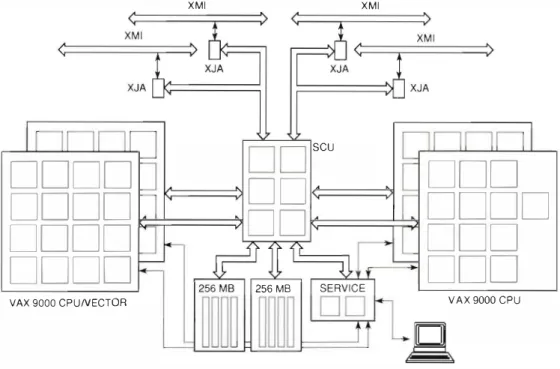
The VAX 9000 system is a tightly coupled multipro cessor, which runs the symmetric multiprocessing (SMP) version of the VMS operating system and can have up to four processors sharing a central main memory. Figure l shows a simp l ified block diagram of the system. The major system components include four CPUs, two memory controllers, two I/o controllers, and a service processor, which is
Digital Technical journal Vol. .! No. 4 Fall /<)')()
connected through the system control unit (SCU). Through a cross-bar switch, the SCU provides high speed, simultaneous transfers among the central processors, I /O devices, and memory banks. System cache consistency is maintained with duplicate tag directories located in the SCU. As references are made to memory, the addresses are checked against the tag directories. If a cache hit occurs, the cache in question is requested to invalidate or write back to main memory. The scu supplies a bandwidth that al lows near linear performance improvement as new processors are added to the system. The mem ory is interleaved on cache block boundaries to provide bandwidth for multiple CPUs and vector processors.
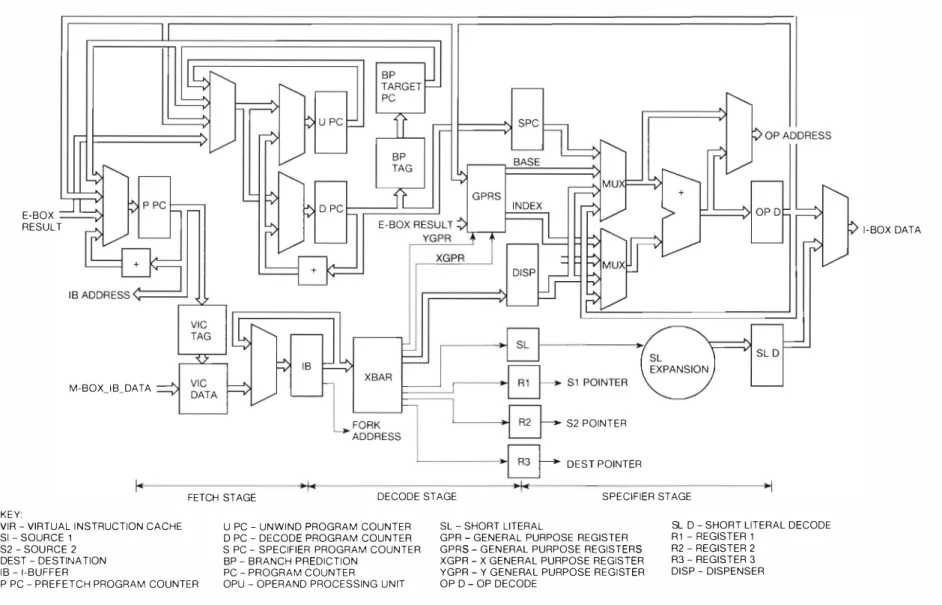
Four XMI backplane buses provide high band width paths to I/O devices. Although the XMI is used as the system bus in VAX 6000 systems, the X M I is used exclusively for I/O in the VAX 9000 system . Several new adapters were designed to increase throughput and reduce latency for I /0 transactions. These adapters include connections to the CI, the N I , the BI, and local disk comrollers. Although high performance IIO features, such as disk striping, solid-state d isk, and load balancing have been added to all VAX systems, the VAX 9000 system benefits the most from these features because it has the I/O back plane bandwidth ro rake advantage of them. A block d iagram of a single VAX 9000 CPU connected to the SCU and the major data paths between the two units is shown in Figure 2 . 1
Technology Contributions to Improved Performance
The central processor cycle rime has been reduced to 16 nanoseconds (ns) mainly by the use of fast emitter-coupled logic ( ECL) semiconductors and
XMI XMI
D O
scuDODD
DOD
DODD
D O
DODD
DODD
D O
DOD
DODD
256 MBDOD
VAX 9000 C P U N ECTOR
�m�
mm
V A X9000
C P UFigure I VAX 9000 System Diagram
fast self-timed random-access memories (RAMs) for registers and caches, and by decreasing the inter connect wire length between components.
Motorola 's Macrocell Array III (MCA)) technology provided both macrocell array and standard cell capabilities. The emire system is composed of 77 unique MCA 3 options and 5 custom chip types. A single MCA 3 contains 838 cells (4 14 major, 224 input, and 200 output), which yield 10,000 equiva lent gates, and 256 I/O pins. Maximum power dissip:nion is 30.0 watts, with un loaded gate prop agation delays of 120 picoseconds (ps). Perfor mance-critical operations, such as mu ltiplication. division, integer and vector register accesses, and system cloc king, were h!rther aided by employing custom chips 2
Caches for instruction stream and memory data, scratch pad registers, ami control stores all require high-speed local storage. Two versions of a proprietary self-timed RAM were designed for these specific applications. A 4 kilobit (Kb) self timed RAM , at 5. 5 ns, and a l6Kb self-timed R A M ,
a t I I . 5 ns, provide i nternal input and output latches and write pulse generation circuitry. Multi ple access modes allow highly pipelined operations to take advantage of shorter access times.
Each new semiconductor generation reduces cycle time. which increases the re!Jtive importance of interconnect delay. High density s ignal carriers
14
(H DSC), tape a u tomated bonding, and a single planar module all reduce the interconnect delay between active components in the VA X 9000
system. Strict impedance control is mai ntained throughout the system. Clock skew is minimized by employing fi xed-length, differential transmission and dedicated routing layers.
CAD Contributions to Improved Performance
Hundreds of computer-aided design (CAD) tools were used during the design and construction of the VAX 9000 system. However, none of these tools was more important in improving performance than the physical layout and timing analysis tools. Once the design team had placed large functional sections, placement tools refined individual macro cell selection and pin placements. Over 33,000 pins were selected to minimize overall wire length and maximize critical interconnections.
Routing presented several challenges. All levels of interconnect included critical signals, differential pairs, and fixed-length requirements. The H DSC
contains large cutouts that enable die attachment and allow cooling through the back panel. These large routing restrictions and special routing characteristics could not be handled by existing
CAD tools. Therefore. we developed Chameleon,
a general-purpose router. With Chameleon, cross tal k is minimized, and crossing counts are main tained and used to increase signal integrity, which improves performance.
To model the timing relationships within the system, we used sophisticated CAD tools to gener ate an accurate representation of the VAX 9000 system. Detailed timing models of each macrocell device were created using the SPICE simulator program 5 Chameleon and signal integrity rools provided delay values for each signal within the
MCA3, H DSC , and planar modules. CPLJDLY , using the AUTODLY timing tool, tied the various pieces together and gave the design engineers a powerful view of the timing domain.
Instruction Processing
VAX systems exist in a variety of environments and run thousands of applications. With any new, high performance VAX system, it is important to increase the speed of all applications and to continue to provide general-purpose computer power. Given the size of the installed VA X base and the nature of the applications, performance gains should not require code modi fications. Digital has gathered substantial information on how VAX processors are
· · · · ·- -- - - -- - - - -- - ---- - -- -- - -
-.: INSTRUCTION
,
•INSTRUCTION
r-"
CACHE
��
(BKB VIC)
I •BUFFER
I :
:
.---'-'-11 ----,
E-BOX
Design Strategy for the VAX 9000 System
used. This data formed the basis for design deci sions and trade-offs we made i n the development of the VAX 9000 system.
Simple Instructions
In many VAX programs, only a few opcodes are responsible for a large percentage of the i nstruc tions issued. Most of these opcodes are simple and limited tO a single arithmetic or logical operation. Often, one of the operands is in memory. A typical example is
ADDL3 < R O ) , R 1 , R2
Because of the high frequency of these instructions, speeding up these instructions is a top priority. Most of the high performance achieved on RISC pro cessors is derived because these instructions are pipelined. I n a complex instruction set computer (CISC), such as a VAX system, pipelining macro instructions is more complex . Therefore, previous VAX implementations have pipelined operations at the microinstruction leveL'
Processing simple instructions in a VAX system i nvolves obtaining and decoding the instruction, fetching source operands, performing an opera tion, and storing the result. The most important
· · --- --- ---
INTEGER
UNIT
ADD UNIT
VECTOR
V-BOX
I/O AND
MEMORY
INTERFACE
BRANCH
INSTRUCTION .
PREDICTION
V<--
DECODE
H
INSTRUCTION
�
FLOATING
( 1 K ENTRY)
jv-
(XBAR)
I:""Y
ISSUE
1 •POINT UNIT
: VECTOR
�VECTOR
REGISTERS
'---Y¢=
MULTIPLy
UNIT
.---'-'-
n
____,:
. _._....___,·.-.-.-.-. ..----_._._._._
,..,.--J1
·.-.-.---
· ... ... · · · .. ·DATA
SWITCH
: I-BOX
OPERAND
.
REGISTER
PROCESSING� FILE
�
MULTIPLY
(OPU/SUFPL)
h
(SLIST/GPRs)
1 •UNIT
'�'==:::::
:
=�
�
:
: ::::
�;I:N
J
..
:: :
�:::::
:
;
�;N:;:I;::
AT
=IO
=N=I
:
::::::;::
:=.£
:..!�
: �����)
�UNIT
DIVIDE
UNIT
RETIRE
UNIT
scu
1 K TB)
]:lc
r
====���
l ;:::
·
�---�---�--
�
-- - - -�
-- - - -�
- - - - -�
- - - --�
- - - - -�
- - - - -�
- -- -�
- -.
.-
�
. ..
Jj
.. ..
.---WRITE
->'l�.c..__---, ... .QUEUE
(WRTQ)
M-BOX
Figure 2 VAX 9000 CPUNector Block Diagram
difference between the way a VAX processor and a
!USC processor process simple instructions is how the variable length instructions and memory speci fiers are handled . VAX operands may reside in general-purpose registers (similar to RISC operands), in memory, or may be embedded in the instruction stream. The VAX architecture provides a rich selection of memory operand specifiers, which often require computations to create the address. In a R ISC processor, only load and store instructions access main memory.
The instruction preprocessing stage (1-box) decodes instructions and fetches operands in the VA X 9000 system. I n the execution stage (E-box), simple VAX instructions n.:s<:mble RISC instructions. A simple opcode describes the operation, a single register file provides source operands, and a desti nation queue supplies a result descriptOr. The !-box operates in parallel as with the E-box, which func tions as a RISC processor by executing one instruc tion each cycle. Execution occurs without the need to identify the operand's source or addr<:ssing com plexity. Figure 3 i l lustrates how simple instructions t1ow through the VAX 9000 pipeline. Although all VAX implementations perform these tasks, the VA X 9000 implementation uses separate, independent hardware units to overlap the work because con current operation is a prerequisite for single-cycle instruction execution.
Instruction Cache
We used an instruction cache in the 1-box to decrease instruction stream fetch latency and reduce the bandwidth requirements on the main cache. Choosing a virtually addressed cache further reduced latency and simplified the design by removing the need for duplicate translation buffers. The virtual instruction cache is an 8 kilobyte (KB)
cache with a quadword line size, 32-byre blocks, and a single-cycle access time. Line valid bits are maintained to allow variable size fills from the main data cache. Because the average VAX code block size is 16 to 20 bytes, the block size of the virtual instruc tion cache provides a good balance between the instruction decode stage and the main cache.
Table 1 Decode Cycles Req u i red
Instruction
M U LF3 R3,R5,R7
ADDL3 SII #48,R4,@(R2) + [R3) AOBLEQ SII# 63 , R 1 0 , 1 0$
16
Context switches, translation bu ffer changes, and instruction stream modifications all require that the virtual instruction cache be invalidated. Two com plete sets of block valid bits reduce cache sweeps to
a single cycle, if consecutive sweeps do nor occur within 256 cycles of each other. Block size and fre quent sweeping reduce the virtual instruction cache's hit rate to approximately 96 percent, but by filling through the main cache, the miss penalty is minimized.
Instruction Decode
Because the majority of instructions executed require only a single cycle to execute, the instruc tion decode's task of keeping ahead of the E-box is not simple. Most instructions must be decoded in a single cycle to keep the VAX 9000 system's ticks per-instruction (tpi) low.
For example, VAX instructions may contain up to si..,x operand specifiers. With 59 different specifier addressing modes, instruction lengths can vary from a single byte to more than 50 byres. However, the overall average VAX instruction length is 3.8 bytes, and 98 percent of instructions require only 8 or less bytes.'i Furthermore, 96 percent of VAX
instructions executed use only 3 or less specifiers. In each machine cycle, a 9-byte instruction buffer is p resented to the decode stage (XBA R). The instruction buffer contains instruction stream data prefetched from the virtual instruction cache. Instruction decoding consists of generating an ini tial m icroadd ress, determining the number of specifiers for the instruction, including each speci fier access mode and data type, and forwarding the appropriate specifier data to the operand process ing stages. The X BA R can handle up to three specifi ers. Instructions that contain more than three specifiers require additional decode cycles. Since general-purpose register specifiers occur approxi mately 41 percent of the time, three register specifi ers can be processed concurrently.1' Short literals comprise nearly 16 percent of the specifiers. How ever, the XBAR can only decode a single short literal per cycle. The remaining specifiers must all be processed by the operand processing unit , which
VAX-1 1 /780 VAX 8650 VAX 9000
3 2
5 4
3 3
OPERATION
PC
GENERATION
VIC ACCESS
INSTRUCTION DECODE
SPECIFIER PROCESSING
TRANSLATE AOORESS
DATA CACHE ACCESS
MULTIPLY UNIT EXECUTION
FLOATING UNIT EXECUTION
INTEGER UNIT EXECUTION
RETIRE
REGISTER WRITE
DATA CACHE ACCESS
Design Strategy for the VAX 9000 System
CYCLE
2 3 4 5 6 7 8 9 10 1 1 12 1 3 1 4 1 5 1 6 1 7 1 8
�
I
.;:::::::��:�:::� I I I
i
1
.
1:::'::::::::::1
i i
: • . • ·=·:·:·:·:·:·:.� : :
' . . . . .
' • • 0 • '
i � �·:::::;::::::!!
(R0),#2.5,R1
D
I �
4(RO),II3.5,R2
D
LOOP: MULF3MULF3
MULF3 8(R0),#4.5,R3
[])
ADDF3 R1 , R2 , R4
BJ
AOOL2 #11xC,RO
II
ADDF3 R3,R4,(R5)+
IIIII
SOBGEO R6,LOOP
•
Figure 3 The VAX 9000 Instruction Pipeline
DJ
0
I 1:::::::::::::,1
' . ' ' ' '04::::::�:,�::::1
' . .: •
m
' ' '.
D
DJ
decodes a single complex specifier per cycle. Unlike preced ing processors, the XBAR hand les multiple specifiers in any order. Table I shows the number of decode cycles required for several VAX processors.
Load/Store A rchitecture
Load/store architectures separate memory accesses from computation. Loads can be scheduled to place arriving memory data at a functional unit just as an
operation begins. To achieve this effect with VAX
instructions, memory specifiers are treated as load/ store instructions. VAX memory specifiers describe the effective addresses of memory operands. VAX
memory specifiers do not contain the source and destination registers that are specified in R ISC load/ store instructions. Rather, the VAX 9000 system assigns temporary register file locations to buffer memory data. By processing specifiers early i n the pipel ine, data can be scheduled to arrive at the appropriate time.
Operand Prefetching
Because most simple instrucrions are decoded and executed in a single cycle by v::trious pipeline stages, instruction operands also must be handled i n a si ngle cycle. Multiple, specialized operand units increase operand processing throughput. From one to three register operands may be forwarded to rhe E-box by one register unit per cycle. A dedicated short literal unit expands all VAX data formats. The operand processing unit performs complex address calculations and requests memory operand data from the cache unit (M-box). Both the operand pro cessing and short literal units can perform multiple cycle operations.
Digital Technical journal Vol. 2 No. 4 Fall IYYO
Memory specifiers act as independent instruc tions executed in the operand processing unit. This unit creates the operand's effective address and for wards it to the M-box. For loads, the actual memory
data is returned to the E-box register file. The trans lated physical address is saved in a queue of write addresses for store/destination specifiers. W hen execution results arrive from the E-box, the previ ously saved address is used to write t he data into the cache.
Conflict Detection and Resolution
Macropipelining in the VA X 9000 system relies on autonomous units operating in parallel . Each inde pendem unit is optimized for an individual task. However, macropipelining does require that mech anisms be added to resolve data dependencies among instruction processing units. Data cont1icts occur when an instruction's results are required by an earlier pipeline stage. An addressing data conilict appears in the following example:
MOVL R O , R 1
MOVB T A B L E ( R 1 ) , R 2
Any dedicated aclclress calculating hardware must wait for the MOVL instruction results before per forming the l'viOVB instruction's effective address computation. A memory conflict is another form of data dependency.
In the following example,
MOVB R 0 , ( R 1 )
M O V B ( R 2 ) , R3
a prefetch unit could read the second instruction's source operand while the E-box writes the first instruction's results, if the values of registers R I and R2 are different . However, when the registers con tain identical values, the read must be delayed until the write occurs. The VAX 9000 system uses several differem mechanisms w detect and resolve data dependencies. Passing pointers, scoreboard masks within the 1-box, the write queue in the M-box, and architectural restrictions are all used to handle vari ous conflicts.
Register Conflicts The simplest hardware mecha nism employed in the VAX 9000 system is the use of pointers to reference data. The operand processing unit oversees a 16-entry source queue, an H-entry destination queue, and a 16-entry source list. A sin gle pointer is inserted into the source queue for each source specifier. The pointer represents either a register number, in the case of general-purpose register operands, or a tag that indicates an entry in the source list where the operand data is located . A pointer is added to the destination queue for e:.�ch destination. This pointer represents a register
num-18
ber or a flag which indicates that the resu lt should be written to memory.
The instruction issue unit removes source pointers from the source queue. These pointers are used to address either the general-purpose registers or source list for the actual source data. Destination pointers from t he destination queue determ ine where resulls should be wrirren. Register conflicts can be detected by comparing the source pointers needed to issue an instruction with all issued desti nation pointers in the destination queue. For exam ple, in Figure 4, the M U L L 3 's RO source queue entry would match the ADDL3 's RO destination queue entry. A write to the general-purpose registers by the E-box removes the destination queue entry, and the instruction issue can resume.
SRCQ
SLIST
DSTQ
Rl
__.DATA
RO
R2
MEM
#0
I-RO
ADDL3 R
1,R2,RO
MULL3 (R3),RO,(R4)
Figure 4 Register Conflict Detection
Addressing Conflicts To resolve addressing data contlicts, the I-box maintains a read/write register scoreboard . Two register masks a re c reated for each instruction decoded . The first register mask denotes the general-purpose registers that t he E-box will read for the instruction, and the second register mask specifies the general-purpose register writes. Each bit in these register masks refers to a single
VAX general-purpose register. Specifiers that are being processed in the operand processing unit are checked against up to six previous instruction masks. From t he first example above, the specifier [TABLE(R I )] requires that the operand processing unit read R 1. If the R l bit is asserted in any preced ing instruction's scoreboard write masks, this effec tive address calculation must be deferred .
The VAX architecture presents a unique address ing conflict p roblem because some speci fiers, such as -(Rn) and (Rn)+, modify general-purpose registers.
In the following example,
S U B L 2 R O , R 1
ADDL2 C R O ) . , R2
the (RO)+ specifier modifies the contents of RO. Therefore, the operand p rocessing u n i t cannot update the general-purpose register without affect ing the prior instruction. The read masks are used ro detect this type of conflict. A l l specifiers that mod ify general-purpose registers must check the scoreboard read masks before proceeding with the instruction. Thus, when a confl ict occurs, the general-purpose register modification stalls.
W hen an instruction completes execu tion, the instruction's read/write mask is removed from the scoreboard . In all addressing conflicts, specifier processing continues once the blocking mask is removed.
Memory Conflicts The write queue is used to resolve memory conflicts. Physical addresses, received from the translation buffer, are inserted into an eight-entry FIFO . These addresses are later paired with the proper write data from the E-box and written into the M-box. To avoid prefetching stale dat:J., :�. I I memory addresses for source memory oper:�.nds are translated and compared with the addresses in the write queue. When no address con fl ict occurs, the data from memory is forwarded to the source .list. Operand requests that conflict with a pending write address are stalled until the contlict is resolved . The conflict is resolved when the appropriate write data is received. The conflict ing address is then removed from the write queue.
Miscellaneous Conflicts The VAX architecture includes instructions with operands that either are not known w hen the instruction is decoded (e.g. ,
INSQlJE, MTPR), or modify large portions of mem ory (e.g . , MOVC 5). To avoid conflicts from t hese instructions, the 1-box suspends processing mem ory specifiers until the instruction execution is completed. Self-modifying code presents another form of conflict, which is solved by an REI instruc tion that not ifies the hardware of this condition.
Branch Instructions
Branch instructions have a substantial influence on the overa l l perform ance of a VAX processor. O n average, a VAX processor executes 3.9 instructions, including the branch. before a branch starts a new instruction sequence. Instructions t hat modi fy the program counter represent nearly 40 percent of t he total instructions execmed. The VAX 9000 system uses a 1024-entry branch cache and a two-tiered prediction schemc to increase t he average code block size and reduce t hc branch-takcn Latcncy.
Dif!.ilai Tecbnicaljournal Vol. .! Nu .j hill I'J'JI!
Design Strategy for the VAX 9000 System
Unlike its predecessors, the VAX 9000 system com m i ts all its resources to a single branch path. The prediction hardware selects the path of execution to resolve memory conflicts for those branch instructions that are decoded before results are available. This path selection is based on prior his tory, if the branch hits i n the branch cache. I f the branch does not hit in the branch cache, the path is predicted staticly, based on the instruction's opcode. When t he branch executes, the prediction is compared to the actual results. The pipeline is flushed back to the correct code path if the branch prediction was incorrect.
The entries in the branch cache store the branch results of the previous execution of t he branch and the target address, if the branch was taken. Because the branch cache is a one-way associative cache t hat can store only 1024 entries, the results h ave an aver age hit rate of approximately 80 percent . However, correct predictions occur 85 percent of the time from the cache, as opposed to an average h it rate of 56 percent, when the predictions are based solely on opcode. Loop branches are always predicted as taken, which increases the overall correct pre diction rate to close to 89 percent . By caching branch targets, the calculation may be avoided and a latency factor of one-cycle branch taken i s achieved. The branch cache can store a sufficient amount of branch context to eliminate the need to sweep the cache.
The 1-box can process instructions with up to two conditional branches outstanding. Uncondi tional branches (e.g., BSBW , BRB) are processed as ordinary instructions by simply changing the instruction flow To reduce the penalty for a bad prediction, which results in a four-cycle penalty, operand specifiers that mod ify general-purpose registers are not processed under a branch predic t ion and cause the operand processing unit to stal L Also, branch instruction execution i s overlapped with the previous instruction to provide the actual branch results earlier.
Compute-intensive Instructions
Compute-intensive instructions requ i re multiple execution stage cycles. Common examples of these instructions are multiplication, division , and float ing point operations. All VAX implementations employ dedicated logic for compute-intensive instructions that occur frequently. Less frequently used instructions depend on microcode-controlled arithmetic and logical data paths. The VAX 9000 system contains four independent execution
cessors. The integer, floating point. multipl y, and divide units cxecute the VAX instruction set. The 1 -box preprocesses i nstructions, w h ich al lows instruction execution to overlap i n thcst: units. I n each cycle, a n e w i nstruction c a n b e initiated i n t h e appropriate unit prior t o the completion of previous instructions. The t1oating poin t and multi ply units are pipelined and can accept one instruc tion each cycle. The integer unit is pipd ined for sim ple instructions. However, complex instructions must use microcode control to perform multicycle operations.
Pipelined instructions are issued in order and proceed through the data path w ithou t further microcode control . upon completion , instruction results are retired in thc same instruction order. The instructions must be proccsscd in order because the resul t of one operation is often needed in a sub sequent operation. Therefore, the pipelines must be short and contain data bypasscs to make results available quickly. The mu ltiply, float, and divide units' internal data paths are 64 -bits wide. To under stand how the pipelined and overlapped operations apply to the fol lowing opcration.
y (i ) = y (i ) + C ( i )
consider the program:
LOOP . MU LG3 R 6 , < R O ) . , R � MU LG3 R6 , ( R Q ) . , R 2 ADDG2 R � , ( R 1 ) • ADDG2 R 2 , < R 1 > .
The two MULG 3/ADDG 2 instruction pairs prevent a pipeline stall that could occur because of data dependencies. The instructions further reduce the loop overhead, which is already fairly small because the loop control instruction was predicted correctly. I nstructions and source operands are prefetched . The mul tiply and add units accept the i nstructions as they become available. The memory references are made as the operand processing unit processes memory specifiers. The majority of speci fier processing is performed independently of the instruction execution.
Memory-intensive Instructions
Some VAX instruction classes are primarily memory operations that require only minor computation. Typical examples of these i nstructions an.: char acter string, decimal, and privileged operating sys tem. Pipel ined execution offers link advantage to memory-incensive instructions because the number of memory references is not reduced as the number of cycles required for execution is reduced by new
20
implementations. Because memory bandwidth is critical, the VA X 9000 system provides features ro benefit thcsc instructions.
For example, the virtual instruction cache ser vices most instruction stream references, which frees the main cache to service prefetched operand rcf<:rences. Both the virtual i nstruction cache and the main cache have 64-bir data paths, important for charactcr string operations and ex tended pre cision arithmetic. The caches are fully pipelined and al low one read per cycle. The main cache block size is 64 bytes. exploiting spatial locality. When cache references do miss. data is wrapped and the most critical data is rewrned first. A write back, write al location algorit hm further reduces main memory and cache bandwidth requirements and reduces latency.
The VAX system is a virtual memory architecture. Virtual add resses need to be translated to physical addresses through page tables in memory. A trans lation buffer caches the most recen t l y used page tables entries. VA X systems, such as the VA X- 1 1 /780 system, process translation buffer misses in micro code, wh ich can be rime-consuming. However, the VAX 9000 system uses a memory management pro cessor to process translation buffer misses as part of instruction preprocessing. This operation is per formed early in the pipeline and is faster than microcode.
The CALL and RETl 'RN instructions push and pop registers on the stack, and these instructions can be memory-bound. The VAX 9000 system contains both the conrrol logic and the bandwidth to process these registers at a rate of one per cycle.
Unconventional Instntctions
Special, dedicated h ardware was added to the
VAX 9000 system to process those VAX i nst ructions that did not fit into the categories listed above. The additional hardware operates within the pipeline architecture and cycle time, and the cost of adding the hardware was minima l .
In the following example,
MOVL R O , - < S P > < - - - > PU S HL R O
the MOVL and PUSHL instructions perform identical operations, but the PliSHL i nstruction does not explicitly specify a destination address. On pn: vious VAX systems, the instruction prefetching would stall until the current instruction execution was comp leted . However, t he VAX 9000 modi fies such instructions during the decode stage by add i ng the implied specifiers. The benefits of this