ISSN: 1992-8645 www.jatit.org E-ISSN: 1817-3195
184
FAIR JOINT USER SCHEDULING BASED ON BEST CQI FOR
CARRIER AGGREGATION IN LTE-ADVANCED
1
AHMED A ALI, 2ROSDIADEE NORDIN AND 3MAHAMOD ISMAIL
1
Department of Electrical, Electronic and Systems Engineering
University Kebangsaan Malaysia (UKM)
E-mail: [email protected], [email protected], [email protected]
ABSTRACT
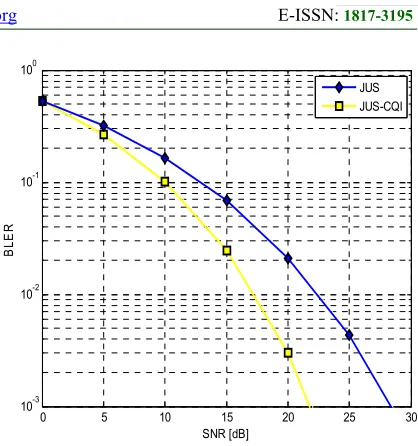
Carrier Aggregation (CA) is one of the main features in Long Term Evolution– Advanced (LTE-A). CA allows the target peak data rates in excess of 1 Gbps in the downlink and 500 Mbps in the uplink to be achieved by aggregating multiple component carriers (CCs) of 20 MHz for each CC. When CA is being put to use, it is vital to complement LTE-A systems with a robust and suitable resource scheduling scheme. There are two basic resource scheduling schemes; (i) Best CQI Scheduling and (ii) Joint User Scheduling (JUS). Since within LTE-A networks users with high data rates have increased exponentially, each scheme probably cannot accommodate the user’s requirement, thus a much simpler, robust, and efficient scheme that caters to real-time traffic patterns and applications needs to be established. This paper focuses on the development of a new and fair joint user scheduling algorithm with carrier aggregation in the downlink of LTE-A. To enhance the system fairness and higher resource utilization, a novel Proportional Fair (PF) scheduling algorithm has been introduced in this study. It is known as JUS-CQI. The proposed scheme has been implemented and validated using a system level simulator built in MATLAB. The impact of the scheduling scheme towards fairness, block error rate and throughput have been examined. Simulation results have shown that the proposed algorithm has improved the users throughput by 15% compared to JUS, and enhanced the system fairness by 8.33%. Furthermore, the results have shown that the required average received Signal-to-Noise power Ratio (SNR) satisfying the average Block Error Rate (BLER) of
10 using JUS-CQI is decreased by approximately 4.8 dB compared to JUS.
Keywords: LTE-advanced, JUS, best CQI scheduling, fairness, block error rate, carrier aggregation.
1. INTRODUCTION
In comparison to LTE, LTE-Advanced is capable of showcasing greater improved system performance. With regards to peak data, it assists up to 1 Gbps in the downlink and 500 Mbps in the uplink [1, 2]. LTE-A combines various LTE carrier bandwidths not exceeding 20 MHz for every carrier to create an operating bandwidth up to 100 MHz. It is easy to observe that carrier aggregation is the most straightforward approach to accelerate the peak data rate to meet the requirements of IMT-Advanced [5]. Every single carrier is referred to as a component carrier (CC) [3].
In a situation where these CCs are continuous and symmetric to one another, such a model is termed as Carrier Aggregation. Whereas, if these CCs are discontinuous and asymmetric, such a model is referred to as a Spectrum Aggregation [4, 6]. The maximum number of CC supported in Release 10 is five [5]. Network
providers have an edge with this spectrum flexibility with the fact that they can utilize every accessible spectrum allocated to them by the government regulator for LTE-A. Along with considerable progression for cells and users, LTE Advanced facilitates a proficient spectrum utilization, reduced power, productivity for users as well as infrastructure.
ISSN: 1992-8645 www.jatit.org E-ISSN: 1817-3195
185 The proposed algorithm is evaluated in terms of user throughput, block error rate and fairness. Furthermore, the suggested scheme permit high performance compared to JUS thus make it feasible for carrier aggregation implementation in LTE-Advanced networks.
The layout for the rest of the paper is as follows: Section 2 discusses limitation and previous works. Section 3 presents the Best CQI Scheduling. Problem formulation and justification has been presented in Section 4. In Section 5, a new scheduling algorithm is described that operates with the Best CQI Scheduling and Joint User Scheduling Scheme (JUS). Section 6, presents simulation parameters and metrics. Simulation results for the new algorithm have been presented and discussed in Section 7. Finally, Section 8 presents the conclusions of this work.
2. PREVIOUS WORKS
By considering throughput from the all the CC, an optimal performance is provided by the Joint User Scheduling (JUS) algorithm [8, 11]. However, when there are large numbers of users and the CCs are large, Proportional fairness is an allocation scheme that can compromise the trade-offs between Maximum Rate and Round Robin. It follows the maximum rate and ensures that no user is starved. The users are being ranked based on priority function. Also, the scheduler allocates resources to the user with the highest priority. Based on PF scheduler, the PRB is allocated to the user that contains max PF metric on all CCs:
, max, ,.., , , 1
where, , is chosen user k at i-th CC of the m-th PRB, K is the total number of users
PF metric , , of user k is that:
, , , ,
, 2
, , is the estimated throughput for user k at the m-th PRB group of the i-th CC at time slot t.
, is user i throughput divided by the total
of CCs. Thus calculated as:
, " ,
#
3
, t is the average throughput for user on the i-th CC. Hence an updated version:
, & 1 '1 ()*1 , &1) , 4
whereby T = average window length
With the fast development of communication technologies, the demand of radio spectrum is increasing rapidly as a rare and valuable resource. The technology of spectrum aggregation is important research and application. The majority of previous research works assume that all spectrum bands in spectrum aggregation have the same property, while different spectrum bands vary greatly in real networks. Determining an ideal component carriers scheduling scheme in LTE-A systems is a technical challenge since one needs to satisfy the different requirements. It needs to handle packets, scheduling in multiple CCs environments, a high system throughput must be achieved, as well as fairness among users. Aggregating the entirety of available carriers for an LTE-A user’s equipment is not practical due to probable low channel quality or high volume traffic in some of the CCs.
Based on the analysis of JUS, we can observe the strengths and weaknesses of JUS. Moreover, we can conclude that the poor JUS performance originates from two aspects, lower spectral efficiency and unsaturated resource utilization. The complexity of JUS is related to the number of CCs that each UE has to connect simultaneously. The more CCs the UE has to communicate with at the same time, the higher the signal processing complexity and the power consumption require at the UEs. The communication equipment has to assign spectrum resources to transmit information flows in the transmitter terminal and combine information flows from different spectrum bands reliably in the receiver terminal.
3. BEST CQI SCHEDULING
ISSN: 1992-8645 www.jatit.org E-ISSN: 1817-3195
186 decrease in fairness by using best CQI scheduling [7]. Users that are away from the BS are mostly not scheduled in this strategy. The flowchart shows the best CQI.
4. PROBLEM FORMULATION AND
JUSTIFICATION
LTE-Advanced networks are made to render minimal latency and additional broadcast rates, when coupled with increasing spectral operational performance beyond the 3G networks. Nevertheless, with regard to the insufficient radio resources, the application and management of these scarce resources are very desirable. Hence, the best approach for a profitable resource allocation must be the center of focus to meet the standard of QoS. Resource allocation mechanisms have demonstrated to be one of the major challenges for LTE-A systems. These mechanisms are accountable for defining how resources are distributed among the various users. A good allocation of resources results in greater bandwidth frugality and a better fairness of the system. Differences among resource allocation strategies are mainly based on the trade-off between decision optimality and computational complexity.
Therefore, the problem could be formulated as: How to enhance the system fairness of JUS while maintaining a high bitrate efficiency performance? In this scheme, we aim to provide the scheduling algorithms that can enhance the system fairness and improve the throughput of the users. To achieve this aim, we introduced a scheme operates between the Best CQI scheduling and (JUS). In this way, a compromise between throughput and fairness can be reached. The RB is assigned to the user who maximizes the CQI in the first time slot of each subframe; whereas in the second time slot the RB is assigned according to the priority function by the proposed scheduling algorithm. In this way, a compromise between throughput and fairness can be reached.
5. SCHEDULING PROPOSED SCHEME
To find a trade-off between fairness and throughput, the scheduling algorithm is proposed to operate with the Best CQI scheduling and Joint User Scheduling Scheme (JUS). The new scheduling algorithm will result in improvement regarding throughput and fairness. The proposed scheduling algorithm assigns the RB to the user that maximizes the CQI in the first time slot of each subframe; whereas in the second time slot the
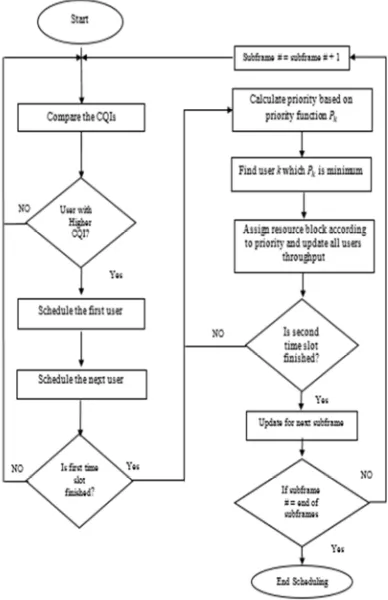
scheduler assigns the RB according to the priority function . In this way, a compromise between throughput and fairness can be reached. One LTE-A frame is divided in 10 subframes of 1 ms duration each. One subframe contains two time slots of 0.5 ms duration. Figure 1 illustrates the flow chart of the proposed scheduling. At the beginning of the scheduling process, the eNodeB compares the CQI from various users and chooses the user with the highest CQI. If there is more than one user with the highest CQI, a random one is selected by the scheduler. In the first time slot, the users with higher CQI are scheduled. In the second time slot, the users are scheduled according to the priority function . At the end of the second time slot, the operation begins again, i. e in the first time slot of the second sub-frame the user with the higher CQI is assigned and in the second time slot the users are assigned the RBs according to the priority function .
, , , ,
, 5
The LTE-A operates in the bandwidth of 20 MHz per component carrier. The number of RB domain 100 RBs for 20 MHz bandwidth. Here is a quick explanation of how the proposed algorithm works. For this example, the matrix has 2 columns and 100 rows. The first and second columns of the matrix, represent the first time slot and the second time slot of the subframe. Each column consists of RBs mapping to users. It is clear from the Figure. 2 that each column has 100 RBs.
In this example, five users are considered and the chosen bandwidth is 20 MHz. It is known that the number of RBs in a bandwidth of 20 MHz is 100. Since the UE4 has the highest CQI on RB1, UE4 is mapped to RB1, UE2 is mapped to RB2 and so on as depicted in Figure 2. Thus, RB1 is assigned to UE4, RB2 to UE2, RB3 and RB4 to UE4 in the first time slot. RB5 and RB6 in the first time slot are assigned to UE1. In the first time slot, the RB is allocated to the user with the higher CQI on that RB. The UE3 and UE5 are not scheduled because it has poor channel condition on these RBs.
ISSN: 1992-8645 www.jatit.org E-ISSN: 1817-3195
[image:4.612.94.288.135.435.2]187 repeated until all the resources are used or all the resources requirements of users are satisfied.
[image:4.612.104.288.463.616.2]Figure 1: The flow chart of proposed scheduling
Figure 2: Resources blocks mapping in the proposed scheduling algorithm
In second time slot the users that are starving in first time slot will be scheduled first. Figure 2 illustrates the Resource blocks mapping as an example. So the problem of unfairness for UE3 and UE5 is resolved in the second time slot, since
four RBs are assigned to UE3 and UE5 independently of its channel condition.
6. SIMULATION PARAMETERS AND
METRICS
Simulation methodology based [12] has been adopted to assess the performance of the both scheduling schemes (JUS) and (JUS-CQI) in LTE-Advanced system with carrier aggregation. Effective Signal to Interference plus Noise Ratio Mapping (EESM) model is used to merge the SINR on each subcarrier to the RBs’ SINR. Data for statistics are gathered from the whole network. A downlink which is an OFDM based on CA system is considered. This is made up of a set of eNB with 21 UEs, whereby each sector is assumed to serve seven users. The UEs are distributed in the cell randomly. In each of the CC is R called resource blocks that has K subcarriers inside their frequency domain with a frame inside the time domain. In this study, JUS algorithm is considered for the resource allocation. To attain the highest data rate, adaptive modulation and coding is very essential. UEs have the possibility of estimating the Channel Quality Information (CQI) of the downlink transmission as well as the feedback to eNB. In this study, two carrier components are considered, each of them with 20 MHz bandwidth, have been configured to form a wide band of 40 MHz. The Proportional Fair (PF) scheduling with the window length average, T = 1,000 is considered in the simulation. Other parameters of the simulation are stated in Table 1.
The behavior of each scheduler is characterized by different parameters: (i) the average throughput per user, (ii) fairness index, (iii) block error rate, and (iv) packet delay. Considered performance metrics are defined as follows:
Average Throughput per user:
This metric represents the average rate of successful message delivery over the physical channel. It is calculated by dividing the size of a transmitted packet by the time it takes to transfer the packets per each user. We chose this metric to examine the degradation of throughput when the number users increase.
Block Error Rate:
ISSN: 1992-8645 www.jatit.org E-ISSN: 1817-3195
188 (CRC) results for Radio Link Control (RLC) transport blocks and computed by defining the relation
between the numbers of RLC transport blocks with CRC error indication and the total number of transmitted transport blocks as expressed in equation below:
-./ ∑ .1 ) 2345 -657 3 89 : 1 1 / 5∑ .1 ) 2345 -657 3
; 100% 6
[image:5.612.84.305.251.511.2]
Table 1. LTE-A simulation system configurations [10]
Fairness Index:
Fairness is an important consideration in most performance studies. Especially in distributed systems, where a set of resources is to be allocated by a number of users, the fair allocation is significant. Any algorithm resulting in an uneven allocation of throughput is termed unfair. For obtaining an index related to the Fairness Index a calculation based on Jain is used [9], as shown in the equation below (7).
> 9 2?33 : 5@ :4@ 2 ∑ ) ∑ )AA 2 7
where )aggregate throughput and n is the number of the users.
7. SIMULATION RESULTS & ANALYSIS
The simulation parameters that are used in these results can be summarized in Table 1. To evaluate the performance of the proposed scheme, we compare it against JUS. In this experiment, the throughput and fairness are compared against the performance of the proposed scheme. Furthermore, we investigate the improvement in the proposed JUS-CQI in terms of the average Block Error Rate (BLER) performance.
In terms of fairness, Figure 3 indicates the Jain’s fairness index for both JUS-CQI and JUS schedulers. the simulation results show that the new JUS-CQI increased slightly as the number of users in increased to 22, compared to JUS (0.96 of JUS-CQI compare to 0.89 of JUS); this is because in the JUS-CQI scheduler case, the scheduling algorithm assigns the RB to the user that maximizes the CQI in the first time slot of each subframe; whereas in the second time slot the scheduler assigns the RB according to the priority function . Therefore, the JUS-CQI scheduler applies the proportional fairness metric in a more global way, in which the metrics of all users play a role in obtaining the solution. In this way, a compromise between throughput and fairness can be reached. Whereas, in the JUS scheduler case, the best user (i.e., the user with the highest metric) is scheduled each time in a greedy approach. Therefore, the JUS-CQI scheduler achieves better fairness in the long-term. This result proves the advantage of JUS-CQI over in-CC scheduler.
Achieving a high throughput capability is one of the key goals of LTE-A, so to calculate and analyze the throughput of the scheduling algorithms is very important and is also a significant part of this research. Figure 4 shows the system throughputs comparison between JUS and JUS-CQI considering the number of UEs within the cell. The increase in the number of UEs leads to the achievement of the overall throughput by the JUS-CQI scheduler, which is 35 Mbps more than the JUS in average.
Parameter Setting and Value
Carrier frequency 2 GHz
Transmission bandwidth
20 MHz per Component carrier
Cell Layout
Hexagonal grid, 7 cell-site, 3 sectors per eNodeB per
Component Carrier
Subframe (TTI) Length 1 ms
MIMO configuration 2×2 MIMO with rank adaptation Dynamic Scheduling
Algorithm
Frequency-Domain based on PF
CCs scheduling scheme JUS
Modulation and coding Scheme
QPSK, 16QAM, 64QAM Granularity of
scheduling 1 TTI
Traffic Model Full buffer
Number of UE per
Sector 7
Resource Elements of
User Data apiece RB 148
Number of Sub-carriers
ISSN: 1992-8645 www.jatit.org E-ISSN: 1817-3195
[image:6.612.91.303.72.271.2]189
Figure 3: Fairness Index
It can be seen that our proposed new scheduling algorithm achieves better throughput than the JUS. This improvement can reach as high as 15%. The Block Error Rate (BLER) vs. SNR (dB) result, for JUS and JUS-CQI, is shown in Figure 5. We can see that the JUS-CQI algorithm provides better performance when compared with JUS. By using the JUS-CQI, the required average received SNR at the average BLER of 10 is decreased by approximately 4.8 dB compared to JUS. In the case of JUS, the UE does not make a proper estimate of the downlink SNR. Based on the downlink SNR, the UE does not determine the CQI that corresponds to the highest Modulation and Coding Scheme (MCS) which leads to higher values of BLER. Such an estimate is affected by different multiple antenna techniques and number
[image:6.612.315.524.74.297.2]of HARQ retransmissions.
Figure 4: User’s throughput comparison
Figure 5: BLER vs. SNR for JUS and JUS-CQI
In brief, our proposed scheme obtains a considerable performance gain over the JUS scheduler in terms of throughput and fairness. Additionally, the JUS scheduling rule is highly influenced by the instantaneous bit rate providing a better description of the large fairness loss. The simulator results show that the new scheduling algorithm balances well between throughput and fairness. Furthermore, the suggested schemes permit high performance, compared to JUS. Thus make it feasible for carrier aggregation implementation in LTE-Advanced networks.
Due to a variety of factors like multiple operators and a diverse number of parameters, it is indeed difficult to compare the computational complexity of these algorithms. For an accurate evaluation of the impact of such computational complexity on scheduling algorithm strategies, further investigation is required. To figure out the control of the complexity of the computation of scheduling, is the most difficult part.
8. CONCLUDING REMARKS
JUS-CQI has been proposed for packet scheduling in LTE-A. The simulation results show that the proposed algorithm has improved throughput and fairness by operates with the Best CQI scheduling and JUS. Results show an enhanced performance compared to conventional JUS scheduling. JUS-CQI offers an efficient trade-off between fairness and throughput efficiency. The simulation results show that the fairness index for
0 2 4 6 8 10 12 14 16 18 20 22
0 0.1 0.2 0.3 0.4 0.5 0.6 0.7 0.8 0.9 1
Users
F
a
ir
n
e
s
s
I
n
d
e
x
JUS JUS-CQI
0 5 10 15 20
0 50 100 150 200 250 300 350 400
Number of UEs
T
h
ro
u
g
h
p
u
t
(M
b
p
s
)
JUS-CQI JUS
0 5 10 15 20 25 30
10-3 10-2 10-1 100
SNR [dB]
B
L
E
R
[image:6.612.96.299.507.693.2]ISSN: 1992-8645 www.jatit.org E-ISSN: 1817-3195
190 JUS-CQI increase slightly compared to JUS (0.96 of JUS-CQI compare to 0.89 of JUS). The increase in the number of UEs leads to the achievement of the overall throughput by the JUS-CQI scheduler, which is 35 Mbps more than the JUS on average. Furthermore, the results show that the required average received Signal-to-Noise power Ratio (SNR) satisfying the average Block Error Rate (BLER) of 10 using JUS-CQI is decreased by approximately 4.8 dB when compared to JUS. There has been an improvement of the throughput within the case of the JUS-CQI algorithm, without costing much in BLER performance at different SNRs. Therefore, the suggested scheme permits high performance, making it feasible for carrier aggregation implementation in LTE-Advanced networks.
ACKNOWLEDGEMENT
The research work for this project is supported by Universiti Kebangsaan Malaysia under grant reference number GUP-2012-036.
REFERENCES:
[1] S. Parkvall, A. Furuskar and E. Dahlman, “Evolution of LTE toward IMT-advanced”,
IEEE Communications Magazine, 49 (2),
February 2011, pp. 84-91.
[2] A. Ghosh, R. Ratasuk and B. Mondal, “LTE-advanced: next-generation wireless broadband technology”, IEEE Wireless
Communications, 17(3), 2010, pp. 10-22.
[3] REPORT, ITU-R M.2134, “Requirements Related to Technical Performance for IMT-Advanced Radio Interface(s)”, 2008. [4] 3GPP R1-084424, “Control Channel Design
Issues for Carrier Aggregation in LTE-A”,
Motorola, Prague, Czech Republic, 2008.
[5] Z. Shen, A. Papasakellariou, J. Montojo, D. Gerstenberger and F. Xu, “Overview of 3GPP LTE-advanced carrier aggregation for 4G wireless communications”,
Communications Magazine, IEEE 50(2),
2012, 122-130.
[6] L. Chen, W. Chen, X. Zhang and D. Yang, “Analysis and simulation for spectrum aggregation in LTE-advanced system,” Vehicular Technology Conference Fall
(VTC 2009-Fall), 2009 IEEE 70th. pp. 1-6,
2009.
[7] S. Schwarz, C. Mehlfuhrer and M. Rupp, “Low complexity approximate maximum throughput scheduling for LTE”, Signals, Systems and Computers (ASILOMAR), 2010 Conference Record of the Forty Fourth
Asilomar Conference on. pp. 1563-1569,
2010.
[8] L. Zhang, K. Zheng, W. Wang and L. Huang, “Performance analysis on carrier scheduling schemes in the long-term evolution-advanced system with carrier aggregation”, IET communications 5(5), 2011, 612-619.
[9] R. Jain, D. Chiu and W. Hawe, “A Quantitative Measure of Fairness and Discrimination for Resource Allocation in Shared Computer System”, Digital Equipment Corporation, Maynard, Mass, USA, 1984.
[10] L. Chen, W. Chen, X. Zhang and D. Yang, “Analysis and simulation for spectrum aggregation in LTE-advanced system”, Vehicular Technology Conference Fall
(VTC 2009-Fall), 2009 IEEE 70th. pp. 1-6,
2009.
[11] L. LIN, Y. LIU, L. Fang, X. Gang, K. LIU and X. GE, “Resource scheduling in downlink LTE-advanced system with carrier aggregation”, The Journal of China
Universities of Posts and
Telecommunications 19(1), 2012, 44-123.
[12] Y-J. Hong, N. Lee & B. Clerckx 2010. System level performance evaluation of inter-cell interference coordination schemes for heterogeneous networks in LTE-A system. GLOBECOM Workshops (GC Wkshps),
![Table 1. LTE-A simulation system configurations [10]](https://thumb-us.123doks.com/thumbv2/123dok_us/8910021.958795/5.612.84.305.251.511/table-lte-a-simulation-system-configurations.webp)