David M. Blei
Pedro J. Moreno
David M. Blei
University of California, Berkeley
Dept. of Computer Science
Berkeley, CA, 94720
Pedro J. Moreno
Cambridge Research Laboratory
Compaq Computer Corporation
Cambridge MA 02142-1612
July 2001
Abstract
We present a novel probabilistic method for partially unsupervised topic segmen-tation on unstructured text. Previous approaches to this problem utilize the hidden Markov model framework (HMM). The HMM treats a document as mutually indepen-dent sets of words generated by a latent topic variable in a time series. We extend this idea by embedding the aspect model for text into the segmenting HMM. In doing so, we provide an intuitive topical dependency between words and a cohesive segmentation model. We apply this method to segment unbroken streams of New York Times arti-cles as well as noisy transcripts of radio programs on SPEECHBOT1, an online audio archive indexed by an automatic speech recognition engine. We provide experimental comparisons between our technique and the HMM approach. Our results suggest that this technique can perform as well as the HMM method and in some cases even better.
Authors email:[email protected],[email protected]
c Compaq Computer Corporation, 2001
This work may not be copied or reproduced in whole or in part for any commercial purpose. Per-mission to copy in whole or in part without payment of fee is granted for nonprofit educational and research purposes provided that all such whole or partial copies include the following: a notice that such copying is by permission of the Cambridge Research Laboratory of Compaq Computer Corpo-ration in Cambridge, Massachusetts; an acknowledgment of the authors and individual contributors to the work; and all applicable portions of the copyright notice. Copying, reproducing, or repub-lishing for any other purpose shall require a license with payment of fee to the Cambridge Research Laboratory. All rights reserved.
CRL Technical reports are available on the CRL’s web page at http://crl.research.compaq.com.
Compaq Computer Corporation Cambridge Research Laboratory
1
Introduction
In the classical information retrieval (IR) problem, a user searches in a corpus of text for documents which satisfy her information needs. This framework assumes a notion of document i.e. that the corpus is divided into cohesive sets of words each expressing a small number of information needs.
In some search-worthy text corpora, such as newswire feeds, television closed cap-tions, or automatic speech recognition (ASR) transcripts of streaming audio, there is no explicit representation of a document. There are implicit document breaks (e.g. television shows, radio segments) but no clear demarcations of where they occur. Seg-mentation is a critical subtask of the IR problem in these situations.
To this end, we implemented a novel probabilistic method of topic segmentation which combines a segmenting hidden Markov model [6] and an aspect model [5]. In this paper, we describe our method and demonstrate good results when applied to noisy ASR transcripts and streams of clean (error-free) unsegmented text.
This paper is divided into six sections. In section 2, we summarize of previous techniques and describe how our method relates to them. In section 3, we describe the standard HMM segmentation approach. In section 4, we describe the theory behind the aspect HMM approach. In section 5, we report on experiments on both clean and ASR text. In section 6, we present our conclusions and suggestions for future work.
2
Previous Work
There is a considerable body of previous research on which this work builds. Hearst [4] developed the TextTiling algorithm which uses a word similarity measure between sen-tences to find the point between paragraphs at which the topic changes. This approach is effective on clean text with explicit sentence and paragraph structure. However, it is difficult to implement on text produced by a speech recognition engine. In addition to the unstructured nature of ASR output, speech recognition engines on unrestricted audio often have word error rates in the range of 20% to 50%. Since Hearst’s algorithm computes cosine similarity between relatively small groups of words on either side of a sentence boundary, it is unclear whether it would be robust enough in the face of many erroneous words.
Beeferman et al. [1] introduced a feature-based segmentation method which does not require text with paragraph and sentence structure. Though their method works well, many of the derived features are based on identifying cue-words which indicate an impending topic shift. In our domain, high error rates often cloud such cue words making them difficult to learn and detect.
2 3 HMM SEGMENTATION
L L
[image:6.612.266.398.80.177.2]
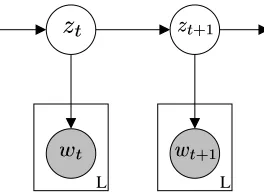
Figure 1: A graphical model representing the segmenting HMM
3
HMM Segmentation
In the segmenting HMM framework, an unsegmented document is treated as a collec-tion of mutually independent sets of words. The model posits that each set is prob-abilistically generated by a hidden topic variable in a series. Transition probabilities between topics determine the next hidden variable in the sequence.
As a generative model, the HMM posits that a document is produced by the fol-lowing process: choose a topic from an initial distribution of topics; generate a set of
independent words from a distribution over words associated with that topic; choose another topic, possibly the same topic from a distribution of allowed transitions; repeat this process. Given a new, unsegmented document, one inverts this process by calculat-ing the most likely set of topics which generated the
-word sets of the given document. Topic breaks occur at the points where the value of the topic variables change.
More formally, !#"$ %&"' ()"+*+**+"$ ,.- are sets of
words and are gen-erated by a topic/ . Each/ depends only on/ 01! and the are independent of each
other given/ . This is illustrated in the graphical model in figure 1. Circles
repre-sent random variables and arrows indicate possibly dependency. The box around
indicates that this random variable is repeated
times for each topic variable in the series.
The HMM is parameterized by a transition probability distribution between topics and a set of topic-based unigram language models23465/87 for each possible value of
/ . To train the model, a set of segments from a corpus is clustered using the9 -means
algorithm. A unigram language model is computed for each of these clusters and an appropriate smoothing technique is applied to account for sparsity. The transition prob-ability distribution between topic states23/#4:;!)5/#<7 is a parameter which is separately
tuned in [6]. We simply use normalized counts of transitions between clusters in the training set to estimate it. Note that this model requires a segmented corpus to train, but works in an unsupervised manner to cluster those segments.
To segment a new document, the stream of text is divided into a sequence of observations of
words each. The Viterbi algorithm [7], a dynamic program-ming technique, is used to find the most likely hidden sequence of topic states =>
#/#?@"A/ ! "+**+*+"A/BC- given an observed sequence of word setsDEE#?&"$ ! "+*+**F"$BG- . Topic
This model is an effective segmentation framework on both clean and ASR text. However, it suffers from the naive Bayes assumption that the words within each obser-vation are mutually independent given a topic.
23 5/J7
,
K
LNM
!
234
L
5/87
As
gets large, this assumption works well for computing23 5/J7. However, the
larger
becomes, the less precise the resulting segmentation will be since the model can only hypothesize topic breaks between sets of words. The window (i.e.
) must be large enough to give an accurate estimate of23O5/87 while small enough to detect a
segmentation point with good granularity.
4
Aspect HMM Segmentation
A segmenting aspect HMM (AHMM) is a hidden Markov model in which each hidden state is an instance of the latent variable in an embedded aspect model. This aspect model determines both the observation emission probabilities and training segment clusters to find the transition probabilities. As in the segmenting HMM, each observa-tion is a set of
words and we use the Viterbi algorithm to find topic breaks.
4.1
The aspect model for documents and words
In this section we summarize the aspect model as it applies to text. For a detailed discussion, see [5].
The aspect model is a family of probability distributions over a pair of discrete random variables. In text data, this pair consists of a document label and a word. It is important to understand that in the aspect model, a document is not represented as the set of its words but simply a label which identifies it. It is associated with its corresponding set of words through each document-word pair.
This model posits that the occurrence of a document and a word are independent of each other given a topic or factor. LetP denote a segment from a presegmented corpus,
denote a word, and/ denote a topic. Under this independence assumption, the joint
probability of generating a particular topic, word, and segment label is
23PQ"'R"A/J7S23PT5/87<23U5/J7'23/87V*
The 23U5/87 parameter is a language model conditioned on the hidden factor. The
23P5/J7 parameter is a probability distribution over the training segment labels. The 23/J7 distribution is a the prior distribution on the hidden factor.
Given a corpus ofW segments and the words within those segments, the training
data for an aspect model is the set of pairsJ3P&XT"$ZY
X
7[- for each segment label and each
4 4 ASPECT HMM SEGMENTATION
maximize the log likelihood of the training data with respect to the parameters23/J7 ,
23PT5/87, and234U5/87. The E-step is
23/T5PQ"'Z7
23/J7'23PT5/87<23U5/J7
\
][^
23/J_N7'23PT5/J_`7'234U5/J_a7
The M-step is
23PT5/87b ced.fJg
23/T5PQ"'h7ji3PQ"'h7
c d.fJg c
Y ^ f)k 23/5P _ "$Z7ji3P _ "$Z7
23U5/87b c
Y f)k 23/T5PQ"'h7ji3PQ"'h7 c d ^ fJg c Y f)k 23/5PQ"' _ 7ji3Pl"$ _ 7 23/87b c Y
f)k c d.fJg
23/T5PQ"'h7ji3PQ"'h7 c ] ^ ced.fJgEc Y f)k 23/ _ 5Pl"$ _ 7ji3PQ"'h7
wherei3Pl"$Z7 is the number of times word appears in documentP .
To avoid overfitting the training data, we use tempered EM as described in [5]. Essentially, we hold out a portion of our training data for cross validation purposes after the E-step. When the performance decreases on the hold-out data, we reduce a parametermonqp which tempers the effect of the next M-step on the parameters of
the model. In the case of a segmenting AHMM, we cross validate by checking the segmentation accuracy on a held out set of transcripts as measured by the CoAP (see section 5.3). We stop training when reducingm no longer improves performance on the
segmentation of the hold-out training data.
4.2
The aspect HMM
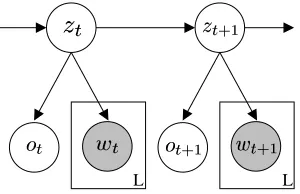
The segmenting AHMM is an HMM for which the hidden topic state is the/ random
variable in a trained aspect model. This is depicted in figure 2. Generatively, the AHMM works in exactly the same way as the HMM except the words from the selected hidden factor are generated via the aspect model rather than independently generated.
To train an AHMM, we train an aspect model on a set of training segments as described in section 4.1. We cluster the training segments by the23P5/87 parameter.
cluster3PJ7rIs)t$uwvsx
L
23PT5/
L
7
Finally, we compute transition probabilities between clusters and initial probabilities of each cluster.
Note that the aspect model does not represent clusters in the way that we compute them. EachP is represented by23P5/87, a probability for each latent factor. There is no
L L
yz {|}~
[image:9.612.206.356.81.178.2]) @
Figure 2: A graphical model representing a segmenting AHMM
assignment. However, in practice,23PT5/87 for a fixedP is peaked towards one value of
/ . In this case, we feel justified in assigning each segment to the factor with maximal
probability.
The AHMM segments a new document by dividing its words into observation win-dows of size
and running the Viterbi algorithm to find the most likely sequence of hidden topics which generated the given document. Segmentation breaks occur when the value of the topic variable changes from one window to the next. The Viterbi algo-rithm requires the observation probability23+5/87 for each time step. While the HMM
uses the naive Bayes assumption to compute this distribution, we treat each as a new
segment label and compute23+5/87 via the aspect model.
One problem with the aspect model is that it is not a truly generative model with re-spect to document labels. The23PT5/J7 parameter is a discrete distribution over the set of
training documents. Therefore, the model can only compute conditional probabilities
about those segments which it was exposed to in training. In the Viterbi algorithm, we need to find23 5/87 for some observation window . This observation is not a
docu-ment label that the model has seen before. To properly find23 5/J7, one should retrain
the model using EM on the training corpus as well as and the words it contains.
However, this is very inefficient. In practice, one can use an online approximation to EM to find23 5/87. We use a variant as described in [3].
Let L
##"$ !"' %)"*+**F"'
L
- where
?
S denotes no word and ,
denotes the full observation. We approximate23/T5j7 recursively as follows.
23/T5 ? 7 23/J7
23/T5 L :;!+7 p p 23 L :;!J5/l"A L 7<23/5 L 7 c ] ^@234 L
:;! 5/
_ 7'23/ _ 5 L 7 p 23/T5 L 7
Then we use Bayes rule to find23F5/J7.
23F5/J7
6 5 EXPERIMENTAL RESULTS
Note that23'7 is not a meaningful probability. However, the Viterbi algorithm only
needs to compute23+5/87 for a single observation at a time. Thus,23<7 behaves like
a scaling constant and we can compute23 5/87 up to this factor. Finally, since the
Viterbi algorithm only compares probabilities, we can use this proportional probability without any loss.
These formulae reflect an online approximation of one E-step in the EM algorithm. We present here an intuitive derivation to illustrate why they make sense as such an approximation. We would like to recursively estimate23/5 7 from partial estimates
of23/T5
L
7. First, notice that
? is the empty word. This immediately gives us the
base case.
23/5
?
7S23/87
We can express23/T5
L
7 in terms of our previous information as follows.
23/5 L 7G \ d.f&' 234Z7'23/T5"$ L 0!#7
We assume that, in a partial observation sequence
L, the marginal probability of
se-lecting any word is simplypO3 O
p7. Observe that when He
L, the word is assumed
to have been accounted for in23/5
L
0!F7 and is absorbed in the conditioning. When
L
, we can compute23/T5
L
"$
L
0!+7 by a simple application of Bayes rule.
23/T5 L 7b p T p 23/T5 L "$ L 0!7 T p 23/T5 L 0!+7 p T p 234 L 5/Q"$ L 0!+7<23/5 L 01!F7 23 L 7 T p 23/T5 L 01! 7 p T p 234 L 5/87<23/5 L 01!F7 c ] ^23 L 5/ _ 7<23/ _ 5 L 01!+7 T p 23/T5 L 01!F7
The final equation expresses23/T5
L
7 in terms of23/5
L
0!
7. As the
approxima-tor sees more words in a single observation, it refines its posterior distribution of the topic. It uses this refined posterior to weight the distribution of the next word.
5
Experimental results
We applied this segmentation model to two large corpora. First, we examined SPEECH
20 40 60 80 100 120 140 160 180 200 220 0.5
0.55 0.6 0.65 0.7 0.75 0.8 0.85
Iterations of EM
Average CoAP of held−out data
[image:11.612.171.385.74.249.2]ATC NYT
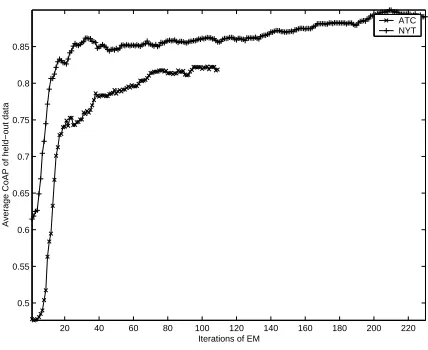
Figure 3: Tempered EM convergence in the ATC and NYT corpora
Within these shows there are 4,917 segments with a vocabulary of 35,777 unique terms. The shows constitute about 4 million words. We estimated the word error rate in this corpora to be in the 30% to 40% range. Note that these are only estimates computed from sampling the corpora as perfect transcripts are unavailable to us.
Additionally, we analyzed a corpus of 3,830 articles from the New York Times (NYT) to compare the ASR performance with error-free text. This corpus constitutes about 4 million words with a vocabulary of 70,792 unique terms. In all reported exper-iments, we learn an aspect model with 20 hidden factors.
5.1
Aspect model EM training
Figure 3 illustrates the performance on held out data during the tempered EM training of the aspect model (see section 4.1). Though the NYT corpus takes longer to converge (due to the higher vocabulary size), it learns more quickly than the ATC corpus since the text contains no errors. The ATC converges faster (due to the smaller vocabulary size) but stays at a low CoAP (see section 5.3) for several iterations before performance improves.
5.2
Sample results and topic labels
In our experiments, we use three variants of our two corpora. First, we create random sequences of segments from the ATC corpus. Second, we create random sequences from the NYT corpus to compare clean versus noisy segmentation. Finally, we use the actual aired sequences of ATC segments since this is domain of the primary problem which we are trying to tackle.
8 5 EXPERIMENTAL RESULTS
I H F G A F C E D C A B A
17 16
J
14 13 12 11 10 9 8 7 6 5 4 3 2
[image:12.612.198.448.41.243.2]1 15
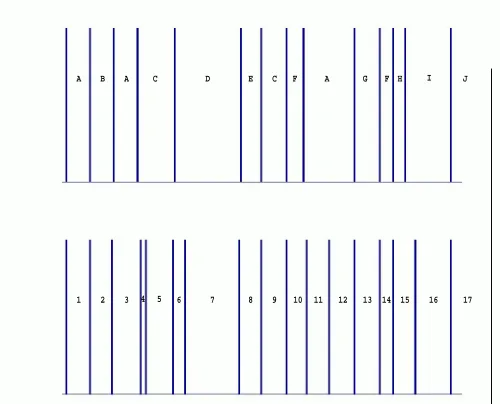
Figure 4: A segmentation of All Things Considered from April 29, 1999. The top diagram is the hypothesis segmentation. The bottom diagram is the true segmentation.
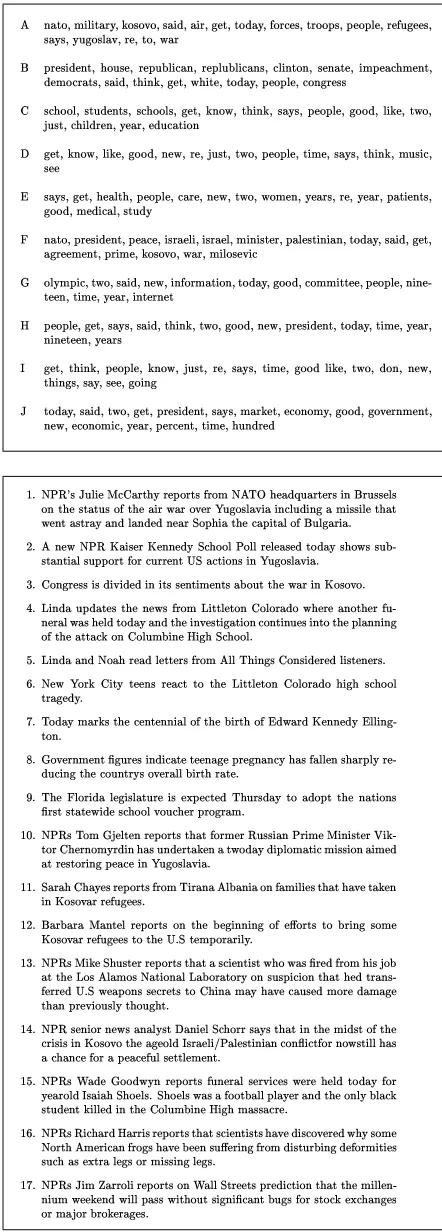
Figure 4 shows a segmentation from a real transcript of ATC on April 29, 1999. The segmentation is not perfect but hypothesizes the detected topic breaks at approximately the correct points in the program. At first, there seem to be many missed breaks. We argue however that these missed story breaks do not always constitute topic breaks and therefore are not indicative of the performance of our model. To illustrate this, we explore a method of topic labeling based on the language model parameters of the aspect model.
One way of identifying the topics which the segmenter finds is by the top fifteen words of the23465/87 parameter for the value of/ which the Viterbi algorithm assigned
to a particular segment. Figure 5 lists these word sets (denoted by a letter) as they correspond to the topics in the segmentation (denoted by a number). For example, story 14 is about the Israeli/Palestinian conflict. Its corresponding segment in the hy-pothesis segmentation can be described by the words in topic F which includepeace,
israeli, andpalestinian.
Analysis of this correspondence often explains missed topic breaks. Articles 11 and 12 are both about the Kosovar refugees. Understandably, they are both assigned to topic A and the break between stories goes undetected.
Note that the segmenter can work even if the top words of 23U5/J7 fail to give a
a¡ ¢4£)¤¥¤¦a§¡¨a¢ª©ª 4« a¬ª ¢ª«¡a¤ ¢a¤§N¢4®ª¯¦N¢4¡ `¨a¢4° ª§¦±¦¯`«¦¢4¡§¡ 4 ª²«³¢4² ¯N ª²¥¯a¢§¡¯¦°´®ª¯N¯N«³¢ «¡`¨«³¢¨´®ª 4«¥`¬¢4§¡¯a¢¡ ¢µFa§
¶ ²§¡¯`«¤¯³4N¢[· ª´«¯ª¢V§¯N²´¸¥¤±Naj¢$§¡¯N²¥´¸¥¤±Na«³¢A±³¥¤4¡ ªj¢V«¯³`¡¯ª¢[¤£)²¯`ª±¡·£)¯N4N¢ ¯N£) ±¦§¦`¦«³¢«¡a¤ ¢¡·¤© ¢®ª¯³N¢µF·¤¡¯ª¢ `¨a¢² ¯³ ª²¥¯a¢±³ ª®ª§¡¯N«¡«
¹«¡±¡· ª¥¢$«¡´¯³4¦«³¢[«±¦· 4 ª¥«¦¢'®ª¯³N¢$© aµ#¢'¡·¤© ¢A«¡`¨«³¢$²¯N ª²¥¯ª¢'®ª ¢$¥¤©4¯a¢<µ[ ¢ º´«N¢ ±¡·¤¥§¡¯Nj¢4¨ª¯`a§N¢¯N´±N`¡¤ 4
» ®4¯¦N¢j©4 aµ#¢j¥¤©4¯a¢ ®ª ¢ ¯Nµ#¢<§¯ª¢
º
´«N¢jµV ¢j²¯N ª²¥¯ª¢¡¤£)¯a¢j«¡`¨«³¢¡·¤© ¢<£´«¤±a¢ «¯N¯
¼
«¡`¨«³¢®4¯¦N¢ ·¯`a¥¡·j¢ ² ¯³ ª²¥¯a¢j±Na§¡¯a¢ ¯Nµ#¢µ[ ¢ µV ª£)¯Nj¢¨4¯Na§¦«³¢§¡¯a¢j¨ª¯`a§N¢²`¡¤¯N4¡«³¢ ®4 4 ¢£)¯N¤±³a¥¢4«¡´¨
½
a¡ ¢4²§¡¯N«¤¯N4N¢ª² ¯Nª±³¯ª¢¤«§¡ª¯³¥¤¢a¤«§¦a¯³¥¢ª£&¤¤«¡¯³§N¢ª²a¥¯N«¡¤¤ªj¢`¡ `¨ª¢«¡a¤ ¢®ª¯¦N¢ ª®ª§¯N¯N£)¯³4N¢4²§¡¤£&¯a¢©ª 4« `¬ª ¢4µFa§N¢£)¤¥ 4«¯N¬4¤±
¾ 4¥¨4£&²¤±`¢NµV ¢ª«¡a¤ ¢ª¯³µ#¢ª¤° ª§£J`¡¤ ªj¢³¡ `¨a¢ª®ª 4 ¢4±³ ª£)£)¤¡¯N¯ª¢N² ¯³ 4²¥¯a¢ª¤¯³¿ ¡¯N¯³<¢¡¤£&¯a¢¨ª¯`a§N¢¤4¡¯³§¡¯³
À ² ¯³ 4²¥¯a¢®ª¯¦N¢ «¡N¨«³¢«ª¤ ¢¡·¤© ¢µV ¢®ª ¢¯Nµ#¢²§¡¯`«¤¯³4N¢¡ `¨a¢¡¤£)¯a¢¨ª¯Na§N¢ ¤¯¦¡¯N¯³j¢¨ª¯`a§¦«
Á ®4¯¦N¢[¡·¤©¢F²¯N ª²¥¯ª¢[© aµ#¢º´«N¢F§¯ª¢F«`¨«¦¢[¡¤£)¯ª¢[®ª 4 T¥¤©ª¯ª¢$µV ¢V 4j¢V¯³µ#¢ ¡·¤®4«¦¢«`¨ª¢«¯N¯a¢®ª 4¤®
 ¡ `¨a¢«¡a¤ ¢µ[ ¢®4¯¦N¢²§¯`«¤¯NªN¢«¡N¨«³¢£&a§¡©ª¯³N¢¯N±³ ª ª£@¨ª¢®ª ¢®ª a¬ª¯³§¡£)¯N4N¢ ¯Nµ#¢¯`±¦ ª ª£&¤±`¢¨ª¯`a§N¢²¯N§¡±³¯NªN¢¡¤£)¯ª¢·´§¯`
ÃaÄ+Å+Æ[ÇÈÉVʪËÌÍÎÏÑÐNÒVÓaÔÕÖ×)ÔÎ³Ø ÙaÔÕ¦ÉAÚÔÙªÛrÅÜ$ÝFÞ.ÖÎNÓªßàªËÓaÔաγԦÉAÍáJâ[Ô¡ËÉÉγÌÉ Ùªá8Õ¡ÖÎÉÕ¦ÓNÕ¡ËÉFÙaÚ$Õ¡ÖÎÓaÍÔFãFÓ`ÔÙ`äªÎ³ÔFåAËæªÙªÉÌÓ`ä4ÍÓÍáЦÌËß4Íáæ)Ó)Û)ÍÉÉÍÌÎ+Õ¡ÖÓNÕ ã[ÎNáªÕÓªÉÕ¡Ô¡Ó`×)Óaáß&ÌÓaáßÎNß&áÎ`ÓaÔFçÙªØÖÍÓ#Õ¡ÖÎгÓaØÍÕ¦ÓaÌÙaÚAâ[ËÌæ4ÓaÔÍÓÄ è4Ä+ÜáÎNãwÅ+Æ[ÇwéÓ`ÍÉγÔ#é#γááÎ`ß4×lçСÖÙ4ÙªÌAÆ'ÙªÌÌ'ԡγÌÎ`ÓªÉÎNßJÕ¡ÙßÓ`×ÑÉÖÙ`ã+ÉÉËê4ë
ÉÕ¡Óaá4ÕÍÓaÌjÉËØØÙªÔÕFÚÙªÔ+ЦËÔ¡Ôγá4Õ+ì+ç8ӪСաÍÙªáÉ[Íá&åAËæªÙ4ÉÌÓ`ä4ÍÓÄ í4ÄÒ[ÙªáæªÔ¡ÎNÉ¡É[ÍÉVßÍäÍß4Î`ß@ÍáJÍÕ¡ÉFÉγáªÕ¡ÍÛ)γá4Õ¡ÉVÓaêÙªË4ÕFÕ¡ÖÎ#ãVÓaÔVÍá8é#Ù4ÉÙaäaÙÄ îÄ+ïjÍáßÓJËØ ßÓ`ÕÎ`ÉÕ¡ÖÎ&áÎNãFÉ#ÚÔÙªÛïjÍÕÕ¡ÌΦա٪áQÒ[ÙªÌÙªÔ¡ÓªßÙJãFÖγÔÎ&ÓaáÙaÕ¡ÖÎNÔ#ÚË4ë
áγԦÓa̪ãVÓªÉ<ÖγÌßÕ¡ÙßÓ`×#ÓaáßÕ¡ÖÎVÍá4äªÎNÉÕÍæ4Ó`Õ¡ÍÙªáгÙaá4Õ¡Íá4ËÎNÉjÍá4ÕÙFÕ¡ÖÎVØÌÓaááÍáæ ÙaÚ'ÕÖÎÓ`ÕզӪСð)ÙªáÑÒ[ÙªÌËÛêÍáÎ+ñFÍæªÖ8çСÖÙ4ÙªÌÄ
ò4Ä+ïjÍáßÓ@ÓaáßJÅ+ÙªÓaÖJÔ¡ÎNÓªß&ÌγÕաγԦÉAÚÔÙªÛÜFÌÌ<ÝVÖÍáæ4ÉFÒ[ÙªáÉÍßγԡÎNß&ÌÍÉաγáÎ³Ô¦É¦Ä ó4Ä+ÅFÎNãôåAÙªÔð;Ò[ÍÕ×աγÎNáÉJÔ¡ÎNӪСÕJÕ¡ÙTÕÖÎïjÍÕÕ¡ÌΦա٪á.Ò[ÙªÌÙªÔ¡ÓªßÙQÖÍæªÖ;ɡСÖÙÙªÌ
Õ¡Ô¡ÓaæªÎNßתÄ
õÄ+Ý<ÙßÓN×JÛ&ÓaÔ¡ðÉ[ÕÖÎ@ЦÎNáªÕ¡Î³ááÍÓaÌjÙaÚ'Õ¡ÖÎêÍÔÕ¡Ö8ÙaÚ[öAßãVÓaÔ¦ßJé#γááÎNß×8ö$ÌÌÍáæaë Õ¡Ùªá Ä
÷4Ä+øÙaäªÎ³Ô¡áÛ)γá4Õ$ùæªËÔ¡ÎNÉ[ÍáßÍÐNÓNÕ¡ÎVաγγáÓaæªÎ+ØÔÎNæªáÓaáЦ×@ÖÓªÉ$ÚÓaÌÌγá)ÉÖÓaÔ¡ØÌ×ԡΦë ßËЦÍáæÕ¡ÖÎЦ٪ËáªÕ¡Ô×É[Ù`äªÎ³Ô¦ÓaÌÌêÍÔÕ¡Ö&Ô¦Ó`Õ¡ÎaÄ
ú4Ä+ÝVÖÎOû<ÌÙªÔ¡ÍßÓÑÌγæªÍÉÌÓNÕ¡ËÔÎ)ÍÉ@γüØÎNЦաÎNßÝVÖ4ËÔ¡É¡ßÓ`×lÕ¡ÙQÓªß4ÙªØÕ@Õ¡ÖÎ8áÓ`Õ¡ÍÙªáÉ ùÔ¡ÉÕ+ÉÕ¦Ó`ÕÎNãFÍß4Î#ɡСÖÙÙªÌ äªÙªËСÖγÔVØÔÙªæªÔ¡ÓaÛ8Ä
Ã`ýÄFÅ+Æ[ÇFÉFÝ<ÙªÛrøAþγÌÕ¡ÎNá&ÔÎNØÙªÔÕ¦ÉAÕ¡ÖÓ`ÕVÚÙªÔ¡Û)γÔVÇFËÉ¡ÉÍÓ`áJÆAÔÍÛ)Î+ÏÑÍáÍÉաγÔ[ÿÍðªë Õ¡ÙªÔAÒ[ÖγÔáÙªÛ@×4Ô¡ßÍáÖÓªÉ<Ëáß4ÎNÔÕ¦ÓaðªÎ³áÓVÕã[ÙßÓ`×#ßÍØÌÙªÛ&Ó`ÕÍÐ'Û)ÍÉÉÍÙªá#ÓaÍÛ)ÎNß Ó`Õ+ÔÎNÉÕ¡ÙªÔÍáæØÎNӪгÎÍá&åAËæªÙ4ÉÌÓ`ä4ÍÓÄ
êêÄFçÓaÔ¡ÓaÖÒ[ÖÓNתÎ`É ÔÎNØÙªÔÕ¦É ÚÔÙªÛ.ÝVÍÔ¡ÓaáÓFÜFÌêÓaáÍÓ[Ùªá#ÚÓaÛ)ÍÌÍÎ`ÉÕ¡ÖÓ`Õ'ÖÓNäªÎ$Õ¡ÓaðªÎ³á Íá8éÙ4ÉÙ`äaÓaÔ[ԡΦÚËæªÎ³ÎNɳÄ
Ã`èÄFâVÓaÔêÓaÔ¦ÓQÏÑÓaáªÕ¡Î³Ì+ԡγØÙªÔÕ¡É&ÙªáTÕ¡ÖÎÑê γæªÍááÍáæQÙaÚÎ ÙªÔÕ¦É@Õ¡ÙQêÔ¡ÍáæÉÙªÛ)Î éÙ4ÉÙ`äaÓaÔ[ԡΦÚËæaÎNÎNÉ[Õ¡ÙÕ¡ÖÎì#ÄçJÕÎNÛ)ØÙªÔ¡ÓaÔ¡ÍÌ×aÄ
Ã`íÄFÅ+Æ[ÇFÉ$Ï8ÍðaÎVçÖ4ËÉÕ¡ÎNÔ$ÔÎNØÙªÔÕ¦ÉjÕ¡ÖÓ`ÕAÓɡЦÍγá4Õ¡ÍÉÕ'ãFÖÙ+ãFÓªÉjùÔÎ`ß#ÚÔÙªÛ.ÖÍÉþÙaê Ó`ÕFÕÖÎïjÙ4ÉFÜFÌÓaÛ)Ù4É[Å+Ó`Õ¡ÍÙªáÓaÌjï<ÓaêÙªÔ¡Ó`Õ¡ÙªÔ×@ÙªáÑÉËÉØÍЦÍÙªá)ÕÖÓ`Õ+ÖÎNß&ÕÔ¦ÓaáÉë ÚγԡÔÎ`ßÑì#Äç8ãVÎNÓaØÙªáÉ+ÉÎ`ЦԡΦզÉVÕ¡Ù8Ò[ÖÍáÓ)Û&ÓN×JÖÓNäªÎÐNÓaËÉÎNß8Û)ÙªÔ¡ÎßÓaÛ)ÓaæªÎ Õ¡ÖÓ`á8ØÔÎNä4ÍÙªËÉÌ×Õ¡ÖÙªËæªÖªÕNÄ
ÃîÄFÅ+Æ[Ç ÉγáÍÙªÔ[áγã+ÉFÓaáÓ`Ì×ÉÕÓaáÍγÌjçÐÖÙªÔ¡ÔFÉÓ`×É$Õ¡ÖÓ`ÕFÍá)Õ¡ÖÎ#Û)ÍßÉÕVÙaÚ<Õ¡ÖΠЦԡÍÉÍÉ$ÍáJéÙ4ÉÙaäªÙ#Õ¡ÖÎÓaæªÎ³ÙªÌßÉÔ¡ÓaÎNÌÍaÆ$ÓaÌÎNÉÕ¡ÍáÍÓ`á@Ц٪áÍСÕÚÙªÔ[áÙ`ã+ÉÕ¡ÍÌÌÖ Ó)СÖÓ`áгÎFÚÙªÔ+Ó@ØÎNӪЦγÚËÌ<ÉγÕÕÌÎNÛ)γáªÕNÄ
Ã`òÄFÅ+Æ[ÇFÉ ÓªßÎ8øÙ4ÙßãF×4áÔÎNØÙªÔÕ¦ÉÚËáγԦÓaÌFÉÎNÔä4ÍгÎNÉ#ã[ÎNÔÎJÖÎNÌßOÕ¡ÙßÓ`×OÚÙªÔ ×ªÎNÓaÔ¡ÙªÌßÉÓaÍÓaÖ)ç4ÖÙ4ÎNÌɦÄ$çÖÙγÌÉ'ãFÓªÉ$ÓÚÙ4ÙaÕ¡êÓaÌÌØÌÓ`תγÔ$ÓaáßÕ¡ÖÎ+ÙªáÌ×êÌӪСð ÉÕËßγáªÕ+ðÍÌÌÎNß)Íá&Õ¡ÖÎ@ÒAÙªÌËÛ@êÍáÎñFÍæªÖJÛ&ÓaÉ¡ÉӪгÔΪÄ
Ã`óÄFÅ+Æ[ÇFÉ<ÇFÍСÖÓaÔ¦ßñ+ÓaÔÔ¡ÍÉԡγØÙªÔÕ¦ÉÕ¡ÖÓ`Õ$ÉгÍγáªÕ¡ÍÉÕ¦ÉÖÓ`äªÎAß4ÍÉЦÙaäªÎ³Ô¡ÎNßFãFÖ4×ÉÙªÛ)Î ÅFÙªÔÕÖ)ÜFÛ)γԡÍгÓaá#ÚÔÙªæ4É'ÖÓ`äªÎ[êγÎNá)ÉË ÎNÔÍáæFÚÔ¡ÙaÛwßÍÉÕËÔ¡êÍáæßγÚÙªÔ¡Û)ÍÕÍÎNÉ ÉËСÖÑÓªÉVΦü4Õ¡Ô¡ÓÌγæ4É[ÙªÔFÛ)ÍÉÉÍáæÌγæ4ɳÄ
[image:13.612.166.387.73.689.2]ÃõÄFÅ+Æ[ÇFÉVʪÍÛ ÓaÔ¡ÔÙªÌÍԡγØÙªÔÕ¡É[Ùªá QÓaÌÌ ç4ÕԡγγաÉ[ØÔ¡ÎNßÍСաÍÙªá@Õ¡ÖÓ`ÕVÕÖÎÛ)ÍÌÌγáë áÍËÛrãVγγðªÎNáßJãFÍÌÌjØӪɡÉFãFÍÕ¡ÖÙªËÕÉÍæªáÍù гÓaáªÕFêËæ4ÉVÚÙªÔ+ÉÕ¡ÙСðJΦüÐÖÓaáæªÎNÉ ÙªÔFÛ)Ó`þÙªÔ[êÔÙªðªÎ³Ô¦ÓaæªÎNɳÄ
10 5 EXPERIMENTAL RESULTS
Source P(missed) P(false) P(disagree)
[image:14.612.219.447.73.136.2]Random NYT 0.123 0.080 0.096 Random ATC 0.263 0.052 0.143 Actual ATC 0.434 0.063 0.233
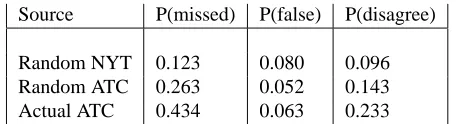
Figure 6: CoAP results on the ATC and NYT corpora. In the case of randomly gen-erated transcripts, the reported results are the mean over ten sets of random transcripts taken from the same set of testing segments.
5.3
Quantitative Results
We use the co-occurrence agreement probability (CoAP) introduced in [1] to quantita-tively evaluate our segmenter. The CoAP is defined as
23agreement7
\
L
3
"87ô3
"J763
"J7
The function
3
"87 is a probability distribution over the distances between words in
a document; the functions are p if the two words fall in the same segment and
otherwise; and function indicates agreement between the operands.
In our case,
3
"J7 p if the words are9 words apart and otherwise. With this
choice of
, the CoAP is a measure of how often a segmentation is correct with respect to two words that are9 words apart in the document. Following [1], we choose9 to be
half the average length of a segment in the training corpus, 170 in the ATC corpus, and 200 in the NYT corpus.
A useful interpretation of the CoAP is through its compliment [1]
23disagreement7Ge23missed7<23seg7
3'p! 23seg7'7'23false7
where23seg7 is the a priori probability of a segment,23missed7 is the probability of
missing a segment, and23false7 is the probability of hypothesizing a segment where
there is no segment.
Figure 6 shows the error and its decomposition for three experiments: the NYT corpus with randomly generated sequences of articles; the ATC corpus with randomly generated sequences of segments; and the ATC corpus with the true ordering of seg-ments as they were aired. It is interesting to note that our system tends to underseg-ment as indicated by the high23missed7. Furthermore, in the actual ATC orderings
23missed7 is even higher due to the phenomenon of multiple segments with similar
topics (see section 5.2).
0 20 40 60 80 100 120 140 160 180 200 0.4
0.45 0.5 0.55 0.6 0.65 0.7 0.75 0.8 0.85 0.9
window size (in words)
average CoAP
[image:15.612.174.383.74.246.2]AHMM HMM
Figure 7: Window width vs. CoAP for the HMM and AHMM in the NYT corpus
scheme described in section 4.2, words in the beginning of the window are weighted more heavily than words towards the end of the window. Therefore, as the window size increases, more words make less impact on the observation distribution and the segmenter does not perform as well.
The HMM does well on large windows since all words are counted equally. How-ever, this increase in performance is at the expense of low segmentation granularity. While the HMM performs better than the AHMM for large windows, it never attains the performance of the AHMM in small windows. Typically, the AHMM reaches peak performance at a window size of 10-15 words. The HMM begins to perform better than the AHMM at around 100 words.
6
Conclusions and future work
In this paper, we have introduced a new approach to text segmentation using a unique probabilistic model that combines an aspect model with an HMM. This is a unified framework within which we learn both document clusters for training and observation probabilities for new segmentations. The AHMM does well with small windows of words allowing for a more precise segmentation than with the HMM.
We have experimented with this system on noisy text sources produced by a speech recognition system. Since our model is purely statistical, we can segment this output and accurately hypothesize topic transition points. Our results on transcripts produced by the SPEECHBOTsystem are quite encouraging.
12 REFERENCES
explore a temporal analysis of our data and model long term topic shifts in the hidden factors and language models.
References
[1] Doug Beeferman, Adam Berger, and John Lafferty. Statistical models for text segmentation. Machine Learning, 1999.
[2] A. P. Dempster, N. M. Laird, and D. B. Rubin. Maximum likelihood from incom-plete data via the em algorithm. Journal of the Royal Statistical Society, Series B
(Methodological), 39(1):1–38, 1977.
[3] Daniel Gildea and Thomas Hofmann. Topic-based language models using em.
EuroSpeech-99, pages 2167–2170, 1999.
[4] Marti A. Hearst. Context and structure in automated full-text information access.
University of California at Berkeley dissertation. Computer Science Division Tech-nical Report, 1994.
[5] Thomas Hofmann. Probabilistic latent semantic indexing. Proceedings of the
Twenty-Second Annual International SIGIR Conference on Research and Devel-opment in Information Retrieval, 1999.
[6] P. van Mulbregt, I. Carp, L. Gillick, S. Lowe, and J. Yamron. Text segmentation and topic tracking on broadcast news via a hidden markov model approach. 1998.
CRL
2001/07
J
uly
2001