2017 2nd International Conference on Computer, Network Security and Communication Engineering (CNSCE 2017) ISBN: 978-1-60595-439-4
Iterative Channel Coded Physical Layer Network Coding on
Impulsive Noise Channels
Yuan-yi ZHAO
School of Electrical and Electronic Engineering Newcastle University Newcastle-upon-Tyne, UK
Keywords: PNC, Impulsive noise, Iterative decoding.
Abstract. Physical-Layer Network Coding (PNC) employed on a conventional two-way relay communications is an active research area due to the potential doubling of the throughput compared with traditional routing. In this paper, we investigate the effects of impulsive noise added at the relay and sink nodes of a TWRC employing link-by-link coded PNC. The Gaussian mixture model is chosen to model the impulsive noise and the performance of bit-interleaved coded modulation with iterative decoding (BICM-ID) and turbo codes on the conventional two-way relay communications is evaluated through simulation results for different mixtures, α, of impulsive noise. For high and low values of α the turbo codes outperform trellis BICM, but it is shown that for values between α = 0.1 and α = 0.5, a PNC system with trellis BICM outperforms a comparable PNC system with turbo codes, where both coding schemes have the same block size, code rate and constraint length.
Introduction
Physical-layer network coding (PNC) is a technique for wireless two-way relay communications [1], which exploits interference at a relay node to boost the throughput. In [2], Hausl introduced an extension of the conventional two-way relay communication with a joint network-channel coding method for PNC. Zeng et al. [3] presented the noncoherent detection of iterative differential phase-shift keying (DPSK) demodulation for PNC combined with turbo codes on a conventional two-way relay communications. There are several studies on trellis BICM combined with PNC on a conventional two-way relay communications. In [4], Xu et al. showed that trellis BICM can significantly improve the BER performance of a PNC system by applying a suitable iterative demapping and decoding framework and proper constellation mapping schemes specially designed for PNC.
In this paper, we consider a type of PNC called link-by-link PNC[6], where encoding and decoding takes place at the relay and source nodes in both time slots. It is generally assumed that the noise added at the relay and sink nodes has a Gaussian distribution, but there are some scenarios where the noise could be impulsive. Impulsive noise can severely degrade performance of communication systems; and more importantly, PNC will be an important methodology for boosting the throughput in the above scenarios. After a review of the literature it appears that the effect of impulsive noise on a conventional two-way relay communications employing PNC has not been considered. To investigate this, turbo codes and trellis BICM have been chosen as their encoders are both based on convolutional codes and their decoders are based on the turbo principle. For a fair comparison, we look at trellis BICM and turbo codes with the same component convolutional encoders. The Gaussian mixture model (GMM) has been selected [7][8] with a probability density function (pdf), p(x), that is defined by two-terms, i.e.,
system model of link-by-link channel-coded PNC on a conventional two-way relay communications. In Section III, a derivation of the log-likelihood ratios (LLRs) of the received symbols at the relay effected by impulsive noise for the turbo decoder and the trellis BICM demapper and decoder is presented. In Section IV, simulation results and discussions are presented and conclusions are given in Section V.
System Model
The system model of the conventional two-way relay communications employing trellis BICM combined with PNC is shown in Fig.1. During the MAC phase two assumptions are made: The channel has perfect synchronization and power control and the relay receives packets from each node with the same symbol energy E [9]. Two source nodes, A and B, have no direct-link to each
other and instead transmit their messages through the relay. Let mA∈ {0, 1}k and mB∈ {0, 1}k be the k-bit binary messages sent from node A and node A. The information sequences are encoded
resulting in cA∈ {0,1}n and cB∈ {0,1}n, where n is the length of the codes. The two trellis BICM code words are interleaved and mapped to a quadrature phase shift keying (QPSK), where anti-Gray mapping is used to ensure the trellis BICM iterative decoder achieves a coding gain with each iteration [4]. It is also assumed that the source and relay employing the same interleavers. Therefore, the received information sequence at the relay can be expressed as[10] y = xA + xB + η. where xA
and xB are the electromagnetic signals transmitted from nodes A and B respectively, η is the noise added at the relay and (xA , xB ) ∈ {1 + j, 1 − j, −1 − j, −1 + j }, and the sum of the two transmitted
QSPK signals xR can have nine possible complex values.. The relay must then determine the log-likelihood ratio (LLR) of y given that xR = xA + xB was transmitted, L(y|xA + xB ). This is decoded at the relay to give the message mR = mA ⊕ mB , where ⊕ is the XOR operation. The
decoded message is then re-encoded to give cR = cA ⊕ cB , which is mapped to a QPSK constellation
and broadcast back to nodes A and B. At nodes A and B, the received signal is decoded to obtain mR, where node A can obtain mB by performing the XOR of mR with its known binary message mA.
[image:2.612.105.510.461.637.2]A similar operation is performed at node B to obtain mA.
Figure 1. System model of trellis BICM encoder and iterative decoding processing the PNC system.
Iterative Decoding Schemes Combined with PNC
Turbo Decoding at the Relay
Essentially, the turbo decoder will be decoding a vector of LLR values that give a measure of the reliability of the combination of both source nodes codewords. Since turbo codes are linear this means the sum of any two codewords is another valid codeword, which can also be decoded. From the nine-point constellation diagram, each received symbol y is demapped to a pair of LLR values,
| and |, which imply the reliability of the two XORed transmitted bits,
and , where the superscript denotes the first or second bit and = ⊕ and
= ⊕ . The reliability of y conditioned is
= ln | !
"#$
| !"#%, (2)
The conditional pdf of y given that = 0 is determined as:
= 0 = ()*+,-./
.
.0. + )*+,1./
.
.0. 2 × 4)*5+6-./7 .
.0. + )*5+61./7
.
.0. + 2)*.0.+6.9. (3)
where σ is the noise variance, yI is the real part of y and yQ is the imaginary part. Similarly, the
conditional pdf of y given that the = 1 can be determined as well. Therefore, by substituting
(3) into (2), the LLR of first demapped bit can be simplified to [11]:
= ln cosh ?@., −@.. (4)
When impulsive noise is added at the relay, the pdf from the GMM in (1) is substituted into the
above expressions. By substituting (1) into (4), the LLR of A and A can be derived respectively.
Trellis BICM at the Relay
For trellis BICM, it is a spectrally efficient coded modulation scheme that has been shown to perform well under suitable signal mapping schemes with iterative demapping-decoding. i,e., the BICM-ID [12]. The operation of the demapper is described in [12], and in this paper decoding is realized with the log-MAP algorithm[13]. The demapper exchanges extrinsic information and a priori information with the decoder for each iteration. In order to demap the received symbol, the
conditional LLRs of the received symbol, and are derived. has
given in (2), which can also be expressed as:
= ln | | !!#$B| #$$B| !!##$. (5)
Assuming that all the coded bits are independent due to the bit interleaving, the joint probabilities can be expressed as the product of individual probabilities. Cancelling out p(y) and factorizing
reduces to two terms and we can extract the common term
= ln !
"#
!"#$%
. Similarly, = ln !
.#
!
.#$%. The terms
and are the a priori LLRs of the XORed message bits. Rearranging (2) we obtain:
= 1 = CDE+FG!"%
BCDE+FG!"%,
(6)
= 1 =
BCDE+FG!"%
(7)
By substituting (6) and (7) into (5), the LLR L(y|m(1)) for the first received coded bit is
= + ln H| !#$B| !#C
DE+FG!.%
| !#$$B| !#$CDE+FG!.%
I. (8)
Applying the same procedure to derive the LLR of y conditioned on the second XORed message bit,
can be derived as well. Since anti-Gray mapping is applied to the QPSK constellation
for trellis BICM, the four conditional probabilities are:
| =√K@ .∑ )*
5+61M67.1+,1M,. .0.
N6,N, , (9)
where (sI,sQ) are the four corner points of the anti-Gray mapped nine-point constellation diagram.
Results and Discussion
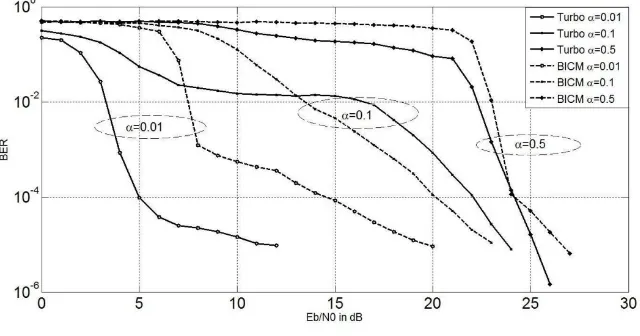
[image:4.612.144.464.510.678.2]In this section, the performance of link-by-link coded PNC employing trellis BICM or turbo codes on additive impulsive noise channels is evaluated at the relay of a conventional two-way relay communications through simulation results. At the relay, any large positive or negative impulses are clipped so that their energy is no greater than the transmitted symbol energy E. The performance of coded PNC is seriously affected on additive impulsive noise channels resulting in error floors, as shown in Fig.2. For the turbo codes, a rate half (37, 21)8 recursive systematic convolutional code (RSC) with a constraint length of five is used to obtain a rate half punctured turbo code, while the same RSC is also used for a rate half trellis BICM. From the results, the rate half trellis BICM performs worse than the rate half punctured turbo code when α is smaller than 0.1. The turbo code approximately a 4dB advantage when α = 0.01 at a BER of 10-3. However, when α is larger than 0.1, trellis BICM begins to outperform the turbo codes. Finally, when α ≥ 0.5 the channel is very impulsive and both coding schemes have a similar performance. In Fig.2, it shows the water-fall region of turbo codes: when α ≥ 0.05, the water-fall region starts at around 20dB for both codes. However, by comparing the BER curves at α = 0.1 it can be seen that, the rate half trellis BICM outperforms the turbo code when the SNR is greater than 13dB with a 2.5dB coding gain at BER of 10-4.
Figure 2. BER performance of rate 1 (37, 21)8 Turbo codes and (37, 21)8 trellis BICM with impulsive noise at relay, Interleaver length =50,000 bits, 5 iterations.
within that symbol. However, the presence of bit interleaving in the iterative receiver causes neighbouring effected bits to be spread out within the trellis of a convolutional code, which improves decoding performance. Second, between this range of mixtures there are sufficient by large impulses that will result in an increased number of unreliable symbols propagating through both decoders. This degrades the performance of the turbo codes, but trellis BICM comprises a single decoder and a demapper, which prevents the propagation of unreliable symbols. For α > 0.5 large impulses dominate the received symbols and both trellis BICM and turbo codes perform badly. Over all, turbo code outperforms when 0 ≤α≤ 0.1, trellis BICM shows its advantage when 0.1 ≤α ≤ 0.5, and both codes achieve a poor performance when 0.5 ≤α≤ 1.
Conclusions
In this paper, the iterative decoding behaviour of trellis BICM and turbo codes combined with link-by-link PNC on additive impulsive noise channels has been investigated at the relay of a conventional two-way relay communications. We might expect that the turbo codes would always outperform trellis BICM on these channels, but simulation results have shown that in fact there is range of mixtures between α = 0.1 and α = 0.5 where trellis BICM actually outperforms turbo codes. This is because trellis BICM applies bit-interleaving that decreases the effects on neighboring bits and additionally it only has a single component decoder, which prevents the propagation of unreliable symbols. We have shown that trellis BICM is a good choice for link-by-link coded PNC on conventional two-way relay communications with additive impulsive noise, offering a good trade-off between performance and complexity. There is also great scope for more research in this area to achieve further improvements in performance, by investigating new signal processing techniques and channel code design methodologies specifically for impulsive noise channels.
References
[1] S. Zhang, S. C. Liew, and P. L. Lam, “Hot topic: physical layer network coding,” in
Proceedings of the 12th annual international conference on Mobile Computing and Networking (MobiCom), Aug. 2006, pp. 358-365.
[2] H. J. Hausl, C., “Iterative network and channel decoding for the two-way relay channel,”
Communications, 2006. ICC ’06. IEEE International Conference on,, pp. 1568-1573, June 2006. [3] W. Zeng, “Turbo dpsk in bi-directional relaying,” Wireless Communications and Networking Conference Workshops (WCNCW), 2013 IEEE,, pp. 155 - 159, 7-10 April 2013.
[4] G. Q. Xu Li, Shengli Zhang, “Mapping and coding design for channel coded physical-layer network coding,” High Mobility Wireless Communications(HMWC),, pp. 120 – 125, 2013.
[5] T. Huang, T. Yang, J. Yuan, and I. Land, “Convergence analysis for channel-coded physical layer network coding in gaussian two-way relay channels,” in 8th International Symposium on Wireless Communication Systems (ISWCS), 2011, pp. 849–853.
[6] Zhao, Yuanyi, et al. "Link-By-Link Coded Physical Layer Network Coding on Impulsive Noise Channels." Sensor Signal Processing for Defence IEEE, 2015:1-5.
[7] Zhao, Yuanyi, et al. "Non-binary turbo-coded physical-layer network coding on impulsive noise channels." Electronics Letters 52(2016).
[8] D.MIddleton, “Procedures for determining the parameters of the first-order canonical models of class a and class b electromagnetic interference,” IEEE Transactions on Electromagnetic Compatibility, vol. 21, pp. 190–208, 1979.
[10] S. T. Brink, J. Spiedel, and R. H. Yan, “Iterative demapping and decoding for multilevel modulation,” in Global Telecommunications Conference, 1998, pp. 579–584.
[11] D. Fang and A. Burr, “Performance degradation of turbo coded physical layer network coding on the two-way relay channel,” in IEEE 22nd International Symposium on Personal Indoor and Mobile Radio Communications (PIMRC), 2011, pp. 1748–1752.
[12] X. Li and J. A. Ritcey, “Bit-interleaved coded modulation with iterative decoding,” IEEE Commun. Lett., vol. 17, pp. 169–171, Nov. 1997.
[13] S. Benedetto, D. Divsalar, and G. Montorsi, “A soft-input soft-output app module for iterative decoding of concatenated codes,” IEEE Commun. Lett., pp. 22–24, 1997.
[14] T. K. Moon, “Error correction coding: Mathematical methods and algorithms,”