University of Huddersfield Repository
Hornsby, RichardThe development of nursing document control procedures: a process of organisational change
Original Citation
Hornsby, Richard (2011) The development of nursing document control procedures: a process of organisational change. Masters thesis, University of Huddersfield.
This version is available at http://eprints.hud.ac.uk/id/eprint/12151/
The University Repository is a digital collection of the research output of the University, available on Open Access. Copyright and Moral Rights for the items on this site are retained by the individual author and/or other copyright owners. Users may access full items free of charge; copies of full text items generally can be reproduced, displayed or performed and given to third parties in any format or medium for personal research or study, educational or notforprofit purposes without prior permission or charge, provided:
• The authors, title and full bibliographic details is credited in any copy; • A hyperlink and/or URL is included for the original metadata page; and • The content is not changed in any way.
For more information, including our policy and submission procedure, please contact the Repository Team at: [email protected].
THE DEVELOPMENT OF NURSING
DOCUMENT CONTROL
PROCEDURES: A PROCESS OF
ORGANISATIONAL CHANGE
RICHARD HORNSBY
A thesis submitted to the University of Huddersfield in
fulfilment of the requirements for the degree of Masters of
Arts by Research
Copyright Statement
i. The author of this thesis (including any appendices and/or schedules to this thesis) owns any copyright in it (the “Copyright”) and he has given The University of Huddersfield the right to use such Copyright for any administrative, promotional, educational and/or teaching purposes.
ii. Copies of this thesis, either in full or in extracts, may be made only in accordance with the regulations of the University Library. Details of these regulations may be obtained from the Librarian. This page must form part of any such copies made.
Abstract
There were two distinct aims of this research study; firstly, to gain a greater understanding of nursing documentation practice, and, secondly, to study the management of change within a health care setting. The importance of creating high quality nursing documents for the purposes of recording patient care is well emphasised within the published work of key health care figures, such as the Nursing and Midwifery Council (2010) and the Health Service Ombudsman (2006); however the necessary guidance to achieve such high quality documents appears to be lacking. Previous studies have been inconclusive in diagnosing the root causes of nursing documentation issues, and consequently, recommendations for improvement have largely involved the redesign of a single document, which have often failed to address the underlying problem. Collectively, the inconsistencies within the literature marked the need to undertake further research, in order to thoroughly investigate nursing documentation practice and to better understand the organisational and cultural barriers to the successful implementation of change within the NHS.
The research took a case study approach which involved an investigation of nursing documentation practice and organisational change within a single organisational setting. A two phase methodology was developed in order to collect sufficient levels of data to form research findings. Firstly, an analysis of 161 documents provided a degree of quantitative data to gain a greater understanding of the standard of nursing documents in use within the case study organisation. This was followed by eleven semi-structured interviews and a focus group in addition to the use of a diary log, kept by the researcher, to record key observations over a two year period.
The main findings provided evidence of a lack of formalised procedure for the development and management of nursing documentation within the case study organisation. Authors of nursing documents did not always see their role as „educators‟, however a number of nurses interviewed within the purposes of the research voiced concerns in relation to a lack of understanding, and, when tested, gave differing responses and interpretations as to the meaning of some of the assessments contained within key nursing documents.
Acknowledgements
Special thanks are extended to my supervisors at the University of Huddersfield; Mr Steve Lawson and Dr Ruth Deery. Their continued support and valuable feedback are very much appreciated and have been instrumental in the successful completion of this research project.
Table of Contents
Abstract ……….. 2
Acknowledgements ……….. 3
Table of Contents ……….. 4
List of Tables ……….. 7
List of Figures ……….. 7
Chapter One – Introduction ……….. 8
1.1 Introduction ………...8
1.2 Background to the Research ………...8
1.3 Aims and Objectives of the Research ………...9
1.4 Organisational Context …………..………...10
1.5 Structure of the Research ………..………...11
Chapter Two – Literature Review ………...………. 13
2.1 Introduction ……….13
2.2 Nursing Documentation ……….14
2.2.1 Publicised Problems and Concerns Relating to Current Practice…….16
2.2.2 Improvements in Nursing Documentation ……….20
2.3 Organisational Change ……….21
2.3.1 Planned Change and Kurt Lewin‟s Three Step Model ……….21
2.3.2 The Rise of Emergent Change ……….24
2.3.3 Putting Change Management in the NHS into Perspective ……….26
2.4 Managing Change in the NHS / Public Sector ……….27
2.4.1 Structural Changes within the NHS ……….27
2.4.2 Putting Change Management in the NHS into Perspective ……….30
2.5 Corporate Culture ……….32
2.5.1 Culture Identification within the NHS ……….32
2.5.3 Designing an Effective Approach to Cultural Change ……….36
2.6 Literature Review Summary and the Identification of Research Aims and Objectives ………37
Chapter Three – Methodology ……… 39
3.1 Introduction ……….39
3.2 Research Philosophy ……….39
3.3 Ontological Considerations ……….41
3.4 Epistemological Considerations ……….42
3.5 Case Study Design ……….43
3.6 Methods ……….44
3.6.1 Phase 1 – Content Analysis of Trust A‟s Nursing Documentation..….44
3.6.2 Phase 2 – Semi-Structured Interviews, Focus Group and Diary Log / Field Notes ……….45
3.7 Access and Ethical Considerations ……….51
Chapter Four – Findings ……… 53
4.1 Phase 1 – Content Analysis of Trust A‟s Nursing Documentation…...53
4.1.1 Phase 1 – Summary of Findings ………....57
4.2 Phase 2 – Further Exploration of Trust A‟s Nursing Documentation Practice ………....58
4.2.1 Semi-Structured Interviews ……… 58
4.2.2 Focus Group ………....63
4.3 Discussion of Findings and the Creation of an Improvement Model ..70
4.4 KTP Involvement ………72
4.4.1 Overseeing the Development of New Nursing Documentation Policy / Procedures within Trust A ………72
4.4.2 Summary of KTP Involvement ………77
Chapter Five – Barriers to Change ………. 79
5.1 Motivational Issues and Resistance to Change ……… 79
5.2 Power Structures ……… 82
5.4 Identifying Pushing and Resisting Forces to Change from
a Cultural Web ………...84
5.5 Chapter Summary ………87
Chapter Six – Conclusions and Recommendations ………... 89
6.1 Summary of Findings ………89
6.2 Recommendations for Future Research ………92
6.3 Contribution to Knowledge ………93
6.4 Limitations of the Study ………95
6.5 Conclusion ………96
6.6 Final Recommendations ………96
References ………..……… 101
Appendix A ……… 106
Appendix B ………..………… 107
Appendix C ………..……… 108
Appendix D ………..……… 109
Appendix E ………..……… 110
Appendix F ………..……… 111
Appendix G ………..……… 112
Appendix H ………..…… 113
Appendix I ………..…… 114
Appendix J ………..………… 115
List of Tables
Table 1 – „Clinical Intensity from 1999-2009 ………17
Table 2 – „Alternative Terms for the Main Research Paradigm‟ ………40
Table 3 – „Focus Group Questions‟ ………48
Table 4 – „Examples of Duplicated Documents in Use within Trust A‟ ……. 56
Table 5 – „Assessment Criteria Taken from One of Trust A‟s
Nursing Documents‟ ………67
Table 6 – „User Requirements for Document Repository System‟ ………75
Table 7 – „A Summary of Key „Pushing‟ and „Resisting‟ Forces to Change
within Trust A‟ ………88
List of Figures
CHAPTER ONE
INTRODUCTION
1.1 Introduction
The purpose of this introductory chapter is to provide an account and
overview of the research which is portrayed in the next five chapters. This
introduction begins with an overview and background of nursing
documentation practice and organisational change within the NHS, followed
by a determination of the research problem and identification of the research
aims and objectives. The chapter concludes with a background of the NHS
institution designated as a case study organisation for the purposes of this
research, and is followed by a brief summary of the structure of the research
depicted in each of the following chapters.
1.2 Background to the Research
This research forms part of a two year „Knowledge Transfer Partnership‟
(KTP)1 project undertaken to examine nursing documentation practices and the management of change within a single NHS Foundation Trust in England.
The impetus for the project arose from discussions between the researcher
and the case study organisation‟s Director of Nursing, in relation to senior
manager concerns towards nursing documentation practice and the
inappropriateness of previous incentives designed to improve performance.
As a consequence, a formal request was made to the researcher to
investigate current practice, provide clear recommendations for improvement
and produce strategies to ensure successful implementation of change within the organisation. As part of the „KTP‟ process, a request was additionally
made for the researcher to take on a project management role within the case
study organisation to manage, oversee and develop formally agreed solutions
for improvement, with a view to handing over completed products to senior
1 Knowledge Transfer Partnerships are partially government-funded programmes which aim to improve
management for implementation. The study is consequently split into two sections to accommodate this, as reflected within the „Research Findings‟ and „KTP Involvement‟ sections illustrated within Chapter Four.
The importance of creating high quality nursing documents for the purposes of
recording patient care is well emphasised within the published work of key
health care figures, such as the Nursing and Midwifery Council (2010) and the
Health Service Ombudsman (2006); however the necessary guidance to
achieve such high quality documents appears to be lacking. In addition, the
complexities of nursing documentation practice are highlighted in great detail
in Chapter Two, and as such, it is apparent that problems exist not only within
the case study organisation, but within the NHS spectrum as a whole.
Previous studies (Karlsen, 2007; Bjorvell et al 2003) have been inconclusive
in diagnosing the root causes of nursing documentation issues, and
consequently, recommendations for improvement have largely involved the
redesign of a single document, which have often failed to address the
underlying problem. Collectively, the inconsistencies within the literature mark
the need to undertake further research in order to thoroughly investigate
nursing documentation practice and to implement an improvement model
capable of effecting change.
Moreover, the management of change within the NHS is often described as a
complex and difficult process (Alexis 2005, Bamford and Daniel, 2005). As a
result of the current political environment, a review of the literature detailed
within Chapter Two determined a need to gain a greater understanding of
cultural and organisational issues within the NHS, to acknowledge potential
barriers and establish strategies required to ensure the successful
implementation of change programmes.
1.3 Aims and Objectives of the Research
Based on the above section indicating the complexities surrounding nursing
documentation practice and the effective management of change within a
1. To gain a greater understanding of nursing documentation
practice within the NHS
2. To study the management of change within a health care setting.
In order to achieve the research‟s aim, four objectives have been identified,
which in turn, guide the investigation of the research focus.
1) To undertake a document analysis to determine the overall standard of
nursing documentation in use within a case study organisation.
2) To explore nursing documentation practice within a case study setting
3) To produce a nursing documentation improvement model
4) To identify the perceived organisational and cultural barriers to change
within the case study organisation.
1.4 Organisational Context
The research will not make reference to any individual or hospital name in
order to protect the privacy and confidentiality of the case study organisation
and its staff. As a consequence, the case study organisation will be referred to as „Trust A‟ within the context of this research.
Trust A is based in Northern England, providing healthcare for a local
community of over 400,000 people. The organisation operates on two
separate sites, which are based within an approximate proximity of five miles
of each other (the two locations will be referred to as ‘Site 1’ and ‘Site 2’ to
maintain confidentiality). Sites 1 and 2 merged at the turn of the 21st Century, which coincided with the award of „Foundation Trust‟ status some 6 months
later. At the time of writing there are 46 wards in operation throughout the
organisation, each catering for specific medical conditions and patient requirements. Trust A‟s Annual Report (2009/2010) indicated that services had been recognised as “good” quality by the social care regulator, but that
management identified a newly developed quality improvement programme in relation to „improving the patient experience‟, and, consequently,
enhancements in nursing documentation practice were identified as a priority
area in order to better meet organisational goals and targets.
1.5 Structure of the Research
The initial focus of the research in relation to nursing documentation practice
and the management of change are portrayed within Chapter One in order to
present an overall view of the research, its background, aims and objectives
and structure.
Chapter Two reviews the literature surrounding the research area. This
chapter aims to review and critique the work of relevant studies and identify
gaps in current research. The chapter begins with an overview of the
importance of nursing documentation, outlining some of the problems
associated with current practice and an analysis of the improvement
recommendations detailed within previous studies. The chapter also
discusses aspects of organisational and cultural change models portrayed
within current literature, with relation both to the private sector and the NHS.
Chapter Three discusses the methods and tools used within the context of
the research. Within this chapter, different research philosophies are
discussed and assessed, and reference is made to both ontological and
epistemological consideration. The chapter discusses a two phase
methodology, including the structure of quantitative and qualitative
approaches for data collection. The chapter concludes with an overview of
ethical considerations to be made within the context of this research.
Chapter Four is split into two sections to incorporate the „Research Findings‟
and „KTP Involvement‟ aspects of the research. The initial section of the
chapter tackles the first and second objectives of the research, presenting a
data analysis of the methods included within Chapter Three and a discussion
organisation. An improvement model is additionally created to fulfil the research‟s third objective. The second section of the chapter incorporates the „KTP Involvement‟ of the research, providing an account of the development
of the improvement model provided within the first section of the chapter,
including product development, timescales and problems encountered
throughout the process.
In order to fulfil the fourth objective of the research, Chapter Five provides an
account of the organisational and cultural barriers to change within the case
study organisation, and identifies pushing and resisting forces to the
successful implementation of the improvement model created within the
context of the research.
Chapter Six forms the final chapter of the research, detailing final conclusions
and recommendations. The findings of the research are summarised, taking
CHAPTER TWO
LITERATURE REVIEW
2.1 Introduction
The researcher utilised the resources available for students at the University
of Huddersfield, including the on-campus library and an electronic search engine known as „Summon,‟ to access scholarly material. Content was viewed
(largely electronically) through the inputting of key words within the search engine i.e. „Nursing Documentation‟, „Organisational Change in the NHS,‟ „Corporate Culture‟. This chapter aims to critique the literature obtained by the
researcher and is subsequently split into four sections;
1) A review of nursing documentation, including its overall purpose,
problems of use in current practice and the identification of previous
studies which have investigated potential improvements.
2) An analysis of the concept of organisational change, including a critique of two approaches which dominate the literature; „Planned‟ and „Emergent‟ approaches to change.
3) An account of organisational change in the NHS / public sector,
establishing key differences between public and private sector change
management, and a critique of previous literature within this area.
4) An analysis of the meaning of corporate culture, how this affects the
change management process and a critique of current models and
theory within this field.
The review has been structured in this manner to increase knowledge within this research‟s area of study, to identify gaps within the literature and to guide
2.2 Nursing Documentation
This opening section of the review seeks to critique the literature surrounding
nursing documentation, aiming to provide particular clarity as to overall
purpose / reasons for use and to gain a greater understanding of some of the
publicised problems for the manner in which it is perceived in practice. In
addition, this review will study previous investigations tailored towards making
substantial improvements in nursing documentation, both in its overall
appearance and perception. Whilst the proposed research takes the form of a
case study approach for a single health organisation in the UK, it is hoped that
the knowledge gained throughout the review will provide a suitable platform
for the researcher to formulate and approach specific research objectives,
which aim to provide a different perspective to current literature.
As a starting point, the Nursing and Midwifery Council‟s (NMC) „Record Keeping Guidance for Nurses and Midwives‟ (2010, page 1) sets out the
importance of documentation within the nursing role, detailing it as an “integral” part of nursing practice, “which is not an optional extra to be fitted in
if circumstances allow”. In addition, the guidance sets out a number of
principles for acceptable practice, ranging from the standard of handwriting to
the quality of written content. It must be noted, however, that the information
contained from this source is intended for guidance purposes only. As a
consequence, it would not be appropriate to assume that the contained
information truly reflects actual practice.
Whilst Cheevakasemsook et al (2006, page 366) describe nursing documentation as “one of the most important functions of nurses since the
time of Florence Nightingale”, differing viewpoints within the literature confuse
Care Planning and Communication
Large proportions of the literature cite that a traditional and fundamental
purpose of nursing documentation is to plan patient care (Sheppard et al
2009, Hall 2009 and Clemow 2006). Such a viewpoint appears to be closely
linked to the previously identified NMC (2010) guidance, particularly in relation
for the requirement to record key decisions and identify risk / early detection of complications. Sheppard et al (2009, page 42) define care planning as “the
process of setting goals and interventions based on needs identified by an
assessment and planning how to meet these goals with clients.”
Consequently, a care planning approach would result in the use of documentation to assess the patient‟s health status and situation, to record
the care that a patient has received, and to plan any future care requirements,
where necessary. Others propose that the planning of care is one the main
tools available for communication between health care staff (Tornvill and
Wilhelmsson, 2008; Webb and Pontin, 1997). Particular emphasis is placed
on its use for communication between consultant and nurse, and additionally,
the efficient transfer of patient information during shift handovers.
Litigation
Recent publications seem to place a greater emphasis on the requirement of
nursing documentation for litigation purposes (Allen 1998, Nazarko 2007,
Teytelman, 2002). Nazarko (2007, page 336) seems to blame a rise in
complaints and litigation claims within the UK for the shift away from the
traditional purpose of nursing documentation, referring to the legal pressures of “if it was not documented it was not done.” Allen (1998, page 1229) suggests that nurses fear litigation and take an approach of “getting
everything down in writing to cover your back.” The author implies that this leads to an abundance of unnecessary information being added to a patient‟s
record of care. Other authors have reported how negligent documentation
cases have incurred heavy financial implications for health institutions
Benchmarking
The CRNBC (College of Registered Nurses of British Columbia, 2008) states that documentation “demonstrates whether or not a nurse has applied nursing
knowledge, skills and judgement.” This source addresses an area which is
often dismissed within the literature, indicating the importance of using written
entries as an internal means of benchmarking competence and improving the
knowledge and skills of nurses.
Whilst it is acceptable for nursing documentation to fulfil a number of distinct purposes, the rise of litigation circumstances is marked as a “complexity”
(Cheevakasemsook et al 2006, page 366), which has led to widespread
problems and concerns. These are addressed in more detail within the
following section.
2.2.1 Publicised Problems and Concerns Relating to Current Practice
A number of investigations have diagnosed problems relating to nurse‟s
written entries within documentation. Of particular mention is the work of
Nazarko (2007), Karlsen (2007), North and Serkes (1996); all of whom expose
issues with nurses failing to keep accurate records. In an attempt to diagnose
the root cause of these problems, four areas of concern are highlighted,
namely; time constraints, poor staff perspectives, education and a lack of
standardised approaches.
Time Constraints
Cheevakasemsook et al (2006, page 371) establish five common tasks that a
nurse must undertake in his/her daily activity; “Nursing Documentation,
Medication Administration, Medication Preparation, Medical Orders and Patient Chart Reviews.” The results of the study mirror other literature in
diagnosing that documenting patient care can take between 25-50% of a
nurses time (Duffield et al, 2008; Owen, 2005). The argument that the poor
on staff shortages (Owen, 2005). However, a deeper analysis points to
increased litigation and technology alongside shortened lengths of stay which
are significantly increasing the necessary amount of record keeping and
writing (Duffield et al, 2008). In any case, it is necessary to note from the
literature that the time available for a nurse to carry out common tasks is
being stretched. This in turn may be detrimental to the quality of written content, illustrated in a recent study in the USA which indicated that, “81% of
nurses thought that dealing with documentation directly affected the time
spent in providing patient care” (Duffield et al 2008, page 3270).
Critically speaking, it would appear that arguments of time constraint issues
are fairly weak in nature, and, on first investigation, it is easy to fall into the
trap of labelling such concerns as a mere „excuse‟ for unsatisfactory
performance. Indeed, it could be argued that nurses should simply find the
time to complete the relevant documentation to the required standard.
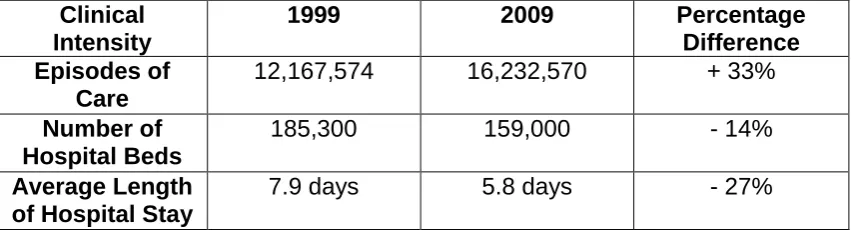
However, the statistics (Table 1) indicating the sheer intensity of recent clinical
activity over the last decade, may prove otherwise. Although the total
episodes of care rose by 33% over the period, the number of beds available
and average length of patient stay fell dramatically. Consequently nurses are
caring for more patients on a much quicker throughput, yet have fewer
hospital beds to allocate them. Based on these statistics, there is certainly
reason to believe that resources are being stretched, and that subsequently,
time constraints are a real cause for concern amongst nurses in the NHS.
Clinical Intensity
1999 2009 Percentage
Difference Episodes of
Care
12,167,574 16,232,570 + 33%
Number of Hospital Beds
185,300 159,000 - 14%
Average Length of Hospital Stay
[image:19.595.86.512.569.684.2]7.9 days 5.8 days - 27%
Table 1 – ‘Clinical Intensity from 1999-2009’
Staff Perspectives
Teytelman‟s (2002, page 122) assumption that documentation can be “a nurse‟s best friend in his or her professional career,” must be questioned as a
consequence of the negativity already portrayed within this review.
Consequently, it is hardly surprising that the literature largely blames poor
attitudes for inconsistent and incomplete nursing documentation (Allen, 1998;
Owen, 2005). Cheevakasemook et al (2006, page 368) reinforce this
suggestion in determining that nursing documentation is “devalued as an unimportant task,” which is commonly viewed as a burden amongst nursing
staff. Such a statement implies that there is no direct relationship between
documentation and patient care, i.e. poor documentation practice can exist
alongside good patient care. This, of course, marks a substantial variance
from NMC (2010) guidance, and therefore must be acknowledged as a major
problem within current nursing documentation practice.
There are a number of authors who are critical of the perceived negative
attitudes towards documentation, most notably Allen (1998) and Duffield et al
(2008). That being said, Allen (1998, page 1229) does concede that there is “a very real danger” of nurses giving priority to written records, rather than
administering care to patients on the ward. Such a statement indicates that
documentation should not be the priority activity for nurses. Accompanied with
time constraints issues, the above studies have strongly indicated that nurses
generally have very negative opinions of nursing documentation, which, in
turn has had a detrimental effect on the quality of written information.
Education
On a different note, some studies are keen to dismiss poor attitudes and time
constraints and argue that some nurses do not have sufficient knowledge or
skills to fill in documentation efficiently. Webb and Pontin (1997, page 400)
certainly recognise this and describe education in this area as a “major
challenge.” However, it is the work of Cheevakasemsook et al (2006, page
efficiently complete documentation. In particular, a participating nurse in the study is said to have confessed that, “we don‟t know how to create a nursing
care plan.” The planning of care has previously been identified as a
fundamental and key purpose of nursing documentation. The above statement
therefore indicates that issues exist which are far deeper than the initial
concerns of time resource indicated within the literature. Pontin and Webb
(1997) and Cheevakasemsook et al (2006) diagnose an apparent uncertainty
amongst nurses, particularly in the establishment of best practice for
completing care documentation. Whilst it must be noted that the work of these
authors only reflect the attitudes of staff within two health-care institutions, a
sense of nurse insecurity is noted in other investigations, notably in terms of a
growing emphasis on litigation (Nazarko, 2007), a reluctance to consider
documentation as a high priority activity (Owen 2005) and the impact of the
recent emergence of electronic sources of documentation (Ting Lee, 2005).
Lack of Standardised Approaches
In particular relevance to this study, problems have also been associated with
a lack of standardisation in terms of the development and management of
nursing documentation within health institutions (Cheevakasemsook et al,
2006). In truth it is surprising that this area of concern does not dictate more of
the literature, particularly as it is argued that the lack of guidelines or a
standard approach to documentation can “lead to wasted time, high costs and uncomfortable charting.” (Cheevakasemsook et al, 2006. page 367). Although
Cheevakasemsook et al (2006) further highlight the need to promote high
quality documents and written responses through the use of standardised
procedures or guidelines; little indication is given as to how this may be
achieved. Indeed, the literature is unable to clarify exactly what a high quality document is. This is epitomised by the NMC‟s „Record Keeping Guidance for Nurses and Midwifes‟ (2010), which concentrates on the information to be
written within nursing documentation rather than providing guidance for the
creation of high quality documents that are fit for purpose. At this stage it is
difficult to tell whether this marks a gap in the literature or indeed a gap within
such uncertainty forms the starting point for this study, in terms of how an
approach towards document management and control may improve previous
concerns relating to perceived negative attitudes, a lack of education and time
constraints.
2.2.2 Improvements in Nursing Documentation
A number of studies have investigated systems designed to improve nursing
documentation within healthcare institutions (Karlsen 2007, Bjorvell et al 2003,
North and Serkes 1996). Each of these studies has attempted to improve the
quality of written information through the re-design of a single nursing
document. Whilst the improvement of written information is undoubtedly an
important aspect to tackle, especially in terms of an apparent lack of nurse
competence, little advancement is made towards the setting up of minimum standards and procedures for all of an institution‟s nursing documents. This
seems particularly bizarre in light of Cheevakasemsook et al (2006) opinions
that a lack of minimum standards is likely to have a detrimental effect on a
health-care institution.
Consequently, there appears to be a general sense of confusion amongst the
literature. Although it is generally agreed that there are substantial problems
with current nursing documentation practice within the NHS, authors offer
differing opinions of both the root causes, and suggestions for improvement.
In order to bridge some of the gaps in the literature, this study aims to
thoroughly investigate nursing documentation issues within a single NHS
organisation. In addition, the study will investigate potential improvements
from a differing angle, in anticipation that better systems of document control
and management will eradicate some of the aforementioned concerns relating
to perceived negative attitudes and inconsistent written entries within nursing
2.3 Organisational Change
The concepts of organisational change and change management certainly
seem to be a popular area for the publication of literature in recent years. It
must be noted that, as a consequence, this section of work does not intend to
review all the available literature, but, instead, aims to address areas which
are relevant to this particular study. Whilst organisational change specific to
the NHS and public sector are explored in more detail in the following sections
of this review, in the first instance it is useful to grasp an understanding of the
basic approaches made towards change management as a concept. A review
of the literature points to two distinct approaches to the management of change; „Planned‟ and „Emergent‟.
2.3.1 Planned Change and Kurt Lewin’s Three Step Model
The literature struggles to produce a concrete definition of Planned change, however Burnes (2004, page 267) refers to the concept as a term, “to
distinguish change that was consciously embarked upon and planned by an
organisation, as averse to types of change that might come about by accident,
by impulse or that might be forced on an organisation.” Central to Planned
change is the notion of a cyclical, iterative process which identifies a
collaborative nature of the change effort (Coram and Burnes, 2001). In this
sense, all members of an organisation should plan, and be involved in
change. Many authors trace the origins of Planned change to Kurt Lewin and acknowledge his work around „Force Field Analysis‟ and „Group Dynamics‟ as
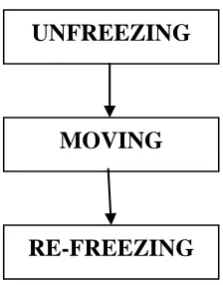
instrumental concepts to understanding the approach (Bamford and Daniel, 2005; Carnall, 2007; Connor and Lake, 1994). However, it is the „Three-Step Model‟ which “is often cited as Lewin‟s key contribution to organisational change”. (Burnes, 2004, page 274). The Three-Step Model emphasises the
iterative approach in terms of defining a number of pre-planned steps to move
from one fixed state to another (Bamford and Daniel, 2005). Lewin argued that
Figure 1: ‘Lewin’s Three-Step Model (1951)’
The primary stage of the Three-Step Model, „Unfreezing‟, involves
organisational recognition that change is required and the need to destabilise current behaviours so that new attitudes and skills can be adopted. „Moving‟
involves the exploration and identification of the options available for change. The final stage, „Re-freezing‟, involves the stabilisation of change to ensure
that new behaviours are adopted and old equilibriums are discarded.
A number of authors have described Lewin‟s Three-Step model as „unfashionable‟ in recent years, and scrutinise an apparent inability for the
model to fully address organisational issues (Burnes 2004, Connor and Lake 1994). Consequently recent literature has attempted to elaborate on Lewin‟s
model, to develop additional steps and phases. Of particular mention are Bullock and Batten‟s (1985) „Four Phase Model of Planned Change‟ and Lippit et al (1958) „Seven Phase Model of Planned Change‟. Seemingly not wanting
to be outdone, Cummings and Huse (1989) also developed an eight phase model in relation to Lewin‟s work.
The emergence of newer models has clearly changed thinking around the
Planned change approach, to the extent that some authors refer to a strong association with the newer phenomenon of „Organisation Development (OD)‟
(Burnes, 2004; Coram and Burnes, 2001). Consequently Burnes (2004, page 267) concludes that, “the Planned approach to change is now most closely
associated with the practice of Organization Development (OD) and indeed
lies at its core.” That being the case, the existence of OD must be challenged. UNFREEZING
MOVING
Is this a new concept which adds value to the literature surrounding change management, or alternatively is it merely „Planned change‟ disguised in new
clothes? The answer to such a question will bring about much difference in
opinion; however, the evidence portrayed within this review would suggest that OD adds little to the initial „Planned‟ approach. Instead, a „re-branding‟ exercise is suggested, in attempts to tackle the „unfashionable‟ criticisms of
Planned change, cited within the literature.
Wooten and White (1999, page 7) indicate that, “much of the existing OD
(Planned approach) technology was developed specifically for, and in
response to, top-down, autocratic, rigid, rule based organizations operating in
a somewhat predictable and controlled environment.” This has led many
authors to take a critical stance to Planned change, particularly in terms of an inappropriate approach to today‟s world. Specifically, the literature identifies
two particular problems, which are as follows. Firstly, many writers are critical
of the linear approach of Planned change (Connor and Lake 1994; Burnes
2004, Carnall 2007). In particular, it is emphasised that such an approach is no longer appropriate as, “change cannot occur from one stable state to
another with the turbulent business environment that exists today”. Bamford
and Daniel (2005, page 393). There is certainly some substance in the argument that today‟s world is „turbulent and chaotic‟ and that, as a
consequence, a more continuous and open ended process is required to
manage organisational change (Burnes, 2004). In addition, the literature is critical of the model‟s inability to tackle radical and transformational change
(Schein, 1985; Francis et al, 2003; Burnes, 2004). Secondly, the collaborative
approach central to the concept of Planned change is widely criticised as an
unsuitable approach towards change management. In particular, it must be
recognised that it is unlikely for all members of an organisation to work
together, in the same direction, to sustain change. Therefore, the model is
often scrutinised for not allowing enough scope for organisational conflict
2.3.2 The Rise of Emergent Change
The concept of Emergent change has gained the support of more recent
literature, perhaps in an attempt to overcome the criticised aspects of Planned
change. In an attempt to define the concept, this section of work refers to
Burnes (2009, page 371), who explains that,
“the Emergent approach starts from the assumption that change is not
a linear process or a one off isolated event but is a continuous,
open-ended, cumulative and unpredictable process of aligning and
re-aligning an organization to its changing environment.”
Supporters typically view the Emergent approach as a continuous process
that is usually achieved through small, incremental changes. This, in time, will
lead to major transformations within an organisation (Coram and Burnes,
2001; Esain et al, 2008; Burnes, 2009). In addition, Emergent change emphasises „bottom up‟ actions rather than the „top-down‟ approach associated with Planned Change. “The rationale behind this is that the pace of
change is so rapid and complex, once it occurs, that it is impossible for senior
management to identify, plan and implement every action required.” (Bamford
and Daniel, 2005, page 394). Essentially, therefore, it is argued that change
management should involve individuals from all levels of the organisation. This marks a substantial difference from the „top-down‟ approach, through
which there is strong reliance on senior management authority and decision
making.
Criticisms that the process of change can rarely follow a sequence of
pre-determined stages have led to a number of alternative models, which encourage continual improvements. Of particular mention are Deming‟s model of „Plan, Do, Check, Act‟, Kotter‟s (1996) „Eight Steps to Successful Change‟ and Francis et al (2003) who developed a model of „Five Competencies‟
related to transformational change. It must be noted, however, that these
models have a number of similarities with their Planned change counterparts,
steps towards the management of change. This, of course, questions the real
need for the literature to promote separate approaches, but these criticisms
are detailed more thoroughly within the section below.
Although, the Emergent approach is said to provide a different dimension to
the concept of change management, it has notably received a number of
critical remarks (Bamford and Daniel, 2005; Connor and Lake, 1994; Hendry,
1996). Critics typically point to three areas of discussion. Firstly, the approach
seems to assume that all organisations operate within a turbulent
environment. Coram and Burnes (2001, page 98) issue concerns over the applicability of the process in determining that, “it is, by its own definition, not
applicable to organisations operating in stable environments where fine-tuning
is the order of the day, or those whose circumstances require major changes
through the use of rapid and coercive measures.” Secondly, Bamford and
Daniel (2005, page 393) put forward the argument that supporters of Emergent change “appear more united in their stance against planned change
than their agreement upon a specific alternative.” It must be noted that the
researcher came to a similar conclusion when passing judgement on the
information received throughout the literature. Whilst a number of different
Emergent models for organisational change have been identified within this
chapter, none are accredited with the innovation, or indeed the prestige, that is associated with Lewin‟s Three Step Model and Planned change. Finally, it is
argued that all processes of change should have a beginning, middle and an
end, as indicated within the Planned change model (Coram and Burnes, 2001;
Connor and Lake, 1994). Taking a critical stance, there are certainly many similarities between Kotter‟s (1996) and Deming‟s „Emergent Models‟ and Lewin‟s model of „Planned Change‟, perhaps most notably that they seek to
recognise the need for change, make the necessary amendments and ensure that the new „status quo‟ is embedded within the organisation. Hendry (1996,
page 624) particularly reinforces the opinion of the researcher in stating; “scratch any account of creating and managing change and the idea that
change is a three-stage process which necessarily begins with a process of
2.3.3 Putting Change Management into Perspective
In view of the literature outlined above, it would appear likely that support will
remain divided for the Planned and Emergent approaches to change. Burnes (2004) adds an additional angle to the debate; the „Contingency Theory‟,
which wisely acknowledges that no two organisations are the same. In this
sense the approaches taken towards the management of change should vary
in the view of differing organisational structures and operations. “Consequently the „one best way‟ for all organisations is replaced by the one best way for each organisation.” (Burnes, 2004. page 70).
The literature widely criticises the limitations of both approaches, yet does not
provide a solid foundation through which to pass judgement over which, if any,
models should be selected over another for the purposes of change
management. This review has therefore not served to promote a single
approach for which to base the research, but instead has indicated the appropriate need to categorise change models as „situational‟ (Coram and
Burnes, 2001). The key message to be taken into the main body of this study
is that the approach to change should therefore be particularly dependant on
2.4 Managing Change in the NHS / Public Sector
The previous sections of this review indicated that the concept of
organisational change has been a popular area for the publication of literature
in recent years. However, it is noticeable that the vast majority appear to focus
on approaches tailored around the private sector (Coram and Burnes, 2001;
Betts and Holden, 2003; Page et al, 2008). Initially, this marks a substantial
gap within the literature, which seems to dismiss a key aspect in relation to
this study, namely; the requirement to develop relevant approaches to change
within public sector organisations.
The differences between public and private management models seem to split
opinion within the literature. In the first instance Coram and Burnes (2001)
indicate that public sector managers face different challenges from private sector counterparts, “especially in terms of public accountability,
demonstrating value for money, and in meeting the increasing expectations,
regarding service levels and quality, of both the general public and politicians.”
However, this opinion clashes with other authors, most notably Page et al
(2008), Esain et al (2008) and White (2000), who suggest that increasingly
turbulent environments have led to closer parallels between the public and
private sectors. McHugh and Brennan (1994) and Bamford and Daniel (2005)
establish a number of structural changes within the UK public sector, which in
turn have put new pressures on public sector managers to increase customer focus and further emphasise quality of service. “Managing change is,
therefore, not only the preserve of the private sector, but integral to
management in public and voluntary sectors.” (White, 2000, page 162).
2.4.1 Structural Changes within the NHS
Before judgement may be passed over the debate which has been
documented in relation to the extent of the gaps between public and private
sector management, it is important in the first instance to note the
monumental scale of structural change which has occurred within the NHS
emergence of „NHS Trusts‟ in the early 1990s, followed by the more recent creation of „NHS Foundation Trusts‟, has aimed to devolve a traditionally
centralised government approach, and the intended drawing of clinicians into
managerial roles has become more commonplace. In a paper entitled, „A Short Guide to NHS Foundation Trusts‟, the Department of Health (2005,
page 2) emphasise that current institutions are,
“at the heart of a patient-led NHS, where local managers and staff
working with local people have the freedom to innovate and develop
services tailored to the particular needs of their patients and local communities.”
The structural changes mark a huge shift from the traditionally centralised „NHS system‟, and although the organisation is unlikely to ever become fully
self-sufficient, the new reforms have been criticised by a number of authors. O‟Brien (2002, page 443) describes the new changes as “top-down radical shock strategies,” while others reflect on de-motivated staff (Bamford and
Daniel, 2005) and the inability for clinicians to carry out managerial roles
(Johnson and Scholes, 2001). However, these criticisms generally sit outside
the boundaries of this study, and, of more importance are the impact of these
changes and the bridging of gaps in organisational thinking and strategy.
Consequently, the re-structuring and privatisation of a number of public sector
organisations has led to an “increasingly hazy” (Coram and Burnes, 2001
page 95) boundary between the public and private sector. The creation of an
independent approach to managing change within the public sector, at least
within the example of the NHS, would therefore seem inappropriate,
particularly as it would appear that the business styles and management
systems of the private sector are frequently crossing over into public sector
organisations. Instead, it is imperative that the NHS‟ management and staff
are receptive to the recent structural changes and able to adopt new approaches that are appropriate to the challenges that they face (O‟Brien,
Recent authors are keen to promote the „Emergent‟ model as an appropriate
mechanism for managing change in the modern NHS (Massey and Williams,
2006; Esain et al, 2008). This seems logical based on the recent radical
structural changes of the organisation as a whole. However, it is important to
approach such opinions with an element of caution, particularly drawing on
previous conclusions that the approach taken towards change should be purely „situational‟ (Burnes, 2004). Consequently, the approach taken by one
particular NHS institution may not necessarily be transferrable to other
healthcare organisations. The ability for Foundation Trusts to formulate their
own strategic objectives has opened the doors to the notion of continuous
improvement within the NHS (Esain et al, 2008). This poses a major challenge
for management. Institutions are no longer expected to simply provide a
service, but, instead, are required to adapt to the requirements of customers
and mirror strategies which are more closely associated with private sector
organisations. This marks a significant transformation from the traditionally
stable and static environment of the NHS, and undoubtedly results in critics labelling the „Planned‟ approach as an inappropriate mechanism towards the
management of change.
In addition, a number of authors indicate that top-down management
approaches are no longer appropriate for the newly reformed NHS system (O‟Brien, 2002; Massey and Williams, 2006; Johnson and Scholes, 2001).
This is particularly well portrayed in a recent study, where a Chief Executive of a UK „Trust‟ concedes that, “some of the decisions (from top management) aren‟t very good because that small group is so far removed from the information.” (Johnson and Scholes, 2001, page 288). However, it is the work
of Massey and Williams (2006) around the role of change agents within the
NHS that sparks most interest. Here, the authors identify that radical changes have enabled leaders to step forward, giving them opportunities to “make a difference to their own and their team‟s environment while also delivering care
to patients.” (Massey and Williams, 2006, page 669). Again, this seems to align with the bottom-up approach associated with „Emergent‟ change and
emphasises how staff members may be better placed to tackle change
2.4.2 Putting Change Management in the NHS into Perspective
In introducing the management of change within the NHS, the researcher
initially suggested that there was a substantial gap within current literature in
relation to a perceived lack of public sector focus around organisational change. However, the increasingly „hazy boundaries‟ (Coram and Burnes,
2001) which have been revealed throughout this review have established that
the proposed gap within the literature is not as severe as originally
anticipated. The addition of radical structural changes within the NHS also
acts in placing less importance on the divide between the sectors and the
desire to develop alternative models specifically suited to organisational
change within the public sector. It must be noted, therefore, that this research
does not intend to add to the literature in this fashion. The current literature
portrays a strong desire to adopt a universal model for organisations to follow
in order to manage change. This seems bizarre, as the inabilities of current
models to adapt to certain situations or environments are well documented.
This is epitomised by a piece of work undertaken by Bamford and Daniel
(2005), who attempted to match three theoretical models with a change
management approach undertaken by an NHS institution. Their work concludes that „no suitable model yet exists‟ for explaining the process of
change, and that the approach taken by the organisation involved mixed
elements of a number of different theoretical models.
This review has diagnosed the promotion of „Emergent‟ models for change
management, both in the NHS and the public sector. Whilst authors are able
to provide reasoned arguments as to why this should be so, they fail to take
into account the differing situations which organisations operate within.
Consequently, this review will not be promoting a particular model for use within the intended research, but, instead, aims to reiterate that there is „no
best way‟ to manage change. To provide some concluding remarks, the
researcher is in firm agreement with Coram and Burnes (2001, page 95), who indicate that is of far more importance for an organisation to, “balance the
structural and cultural aspects of change, especially the need to appreciate
important area in the management of change, particularly in view of recent
structural changes in the NHS. Consequently, the next section of this review
addresses the literature of this topic in more detail.
In conclusion, there are two main points that are illustrated within this section
of the literature review. Firstly, the recent structural changes of the NHS and
subsequent reforms of other public sector organisations have bridged gaps in
the perceived differences through which change should be managed. Secondly, regardless of the organisation, there is „no one best way‟ to
manage change. This dismisses the need for public sector organisations to
adopt differing models to private sector counterparts. As a consequence, this
study does not intend to align the case study organisation‟s approach for
change to a particular model, but instead, will promote an approach which
matches the situation and environment which the organisation operates
2.5 Corporate Culture
The literature widely acknowledges that corporate culture is difficult to define
(Burnes, 2004; Brunetto, 2001; Schraeder et al, 2004). As a result there are a
number of definitions, however as Brunetto (2001, page 467) explains, “all
make reference to shared assumptions, beliefs, attitudes, rituals and values that shape the organisational life of one group of employees.” This reference
to a single group of employees is intriguing, and is supported by the work of other authors, who identify that the „superficial‟ culture reflected in an institution‟s policies and mission statement rarely reflects the actual culture of
an organisation. Consequently it is not uncommon for sub-cultures to exist
within different divisions of an organisation (Brunetto, 2001; Johnson et al
2005; Burnes, 2004). In relation to this study, it is therefore important to note
that different cultures may exist within separate departments, divisions or
even amongst different wards. An investigation of the cultural issues within the
case study organisation will therefore need to be undertaken to explore this
possibility.
Bearing this in mind, perhaps the best way to define culture is “the way things
are done around here.” (Burnes, 2004, page 170). It must be stressed that
employees who adopt this notion will naturally resist programmes which
threaten to change routines and rituals (Schraeder et al, 2004). Consequently,
many writers are of the opinion that managers should be wary that a shift in
cultural thinking may be necessary for organisational change to be successful
(Brunetto, 2001; Schraeder et al, 2005, Burnes, 2004).
2.5.1 Culture Identification within the NHS
Previous research suggests that the values and motives of public sector
employees are distinct from their private sector counterparts (Brunetto, 2001; Schraeder et al, 2004). This seems bizarre in light of the increasingly „hazy boundaries‟ (Coram and Burnes, 2001) between public and private sector
management, previously identified within this literature review. However, with
be made to the possibility that recent radical transformations are yet to be fully
embraced, and that subsequently, undesirable staff values and motives remain within the organisation. This links particularly well with Lipsky‟s (1980) „Street Level Bureaucracy‟ concept, through which the policies and objectives
of public sector managers are not shared by the lower level participants of the
organisation. Indeed, Lipsky identifies the lower level workers of the public sector as the „policy setters‟, as they have “considerable discretion in
determining the nature, amount, and quality of benefits and sanctions provided by their agencies.” (Lipsky, 1980, page 13). Consequently the
decisions that nurses make in terms of how they are able to care for patients
are almost certainly detached from the result-orientated approach that
management take towards performance and cost-saving.
Bearing this in mind, managing change within the NHS can be difficult (Alexis,
2005). Accompanied with the recent structural transformations, it is vital for
managers to understand the cultures that exist within the organisation, to
identify potential barriers to change and to keep individuals and groups
motivated so that they can perform to the best of their abilities (Alexis, 2005).
2.5.2 The ‘Cultural Web’
The literature contains many established and well-recognised tools to
determine and measure culture within an organisation. Of particular mention is
the work of Handy (1986) who categorised culture into the four groups of
power, role, task and person; Deal and Kennedy‟s (1982) four classifications of organisational culture; Cummings and Huse (1989) „Four Major Elements of Culture‟; and the McKinsey „7-S framework‟ designed by Peters and
Waterman (1982), which defines culture as a central component of all
organisational activity. Although each of these models would be suitable for the purposes of identifying culture, after a period of reflection the „Cultural Web‟ developed by Johnson et al (2005) was taken forward as the most
substantial access to staff members within the case study organisation, and the ability to identify and „re-map‟ culture as a result. In an attempt to better
define the concept of the cultural web, this review makes reference to
Johnson et al (2005, page 201), who describe their model as a, “representation of the taken for granted assumptions, or paradigm, of an organisation and the physical manifestations of organisational culture.”
As can be seen from Appendix A, the „Cultural Web‟ comprises of seven key
elements, which are described as follows;
The paradigm is the set of assumptions which are taken for granted and are held in common within an organisation. This sits within the
centre of the model
The rituals and routines indicate the “way things are done around
here” which illustrates the way in which staff members behave towards
each other and the organisation as a whole.
The stories which are shared by members of the organisation to stakeholders reflect current attitudes and highlight important events
which have occurred throughout the history of the organisation.
The symbols of the organisation i.e. company cars, laptops, titles etc. aid in determining power structures and the nature of an organisation.
The key individuals or management groupings are reflected within the element of power structures. These individuals are most likely to be commonly associated with the organisation‟s core paradigm, and are
identified in anticipation of emphasising what is important to the
organisation.
Organisational structures are likely to reflect power, and once again, identify important groups/individuals to promote what is important to the
organisation.
The control systems illustrate the various performance measurement and reward systems which focus activities towards what is of overall
The development of a cultural web as part of this research is likely to have
three distinct benefits. Firstly, surfacing the taken for granted assumptions
within an organisation is useful in the first instance for “questioning what is normally rarely questioned” (Ambrosini et al. 1998, page 139). Ultimately, change will prove difficult if the very nature of an organisation‟s existence and
purpose are never fully identified or questioned. Secondly, the web can also
be used to identify both the pushing and resisting forces to change. As a
consequence, change agents will seek to develop an approach which utilises the strengths of an organisation‟s culture and overcomes or reduces the
forces which are likely to have a detrimental effect upon the change
programme. Thirdly, Johnson and Scholes (2001) imply that the web may be
used to „re-map‟ an organisation‟s culture. They argue that mapping the
desired paradigm, routines, symbols etc. that would support a new strategy
would indicate the difficulties of change management and provide an insight
as to what may or may not be managed throughout cultural change (Johnson
and Scholes, 2001).
As part of their work, Johnson et al (2005) documented a cultural web of an NHS institution, as portrayed by a small number of the organisation‟s Ward
Managers. Although information could effectively be drawn from that model, it
must be noted that the data is unlikely to add any value to this study. Firstly,
the information has been drawn from a different organisation, which although
categorised as an NHS institution, is unlikely to share the same cultural issues
as the case study organisation. Secondly, the information was drawn from senior management, who, as identified through Lipsky‟s (1980) street-level
bureaucracy theory are likely to have differing perceptions to lower-level staff
members. Consequently, this review has determined the need for a cultural
web of the case study organisation to be developed. Whilst the researcher‟s
perceptions of culture recorded within this model will be open to scrutiny, the
advantages of access to the behaviours and routines of large proportions of
nursing staff will help in diagnosing potential pushing and resistant forces to