The London School of Economics and Political Science
In the Shadow of the Prison Gates: An Institutional Analysis of
Early Release Policy and Practice in England and Wales, 1960
– 1995
Thomas Charles Guiney
Declaration
I certify that the thesis I have presented for examination for the MPhil/PhD degree of the London School of Economics and Political Science is solely my own work other than where I have clearly indicated that it is the work of others (in which case the extent of any work carried out jointly by me and any other person is clearly identified in it).
The copyright of this thesis rests with the author. Quotation from it is permitted, provided that full acknowledgement is made. This thesis may not be reproduced without my prior written consent.
I warrant that this authorisation does not, to the best of my belief, infringe the rights of any third party.
Abstract
This thesis explores the historical development of early release policy and practice in England and Wales between 1960 - 1995. The evolution of criminal justice as a public policy concern has attracted considerable interest within the literature but this has tended to focus on the role of individuals as key agents of policy change or the ‘big picture’ socio-economic shifts associated with late twentieth-century modernity. Comparatively little attention has been paid to the mediating role of institutions at the intersection between policy and politics.
This thesis builds the case for a systematic and historically grounded analysis of public policy and examines the important, but often overlooked, influence of political institutions on the trajectory of criminal justice in England and Wales. Building upon detailed archival research this thesis considers three critical junctures in the evolution of early release policy and practice; the introduction of a modern system of parole in the Criminal Justice Act 1967; the complex policy debates that surrounded the extension of release on licence to short sentence offenders in the 1980s; and the steps taken to rationalise the operation of early release by the Carlisle Committee and Criminal Justice Act 1991.
Table of Contents
Abstract 3
List of Tables 6
List of Figures 7
Acknowledgements 9
1. Criminal Justice in Historical Perspective, 1960 – 1995 11
1.1 Introduction 11
1.2 Continuity and Change within the Criminal Justice System 13 1.3 The evolution of ‘Early Release’ in England and Wales 31 1.4 Research Questions and Contribution of this Thesis 41
2. Developing a Theoretical Framework: Towards an Institutional
Analysis of Early Release Policy and Practice 44
2.1 Introduction 44
2.2 Theorising Policy Change within the Criminal Justice System 45
2.3 The ‘New Institutionalism’ 59
2.4 Summary of Theoretical Approach 72
3. Research Design and Methodology 75
3.1 Introduction 75
3.2 The Criminologist as Historian 76
3.3 Research Design: A Case Study Approach 81
3.4 Methodology 86
3.5 Summary of Methodological Approach 104
4. An ‘Idea Whose Time Had Come’: The Establishment of a Modern
System of Parole in England and Wales, 1960 – 1968 106
4.1 Introduction 106
4.2 The Context 107
4.3 Preparing the Ground 119
4.4 The Criminal Justice Act 1967 141
4.5 Conclusion 150
5. The Politics of Inertia: The Extension of Early Release to Short
Sentence Offenders, 1975 – 1982 159
5.1 Introduction 159
5.2 The Context 160
5.3 What to do About Short Sentence Prisoners? 167
5.4 The Criminal Justice Act 1982 199
6. Early Release at a Crossroads: The Carlisle Committee and
Criminal Justice Act, 1987 - 1992 212
6.1 Introduction 212
6.2 The Context 213
6.3 The Long Road to Legislation 222
6.4 The Criminal Justice Act 1991 245
6.5 Conclusion 257
7. Discussion 266
7.1 Introduction 266
7.2 The Evolution of Early Release Policy and Practice 267
7.3 Epilogue: The Merits of Historical Study 279
8. References 282
9. Appendices 325
Appendix 1: Early Release Key Event Timeline, 1960 – 1995 326
Appendix 2: Biography of Key Actors 328
Appendix 3: The Freedom of Information Act as a Social Science
Research Tool: A Methodological Note 331
Appendix 4: Lord Gardiner’s note ‘A Parole System’ to the Study
Group on Crime Prevention and Penal Reform, March 1964 339 Appendix 5A: Guidance to civil servants on briefing the Home
Secretary 1965 340
Appendix 5B: Revised guidance for civil servants on briefing the
Home Secretary, 1966 340
Appendix 6: Letter from Michael Moriarty, Head of the Crime Policy Planning Unit to Neil Cairncross, Deputy Under-
Secretary of State, 15th May 1975 341
Appendix 7: Letter from the Lord Chief Justice to Home Secretary,
9 October 1981 343
Tables
Table 1: National Archives, Key File Series 88
Table 2: Interview Schedule and Background Information 93
Figures
Figure 1: Total Recorded Crime, England and Wales, 1900 –1997 15 Figure 2: Overall Crime, CSEW and Recorded Crime, England and
Wales, 1981 – 1997 17
Figure 3: Persons Sentenced to Immediate Custody, 1950 – 2001 21 Figure 4: Average Prison Population in Comparison to the Certified
Normal Accommodation of the Prison Estate, 1960 – 1995 22 Figure 5: Geographical Spread of Prison Estate England and Wales,
1965 23
Figure 6: Geographical Spread of Prison Estate England and Wales,
1995 23
Figure 7: Government Expenditure on Welfare, Healthcare, Education,
Defence and Protection in Millions (2014 prices) 27 Figure 8: Functional Breakdown of Home Office Expenditure,
1968 – 1990 28
Figure 9: The Operation of Parole for Determinate Sentences,
1968 – 1994 35
Figure 10: Parole Board Expenditure, 1978/79 – 1994/95 (at 2014 prices) 36 Figure 11: Ontology, Epistemology and Methodology: A Directional
Dependence 44
Figure 12: Tributaries to Legislation Responses to Crime Volume 2 49 Figure 13: Initial Orientation towards the Primary Data 74 Figure 14: Illustrative Example of Thematic Analysis 102 Figure 15: UK Parliamentary Majorities, 1959 – 1997 114 Figure 16: Government Spending as a % of Gross Domestic Product
(GDP), 1960/61 – 1994/95 116
Figure 17: Number of Prisoners held Either Two or Three to a Cell,
1965 – 1991 118
Figure 18: Computation of Parole Release Eligibility 131
Figure 20: Divisions during the Passage of the Criminal Justice Act 1967 143 Figure 21: Divisions during the Passage of the Criminal Justice Act 1991 143
Figure 22: Daily Mirror, Monday 12 August 1968 149
Figure 23: Home Office Prison Population Projections 1970 – 1973 161 Figure 24: Media Reception to the Extension of Parole 173 Figure 25: Home Office Options Appraisal of Early Release for
Short Term Prisoners 190
Figure 26: Caricature of Home Secretary Whitelaw in New Society 195 Figure 27: Video Recordings from the 1981 Conservative Party
Conference 196
Figure 28: Media Response to the 1981 Conservative Party
Conference 197
Figure 29: The Use of Partly Suspended Sentences, 1982 – 1990 202 Figure 30: Incidence of Prison Indiscipline, 1972 – 1995 215 Figure 31: The Average Remand Population, 1974 – 1994 217 Figure 32: Media Response to Hurd’s Introduction of 50%
Remission 225
Figure 33: Extract from file ‘1987 General Election: Manifesto
Planning notes and briefs’ 227
Figure 34: Carlisle Committee Recommendations 232
Figure 35: Home Office Impact Assessment of the Carlisle
Committee Recommendations upon the Prison Population 236 Figure 36: Composition of the Commons Select Committee,
Criminal Justice Bill 1990/1991 247
Figure 37: House of Lords Division on Life Sentences, Criminal
Acknowledgements
This thesis would not have been possible without the help and encouragement of my friends, family and work colleagues.
I would like to place on record my deep-felt gratitude for the support and guidance of my supervisors Tim Newburn and Robert Reiner. During the course of this study I have proved conclusively that Tim’s door really is always open and I would like to thank him for all the advice, experience and signature straight-talking he has offered over the last few years. Robert’s classes on crime and criminal justice first piqued my interest in criminology and his irrepressible energy and enthusiasm for the subject have been a constant source of inspiration for me ever since.
Over the last six years the LSE has become a home from home for me and I would like to thank all the staff and students in the School of Social Policy and the Mannheim Centre for Criminology for helping to create such a friendly and intellectually vibrant environment for PhD study. I am indebted to the many archivists, civil servants and librarians who dealt with my numerous information requests with such professionalism and I would also like to extend my thanks to those I interviewed in the course of this study for being so generous with their time and thoughtful in their responses. I hope I have done justice to the incredible wealth of information they have all shared with me.
As a part-time student my thanks are due to all my work colleagues, past and present, for tolerating my regular absenteeism and to Carol in particular who helped to fill in so many of the gaps in my knowledge about the Home Office and offered a much needed sounding board as my thinking began to take shape. Thanks also to my good friends John, Gina, Chris B, Tracey, Sarah, Marcus, Chris P, Mark and Sophie as well as my old Oakhill Court housemates Charlotte, Chloe, Pete, Antony and Kat. Your patience and healthy indifference towards this study has kept me grounded and well drilled on the virtues of brevity and plain English.
Source: TNA: HO 303/98
1.
Criminal justice in historical perspective, 1960 – 1995
1.1 Introduction
It has been said with truth that it is easy to imprison a man; the difficult thing is to release him (Home Office 1959 p.19).
In this study I examine the various ways in which the liberal democratic state seeks to justify, and in turn, administer an effective criminal justice system. In particular I argue that a systematic and historically grounded study of public policy can help to illuminate the evolving aims and techniques of criminal justice in England and Wales between 1960 - 1995.
In this introductory chapter I outline the central concerns of this study and reflect upon how criminal justice has evolved as a public policy concern since 1960. The broad contours of this historical shift have been well mapped within the criminological literature (see Bottoms and Stevenson 1992; Garland 2001; Windlesham 1993). In short, this general picture suggests that as classical theories of punishment fell into decline in the late nineteenth century a modernizing project began to gather pace, which saw punishment re-cast primarily as a means of rehabilitating offenders (Allen 1981; Garland 1985). Over time this perspective grew in sophistication and exerted increasing influence over the administration of criminal justice in post-war England and Wales. By the 1960s this had crystalized into a policy framework Garland has described as ‘penal welfarism’, a complex web of values and attitudes united by a common belief that, ‘penal measures ought, where possible, to be rehabilitative interventions rather than negative, retributive punishments’ (2001 p.34).
criminal justice has fundamentally re-shaped criminal justice policy. Where the operation of the criminal justice system had once been seen as a bipartisan matter with a strong humanitarian impulse, the emergence of a highly charged ‘penal populism’ has often seen ‘penal effectiveness sacrificed at the altar of electoral advantage’ (Roberts et al 2003 p.5; see also, Bottoms 1995; Lacey 2007).
Comparative historical analysis offers a unique insight into the significant reconfiguration of the criminal justice landscape since 1960 (Farrell et al 2014). L.P Hartley famously wrote that ‘the past is a foreign country: they do things differently there’ (Hartley 1953) and this neatly encapsulates the appeal of historical study, it reminds us of the contingency of seemingly stable social structures and forces us to confront taken for granted ideas and assumptions about the political world. ‘Distilling the frenzy’ of contemporary historical events (Hennessey 2013) focuses our attention
on the changing knowledges, understandings and techniques of government as well as the various actors, ideas and struggles that came to define the administration of criminal justice in the latter half of the 20th century. For these reasons Loader and Sparks have argued that, ‘an account of change in the criminal justice arena is best approached as a special case of an historical enquiry into politics’ (2004 p.6). It draws
attention to the ‘struggles over the meanings and import of such ideas as order, authority, legitimacy, freedom, rights and justice’ that go to the heart of public policy (Loader 2006 p.562). But most importantly it speaks directly to evolving conceptions of the ‘right’ and the ‘good’ society (Rawls 1999; Sandel 1998).
of criminal justice policy. In so doing my point of entry will be the evolution of ‘early release’ policy and practice from 1960 – 1995, thirty-five years characterised by continual legislative and administrative reform in England and Wales (a theme I return to in Chapter 3 of this study).
I will argue that contemporary discussion of crime control and penal policy has focused to a significant degree on the entry points into the criminal justice system, most notably, the politicisation of law and order (Downes and Morgan 2007), the role of the police (Newburn 2003; Reiner 2000), sentencing behaviour (Bottoms 1995; Roberts et al 2003) and the centrality of the prison within our penal ‘imaginary’ (Mathiesen 2005; Pratt 2007). But this is only one part of the story. Criminology has had relatively little to say about the termination of prison sentences (Padfield 2007; 2012a). The extract above from the White Paper ‘Penal Policy in a Changing Society’ (Home Office 1959) is so interesting (and seemingly counter-intuitive), because it shifts the locus of penal enquiry from the sentence of the court and the quantum of punishment to the day-to-day operation of the penal system and the decision to release prisoners back into society. In that sense this is a study of what goes on behind the scenes of our criminal justice system. It is a study of what happens in the shadow of the prison gates.
In this introductory Chapter I outline the central concerns of this study and expand upon why the reconfiguration of criminal justice in England and Wales is such an important topic for scholarly enquiry. I begin with a detailed review of the primary data and secondary literature and what they reveal about the evolution of criminal justice between 1960 – 1995. Having examined the broad contours of this historical shift I turn to the evolving role of early release within the administrative apparatus of the criminal justice system. Here I argue that ‘early release’ has been a relatively unexplored area of public policy that merits further scrutiny. Finally, I offer a summary of my research questions, the contribution of this thesis and an overview of the chapters that follow.
1.2 Continuity and Change within the Criminal Justice System
of public policy, has become an altogether more complex pursuit since the 1960s and the breakdown of the post-war consensus (Dutton 1997; Kavanagh and Morris 1994; Marsh et al 1999). But this is as much a story of continuity as change (Faulkner 1991). Penal administrators operating in 1960 would have recognised many of the central concerns of criminal justice at the close of the 20th century and yet, the re-configuration
of criminal justice and the role of the liberal democratic state within that process would no doubt seem extraordinary and deeply troubling for a generation of penal administrators shaped by the world-view of penal-welfarism and active, if often reluctant, participants in the emergence of a more muscular brand of penal populism (Pratt 2007). The literature detailing these shifts is far-reaching and cannot be reviewed in detail here. Instead I draw attention to three particularly significant dimensions of change within the criminal justice field; the politicisation of criminal justice, the operational implications of a more punitive conception of punishment and the critical role of the Home Office at the inter-section between politics and policy.
1.2.1 The politics of crime control
The first and arguably most striking feature of change has been the steady erosion, either real or perceived, of the liberal democratic state as the pre-eminent guarantor of social order (Garland 1996), a trend that has gone hand-in-hand with the emergence of crime as a subject of intense political and public debate (Garland 2001; Loader and Sparks 2004; Newburn 2007b p.425).
Drawing upon evidence from police recorded crime figures and the Crime Survey of England and Wales1 (CSEW) it is possible to trace the broad contours of this historical shift. In so doing it is necessary to proceed with caution. There has been a tendency amongst politicians and other commentators to treat these statistics as an objectively ‘true’ or ‘real’ picture of crime but in reality both data sources offer a partial perspective that can both illuminate and obscure an analysis of crime trends (Maguire 2007 pp.253-254). Recorded crime statistics have been collected since 1851 and allow for a broad historical survey of the incidence of crime made known to the police. However, these figures are subject to variations in police accounting and limited in scope to ‘notifiable offences’ that ignore the prevalence of less serious, ‘summary
offences’ (Newburn 2007b). In comparison, the CSEW is generally seen as a more reliable measure for many classes of criminal activity. However, it does not cover some serious crimes like murder or so-called ‘victimless crimes’ like drug abuse, while the more recent origins of the survey can make longer-term historical comparisons difficult (Maguire 2007 pp.241-301).
[image:15.595.114.525.357.675.2]For these reasons extrapolating long-term historical trends is challenging and value-laden. Nonetheless, there does appear to be a degree of convergence in the data, at least for the period 1960 - 19932. The recorded crime statistics suggest that the incidence of crime increased markedly in the post-war era before beginning to fall around 1995. As Figure 1 reveals, a total of 743,713 crimes were reported to police in England and Wales in 1960, a figure that grew steadily through the 1970s before accelerating to 5,100,241 in 1995.
Figure 1: Total Recorded Crime, England and Wales, 1900 - 1997
Source: Home Office (2012)
Over time the steep rise in recorded crime became highly contested and a significant focus of political debate (Maguire 2007 pp.253-254) but the headline figures can
obscure subtle differences in the incidence of crime over time, between rural and urban settings as well as individualised, lived experiences of crime. Significant variation can also be found between classes of criminal offence. Total violent crime, including assault and homicide increased from 49,439 reported incidents in 1960 to 310,936 cases in 1995, a rise of 529% in thirty years (Home Office 2012). Property offences also increased markedly albeit from a higher baseline. To take one example, the incidence of theft and the handling of stolen goods increased from 763,561 in 1960 to 2,452,109 in 1995, a rise of 221% (Home Office 2012). More difficult to quantify is the relationship between recorded crime rates and the so-called ‘dark figure’ of actual crime (Biderman and Reiss 1967). For example, Reiner (2010) has suggested that it is possible to distinguish a number of distinct phases within the recorded crime rise. Drawing on evidence from the General Household Survey (GHS), Reiner argues that between 1955 - 1983 much of the rise in recorded crime, particularly in relation to property offences, can be attributed to the increasing propensity of victims to report crimes to the police (2010 p.254). Thereafter, reporting rates began to stabilise and the available evidence does confirm that crime grew at an unprecedented rate between 1983 – 1992, before beginning to fall after 1993.
A broadly comparable picture can be found in the CSEW. Established in 1981 as the British Crime Survey (BCS), the survey indicates that the recorded crime statistics significantly underestimate the incidence of crime while also appearing to reinforce the conclusion that crime increased markedly in the 1980s before beginning to fall in the mid-1990s (see Figure 2). Total reported crime increased from 11,066,000 in 1981 to a peak of 19,109,000 in 1995 before falling thereafter. Allied to this there was also a worrying increase in the risk of victimisation. The percentage of households that reported they had been victims of crime once or more in 1981 was 27.7%, a figure that would increase to 39.7% in 1996 before beginning to fall. The impact of this transformation in the basic conditions of social life led the sociologist Jock Young to describe rising crime rates as ‘the major motor in the transformation of public behaviour and attitudes, in the development of the crime control apparatus…’ (1999
policy-makers sought to deal with the inexorable rise in recorded crime, especially amongst young people (1989 p.93).
Figure 2: Overall Crime, CSEW and Recorded Crime, England and Wales, 1981 – 1997
Source: ONS (2013)
Morris suggests that governmental responses to crime progressed through four discreet phases in the post war period. In the aftermath of World War Two deterrence and the ‘certainty of detection’ emerged as the primary tools of crime control. In the 1960s this gave way to a ‘period of optimism and the power of rehabilitation’ (Morris 1989 p.106). Ultimately this proved short lived and the 1970s ushered in a period of scepticism about ‘rehabilitation’ defined by a belief that ‘nothing works’ (often attributed to the much misquoted Martinson 1974). In time this fatalism was supplanted by a more pragmatic focus on situational crime control and a ‘just deserts’ sentencing philosophy premised upon the belief that punishment should be proportionate to the harm caused by the offence (von Hirsh 1976 and 1985; von Hirsh and Ashworth 1998).
[image:17.595.113.526.146.425.2]2001). For much of the post-war period crime control was a bi-partisan matter to be administered by experts away from the glare of party politics (Windlesham 1987, 1993, 1996, 2001). This undoubtedly had political benefits so long as the bipartisan equilibrium was maintained but it also reflected a strong civilising impulse to manage such an emotive issue in the right and proper way (Loader 2006). As Roy Jenkins made clear in his maiden speech as Home Secretary to the House of Commons on 2nd February 1966,
In my view crime is a most unsuitable subject for strict party conflict, and as long as I am Home Secretary I hope that we can prevent it from becoming a subject for strict party conflict. It is a most unsuitable subject because it is one in which, more than most, passion and emotion are very bad counsellors. We all have a duty to encourage the nation to look objectively at the facts and to see which reasoned conclusions about prevention and punishment can be drawn from them. It would be most unwise to introduce politics into the question of crime to the extent of suggesting that this most difficult situation was the fault of this Government (HC Deb 2 February 1966 vol 723 c1121).
The Conservatives fused the issues of law-breaking and order defiance. They attacked not just the policies but the integrity of Labour. They refashioned their traditional claim to be the natural party of government, representing the order of established authority. They successfully pointed to Labour’s responsibility for the alleged ‘ungovernability’ of Britain. They capitalized on widespread public fears about: national decline; loss of economic competitiveness and bad industrial relations; the growth of permissiveness and declining public morals; fear of crime, inner city decay, and the extravagances of youth fashion and street protests. They made restoring the ‘rule of law’, which they claimed Labour had undermined, one of their five major tasks… (Downes and Morgan 2007 p.204).
The 1979 election had been won, in part, on ‘the most radically tough law and order ticket the Conservatives had ever produced’ (Downes and Morgan 2007 p.213) but away from the rhetoric government policy for much of the 1980s continued to rest upon a complex blend of classic liberalism, one nation conservatism and an emerging ‘new right’ agenda that blended elements of neo-liberalism and neo-conservatism (O’Malley 2000). Reiner (2010) has described law and order in the 1980s as a rather phoney ‘war on crime’ and with the notable exception of public order argues that there was a systematic attempt to make greater use of non-custodial sentences, to implement findings from the nascent field of situational crime control and recast crime control as a social issue for which everybody must take a share of the responsibility (2010 pp.8-9). This ‘Indian summer’ (Windlesham 1993) came to an end following the 1992 General Election as the Major government grappled with the mass unemployment associated with the ‘Lawson boom’, the destabilising effects, both political and economic, of ‘Black Wednesday’ and the steps taken by Kenneth Clarke and Michael Howard to move government policy in a more punitive direction (Downes and Morgan 2007 p.258).
cost of Conservative economic mismanagement; the Criminal Justice Act 1991 was heavily condemned for focusing on the offence rather than the offender; while the now famous ‘tough on crime, tough on the causes of crime’ slogan came to signify New Labour’s embrace of a more muscular approach to law and order. So much so that by the mid-1990s the main political parties were converging around a more punitive law and order agenda and, ‘a new second order consensus emerged. No party could any longer afford to cede the law and order ground to the opposition: all parties felt obliged to address it in some way’ (Downes and Morgan 2007 p.204).
1.2.2 The ‘punitive turn’
The decline of the ‘rehabilitative ideal’ (Allen 1981) and subsequent politicisation of law and order had a profound impact upon the emotional tone of penal policy and justifications for punishment (Garland 2001; Pratt 2007). As the demand for more retributive forms of justice increased so too did the ‘toughness’ of punishment and the centrality of the prison within the modern penal imaginary (for a dissenting view see Mathews 2005; 2010).
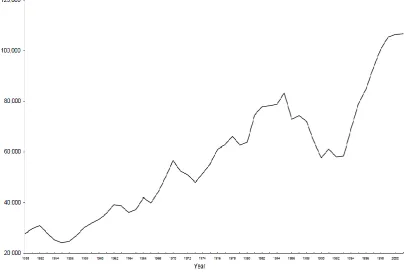
The impact upon the prison population was particularly pronounced. Between 1960 - 1995 the courts demonstrated a growing propensity to sentence offenders to custody and for longer periods of time. Figure 3 reveals that in 1965 approximately 40,000 persons found guilty of criminal offences were sentenced to immediate custody. By 1985 this figure had doubled to more than 80,000 before concerted effort by the Home Office, the Lord Chief Justice and the Magistrates’ Courts resulted in year-on-year reductions in the use of custody between 1985 and 1994 (Home Office 2002) at which point the use of immediate custody began to rise sharply. Similar trends can be found in sentence lengths. In 1969 the average sentence length for males aged 17 or over was 11.5 months. By 1986 this had increased to 13 months cementing the position of England and Wales as one of Europe’s most prolific incarcerators (see Home Office Criminal Statistics England and Wales, 1960 – 1995).
is, ‘growing evidence that sentences are affected not only by the legislative context in which they work but also by the general mood, or what Tonry refers to as “sensibilities” – the penal zeitgeist’ (2007 p.459).
Figure 3: Persons Sentenced to Immediate Custody, 1950 – 2000
Source: Home Office (2001 p.18)
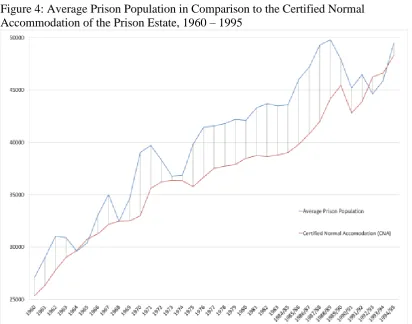
Figure 4: Average Prison Population in Comparison to the Certified Normal Accommodation of the Prison Estate, 1960 – 1995
Source: Various, Home Office Report on the Work of the Prison Department 1960-1987. Home Office, Report on the Work of the Prison Service 1988 – 1991, HMPS Report on the Work of the Prison Service, 1992 - 1996
A rising prison population also saw the emergence of a new form of ‘tactical management’ as the Home Office sought to maximise the use of accommodation
within the prison estate (Faulkner 2014 p.41). In 1965 the Prison Service operated 108 facilities in England and Wales, a figure that increased to 165 establishments in 1995 as the Government shifted its focus from large urban prisons towards the flexibility of a greater number of medium-sized facilities. The geographic spread of prison institutions in England and Wales between 1960 and 1996, along with an indication of prison capacity can be found below at Figure 5 and Figure 6. At a strategic level this logic was understandable but in practice the efforts of the Prison Service to even out the distribution of prisoners within the estate presented a series of operational challenges. Tactical management of the prison estate saw the regular use of ‘overcrowding drafts’ to transfer prisoners to less overcrowded prisons. These drafts
Conditions in local prisons were particularly poor while the landmark Mountbatten Report (Home Office 1966c) into prison security and the Prison Department’s subsequent adoption of a policy of dispersal served to promote a focus on control and risk management to the detriment of the rehabilitative programmes associated with penal welfarism (Ryan 203 p.28).
In part, these operational pressures appear to be the administrative by-product of wider shifts in the moral basis of punishment and the politicisation of penal policy. For the first half of the twentieth century punishment was largely rehabilitative in its focus and orientated towards the successful integration of offenders back into society. It is important not to overstate this point, Ryan (2003) has written persuasively about the underlying disconnect between the rhetoric and reality of the ‘rehabilitative ideal’, but there is no doubt that this guiding philosophy exerted considerable influence on those working within the criminal justice system. Perhaps the archetypal expression of this policy position can be found in the 1959 White Paper ‘Penal Practice in a Changing Society’,
The constructive function of our prisons is to prevent the largest possible number of those committed to their care from offending again. Since the report of the Gladstone Committee in 1895, it has been accepted that this end will not be reached by a regime designed simply to deter through fear. The object should be, in the words of that Committee, to send the prisoners out “better men and women, physically and morally, than when they came in” (Home Office 1959 p.11).
sentencing behaviour (Bottoms 1995 p.40). The impact of this shift upon the prison estate has been considerable. Roberts et al have suggested that a central feature of the punitive turn has been a tendency to ‘allow the electoral advantage of a policy to take precedence over its penal effectiveness’ (2003 p.5) with the result that an increasingly
tough political stance has often gone hand in hand with an administrative or technocratic discourse of ‘crisis’. The following description of the prison estate from Dennis Trevelyan, Director General of the Prison Service in the 1980 Prison Service Annual Report is typical of this outlook and will be explored in greater detail in Chapters Four, Five and Six of this study,
Conditions for prisoners, already poor in many prisons, deteriorated still further; the risk of serious disorder inevitably increased; main services ranging from power supply to the drainage never designed to cope with such numbers were overloaded. The prison service at all levels was driven to concentrate on crisis management which even before 1980 had absorbed so much of its energy and resources as to inhibit more constructive work (Home Office 1980b p.3).
This review of the evidence does suggest that punishment has become an altogether more emotive and politicised issue in England and Wales. The operational implications of this shift have been profound. As the prison population has grown, costs have escalated and everyday conditions within the prison estate deteriorated for much of the period in question. In turn penal administrators have been forced into a series of adaptive strategies to deal with the new realities of mass incarceration. This has seen the emergence of a ‘grim realism’ within the Home Office (Faulkner 2014 p.41), growing calls for the use of non-custodial measures and a discourse of crisis that has seen many policy-makers, practitioners and penal reformers internalise the belief of a prison estate in turmoil and on the brink of catastrophic breakdown.
1.2.3 The Home Office
The third, and arguably least developed, issue within the existing literature concerns the role of the Home Office as both a catalyst and brake upon policy change.
The American political scientist Theda Skocpol once remarked that, ‘as politics create policies, policies also remake politics’ (1992 p.58) but this dialectic remains a rather
challenges of a high prison population (Howard League 2009; Mathiesen 2005) comparatively little is known about the role played by the Home Office at the intersection between these forces. How did the internal workings of the Home Office influence the development of public policy? What role did its culture and ethos play in the trajectory of criminal justice? How did the Department relate to other key stakeholders within the criminal justice ecosystem?
The first point to note is that discharging the various responsibilities of the Home Office became an altogether more complex and administratively burdensome task between 1960 – 1995, not least because the Home Office was responsible for a uniquely broad and disparate portfolio of interests. In part this reflected the Home Secretary’s residual responsibility for the Royal Prerogative and the historic position of the Home Office as the de facto administrator for tasks that had not been allocated to other Government Departments. As both a Minister of State and Secretary of State at the Home Office few were better qualified to reflect upon this unique challenge than Douglas Hurd when he noted that,
… the Home Office in 1983 handled a more bizarre ragbag of unconnected matters than it does today. As the senior Minister of State I found myself at once coping with criminal justice, the police, the regulation of broadcasting, civil defence, gambling, racing and anything else which happened at the time to need a ministerial presence or signature. Each of these subjects had its own hierarchy within the Home Office, and its array of pressure groups outside’ (Hurd 2003 p.288).
This diverse portfolio required a large executive. Mirroring increases across Whitehall total staff numbers (industrial and non-industrial) at the Home Office and its various subsidiaries grew from 20,861 in 1970 to 49,353 in 1992. During this time the junior ministerial team also grew in size and stature. In 1970 the Home Secretary could call upon the services of one Minister of State and two Parliamentary Under-Secretaries. By 1995 this had expanded to three Ministers of State and one Parliamentary Under-Secretary supported by a team of special advisors.
prisons and the courts grew from approximately £3.5bn in 1960 (at 2014 prices) to £22.5b in 1995, a budgetary increase that represented comparable real term growth to investment in Education, Health and Welfare albeit from a far lower baseline (see Figure 7).
Figure 7: Government Expenditure on Welfare, Healthcare, Education, Defence and Protection in Millions (2012 prices)
Source: UK Public Spending, www.ukpublicspending.co.uk/
In contrast investment in the Probation and Aftercare Department was marginal while the Prison Service budget grew from £578m to £2billion as additional investment came on stream in the 1980s. In part this reflected the rising cost of accommodating prisoners as the average annual cost of accommodating an adult male offender grew from £6,983 in 1965 to £32,021 in 1995 (at 2014 prices). But it also represented a significant capital outlay, the centre-piece of which was the Thatcher governments’ £1 billion investment (1987 prices) in a prison building programme, the largest of its kind since the Victorian era.
Figure 8: Functional Breakdown of Home Office Expenditure, 1968 - 1990
Source: Various, HMSO Government Expenditure Plans 1968 - 1991
England and Wales’ and a series of initiatives including the Next Steps Agencies and
Citizens Charter intended to open up public administration to private sector discipline and rigour (Jones 1993).
As McLaughlin has noted, the Home Office was one of a few Departments that ‘steadfastly refused to publish an annual report, set targets or construct benchmarks
against which its performance could be measured’ (1994 p.118). But this began to change as the financial outlook for the United Kingdom deteriorated and it became clear that the government’s commitment to law and order was not delivering substantive reductions in recorded crime, re-offending or increases in police clear-up rates (McLaughlin 1994 p.115). Faced with the inability or unwillingness of various criminal justice agencies to respond to increasing criticism and ‘put their houses in order’ (McLaughlin 1994 p.115) the government responded in the late 1980s by
opening up the criminal justice system to investigation from the Public Accounts Committee, the National Audit Office and Audit Commission (Jones 1993 p.198). This process began to fundamentally re-shape the Department leading to the establishment of the Prison Service as an Executive Agency in 1993 and the appointment of Derek Lewis, a former chief executive of Granada Television as Director General, the first non-career civil-servant to hold the post. As Faulkner has argued, the eventual embrace of new public management principles by the Home Office proved to be a double edged sword,
The new public management undoubtedly brought important benefits – an increase in efficiency, a discipline of quantitative and cost-conscious analysis, a focus on achieving results rather than administering a process, sometimes improvements in safety or openness and accountability. It broke down some sense of the secrecy, and some of the professional mystique, in which some professions, for example the law, medicine and the police had been able to operate… None of these benefits should be underestimated. But it also, sometimes, brought a loss of trust, a culture of blame, and a loss of respect for equity, loyalty and even integrity. Public administration came to be portrayed as it if were a technical matter, indistinguishable from other forms of management, in which values or principles had no place… (2006 pp.29-30).
there is has tended towards internalised accounts that prioritise descriptive rigour over explanatory power. For example, glimpses of life in the Home Office can be found in the reflections of Roy Jenkins (1991) and his 1975 article, ‘On Being a Cabinet Minister’, as well as the memoirs of William Whitelaw (1989) Douglas Hurd (2004),
Kenneth Baker (1993) and David Waddington (2012). Other notable contributions to this area include the 1976 Cropwood Round-Table Conference ‘Penal Policy Making in England’ (Walker and Giller 1977) and an interview with Michael Moriarty on the subject of law-making within the Home Office for the BBC documentary series ‘Westminster and Beyond’ edited by King and Sloman (1973).
A more considered treatment of the topic can be found in the 1982 RIPA publication ‘The Home Office: Perspectives on Policy and Administration’ to mark the
Bicentenary Anniversary of the Home Office. Among the many contributors, former Home Secretary James Callaghan offers a fascinating insight into the centralizing tendencies of the Department, the autonomous workings of each Directorate, a heavy legislative workload and a rather myopic outlook that prioritised short term crisis management over long-term strategic planning (Callaghan 1982 pp.9 - 22). More recently, a comprehensive overview of life in the Home Office has been offered by David Faulkner, a former Deputy under Secretary of State, in his publication ‘Servant of the Crown’ (2014). Faulkner offers a fascinating account of his career as a civil
servant and the ascendancy and subsequent decline of a liberal disposition towards the problem of crime. But I would argue that ‘Servant of the Crown’ is at its most interesting for what it reveals about the Home Office as an institution, its culture and configuration. One gets the sense of a Department struggling to keep pace with rapid social, economic and political change. For example, Faulkner describes a Prison Service in a ‘constant state of crisis’ and indicates that the department struggled to respond to multiple and complex social problems in a holistic way because, ‘it was part of the culture of the Home Office that the different departments, and the divisions within them, did not interfere with each other’s business’ (2014 p.69).
publication from Radical Alternatives to Prison and the National Council of Civil Liberties (Cohen and Taylor 1976) or the interesting debates that built up around the 1985 Social Democratic Party proposal to create a Ministry of Justice (Clement-Jones 1985). For example, Tony Gifford criticised the Byzantine machinery of government that linked the Home Office, Lord Chancellor’s Office and the Attorney General (1986 pp.16-23). Anthony Lester QC (as he then was) criticised the ‘institutional schizophrenia’ of the Home Office he attributed to a Departmental conflict of interest between its ‘justice’ and ‘security’ responsibilities (1984 p.139). While the SDP Working Party concluded that, ‘over the last 20 years the Home Office’s legitimate concerns to maintain order and security have increasingly overshadowed its role in safeguarding liberty’ (Clemont-Jones 1985 p.2), an assessment that strongly suggests
that the Home Office was not a neutral arbiter in disputes between public safety and individual liberties.
In this section I have examined the evolution of criminal justice as a public policy concern in England and Wales between 1960 – 1995. My review of the primary data and secondary literature has revealed a complex picture of continuity and change. It is apparent that administrative concerns such as resource prioritisation, public presentation delivery are just as important today as they were in 1960 but over time these choices have been transformed by the politicisation of criminal justice; the ‘punitive turn’ in justifications for punishment and the changing role of the Home Office at the intersection between politics and policy. This suggests a significant reconfiguration of criminal justice in England and Wales with important implications for the humanity, fairness and effectiveness of the system (Lacey 2007) and the relationship between citizens and the state (Faulkner 2014).
1.3 The evolution of ‘Early Release’ in England and Wales
the criminal justice system, the termination of sentences and the release of offenders back into the community. As an area of public policy that impacts so profoundly upon individual liberty, early release is inherently bound up with societal justifications for punishment and the legitimate role of imprisonment within a liberal democracy (Padfield 2007; Padfield et al 2012a). Equally, the termination of prison sentences is an extremely challenging legal-administrative task that merits detailed study in its own right. It requires effective oversight of a detailed caseload, coordination between a variety of different agencies and the careful balancing of individual liberty and public safety (Morris and Beverley 1975).
In this section I examine the historical development of early release policy and practice in England and Wales. I begin by defining my terms and unpacking the central concerns of this study. I then explore this process of policy change in more detail. Early release was subject to almost continual reform between 1960 – 1995 and I will argue that three dimensions of this historical shift are particularly apparent within the primary data and secondary literature; the shifting normative basis for early release; growing interest in human rights and procedural justice; and efforts to improve the day-to-day administration of the parole system. My analysis reveals that there has been very little historical study of early release and by implication few systematic accounts of how these forces coalesced over time to shape the long-term historical trajectory of early release policy and practice in England and Wales. It is these concerns that have informed my research questions and the central findings from this study set out in Chapter Seven.
1.3.1 Conceptualising ‘early release’
advocated throughout the period in question. While each of these mechanisms has resulted in the release of determinate sentence offenders before the end of the sentence imposed by the court their historical antecedents, legal basis and practical operation have differed markedly.
The concept of remission was originally introduced by prison authorities as a tool of control to assist with the maintenance of order within the prison estate (Padfield et al 2012a p.968). Remission of a prison sentence could be earned by a prisoner for positive co-operation with the prison authorities while indiscretions would typically result in the forfeiture of accumulated benefits. For this reason, remission was a discretionary privilege in the gift of the Prison Governor but over time it evolved into a presumptive entitlement to only be withheld from prisoners in cases of bad behaviour (Home Office 1989c; McConville 1981). This entitlement was eventually codified after the Second World War when the Prison Rules were amended to the effect that all prisoners in England and Wales serving determinate prison sentences were eligible, subject to good behaviour, for unconditional release after serving two-thirds of their sentence (Fox 1952). This makes quantitative analysis of remission difficult. Because remission time applied to all sentences, subject to good behaviour, no information was collected by the Home Office on a systematic basis making it impossible to trace the development of remission with any confidence. In this sense remission exerted a strong gravitational pull within the penal system for while it cannot be measured directly its presence was certainly felt by prison service personnel and prisoners alike.
In contrast, the concept of parole has tended to evoke a future-orientated quality concerned with a prisoner’s suitability for conditional release back into the community (Hood and Shute 2002). Derived from the French chivalric tradition, parole was originally used as a term of art in times of war when an officer gave his ‘parole d'honneur’, or word of honour, not to escape from captivity, or to refrain from certain other actions to which his captors object (Hansard HL Deb 12 June 1967 vol 283 c721). In more recent times parole has acquired a more specific legal meaning and in their study of the fledgling parole system Morris and Beverly defined the modern parole system as ‘a procedure whereby a man’s sentence may be varied by administrative action’ (1975 p.2). While remission provided a reward for past deeds
sentence and released on licence with the possibility of recall to prison for breach of their parole conditions. Hood and Shute put this in the following terms,
The concept of parole - by which we mean the discretionary release of prisoners from custody under some form of supervision before the expiration of their sentence - has a long, honourable, yet turbulent history within the English penal system. Parole has assumed a number of different forms and had a variety of justifications. But fundamentally it has always rested on the assumption that the court, when imposing a sentence of imprisonment, especially a long sentence of imprisonment, is not in a position to judge the precise period for which it is necessary to keep an offender in custody for the protection of the public. Parole, therefore, has always been linked to some degree of indeterminacy of sentence based on consequentialist criteria. As such, it has existed in actual or potential conflict with classical, desert-based approaches to the allocation of punishment (Hood and Shute 2002 p.835).
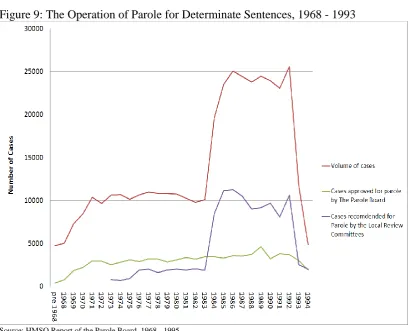
As a product of consequentialist logics it is perhaps unsurprising that parole has demonstrated such remarkable plasticity as a tool of public policy. Since the creation of the modern parole system in the Criminal Justice Act 1967 the operation of parole for determinate prisoners has progressed through a number of distinct operational stages as policy makers sought to adjust the risk appetite of the Parole Board and streamline decision-making for prisoners serving short sentences. Figure 9 reveals that for most of the 1970s the number of cases processed by the parole system, either by the Parole Board or locally based Local Review Committees, fluctuated at around 10,000 applications per year. During this time the number of cases approved for parole increased steadily from 2210 in 1970, a 28.3% success rate, to approximately 5000 in 1980, representing a success rate of over 50%. Thereafter the volume of cases considered for parole increased dramatically following Leon Brittan’s decision in 1983 to reduce the minimum threshold for parole to six months. As a direct consequence of this decision to extend parole to the majority of short sentence prisoners the caseload of the parole system peaked in 1986 when 24,380 cases were considered and approximately 15,000 prisoners were granted parole, a success rate of over 60% that bore little resemblance to the risk-averse instincts of the early Parole Board.
scope of the parole system and this downtrend accelerated after 1992 when the Criminal Justice Act 1991 came into effect and introduced a radically altered system of parole based upon greater recognition of just deserts and risk management (Hood and Shute 1994).
Figure 9: The Operation of Parole for Determinate Sentences, 1968 - 1993
Source: HMSO Report of the Parole Board, 1968 - 1995
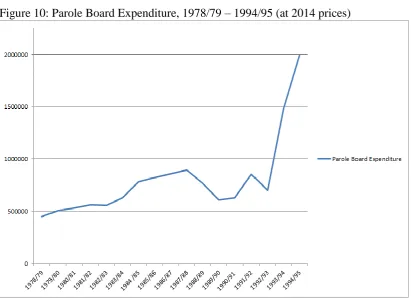
These policy changes had a significant impact upon the administration of the parole system. In 1970 the lay membership of the Parole Board stood at 27 supported by a full time Chair and a secretariat of six officials. By 1990 the membership of the Parole Board had grown to 63 with a secretariat of 9 full time officials. As Figure 10 reveals the expenditure of the Parole Board also grew steadily from 1978/79 before increasingly rapidly after 1992/93 as the government responded to the case of Thynne, Wilson and Gunnell v United Kingdom3 by placing the review of discretionary life sentence prisoners on a judicial footing with greater regard for due process, provision of legal representation and a right to address the court.
Figure 10: Parole Board Expenditure, 1978/79 – 1994/95 (at 2014 prices)
Source: HMSO Report of the Parole Board, 1978 - 1995
This general picture suggests that the policy and practice of early release did change significantly between 1960 - 1995. But what was going on behind these headline figures? In what follows I want to suggest that the existing literature has tended to focus on three significant dimensions of policy change within early release policy and practice.
1.3.2 An uncertain inheritance
1967 was closely linked to prevailing interest in treatment, training and rehabilitation (2003 p.384). This was particularly apparent in the widespread belief that prisoners reached a ‘recognisable peak’ in their training where they were more likely to respond positively to ‘early release’ under supervision than continued incarceration. Reminiscent of Mick Ryan’s (2003) critique of the rhetoric and reality of the ‘rehabilitative ideal’ Shute draws attention to the weak empirical basis of the ‘recognisable peak’ argument and suggests that more pragmatic considerations exerted a significant influence over the development of the modern parole system,
Why might policy-makers have been drawn to claims with so little empirical foundation? The most likely answer is that they offered a convenient way of providing a veneer of theoretical respectability to policies which were driven by other, more pragmatic concerns. One of these was the belief that parole might contribute to the maintenance of discipline in prisons. Even more significant, though was the thought that parole would provide a quick and relatively inexpensive solution to the pressing problem of prison overcrowding (2003 p.385).
In their unpublished article ‘The Changing Face of Parole in England and Wales: A Story of Well-intentioned Reforms and Some Unintended Consequences’ Hood and Shute (2002) elaborated further on this theme. They argue that early release has demonstrated remarkable flexibility as a tool of public policy supporting such varied objectives as ‘quietly releasing out the back door those who were neither in need of rehabilitation nor posed any significant risk to the public’, providing a bridge into the
(Ashworth 1989). In this sense early release can be seen as inherently bound up with wider justifications for sentencing and punishment,
The weight accorded to these different considerations, and the resolution of conflicts between them, has been affected by changes in the structures and objectives of the sentencing and prison systems. It has also been affected by changing conceptions of the problem of criminality, by changing social and legal values, and by changing public sentiments (Hood and Shute 2002 p.836).
Interestingly, I have been unable to find more than a handful of studies that explore either the operation or policy thinking behind remission in detail (McConville 1981; Turner 1966a; West 1972). Unlike parole, remission has tended to operate under the radar of academic scrutiny attracting sporadic attention in times of crisis. Furthermore, there has been little or no sustained enquiry into the relationship between parole and remission, an idiosyncrasy of the British system that appears to have exerted a significant influence over the trajectory of early release in England and Wales (Home Office 1989c; Hunt 1972). More generally these accounts have tended towards the broad sociological sweep of early release rather than the empirical particulars of the policy-making process (Shute 2003). There are few, if any, narrative histories of early release policy and practice while attempts to assess the public policy implications of resource allocation, public administration or management of stakeholders with an interest in early release are limited (for a notable exception see Maguire 1992).
1.3.3 The growing influence of human rights and procedural justice
The second and arguably most discussed dimension of change, concerns the quasi-legal status of early release decision-making (Hawkins 1973; Hood 1974a, 1974b; Padfield 2007). As I noted above early release has profound implications for the relationship between state and citizen and executive control of this process has attracted considerable scrutiny. Padfield et al (2012a) have examined the growth of quasi-judicial decision making and draw attention to prima facie concerns about transparency, due process and accountability in a number of areas of contemporary practice,
and magistrates in the criminal courts are responsible… But the ‘system’ for determining sanctions has, almost by stealth, been stretched: key elements of decision-making have been moved upstream and downstream of the courts, thereby falling largely outside judicial control. On the one hand, a significant number and proportion of criminal sanctions (mainly, but not exclusively, financial penalties) are today imposed out-of-court, administratively, by the police, the Crown Prosecution Service (CPS) and many other bodies. At the other end of the spectrum, decisions about whether and when to release the fast growing numbers of prisoners serving indeterminate custodial sentences – and later whether to recall some of them to prison - lie in the hands of the Parole Board (2012a p.956).
Early release has become a key locus for executive action and Padfield et al question the legitimacy of transferring major decisions about the liberty of individuals to a ‘non-judicial’ or ‘non-court’ body (Padfield et al 2012a p.957). The authors provide an excellent overview of the development of parole and the shift away from rehabilitation to the management of risk before turning to some of the more problematic aspects of the parole system (Padfield et al 2012a pp.968 -980). Chief among them is the problematic operation of indeterminate sentences and the impact of a series of negative judgements from the European Court of Human Rights (ECtHR) that have drawn attention to significant breaches of prisoners’ human rights. What is interesting about the analysis of Padfield et al is the role afforded to the courts and the ECtHR as key drivers of policy change. Far from the Whitehall or Westminster models of policy change, legal decisions emerge as a key driver of reform, prompting the Parole Board to improve its procedures, ‘to make them more ‘court-like’ and bring them more into line with the principles of natural justice and the European Convention on Human Rights (Nichol 2007 pp.1-19).
aftercare and supervision based upon risk-assessment (Liebling 2007 pp.63-71). A useful comparative analysis of international policy and practice can also be found in ‘Release from Prison: European Policy and Practice’ (Padfield et al 2012b) while a
historical perspective on these issues can be found in Bottomley’s ‘Decisions in the Penal Process’ (1973a) and ‘Dilemmas of Parole in a Penal Crisis’ (1984).
1.3.4 The day-to-day administration of early release.
As a direct result of these pressures the day-to-day administration of early release has been the subject of almost continual scrutiny from within the academy and penal reform lobby.
Chief amongst these contributions one finds the Longford Committee report ‘Crime: A Challenge to Us All’ (Labour Party Study Group 1964a) a policy blueprint that was instrumental in championing the introduction of a system of parole eventually given legal effect by the Criminal Justice Act 1967. By the 1970s the initial optimism of the Longford Committee had given way to a new found scepticism about the reformative value of the penal system. In 1975 the National Association for the Care and Re-settlement of Offenders (NACRO) published ‘Parole: The Case for Change’ (Cavadino et al 1977) offering a powerful critique of a system said to be built upon on an unsubstantiated theory, unfair in its treatment of individual prisoners, offered few procedural safeguards such as a right to a hearing and placed huge strain upon prisoners and their families given the uncertain outcome of the discretionary system. A failing exacerbated by the Parole Board’s longstanding refusal to provide reject reasons. In response NACRO called for a more judicial system along the lines outlined above by Hood (1974b). A similar assessment can be found in ‘Prison Secrets’ (Cohen and Taylor 1976). Where NACRO favoured reform of the present system, Radical Alternatives to Prison (RAP) and the National Council for Civil Liberties (NCCL) went further in suggesting that parole was ‘a perfect example of what happens when executive power becomes arbitrary in a closed setting like the prison’ and called for its ‘total abolition’ (Cohen and Taylor p.88).
Present System and Attitudes Towards It’ (Mackay 1980) while the newly formed All Party Parliamentary Penal Affairs Group published ‘Too Many Prisoners’ (1980) calling for automatic release of short sentence offenders. Dissatisfied by the results of an internal Home Office review of early release the Howard League established its own working group under the Chairmanship of Professor the Lord McGregor of Durris. The working groups report ‘Freedom on Licence’ offers a far reaching review of the parole system from the parliamentary debates that shaped the Criminal Justice Act 1967, to the American experience and the contours of the existing parole debate
(Howard League 1981). The report concluded with a series of policy recommendations for the reform of the parole system and called upon the government to take immediate steps to breathe new life into a system that could no longer be relied upon to safeguard the rights of prisoners,
We believe that the Parole Board has become a creature of the Executive and that its independence has been diluted in a way that was not intended by Parliament. As a result, the Board has become a defender of the system as it stands, rather than an explorer of the system as it could be (Howard League 1981 p.83).
This rich and varied literature continued into the 1990s with the deliberations of the Carlisle Committee and Criminal Justice Act 1991 attracting comment from the Prison Reform Trust (1991), the Howard League of Penal Reform (1990), JUSTICE (1990) and many others. Such contributions have provided a wealth of evidence and insight for this study, both as secondary sources on the key developments in early release policy and practice, but also as fascinating primary sources of evidence that reveal something of the key fault lines in early release debate, prevailing vogues in criminal justice and shifting justifications for punishment. That said these sources are by their very nature piecemeal and partisan and provide few clues to the broader socio-economic shifts that structured and sustained such changes. Further research is therefore required to place such sources in their appropriate historical context.
1.4 Research Questions and Contribution of this Thesis
review of the evidence has revealed a more nuanced picture of both continuity and change (see also Faulkner 1991). While many of the central tasks of criminal justice have endured the shocks associated with late twentieth century modernity there is good evidence to suggest that criminal justice has become an altogether more volatile public policy concern (Bottoms and Stevenson 1992; Newburn 2007b; Pratt 2007). Policy-makers have struggled to come to terms with the new realities of the high-crime society and have often been forced onto the back foot in dealing with the administrative implications of a more contested discourse of punishment (Garland 2001). Three dimensions of this shift were particularly pronounced, the politicisation of criminal justice, the punitive turn within punishment and the changing role of the Home Office within this complex eco-system.
While this wider context provides an important backdrop to the development of early release in England and Wales I have argue that unlike the reform of policing, crime control and sentencing, early release has been subject to comparatively little sustained attention, not least as a subject for detailed historical scrutiny. Instead the existing literature has tended to focus on a number of key areas of policy change, most notably the shifting normative basis for parole, the growing influence of human rights and procedural justice (Padfield 2007; Padfield et al 2012a) and reform of the everyday operation of early release (see Howard League 1981). Other elements of the literature remain underdeveloped. There has been little exploration of the historical development of early release, the key periods of reform, crisis and public policy debate. Nor has there been sustained analytical interest in the public policy implications of early release or how policy-makers have sought to shape this area of criminal justice administration. My primary research questions emerge from this review of the existing evidence and have been framed in order to contribute to our understanding of this subject matter in two ways; to construct a detailed narrative history of early release policy and practice in England and Wales and explain these changes. These concerns form my primary research questions: First, in what ways did the policy and practice of early release develop in England and Wales between 1960 - 1995? Second, how might we account for these changes?
the criminal justice field; the politicisation of criminal justice, the administrative implications of a more punitive penal system and institutional change within the Home Office. In Chapter Two I will introduce a fourth element of change related to the broader re-alignment in the political economy of criminal justice. The detailed study of early release offers a useful opportunity to explore how these forces have operated in practice. From this I have derived my secondary research questions.
a) In what ways did the policy-making process change between 1960 - 1995? What might this reveal about the changing roles of politics, practice and expert knowledge within public policy?
b) What impact, if any, did changes in the moral justification for punishment play in the development of early release policy and practice? c) What do the archival records reveal about the changing culture, structure and objectives of the Home Office between 1960 – 1995? In what ways might this have influenced the trajectory of early release policy and practice?
d) In what way did changes in the underlying political economy of criminal justice influence the aims and techniques of early release between 1960 - 1995?
2.
Developing a Theoretical Framework: Towards an Institutional
Analysis of Early Release Policy and Practice
2.1 Introduction
In Chapter Two I develop a theoretical framework for the empirical exploration of my research questions. In so doing I review the various accounts of policy change within the criminological literature and advance the case for a systematic and historically grounded institutional analysis of early release policy in England and Wales.
Given the challenge of conceptualising both the ‘how’ and ‘why’ of policy change I have found the logic model developed by Hay (2002) in ‘Political Analysis: A Critical Introduction’ and set out in Figure 11 below a helpful framework for thinking through
my research questions.
Figure 11: Ontology, Epistemology and Methodology: A Directional Dependence
Source: Hay (2002 p.64)