N A N O E X P R E S S
Open Access
Synthesis of Different Layers of Graphene
on Stainless Steel Using the CVD Method
Ferial Ghaemi
1*, Luqman Chuah Abdullah
1,2, Paridah Md Tahir
1and Robiah Yunus
2Abstract
In this study, different types of graphene, including single-, few-, and multi-layer graphene, were grown on a stainless steel (SS) mesh coated with Cu catalyst by using the chemical vapor deposition (CVD) method. Even though the SS mesh consisted of different types of metals, such as Fe, Ni, and Cr, which can also be used as catalysts, the reason for coating Cu catalyst on the SS surface had been related to the nature of the Cu, which promotes the growth of graphene with high quality and quantity at low temperature and time. The reaction temperature and run time, as the most important parameters of the CVD method, were varied, and thus led to the synthesis of different layers of graphene. Moreover, the presence of single-, few-, and multi-layer graphene was confirmed by employing two techniques, namely transmission electron microscopy (TEM) and Raman spectroscopy. On top of that, electron dispersive X-ray (EDX) was further applied to establish the influence of the CVD parameters on the growth of graphene.
Keywords:Graphene, Stainless steel, Chemical vapor deposition
Background
Graphene is one of the most interesting nanomaterials applied in many expanding disciplines of contemporary studies. This nanomaterial, a two-dimensional (2D) ma-terial, is formed by sp2-bonded carbon atoms that are highly packed into a 2D honeycomb lattice that owns ex-cellent characteristics, such as mechanical, thermal, and electrical properties [1, 2]. In fact, since 2004, many methods have been improved to fabricate high quality and quantity of graphene materials [3–6]. Graphene is classified into three types, including single- or double-layered graphene (SLG; about 1–2 layers), few-double-layered graphene (FLG; consisting of 3–5 layers), and multi-layered graphene (MLG; consisting of 5–10 layers) [7, 8]. Since decades ago, coating carbonic materials on steel in the steel industry has been carried out to improve the steel properties by using of a low amount of carbon materials [9]. Among the different types of carbonic materials such as amorphous carbon materials, gra-phene with unique properties offers highly promising opportunities for the development of stainless steel
surface not only to prevent electrochemical corrosion but also has potential applications in nano-electronics, molecular separation, high-strength composites, and surface coating industries [10–12].
In this process, steel is placed into a carbon-rich envir-onment at high temperatures for a certain amount of time and then quenched. Although the processes for coating the metal with carbonic material are different from the rest, the chemical vapor deposition (CVD) technique is generally used to grow graphene on the sur-face of the metals. Therefore, CVD, as one of the most frequently used techniques, was applied to synthesize graphene [13, 14]. Furthermore, a few researchers did probe into synthesizing graphene on stainless steel (SS) or iron substrate. Though the yield of the graphene pro-duced through CVD method is very poor, the quality of the obtained graphene is high [15, 16]. On the other hand, Cu has a main role to synthesize graphene in a large scale [17]. Therefore, in this research, in order to overwhelm the drawback of producing a large-scale amount of graphene and also keep its quality, CVD on Cu (as promoter catalyst) is considered as one of the most promising methods due to its fabrication in a large-scale and high-quality graphene [18, 19].
* Correspondence:[email protected]
1Institute of Tropical Forestry and Forest Products (INTROP), Universiti Putra
Malaysia (UPM), 43400, Serdang, Selangor, Malaysia
Full list of author information is available at the end of the article
In addition, to achieve the different layers of graphene (SLG, FLG, and MLG) on stainless steel substrates, some parameters of the CVD method should be optimized. Therefore, the most important parameters of the CVD technique, such as reaction temperature and time, which affected the graphitization, the structures, and the amount of the different layers of graphene on the SS sur-face, had been changed. Hence, by controlling these two parameters, the number of graphene layers changed as well. Besides, the SS surface was coated with Cu solu-tion, which had never been attempted before, to pro-mote high quality of graphene sheet on SS surface. On top of that, some analytical instruments were applied to evaluate the resulting graphene. Raman spectroscopy, as a non-invasive method, was utilized to determine the number of graphene layers and graphitization [20]. Other than that, electron microscopes, such as scanning electron microscopy (SEM) and transmission electron microscopy (TEM), were used to determine the morph-ology and the structure of the different types of gra-phene on the SS. Moreover, electron dispersive X-ray (EDX) was employed to investigate the composition of the products.
Methods
In this work, stainless steel (150 meshes, NE Scientific Co., Malaysia) that comprised of 50-μm diameter fibers was purchased and applied as a substrate to synthesize the graphitic structures on its surface. The composition of the SS mesh was obtained by using EDX and is given in the following: C 0 wt%, Si 0.53 wt%, Cr 19.10 wt%, Ni 8.6 wt%, and Fe 70.3 wt%, while the rest had been re-lated to other components. The pristine SS mesh was cut into a circle shape with 2-cm diameter and immersed into 9 M sulfuric acid solution for a few mi-nutes to pretreat the SS surface. After that, the SS mesh was immersed into 50 mM Cu(NO3)2.3H2O solution and sonicated for 2 h to coat the surface of SS with Cu particles. The EDX results of SS mesh coated with Cu are as follows: C 0%, O 5.3%, Si 0.21%, Cr 10.2%, Ni 5.2%, Fe 46.2%, and Cu 32.2%, while the remaining weight was related to other components. The presence of oxygen was associated with the elemental compos-ition of Cu nitrate trihydrate. Besides, when the SS mesh was placed into the CVD reactor and the temperature was increased to 300 °C, the nitrate com-pound was removed.
In order to synthesize the graphene, pure acetylene (C2H2) was used as the hydrocarbon source, while nitro-gen (N2) and hydronitro-gen (H2) were utilized as the carrier gases. Next, the reaction temperature and the time in the CVD technique were altered to grow the graphene with different layers. First, the SS mesh was located in the CVD chamber, and then, the temperature was
increased (950, 1000, and 1050 °C) under the flow of N2 gas. When the system reached the required temperature, the acetylene gas as a carbon source was inserted into the system at 50 sccm with the presence of H2/N2flow (10 ssm/50 sccm), for different run times from 10 to 50 min. Finally, the C2H2flow rate was stopped, and the furnace was turned off under the presence of N2 flow. Thus, in order to evaluate the morphology, graphitization and composition of the produced nanomaterials, Raman spectroscopy, SEM, TEM, and EDX were employed.
Results and Discussion
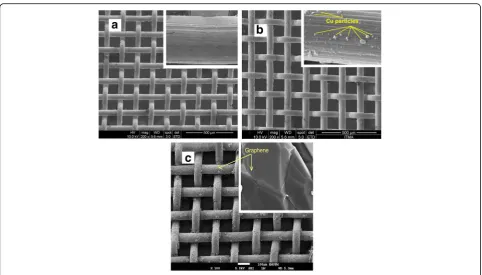
In this research, different layers of graphitic materials were produced on the SS mesh via CVD technique. Hence, in attaining this aim, reaction temperature and run time had to be optimized to control the number of graphene layers. SEM images in Fig. 1 illustrate the neat SS mesh and the SS coated with graphene.
Optimization of the CVD Parameters
The reaction temperature and the run time, as the most impotent parameters of the CVD method, were altered in order to determine the optimum condition to produce SLG, FLG, and MLG on the SS mesh. To further evalu-ate the effects of the reaction temperature and the run time on both the structure and the morphology of the grown graphene on the SS mesh, Raman spectroscopy, TEM, and EDX were applied.
Temperature Effects
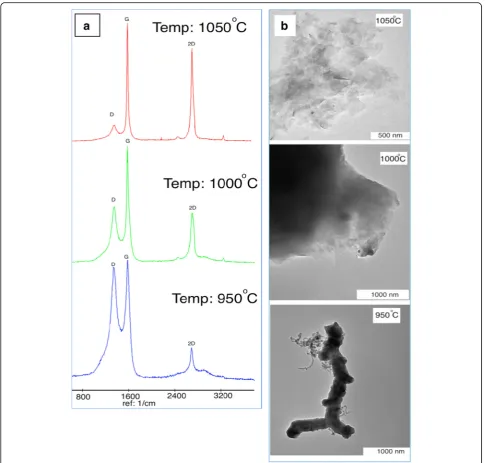
To study the influence of the reaction temperature on the structure and the morphology of the products, the temperature was increased from 950 to 1050 °C at 30 min run time under 50/50/10 sccm with C2H2/N2/H2 flow rate. The number of graphene layers and also the graphitic structures were determined by using the Ra-man spectroscopy, which is not only a non-destructive method but also a fast one [21]. In the Raman spectra, D peak (~1350 cm−1) and 2D peak (~2650 cm−1), in re-lation to the electronic and geometrical structures through the double-resonance process, were investi-gated. The D peak provided information about the breathing modes of the sp2 atom [22] activated by the presence of any defective structure (e.g., lattice disorder, edges, or functional groups [23]). Another peak was the G peak (~1580 cm−1), which was associated with an E2g stretching mode of the graphitic structure. The stretch-ing of the C–C bond in graphitic materials gave rise to the G peak, which was related to all sp2carbon systems. Moreover, the intensity ratio of the D peak and the G peak (ID/IG) was utilized to evaluate the degree of graphitization [23]. Besides, the high amount of the I2D/IG ratio revealed the high quality and also the low number of graphene layers [24]. Therefore, by
increasing the I2D/IG ratio, the number of graphene layers decreased. The Raman spectra at different tem-peratures are displayed in Fig. 2a. It had been discov-ered that by increasing the temperature from 950 to 1050 °C, the intensity ratio of ID/IG decreased, but I2D/ IGincreased, which showed that the graphitization grew with the decrease in the number of graphene layers (in-creased 2D peak and de(in-creased D peak).
Moreover, the TEM images in Fig. 2b revealed the morphology and the structures of the produced mate-rials. In order to carry out the TEM test, the SS mesh was immersed into acetone 60% solution and agitated ultrasonically for 15 min to separate the graphene sheet from the SS surfaces. Based on the achieved TEM im-ages, the carbon nanofiber and the carbon nanotubes were produced at 950 °C, but when the temperature reached 1000 °C, the multi-layer graphene was synthe-sized and the number of graphene layer decreased to few layer at 1050 °C. Besides, based on the EDX results, by increasing the temperature, the carbon atoms creased (Table 1). Therefore, it was found that by in-creasing the temperature, the amount of graphene increased, but the number of graphene layers decreased.
Time Effects
Reaction time leads to the activation of the metallic cata-lyst to grow the different number of layers of graphene with high quality and graphitization. Therefore, the time had to be optimized for each type of graphitic structures
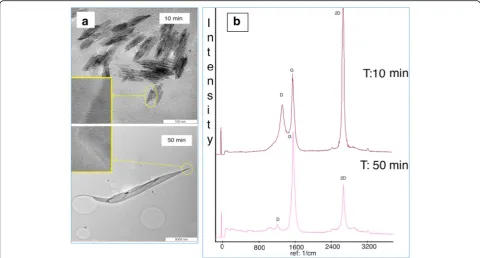
by using different times (10, 30, and 50 min) while the other parameters were kept constant (at 1050 °C under N2/H2/C2H2flow rates for 50/10/50 sccm) to determine the effects of the reaction time on the graphitization, as well as the morphology of the products.
[image:3.595.57.540.85.360.2]10 min was suitable for growing single-layer graphene, while 30 min was the optimum reaction time to synthesize a few layers of graphene and 50 min to grow multi-layer graphene on the SS at 1050 °C.
Conclusions
[image:4.595.56.543.86.549.2]The most important goal of this research was to grow different layers of graphene on the SS mesh. Hence, a simple method was employed to fabricate different layers of graphene sheets on SS surface coated with Cu parti-cles as a promoting catalyst for graphene growth in a large scale with high quality via CVD technique. Fig. 2aRaman spectra andbTEM images of graphitic structures at different temperatures
Table 1EDX results at different reaction temperature
Component (wt%) 950 °C 1000 °C 1050 °C
C 18.2 22.6 24.8
O 4.1 3.9 4.2
Cr 10.1 9.2 8.7
Ni 4.8 4.2 4
Fe 32.1 30 28.7
Cu 30.1 29.6 29.2
Others Rest Rest Rest
[image:4.595.59.291.619.730.2]Therefore, in order to determine the different layers of graphene, some parameters of the CVD process had been changed. The reaction temperature was ranged from 950 to 1050 °C, while the reaction time was varied from 10 to 50 min. On the other hand, the effects of these parameters on the graphitization, the number of graphene layers, and the amount of C atoms of the product were demonstrated by Raman spectroscopy and EDX, respectively. In addition, SEM and TEM were used to analyze the morphology and the structures of the gra-phene on SS mesh. Based on the results, single-layer graphene on SS with about 10.2 wt.% C atoms was grown at 1050 °C for 10 min under the 50 sccm acetyl-ene flow rate with low graphitization (ID/IG= 0.4 and I2D/ IG= 1.94). Meanwhile, the FLG with 24.8 wt.% C atoms was grown at 1050 °C for 30 min under the 50 sccm acetylene flow rate with high graphitization (ID/IG= 0.1
and I2D/IG= 0.75). Other than that, the MLG with about 22.6 wt.% C atoms was synthesized at 1000 °C for 30 min under the 50 sccm acetylene flow rate with low graphitization (ID/IG= 0.5 and I2D/IG= 0.45). Furthermore, by increasing the temperature to 1050 °C for 50 min, the MLG was achieved with 27.8 wt.% C atoms and the highest graphitization was attained (ID/IG= 0.05 and I2D/IG= 0.5). Nonetheless, it is worth noting that the growing of the structures with low graphitization at 950 °C for 30 min under the 50 sccm was related to non-graphene materials (ID/IG= 0.95 and I2D/IG= 0.24).
Abbreviations
CVD:Chemical vapor deposition; EDX: Electron dispersive X-ray; FLG: Few layer graphene; MLG: Multi-layer graphene; SEM: Scanning electron microscopy; SLG: Single-layer graphene; SS: Stainless steel; TEM: Transmission electron microscopy
Acknowledgements
The authors gratefully acknowledge the financial support given by Universiti Putra Malaysia (UPM).
Funding
This research has been financially supported by Universiti Putra Malaysia, Malaysia.
Authors’Contributions
The experiments and results were derived by FG and the preparation and correction of the final draft were done by PT and RY. Some hints of the characterizations were proposed by LCA. All authors read and approved the final manuscript.
Competing Interests
The authors declare that they have no competing interests.
[image:5.595.57.538.88.346.2]Fig. 3aRaman spectra andbTEM images of graphitic structures at different time
Table 2EDX results at different reaction time
Element (wt.%) 10 min 50 min
C 10.2 27.8
O 4.6 3.9
Cr 9.1 7.9
Ni 4.6 3.7
Fe 40.7 27.6
Cu 30.2 28.8
[image:5.595.56.294.620.732.2]Ethics Approval and Consent to Participate
No human or animal cells were used in this research.
Author details
1Institute of Tropical Forestry and Forest Products (INTROP), Universiti Putra
Malaysia (UPM), 43400, Serdang, Selangor, Malaysia.2Department of
Chemical and Environmental Engineering, Universiti Putra Malaysia (UPM), 43400, Serdang, Selangor, Malaysia.
Received: 20 July 2016 Accepted: 1 November 2016
References
1. Ghaemi F, Ahmadian A, Yunus R, Salleh MAM, Senu N (2015) Effect of growing graphene flakes on branched carbon nanofibers based on carbon fiber on mechanical and thermal properties of polypropylene. RSC Adv 5: 9925–9932
2. Ma H, Zeng J, Harrington Ma L, Ma M, Guo X, Ma Y (2016) Hydrothermal fabrication of silver nanowires-silver nanoparticles-graphene nanosheets composites in enhancing electrical conductive performance of electrically conductive adhesives. Nanomater 6:119
3. Novoselov KS, Geim AK, Morozov SV, Jiang D, Zhang Y, Dubonos SV, Firsov AA (2004) Electric field effect in atomically thin carbon films. Science 306: 666–669
4. Ghaemi F, Yunus R, Salleh MAM, Rashid SA, Ahmadian A, Lim HN (2015) Effects of the surface modification of carbon fiber by growing different types of carbon nanomaterials on the mechanical and thermal properties of polypropylene. RSC Adv 5:28822–28831
5. Novoselov KS, Jiang D, Schedin F, Booth TJ, Khotkevich VV, Morozov SV, Geim AK (2005) Two-dimensional atomic crystals. Proc Natl Acad Sci U S A 102:10451–10453
6. Penuelas J, Ouerghi A, Lucot D, David C, Gierak J, Estrade-Szwarckopf H, Andreazza-Vignolle C (2009) Surface morphology and characterization of thin graphene films on SiC vicinal substrate. Phys Rev B 79:033408 7. Ghaemi F, Yunus R, Ahmadian A, Ismail F, Salleh MAM, Rashid SA (2015)
Few-and multi-layer graphene on carbon fibers: synthesis and application. RSC Adv 5:81266–81274
8. Alwarappan S, Boyapalle S, Kumar A, Li CZ, Mohapatra S (2012) Comparative study of single-, few-, and multilayered graphene toward enzyme conjugation and electrochemical response. J Phys Chem C 116:6556–6559 9. Gullapalli H, Mohana Reddy AL, Kilpatrick S, Dubey M, Ajayan PM (2011)
Graphene growth via carburization of stainless steel and application in energy storage. Small 7:1697–1700
10. Dumée LF, He L, Wang Z, Sheath P, Xiong J, Feng C, Tan MY et al (2015) Growth of nano-textured graphene coatings across highly porous stainless steel supports towards corrosion resistant coatings. Carbon 87:395–408 11. Novoselov KS, Fal’ko VI, Colombo L, Gellert PR, Schwab MG, Kim K (2012)
A roadmap for graphene. Nature 490(7419):192–200
12. Gaikwad AV, Rout TK, Van der Plas D, Dennis RV, Banerjee S, Pacheco Benito S et al (2012) Carbon nanotube/carbon nanofiber growth from industrial by-product gases on low- and highalloy steels. Carbon 50(12):4722–4731 13. Zhang Y, Zhang L, Zhou C (2013) Review of chemical vapor deposition of
graphene and related applications. Acc Chem Res 46:2329–2339 14. Ghaemi F, Yunus R, Mohd Salleh MA, Lim HN, Rashid SA (2015) Bulk
production of high-purity carbon nanosphere by combination of chemical vapor deposition methods. Fuller Nanotub Car N 23:669–675
15. John R, Ashokreddy A, Vijayan C, Pradeep T (2011) Single-and few-layer graphene growth on stainless steel substrates by direct thermal chemical vapor deposition. Nanotechnol 22:165701
16. Malard LM, Pimenta MA, Dresselhaus G, Dresselhaus MS (2009) Raman spectroscopy in graphene. Phys Rep 473:51–87
17. Wood JD, Schmucker SW, Lyons AS, Pop E, Lyding JW (2011) Effects of polycrystalline Cu substrate on graphene growth by chemical vapor deposition. Nano Lett 11(11):4547–4554
18. Li X, Cai W, An J, Kim S, Nah J, Yang D, Banerjee SK (2009) Large-area synthesis of high-quality and uniform graphene films on copper foils. Science 324:1312
19. Mattevi C, Kim H, Chhowalla M (2011) A review of chemical vapour deposition of graphene on copper. J Mater Chem 21:3324
20. Ferrari AC, Meyer JC, Scardaci V, Casiraghi C, Lazzeri M, Mauri F, Geim AK (2006) Raman spectrum of graphene and graphene layers. Phys Rev Lett 97:187401
21. Cançado LG, Jorio A, Ferreira EM, Stavale F, Achete CA, Capaz RB, Ferrari AC (2011) Quantifying defects in graphene via Raman spectroscopy at different excitation energies. Nano Lett 11:3190–3196
22. Ferrari AC, Basko DM (2013) Raman spectroscopy as a versatile tool for studying the properties of graphene. Nat Nanotechnol 8:235–246 23. Hwang JY, Kuo CC, Chen LC, Chen KH (2010) Correlating defect density
with carrier mobility in large-scaled graphene films: Raman spectral signatures for the estimation of defect density. Nanotechnol 21:465705 24. Yoon D, Moon H, Son YW, Choi JS, Park BH, Cha YH, Cheong H (2009)
Interference effect on Raman spectrum of graphene on SiO 2/Si. Phys Rev B 80:125422
25. Tongay S, Lemaitre M, Miao X, Gila B, Appleton BR, Hebard AF (2012) Rectification at graphene-semiconductor interfaces: zero-gap semiconductor-based diodes. Phys Rev X 2:011002
Submit your manuscript to a
journal and benefi t from:
7Convenient online submission
7Rigorous peer review
7Immediate publication on acceptance
7Open access: articles freely available online
7High visibility within the fi eld
7Retaining the copyright to your article
Submit your next manuscript at 7 springeropen.com