One-Dimensional High-Order Compact Method for Solving
Euler’s Equations
M. A. H. Mohamad
a*
and S. Basri
band B. Basuno
caLecturer, Department of Mechanical Engineering, Centre of Diploma Studies,
Universiti Tun Hussein Onn Malaysia
bProfessor, Department of Aerospace Engineering, Faculty of Engineering, Universiti Putra Malaysia cSenior Lecturer, Department of Aeronautic Engineering,
Faculty of Mechanical and Manufacturing Engineering, Universiti Tun Hussein Onn Malaysia *Corresponding author: [email protected]
Abstract. In the field of computational fluid dynamics, many numerical algorithms have been developed to simulate inviscid, compressible flows problems. Among those most famous and relevant are based on flux vector splitting and Godunov-type schemes. Previously, this system was developed through computational studies by Mawlood [1]. However the new test cases for compressible flows, the shock tube problems namely the receding flow and shock waves were not investigated before by Mawlood [1]. Thus, the objective of this study is to develop a high-order compact (HOC) finite difference solver for one-dimensional Euler equation. Before developing the solver, a detailed investigation was conducted to assess the performance of the basic third-order compact central discretization schemes. Spatial discretization of the Euler equation is based on flux-vector splitting. From this observation, discretization of the convective flux terms of the Euler equation is based on a hybrid flux-vector splitting, known as the advection upstream splitting method (AUSM) scheme which combines the accuracy of flux-difference splitting and the robustness of flux-vector splitting. The AUSM scheme is based on the third-order compact scheme to the approximate finite difference equation was completely analyzed consequently. In one-dimensional problem for the first order schemes, an explicit method is adopted by using time integration method. In addition to that, development and modification of source code for the one-dimensional flow is validated with four test cases namely, unsteady shock tube, quasi-one-dimensional supersonic-subsonic nozzle flow, receding flow and shock waves in shock tubes. From these results, it was also carried out to ensure that the definition of Riemann problem can be identified. Further analysis had also been done in comparing the characteristic of AUSM scheme against experimental results, obtained from previous works and also comparative analysis with computational results generated by van Leer, KFVS and AUSMPW schemes. Furthermore, there is a remarkable improvement with the extension of the AUSM scheme from first-order to third-order accuracy in terms of shocks, contact discontinuities and rarefaction waves.
Keywords: High-order compact schemes, finite difference methods, flux-difference splitting, flux vector splitting, euler equation
PACS : 47.11.Bc
INTRODUCTION
the Roe’s [2] scheme due to its accuracy and efficiency. The FVS schemes, such as Steger and Warming’s [3], van Leer’s [4] and KFVS [5] are known to be simple and robust for capturing of intense shocks and rarefaction waves. However, while FVS is based on scalar calculations and FDS is based on matrix calculations. Liou and Steffen [6] have proposed AUSM (Advection Upstream Splitting Method) that has the accuracy of FDS schemes and the robustness and efficiency of FVS schemes. In this method, the inviscid flux at a cell interface is split into a convective contribution, upwinded in the direction of the flow and a pressure contribution which is upwinded based on acoustic considerations. The direction of the flow is determined by the sign of a Mach number defined by combining information from both the left and right states about the cell interface. AUSM scheme in Euler equations has gained increasing interest in solving compressible flow problems. In addition to that, development and modification of source code were also carried out to ensure that the definition of Riemann problem can be identified. However the new test cases for compressible flows, the shock tube problems namely the receding flow and shock waves were not investigated before by Mawlood [1]. Meanwhile, another test case such as unsteady shock tube and quasi one-dimensional flow in a divergent nozzle were using as a comparative study.
In this work the computational code using AUSM scheme will be used to develop a one-dimensional Euler solver by using high-order compact finite-difference techniques for compressible flows. The validation will be used up to the 3rd-order against experimental and comparison of computational results due to van Leer, KFVS and AUSMPW schemes. Due to the efficiency of the scheme as observed by other researchers namely Liou [7,8,9], Radespiel and Kroll [10], Billet and Louedin [11], Mary and Sagaut [12], Evje and Fjelde [13], Manoha et al. [14], Wada and Koda [15]Mawlood et al. [16,17,18], Zha and Hu [19] and Chaudhuri et al. [20]. Besides that, the characteristic of the numerical method was not compared completely with the other schemes. The test problems considered contain various types of discontinuities, such as shock waves, rarefaction waves and contact surfaces. In the absence of available CFD code, a comprehensive validation of code is required and the AUSM scheme has yet to be validated for a wide range of cases. For this reason, a systematic approach has to be adopted to examine the AUSM scheme before the method can be applied to a more complicated and complex compressible flow problems. Further analysis had also been done in comparing the characteristic of AUSM scheme against experimental results, obtained from previous works and also comparative analysis with computational results generated due to van Leer, KFVS and AUSMPW schemes.
EULER EQUATIONS AND FLUX SPLITTING SCHEME
The one-dimensional Euler equation may be written as
=
0
∂
∂
+
∂
∂
x
E
t
Q
(1)
where
,
⎥
⎥
⎥
⎦
⎤
⎢
⎢
⎢
⎣
⎡
=
e
u
Q
ρ
ρ
ρ
⎥
⎥
⎥
⎦
⎤
⎢
⎢
⎢
⎣
⎡
+
=
uH
p
u
u
E
ρ
ρ
ρ
2
and ρ, u, p, e and H are the density, velocity, pressure, total energy, and total enthalpy respectively. The total enthalpy H, is related to the other quantities by the relation
ρ
p
e
H
=
+
(2)2
2
1
)
1
(
u
p
e
+
−
=
γ
ρ
(3)where
γ
is the ratio of specific heat and takes the value of 1.4 for air.The extension of the scalar high order numerical fluxes developed above to Euler equations is straightforward. The AUSM flux splitting technique used here is detailed in references [6, 22]. Once the split fluxes
E
i±are obtained then the method described above is used to obtain the higher order numerical fluxes. Equation (23) is, thus, written in a semidiscretized form as
L
(
Q
)
t
Q
=
∂
∂
(4)
where
x
E
E
Q
L
m
i m
i
−
Δ
−
=
(
+ −)
/
)
(
) (
2 / 1 ^ ) (
2 / 1 ^
(5)
Using the method-of-lines [5], the systems of equations (1) are integrated by a multistage TVD Runge-Kutta scheme [23].
BOUNDARY CONDITIONS
For the shock tube problem considered in this paper, a short time span for unsteady flow is considered such that the waves will not reach the end walls and so conditions at these boundaries are held fixed. For the supersonic-subsonic nozzle problem, one type of boundary conditions i.e. inflow/outflow is encountered. At the supersonic inflow, values of velocity, density and pressure are specified while at the subsonic outflow the velocity is specified and the density and pressure are extrapolated from the interior.
Meanwhile for the receding flow problem, the left and right parts of the conditions are fixed to the states similar to the initial conditions. The numerical and exact solutions are found in the spatial domain 0 ≤x≤ 1 using 100 cells. The value of CFLnumber is taken as 0.9 and it is used for the determination of the time step as 0.15. The ratio of specific heats γ is chosen to be 1.4 on both sides of the interfaces.
For the boundary conditions at shock wave in shock tube, the left and right parts of the conditions are fixed to the states similar to the initial conditions. The numerical and exact solutions are found in the spatial domain 0 ≤x≤ 1 using 201 cells. The value of CFLnumber is taken as 0.9 and it is used for the determination of the time step as 0.012. The ratio of specific heats γ is chosen to be 1.4 on both sides of the interfaces.
THE BASIC DISCRETIZATION METHOD
Spatial Discretization and Numerical Fluxes
The model equation for nonlinear scalar conservation law in one-dimensional space can be written as [2,3]
(
)
=
0
∂
∂
+
∂
∂
x
u
f
t
u
with the subject to the given initial condition [2,3]
u
(
x
,
0
)
=
u
0(
x
)
(7)where
x
u
f
∂
∂
(
)
is some vector-valued function of u. Equation (7), is specialized to
)
0
(
)
0
,
(
)
0
(
)
0
,
(
>
≡
<
≡
x
u
x
u
x
u
x
u
R L
(8)
Equation (6) can be written in split flux form as [5]
(
)
(
)
=
0
∂
∂
+
∂
∂
+
∂
∂
+ −x
u
f
x
u
f
t
u
(9)
where
f
(
u
)
=
f
+(
u
)
+
f
−(
u
).
This flux vector splitting has been introduced by [3]. The split fluxesf
+(
u
)
and)
(
u
f
−are also homogeneous functions of degree one in u [21]. Conservative semidiscretization of equation (9) can be written as [5]
+
(
ˆ
1/2−
ˆ
1/2)
/
Δ
=
0
∂
∂
−
+
f
x
f
t
u
i i
i
(10)
where
f
ˆ
i+1/2 andf
ˆ
i−1/2 is known as the numerical flux function.Firrst-order upwind approximation to the numerical flux is given by [5]
− + − −
− + + +
−
=
+
=
i i i
i i i
f
f
f
f
f
f
1 2 / 1
1 2
/ 1
ˆ
ˆ
(11)
Following Ravichandran [5], a high-order numerical flux can be obtained as follows. The numerical flux
f
ˆ
i+1/2 isdecomposed into positive and negative parts,
f
ˆ
i++1/2 andf
ˆ
i+−1/2 such that
f
ˆ
i+1/2=
f
ˆ
i++1/2+
f
ˆ
i−+1/2 (12) The decomposed numerical fluxes are defined such that
F
im=
f
ˆ
i+m1/2−
f
ˆ
i−m1/2 (13)where
F
im/
Δ
x
is a high-order approximation to the derivativex
u
f
i∂
∂
m(
)
, to be determined by a high-order
compact scheme.
Zhong [22] has presented a third-order approximation to a first derivative by an upwind based compact relation as
Equation (14) can be written for the interior points
i
=
2
toi
=
N
−
1
. For the boundary pointsi
=
1
andi
=
N
, the following second order explicit relations are used
F
1m=
−
1
.
5
f
1m+
2
f
2m−
0
.
5
f
3m (15)F
Nm=
1
.
5
f
Nm−
2
f
Nm−1+
0
.
5
f
Nm−2 (16)
Plugging equation (13) in equation (14) yields the following relations for the interior points
i
=
2
toi
=
N
−
1
.+ + + + + + + +
−
+
i+
i=
i+
ii
f
f
f
f
f
ˆ
60
ˆ
11
.
25
ˆ
37
.
5
52
.
5
75
.
18
1/2 1/2 3/2 1 (17)− − + − + − + −
−
+
i+
i=
i+
ii
f
f
f
f
f
ˆ
60
ˆ
18
.
75
ˆ
52
.
5
37
.
5
25
.
11
1/2 1/2 3/2 1 (18)
With
F
1m andF
Nm evaluated explicitly, two sets of (N - 1) equations are to be inverted for the split numericalfluxes
f
ˆ
im+1/2. Before using these fluxes it is necessary to limit their values and this is achieved by defining the differences − + − + − + + + + + +−
=
−
=
2 / 1 1 2 / 1 2 / 1 2 / 1ˆ
ˆ
ˆ
ˆ
i i i i i if
f
f
d
f
f
f
d
(19)and limiting by the limiter
)
,
ˆ
mod(
min
ˆ
)
,
ˆ
mod(
min
ˆ
2 / 1 ) ( 2 / 1 2 / 1 ) ( 2 / 1 − − + − + + + + + +=
=
D
f
d
f
d
D
f
d
f
d
i m i i m i (20)The third-order TVD flux differences of [23] may be used here
(min
mod(
,
)
2
min
mod(
,
))
6
1
1
1 + + + + + +−
+ − + +
=
+
i i ii
f
f
f
f
D
δ
λδ
δ
λδ
(21)
(min
mod(
,
)
2
min
mod(
,
))
6
1
1 1 − + + − + − + − + + −=
+
i i ii
f
f
f
f
D
δ
λδ
δ
λδ
(22)where
1
≤
λ
≤
4
.The limited numerical fluxes are then calculated from
) ( 2 / 1 1 ) ( 2 / 1 ) ( 2 / 1 ) ( 2 / 1
ˆ
ˆ
ˆ
ˆ
m i i m i m i i m if
d
f
f
f
d
f
f
− + − + − + + + + + +−
=
+
=
(23) and1(/2) ) ( 2 / 1 ) ( 2 /
1
ˆ
ˆ
ˆ
mi m i m
i
f
f
f
−+ +
+
+
=
+
(24)
⎪
⎩
⎪
⎨
⎧
<
>
<
>
<
=
0
)
(
0
0
)
(
,
0
)
(
,
)
,
mod(
min
ab
if
ab
a
b
if
b
ab
b
a
if
a
b
a
(25)RESULTS AND DISCUSSION
In this study, four problems are considered as the shock tube problems such as unsteady shock tube and quasi one-dimensional flow in a divergent nozzle were using as a comparative study, meanwhile the another test cases for compressible flows, namely the receding flow and shock waves were not investigated before by Mawlood [1] will be presented as a new test cases. In addition, the computed results were compared with available exact solutions, and numerical results from other schemes, such as AUSM scheme, AUSMPW scheme, van Leer’s scheme and KFVS scheme. Results are also shown with first-order accurate upwind space discretization compared with up to third-order compact scheme.
The first problem considered is the unsteady shock tube problem. This problem is an interesting test case to assess the ability of a compressible code to capture shocks and contact discontinuities and to produce exact profiles in the rarefaction wave. The problem spatial domain is 0 ≤ x ≤ 1. The initial solution of the problem consists of two uniform states, termed as left and right states, separated by a discontinuity at x = 0.5. As in the first problem, results are obtained using first-order and third-order upwind schemes with the AUSM scheme, van Leer’s scheme and KFVS scheme. The number of mesh points used is 101 and CFL = 0.2. The initial conditions of the left and right states are
(ρL, uL, pL) = (1, 0, 1)
(ρR, uR, pR) = (0.125, 0, 0.1)
The wave pattern of this problem consists of a rightward moving shock wave, a leftward moving rarefaction wave and a contact discontinuity separating the shock and rarefaction waves and moving rightward. Figure 1 shows results obtained by the first order and third-order accurate schemes for the distribution of pressure, density and velocity along the tube at time, t = 0.2 units, in comparison with the exact solution. From the numerical results of the 1st -order schemes for this particular problem, two observations can be made: first, the solutions produced are non-oscillatory and second, shock smearing is present in both 1st-order schemes with the degree of shock smearing more apparent in the KFVS scheme in comparison with the AUSM scheme. In addition, it is shows that in the density profile the contact discontinuity is narrowly visible and in the velocity profile there is a minor overshoot at the right corner of the expansion wave. Meanwhile, the transition of the shock wave in the velocity profile occupies eleven to twelve zones.
From the numerical result of up to 3rd-order schemes, it is shows that the AUSM scheme is able to produce non-oscillatory and crisp shock transition, which can hardly be obtained from the KFVS and van Leer schemes. This is true as the results produced by the KFVS scheme are more diffusive in comparison with the AUSM scheme, while the van Leer scheme generated a small jump around the contact discontinuity in the velocity distribution. In addition, it is shows that in the density profile the contact discontinuity is narrowly visible especially at AUSM scheme compare to the other schemes. Meanwhile, the transition of the shock wave in the velocity profile occupies four to six zones. Beside these findings, it is also observed that the 3rd-order AUSM scheme is able to produce numerical solutions that are on par with the 3rd-order KFVS and 5th-order compact upwind van Leer schemes.
The second problem considered is a quasi one-dimensional supersonic-subsonic flow in a divergent nozzle. The nozzle cross-section S(x) varies according to
S(x) = 1.398 + 0.347 tanh
(
0
.
8
(
x
−
4
)
)
; 0 ≤x≤ 10(ρ1, u1, p1) = (0.459, 432.5, 0.2724 x 10⁵)
(ρN, uN, pN) = (0.811, 146.94, 0.673 x 10⁵)
These conditions correspond to a normal shock at x = 5 with supersonic flow at the inlet Mach number M1 = 1.5 and
subsonic flow at the outlet Mach number MN = 0.431. Calculation are performed with a time step, ∆t corresponding
to Courant-Friedrichs-Lewy, CFL number = 1. The number of points used to solve this problem is N = 51. The integration in time is continued until steady state is reached. The solution is assumed to converge when the absolute value of the residual in pressure ⏐pn+1– pn⏐≤ 0.1.
Figure 2 shows first-order and third-order upwind results for the distribution of pressure, density and Mach number along the flow in comparison with the exact solution. The numerical solution shows that the1st-order AUSMPW scheme is able to produce solutions that outweigh other numerical solutions schemes. These are justified by the over-diffusivity of the KFVS and AUSM schemes around the region of the shock after the shock as clearly. While the numerical solutions of the AUSMPW and van Leer schemes are observed to have almost similar performance, where the van Leer scheme is able to produce a slightly better shock resolution for the pressure distribution, the AUSMPW scheme leads the shock resolution for the density and Mach number distributions. In Figure 2, it also shows that the numerical solutions computed by a 5th-order compact upwind van Leer scheme (Mawlood et al. [16]) are also used to compare with the 3rd-order AUSM scheme and it revealed that the degrees of post-shock oscillations are more severe within the van Leer scheme in comparison to the AUSM scheme.
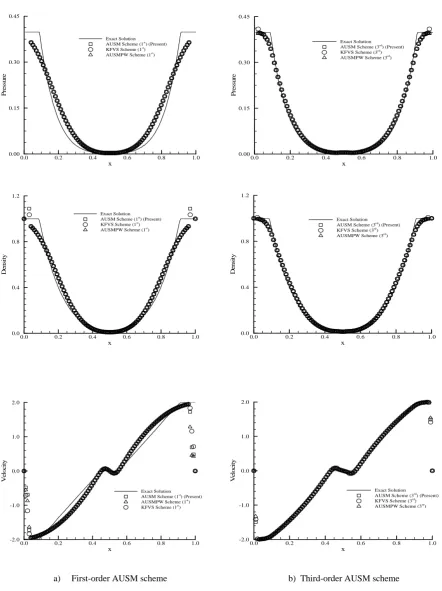
The third problem considered as compressible flows, which were not investigated before by Mawlood [1] is a receding flow problem, which is designed by Toro [24]. This test is also useful in assessing the performance of numerical methods for low density flows (Toro [24], Einfeldt et al. [25], Sun and Takayama, [26]). This problem has a solution consisting of two strong rarefactions waves and a trivial stationary contact discontinuity. The initial solution of the problem consists of two symmetric expansion waves at the origin, separated by a discontinuity at x = 0.5 and the pressure or density is very small at central region (close to vacuum), which makes this problem a suitable test for low-density flows. The initial pressure and density are the same everywhere; p2 = p1 = 1.0, ρ2 = ρ1 = 0.4. The
initial velocities are of opposite sign: Ul = -2.0, Ur = 2.0 and these are given in SI units for a perfect gas as
(
ρ
l,
U
l,
p
l) (
=
1
,
−
2
,
0
.
4
)
and(
ρ
r,
U
r,
p
r) (
=
1
,
2
,
0
.
4
)
The numerical results of the 1st-order AUSM scheme are compared with the 1st-order KFVS scheme and 1st-order AUSMPW scheme and are illustrated by Figure 3. From the numerical results of the 1st-order schemes for this particular problem, these figures shows that the pressure, density and velocity results from three schemes are no agree similarly well with the exact solutions at the expansion waves. To further validate the numerical results of the 3rd-order and 5th-order AUSM scheme, its results are compared with the same orders of numerical solutions from other schemes, such as KFVS scheme and AUSMPW scheme, which are given in Figure 3. This figure shows an improvement of the accuracy of expansion waves by two symmetric that the pressure and density results from three schemes agree similarly well with the exact solutions.
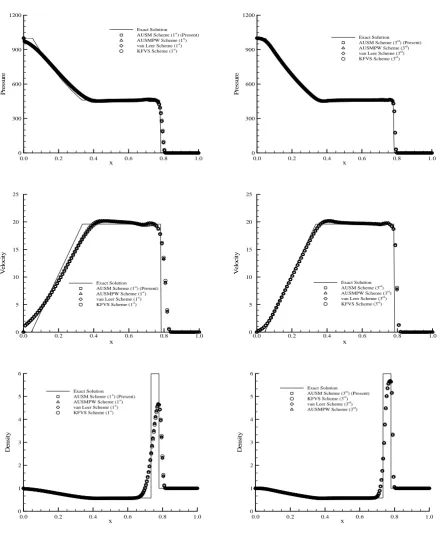
The last problem considered is a shock wave in shock tube which consists of strong right running shock waves using Mach number 3 which contains a left rarefaction, a contact surface and a right shock wave (Toro [24], Sun and Takayama, [26]). It is designed to consider the accuracy and robustness of numerical methods. The initial solution of the problem consists of two uniform states in the left and right parts conditions and these are given in SI units for a perfect gas as
(
ρ
l,
U
l,
p
l) (
=
1
.
0
,
0
.
0
,
1000
.
0
)
and(
ρ
r,
U
r,
p
r) (
=
1
.
0
,
0
.
0
,
0
.
01
)
CONCLUSIONS
A third-order compact upwind method based on the flux-vector splitting approach was developed for high speed inviscid flows. A new flux limiting procedure, different from those used in similar approaches, was introduced for resolving shock waves and other types of discontinuities without spurious oscillations. The scheme is tested by performing calculations for a compressible flows shock tube cases namely unsteady shock tube, quasi one-dimensional flow in a divergent nozzle, the receding flow and shock waves in shock tube. Results are also presented to validate up to the 3rd-order AUSM scheme against experimental and comparison of computational results due to van Leer, KFVS and AUSMPW schemes.
From this result, it was found that there is an improvement to the shock capturing properties in terms of shock resolution and non-oscillatory shock smearing results when compared between the present scheme with other schemes from 1st-order to 3rd-order and 5th-order in all test cases. Beside that, it can be seen that the KFVS and van Leer schemes has the least value of absolute error percentage when compared with the other schemes. In addition, from this research an improvement is shown of the accuracy of expansion waves by two symmetric and the accuracy of contact surface and left expansion waves with further validation from the numerical results. It can be seen that, the resolution and robustness of the overall scheme is comparable with the exact Riemann solver and it can resolve exactly one-dimensional stationary contact discontinuities. It was found that by using the AUSM scheme from 1st -order to 3rd-order accuracy especially in unsteady shock tube, steady-state numerical solutions of the divergent nozzle, receding flow and shock waves in shock tube, the improvement of shock capturing properties such as the accuracy of shocks, contact discontinuities and rarefaction waves were achieved.
ACKNOWLEDGMENTS
Distance ( m )
Pr
es
su
re
(
N
/
m
2)
0 0.2 0.4 0.6 0.8 1
0 0.2 0.4 0.6 0.8 1
AUSM Scheme (1st
) (Present) KFVS Scheme (1st
) Exact Solution
101 mesh points
Distance ( m )
Pr
es
su
re
(
N
/
m
2)
0 0.2 0.4 0.6 0.8 1
0 0.2 0.4 0.6 0.8
1 AUSM Scheme (3rd
) (Present) KFVS Scheme (3rd)
van Leer Scheme (5th
) Exact Solution
101 mesh points
Distance ( m )
De
ns
it
y
(
k
g
/
m
3)
0 0.2 0.4 0.6 0.8 1
0 0.2 0.4 0.6 0.8 1
AUSM Scheme (1st
) (Present) KFVS Scheme (1st
) Exact Solution
101 mesh points
Distance ( m )
De
nsi
ty
(
k
g
/
m
3)
0 0.2 0.4 0.6 0.8 1
0 0.2 0.4 0.6 0.8
1 AUSM Scheme (3rd
) (Present) KFVS Scheme (3rd
) van Leer Scheme (5th
) Exact Solution
101 mesh points
Distance ( m )
V
eloc
ity
(
m
/
s
)
0 0.2 0.4 0.6 0.8 1
0 0.2 0.4 0.6 0.8 1
AUSM Scheme (1st
) (Present)
KFVS Scheme (1st
) Exact Solution
101 mesh points
Distance ( m )
Ve
lo
ci
ty
(
m
/
s
)
0 0.2 0.4 0.6 0.8 1
0 0.2 0.4 0.6 0.8 1
AUSM Scheme (3rd
) (Present)
KFVS Scheme (3rd
)
van Leer Scheme (5th
) Exact Solution
101 mesh points
[image:9.595.66.505.102.742.2]x x x x x x x x x x x x x xx xx xx x x x x xx x x xx
xx xx x x
x x x x x x x x x x x x x x x x
Distance ( m )
P re ssu re ( N / m 2)
0 2 4 6 8 10
1.0E+04 2.0E+04 3.0E+04 4.0E+04 5.0E+04 6.0E+04 7.0E+04
AUSM Scheme (Present) van Leer Scheme KFVS Scheme AUSMPW Scheme Exact Solution
x
51 mesh points
Distance ( m )
Pr es sur e ( N / m 2)
0 2 4 6 8 10
1.0E+04 2.0E+04 3.0E+04 4.0E+04 5.0E+04 6.0E+04 7.0E+04
AUSM Scheme (Present) van Leer Scheme Exact Solution
51 mesh points
x x x x x x x x x x x x x xx x xx x x x x x xx x x xx x xx x x
x x x x x x x x x x x x x x x x x
Distance ( m )
D ens it y ( kg / m 3)
0 2 4 6 8 10
0.3 0.4 0.5 0.6 0.7 0.8 0.9
AUSM Scheme (Present) van Leer Scheme KFVS Scheme AUSMPW Scheme Exact Solution
x
51 mesh points
Distance ( m )
D ens it y ( kg / m 3)
0 2 4 6 8 10
0.3 0.4 0.5 0.6 0.7 0.8 0.9
AUSM Scheme (Present) van Leer Scheme Exact Solution
51 mesh points
x x x x x x x x x x x x xx x x x x xx xx x x x x x x x x
x x x x x x x x x xx x x x x x x x x x x
Distance ( m )
Ma
ch
0 2 4 6 8 10
0.25 0.5 0.75 1 1.25 1.5 1.75 2
AUSM Scheme (Present) van Leer Scheme KFVS Scheme AUSMPW Scheme Exact Solution
x
51 mesh points
Distance ( m )
Ma
ch
0 2 4 6 8 10
0.25 0.5 0.75 1 1.25 1.5 1.75 2
AUSM Scheme (Present) van Leer Scheme Exact Solution
51 mesh points
[image:10.595.68.509.100.668.2]a) First-order AUSM scheme b) Up to Third-order AUSM scheme
x
P
re
ssu
re
0.0 0.2 0.4 0.6 0.8 1.0
0.00 0.15 0.30 0.45
Exact Solution
AUSM Scheme (1st) (Present)
KFVS Scheme (1st)
AUSMPW Scheme (1st)
x
Pr
es
su
re
0.0 0.2 0.4 0.6 0.8 1.0
0.00 0.15 0.30 0.45
Exact Solution
AUSM Scheme (3rd
) (Present)
KFVS Scheme (3rd
)
AUSMPW Scheme (3rd
)
x
D
en
sity
0.0 0.2 0.4 0.6 0.8 1.0
0.0 0.4 0.8 1.2
Exact Solution
AUSM Scheme (1st) (Present)
KFVS Scheme (1st)
AUSMPW Scheme (1st)
x
D
en
sity
0.0 0.2 0.4 0.6 0.8 1.0
0.0 0.4 0.8 1.2
Exact Solution
AUSM Scheme (3rd
) (Present)
KFVS Scheme (3rd)
AUSMPW Scheme (3rd)
x
V
elo
city
0.0 0.2 0.4 0.6 0.8 1.0
-2.0 -1.0 0.0 1.0 2.0
Exact Solution
AUSM Scheme (1st) (Present)
AUSMPW Scheme (1st)
KFVS Scheme (1st)
x
V
elo
city
0.0 0.2 0.4 0.6 0.8 1.0
-2.0 -1.0 0.0 1.0 2.0
Exact Solution
AUSM Scheme (3rd
) (Present)
KFVS Scheme (3rd
)
AUSMPW Scheme (3rd
)
[image:11.595.69.512.103.695.2]a) First-order AUSM scheme b) Third-order AUSM scheme
x
P
re
ssu
re
0.0 0.2 0.4 0.6 0.8 1.0
0 300 600 900 1200
Exact Solution
AUSM Scheme (1st) (Present)
AUSMPW Scheme (1st)
van Leer Scheme (1st)
KFVS Scheme (1st)
x
P
re
ssu
re
0.0 0.2 0.4 0.6 0.8 1.0
0 300 600 900 1200
Exact Solution
AUSM Scheme (3rd
) (Present)
AUSMPW Scheme (3rd
)
van Leer Scheme (3rd
)
KFVS Scheme (3rd
)
x
V
el
oci
ty
0.0 0.2 0.4 0.6 0.8 1.0
0 5 10 15 20 25
Exact Solution
AUSM Scheme (1st
) (Present)
AUSMPW Scheme (1st)
van Leer Scheme (1st)
KFVS Scheme (1st)
x
V
el
oci
ty
0.0 0.2 0.4 0.6 0.8 1.0
0 5 10 15 20 25
Exact Solution
AUSM Scheme (3rd)
AUSMPW Scheme (3rd)
van Leer Scheme (3rd)
KFVS Scheme (3rd)
x
D
en
sity
0.0 0.2 0.4 0.6 0.8 1.0
0 1 2 3 4 5 6
Exact Solution
AUSM Scheme (1st
) (Present)
AUSMPW Scheme (1st
)
van Leer Scheme (1st
)
KFVS Scheme (1st
)
x
D
en
sity
0.0 0.2 0.4 0.6 0.8 1.0
0 1 2 3 4 5 6
Exact Solution
AUSM Scheme (3rd
) (Present)
KFVS Scheme (3rd
)
van Leer Scheme (3rd
)
AUSMPW Scheme (3rd
)
[image:12.595.70.513.104.658.2]a) First-order AUSM scheme b) Third-order AUSM scheme
REFERENCES
1. Mawlood, M. K, “A high-order compact fnite difference solver for the two-dimensional Euler and Navier-Stokes
equations”, Ph.D. Thesis, Universiti Putra Malaysia, 2004. 2. Roe, P. L., Journal of Computational Physics43, 357-372 (1981).
3. Steger, J. L. and Warming, R. F., Journal of Computational Physics40, 263-293 (1981). 4. Van Leer, B., Lecture Notes in Physics170, 507-512 (1982).
5. Ravichandran, K. S., Journal of Computational Physics130, 161-173 (1997). 6. Liou, M. S. and Steffen, C. J. Jr., Journal of Computational Physics107, 23-39 (1993).
7. Liou, M.-S. and C. J. Steffen, Jr., Center for Modeling of Turbulence and Transition (CMOTT), 1990, pp 144-145.
8. Liou, M.-S., Lecture Notes in Physics414, 115 (1993).
9. Liou, M.-S., Journal of Computational Physics129, 364-382 (1996).
10. Radespiel, R. and Kroll, N., Journal of Computational Physics121, 66-78 (1995). 11. Billet, G. and Louedin, O., Journal of Computational Physics170, 161-183 (2001). 12. Mary, I. and Sagaut, P., AIAA Journal40, 1139 – 1145 (2002).
13. Evje, S. and Fjelde, K. K., Computers and Fluids32, 1479-1530 (2003).
14. Manoha, E., Redonnet, S. Terracol, M., and Guenanff, G., ECCOMAS (24 – 28 July 2004).
15. Wada, K. and Koda, J., Monthly Notices of the Royal Astronomical Society No. 11, 349, 270-280 (2004).
16. Mawlood, M. K., Asrar, W., Omar, A. A. and Basri, S., “A higher-order shock capturing scheme for inviscid flows”
Proceedings, 2nd World Engineering Congress, Sarawak, Malaysia, 383-388 (2002).
17. Mawlood, M. K., Asrar, W., Omar, A.A. and Basri, S., 41st Aerospace Sciences Meeting and Exhibit Conference, AIAA
2003-0076, USA.
18. Mawlood, M. K., Basri, S., Asrar, W., Omar, A. A., Mokhtar, A. S. and Ahmad M. M. H. M., International Journal of
Numerical Methods for Heat & Fluid Flow No. 1, 16, 107-120 (2006). 19. Zha, G. C. and Hu, Z., AIAA Journal No. 2, 42, 205 – 214 (2004).
20. A. Chaudhuri, C. Guha and T. K. Dutta, CHEMCON-05, New Delhi, Session: Computational Fluid Dynamics, 2005, pp.
1-8.
21. Hirsch, C., Numerical computation of internal and external flows. Vol. 2: Computational methods for inviscid and viscous
flows. John Wiley and Sons, UK, 1990.
22. Zhong, X., Journal of Computational Physics144, 662-709 (1998).
23. Yee, H. C., Upwind and symmetric shock capturing schemes, 1987, NASA TM 89464.
24. E. F. Toro, Riemann solvers and numerical methods for fluid dynamics. 2nd Edition, Springer, Berlin, 1999. 25. B. Einfeldt, C. D. Munz, P. L. Roe and B. Sjogreen, Journal of Computational Physics92, 273-295 (1991).