A Review on Modern Distributed
Computing Paradigms: Cloud
Computing, Jungle Computing
and Fog Computing
Majid Hajibaba and Saeid Gorgin
Department of Electrical and Information Technology, Iranian Research Organization for Science and Technology (IROST), Tehran, Iran
The distributed computing attempts to improve perfor-mance in large-scale computing problems by resource sharing. Moreover, rising low-cost computing power coupled with advances in communications/networking and the advent of big data, now enables new distributed computing paradigms such as Cloud, Jungle and Fog computing.
Cloud computing brings a number of advantages to consumers in terms of accessibility and elasticity. It is based on centralization of resources that possess huge processing power and storage capacities. Fog computing, in contrast, is pushing the frontier of computing away from centralized nodes to the edge of a network, to enable computing at the source of the data. On the other hand, Jungle computing includes a simultaneous combination of clusters, grids, clouds, and so on, in order to gain maximum potential computing power.
To understand these new buzzwords, reviewing these paradigms together can be useful. Therefore, this paper describes the advent of new forms of distributed com-puting. It provides a definition for Cloud, Jungle and Fog computing, and the key characteristics of them are determined. In addition, their architectures are illustrated and, finally, several main use cases are introduced.
Keywords: distributed system, cloud computing, jungle
computing, fog computing
1. Introduction
The introduction of computer networks in the 1970s led to the development of distributed sys-tems(Andrews, 1999). A distributed system is a collection of independent computers that ap-pears to the user as a single computer ( Tanen-baum & Steen, 2006)and provides a single sys-tem view. The coordinated aggregation of these
distributed computers allows access to a large amount of computing.
Up to this time, a few technologies emerged in the distributed systems. Peer-to-peer (P2P)
network is one of the primary distributed sys-tems. However, an important class of dis-tributed systems is the disdis-tributed computing system which uses for high performance com-puting tasks (Tanenbaum & Steen, 2006). In this way, with low-cost and more powerful per-sonal computers, as well as high-speed net-works, Cluster computing has become widely popular. Other well-known distributed comput-ing paradigms, includcomput-ing Grid computcomput-ing and Cloud computing, appeared with the evolution of the Internet in the mid-1990s and 2007, re-spectively.
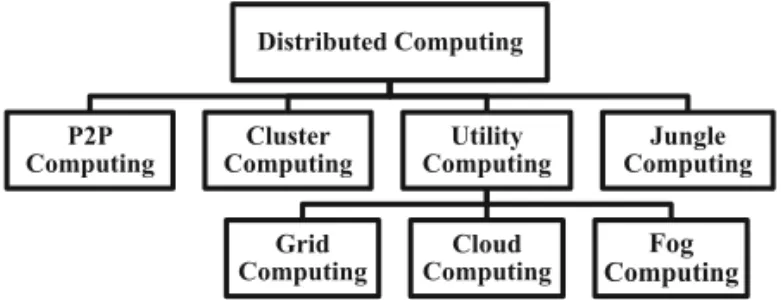
extended the Cloud computing paradigm to the edge of the network, in 2012, to enable a new kind of applications and services(Bonomi, Mil-ito, Zhu, & Addepalli, 2012). A taxonomy of distributed computing paradigms is shown in Figure 1.
Distributed Computing
P2P Computing
Cluster Computing
Utility Computing
Grid Computing
Cloud Computing
Fog Computing
Jungle Computing
Figure 1.Taxonomy of distributed computing.
In this paper, we review these two new dis-tributed computing paradigms, Jungle comput-ing and Fog computcomput-ing, along with Cloud com-puting which is related to them. We name these three as modern distributed computing paradigms. A review of these models and their characteristics helps to better understand mod-ern distributed computing paradigms and their similarities and differences.
The rest of the paper is organized as follows. The Cloud computing model, characteristics and concepts are explained in Section 2. In Section 3, the Jungle computing is described and its characteristics are delineated. In Sec-tion 4, Fog computing and its characteristic are introduced. Finally, in Section 5, we conclude the paper with a summary of our review.
2. Cloud Computing 2.1. Overview
Cloud computing is neither a completely new concept(Antonopoulos & Gillam, 2010; Halpert, 2011) nor a new technology (Halpert, 2011; Yang, Chen, & Chen, 2012). It is just a new business operational model originated from other existing technologies such as Virtualization,SOA and Web2. Several definitions of Cloud com-puting exist in the academic and the commer-cial world(Buyya, Broberg, & Goscinski, 2011; Mell & Grance, 2009; Armbrust, et al., 2009; Vaquero, Rodero-Merino, Caceres, & Lindner,
2009; Forrest & inquiries, 2009), but we com-bine those definitions into a new one:
Cloud is a parallel and distributed system con-sisting of a shared pool of virtualized resources
(e.g. network, server, storage, application, and service) in large-scale data centers. These re-sources can be dynamically provisioned, recon-figured and exploited by a pay-per-use eco-nomic model in which consumer is charged on the quantity of cloud services usage and provider guarantees Service Level Agreements
(SLA)through negotiations with consumers. In addition, resources can be rapidly leased and released with minimal management effort or service provider interaction. Hardware man-agement is highly abstracted from the user and infrastructure capacity is highly elastic.
Data center #1
Cloud manager
Data center #3
Data center #2
Figure 2.Cloud computing architecture.
Figure 2 depicts an abstract view of Cloud com-puting architecture. The aim is to concen-trate computation and storage in data centers, where high-performance machines are linked by high-bandwidth connections, and all of these resources are carefully managed. The end-users make the requests that initiate computations and receive the results(Hayes, 2008).
In spite of the existing differences among def-initions of Cloud computing, it has some basic characteristics that are described in Table 1. There are some other characteristics of Cloud computing that are summarized in(Gong, Liu, Zhang, Chen, & Gong, 2010).
In addition to the outstanding characteristics, Cloud computing brought cost saving for con-sumers through removing capital expenses
(CapEx)as well as reducing operating expenses
Characteristic Comment
Virtualization
Hardware Virtualization mediates access to the physical resources, decouples applications from the underlying hardware and creates a virtualized hardware platform using a software layer. This software layer is virtual machine monitor(VMM), also called hypervisor, which creates and runs virtual machines (VM). A virtual machine is like a real computer, except that it uses virtual resources.
Using Virtualization, virtual resources are isolated from each other and are independent of partic-ular hardware, thus enabling the assignment of virtual resources to another physical hardware in case of capacity constraints or hardware failures.
Through Virtualization, the underlying architecture is abstracted from the user while it still provides flexible and rapid access to it.
Multitenancy
This feature allows several customers (tenants) to share data center infrastructure, without being aware of it and without compromising the privacy and security of each customer’s data (through isolation). Even though multitenancy is cost-effective, it causes performance degra-dation in simultaneously accessing shared services(multi-tenant interference)and performance unpredictability.
Service oriented architecture (SOA)
In this architecture everything is expressed and exposed as a service (Buyya, Broberg, & Goscinski, 2011)which delivers an integrated and orchestrated suite of functions to an end-user through composition of both loosely and tightly coupled functions(Vouk, 2008). Abstraction and accessibility are two keys to achieve the service oriented conception(Gong, Liu, Zhang, Chen, & Gong, 2010).
On-demand self-service
Cloud computing allows self-service access so that customers can request, customize, pay, and use services, as needed, automatically, without requiring interaction with providers or any intervention of human operators(Mell & Grance, 2009; Buyya, Broberg, & Goscinski, 2011).
Elasticity (dynamic provisioning)
To provide the illusion of infinite resources, more virtual machines(on two or more physical machines) can be quickly provisioned (scale out), in the case of peak demand, and rapidly released(scale in), to keep up with the demand. Also, more virtualresources(on a single physical machine)can be provisioned when the work load increases(scale up)and released when the work load decreases(scale down). These scaling methods can automatically be done according to the user’s predefined conditions(Auto Scaling).
Broad network access
Services are available over the network and accessed through standard mechanisms that can be achieved by heterogeneous thin or thick client platforms such as mobile phones, laptops and PDAs (Mell & Grance, 2009).
Resource pooling
The Cloud provider offers a pool of computing resources to serve multiple consumers using a multi-tenant model, with different physical and virtual resources. Location transparency in the Cloud that hides resource’s physical location from the customer(but provider may offer location at a higher level of abstraction, like country)provides more flexibility to Cloud providers for managing their own resource pool.
Business model
Cloud computing is mainly supported by gigantic IT companies. They plan that all investments on Cloud computing should get return on investment(ROI)in the near future(Gong, Liu, Zhang, Chen, & Gong, 2010). Still, there are many business models that can be used in Cloud computing, Cloud providers often employ a pay-per-use service-driven model.
Measured service
Cloud computing is based on the concept of utility computing which provides computing services through an on-demand, pay-per-use billing method. Cloud systems can transparently monitor, control and measure service usages for both the provider and the consumer by leveraging a metering capability at some level of abstraction appropriate to the type of service, similar to what is being done for utilities such as Electricity, Gas, Water, Telecommunication, etc.
Customization Cloud computing allows users to deploy specialized virtual appliances and to be given privileged(root)access to the virtual servers in order to consider the great disparity between user needs in a multi-tenant environment(Buyya, Broberg, & Goscinski, 2011).
Table 1.Cloud computing characteristics.
the cost of electricity, system admins, hardware engineers, network engineers, facilities man-agement, fire protection, and insurance or local and state taxes on facilities. There are other hidden OpEx costs that a Cloud instance can eliminate, such as purchasing and acquisition overhead, asset insurance, and business
inter-ruption planning and software(Joyent, 2012).
SLA issues, customization, performance unpre-dictability, technology bottlenecks, etc., which are addressed in many researches(Vouk, 2008; Armbrust, et al., 2009; Dikaiakos, Katsaros, Mehra, Pallis, & Vakali, 2009; Zhang, Cheng, & Boutaba, 2010; Jansen, 2011; Hu, et al., 2011; Akande, April, & Van Belle, 2013; Xiao & Xiao, 2013).
At least three delivery models exist on the Cloud: Software as a Service (SaaS), Platform as a Service(PaaS), and Infrastructure as a Service
(IaaS)deployed as public, private, community, and hybrid Clouds. These service types and boundaries are elaborated in the following sec-tions.
2.2. Delivery Models
Consumers purchase Cloud services in the form of infrastructure, platform, or software.
Infrastructure services are considered to be the bottom layer of Cloud computing systems( Nur-mi, et al., 2009). Infrastructure as a Ser-vice(IaaS)offers virtualized resources(such as computation, storage, and communication) on-demand to the infrastructure specialists (IaaS consumers)who are able to deploy and run ar-bitrary operating systems and customized ap-plications. IaaS Cloud providers often provide virtual machines(VMs) with a software stack that allows to make them customized, similar to physical servers. They grant privileges to users for doing some operations on their virtual server
(such as starting and stopping it). Therefore, an infrastructure specialist does not manage or con-trol the underlying Cloud infrastructure while having control over operating systems, stor-age, deployed applications, and possibly limited control of some networking components, e.g. host firewalls(Marinescu, 2013). This type of service is particularly useful for start-ups, small and medium businesses (SMBs) with rapidly expanding or dynamic changes, that do not want to invest in infrastructure. IaaS providers fo-cus on availability guarantees, specifying the minimum percentage of time the system will be available during a certain period in terms of SLA(Buyya, Broberg, & Goscinski, 2011). The SLA for the IaaS is the most complex as the infrastructure specialists have control over the virtual machines(Myerson, 2013).
Another service in the Cloud that offers a higher level of abstraction to make a Cloud easily programmable is known as Platform as a Ser-vice (PaaS) (Buyya, Broberg, & Goscinski, 2011). PaaS Cloud providers provide a scal-able platform with a software stack containing all tools and programming languages supported by the provider. They allow developers (PaaS consumers) to create and deploy applications without the hassle of managing infrastructure, and regardless of the concerns about processors and memory capacity. Therefore, the devel-oper does not manage or control the underlying Cloud infrastructure including network, servers, operating systems or storage while having con-trol over the deployed applications and possibly application-hosting environment configurations
(Mell & Grance, 2009). PaaS is not useful for portable applications, applications written in a special programming language, or appli-cations that need specific hardware or software to run. Besides the infrastructure availability, PaaS providers try to guarantee the accessibil-ity and accuracy of their platform in terms of SLA. The SLA for the PaaS is not as complex as the SLA for the IaaS in which the developers have control over the application development life cycle, but not over the virtual machines. Deliveringapplicationssuppliedbyservice pro-viders at the highest level of abstraction in the Cloud to the end-users (SaaS consumers)
throughathinclientinterfacesuchasaweb por-tal is known as Software as a Service (SaaS). SaaS Cloud providers supply a software stack containing an operating system, middlewares such as database or web servers, and an in-stance of the Cloud application, all in a vir-tualmachine. Therefore,theend-userdoesnot manageorcontroltheunderlyingCloud infras-tructure including network, servers, operating systems,storage,orevenindividualapplication capabilities,withthepossibleexceptionof lim-iteduser-specificapplicationconfiguration set-tings(Marinescu,2013).
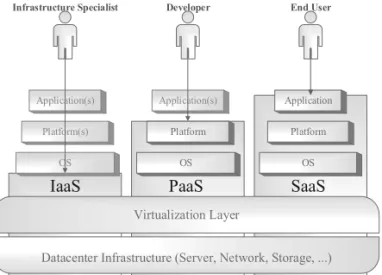
SaaS is the simplest as the end-users only have access to the SaaS application. These three de-livery models are demonstrated in Figure 3.
Virtualization Layer
Datacenter Infrastructure (Server, Network, Storage, ...)
OS OS
Platform(s) Platform Platform
Application(s) Application(s) Application
OS
SaaS PaaS
IaaS
End User Developer
Infrastructure Specialist
Figure 3.Infrastructure as a Service, Platform as a Service, Software as a Service.
Amazon EC2, Google App Engine and Sales-force.com are three main use cases of cloud service models that offer IaaS, PaaS and SaaS respectively.
2.3. Deployment Models
There are four general Cloud deployment mod-els known as private, public, community, and hybrid Cloud.
In Private Cloud, the infrastructure is owned and exclusively used by a single organization, and managed by the organization or a third-party and may exist on or off the premises of the organization. Many organizations, particularly governmental or very large organizations, em-braced this model to exploit the Cloud benefits like flexibility, reliability, cost reduction, sus-tainability, elasticity, and so on. However, they are often criticized for being similar to tradi-tional proprietary server farms and for not pro-viding benefits such as no up-front capital costs
(Zhang, Cheng, & Boutaba, 2010).
In Community Cloud, the infrastructure is shared by several organizations and supports a specific community with shared concerns such as mis-sion, security requirements, policy, and com-pliance considerations(Mell & Grance, 2009).
It may be owned and managed by the organi-zations or by a third-party and may exist on-premises or off-on-premises.
In Public Cloud, the infrastructure exists on the premises of the Cloud provider and is avail-able to the general public or a large industry group, and is owned by an organization selling Cloud services. There are three major Public Cloud computing styles based on the underly-ing resource abstraction technologies, includunderly-ing Amazon EC2, Google App Engine and Win-dows Azure (Qian, Luo, Du, & Guo, 2009). However, a public Cloud can use the same hard-ware infrastructure(with large scale)as a Pri-vate one (Marinescu, 2013). In contrast with Private, Public Cloud lacks fine-grained control over data, network and security settings, which hampers their effectiveness in many business scenarios (Zhang, Cheng, & Boutaba, 2010). This model is suitable for small and medium businesses (SMBs) to support their growing business without huge investment in the infras-tructure.
Sometimes the best infrastructure to fit an or-ganization’s specific needs requires both Cloud and on-premises environments. In Hybrid Cloud, the services within the same organisation are a composition of two or more Clouds (Private, Community, or Public) to address the limita-tions of each model with more scalability and flexibility whilst both saving money and pro-viding additional security. On the down side, Hybrid Cloud environments involve complex management and governance challenges. Some other deployment models, such as Vir-tual Private Cloud and Managed Cloud are well known but not widely used. Virtual Private Cloud is a Private Cloud that leverages a Pub-lic Cloud infrastructure using advanced network capabilities (such as VPN) in an isolated and secured manner. Managed Cloud is a type of private Cloud that is managed by a team of ex-perts in a third-party company. Managed Cloud includes access to a dedicated, 24×7× 365 support team via phone, chat, online support, and so on to support Cloud servers from the OS up through the application stack. Amazon VPC
Public Cloud
Private Cloud Virtual Private CloudFreeUser UseratORGA
Community Cloud
Hybrid Cloud
UseratORGB UseratORGC
UseratORGD
Figure 4.Cloud computing deployment models.
Cloud such as HP Helion Managed Virtual Pri-vate Cloud(HP Helion Managed Virtual Private Cloud, n.d.).
Figure 4 illustrates the above mentioned deploy-ment models.
3. Jungle Computing
3.1. Overview
Jungle computing is a simultaneous combina-tion of several distributed and high performance computing systems to achieve peak performance as well as reduce programming complexity. Jungle computing system is highly heteroge-neous. It may include clusters, grids, clouds, supercomputers, and even mobile devices, pos-sibly with accelerators such as GPUs and FP-GAs(Drost, et al., 2012).
Traditional distributed systems are more equip-ped with state-of-the-art many-core technolo-gies such as multi-core processors, processor clusters, GPUs, as well as supercomputers on-chip. Although these devices often provide or-ders of magnitude speed improvements, they make computing platforms more heterogeneous and hierarchical and vastly more complex to program and use(Seinstra, et al., 2011). Further complexities because of urgent desire for scala-bility and several issues like data distribution, software heterogeneity, and ad-hoc hardware availability force scientists into concurrent use of multiple platforms (Seinstra, et al., 2011). These platforms may use different middle-wares, programming interfaces, access policies, and protection mechanisms. Furthermore, the di-verse computing paradigms differ in usage mo-del. As an example, a stand-alone machine is usually permanently available, a Grid resource will have to be reserved, whilst a Cloud requires a credit card to gain access(Drost, et al., 2012).
SuperComputer Standalone
Machine Desktop Grids Mobile Device
Cloud
Cluster Interface Supercomputer
Interface Cloud
Interface Standalone Machine
Interface Mobile Device
Interface
Desktop Grid Interface
GRID Grid Interface
Middleware
Arbitrary application
Jungle
Local-area
Wide-area Local-area
node
node
L
o
ca
l-a
rea
Wide-area
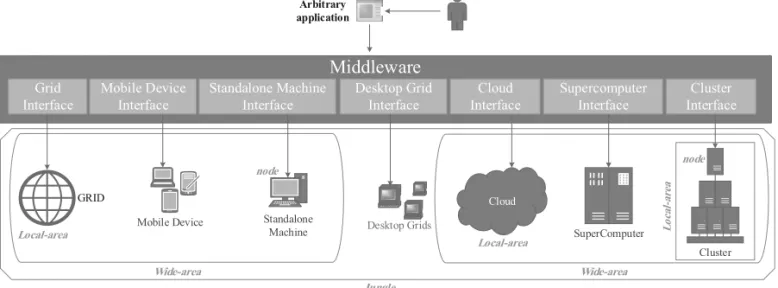
This new distributed computing model makes available a diverse collection of resources to research scientists. These resources can be independent computers, supercomputers, clus-ter systems, grids, desktop grids, clouds, etc., which are all connected via fast networks. By looking at such systems from a high-level per-spective, it can be seen that all these systems consist of a number of basic computing nodes. Each node has local memories and processors, and is capable of communicating over a local-area (multi-node) or wide-area ( multi-local-area) connection and create a Jungle ( multi-wide-area), as is shown in Figure 5.
Jungle computing systems, in the worst case, in-clude all computing platforms depicted in Fig-ure 5. However, in practice, every possible sub-set of this figure represents a realistic scenario for Jungle computing system. Hence, if there are fundamental methodologies working in the worst case scenario, it can make sure that the solution applies to all possible scenarios.
Foreachusedresource inthe Jungle,the arbi-traryapplicationmayhavetobere-compiled,or evenpartiallyre-written,tohandlethechanges inavailablesoftwareandhardware(Drost,etal., 2012). Moreover, torunanyapplication,a dif-ferent middleware interface for each resource shouldbeavailable.
Once an application has been successfully star-ted in a Jungle, another aspect that hinders the use of Jungle computing systems is the lack of connectivity between resources. Resources, es-pecially clusters and supercomputers, are usu-ally not designed for communication with the outside world. Traditional tightly coupled HPC tools are not particularly suited for distributed, heterogeneous and hierarchical environments. Therefore, a Jungle computing platform over-comes these problems in order to simultane-ously and transparently use all of the available computing powers. Consequently, Jungle must have at least the following characteristics ( Se-instra, et al., 2011)which are listed in Table 2.
Characteristic Comment
Resource independence
Resources differ considerably in their details such as processor architecture, amount of memory and performance. This feature hides the physical characteristics of resources from the applications or end-users interacting with those resources.
Middleware
independenceand
interoperability
Middleware independenceallows a Jungle to embrace new middleware technologies with minimal impact on their applications, thereby it eliminates the need for implementing a differentinterfaceforeachmiddlewareandprovidesinteroperabilitybetweenmiddlewares.
Robust
connectivity and globally unique resource naming
This feature is needed to remove connectivity problems such as communication problems with firewalls, transparent renaming of IP addresses, and multi-homing(machines with multiple addresses).
Resource names must be globally unique within a Jungle so that when a user or application on the Jungle specifies a resource name, the connection is routed to that resource. These resources can have the same name in their local system.
Malleability Jungle with malleability will be able to adapt to resource changes. Malleability providestolerance to the variations in resources availability, e.g., reservations ending, in order to correctly handle joining and leaving.
System-level fault-tolerance
This feature ensures that the Jungle computing system can be used by the end-user, even when something goes wrong in one or more elements in the hardware configuration. In case of a failure, the failing resource has to be replaced by a backup system.
Application-level
fault-tolerance This feature can complement system-level fault-tolerance by restoring the state of theapplications that ran on a failed resource.
Parallelization
This feature relieves programmers from the tedious and error-prone manual parallelization process and makes programming models available to end-users. It hides all or most of the inherent complexities of parallelization by converting automatically sequential program into parallel program utilizing all available resources.
Integration with external software
This feature is needed for integrating black box legacy codes such as system-level soft-ware (e.g., specialized communication libraries) and architecture-specific compute kernels (e.g., CUDA-implemented algorithms for GPU-execution)with a software system for Jungle computing.
Computational astrophysics, climate modelling
(Drost, et al., 2012), remote sensing(Kessel, et al., 2014), image analysis, drug designing, as-tronomy or Neuroinformatics (Seinstra, et al., 2011) are some examples of the applications that can benefit from Jungle computing systems.
3.2. Computing in the Jungle
In this section, we briefly describe two software platforms designed to support Jungle comput-ing. First, the Ibis high-performance distributed programming system (Seinstra, et al., 2011), and next the Constellation (Maassen, Drost, Bal, & Seinstra, 2011) that is a platform for creating flexible and efficient applications for Jungle computing systems, will be described.
3.2.1. Ibis
Ibis (Ibis: Computing in the Jungle, n.d.), is anopensourceJavadistributedcomputing soft-wareplatformwithanintegrated,layered archi-tecture that offers an efficient and transparent solutionforJunglecomputing. TheaimofIbis istocreateanefficientJava-basedplatformfor distributedcomputing thatcombines all ofthe fundamental methodologies into a single inte-gratedprogrammingsystemtosimplifythe pro-grammingand deploymentof Jungle Comput-ing. Ibis provides high-level, architecture- and middleware-independent interfaces that allow transparentimplementationofefficient applica-tions. Thesefeaturesproviderobustnessand dy-namicvariationsintheavailabilityofresources
(Seinstra,etal.,2011).
The Ibis platform consists of two distinct sub-systems, which provide all functionality that is traditionally associated with programming lan-guages and communication libraries, as well as operating systems. The former is Ibis Dis-tributed Deployment System which allows users to easily start and deploy any application in the Jungle, while the latter is Ibis High Per-formance Programming System which allows programmers to write applications specifically designed to run in a Jungle computing system. An overview of the Ibis architecture is depicted in Figure 6, whilst detailed architecture can be seen in(Bal, et al., 2010).
Figure 6.Overview of the Ibis architecture(Drost, et al., 2012).
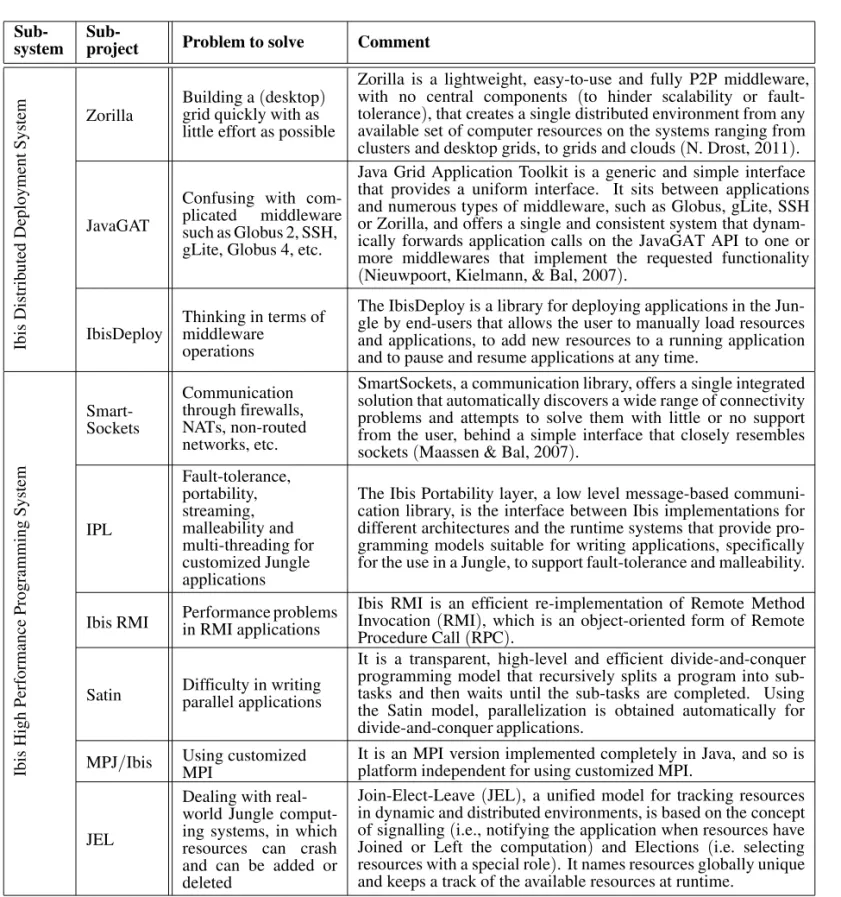
Ibis is designed in a modular way and consists of a number of sub-projects, which are possible to be used individually. Each sub-project solves a specific problem. Some of them are showed in Table 3.
Although Ibis is written in Java, it interfaces easily with the existing software and supports running any application written in any program-ming language such as C, C++, FORTRAN, MPI, or otherwise(Drost, et al., 2012).
The Ibis platform meets the characteristics of Jungle computing(Seinstra, et al., 2011)as pre-sented in Table 4.
3.2.2. Constellation
Ibis/Constellation, or in brief Constellation, is a lightweight software platform specifically de-signed for distributed, heterogeneous and hier-archical computing environments. As addition to the Ibis project, it enables applications to ef-ficiently run on Jungle computing systems. In addition, Constellation makes it straightforward to re-targeting applications to completely differ-ent computing environmdiffer-ents(Maassen, Drost, Bal, & Seinstra, 2011).
Sub-system Sub-project Problem to solve Comment
Zorilla Building agrid quickly with as(desktop) little effort as possible
Zorillais a lightweight, easy-to-use andfully P2P middleware, with no central components (to hinder scalability or fault-tolerance),thatcreatesasingledistributedenvironmentfromany availablesetofcomputerresourcesonthesystemsrangingfrom clustersanddesktopgrids,togridsandclouds(N.Drost,2011).
JavaGAT
Confusing with com-plicated middleware suchasGlobus2,SSH, gLite,Globus4,etc.
JavaGrid ApplicationToolkitisageneric andsimpleinterface that providesa uniform interface. It sits between applications andnumeroustypesofmiddleware,suchasGlobus,gLite,SSH orZorilla,andoffersasingleandconsistentsystemthat dynam-icallyforwardsapplication calls ontheJavaGAT APItooneor more middlewares that implement the requested functionality (Nieuwpoort,Kielmann,&Bal,2007).
Ib
is
Distr
ib
uted
Dep
lo
ym
en
tS
ys
tem
IbisDeploy Thinkingmiddlewareintermsof operations
The IbisDeploy is a library for deploying applications in the Jun-gle by end-users that allows the user to manually load resources and applications, to add new resources to a running application and to pause and resume applications at any time.
Smart-Sockets
Communication through firewalls, NATs, non-routed networks, etc.
SmartSockets, a communication library, offers a single integrated solution that automatically discovers a wide range of connectivity problems and attempts to solve them with little or no support from the user, behind a simple interface that closely resembles sockets(Maassen & Bal, 2007).
IPL
Fault-tolerance, portability, streaming, malleability and multi-threading for customized Jungle applications
The Ibis Portability layer, a low level message-based communi-cation library, is the interface between Ibis implementations for different architectures and the runtime systems that provide pro-gramming models suitable for writing applications, specifically for the use in a Jungle, to support fault-tolerance and malleability.
Ibis RMI Performance problemsin RMI applications Ibis RMI is an efficient re-implementation of Remote MethodInvocation(RMI), which is an object-oriented form of Remote Procedure Call(RPC).
Ibi
s
Hi
gh
Pe
rformance
Programmi
ng
Sy
st
em
Satin Difficulty in writingparallel applications
It is a transparent, high-level and efficient divide-and-conquer programming model that recursively splits a program into sub-tasks and then waits until the sub-sub-tasks are completed. Using the Satin model, parallelization is obtained automatically for divide-and-conquer applications.
MPJ/Ibis Using customizedMPI It is an MPI version implemented completely in Java, and so isplatform independent for using customized MPI.
JEL
Dealing with real-world Jungle comput-ing systems, in which resources can crash and can be added or deleted
Join-Elect-Leave(JEL), a unified model for tracking resources in dynamic and distributed environments, is based on the concept of signalling(i.e., notifying the application when resources have Joined or Left the computation) and Elections (i.e. selecting resources with a special role). It names resources globally unique and keeps a track of the available resources at runtime.
Table 3.Ibis sub-projects.
an activitymay be created to support different
hardware architectures and they may consist of a script, C, CUDA, OpenMP or MPI, etc. Con-stellation usesExecutorsto represent hardware capable of running activities. Anexecutormay represent a single core of a machine, a single machine with multiple cores, a specialized piece of hardware(e.g., a GPU), an entire Cluster, and so on(Maassen, Drost, Bal, & Seinstra, 2011).
It is very easy to exploit new resources by de-ploying extraexecutorson those new resources. Figure 7 shows an abstract of the Constellation architecture.
Characteristic of
Jungle Computing Ibis
Resource independence Since Ibis is a Java-based platform, JVM Virtualization provides resource independence.
Middleware
independenceand
interoperability
JavaGAT provides thisfunctionality using adapterswhich interact witha middleware tostarttherequiredtask. JavaGATwillautomaticallyselecttheappropriateadapterfor eachresource,andadaptersareeasilyadded,ifneeded.
Robust connectivity and globally unique
resource naming These features are supported by the SmartSockets and the JEL, respectively.
Malleability System-level fault-tolerance
These features provided by the Satin, the IPL and resource tracking mechanisms of the JEL, which is an integral part of the IPL. Zorilla also supports fault tolerance and malleability by implementing all functionality using peer-to-peer techniques.
Application-level
fault-tolerance Application-level fault-tolerance can be built on top of the system-level fault-tolerancemechanisms provided by the IPL.
Parallelization This requirement is fulfilled through a number of programming models such as Satinmodel implemented on top of the IPL. Integration with
external software This is achieved through JNI(plugins). (Java Native Interface) or through adaptor interfaces
Table 4.Ibis vs. Jungle characteristics.
distributed and heterogeneous environment, it is easier and often faster to just create several independent activities targeted at smaller and simpler homogeneous environments.
Using equi-kernels, which are different imple-mentations of the same kernel functionality, integration with external software is provided while maintaining resource independence. By including a default equi-kernel for each opera-tion, the Constellation can transparently exploit special hardware and codes, without failing to operate when such hardware is not available
(Kessel, et al., 2014). Furthermore, the match-making mechanism and labelling approach of Constellation makes it very simple to config-ure. Matchmaking(Raman, Livny, & Solomon,
Figure 7.An abstract of the Constellation architecture (Maassen, Drost, Bal, & Seinstra, 2011).
1998)is one of the main problems in heteroge-neous applications that gives the right activities to the right resource while Labelling allows an application to tag different types of activities and hardware(Maassen, Drost, Bal, & Seinstra, 2011).
Atlast, Constellationmeetsthe characteristics of Jungle computing by leveraging Ibis plat-form that fully provides middleware indepen-dence, robust connectivity, and system-level fault-tolerance, while it offers mechanisms to support for malleability and application-level fault-tolerance(Kessel,etal.,2014).
4. Fog Computing 4.1. Overview
from the Cloud systems and place them closer to the end-user, which is the aim of Fog com-puting.
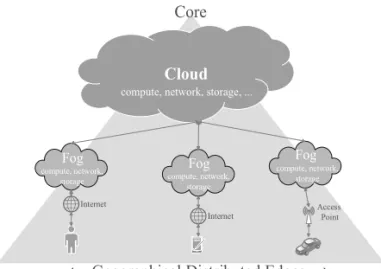
The Fog is organizationally located below the Cloud and serves as an optimized transfer medium for services and data within the Cloud, which is depicted in Figure 8.
Cloud compute, network, storage, ...
compute, network, storage
Internet
Internet Access
Point
Fog Fog
compute, network, storage
Fog
Core
Geographical Distributed Edges
compute, network, storage
Figure 8.Fog computing architecture.
The Fog computing happens outside the Cloud and ensures that Cloud services, compute, stor-age, workloads, applications and big data can be provided at any edge of the network(Internet)
in a truly distributed way. By controlling data in various edge points, Fog computing integrates core Cloud services to turning data center into a distributed Cloud platform for users. In other words, FOG brings computingfrom the core to the edge of the network(fog).
In this context, it may be just another name for Edge computing (Bonomi, The Smart and Connected Vehicle and the Internet of Things, 2013). Edge Computing is pushing the fron-tier of computing applications, data, and ser-vices away from centralized nodes to the log-ical extremes of a network. It enables analyt-ics and knowledge generation to occur at the source of the data. This approach requires lever-aging resources that may not be continuously connected to a network such as laptops, smart-phones, tablets and sensors (LaMothe, 2013). Two systems that can provide resources for computing near the edge of the network are the MediaBroker (Lillethun, Hilley, Horrigan, & Ramachandran, 2007)for live sensor stream analysis, and Cloudlets(Satyanarayanan, Bahl,
Caceres, & Davies, 2009) for interactive ap-plications. However, neither currently sup-ports widely distributed geospatial applications
(Hong, Lillethun, Ramachandran, Ottenw¨alder, & Koldehofe, 2013).
Users are clamoring for access to the massive quantities of information at any time, in any place and with any device that is extremely dispersed and produced by and about people, things, and their interactions. The flexibility of the Cloud makes it a good choice for this need. As the technology advances, the question for many businesses is how they can benefit from big data and how to use Cloud computing to make it happen. In order to make an effective and optimized Cloud model, businesses require a new approach to crunching huge quantities of data and delivering them to their users via ge-ographically distributed platforms and not via the Cloud which is located in one place. Thus, the idea of Fog computing has emerged to dis-tribute all data and place it closer to the end-user, eliminate service latency, improve QoS and re-move other possible obstacles connected with data transfer. Because of its wide geographi-cal distribution, the Fog paradigm is well posi-tioned for big data and real time analytics and it supports mobile computing and data streaming.
Fog computing is not a replacement for Cloud computing. It is just an addition which devel-ops the concept of Cloud services. Services are hosted at the network edge or even end de-vices such as set-top-boxes or access points, etc. Conceptual Fog computing builds upon ex-isting and common technologies like Content Delivery Networks(CDN), but based on Cloud technologies it should ensure the delivery of more complex services(Buest, 2013; Kleyman, 2013). However, developing applications us-ing fog computus-ing resources is more complex
(Hong, Lillethun, Ramachandran, Ottenw¨alder, & Koldehofe, 2013).
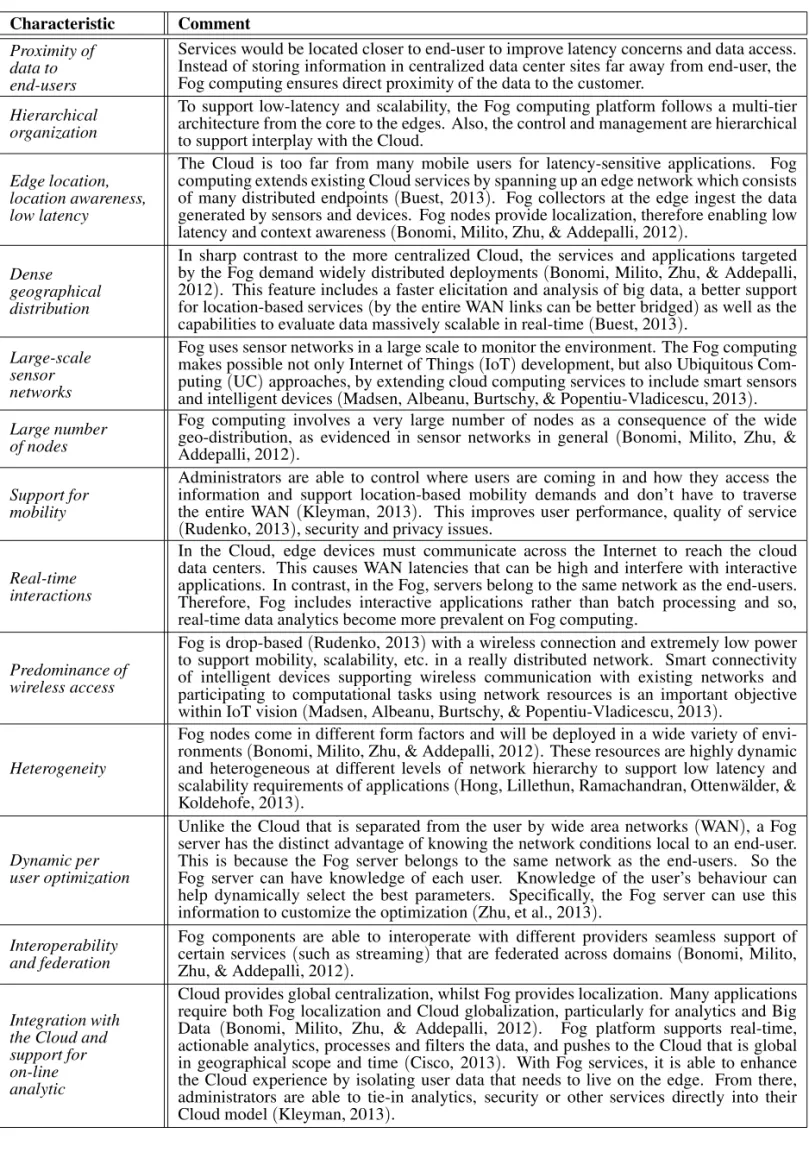
Characteristic Comment
Proximity of data to end-users
Services would be located closer to end-user to improve latency concerns and data access. Instead of storing information in centralized data center sites far away from end-user, the Fog computing ensures direct proximity of the data to the customer.
Hierarchical organization
To support low-latency and scalability, the Fog computing platform follows a multi-tier architecture from the core to the edges. Also, the control and management are hierarchical to support interplay with the Cloud.
Edge location, location awareness, low latency
The Cloud is too far from many mobile users for latency-sensitive applications. Fog computing extends existing Cloud services by spanning up an edge network which consists of many distributed endpoints(Buest, 2013). Fog collectors at the edge ingest the data generated by sensors and devices. Fog nodes provide localization, therefore enabling low latency and context awareness(Bonomi, Milito, Zhu, & Addepalli, 2012).
Dense geographical distribution
In sharp contrast to the more centralized Cloud, the services and applications targeted by the Fog demand widely distributed deployments(Bonomi, Milito, Zhu, & Addepalli, 2012). This feature includes a faster elicitation and analysis of big data, a better support for location-based services(by the entire WAN links can be better bridged)as well as the capabilities to evaluate data massively scalable in real-time(Buest, 2013).
Large-scale sensor networks
Fog uses sensor networks in a large scale to monitor the environment. The Fog computing makes possible not only Internet of Things(IoT)development, but also Ubiquitous Com-puting(UC)approaches, by extending cloud computing services to include smart sensors and intelligent devices(Madsen, Albeanu, Burtschy, & Popentiu-Vladicescu, 2013).
Large number of nodes
Fog computing involves a very large number of nodes as a consequence of the wide geo-distribution, as evidenced in sensor networks in general (Bonomi, Milito, Zhu, & Addepalli, 2012).
Support for mobility
Administrators are able to control where users are coming in and how they access the information and support location-based mobility demands and don’t have to traverse the entire WAN (Kleyman, 2013). This improves user performance, quality of service (Rudenko, 2013), security and privacy issues.
Real-time interactions
In the Cloud, edge devices must communicate across the Internet to reach the cloud data centers. This causes WAN latencies that can be high and interfere with interactive applications. In contrast, in the Fog, servers belong to the same network as the end-users. Therefore, Fog includes interactive applications rather than batch processing and so, real-time data analytics become more prevalent on Fog computing.
Predominance of wireless access
Fog is drop-based(Rudenko, 2013)with a wireless connection and extremely low power to support mobility, scalability, etc. in a really distributed network. Smart connectivity of intelligent devices supporting wireless communication with existing networks and participating to computational tasks using network resources is an important objective within IoT vision(Madsen, Albeanu, Burtschy, & Popentiu-Vladicescu, 2013).
Heterogeneity
Fog nodes come in different form factors and will be deployed in a wide variety of envi-ronments(Bonomi, Milito, Zhu, & Addepalli, 2012). These resources are highly dynamic and heterogeneous at different levels of network hierarchy to support low latency and scalability requirements of applications(Hong, Lillethun, Ramachandran, Ottenw¨alder, & Koldehofe, 2013).
Dynamic per user optimization
Unlike the Cloud that is separated from the user by wide area networks(WAN), a Fog server has the distinct advantage of knowing the network conditions local to an end-user. This is because the Fog server belongs to the same network as the end-users. So the Fog server can have knowledge of each user. Knowledge of the user’s behaviour can help dynamically select the best parameters. Specifically, the Fog server can use this information to customize the optimization(Zhu, et al., 2013).
Interoperability and federation
Fog components are able to interoperate with different providers seamless support of certain services(such as streaming)that are federated across domains(Bonomi, Milito, Zhu, & Addepalli, 2012).
Integration with the Cloud and support for on-line analytic
Cloud provides global centralization, whilst Fog provides localization. Many applications require both Fog localization and Cloud globalization, particularly for analytics and Big Data (Bonomi, Milito, Zhu, & Addepalli, 2012). Fog platform supports real-time, actionable analytics, processes and filters the data, and pushes to the Cloud that is global in geographical scope and time(Cisco, 2013). With Fog services, it is able to enhance the Cloud experience by isolating user data that needs to live on the edge. From there, administrators are able to tie-in analytics, security or other services directly into their Cloud model(Kleyman, 2013).
Already, we are seeing everything-as-a-service models. This means that the future of the com-puting paradigms must support the idea of the Internet of Thing(IoT)in order to successfully emerge, wherein sensors and actuators blend seamlessly with the environment around us and the information is shared across platforms in order to develop a common operating picture
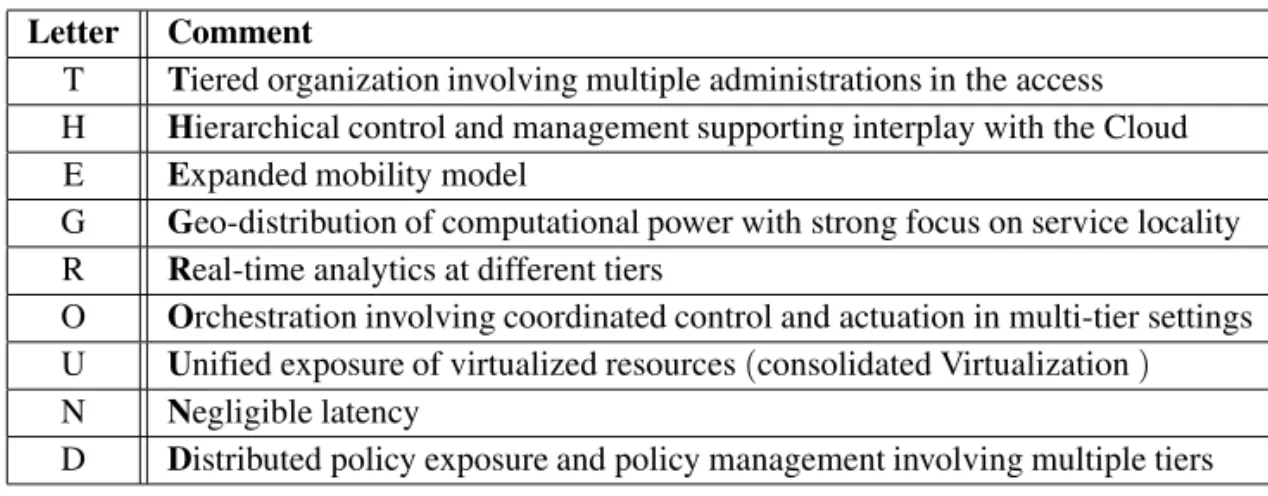
(Gubbi, Buyya, Marusic, & Palaniswami, 2013). Fog computing supports emerging Internet of Thing applications that demand real-time or pre-dictable latency such as industrial automation, transportation, sensor networks and actuators. This model is called Fog computing simply be-cause the Fog is a Cloud close to the ground and Fog promises to take hardware and software virtualization back down from cloud to earth, where it belongs. Therefore, the differences be-tween the Fog and the Cloud can be summarized in “The Ground” term(Nemirovsky, Milito, & Yanuzzi, 2012), which is described in Table 6. The basic technology for Fog computing is the concept of drop(Rudenko, 2013). A drop is a chip of a microcontroller with built-in memory and data transfer interface, which is combined with wireless connection Mesh chip. Such a drop works on a small battery which is enough for a couple of years. Users can connect differ-ent temperature, light, voltage sensors, etc. With the help of such mini-chips it is possible to create really distributed network of data or devices all around the planet. Constant data circulation in the world makes providers cre-ate new technologies for their local storage and caching. The drops allow keeping the data close
to a user instead of storing them in a data center somewhere far away. It helps to avoid possible delays in data transfer(Rudenko, 2013).
The concept of Fog computing is not some-thing to be developed in the future. It is al-ready here and a number of distributed com-puting and storage start-ups are adopting the phrase(Kleyman, 2013). A lot of companies have already introduced it, while other compa-nies are ready for it(Rudenko, 2013). Actually, any company which delivers content can start using Fog computing. A good example is Net-flix(NetFlix, n.d.), a provider of media content, who is able to reach its numerous globally dis-tributed customers. With the data management in one or two central data centers, the deliv-ery of video-on-demand service would not be efficient enough. Fog computing thus allows providing very large amounts of streamed data by delivering the data directly into the vicinity of the customer (Buest, 2013). Another use case is Symform(Symform, n.d.), a Cloud stor-age provider, which uses a decentralized, dis-tributed, virtual, and crowd-sourced Cloud. Its approach can provide better disaster resilience than data centers hundreds of miles apart. It can do that in a way that is extremely cheap, and in some cases free(Perry, 2013). Smart Grid is an-other rich Fog use case(Bonomi, Milito, Zhu, & Addepalli, 2012). It is the next generation of computing and provides tremendous value to providers and users.
Letter Comment
T Tiered organization involving multiple administrations in the access H Hierarchical control and management supporting interplay with the Cloud E Expanded mobility model
G Geo-distribution of computational power with strong focus on service locality R Real-time analytics at different tiers
O Orchestration involving coordinated control and actuation in multi-tier settings U Unified exposure of virtualized resources(consolidated Virtualization) N Negligible latency
D Distributed policy exposure and policy management involving multiple tiers
5. Conclusion
The future of computing is heading toward using shared heterogeneous resources and is concerned about Big Data. These require-ments result in emerging new distributed com-puting paradigms. In this article, we have strived to clarify modern distributed comput-ing paradigms, namely Cloud, Jungle and Fog computing.
In Cloud computing, resources are moving away from end-users towards centralized systems that possess huge processing power and storage ca-pacities. In this model, problems arise for latency-sensitive applications, which require no-des in the vicinity to meet their delay require-ments and users have no control over the man-ner in which they can access their data. Fog computing, in contrast, at a really distributed level, provides computing services between end points and traditional Cloud computing data centers, away from centralized nodes to the edge of a network. On the other hand, distributed computing infrastructures such as Cloud, Clus-ter or Grid currently are undergoing revolution-ary change and becoming more heterogeneous and hierarchical. This leads scientists to use a si-multaneous combination of heterogeneous, hi-erarchical, and distributed computing resources as a Jungle computing system, to access more computing power.
Cloud computing has got the momentum in the distributed computing in recent years and may be mature with new technologies and paradigms such as Jungle and Fog. It is obvious that Cloud computing is used in Fog computing and may or should be used in Jungle computing. There-fore, bear in mind that knowing Cloud comput-ing is essential in distributed computcomput-ing. On the other hand, since Cloud computing may not be a mainstream technology in the near future, as Grid computing is no longer a concept to be discussed, it is useful to take a glance at the other, newly distributed computing paradigms.
Acknowledgments
The authors would like to thank the anonymous reviewers for their valuable comments and sug-gestions to improve the quality of the paper.
References
[1] A. O. AKANDE, N. A. APRIL, J.-P. VANBELLE,
Man-agement Issues with Cloud Computing.Second In-ternational Conference on Innovative Computing
and Cloud Computing, (2013) New York, NY,
USA: ACM, pp. 119–124.
[2] AMAZONVPC,(n.d.). Retrieved from Amazon:
http://aws.amazon.com/vpc/
[3] G. R. ANDREWS, Foundations of Multithreaded,
Parallel, and Distributed Programming.
Addison-Wesley, 1999.
[4] N. ANTONOPOULOS, L. GILLAM, Cloud
Comput-ing: Principles, Systems and Applications. Springer, 2010.
[5] M. ARMBRUST, A. FOX, R. GRIFFITH, A. D. JOSEPH, R. H. KATZ, A. KONWINSKI, M. ZAHARIA, Above the Clouds: A Berkeley View of Cloud Comput-ing. EECS Department, University of California, Berkeley, 2009.
[6] H. E. BAL, J. MAASSEN, R. V. NIEUWPOORT, N.
DROST, N. PALMER, G. WRZESINSKA, C. JA,
Real-world distributed computing with Ibis.IEEE Com-puter,(2010), 54–62.
[7] F. BONOMI, The Smart and Connected Vehicle and
the Internet of Things. Workshop on
Synchroniza-tion in TelecommunicaSynchroniza-tion Systems (WSTS),(2013)
San Jose, California, USA.
[8] F. BONOMI, R. MILITO, J. ZHU, S. ADDEPALLI, Fog
Computing and Its Role in the Internet of Things.
Proceedings of the First Edition of the MCC
Work-shop on Mobile Cloud Computing, (2012), pp.
13–16.
[9] R. BUEST,Fog Computing: Data, Information,
Ap-plication and Services need to be delivered more efficiently to the end user.(2013, October 19). Re-trieved from clouduser.de:
http://clouduser.de/en/analysis/fog- computing-data-information-application- and-services-needs-to-be-delivered-more-efficient-to-the-enduser-22362
[10] R. BUYYA, J. BROBERG, A. GOSCINSKI, CLOUD
COMPUTING Principles and Paradigms,(1 ed.).
Wiley, 2011.
[11] CISCO. Fog Computing, Ecosystem, Architecture
and Applications.(2013). Retrieved from http://www.cisco.com/web/about/ac50/ac 207/crc new/university/RFP/rfp13078.html
[12] CSA,Security Guidance for Critical Areas of Focus in Cloud Computing V2.1.. Cloud Security Alliance, 2009.
[13] M. D. DIKAIAKOS, D. KATSAROS, P. MEHRA, G. PALLIS, A. VAKALI, Cloud Computing: Distributed Internet Computing for IT and Scientific Research.
[14] GARTNER, INC., Gartner’s 2013 Hype Cycle for
Emerging Technologies Maps Out Evolving Rela-tionship Between Humans and Machines, (2013) Stamford, Connecticut, USA: Gartner.
[15] N. DROST, J. MAASSEN, M. A. MEERSBERGEN, H. E.
BAL, F. I. PELUPESSY, S. P. ZWART, F. J. SEINSTRA,
High-performance Distributed Multi-model/Multi-kernel Simulations: A Case-study in Jungle Com-puting.IEEE International Parallel and Distributed
Processing Symposium Workshops,(2012)
Shang-hai, China: IEEE, pp. 150–162.
[16] W. FORREST,Clearing the Air on Cloud Computing.
McKinsey & Company, 2009.
[17] C. GONG, J. LIU, Q. ZHANG, H. CHEN, Z. GONG, The
Characteristics of Cloud Computing.39th Interna-tional Conference on Parallel Processing Work-shops,(2010)San Diego, CA: IEEE, pp. 275–279. [18] J. GUBBI, R. BUYYA, S. MARUSIC, M. PALANISWAMI,
Internet of Things(IoT): A vision, architectural el-ements, and future directions. Future Generation
Computer Systems,29(7) (2013), 1645–1660.
[19] B. HALPERT,Auditing Cloud Computing: A Security
and Privacy Guide. John Wiley & Sons, 2011. [20] B. HAYES, Cloud Computing.Communications of
the ACM,(2008), 9–11.
[21] K. HONG, D. LILLETHUN, U. RAMACHANDRAN, B.
OTTENWALDER¨ , B. KOLDEHOFE, Mobile Fog: A Programming Model for Large–Scale Applications on the Internet of Things.Proceedings of the sec-ond ACM SIGCOMM workshop on Mobile cloud
computing,(2013)New York, NY, USA: ACM, pp.
15–20.
[22] HP HELION MANAGED VIRTUALPRIVATE CLOUD,
(n.d.). Retrieved from HP:
http://www8.hp.com/us/en/business-ser-vices/it-services.html?compURI=1079571 [23] F. HU, M. QIU, J. LI, T. GRANT, D. TYLOR, S. MC
-CALEB, R. HAMNER, A Review on Cloud
Com-puting: Design Challenges in Architecture and Security. Journal of Computing and Information Technology,(2011), 25–55.
[24] IBIS: COMPUTING IN THEJUNGLE,(n.d.). Retrieved from VU University Amsterdam:
www.cs.vu.nl/ibis/
[25] W. A. JANSEN, Cloud Hooks: Security and Privacy Issues in Cloud Computing. the 44th Hawaii In-ternational Conference on System Sciences,(2011) Washington, DC, USA: IEEE Computer Society, pp. 1–10.
[26] JOYENT,The Compelling Economics of Cloud
Com-puting. Joyent, 2012.
[27] P. KACSUK, Z. N´EMETH, T. FAHRINGER,Distributed
and Parallel Systems: From Cluster to Grid Com-puting. Springer, 2007.
[28] B. KAHANWAL, T. P. SINGH, The Distributed
Com-puting Paradigms: P2P, Grid, Cluster, Cloud, and Jungle.International Journal of Latest Research in
Science and Technology,(2012), 183–187.
[29] T. V. KESSEL, N. DROST, J. MAASSEN, H. BAL, F.
SEINSTRA, A. PLAZA, Towards a High-Performance
Distributed CBIR System for Hyperspectral Remote Sensing Data: A Case Study in Jungle Comput-ing. InHigh-Performance Computing on Complex Environments(E. JEANNOT, J. ZILINSKAS),(2014).
Wiley.
[30] B. KLEYMAN, Welcome to Fog Computing:
Ex-tending the Cloud to the Edge. (2013, August
23). Retrieved from Data Center Knowledge: http://www.datacenterknowledge.com/ archives/2013/08/23/welcome-to-the-fog-a-new-type-of-distributed-computing/
[31] R. LAMOTHE, Edge Computing. Richland, USA:
Pacific Northwest National Laboratory, 2013.
[32] D. LILLETHUN, D. HILLEY, S. HORRIGAN, U. RA -MACHANDRAN, MB++: An integrated
architec-ture for pervasive computing and high-performance computing.International Conference on Embedded and Real-Time Computing Systems and
Applica-tions, (2007) Daegu, South Korea: IEEE, pp.
241–248.
[33] J. MAASSEN, H. E. BAL, SmartSockets: Solving the Connectivity Problems in Grid Computing. Pro-ceedings of the 16th International Symposium on
High Performance Distributed Computing,(2007)
Monterey, California, USA: ACM, pp. 1–10.
[34] J. MAASSEN, N. DROST, H. E. BAL, F. J. SEINSTRA, Towards jungle computing with Ibis/Constellation.
Workshop on Dynamic Distributed Data-intensive Applications, Programming Abstractions, and Sys-tems, (2011) New York, NY, USA: ACM, pp. 7–18.
[35] H. MADSEN, G. ALBEANU, B. BURTSCHY, F.
POPENTIU-VLADICESCU, Reliability in the Utility
Computing Era: Towards Reliable Fog
Comput-ing.International Conference on Systems, Signals
and Image Processing (IWSSIP),(2013)Bucharest, Romania: IEEE, pp. 43–46.
[36] D. C. MARINESCU,Cloud Computing: Theory and
Practice. Morgan Kaufmann, 2013.
[37] P. MELL, T. GRANCE,The NIST Definition of Cloud
Computing. Information Technology Laboratory:
National Institute of Standards and Technology, 2009.
[38] J. M. MYERSON,Best practices to develop SLAs for
cloud computing. IBM, 2013.
[39] N. DROST, Zorilla: a peer-to-peer middleware for real-world distributed systems. Concurrency and Computation: Practice & Experience,23(13) (2011), 1506–1521.
[40] M. NEMIROVSKY, R. MILITO, M. YANUZZI, Fog
Computing. Barcelona Supercomputing Center,
2012.
[42] R. V. NIEUWPOORT, T. KIELMANN, H. E. BAL,
User-friendly and reliable grid computing based on im-perfect middleware.Proceedings of the ACM/IEEE
Conference on Supercomputing, (2007) Reno,
Nevada, USA.
[43] D. NURMI, R. WOLSKI, C. GRZEGORCZYK, G.
OBERTELLI, S. SOMAN, L. YOUSEFF, D. ZAGOROD -NOV, The Eucalyptus Open-source
Cloud-computing System. Proceedings of the 9th IEEE/ACM International Symposium on Cluster
Computing and the Grid,(2009)Shanghai, China:
IEEE Computer Society, pp. 124–131.
[44] T. PERRY,What Comes After the Cloud? How About
the Fog? (2013, Feburay 8). Retrieved from IEEE Spectrum: http://spectrum.ieee.org/tech- talk/computing/networks/what-comes-after-the-cloud-how-about-the-fog
[45] L. QIAN, Z. LUO, Y. DU, L. GUO, Cloud Computing:
An Overview.the 1st International Conference on
Cloud Computing(CloudCom 09), (2009) Berlin,
Heidelberg: Springer, pp. 626–631. [46] RACKSPACE,(n.d.). Retrieved from
http://www.rackspace.com
[47] R. RAMAN, M. LIVNY, M. SOLOMON, Matchmaking:
istributed resource management for high throughput computing.Procceding of the Seventh IEEE Interna-tional Symposium on High Performance Distributed
Computing,(1998)Chicago, IL, USA, pp. 140–146.
[48] E. RUDENKO,Fog Computing Is a New Concept of
Data Distribution.(2013, December 5). Retrieved
from CloudTweaks:
http://www.cloudtweaks.com/2013/12/fog- computing-is-a-new-concept-of-data-distribution/
[49] M. SATYANARAYANAN, P. BAHL, R. CACERES, N.
DAVIES, The case for VM-based cloudlets in mobile
computing. IEEE Pervasive Computing, (2009), 14–23.
[50] F. J. SEINSTRA, J. MAASSEN, R. V. NIEUWPOORT,
N. DROST, T. V. KESSEL, B.VANWERKHOVEN, A.
H. BAL, Jungle Computing: Distributed
Super-computing Beyond Clusters, Grids, and Clouds. In
Grids, Clouds and Virtualization(M. CAFARO, G.
ALOISIO),(2011)pp. 167–199. London: Springer.
[51] SYMFORM,(n.d.). Retrieved from
http://www.symform.com/
[52] A. S. TANENBAUM, M. V. STEEN, Distributed
sys-tems: Principles and Paradigms, (2nd Edition).
Pearson Prentice Hall, 2006.
[53] L. M. VAQUERO, L. RODERO-MERINO, J. CACERES,
M. LINDNER, A break in the clouds: towards a cloud
definition.ACM SIGCOMM Computer Communi-cation Review,39(1) (2009), 50–55.
[54] M. A. VOUK, Cloud Computing – Issues, Research
and Implementations. Journal of Computing and
Information Technology,(2008), 235–246.
[55] Z. XIAO, Y. XIAO, Security and Privacy in Cloud
Computing.IEEE Communications Surveys & Tu-torials,(2013), 843–859.
[56] C.T. YANG, B.-H. CHEN, W.-S. CHEN, On Imple-mentation of a KVM IaaS with Monitoring System on Cloud Environments. In Communication and Networking(T.-H. KIM, H. ADELI, W.-C. FANG, T.
VASILAKOS, A. STOICA, C. Z. PATRIKAKIS, Y. XIAO),
(2012)pp. 300–309. Berlin: Springer.
[57] Q. ZHANG, L. CHENG, R. BOUTABA, Cloud
comput-ing: state-of-the-art and research challenges. Jour-nal of Internet Services and Applications,(2010), 7–18.
[58] J. ZHU, D. S. CHAN, M. S. PRABHU, P. NATARAJAN,
H. HU, F. BONOMI, Improving Web Sites
Perfor-mance Using Edge Servers in Fog Computing Ar-chitecture.IEEE Seventh International Symposium
on Service-Oriented System Engineering, (2013)
IEEE, pp. 320–323.
Received:March, 2014
Revised:June, 2014
Accepted:June, 2014
Contact addresses:
Majid Hajibaba Department of Electrical and Information Technology Iranian Research Organization for Science and Technology(IROST)
Tehran Iran e-mail:[email protected]
Saeid Gorgin Department of Electrical and Information Technology Iranian Research Organization for Science and Technology(IROST)
Tehran Iran e-mail:[email protected]
MAJIDHAJIBABAreceived his MS degree in computer science from Iran University of Science and Technology. Currently, he is a Ph.D. student at Iranian Research Organization for Science and Technology. His re-search in Ph.D. is focused on distributed computing. Other rere-search interests include programming languages, compilers, software testing, cloud computing, big data and high performance computing.