Vol. 3, No. 4, 2010, 670-677
ISSN 1307-5543 – www.ejpam.com
Codes over Quaternion Integers
Mehmet Özen
∗, Murat Güzeltepe
Department of Mathematics, Sakarya University, TR54187 Sakarya, Turkey
Abstract. In this paper, we study codes over some finite fields by using quaternion integers. Also, we obtain the decoding procedure of these codes.
2000 Mathematics Subject Classifications: 94B05, 94B15, 94B35, 94B60
Key Words and Phrases: Block codes, Mannheim distance, Cyclic codes, Syndrome decoding
1. Introduction
In this study, we consider codes over finite fields equipped with a quaternion Mannheim metric. Mannheim distance and codes over Gaussian integers with respect to the Mannheim metric which are suitable for quadrature amplitude modulation (QAM)-type were introduced by Huber in [1, 2]. A Mannheim metric is a Manhattan metric modulo a two-dimensional (2-D) grid. Two classes of codes over Gaussian integersZ[i]were considered in[1], namely, the one Mannheim error-correcting (OMEC) codes, and codes having minimum Mannheim distance greater than 3. In[2], most of the proposed codes were shown to bei−cyclic in the sense of constacyclic codes, as defined by Berlekamp. In a similar technique, in[3], codes over Eisenstein-Jacobi integersZ[w]were presented together with a decoding algorithm for a proper Mannheim metric.
In Section 2, quaternion integers and quaternion Mannheim distance have been consid-ered. Also, we present some fundamental algebraic concepts. In Section 3, we are interested in constructing perfect codes which are able to correct errors of quaternion Mannheim weight one. In Section 4, double error correcting codes which have minimum distance four or more are constructed and decoding procedure for these codes is given.
∗Corresponding author.
Email addresses:ozensakarya.edu.tr(M. Özen),mguzeltepesakarya.edu.tr(M.Güzeltepe)
2. Quaternion Integers and Quaternion Mannheim Distance
Definition 1. The Hamilton Quaternion Algebra over the set of the real numbers (R), denoted by H(R), is the associative unital algebra given by the following representation:
i) H(R)is the freeR module over the symbols1,i,j,k, that is, H(R) ={a0+a1i+ a2j+
a3k: a0,a1,a2,a3∈ R};
ii) 1 is the multiplicative identity;
iii) i2= j2=k2=−1;
iv) i j=−ji=k, ik=−ki= j, jk=−k j=i[4]. The set H(Z), which is defined by H(Z) =
a0+a1i+a2j+a3k: a0,a1,a2,a3∈ Z is
a subset ofH(R), whereZ is the set of all integers. More information which is related to the arithmetic properties ofH(Z)can be found in[4, pp. 57-71,]. Ifq=a0+a1i+a2j+a3kis a quaternion integer, its conjugate quaternion isq=a0−(a1i+a2j+a3k). The norm ofqis
N(q) =qq=a20+a12+a22+a23. A quaternion integer consists of two parts which are the real part and the imaginary part. Letq= a0+a1i+a2j+a3k be a quaternion integer. Then its real part is a0 and its imaginary part is a1i+a2j+a3k. In the rest of this paperV denotes
the imaginary part of a quaternion integer. The commutative property of multiplication does not hold for quaternion integers. However, if the imaginary parts of quaternion integers are parallel to each other, then their product is commutative. DefineRas follows:
R={a+bV : a,b∈ Z }
which is a subring of the quaternion integer ring. The commutative property of multiplication holds over R. Note that the structure of the ring R = {a+bV : a,b∈ Z } is related to the primeπ=m+nV, wherem,n∈ Z.
Theorem 1. For every odd, rational prime p in the set of natural numbers N, there exists a primeπ∈H(Z), such that N(π) =p=ππ. In particular, p is not prime in H(Z)[4, p. 66].
Corollary 1. π∈H(Z)is prime in H(Z)if and only if N(π)is prime inZ [4, p. 66].
Definition 2. Let Rπbe the residue class of R moduloπ, whereπ=m+nV is a prime quaternion integer. Then the modulo functionµ:R={a+bV : a,b∈ Z } →Rπis defined by
µ(q) =z modπ=q−[qπ
ππ]π, (1)
We can employ the extended Euclidean algorithm for the ringRto computeuandvwhich satisfy
1=uπ+vπ.
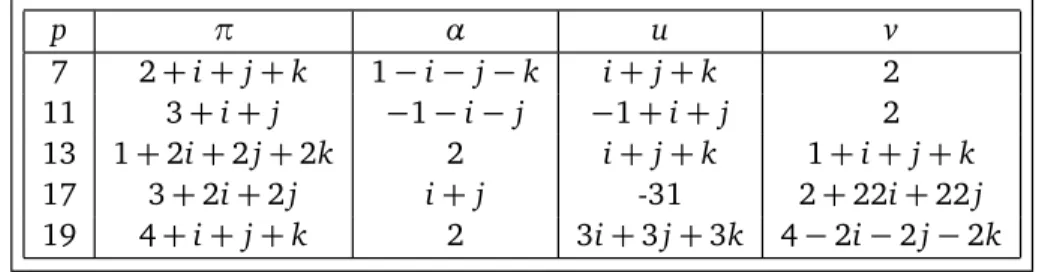
The Table 1 givesπ, u, andv for the primes in Z. Letπbe a prime quaternion integer and letp=ππ. Let us define a function f :Zp→Rπby
z= f(r) =µ(r+π).
The function f defines a bijective mapping fromZpintoRπ. Using the equation 1=uπ+vπ, we get the inverse mapping f−1as
r= f−1(z)≡z(vπ) +z(uπ)modp.
Ifr is an element ofZp, thenr=kπ+zandr =r=kπ+z, hence,
z(vπ) +z(uπ) = (r−kπ)(vπ) + (r−kπ)(uπ)
≡r(vπ+uπ) modp ≡r modp.
f defines an isomorphism, namely, f(z1 +z2) = f(z1) + f(z2) and f(z1z2) = f(z1)f(z2). Since the remainder from dividing the elementqby the elementπisz=µ(q)the norm of the element obtained by the functionµis minimum[4, p. 61].
Let us introduce the quaternion Mannheim distance. Let α,β ∈ Rπ and γ = β−α =
a0+a1i+a2j +a3k (mod π), where a proper π is a prime quaternion integer. Let the quaternion Mannheim weight ofγbe defined as
wQM(γ) = a0
+
a1
+
a2
+
a3
.
The quaternion Mannheim distancedQM betweenαandβis defined as
dQM(α,β) =wQM(γ).
Indeed,dQM is a metric. Letα,β andγbe any three elements ofRπ. We have
i) dQM(α,β) =wQM(δ1), withα−β≡δ1(modπ),δ1∈RπandN(δ1)minimum,
ii) dQM(α,γ) =wQM(δ2), withα−γ≡δ2(modπ),δ2∈RπandN(δ2)minimum, iii) dQM(β,γ) =wQM(δ3), withγ−β≡δ3(modπ),δ3∈RπandN(δ3)minimum. Thus,α−β≡δ2+δ3(modπ). Notwithstanding, N(δ2+δ3)≥N(δ1), because
3. One Quaternion Mannheim Error Correcting Codes
Letαbe a primitive element ofRπand letpbe a prime inZ, whereπ=a0+a1i+a2j+a3k is a quaternion prime number andp=ππ¯. Then,αp−1=1 and the parity check matrixHand the generator matrixGby using the primitive elementαare obtained as follows, respectively;
H= α0 α1 · · · α(p−1)/2−1 ,G=
−α1 1 0 · · · 0 −α2 0 1 · · · 0
..
. ... . .. ... −α(p−1)/2−1 0 0 1
.
Hence, the one quaternion Mannheim error correcting codes of lengthn= (p−1)
2 can be constructed by the parity check matrixH. Then the codeC defined by the above parity check matrixH is able to correct any quaternion Mannheim error of weight one. The value of one quaternion Mannheim error is 1 or -1. The decoding algorithm for these codes is clear. Let the received vector ber=c+e, where the weight of the error vectoreis 1 and the vectorcis a codeword. Then the syndrome of the received vectorr is computed byS(r) =H rt r, where rt rdenote the transpose of the received vector r. The value of the error is computed bySα−l, where l (modn) helps to find the location of the error, l is a nonnegative integer, and nis equal to(p−1)
2.
We now consider a basic example with regard to the one quaternion Mannheim error correct-ing codes.
Example 1. Letπ=2+i+j+k andα=1−i−j−k. Then, we obtain the parity check matrix H and the generator matrix G by using the primitive elementαof Rπas follows, respectively;
H= α0, α1, · · ·, α(p−1)/2−1 ,G=
−α1, 1, 0, · · ·, 0 −α2, 0, 1, · · ·, 0
..
. ... . .. ...
−α(p−1)/2−1, 0, 0, 1
.
Let the received vector r be 1−i−j−k, 0, −1+i+j+k , then S(r) = H rt r = 4≡ −1+i+ j+k≡α4(modπ)(See Table 2), and the location of the error is found4≡1(mod3). The value of the error is computed as Sα−l = −1. So, the received vector r is corrected as c=r−e= 1−i−j−k, 1, −1+i+j+k .
The code, of which the parity check matrix is H= α0, α1, · · ·, α(p−1)/2−1can be generalized asn= (pr−1)
2. In this situation, the parity check matrix would be
H= α0, α1, · · ·, α(pr−1)/2−1 . (2)
4. Double Error Correcting Codes
Let pbe a prime inZ which is factored inH(Z)asππ, whereπis a prime in H(Z). Let
β denote an element ofRπ of order 2n. Thus βn =−1, and we can write Rπ = β
∪ {0} sinceβ is a primitive element ofRπ, where〈.〉denotes an ideal. Therefore, we consider the codeC defined by the following parity check matrixH:
H=
β0, β1, β2, · · ·, βn−1 β0, β3, β6, · · ·, β3(n−1)
.. .
β0, β2t+1, β2(2t+1), · · ·, β(n−1)(2t+1)
, (3)
wheret<nis a nonnegative integer. A wordc= c0, c1, · · ·, cn−1
∈Rnπis a codeword ofC if and only ifH ct r=0. Ifc(x) =Pni=−01cixi is a codeword polynomial, we get
c(β2j+1) =0, for j=0, 1,· · ·,t.
The polynomial g(x) = (x−β)(x−β3)· · ·(x−β2t+1)is the generator polynomial ofC, and C =
g(x)
is a principal ideal of Rπ[x]〈xn+1〉. If we multiply the code polynomial c(x) by x(mod(xn+1)), then we get
x c(x) =c0x+c1x2+· · ·+cn−1xn.
But we know that xn =−1. Therefore, if c(x)∈C, then x c(x)∈C. Thus, multiplyingc(x)
by x (mod(xn+1))means the following:
i) Shiftingc(x)cyclically one position to the right;
ii) Rotating the coefficientcn−1 byπradians and locating it for the first symbol of the new
codeword.
Theorem 2. Let C be the code defined by the parity check matrix as in (3). Then C is able to correct any error pattern of the form e(x) =eixi+ejxj, where0≤wQM(ei),wQM(ej)≤1.
Proof. Suppose that double error occurs at two different componentsl1,l2 of the received
vector r . Let the error vectors bee1,e2, where 0≤wQM(e1),wQM(e2)≤1, respectively. First we compute the syndromeSofr:
S(r) =H rt r=
s1 s3
. (4)
The polynomialσ(z) , which helps us to find the errors location and the value of the errors, is computed as follows.
σ(z) = (z−βl1)(z−βl2) =z2−(βl1+βl2)z+βl1.βl2=z2−(s
whereǫis determined from the syndromes. Froms1=βl1+βl2,s3=β3l1+β3l2andǫ=βl1+l2
we get
s31−s3=3ǫβl1+3ǫβl2+β3l2+β3l1−(β3l2+β3l1) =3ǫ(βl1+βl2) (6) from which we obtain
s31−s3
3s1
= 3ǫ(β
l1+βl2)
3(βl1+βl2) =ǫ(modπ). (7)
Thus, the roots of the polynomial σ(z) lead us to find the locations of the errors and their values. If βl1
1 and β l2
2 are the roots of the polynomial σ(z), then l1 and l2 (mod n) are
locations of the errors. Thus, we can distinguish three situations: no error, single error, and two errors.
i) No error: s1=s3=0,
ı8tem[ii)]One error: s31=s36=0, iii) Two errors:s316=s3ands16=0.
We illustrate the decoding procedure with the following example.
Example 2. Letπ= 1+2i+2j+2k and letβ =2. Let C be the code defined by the parity check matrix
H=
1, 2, −2+i+j+k, 1−i−j−k, 3, i+j+k 1, 1−i− j−k, −1, −1+i+ j+k, 1, 1−i−j−k
.
Suppose that the received vector is r= 3, 3, 1, 0, −1, 1 . We now apply the decoding procedure for the code in Theorem 2.
1) Calculating the syndrome:
S=H rt r =
s1 s3
=
3 −i−j−k
modπ.
One can verify that s36=s13, which shows that two errors have occurred.
2) Calculating the Error Locations and the Value of Errors: Using the formulas (6) and (7), we obtainǫ≡1−i−j−k(mod π)and the roots of the polynomialσ(z)areβ5,β10(See Table 3). Therefore, the locations of the errors are
l1=5≡5(mod 6)and its value is(β5Àβ5) =1and l2=10≡4(mod 6)and its value is
(β10Àβ4) =−1. Thus, one error has occurred in location 6 and its value is 1, and another one in location 5 and its value is -1.
Proof. It is sufficient to show that the decoder can distinguish single and double errors for the proof. Suppose that an error of the quaternion Mannheim weight one did occur. Then s31=s36=0(modπ). From Eq. (5), we get
z1,2=
s1± qs
3 s1
2 =
s1±s1 2 .
In view of Theorem 2, the decoder can distinguish between single and double errors.
5. Conclusion
In this paper, codes over the subring R of the quaternion integer ring H(Z) are con-structed and decoding algorithms of these codes are given. Moreover, it is seen that all of the one quaternion Mannheim error correcting codes are perfect. Furthermore, these codes are constructed using a metric which is called quaternion Mannheim metric.
ACKNOWLEDGEMENTS The authors would like to thank the anonymous referees for their helpful comments and suggestions.
References
[1] K Huber. Codes Over Gaussian Integers, IEEE Trans. Inform.Theory, vol. 40, pp. 207-216, Jan. 1994.
[2] E R Berlekamp. Algebraic Coding Theory, Laguna Hills, CA: Aegan Park, 1984.
[3] K Huber. Codes over Eisenstein-Jacobi integers, AMS. Contemp. Math., vol. 158, pp. 165-179, 1994.
[4] G Davidoff. P Sarnak. and A Valette. Elementary Number Theory, Group Theory, and Ramanujan Graphs, Cambridge University Pres, 2003.
Table1: Tableof p,π,aprimitiveelementα∈R
π,uandv(where1=uπ+vπ),for p<23.
p π α u v
7 2+i+j+k 1−i−j−k i+j+k 2
11 3+i+j −1−i− j −1+i+j 2
13 1+2i+2j+2k 2 i+j+k 1+i+j+k
17 3+2i+2j i+j -31 2+22i+22j
19 4+i+j+k 2 3i+3j+3k 4−2i−2j−2k
Table2: Powersoftheelementα=1−i−j−kwhihisarootofx
3+1
.
s αs s αs
0 1 4 −1+i+j+k
1 1−i− j−k 5 i+j+k
2 −i−j−k 6 1
3 -1 7 1−i−j−k
Table3: Powersoftheelementβ=2whihisarootof x
6+1
.
s βs s βs
0 1 8 2−i−j−k
1 2 9 −1+i+j+k
2 −2+i+j+k 10 -3
3 1−i−j−k 11 −i− j−k
4 3 12 1
5 i+j+k 13 2
6 -1 14 −2+i+j+k