
Rohovyi Yurii, Kolesnik Oksana. Influence of negative redox potential on functional and biochemical processes of the kidneys at the polyuric stage of sublimate nephropathy. Journal of Education, Health and Sport. 2020;10(1):188-200. eISSN 2391-8306. DOI
http://dx.doi.org/10.12775/JEHS.2020.10.01.021
https://apcz.umk.pl/czasopisma/index.php/JEHS/article/view/JEHS.2020.10.01.021
http://dx.doi.org/10.5281/zenodo.3731406
The journal has had 5 points in Ministry of Science and Higher Education parametric evaluation. § 8. 2) and § 12. 1. 2) 22.02.2019. © The Authors 2020;
This article is published with open access at Licensee Open Journal Systems of Nicolaus Copernicus University in Torun, Poland
Open Access. This article is distributed under the terms of the Creative Commons Attribution Noncommercial License which permits any noncommercial use, distribution, and reproduction in any medium, provided the original author (s) and source are credited. This is an open access article licensed under the terms of the Crea tive Commons Attribution Non commercial license Share alike.
(http://creativecommons.org/licenses/by-nc-sa/4.0/) which permits unrestricted, non commercial use, distribution and reproduction in any medium, provided the work is properly cited. The authors declare that there is no conflict of interests regarding the publication of this paper.
Received: 20.12.2019. Revised: 25.12.2019. Accepted: 31.01.2020.
UDC 612.464:54649:577.121
INFLUENCE OF NEGATIVE REDOX POTENTIAL ON FUNCTIONAL AND BIOCHEMICAL PROCESSES OF THE KIDNEYS AT THE POLYURIC STAGE OF
SUBLIMATE NEPHROPATHY
Yurii Rohovyi1, Oksana Kolesnik2
Higher State Educational Establishment of Ukraine
“Bukovinian State Medical University”, Chernivtsi, Ukraine 1Chief of the department pathological physiology
2Assistant of the department pathological physiology, Chernivtsi, Ukraine
Abstract
Goal.To find out the effect of water load of negative redox potential on the functional
and biochemical processes of the kidneys in comparison with induced diuresis with ordinary
tap water at the poliuric stage of sublimate nephropathy in hyponatric diets.
Materials and methods. In experiments on 60 white non-linear mature male rats in a
hyposodium diet at the poliuric stage of sublimate nephropathy 72 hours after subcutaneous
administration of sublimate at a dose of 5mg/kg per load of water with a negative redox
potential (-232.0±25.12 mV) compared to induced diuresis with ordinary tap water (redox
potential 88.7±18.35 mV), which ORP-meter was measured, lipid peroxidation, tissue
fibrinolysis, succinate dehydrogenase activity, β-2-microglobulin reabsorption, excretory,
Results and discussion. According to the experience installed protective, antioxidant
effects of water negative redox potential, which was manifested by the decrease in the level of
diene conjugates, malonic aldehyde, the degree of swelling and damage by the ratio of
K+/Na+ to the cortical substance of the kidney, improve the reabsorption of sodium ions,
β-2-microglobulin in the proximal tubules with a reduction in the loss of this cation from urine by
increasing the supply of electrons to the tubules of the kidneys. Improving the energy status of
the proximal nephron in conditions experience increased activity of succinate dehydrogenase
in the cortical portion of the kidney has led to the improvement of tissue fibrinolysis and
processes glomerular-tubular and tubular-tubular balance with loss correlations, the relative
water reabsorption from the glomerular filtration, absolute proximal and distal reabsorbtion of
sodium ions.
Key words: poliuric stage sublimate nephropathy; kidney; water diuresis; renal
function; water negative oxidation-reduction potential.
Introduction
It is known that a decrease in the redox potential of water for every 59 mV leads to an increase in the number of electrons by 10 times. By reducing the redox potential of water by 118 mV, the number of electrons increases by 100 times, and by 177 mV – by 1000 times [1], etc. An increase in the number of electrons can improve the synthesis of ATP macroergs and, accordingly, positively effect kidney function [2]. Naturally, the question arises that loading the body with water of a negative redox potential should be energetically beneficial for cells, including for nephrocytes, whose main energy-dependent process is reabsorption of sodium ions [3, 4]. The influence of water with a negative redox potential on intact rats and in the oliguric stage of sublimate nephropathy was studied [5, 6]. At the same time, the question of the effect of water with a negative redox potential on kidney function at the polyuric stage of sublimate nephropathy in the hyponatric diet has not yet been clarified.
The aim of this study was to find out the effect of water load of negative redox potential on the functional and biochemical processes of the kidneys in comparison with induced diuresis with ordinary tap water at the poliuric stage of sublimate nephropathy in hyponatric diets.
Methods
studied, which was modeled in the conditions of hyposodium diet by subcutaneous administration of sublimate at a dose of 5mg / kg with the study after 72 hours [7, 8]. Water with a negative redox potential was obtained by treating tap water with microhydrin. The redox potential of water was determined by the ORP meter [1, 2].
Kidney function was studied under conditions of induced water diuresis with ordinary tap water and water of negative redox potential, for which the studied liquids in an amount of 5% of body weight were injected into the stomach of rats using a metal probe, followed by urine collection within 2 hours. The value of diuresis (V) was estimated in ml/2 h •100 g after water loading, animals were euthanized by decapitation under light ether anesthesia. In order to obtain plasma blood was collected in tubes with heparin. The concentration of creatinine in blood plasma and urine was determined by reaction with picric acid and sodium ions by flame photometry on FPL-1. Glomerular filtration rate (Ccr) was estimated by endogenous creatinine clearance, which was calculated using the formula:
Ccr = Ucr • V / Pcr
where Ucr and Pcr are the concentration of creatinine in the urine and blood plasma, respectively.
The relative reabsorption of water (RH2O %) was estimated using the formula:
RH2O % = ( Ccr-V)/ Ccr • 100%
Absolute reabsorption of sodium ions (RFNa+) was calculated using the formula:
RFNa+ = Ccr•ּ PNa+ - V•ּ UNa+
Proximal and distal reabsorption of sodium ions (TpNa+, TdNa+) was investigated. Calculations were performed using the following formulas:
TpNa+ = (Ccr - V) • PNa+
The state of the glomerular-tubular and tubular-tubular balance was studied by conducting a correlation analysis between the processes of glomerular filtration, absolute, proximal, distal reabsorption of sodium ions and relative reabsorption of water [13, 5].
In the cortical substance of the kidneys, indicators of lipid peroxidation were determined: diene conjugates and malone aldehyde [13]. The state of energy metabolism was assessed by the activity of succinate dehydrogenase [13]. β2-microglobulin was determined by chemiluminescent analysis on an automatic immuno-chemiluminescent analyzer MAGLUMI 1000 in blood serum and urine at the BSMU educational and scientific laboratory with the calculation of its reabsorption. Tissue fibrinolysis in the kidneys was evaluated by determining azofibrin lysis with determination of total (TFA), non-enzymatic (NFA) (incubation of samples in the presence of an enzymatic fibrinolysis blocker-ε-aminocaproic acid) and enzymatic fibrinolytic activity (EFA), which was determined by the formula: EFA=TFA-NFA [13].
All studies were performed in compliance with the Council of Europe Convention on the protection of vertebrates, which is used in experiments and other scientific purposes (from 18.03.1986), the EEC Directive No 609 (from 24.11.1986), orders of the Ministry of health of Ukraine No 960 from 23.09.2009 and No 944 from 14.12.2009. Statistical data processing was performed using computer programs “Statgrafics “and”Exel 7.0".
Results
Diuresis, ml/2 h х 100 g 3 2 * 1 0 1 2 3 4 Glomerular filtration, ml/2 h х 100 g
3 2 **** 1 0 10 20 30 40
Excretion of sodium ions, mcmol/2 h х 100 g
**** •• 3 2 **** 1 0 5 10 15 20 25 30 Proximal reabsorption of sodium ions, mmol/2 h х 100 g
**** •• 3 2 **** 1 0 5 10 15 20 25
Distal reabsorption of sodium ions, mcmol/2 h х 100 g
3 2 1 0 200 400 600 800
K+/Na+ cortex,
units *** •• 3 2 **** 1 0 0,5 1 1,5 2 2,5
Dry matter content - cortex, % *** •• 3 2 **** 1 0 5 10 15 20 25 30
Diene conjugates - cortex, nmol/mg protein *** •• 3 2 **** 1 0 0,05 0,1 0,15 0,2 0,25
Malone aldehyde - cortex, nmol/mg protein *** •• 3 2 **** 1 0 0,5 1 1,5
Fig.1. Influence of water load of negative (-232.0±25.12 mV) redox potential on indicators of lipid peroxidation, dry matter content, ratio of potassium ions to sodium ions (K+/Na+) in the renal cortex and indicators of kidney function in the hyposodium diet against the background
of water load of 5% of body weight with urine collection for 2 hours at the poliuric stage of sublimate nephropathy.
1-control, intact animals with a load of ordinary tap water with a redox potential of 88.7±18.35 mV, 2-poliuric stage of sublimate nephropathy 72 hours after the introduction of
sublimate with a load of ordinary tap water with a redox potential of 88.7±18.35 mV, 3-poliuric stage of sublimate nephropathy 72 hours after the introduction of sublimate with water load negative (-232,0±25,12 mV) redox potential. The probability of differences is
marked: compared to control 1: * - p < 0.05; *** - p < 0.01; **** - p < 0.001; compared to poliuric stage sublimate nephropathy, group 2: • • - p < 0.02.
TFА cortex, Е440/h • g * • 3 2 * 1 0 10 20 30 40
EFА cortex, Е440/h • g
* • 3 2 * 1 0 5 10 15 20 25 30
NFА cortex, Е440/h • g
3 2 1 0 2 4 6 8 10
TFA medullary, Е440/h • g
*** • 3 2 **** 1 0 20 40 60 80
EFА medullary, Е440/h • g
*** • 3 2 **** 1 0 20 40 60 80
NFА medullary, Е440/h • g
** • 3 2 *** 1 0 5 10 15 20 25 30
TFА papilla, Е440/h • g
*** • 3 2 **** 1 0 50 100 150 200 250
EFА papilla, Е440/h • g
*** • 3 2 **** 1 0 50 100 150 200
NFА papilla, Е440/h • g
** 3 2 ** 1 0 10 20 30 40 50
Fig. 2. Influence of water load of negative (-232.0±25.12 mV) redox potential on the indicators of fibrinolysis of TFA-total, EFA-enzymatic and NFA-non-enzymatic fibrinolytic
activity in the cortical, medulla and papilla of the kidneys due to hyposodium diet on the background of water load of 5% of body weight with urine collection for 2 hours at the
poliuric stage of sublimate nephropathy.
1-control, intact animals with a load of ordinary tap water with a redox potential of 88.7±18.35 th, 2-poliuric stage of sublimate nephropathy 72 hours after the introduction of
sublimate with a load of ordinary tap water with a redox potential of 88.7±18.35 mV, 3-poliuric stage of sublimate nephropathy 72 hours after the introduction of sublimate with water load negative (-232,0±25,12 mV) redox potential. The significance of the differences was noted: compared to control 1: * - p < 0.05; * * - p < 0.02; * * * - p < 0.01; * * * * - p <
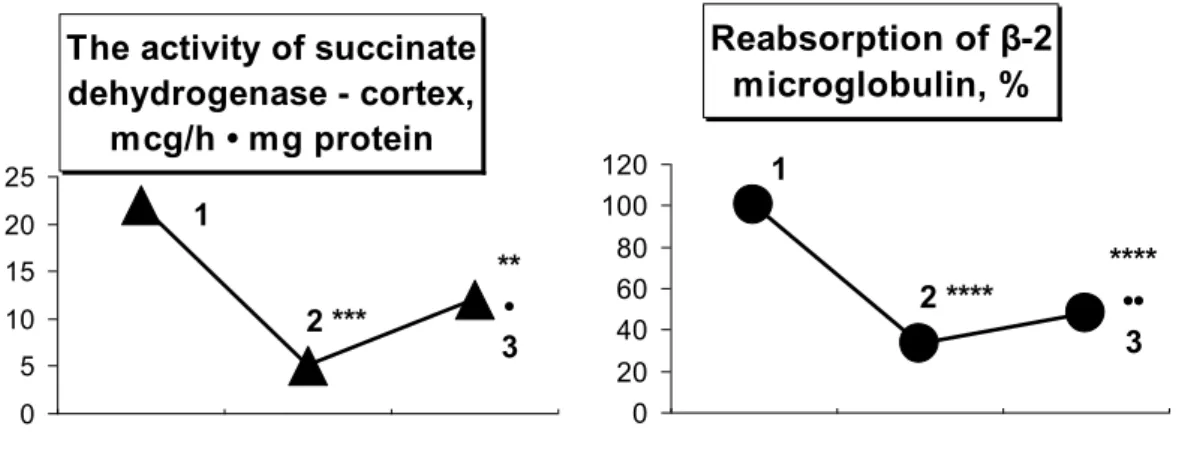
Improvement of the energy state of the proximal nephron under the influence of water of negative redox potential at the polyuric stage of sublimate nephropathy was characterized by an increase in the activity of succinate dehydrogenase in the renal cortex and an increase in the reabsorption of β-2-microglobulin (Fig. 3).
The activity of succinate dehydrogenase - cortex,
mcg/h • mg protein
** • 3 2 ***
1
0 5 10 15 20 25
Reabsorption of β-2 microglobulin, %
**** •• 3 2 ****
1
0 20 40 60 80 100 120
Fig. 3. The effect of water load of negative (-232.0±25.12 mV) redox potential on the activity of succinate dehydrogenase in the cortical substance of the kidneys and reabsorption of β -
2-microglobulin in the hyposodium diet against the background of water load of 5% of body weight with urine collection for 2 hours at the poliuric stage of sublimate nephropathy.
1-control, intact animals with a load of ordinary tap water with a redox potential of 88.7±18.35 mV, 2-poliuric stage of sublimate nephropathy 72 hours after the introduction of
sublimate with a load of ordinary tap water with a redox potential of 88.7±18.35 mV, 3-poliuric stage of sublimate nephropathy 72 hours after the introduction of sublimate with
water load negative (-232,0±25,12 mV) redox potential. The significance of differences observed in comparison to control 1: ** - p < 0.02; * * * p < 0,01; * * * * p < 0.001; compared with poliuric stage sublimate nephropathy, group 2: • p < 0.05; •• - p < 0.02.
1 2
3 4 Ccr
RFNa+ TpNa+TdNa+ ****
*
*** ****
*
*** **** ****
* ***
0 0,1 0,2 0,3 0,4 0,5 0,6 0,7 0,8 0,9 1
1 2
3 4 Ccr
RFNa+ TpNa+TdNa+ *
****
* **** ****
*
0 0,1 0,2 0,3 0,4 0,5 0,6 0,7 0,8 0,9 1
Fig.4. The effect of a negative water load (-232.0±25.12 mV) of the redox potential (lower figure) compared to a normal load (redox potential 88.7±18.35 MB) of tap water (upper figure) on the state of the glomerular-tubal and tubular-tubular balance of the kidneys at the
poliuric stage of sublimate nephropathy.
Ccr-glomerular filtration (mcl/ min • 100g); RFNa+, 1-absolute reabsorption of sodium ions (mmol / min • 100 g); TpNa+, 2-proximal reabsorption of sodium ions (mmol/2 h•100 g); TdNa+, 3-distal reabsorption of sodium ions (mmol/2 h•100 g); 4-relative reabsorption of
water (%); the reliability of the correlation was noted: * - p < 0.05; * * * - p < 0.01; * * * * - p < 0.001.
Discussion
with secondary damage proximal tubules as a result of accumulation of sodium ions in the body with an increase in the influence of factors with vasodilator mechanism of action and the implementation of reperfusion syndrome "no-reflow" [7, 14, 15]. Under these conditions, the effect of water loading of the negative redox potential with a decrease in losses of sodium ions in the urine by improving its reabsorption and β-2-microglobulin in the proximal nephron is due to the antioxidant properties of microhydrin [2, 5, 6]. This also explains the decrease in the intensity of peroxide oxidation of lipids in the cortical substance of the kidneys with a decrease in the level of malon aldehyde, diene conjugates, the degree of damage to the cortical area of the kidneys due to an increase in the K+/Na+ ratio and a decrease in edema of the cortical substance of the kidneys. The improvement in the proximal tubule with increased production of urokinase in the past [13] led to an increase in total enzymatic and nonenzymatic fibrinolytic activity in the cortex, the medulla and papilla of the kidneys over load water negative redox potential in poliuric stage of sublimate nephropathy. Improving the energy status of the proximal nephron in terms of the effects of water negative redox potential on poliuric stage of sublimate nephropathy increased activity of succinate dehydrogenase in the cortical substance of the kidneys due to increased supply of electrons and antioxidant effects. Improvement of glomerular-tubular and tubular-tubular balance processes with loss of correlation dependences of relative reabsorption of water with glomerular filtration, absolute, proximal and distal reabsorption of sodium ions under the conditions of negative redox potential of water at the poliuric stage of sublimate nephropathy is due to improvement of active energy-dependent transport processes due to reduction of passive reabsorption processes.
Conclusions
1. Loading water with a negative redox potential (-232.0±25.12 mV) in comparison with induced diuresis with ordinary tap water (redox potential 88.7±18.35 mV) at the poliuric stage of sublimate nephropathy due to its antioxidant properties causes a decrease in the level of diene conjugates, malon aldehyde, the degree of edema and damage in the ratio of K+/Na+ in the cortical substance of the kidneys, improves the reabsorption of sodium ions, β-2-microglobulin in the proximal tubules with reduced loss of this cation in the urine due to increased electron supply to the renal tubules.
balance with loss correlations, the relative water reabsorption from the glomerular filtration, absolute proximal and distal reabsorption of sodium ions.
Prospects for further research it is of interest to study the functional state of the kidneys due to water load of negative redox potential in the late period on the 30th day of the polyuric stage of sublimate nephropathy.
Literature
1. Шульц ММ., Писаревский АМ., Полозова ИП. Окислительный потенциал. Теория и практика. Л.: Химия, 1984. 168 с.
2. Роговий Ю.Є., Колеснік О.В. Вплив води від’ємного окисно-відновного потенціалу на функцію нирок у інтактних щурів. Бук. мед. вісник. 2012. Т.16, № 3 (частина ІІ). С. 191 -194.
3. Пішак ВП, Гоженко АІ, Роговий ЮЄ. та [ін] Роль катепсину Д кіркової речовини нирок у пригніченні проксимальної реабсорбції іонів натрію за умов масивної протеїнурії. Український медичний альманах, 2000; 1: 135-138.
4. Гоженко АІ, Роговий ЮЄ, Федорук ОС. та [ін]. “Приховане” ушкодження проксимального відділу нефрона. Oдеський мед.ж., 2001;5: 16-19.
5. Роговий Ю.Є., Колеснік О.В. Стан клубочково-канальцевого та канальцево-канальцевого балансу за навантаження водою від’ємного окисно-відновного потенціалу. Галицький лікарський вісник. 2015. Т. 22, № 4 (частина 2). С. 56 – 60.
6. Роговий Ю.Є., Колеснік О.В., Бочаров А.В. Вплив води від’ємного окисно-відновного потенціалу на функцію нирок в олігуричній стадії сулемової нефропатії. Вісник наукових досліджень. 2017. № 1. С.129-133.
7. Роговий ЮЄ, Злотар ОВ, Філіпова ЛО. Патофізіологія гепаторенального синдрому на поліуричній стадії сулемової нефропатії. Чернівцi: Meдичний Університет, 2012: 197.
8. Роговий ЮЄ, Слободян КВ, Філіпова ЛО. Патофізіологія вікових особливостей фунцій нирок за умов надлишку і дефіциту іонів натрію при сулемовій нефропатії. Чернівцi: Meдичний Університет, 2013: 200.
9. Бойчук ТМ., Роговий ЮЄ., Арійчук ОІ. Патофізіологія нирок за нефролітіазу. Чернівці: Буковина друк, 2018. 195 с.
11. Rohovyi YuYe., Ariychuk OI. Pahophysiological analysis of the renal function by cystatin C in the formation of renal stones 0.6-1.0 cm in size in conditions of treatment with apparatus litotriptor Duet Magna. J. of Education, Health and Sport., 2017;6:545-553.
12. Rohovyi Yu. Ye., Ariychuk O. I., Gerush O. V. Pathophyisiology analysis overload nephron protein in the proximal tubule damage in the nephrolithiasis size stones of 0.6-1.0 sm. Journal of Education, Health and Sport.2017;7(7):1325-1335. eISSN 2391-8306.
DOI http://dx.doi.org/10.5281/zenodo.1250508
http://ojs.ukw.edu.pl/index.php/johs/article/view/5515
https://pbn.nauka.gov.pl/sedno-webapp/works/865738
13. Пішак ВП, Гоженко АІ, Роговий ЮЄ. Тубуло-інтерстиційний синдром.
Чернівці: Медична академія, 2002: 221.
14. Гоженко АИ. Теория болезни. Одесса: Феникс, 2018: 236 с.
15. Роговий ЮЄ., Бочаров АВ., Кобилянська РМ. Роль альтернативних методів навчання при викладанні теоретичних та клінічних медичних дисциплін. Meдична освіта.
2003. № 1. С.22-24.
Reference
1. Shults MM., Pisarevskyi АМ., Polozova IP. Okislitelniy potencial. Teoria i praktika [Oxidation potential. Theory and practice]. L.: Chemistry, 1984. 168 p. (in Ukrainian).
2. Rohovyi YuYe, Kolesnik OV. Vpliv vodi vidiemnogo okisno-vidnovnogo potencialu na funktiu nirok u intactnich schuriv [Effect of negative redox potential water on kidney function in intact rats]. Buk. Med. Bul. 2012. V.16, № 3 (part ІІ). P. 191 -194. (in Ukrainian).
3. Pishak VP, Gozhenko AI, Rohovyi YuYe. et [al] Rol katepsinu D kirkovoi rechovini nirok v prignicheni proksimalnoi reabsorbtii ioniv natriu za umov massivnoi proteinurii [The role of cathepsin D cortical substance of kidneys in the inhibition of proximal reabsorption of sodium ions under conditions of massive proteinuria]. Ukrainian medical almanac, 2000; 1: 135-138. (in Ukrainian).
4. Gozhenko AI, Rohovyi YuYe, Fedoruk OS. et [al] “Prichovane” ushkodzenia proksimalnogo viddilu nephrona [The “hidden” damage of the proximal nephron]. Odessa med.j., 2001;5: 16-19. (in Ukrainian).
kanalcevo-[State of the glomerular-tubular and tubular-tubular balance due to water load of negative redox potential]. Galician med. Bul. 2015. V. 22, № 4 (part 2). P. 56 – 60. (in Ukrainian).
6. Rohovyi YuYe, Kolesnik OV, Bocharov AV. Vpliv vodi vidiemnogo okisno-vidnovnogo potencialu na funktiu nirok v oligurichniy stadii sulemovoy nephropatii [Influence of water of negative redox potential on kidney function in the oliguric stage of sublimate nephropathy]. Journal of scientific research. 2017. № 1. P.129-133. (in Ukrainian).
7. Rohovyi YuYe., Zlotar OV, Filipova LO. Patophysiologia hepatorenalnogo sindromu na poliurichniy stadii sulemoviy nephropatii [Pathophysiology of hepatorenal syndrome on polunychne stage sublimate nephropathy] Chernivtsi: Medical University, 2012: 197. (in Ukrainian).
8. Rohovyi YuYe., Slobodian KV, Filipova LO. Patophysiologia vikovich osoblivostey funkcii nirok za umov nadlishku i deficitu ioniv natriu pri sulemoviy nephropatii [Pathophysiology of age characteristics of kidney function in conditions of excess and deficiency of sodium ions when Sublimate nephropathy]. Chernivtsi: Medical University, 2013: 200. (in Ukrainian).
9. Boychuk ТN., Rohovyi YuYe., Ariychuk ОІ. Patofiziologia nirok za nefrolitiazu [Pathophysiology of the kidney in nephrolithiasis]. Chernivtsi: Bukovina print, 2018. 195 p. (in Ukrainian)
10. Boychuk TM, Rohovyi YuYe, Popovich GB. Pathophysiologia gepatorenalnogo syndroma pri gemichniy hypoksii [Pathophysiology of the hepatorenal syndrome in hemic hypoxia]. Chernivtsi: Medical University, 2012: 192. (in Ukrainian).
11. Rohovyi YuYe., Ariychuk OI. Pathophysiologichniy analys functii nirok za cystatinom C pri utvoreni nirkovich konkrementiv 0.6-1.0 cm pri likuvani apparatom litotriptor Duet Magna [Pahophysiological analysis of the renal function by cystatin C in the formation of renal stones 0.6-1.0 cm in size in conditions of treatment with apparatus litotriptor Duet Magna] J. of Education, Health and Sport.,2017;6:545-553. doi: http://dx.doi.org/10.5281/zenodo.822488
http://ojs.ukw.edu.pl/index.php/johs/article/view/4584 (in Ukrainian).
12. Rohovyi YuYe., Ariychuk OI., Gerush OV. Patofiziologicheskiy analiz roli peregruzki nefrona belkom v povrejdenii proxsimalnogo kanalca pri nefroliyiaze s razmerom kamney 0.6-1.0 sm [Pathophyisiology analysis overload nephron protein in the proximal tubule damage in the nephrolithiasis size stones of 0.6-1.0 sm]. Journal of Education, Health
http://ojs.ukw.edu.pl/index.php/johs/article/view/5515
https://pbn.nauka.gov.pl/sedno-webapp/works/865738 (in Ukrainian)
13. Pishak VP, Gozhenko AI, Rohovyi YuYe. Tubulo-itersticiyniy sindrom [Tubulo-interstitial syndrome]. Chernivtsi: Medical Academy, 2002: 221. (in Ukrainian).
14. Gozhenko AI. Teoria bolezni [Disease theory]. Оdessa:Fenics, 2018: 236 с. (in Ukrainian).

![trans Tetraaquabis[bis(pyridin 3 yl)methanone κN]manganese(II) bis(perchlorate)](data:image/gif;base64,R0lGODlhAQABAIAAAP///wAAACH5BAEAAAAALAAAAAABAAEAAAICRAEAOw==)