Digital Interactive Kanban Advertisement System
Using Face Recognition Methodology
Feng-Yi Cheng, Chu-Ja Chang, Gwo-Jia Jong
Department of Electronics Engineering, National Kaohsiung University of Applied Sciences, Kaohsiung. Email: [email protected]
ReceivedMay, 2013
ABSTRACT
Most of advertisement systems are presently still launch the publicity content by the static words and pictures. Recently, this static advertisement model will not be able to attract people’s attention more and more. Moreover, the static infor-mation content of advertisement system is limited because of the layout shown size. It can not also fully demonstrate the information content of advertisement system. In this paper, we develop a digital interactive kanban advertisement system using face recognition methodology to solve these problems. The system captures the person’s face through the camera. The digital advertisement content size is relevant by the person and camera observation locations. In this paper, we adopt the Adaboost algorithm to judge people face, and the system only need to grab the position of the face. The system doesn’t built expensive and complex equipment to reduce the system cost and enhance the system performance. This system can also achieve the same similar digital interactive advertising effectiveness.
Keywords: Face Recognition; Kanban Advertisement; Adaboost; Interactive
1. Introduction
There are various kinds of advertising media now. For example: televisions, broadcastings, magazines, news- papers, outdoor advertising and transit advertising…etc. Beside above media, the appearance of the web advertis-ing makes advertisadvertis-ing havadvertis-ing more and more develop- ment space. An advantage of web advertising is that consumers can select advertising freely and obtain mes- sages advertising transmit immediately. Advertising can interact with consumers and transmit feedback instantly, but traditional advertising can’t [1,2]. In this paper, in-teractive multimedia as the theme to explore the visual interface design and interactive multimedia development, according to the popular trend of today’s interactive mul-timedia authoring the common interactive mulmul-timedia such as: interactive web pages, DVD movies menu, web advertising, teaching CD-ROM…etc., because of the rapid growth of technology and the technology matures, the traditional static advertising, web, gradually interac- tive multimedia replaced [3].
In recent years, face detection technology tends to mature, the technology has been widely used in cameras, computer identification system and interactive advertis-ing. In [4], they research proposes a system that engages audience to the advertisement through interactive appli-cations and provides data to the advertiser/producer about their audience, but we think that is too complex.
Therefore, we propose an interactive system, using text and pictures to do the interactive display, it can allow users to quickly understand the contents of advertise- ments.
2. Interactivity Kanban Advertisement
The Figure 1 is the configuration of interactive kanban advertisement system. At first, we capture the camera image, then color segmentation extracts the skin color of a face from a cluttered image; then, binary imaging fur-ther forms a more complete region. Next, morphological erosion eliminates some of the small spots in a tested image. Contrary to erosion, dilation enlarges and con-nects a small and disconnected, but marked, facial region. Subsequently, connected component labeling is em-ployed to mark multiple faces in the image. Finally, an area threshold and an aspect ratio are used to validate the corrected facial region. After then we use the Adaboost algorithm [7-10] to make face recognition. At last, we can judge by the distance between the captured face and advertising, when the person is closer and closer, the words will accord to the distance for scaling to achieve
Capture Image
Face Recognition
[image:1.595.309.535.681.718.2]Interactive Advertisements
the purpose of attracting users.
The Figure 2 is our hardware configuration of capture image, the camera mounts on the Kanban Advertisement above.
3. Face Recognition
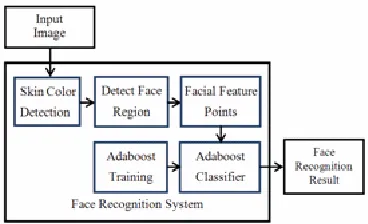
The Figure 3 is our face recognition system, the face recognition has three processing steps: Skin color detec-tion, Detect face region, facial feature points and finally, through Adaboost screening the most right face of people. This part is mainly to capture each person’s face form the image.
3.1. Skin Color Detection
The color segmentation is an important pre-processing step in the face recognition methods. We are used HIS method [5] to detection face skin color. Frist, we trans- form the image of RGB three color changes to H, S. It can be written as
, 360
if B G H
if B G
(1)
where
1
1/ 2 2
1
( )
2 = cos
R G R B
R G R B G B
(2)
3
1 min( ,
S R
R G B
G B, )
(3)Then we can follow the rule to find skin color fc:
camera
[image:2.595.58.293.332.463.2]Kanban Advertisement
Figure 2. Interactivity kanban ad system configuration.
Figure 3. Face recognition block diagram.
1, 8 32 30 163 0,
c
if H and S f
otherwise
(4)
After the skin color detection, we only see the portion of skin color, as shown in Figure 4.
3.2. Face Region Detection Method
After the Skin color detection, we change the RBG to binary used thresholding. Then, we consulted the paper’s method [6] to the binary image is sub-divided into blocks. Then, the total skin area within a block is computed, and if this is greater than or equal to 40% of the block area, the block label is assigned to be skin. A connected region step is then performed by examining the 8 neighbour- hood connectivity among the blocks to create a set of candidate regions. Face regions are selected amongst the candidate regions as the regions having an aspect ratio corresponding to the 1.2 - 2.0 ratio, than use the rate value of the image to define the threshold. It is showed in
Figure 5.
3.3. Capture Facial Feature Points
3.3.1. Eyes Detection
It is obvious that eyes are non-skin color regions, the Cr
and Cb component of eyes and skin contains bigger dif-
ference in the YCrCb space, and the Cb is higher than the
Cr in the eyes region. It can detection location and size
by above information.
3.3.2. Mouths Detection
Mouth is also non-skin color region, in the mouth the Cr
is much higher and the Cb much lower. Increasing the
difference between the Cb and Cr can accurately detected
size and location.
3.4. Adaboost Algorithm
Machine learning algorithm is flourishing in recent year, widely used at various levels. Face Detection this issue in order to obtain better characteristics also introduces a machine learning concepts, these studies are a break- through in the past to the face detection frame, most no-tably the 2004 study is presented using the integral image Viola for the characteristic value of the AdaBoost face detection method. AdaBoost is an algorithm for con- structing a “strong” classifier as linear combination of “weak” classifiers [7-10].
3.4.1. Haar-Like Features and Integral Image
[image:2.595.81.265.608.720.2](a) (b)
Figure 4. (a) Original image; (b) Skin color detection.
(a) (b)
[image:3.595.63.281.84.186.2]Figure 5. (a) Morphological process; (b) Face region detec-tion.
Figure 6. The Haar-like features for AdaBoost algorithm.
The Haar-like features that shown in Figure 6. It used in our face detection system. The features can be rapidly computed at different scales by introducing “Integral Image”.
3.4.2. AdaBoost Algorithm
In fact AdaBoost is a classification of concepts, for ex- ample, In order we pick a better than normal a little bit (>= 50%) of the algorithm, it can again and again use update weighting approach to reduce error rate, The pro- cess is as follows
1) Input M sample of the target image and N sample not of the target image, and I search the number of fea-tures.
2) Initialize weights
Target image samples weights
1 2 m
WP M
(5)
Non-target image samples weights
1 2
n
WN N
(6)
3) For each feature j, train a weak classifier T, and evaluate its error E with respect to W
1 1
(1 )
M N
m m n
m n
E WP T WN T
n
(7)In this derivation when T = 1 consistent with the image features, T = 0 does not meet.
4) Using step 3. Add the choose features to the stage and determine the corresponding weights
1 log i E W E
(8)
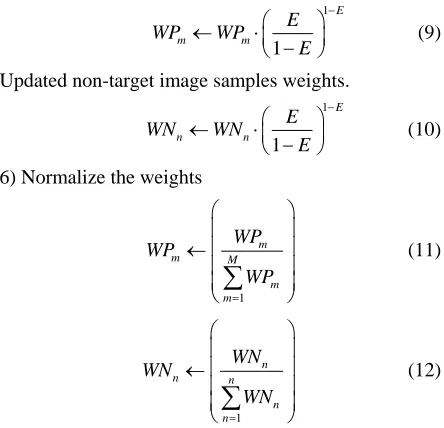
5) For step 3. Searching the better features to updates image sample weights. Updated target image sample weights. 1 1 E m m E WP WP E
(9)
Updated non-target image samples weights.
1 1 E n n E WN WN E
(10)
6) Normalize the weights
1 m m M m m WP WP WP
(11)
1 n n n n n WN WN WN
(12)
7) Check whether the number of the current search features to meet the demand, if the lack of jump back to step 3, otherwise the end of.
4. Interactive Advertisement System
[image:3.595.63.282.211.312.2]The Figure 7 is our interactive advertisement system flow process. At first, we capture the camera’s image,
[image:3.595.318.540.237.451.2] [image:3.595.372.472.556.721.2]then thought the image to do face recognition processing, to get the information of people who watch the Adver- tisement, and then the system further determine whether capture face or not, in other words, to determine if some- one is watch the kanban advertisement system, after then to detection the distance between the person’s face and advertisement, when people are approached the adver- tisement, the advertisement will also show more message telling the people, let people can learn more about the details of the advertisement, to increase the impression of people watch advertisement.
5. Result and Discuss
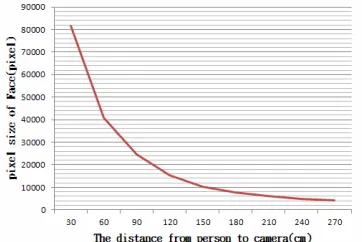
We use a 20 million pixels webcam and a 36-inch TV to achieve the Interactive Kanban Advertisement System. The webcam is set in place of 130cm high and angle of 90 degrees. The Figure 8 shows the information that the relationship between pixel size of face and the distance from person to camera. When the system captures the person’s face, we can use the pixel size of face to deter- mine where the person.
The Figure 9 is the user interface of program, this pro- gram of interface can divided into two parts, the camera of image is on the left, the interactive kanban advertise- ment is on the right. If someone walks past in front of the kanban advertisement, the system will catch person’s face, and the kanban advertisement also shows some words to attract people’s attention, it is like Figure 9.
[image:4.595.309.539.87.180.2]When person is closer and closer, the system will cal- culate the face of pixels to detect the distance, if people rely on close enough, the system will change the adver-
Figure 8. Graph of ratio between person and camera.
[image:4.595.81.262.475.596.2]Figure 9. The user interface of program.
Figure 10. It change the ad content when people rely on close enough.
tising content, display more information attract people to continue to watch, it is like Figure 10.
6. Conclusions
In this paper, we propose an Adaboost algorithm ap- proach to the face recognition for applications of interac-tive advertisement system. Although it has a lot of people to research for the subject so far, however, the proposed approach are more complex, build may more cost or need to take the time to interact with advertisement, caused people inconvenience. Our system only through the dis-tance between the face and advertising to interact, through words and pictures to attract people, reduce the complexity of the system also allows people quickly to understand more information of advertisements.
REFERENCES
[1] J. H. Cho, Y. J. Sah and J. Ryu, “A New Content-related Advertising Model for Interactive Television,” Broadband Multimedia Systems and Broadcasting 2008, March 31 2008-April 2 2008, pp. 1-9.
[2] M.-H. Hsieh, D.-L. Yang and J.-Y. Dai, “A Face Recog-nition System Prototype to Evaluate the Effectiveness of Digital Advertisement,” 2010 Conference on Computer Vision, Image Processing and Information Technology, 2010-06. Zhongli, Taiwan, pp. 283-289.
[3] J. Kim and S. Kang, “An Ontology-Based Personalized Target Advertisement System on Interactive TV,” Con-sumer Electronics (ICCE), 2011 IEEE International Conference, 9-12 Jan. 2011,pp. 895 - 896.
[4] M. Taspinar, A. T. Naskali, M. Kurt and G. Eren, “The Importance of Customized Advertisement Delivery Using 3D Tracking and Facial Recognition,” in Proc. The Sec-ond International Conference on Digital Information and Communication Technology and its Applications (DIC-TAP), 2012, pp. 526-530.
[5] S. Guerfi, J.-P. Gambotto and S. Lelandais, “Implementa-tion of the Watershed Method in the HSI Color Space for the Face Extraction,” Advanced Video and Signal Based Surveillance, Sept. 2005, pp. 282-286.
[image:4.595.59.286.627.722.2][7] J. X. Ruan and J. X. Yin “Multi-Pose Face Detection Using Facial Features and AdaBoost Algorithm,” Second International Workshop on Computer Science and Engi-neering, 2009, pp. 31-34.
[8] Y.-W. Wu and X.-Y. Ai, “Face Detection in Color Im-ages Using AdaBoost Algorithm Based on Skin Color Information,” Workshop on Knowledge Discovery and Data Mining, 2008, pp. 339-342.
[9] S. A. Inalou and S. Kasaei “AdaBoost-Based Face Detec-tion in Color Images with Low False Alarm,” Second In-ternational Conference on Computer Modeling and Simulation, 2010, pp.101-111.
doi:10.1109/ICCMS.2010.287