Chapter 3
THE NATURE OF SCIENCE
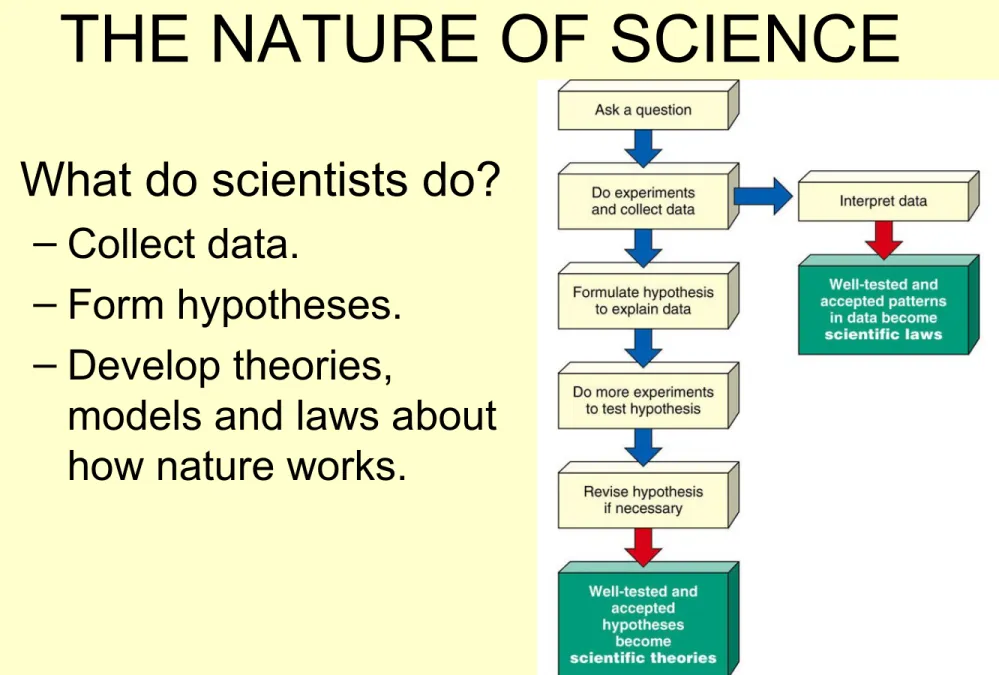
• What do scientists do?
– Collect data.
– Form hypotheses. – Develop theories,
models and laws about how nature works.
Testing Hypotheses
• Scientists test hypotheses using controlled experiments and constructing mathematical models.
– Variables or factors influence natural
processes
– Single-variable experiments involve a control and an experimental group.
– Most environmental phenomena are
multivariable and are hard to control in an
experiment.
Scientific Reasoning and Creativity
• Inductive reasoning
– Involves using specific observations and
measurements to arrive at a general conclusion or hypothesis.
– Bottom-up reasoning going from specific to general.
• Deductive reasoning
– Uses logic to arrive at a specific conclusion. – Top-down approach that goes from general to
Limitations of Environmental
Science
• Inadequate data and scientific understanding can limit and make some results controversial.
– Scientific testing is based on disproving rather than proving a hypothesis.
MODELS AND BEHAVIOR OF
SYSTEMS
• Usefulness of models
– Complex systems are predicted by developing a model of its inputs, throughputs (flows), and
outputs of matter, energy and information. – Models are simplifications of “real-life”.
Systems can be affected by
1. Feedback loops 2. Time delays
1. Feedback Loops:
• Outputs of matter, energy, or information fed back into a system can cause the system to do more or less of what it was doing.
– Positive feedback loop causes a system to
change further in the same direction (e.g. money earning interest)
2. Time delays
• Time delays in a system in which the effects are not know for some time • Allows the problem to
build up slowly and then whole system changes
Ex: population growth, toxic waste leaks, forest
destruction from air pollutant
3. Synergy
• 2 or more processes combined have a
greater effect on a system than the sum of each would have.
Law of conservation of problems
“We can never do just one thing”
• Solution for a problem usually leads to other problems
Ex: addition of MTBE to gasoline to reduce air pollution, then polluted groundwater
• Must consider when we search for solutions
Anticipating Environmental Surprises
Should be aware of:
• Abrupt shifts in stable systems • Synergistic interactions
Matter: Forms, structure, quality
• Pages 47 – 51 Chemistry/Biology review • Chlorinated hydrocarbons: C, H, Cl
DDT, PCB’s (polychlorinated biphenyls) • Chlorofluorocarbons (CFC’s) freon
• N2O nitrous oxide NO nitric oxide
• NO2 nitrogen dioxide CO carbon monoxide • SO2 sulfur dioxide NH3 ammonia
Matter quality
• A measure of how useful a form of matter is as a resource based on availability and concentration
• High quality – concentrated, found near Earth’s surface, great potential for use Coal, Salt, Al can
• Low quality – dilute, found deep
underground or in ocean, in atmosphere with little potential for use.
Fig. 2-8, p. 39
High Quality Low Quality
Salt
Solid Gas
Coal Coal-fired power plant emissions
Gasoline
Automobile emissions Solution of salt in water
Material Efficiency
• Total amount of material needed to
produce each unit of goods or services • Only 2-6% of matter resources flowing
Energy Forms & Quality
Energy -Capacity to do work and transfer heat
ENERGY
• Energy is the ability to do work and transfer heat.
– Kinetic energy – energy in motion
• heat, electromagnetic radiation
– Potential energy – stored for possible use
Electromagnetic Spectrum
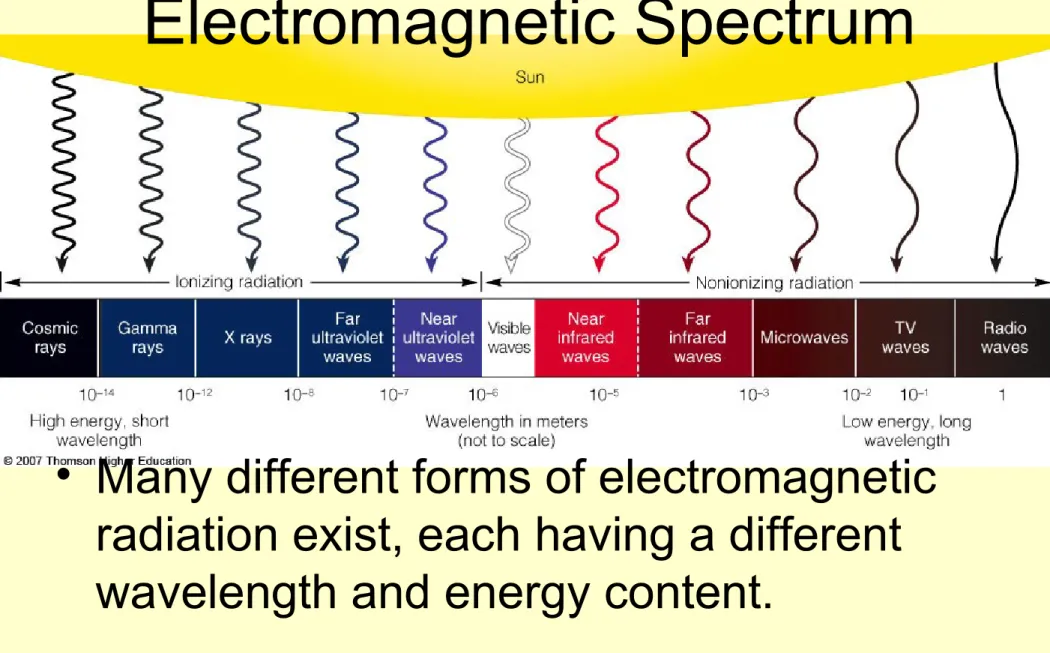
• Many different forms of electromagnetic radiation exist, each having a different wavelength and energy content.
Electromagnetic Spectrum
• Ionizing radiation
Cosmic, gamma, xrays, ultraviolet
Enough energy to knock e- from atoms
Can disrupt living cells, interfere with body processes
• Nonionizing radiation Not as energetic
Heat v. temperature
• Heat – energy that transfers between objects due to temp difference
Heat Transfer
1. Convection – through movement of heated materials
(asthenosphere/tectonic plates)
2. Conduction – through collisions of atoms metals conduct heat
Energy Quality
• High quality – concentrated/useful electricity, chem energy in coal/gasoline • Low quality – dispersed/ little ability to do
Chem/Phys Changes
Law of conservation of matter
“There is no away”
Can’t get rid of anything – will show up somewhere else.
Factors determining harmful effects of pollutants:
1. Chemical nature: Hg vs. Cu
2. Concentration: PPM, PPB, PPT
Categories of Persistence
1. Degradable, nonpersistent – broken down to acceptable levels by natural processes
Biodegradable – by living organisms
2. Slowly degradable, persistent – takes decades or longer DDT (
Dichloro-Diphenyl-Trichloroethane)and most plastics
Nuclear Changes
1. Natural radioactive decay 2. Nuclear fission
1. Natural radioactive decay - isotopes emit particles and/or energy to attain a stable nuclear configuration
a. Alpha – stopped by skin, paper b. Beta – stopped by wood or Al foil
c. Gamma – partially stopped by lead or concrete
Half life
• Amount of time needed for ½ of the nuclei in a radioisotope to decay to more stable isotope.
• Generally takes 10 - ½ lives for an isotope to decay to a safe state.
Radiation exposure
• Background sources – soil, rocks, air, water, food, cosmic rays from space Granite contains Uranium-238 which
decays to Radon-222 (associated with lung cancer)
Cosmic rays exposure increases as altitude increase and in airplane travel
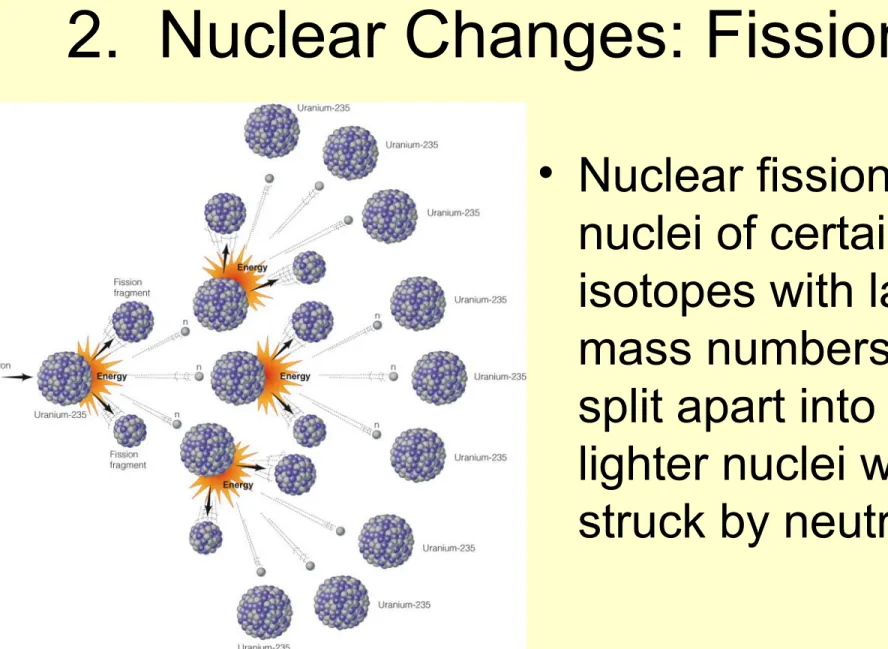
2. Nuclear Changes: Fission
• Nuclear fission: nuclei of certain
isotopes with large mass numbers are split apart into
lighter nuclei when struck by neutrons.
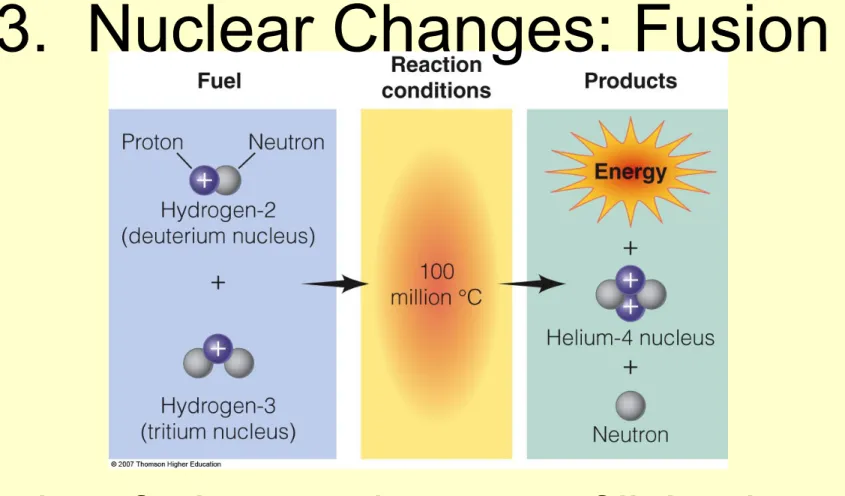
3. Nuclear Changes: Fusion
• Nuclear fusion: two isotopes of light elements are forced together at extremely high
temperatures until they fuse to form a heavier nucleus.
Radiation exposure
• Man-made sources
x-rays, luminous dial watch, TV, smoke detector (Americium), fiesta ware
Coal-fired power plants give off more
Effects of ionizing radiation
• Genetic damage from mutations in DNA – can lead to genetic defects in the next
generation
Damage varies with:
• Type of radiation, penetrating power,
source (outside or inside body) and ½ life • In general radioisotopes with intermediate
½ lives pose greatest threat
ENERGY LAWS
• The first law of thermodynamics: we cannot create or destroy energy.
– We can change energy from one form to another.
• The second law of thermodynamics: energy quality always decreases.
– When energy changes from one form to another, it is always degraded to a more dispersed form. – Usually takes the form of heat given off at lower
Energy Efficiency
• A measure of how much useful work is accomplished by a particular input of energy into a system
• Only about 16% of the energy used in the US ends up performing useful work.
• Wasted through the 2nd law or
How does 2
ndLaw affect life?
• Use high quality energy to maintainmolecules & biochemical processes, and then give off low quality heat to your
surroundings
Matter/energy change laws and
environmental problems
Sinks
• Waste and pollution concentrates in sinks • Storage places such as air, water, soil,
organisms
• As population increases and more
resources are used the capacity of the
Sustainable Low-Throughput
Economies: Learning from Nature
• Matter-Recycling-and-Reuse Economies: Working in Circles
– Mimics nature by recycling and reusing, thus reducing pollutants and waste.
Best solution is low-throughput economy
• Reuse and recycle most nonrenewable resources
• Use renewable resources sustainably • Efficient use of matter/energy resources • Reduce unnecessary consumption
• Emphasize pollution prevention and waste reduction