`
Three Studies Exploring Genetic and Social Influences on the Association Between Religiosity and Substance Use Behaviors
Jason Alan Freeman
A dissertation submitted to the faculty at the University of North Carolina at Chapel Hill in partial fulfillment of the requirements for the degree of Doctor of Philosophy in the Department of Sociology.
Chapel Hill 2016
Approved by: Michael J. Shanahan
Guang Guo Kenneth A. Bollen
ii
iii
ABSTRACT
Jason Alan Freeman: Three Studies Exploring Genetic and Social Influences on the Association Between Religiosity and Substance Use Behaviors
(Under the Direction of Michael J. Shanahan and Guang Guo)
Research exploring the relationship between religiosity and substance use behaviors typically find a significant inverse association between those two phenomena. One implicit assumption of these studies is that the relationship between religiosity and substance use behaviors functions in a similar way for all individuals within a population. However, some research has shown that the association between
religiosity and substance use behaviors may differ between certain sub-groups within a population. In this dissertation I explore three factors that may lead to variation in the association of religiosity and
substance use. I explore variation across family status (i.e. marital and parental status); variation across the life course (between adolescence and early adulthood) and variation due to genetic factors. I find that 1) the association between religiosity and smoking is stronger among married parents compared to other groups; 2) the association between religiosity and alcohol use increases between adolescence and early adulthood; and 3) there is genetic component of the covariance of religiosity and substance use
iv
v
ACKNOWLEDGEMENTS
Throughout the research process I was able to call upon the talents of several mentors and colleagues whose input allowed me to complete this dissertation. First, I would like to acknowledge the mentorship of Michael J. Shanahan and Dr. Guang Guo. Their patience and guidance throughout my time at UNC Chapel Hill has helped me develop as a researcher and complete a project of this nature. I would also like to acknowledge the help of Terrie Moffitt and Ken Bollen, whose input significantly improved the quality and direction of this work.
I would also like to acknowledge the help of the faculty and staff of the 2014 International Workshop on Statistical Genetic Methods for Human Complex Traits. The faculty and staff of the
workshop provided instruction on how to properly conduct research using twin data. The also answered my questions and provided much of the syntax that I used for my analyses.
vi
TABLE OF CONTENTS
LIST OF TABLES ... viii
LIST OF FIGURES ... ix
CHAPTER 1: OVERVIEW, REVIEW OF LITERATURE, THEORETICAL FRAMEWORK, AND SUMMARY OF EMPIRICAL CHAPTERS ... 1
Introduction ... 1
A Review of the Literature on the Association Between Religiosity and Substance Use Behaviors ... 4
Theoretical Framework ... 9
Summary of Empirical Chapters ... 14
CHAPTER 2: DOES FAMILY STATUS MODERATE THE ASSOCIATION BETWEEN RELIGIOSTY AND SUBSTANCE USE BEHAVIORS ... 17
Religiosity and Substance Use Behaviors ... 19
Family Status and Religiosity... 24
Family Status and Substance Use Behaviors... 27
Theoretical Framework ... 29
Reverse Causation ... 31
Data and Methods ... 34
Analytic Strategy ... 42
Results ... 48
Conclusions ... 49
CHAPTER 3: DOES THE ASSOCIATION BETWEEN RELIGIOSITY AND SUBSTANCE USE BEHAVIORS VARY ACROS THE LIFE COURSE? ... 54
`
vii
Variation in Religiosity and Substance Use Across the Life Course ... 57
Explanations for the Association Between Religiosity and Substance Use Behaviors ... 59
Variation in the Association Between Religiosity and Substance Use Behaviors Across the Life Course ... 62
Data and Measures ... 64
Analytic Strategy ... 69
Results ... 75
Discussion ... 76
CHAPTER 3: DOES THE PROPORTION OF THE COVARIANCE BETWEEN RELIGIOSITY AND SUBSTANCE USE BEHAVIORS DUE TO GENETIC FACTORS VARY BETWEEN ADOLESCENCE AND EARLY ADULTHOOD? ... 79
The Genetic Etiology of Religiosity ... 82
The Genetic Etiology of Substance Use Behaviors... 84
Behavioral Disinhibition and the Covariance of Religiosity and Substance Use Behaviors ... 87
Variation in the Proportion of the Covariance of Religiosity and Substance Use Behaviors Due to Genetic Factors ... 89
Data and Measures ... 91
Analytic Strategy ... 97
Results ... 101
Discussion ... 103
CHAPTER 5: CONCLUSIONS AND IMPLICAITONS ... 107
Conclusions ... 107
Implications ... 109
APPENDIX ... 114
viii LIST OF TABLES
Table 1.2 ... 33
Table 2.2 ... 35
Table 3.2 ... 44
Table 1.3 ... 64
Table 2.3 ... 66
Table 3.3 ... 72
Table 1.4 ... 90
Table 2.4 ... 95
Table 3.4 ... 98
Table 4.4 ... 100
ix LIST OF FIGURES
Figure 1.2 ... 19
Figure 2.2 ... 31
Figure 3.2 ... 32
Figure 4.2 ... 39
Figure 5.2 ... 46
Figure 6.2 ... 47
Figure 1.3 ... 73
Figure 2.3 ... 74
Figure 1.4 ... 96
Figure 2.4 ... 102
1
CHAPTER 1: OVERVIEW, REVIEW OF LITERATURE, THEORETICAL FRAMEWORK, AND SUMMARY OF EMPIRICAL CHAPTERS
INTRODUCTION
The consequences of substance use behaviors (e.g. smoking, alcohol use, etc.) exact a significant cost on U.S. society. For example, according to data from the U.S. Department of Health and Human Services (2014), for the years 2009-2012 smoking cost the U.S. more than 289 billion dollars annually. These costs include direct medical costs as well as lost productivity. As a result, factors that reduce the frequency of substance use behaviors carry an inherent indirect benefit for U.S. society—assuming they do not exact significant costs themselves. One such factor is religiosity, which studies consistently find is beneficial for the health and well-being of individuals (see Mochon, Norton and Ariely 2011).
Studies exploring the association between religiosity and substance use behaviors consistently find a significant inverse association between those two phenomena. For example, in a meta-analysis conducted by Yeung and Colleagues (2009), the researchers find that youth religiosity has a moderate, yet significant, weighted mean correlation (Zr = 0.16) with substance use behaviors.
2
moderate his or her levels of substance use behaviors. Specifically, they found that individuals who were highly religious and who also attended a highly religious school were less likely to binge drink or use marijuana than individuals who were highly religious who attended a less religious school. The failure to explore potential variation in the association between religiosity and substance use behaviors is
problematic because it likely provides an inaccurate view of the association. This inaccurate view could lead researchers who explore the relationship between religiosity and substance use behaviors to unintentionally present an excessively positive view of the association between religiosity and substance use behaviors in cases where religiosity has no association, or potentially a negative association,
exacerbating the negative effects of substance use on the individual.
This dissertation addresses the problematic absence of research exploring variation in the association between religiosity and substance use behaviors by addressing three potential sources of variation in the association, they are: Variation across sub-groups of the population; variation across the life course; and variation due to genetic factors. I explore these potential sources of variation using data from the National Longitudinal Study of Adolescent to Adult (Add) Heath and a variety of methods which include linear regression models, negative binomial regression models, ordinal logistic regression
models and bivariate Cholesky decomposition models.
In the remainder of this dissertation, I begin by reviewing the literature on the relationship between religiosity and substance use behaviors. In this section I describe the explanations that have been put forward to explain the association between religiosity and substance use behaviors as well as the weaknesses within the literature on the association between religiosity and substance use
3
4
A REVIEW OF THE LITERATURE ON THE ASSOCIATION BETWEEN RELIGIOSITY AND SUBSTANCE USE BEHAVIORS
Research exploring the association between religiosity and substance use behaviors date back to the 1960’s (Gorsuch and Butler 1976). Despite an early finding by Hirschi and Stark (1969) which
revealed that children who attend religious services are no more likely than non-attenders to accept ethical principles and are only slightly more likely than non-attenders to respect conventional authority, most contemporary studies find that religiosity is inversely associated with substance use behaviors (Stark 1996; Yeung, Chan, and Lee 2009).1 This is the case across racial groups (Wallace et al. 2003) as well as for both males and females (Yeung et al. 2009). Many of the studies exploring the association between religiosity and substance use behaviors utilize samples of adolescents and young adults (Yeung et al. 2009). This is likely because substance use is more prevalent among adolescents and early adults compared to older adults and children (Johnston et al. 2014; Johnston, Bachman, and Schulenberg 2011).
Explanations for the Association. Several explanations have been put forward to explain the
inverse association between religiosity and substance use behaviors. Early on individuals cited fear of divine punishment as the reason religious individuals were less likely to use drugs or alcohol compared to non-religious individuals (Hirschi and Stark 1969; Stark 1996). However, this particular view has largely fallen out of favor due to lack of empirical evidence to support it. One common explanation that is cited among contemporary researchers is the influence of prohibitions on substance use behaviors by religious groups. For example, Michalak and colleagues (2007) find that followers of religious groups that forbid the use of a particular substance are more likely to abstain from using that substance than other groups. This effect is especially true if individuals view their religious group as their primary
5
reference group (Chawla et al. 2007). In regards to alcohol use in particular, religious prohibitions have a significant influence on rates of use. Religious groups that explicitly forbid alcohol use (e.g. Mormons and Muslims) tend to have lower rates of alcohol use while religious groups that do not explicitly forbid alcohol use or have more liberal attitudes toward alcohol use (e.g. Liberal Protestants) tend to have higher rates of alcohol use. In fact, the religious group within the U.S. with the highest levels of alcohol use are Catholics, who use alcohol as a sacrament during religious ceremonies (Engs, Diebold, and Hanson 1996; Kang Sim et al. 2013).
Another explanation that is commonly put forward to explain the inverse association between religiosity and substance use behaviors is the fact that religious individuals often have lower levels of life stress than non-religious individuals (Ellison 1994). These lower levels of life stress which would likely to lead to lower levels of substance use because individuals often turn to substances such as tobacco and alcohol to cope with stressors. Wills, Yaeger, and Sandy (2003) find that negative life events have a weaker impact on both initial substance use and the growth of substance use over time among religious individuals compared to non-religious individuals. These findings replicate previous findings from similar studies (see Strawbridge et. al 1998; Kendler, Gardner, and Prescott 1997; Krause 1997).
A third explanation that is commonly put forward to explain the inverse association between religiosity and substance use behaviors is the positive influence of religiosity on pro-social behaviors, such as self-control. Several studies find that individuals with higher levels of self-control tend to have higher levels of religiosity (e.g. Muraven et al. 2006; Muraven et al. 1998; Geyer and Baumeister 2005, p. 418) and lower levels of substance use (Vazsonyi, Pickering, Junger, & Hessing, 2001; Wood,
6
interaction between religiosity and self-control where self-control has a greater impact on alcohol use among individuals with low levels for religiosity.
A fourth explanation that is commonly put forward to explain the inverse association between religiosity and substance use behaviors, particularly among adolescents and children, is the influence of parental religiosity. Prior to early adulthood, when individuals typically achieve increased personal autonomy, an individual’s religiosity is largely the product of the religiosity of their parent. As a result, an inverse association between an individual’s religiosity and their levels of substance use behaviors is likely to be at least partially driven by the religiosity of their parents. Evidence for this comes from the research of Foshee and Hollinger (1996). They find that maternal religiosity during adolescence is associated with lower rates of alcohol use, over and above personal religiosity. Because the personal autonomy of individuals typically increases from adolescence to early adulthood, it is likely that the association between parental religiosity and adolescence substance use behavior diminishes over time and largely vanishes by adulthood.
It is likely that a combination of some or all of these explanation at least partially explain the association between religiosity and substance use behaviors. More research needs to be done in order to gain a deeper understanding of the factors that drive the association between religiosity and substance use behaviors.
Weaknesses within the Literature. The literature on the association between religiosity and
7
a measure of reliability of the religiosity measure and do not discuss the validity of the measures used (Wong, Rew, and Slaikeu 2010).
Second, studies that explore the association between religiosity and substance use behaviors often use a single item to measure religiosity. This is problematic because religiosity is a multi-dimensional concept that cannot be fully measured with a single item (Idler et al. 2003). However, studies consistently find a significant inverse association between religiosity and substance use; regardless of the measure of religiosity and/or substance use used (Yeung et al. 2009).
Third, most studies on religion and substance use behaviors use cross-sectional data. As a result, most studies exploring the association between religious and substance use behaviors treat the
association as a time-invariant. As I will reveal in chapter 3, the association between religiosity and alcohol use varies between adolescence and early adulthood.
Finally, studies examining the relationship between religiosity and substance use behaviors among adolescents and young adults often lack a clear theoretical framework connecting religiosity and substance use behaviors. While a few studies have posited explanations for the association between religiosity and substance use behaviors (e.g. religious prohibitions against substance use), most studies only present a statistical association between religiosity and substance use behaviors and fail to clearly put forward a theoretical model explaining why they believed a statistical association existed in the first place. Next, I will describe the theories that I draw on the explain potential variation in the association between religiosity and substance use behaviors.
While these weaknesses likely lead to a distorted view of the association between religiosity and substance use behaviors, it should be noted that studies consistently find an inverse association
8
9
THEORETICAL FRAMEWORK: VARIATION IN THE ASSOCIATION BETWEEN RELIGIOSITY AND SUBSTANCE USE BEHAVIORS
This dissertation focuses on three largely ignored types of variation in the association between religiosity and substance use behaviors, which are: Variation across sub-groups of the population; variation across the life course; and variation due to genetic factors. Previous research has described potential mechanisms that could lead to each type of variation. In this section I describe how these potential mechanisms might lead to each type of variation.
Variation Across Sub-Groups of the Population. One potential type of variation in the
association between religiosity and substance use is variation across sub-groups of the population. A mechanism that could explain this variation was described by Mark Regnerus in his work “Moral Communities and Adolescent Delinquency: Religious Contexts and Community Social Control” (2003). Regnerus described an expanded version of Rodney Stark’s Moral Communities thesis. The original moral communities thesis posits that rather than personal religiosity discouraging deviant behavior, it is actually the influence of co-religionists within one’s social context that discourages deviant behaviors. The moral communities thesis was Stark’s answer to critiques of the popular “hellfire thesis”, which argued that individuals avoid behaviors that deviate from their religious teachings because of fear of divine sanctions. Critiques of the hellfire thesis have focused on an inconsistent link between personal religiosity and levels of delinquency. Stark found that contexts with low levels of religiosity, such as the West Coast of the United States, had higher levels of delinquency than contexts with higher levels of religiosity. Stark also posited that in contexts where religious norms are stronger (e.g. a religious
10
Research reveals that the influence of an individual’s religiosity on his or her behaviors, including substance use behaviors, can vary depending on the proportion of the individual’s co-religionists—defined as individual’s who share the same religion— inhabiting that individual’s environment (Regnerus 2003; Wallace et al. 2007). One potential mechanism that may explain this variation in the influence of religiosity on an individual’s behavior across environments is variation in plausibility structures, which are groups of like-minded individuals who support and reinforce each other’s shared beliefs, across environments (Regnerus 2007; Berger 1967). Within environments where there are more co-religionists, shared religious beliefs are more likely to be supported, which make them more salient in relation to an individual’s behaviors. Conversely, in environments with fewer co-religionists, religious beliefs may not have the same level of social support or may even be discouraged. For example, Abu-ras, Ahmed and Arfken (2010) find that Muslim college students in the U.S. who were more involved in religious activities, and therefore more integrated into networks of co-religionists, were less likely to drink than Muslim students less involved in religious activities, and therefore less integrated into networks of co-religionists.
11
found that individuals who were highly religious and who also attended a highly religious school were less likely to binge drink or use marijuana than individuals who were highly religious who attended a less religious school. However, Bahr and Hoffman (2008) using Add Health data, found no interaction
between personal religiosity and contextual religiosity.
Variation across the Life-Course. While there is an extensive literature on variation in personal
religiosity across the life course, there are no studies exploring variation in contextual religiosity across the life course. The strongest evidence for potential variation in the association between religiosity and substance use behaviors across the life course comes from the literature on variation in personal
religiosity across the life course. Because early adulthood is the point in the life course where individuals are least likely to be involved in religion, young adults are less likely to be part of religious contexts such as religious congregations. However, it is not known if the larger contexts that young adults inhabit (e.g. universities, workplaces) are less religious than the contexts they inhabit during adolescence (i.e. school, family environment).
So overall there is a possibility that the association between religiosity and substance use behaviors varies across time, no studies had previously explored this before this dissertation. In chapter 3 I explore whether or not the association between religiosity and substance use behaviors vary
between adolescence and early adulthood.
Genetic Component of the Association Between Religiosity and Substance Use Behaviors. The
12
behavior. Miller and Stark (2002) argue that males are typically less religious than females largely due to their greater propensity to engage in risk-taking (impulsive) behaviors compared to females. Extending this argument, behavioral disinhibition drives individuals towards lower levels of religiosity while simultaneously driving individuals towards higher levels of substance use behaviors. Evidence for this hypothesis comes from the fact that during the transition from adolescence to adulthood, levels of religiosity among individuals tend to reach their lowest levels of the life course (Uecker, Regnerus, and Vaaler 2007) while levels of substance use behaviors tend to reach their highest levels (Johnston et al. 2011). This is simultaneous with an increase in the genetic component of the covariance between religiosity and substance use behaviors (Kendler and Myers 2009).
Both twin studies and candidate gene studies reveal evidence for the existence of behavioral disinhibition. Twin studies reveal the heritability of behavioral disinhibition to be approximately 80% (Krueger et al. 2002; Young et al. 2000). In addition, Hendershot and colleagues (2011) find that the cholinergic muscarinic receptor 2 gene (CHRM2), which codes for a muscarinic acetylcholine receptor subtype, is associated with latent measures of substance use and overall behavioral disinhibition. The muscarinic acetylcholine receptor subtype encoded by CHRM2 (M2 receptors) serve diverse functions, including inhibition of adenylate cyclase activity, modulation of potassium channels, and regulation of acetylcholine release and dopamine signaling (Volpicelli and Levey 2004; Threlfell et al. 2010; Woolf and Butcher 2011).
13
So overall there are solid theory-based reasons for expecting there to be variation in the association between religiosity and substance use behavior. In the next section I will describe my specific research questions, hypotheses, and results. I will present my research questions, hypotheses and results in more detail in my empirical chapters (chapters 2-4). I conclude the dissertation by describing my overall conclusions based on my empirical findings and the implications that this
14 SUMMARY OF EMPIRICAL CHAPTERS
Chapter 2. In chapter 2 I explore the question, “Does the association between religiosity and
substance use behaviors (i.e. smoking, alcohol use) vary across family statuses (i.e. marital statuses and parental statuses)?” My main hypothesis is that the association between religiosity and substance use behaviors is stronger for individuals with “traditional” family statuses (e.g. married individuals)
compared to individuals with “nontraditional” family statuses (e.g. single parents, cohabitating individuals). My hypothesis is based on the idea that individuals with traditional family statuses—in particular married parents—are more likely to be well integrated into social networks with religious individuals (Stolzenberg, Blair-Loy, and Waite 1995). As a result, the plausibility of their religious beliefs is more likely to be supported and reinforced by like-minded co-religionists (e.g. other married parents within the same congregation), which will increase the influence of their beliefs on their behaviors, including substance use behaviors.
Overall, I find that the association between religiosity and smoking is stronger for married parents relative to single parents and cohabitating individuals, which provides partial support for the expanded version of Stark’s hypothesis. This study reveals the need to explore variation in the
association between religiosity and substance use behaviors in particular, and religiosity and health in general.
Chapter 3. In chapter 3 I explore the question, “Does the slope of the association between
religiosity and substance use behaviors (i.e. smoking, alcohol use) vary between adolescence and early adulthood?” Previous studies have found that the strength of the association between religiosity and an individual’s behavior is moderated by the level of religiosity of the context that individual inhabits. As a result, if there is variation in the religiosity of the contexts that an individual inhabits between
15
association between religiosity and substance use behaviors across those two life stages. However, because there is no compelling evidence to show that there are more (or fewer) co-religionists inhabiting the environments of young adults compared to adolescents I hypothesize that the slope of the association between personal religiosity and substance use behaviors will not differ between adolescence and early adulthood.
Overall I find that the association between religiosity and alcohol use is stronger during early adulthood compared to adolescence. This seems to indicate that the contexts that individuals inhabit during early adulthood are more religious than the contexts inhabited by individuals during adolescence. These findings reveal the need for further study of the mechanisms that lead to variation in the
association between religiosity and human behavior.
Chapter 4. In chapter 4 I explore the question, “Do genetic factors at least partially explain the
covariance of religiosity and substance use behaviors and does the genetic component of the covariance between religiosity and substance use behaviors vary between adolescence and early adulthood?” There is strong evidence that a common set of genes underlies the association between religiosity and substance use behaviors. This evidence largely comes from research on behavioral disinhibition, an underlying genetic liability for substance use behaviors and risk-taking behaviors. Applying Miller and Stark’s conceptualization of declines in religiosity as a form of risk taking behaviors, there is a strong likelihood that a common set of genetic factors influence both substance use behaviors and declines in religiosity. This leads me to my first hypothesis of this study which is that genetic factors at least partially explain the covariance between religiosity and substance use behaviors.
16
due to genetic factors for both religiosity and substance use behaviors are smaller during adolescence compared to early adulthood. As a result, if a common set of genetic factors influence both religiosity and substance use behaviors then it is likely that the influence of the genetic factors will be smaller during adolescence compared to early adulthood. This leads me to the second hypothesis of this study which is that there is a significant increase in the proportion of the covariance between religiosity and substance use behaviors due to genetic behaviors between adolescence and early adulthood.
17
CHAPTER 2: DOES FAMILY STATUS MODERATE THE ASSOCIATION BETWEEN RELIGIOSTY AND SUBSTANCE USE BEHAVIORS
The consequences of substance use behaviors (i.e. smoking, alcohol use, etc.) exact a significant cost on U.S. society. For example, according to data from the U.S. Department of Health and Human Services (2014), for the years 2009-2012 smoking cost the U.S. more than 289 billion dollars annually. These costs include direct medical costs as well as lost productivity. As a result, factors that reduce the frequency of substance use behaviors carry an inherent indirect benefit for U.S. society—assuming they do not exact significant costs themselves. One such factor is religiosity, which studies consistently find is beneficial for the health and well-being of individuals (see Mochon, Norton and Ariely 2011).
In studies exploring the association between religiosity and substance use behaviors researchers consistently find a significant inverse association between those two phenomena (Bahr and Hoffman 2008; Wallace and Colleagues 2007). For example, in a meta-analysis conducted by Yeung and
Colleagues (2009), the researchers find that youth religiosity has a moderate, yet significant, weighted mean correlation (Zr = 0.16) with substance use behaviors.
18
behaviors, can vary depending on the proportion of the individual’s co-religionists—defined as individual’s who share the same religion— inhabiting that individual’s environment (Regnerus 2003; Wallace et al. 2007). One potential mechanism that may explain this variation in the influence of religiosity on an individual’s behavior across environments is variation in plausibility structures, which are groups of like-minded individuals who support and reinforce each other’s shared beliefs, across environments (Regnerus 2007; Berger 1967). Within environments where there are more
co-religionists, shared religious beliefs are more likely to be supported, which make them more salient in relation to an individual’s behaviors. Conversely, in environments with fewer co-religionists, religious beliefs may not have the same level of social support or may even be discouraged. For example, Abu-ras, Ahmed and Arfken (2010) find that Muslim college students in the U.S. who were more involved in religious activities, and therefore more integrated into networks of co-religionists, were less likely to drink than Muslim students less involved in religious activities, and therefore less integrated into networks of co-religionists.
19
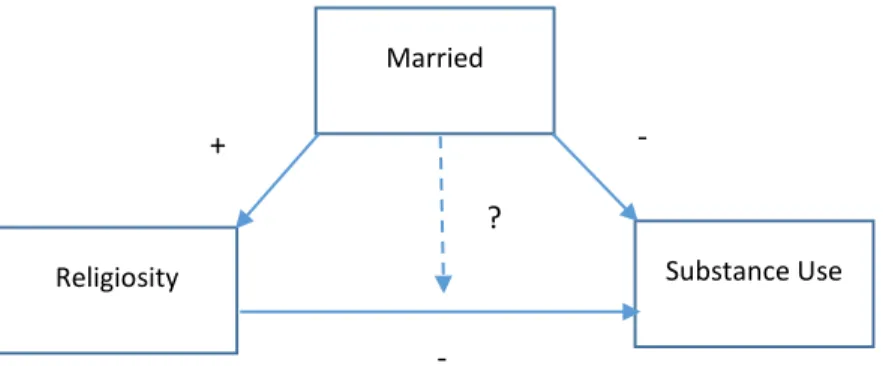
In the remainder of this study I will lay out and test my arguments for why the association between religiosity and substance use behaviors differs across family statuses. Figure 1.2 shows a conceptual model of these arguments. Within the model, family status has a positive influence on religiosity and a negative influence on substance use behaviors. In addition, religiosity is shown to have a direct negative influence on substance use behaviors. In the next section will describe the literature on the association between religiosity and substance use behaviors, family status and religiosity, and family status and substance use behaviors. I will then describe the theoretical framework that I draw upon to explain the part of the conceptual model that is least understood—whether or not family status influences the association between religiosity and substance use behaviors.
RELIGIOSITY AND SUBSTANCE USE BEHAVIORS
Despite an early finding by Hirschi and Stark (1969) which revealed that children who attend religious services are no more likely than non-attenders to accept ethical principles and are only slightly more likely than non-attenders to respect conventional authority, most contemporary studies find that
Figure 1.2: Moderating Effects of Being Married on the Association
between Religiosity and Substance Use.
Married
Religiosity Substance Use
+
-
20
religiosity is negatively correlated substance use behaviors (Stark 1996; Yeung et al. 2009).2 This is the case across racial groups (Wallace et al. 2003) as well as for both males and females (Yeung et al. 2009). Many of the studies exploring the association between religiosity and substance use behaviors utilize samples of adolescents and young adults (Yeung et al. 2009). This is likely because substance use is more prevalent among this population than any other (Johnston et al. 2014, 2011).
Explanations for the Inverse Association. Several explanations have been put forward to explain
the inverse association between religiosity and substance use behaviors. Early on individuals cited fear of divine punishment as the reason religious individuals were less likely to use drugs or alcohol
compared to non-religious individuals (Hirschi and Stark 1969; Stark 1996). However, this particular view has largely fallen out of favor due to lack of empirical evidence to support. One common explanation that is cited among contemporary researchers is the influence of prohibitions on substances use behaviors by religious groups. For example, Michalak and colleagues (2007) find that followers of religious groups that forbid the use of a particular substance are more likely to abstain from using that substance than other groups. This effect is especially true if individuals view their religious group as their primary reference group (Chawla et al. 2007). In regards to alcohol use in particular, religious
prohibitions have a significant influence on rates of use. Religious groups that explicitly forbid alcohol use (e.g. Mormons and Muslims) tend to have lower rates of alcohol use while religious groups that do not explicitly forbid alcohol use or have more liberal attitudes toward alcohol use (e.g. Liberal
Protestants) tend to have higher rates of alcohol use. In fact, the religious group within the U.S. with the highest levels of alcohol use are Catholics, who use alcohol as a sacrament (Engs, Diebold, and Hanson 1996; Kang Sim et al. 2013).
21
Another explanation that is commonly put forward to explain the inverse association between religiosity and substance use behaviors is the fact that religious individuals often have lower levels of life stress than non-religious individuals (Ellison 1994). These lower levels of life stress which would likely to lead to lower levels of substance use because individuals often turn to substances such as tobacco and alcohol to cope with stressors. Wills, Yaeger, and Sandy (2003) find that negative life events have a weaker impact on both initial substance use and the growth of substance use over time among religious individuals compared to non-religious individuals. These findings replicate previous findings from similar studies (see Strawbridge et. al 1998; Kendler, Gardner, and Prescott 1997; Krause 1997).
A third explanation that is commonly put forward to explain the inverse association between religiosity and substance use behaviors is the positive influence of religiosity on pro-social behaviors, such as self-control. Several studies find that individuals with higher levels of self-control tend to have higher levels of religiosity (e.g. Muraven et al. 2006; Muraven et al. 1998; Geyer and Baumeister 2005, p. 418) and lower levels of substance use (Vazsonyi, Pickering, Junger, & Hessing, 2001; Wood,
Pfefferbaum, & Arneklev, 1995). In a study done by Desmond, Ulmer and Bader (2013), the researchers find that religious youth tend to exhibit higher levels of self-control, which partially mediates the effect of an adolescents’ religiosity on his or her marijuana use and drinking. They also find evidence for an interaction between religiosity and self-control where self-control has a greater impact on alcohol use among individuals with low levels for religiosity.
22
research of Foshee and Hollinger (1996). They find that maternal religiosity during adolescence is associated with lower rates of alcohol use, over and above personal religiosity. Because the personal autonomy of individuals typically increases from adolescence to early adulthood, it is likely that the association between parental religiosity and adolescence substance use behavior diminishes over time and largely vanishes by adulthood.
It is likely that a combination of some or all of these explanation at least partially explain the association between religiosity and substance use behaviors. More research needs to be done in order to gain a deeper understanding of the factors that drive the association between religiosity and substance use behaviors.
Weaknesses within the Literature. The literature on the association between religiosity and
substance use behaviors suffers from several weaknesses. First, there is a lack of standardization of religiosity and substance use measures across studies (Moscati and Mezuk 2014; Booth and Martin 1998). Within the literature on the association between religiosity and substance use, concepts such as religiosity, religious involvement, and even spirituality are used interchangeably. Studies also often lack a measure of reliability of the religiosity measure and do not discuss the validity of the measures used (Wong, Rew, and Slaikeu 2010).
Second, studies that explore the association between religiosity and substance use behaviors often use a single item to measure religiosity. This is problematic because religiosity is a multi-dimensional concept that cannot be fully measured with a single item (Idler et al. 2003). However, studies consistently find a significant inverse association between religiosity and substance use; regardless of the measure of religiosity and/or substance use used (Yeung et al. 2009).
23
association as a time-invariant. This is problematic because research has shown that levels of both religiosity (Smith and Snell 2009, p. 211-256; McCullough et. al 2005; Ingersoll-Dayton, Krause and Morgan 2002; Argyle and Beit-Hallahmi 1975) and substance use behaviors (Johnston et al. 2009a; Johnston et al. 2009b) are dynamic across the life. As a result, it is possible that the association between those two phenomena also vary across the life course.
Finally, studies examining the relationship between religiosity and substance use behaviors among adolescents and young adults often lack a clear theoretical framework connecting religiosity and substance use behaviors. While a few studies have posited explanations for the association between religiosity and substance use behaviors (e.g. religious prohibitions against substance use), most studies only present a statistical association between religiosity and substance use behaviors and fail to clearly put forward a theoretical model explaining why they believed a statistical association existed in the first place.
While these weaknesses likely lead to a distorted view of the association between religiosity and substance use behaviors, it should be noted that studies consistently find an inverse association
24 FAMILY STATUS AND RELIGIOSITY
Within the literature on the association between family status and religiosity, a common finding is that religiosity tends to increase once individuals begin the family formation process. For example, as is shown in figure 1.2, religiosity tends to be higher among married individuals compared to unmarried individuals. This is also the case for being a parent compared to being a non-parent. Several factors have been put forward to explain the increase in religiosity that accompanies family formation. Three factors that I will describe here are 1) socialization of children, 2) religion-based resources, and 3) homophily.
Socialization of Children. Parents, in particular parents who grew up within a religious tradition,
often turn to religion a source of moral teachings for their children. Even atheist parents attend religious services at a higher rate than atheist non-parents (Ecklund and Lee 2011). In fact, one of the strongest indicators of whether an individual maintains his or her religious beliefs throughout the life course is the strength of his or her parents’ religiosity (Abu-Ras, Ahmed, and Arfken 2010; Smith and Snell 2009, p. 214). One potential benefit that parents may seek by turning towards religion is the life-long religious adherence of their children with all of its subsequent benefits, such as lower mortality risk compared to non-adherents (Hummer et al. 1999). Also, some parents, particularly parents from conservative Protestant denominations, may turn toward religion because they see the socialization of their children into a religious tradition as part of their parental duties (Bartkowski 2007; p. 512).
25
Wilcox 2002). Conversely, some have argued that religious socialization can also have negative impacts on long-term well-being due to the increased use to corporal punishment among some religious
adherents, namely Conservative Protestants (Ellison and Sherkat 1993). However, there is little evidence to support this claim (see Bartkowski 2007, pp. 512-514).
Religion-Based Resources. Both married couples and parents may choose to turn toward religion
because they are attracted to religion by the unique resources that religious congregations can provide them. Many religious congregations attempt to be “marriage-friendly environments” (Wilcox 2006, p. 102) by providing resources that specifically cater to families (Schleifer and Chaves 2014). These include child care services; organized activities for children such as day camps; marriage counseling; material support in the form of school supplies; as well as non-material resources such as moral teachings and socialization into the religious group. In addition, religious teachings that psychologically link the family unit to some transcendent reality (e.g. “Honour thy father and thy mother: that thy days may be long upon the land which the Lord thy God giveth thee”, Exodus 20:12 KJV) may lend legitimacy to the family unit; thereby strengthening its influence. These resources have been found to have significant benefits for families. For example, Booth and Colleagues (1995) find that increases in religiosity are associated with increases in marital quality. Also, studies show that individuals with strong religious beliefs are more emotionally nurturing and supportive than non-religious parents (Barkowski 2007; p. 513; Wilcox 2006, p. 108).
Homophily. Married couples and parents may turn to religion because religious congregations
26
stereotypes or negative biases against older and/or younger religious adherents that discourage them from seeking interactions with those adherents. Second, religious adherents may feel that adherents who are similar to themselves can better empathize with their unique challenges (e.g. socializing young children into the faith). Third, religious adherents may seek to expand their friendship networks beyond the religious congregation and may feel that other adherents who are similar to themselves may grant them access to larger networks of individuals who are also similar to them. Lastly, religious adherents may seek similar co-religionists because they feel those co-religionists will be able to provide social capital that is specifically useful to people like themselves (e.g. knowledge of low-cost school supplies if they also have school-aged children).
Homophily among religious adherents may also have the latent function of strengthening social bonds within congregations. Shared experiences, beliefs, rituals and identities among religious
adherents can bolster connections between individuals and increase the influence of social norms within the congregation. Those norms may be beneficial to individuals within the congregations by
discouraging certain negative behaviors. For example, Durkheim (1897) found that religious groups with greater social solidarity (e.g. Catholics and Jews) tend to have lower levels of suicide. Durkheim argued that social integration within religious groups reduces anomie, which in turn reduces the likelihood of suicide.
Marriage or Parenthood? One point of contention within literature on family status and
27
and Chaves (2014), using fixed effects models, find that the only factor that increases religious involvement across the life course is having a school-aged child. This finding supports Bahr’s (1970) Family Life Cycle model which argues that church attendance increases after marriage and peaks if couples have school-age children, presumably because the parents attend church and send their children to Sunday school. Despite the strength of Chaves’s finding, there is still no consensus on the question of which aspect of family status influences religious involvement. As a result, it is not clear as to what aspect of family status may moderate the association between religiosity and substance use behaviors.
FAMILY STATUS AND SUBSTANCE USE BEHAVIORS
Studies exploring the association between religiosity and substance use behaviors primarily show that married individuals use substances a lower rate than other groups. For example, Merline and Colleagues (2004) find that among 35-year-olds in the Monitoring the Future study, married individuals were significantly less likely to use cocaine than unmarried individuals.
Marriage likely influences substance use in several ways. First, the social and physical
28
Married couples also tend to have higher levels of life satisfaction and lower levels of life stress. As was described above, greater levels of life satisfaction and lower levels of life stress tend to lead to lower levels of substance use. One potential reason that marriage may increase life satisfaction and decrease life stress is that it is typically accompanied by increased social support (Heinz et al. 2009). While single individuals may turn to substances using friends or substance such as alcohol and tobacco to deal with stress; married individuals often have the added option of turning to a spouse, spouse’s family or married friends. The fact that marriage is also protective against depression and suicide (Miller-Tutzauer, Leonard, & Windle, 1991) provides further evidence that marriage-based social support helps alleviate distress, which may lead to lower levels of substance use.
Some studies also show that becoming a parent is associated with lower levels of substance use (Yamaguchi and Kandel 1985b); though other studies show no effect after controlling for marital status (Bachman et al. 1997; Burton et al. 1996). In addition, studies show that getting divorced (Bachman et al. 1997), as well as cohabitating or remaining single during early adulthood (Newcomb 1987; Bachman et al. 1984) are associated with higher levels of substance use behaviors. Divorce may increase
substance use by cutting individuals from social support that was available to him or her during
29
THEORETICAL FRAMEWORK: MODERATING EFFECT OF FAMILY STATUS ON THE ASSOCIATION BETWEEN RELIGIOSITY AND SUBSTANCE USE.
To explain the potential moderating effects of family status on the association between religiosity and substance use behaviors I draw on the expanded version of Rodney Stark’s moral communities thesis that was described by Mark Regnerus in his work “Moral Communities and Adolescent Delinquency: Religious Contexts and Community Social Control” (2003). The original moral communities thesis posits that rather than personal religiosity influencing behavior, it is actually the influence of co-religionists within one’s social context that discourages deviant behaviors. The moral communities thesis was Stark’s answer to critiques of the popular “hellfire thesis”, which argued that individuals avoid behaviors that deviate from their religious teachings because of fear of divine sanctions. Critiques of the hellfire thesis cited an inconsistent link between personal religiosity and levels of delinquency. Stark found that contexts with low levels of religiosity, such as the west coast of the United States, had higher levels of delinquency than contexts with higher levels of religiosity. Stark also posited that in contexts where religious norms are stronger (e.g. a religious congregation), an individual’s religiosity may become more salient, which increases its influence on their behaviors. In other words, the religiosity of a social context acts as a “light switch”, activating the influence of an individual’s religiosity on their behavior (Regnerus 2005:268).
30
minority. Stark’s “light switch” thesis was expanded to substance use behaviors as well. Wallace and Colleagues (2007) found that the level of religiosity in the school that an individual attends interacts
with their level of personal religiosity to moderate levels of substance use behaviors. Specifically, they found that individuals who were highly religious and who also attended a highly religious school were less likely to binge drink or use marijuana than individuals who were highly religious who attended a less religious school. However, Bahr and Hoffman (2008) using Add Health data, found no interaction
between personal religiosity and contextual religiosity.
The moral communities thesis explains potential variation in the association between the religiosity and substance use behaviors across family status because, as has been described in previous research, the social and physical environments inhabited by married couples and parents is often very different than the social and physical environments inhabited by single and cohabitating individuals (Bachman et al. 1997). Married individuals are more likely to be part of religious congregations than non-married individuals (Becker and Hofmeister 2001; Hood and Nock 1999; Miller and Stark 2002; Stolzenberg et al. 1995; Thornton, Axinn, and Hill 1992; Tilley 2003). Also, married individuals are also more likely to be in social networks with other married couples, who as I described above, are typically more religious than non-married individuals. Also, married couples are less likely to be part of
31
religious networks) and decreased presence in environments where alcohol is prevalent (e.g. bars, fraternity parties, etc.) I have formulated my hypothesis which states that the association between
religiosity and substance use behaviors will be stronger for married individuals compared to single or cohabiting individuals.
REVERSE CAUSATION
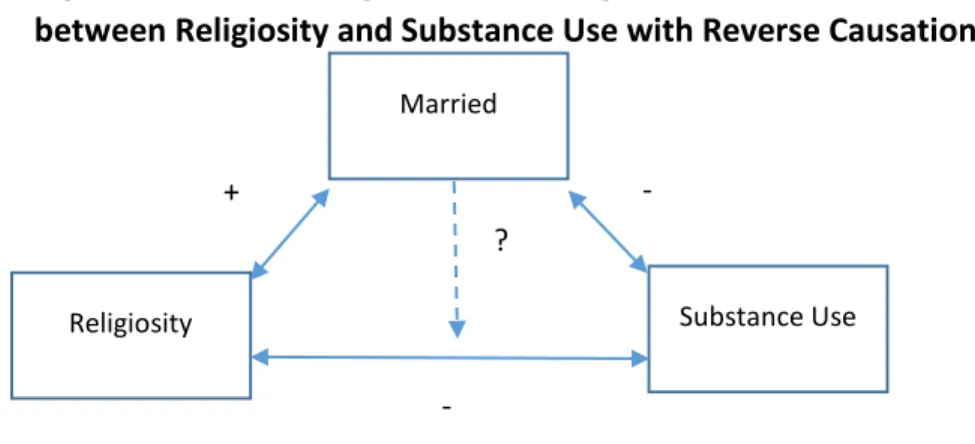
Even though there are compelling reasons to believe that religiosity influences substance use behaviors; marital status influences religiosity; and marital status influences substance use behaviors, there is also reason to believe the association goes in the reverse direction. For example, Uecker and Colleagues find that alcohol use and marijuana use predict declines in religiosity between adolescence and early adulthood. Also, both religiosity (Bramlett and Mosher 2002) and substance use (Leonard, Smith, and Homish 2014) have been found to influence an individual’s likelihood to marry. Figure 2.2 is a revised conceptual model, including reverse causality. Estimating the moderating influence of family status on the association between religiosity and substance use behaviors is problematic in this model because it is impossible isolate the effects of marital status on religiosity, substance use, or the association of those two phenomena.
Figure 2.2: Moderating Effects of Being Married on the Association
between Religiosity and Substance Use with Reverse Causation.
Married
Religiosity Substance Use
+ -
32
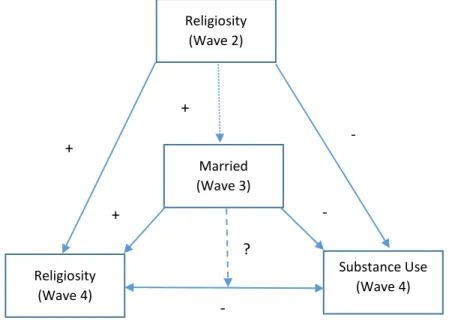
Figure 3.2 presents the specific remedy to the problem that I implement in my analyses. In figure 3.2 marital status is measured prior to religiosity and substance use behaviors. I also include measures of religiosity and substance use taken prior to the measure of marital status. By including a measure of marital status that was taken prior to the measurement of religiosity and substance use behaviors, and controlling for the effects of religiosity and substance use behaviors on marital status, I can isolate the influence of marital status on the association between religiosity and substance use behaviors.
Also, because of data limitations I am forced to use contemporaneous measures of religiosity and substance use behaviors. While it would be ideal to have a measure substance use behavior that is taken after the measure of religiosity, the actual causal order of the association between religiosity and
Married (Wave 3)
Religiosity (Wave 4)
Substance Use (Wave 4) -
- ?
Figure 3.2: The Moderating Effects of Being Married on the Association
between Religiosity and Substance Use, Controlling for Reverse Causation.
+
Religiosity (Wave 2)
+ -
33
34
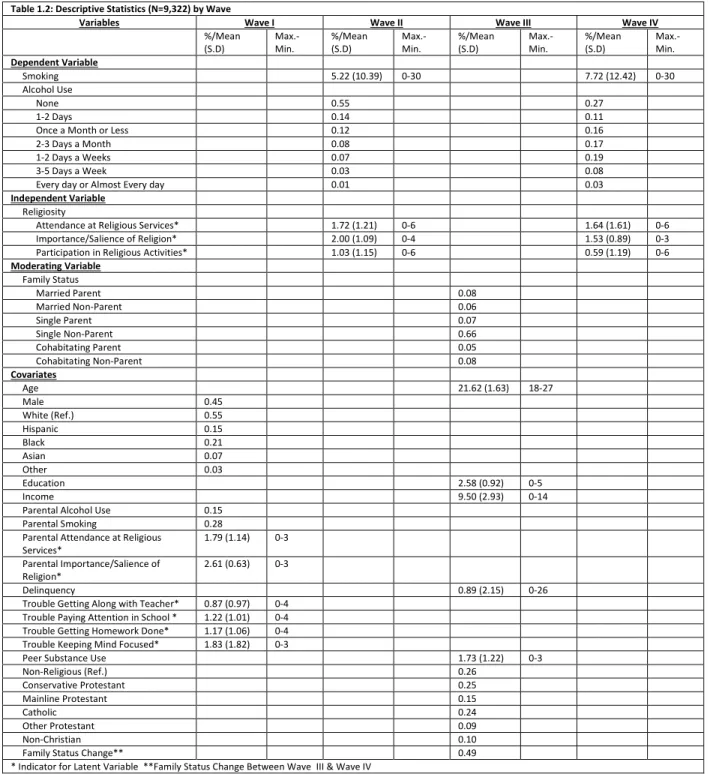
Table 1.2: Descriptive Statistics (N=9,322) by Wave
Variables Wave I Wave II Wave III Wave IV
%/Mean (S.D) Max.-Min. %/Mean (S.D) Max.-Min. %/Mean (S.D) Max.-Min. %/Mean (S.D) Max.-Min. Dependent Variable
Smoking 5.22 (10.39) 0-30 7.72 (12.42) 0-30
Alcohol Use
None 0.55 0.27
1-2 Days 0.14 0.11
Once a Month or Less 0.12 0.16
2-3 Days a Month 0.08 0.17
1-2 Days a Weeks 0.07 0.19
3-5 Days a Week 0.03 0.08
Every day or Almost Every day 0.01 0.03
Independent Variable Religiosity
Attendance at Religious Services* 1.72 (1.21) 0-6 1.64 (1.61) 0-6 Importance/Salience of Religion* 2.00 (1.09) 0-4 1.53 (0.89) 0-3 Participation in Religious Activities* 1.03 (1.15) 0-6 0.59 (1.19) 0-6 Moderating Variable
Family Status
Married Parent 0.08
Married Non-Parent 0.06
Single Parent 0.07
Single Non-Parent 0.66
Cohabitating Parent 0.05
Cohabitating Non-Parent 0.08
Covariates
Age 21.62 (1.63) 18-27
Male 0.45
White (Ref.) 0.55
Hispanic 0.15
Black 0.21
Asian 0.07
Other 0.03
Education 2.58 (0.92) 0-5
Income 9.50 (2.93) 0-14
Parental Alcohol Use 0.15 Parental Smoking 0.28 Parental Attendance at Religious
Services*
1.79 (1.14) 0-3 Parental Importance/Salience of
Religion*
2.61 (0.63) 0-3
Delinquency 0.89 (2.15) 0-26
Trouble Getting Along with Teacher* 0.87 (0.97) 0-4 Trouble Paying Attention in School * 1.22 (1.01) 0-4 Trouble Getting Homework Done* 1.17 (1.06) 0-4 Trouble Keeping Mind Focused* 1.83 (1.82) 0-3
Peer Substance Use 1.73 (1.22) 0-3
Non-Religious (Ref.) 0.26
Conservative Protestant 0.25
Mainline Protestant 0.15
Catholic 0.24
Other Protestant 0.09
Non-Christian 0.10
Family Status Change** 0.49
* Indicator for Latent Variable **Family Status Change Between Wave III & Wave IV
DATA AND METHODS
Add Health. The data for these analyses come from the National Longitudinal Study of
35
and young adults obtained from an initial in-school survey of middle- and high school students conducted from September 1994 to April 1995. In total, 90,118 adolescents who attended 80 high schools and 54 feeder schools (both public and private) took part in the initial interview. During the months of April through December 1995, a sample of the in-school respondents (stratified by gender and grade) were selected to participate in an in-home face-to-face interview (Wave I). This sample included 20,745 individuals. These respondents have been followed up three times over the past 15 years for a total of four waves of in-home data collection.
36
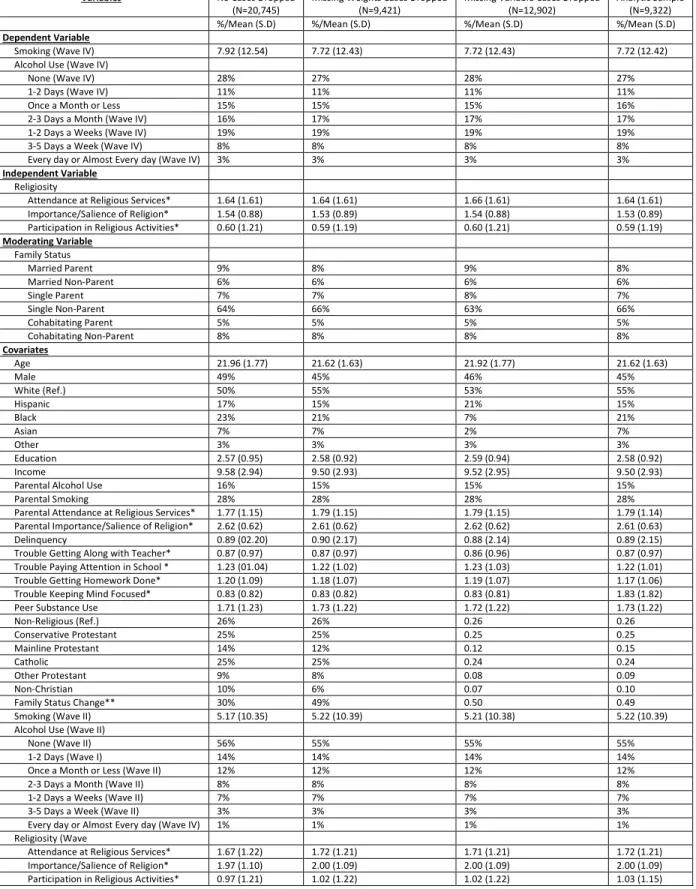
Table 2.2: Attrition Analysis
Variables No Cases Dropped
(N=20,745)
Missing Weights Cases Dropped (N=9,421)
Missing Variable Cases Dropped (N=12,902)
Analytic Sample (N=9,322) %/Mean (S.D) %/Mean (S.D) %/Mean (S.D) %/Mean (S.D) Dependent Variable
Smoking (Wave IV) 7.92 (12.54) 7.72 (12.43) 7.72 (12.43) 7.72 (12.42) Alcohol Use (Wave IV)
None (Wave IV) 28% 27% 28% 27%
1-2 Days (Wave IV) 11% 11% 11% 11%
Once a Month or Less 15% 15% 15% 16%
2-3 Days a Month (Wave IV) 16% 17% 17% 17%
1-2 Days a Weeks (Wave IV) 19% 19% 19% 19%
3-5 Days a Week (Wave IV) 8% 8% 8% 8%
Every day or Almost Every day (Wave IV) 3% 3% 3% 3%
Independent Variable Religiosity
Attendance at Religious Services* 1.64 (1.61) 1.64 (1.61) 1.66 (1.61) 1.64 (1.61) Importance/Salience of Religion* 1.54 (0.88) 1.53 (0.89) 1.54 (0.88) 1.53 (0.89) Participation in Religious Activities* 0.60 (1.21) 0.59 (1.19) 0.60 (1.21) 0.59 (1.19) Moderating Variable
Family Status
Married Parent 9% 8% 9% 8%
Married Non-Parent 6% 6% 6% 6%
Single Parent 7% 7% 8% 7%
Single Non-Parent 64% 66% 63% 66%
Cohabitating Parent 5% 5% 5% 5%
Cohabitating Non-Parent 8% 8% 8% 8%
Covariates
Age 21.96 (1.77) 21.62 (1.63) 21.92 (1.77) 21.62 (1.63)
Male 49% 45% 46% 45%
White (Ref.) 50% 55% 53% 55%
Hispanic 17% 15% 21% 15%
Black 23% 21% 7% 21%
Asian 7% 7% 2% 7%
Other 3% 3% 3% 3%
Education 2.57 (0.95) 2.58 (0.92) 2.59 (0.94) 2.58 (0.92)
Income 9.58 (2.94) 9.50 (2.93) 9.52 (2.95) 9.50 (2.93)
Parental Alcohol Use 16% 15% 15% 15%
Parental Smoking 28% 28% 28% 28%
Parental Attendance at Religious Services* 1.77 (1.15) 1.79 (1.15) 1.79 (1.15) 1.79 (1.14) Parental Importance/Salience of Religion* 2.62 (0.62) 2.61 (0.62) 2.62 (0.62) 2.61 (0.63)
Delinquency 0.89 (02.20) 0.90 (2.17) 0.88 (2.14) 0.89 (2.15)
Trouble Getting Along with Teacher* 0.87 (0.97) 0.87 (0.97) 0.86 (0.96) 0.87 (0.97) Trouble Paying Attention in School * 1.23 (01.04) 1.22 (1.02) 1.23 (1.03) 1.22 (1.01) Trouble Getting Homework Done* 1.20 (1.09) 1.18 (1.07) 1.19 (1.07) 1.17 (1.06) Trouble Keeping Mind Focused* 0.83 (0.82) 0.83 (0.82) 0.83 (0.81) 1.83 (1.82) Peer Substance Use 1.71 (1.23) 1.73 (1.22) 1.72 (1.22) 1.73 (1.22)
Non-Religious (Ref.) 26% 26% 0.26 0.26
Conservative Protestant 25% 25% 0.25 0.25
Mainline Protestant 14% 12% 0.12 0.15
Catholic 25% 25% 0.24 0.24
Other Protestant 9% 8% 0.08 0.09
Non-Christian 10% 6% 0.07 0.10
Family Status Change** 30% 49% 0.50 0.49
Smoking (Wave II) 5.17 (10.35) 5.22 (10.39) 5.21 (10.38) 5.22 (10.39) Alcohol Use (Wave II)
None (Wave II) 56% 55% 55% 55%
1-2 Days (Wave I) 14% 14% 14% 14%
Once a Month or Less (Wave II) 12% 12% 12% 12%
2-3 Days a Month (Wave II) 8% 8% 8% 8%
1-2 Days a Weeks (Wave II) 7% 7% 7% 7%
3-5 Days a Week (Wave II) 3% 3% 3% 3%
Every day or Almost Every day (Wave IV) 1% 1% 1% 1%
Religiosity (Wave
37
Sample Attrition. One potential problems of listwise deletion is the potential of bias due to
patterns of missingness not being random. This would be evidenced by significant differences in the full sample and the sample in which cases have been deleted. Table 2.2 displays the full sample prior to listwise deletion; the sample after cases with missing sample weights are deleted; the sample after cases with missing variables are deleted; and the analytic sample. Table 2.2 reveals few differences across the samples. The full sample has a slightly higher proportion of males compared to the other samples. While this difference is small, it may strengthen the moderating effect of marriage on the association between religiosity and substance use behaviors due to the fact that marriage tends to have a greater influence on the behaviors of males compared to females. Also, the frequency of smoking is slightly higher in the full sample compared other samples. This may limit the generalizability of this sample to the general population. However, overall, these results indicate that it is not likely that the excluded cases will significantly bias the results.
Substance Use Behaviors. For my analyses I utilize two measures of substance use behaviors as
dependent variables: Frequency of smoking and frequency tends to have a greater influence on the behaviors of males compared to females. of alcohol use. Frequency of smoking is a measure based on the question, “During the past 30 days, how many days did you smoke cigarettes.” This is a count variable, ranging from 0 to 30. Table 1.2 indicates that the mean level of smoking within the sample is a little over 7 days in the previous 30 days. Frequency of alcohol use is a measure based on the question, “During the past 12 months on how many days did you drink alcohol”. This variable is composed of 7 categories with 0 indicating “no days”, and 6 indicating “every day or almost every day.” Table 1.2 indicates a large percentage of the sample (27%) hadn’t drank any alcoholic beverage in the past 12 months.
Religiosity. The concept of religiosity has been notoriously hard to define over the years. The
38
39
Figure 4.2: Latent Religiosity Variable
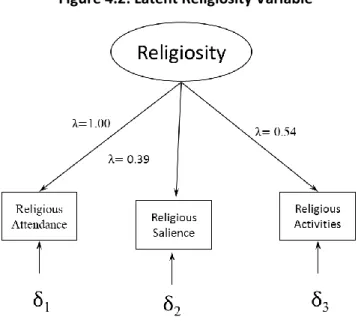
The latent religiosity variable utilized in my analyses is based Kogan and colleagues (2005) who used it to uncover risk and protective factors for substance use among African American high school dropouts. Figure 4.2 illustrates the relationship between the latent religiosity variable and each indicator variable. The coefficient (λ) of the first indicator, attendance at religious services, is constrained to 1 to ensure that the model is identified. In regards to the other two indicators, both religious salience (λ=0.39) and attendance at religious activities (λ=0.54) have a positive association with the latent religiosity variable. As a result, a 1-unit change in the latent religiosity variable corresponds to a 1 standard deviation change in that variable.
Family Status. I utilize a 6 category variable to measure family status as my moderating variable.
40
parent, cohabitating non-parent. Individuals are considered to be married if they indicate that one of the members of their household is their husband or wife. Similarly, Individuals are considered to be cohabitating if they indicate that a household member is partner, boyfriend or girlfriend. In addition, respondents are considered parents if they indicated that they have a son or a daughter living in their residence. Single individuals are individuals who are not married or cohabitating and do not have a child in the residence. As indicated by Table 1.2, most individuals in the sample were single non-parents (Mean=0.66) during Wave III.
Covariates. Covariates for age, sex, race and educational attainment are included in each model.
As indicated in Table 1.2, Ages within the sample at Wave III range from 18 years old to 27 years old with a mean age of approximately 28 years old. Age is included as a covariate because studies show that religiosity and substance use behaviors function differently at different ages. For example, according to the 2009 Monitoring the Future study, 15% of 8th graders report using alcohol in the past 30 days (Johnston et al. 2009a). This number increases to 44% among 12 graders and increases further during late adolescence to 53% of 19 and 20 year olds; 73 % of 21 and 22 year olds and 78% among 23 and 24 year olds (Johnston et al. 2009a; Johnston et al. 2009b). Age is also related to the concept of the “life course”, which Shanahan and Macmillan define as an age-graded sequence of roles, opportunities, constraints, and events that shape the biography from birth to death; because at various ages
behavioral expectations in regards to religion and substance use behaviors tend to vary. For example, it is largely unacceptable to smoke or use alcohol prior to age 18, during the period of the life course known as adolescence. However, these behaviors become normative after 18 and into the early 20’s, during the period of the life course known as early adulthood. As a result, it is important to control for age as a proxy for differences in behavioral expectations related to differences in life stage.
41
highest level of education completed by the respondent. Educational attainment ranges from 0 = ≤ 8th grade to 5 = professional training beyond a four-year college/university. The modal level of education within the sample is a high school diploma, with approximately 44% of respondents indicating that a high school diploma is their highest level of education. Household income is measured as total income from all sources before taxes and deductions. Most respondents reported their household income in dollars. A few preferred to report a range; the midpoints of the indicated ranges were used for these respondents. Household income was logged for this analysis, which reduced the likelihood of a non-linear relationship between income and substance use.
Religious affiliation is a variable that is loosely based on the coding scheme put forward by Steensland and colleagues (2000). The largest religious group within the samples is Conservative Protestant (25%), followed closely by Catholics (24%). Religious affiliation is a separate dimension from religious involvement, the variable I use as my independent variable because religious affiliation includes racial/ethnic characteristics (i.e. Jewish Identity, African American Baptists) and/or strong beliefs (i.e. Mormons; Seventh-Day Adventists). It is important to control for religious affiliation because certain religious groups have strict prohibitions on substance use (i.e. Mormon; Seventh-Day
Adventists).
42
measure of family status in Wave III with measures of religiosity and substance use behaviors from Wave IV, I include a variable that controls for changes in family status between Wave III and Wave IV.
ANALYTIC STRATEGY
Because our measure for smoking is a count variable, treating them as continuous and using linear models can yield inconsistent and inefficient estimates of parameters. A better approach assumes the counts of delinquency are generated from a Poisson distribution. We estimated a Poisson regression model and, as expected, found overdispersion—the variance exceeded the mean count of smoking— which, if ignored, can result in inefficient estimates of coefficients and downwardly biased standard errors (Long 1997). Consequently, we turned to a negative binomial model, which allows the count of smoking events to vary across individuals, and therefore, the variance to exceed the mean. Also, because Add Health includes siblings and oversamples certain groups within the sample, each analysis accounts for sample structure using survey weights that adjust for the unequal probabilities of selection and sample attrition. The general form of the equation modeling smoking behavior is as follows:
Log (Smokingij) = α+β1Religij+ β2Statusij + β3ReligXStatusij + β4Covariatesij + εij [1];
43
Because alcohol use is a categorical variable I utilized ordinal logistic regression analysis to estimate frequency of alcohol use. The general form of the equation modeling smoking behavior is as follows:
Logit(Drinkingij) = α+β1Religij+ β2Statusij + β3ReligXStatusij + β4Covariatesij [2];
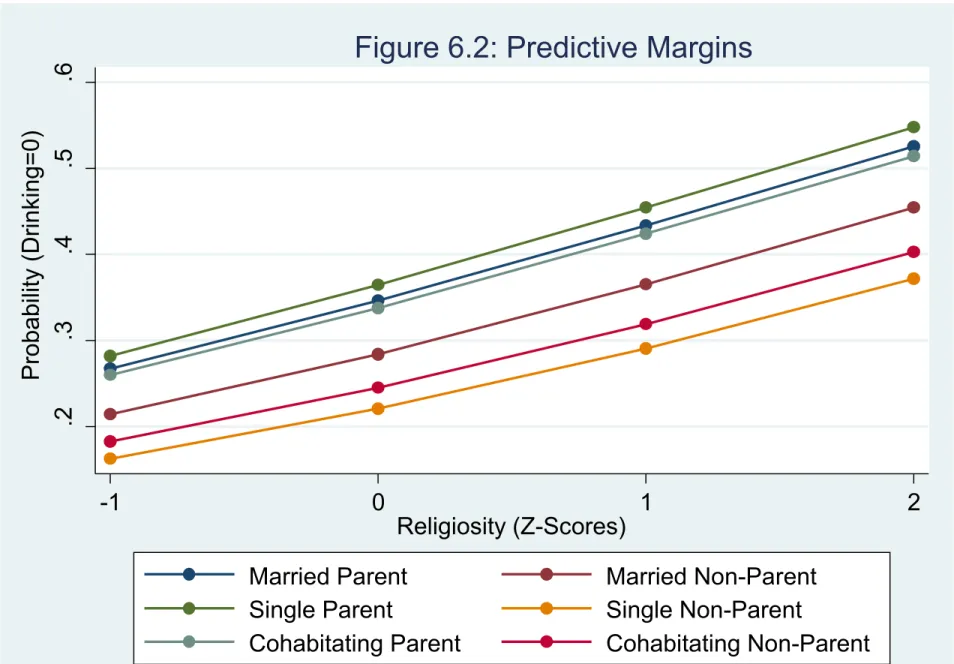
where Drinkingij represents the logged odds of moving the next category of alcohol use for individual i in sibling pair j; β1 represents the slope for religiosity for individual i in sibling pair j; β2 is the slope for family status for individual i in sibling pair j; β3 is the slope for the interaction for individual i in sibling pair j; β4 represents the slope for the covariates for individual i in sibling pair j and ε represents error for individual i in sibling pair j.