Challenges for Provenance in Cloud Computing
Imad M. Abbadi and John Lyle
Department of Computer Science, University of Oxford
Email: firstname . lastname @cs.ox.ac.uk
Abstract
Many applications which require provenance are now moving to cloud infrastructures. However, it is not widely realised that clouds have their own need for provenance due to their dynamic nature and the burden this places on their administrators. We analyse the struc-ture of cloud computing to identify the unique challenges facing provenance collection and the scenarios in which additional provenance data could be useful.
1
Introduction
Cloud computing is an increasingly popular approach for the processing of large data sets and computationally expensive programs. This includes scenarios that have clear requirements for maintaining the provenance of data, including eScience [5] and healthcare [15], where assurance in the quality and repeatability of results is es-sential. In addition, clouds have their own application for provenance: the identification of the origins of faults and security violations. However, cloud systems are struc-tured in a fundamentally different way from other dis-tributed systems, such as grids, and therefore present new problems for the collection of provenance data.
In this paper we describe the challenges in collecting provenance for cloud computing and identify where ad-ditional work is needed. We believe that there is an op-portunity for creating new, practical provenance systems for clouds to support scientific computing as well as sat-isfying current requirements for better debugging, audit-ing, forensics, billing and security. These systems must reflect the unique nature of clouds and should take ad-vantage of existing research from grid computing.
1.1
Background: provenance in the cloud
Cloud computing has many competing definitions. The following will be used in this paper:
‘Cloud computing is a model for enabling convenient, on-demand network access to a shared pool of configurable computing re-sources (e.g., networks, servers, storage, appli-cations, and services) that can be rapidly provi-sioned and released with minimal management effort or service provider interaction.’[10]
There are three commonly-discussed types of clouds. Infrastructure-as-a-service (IaaS), platform-as-a-service (PaaS) and software-as-a-service (SaaS). IaaS refers to the provision of virtualized hardware on which the client can run their own operating system and software stack. In PaaS, the operating system and environment are pro-vided and maintained for the client, who then runs their own applications. In SaaS the cloud provider runs and organises the entire software system and provides a spe-cific service.
Provenance, on the other hand, is better defined. It generally refers to information that ‘helps determine the derivation history of a data product, starting from its original sources’ [14]. This information is clearly valu-able in data-intensive computing scenarios, such as sci-entific computing [12], to provide assurance in quality of results [8] and ensure the repeatability of experiments.
We observe that the problem (if not the concept) of provenance should also be familiar to anyone involved in debugging IT systems. System administrators must identify where an error originated, what caused it and the effects it had. This is particularly true of security viola-tions, and provenance records are closely related to data forensics. These tasks are usually supported through log-gingandauditing. This is particularly difficult in com-plex systems with multiple layers of interacting software and hardware such as a cloud. Clouds are dynamic and heterogeneous by definition [4], and involve several com-ponents provided by different vendors which must inter-operate. Tracing the origins of faults on cloud infrastruc-tures involves the collection of evidence and data from
diverse sources with difficult to determine causes and ef-fects. Cloud computing therefore is a good example of a situation where the introduction of better provenance data could provide immediate benefits for system admin-istrators as well as users.
As an aside, we note thatlogsand provenance data
are distinctly different. Logs provide a sequential history of pre-defined actions usually relating to a particular ap-plication. Provenance data refers to the history of the
originsof a particular data object, with perhaps greater requirements for assurance and semantics. Provenance goes beyond an individual application and may refer to many pieces of equipment as well as people. Through-out this paper we refer to logs as being a source of prove-nance, primarily because in cloud systems, when present, they are used in combination for a similar purpose.
1.2
Related work
The need for additional provenance information in cloud computing storage has been well established by Muniswamy-Reddy et al. [11, 12]. The authors have dis-cussed the requirements for adding data provenance to cloud storage systems and have analysed several alter-native implementations. This is in contrast to our work, which considers the entire cloud infrastructure and iden-tifies that existing (but inadequate) tools are already be-ing used for provenance.
The use of provenance for fault tolerance has also been proposed before for grid computing [7, 16]. One aim is to avoid common modes of failure when attempting to use multiple composite web services. This work provides useful motivation for the collection of provenance data, but the move to cloud computing requires a new analysis of current problems in the collection of provenance data. There are many promising tools which could be adapted for use in cloud environments. Muniswamy-Reddy et al. [11, 12] have already evaluated the use of PASS – the Provenance-Aware Storage System – for cloud provenance. Reilly and Naughton [13] have pro-posed extending the Condor batch execution system to capture data on execution environments, machine identi-ties, log files, file permissions and more. While there are significant new challenges on a cloud infrastructure, the Provenance-Aware Condor system certainly collects the right kind of provenance data.
2
Cloud dynamics
In this section we present a taxonomy of cloud infras-tructures, detailed discussion of which can be found in previous work [1], and then describe its dynamic nature and the challenges this presents for provenance collec-tion.
Figure 1: Cloud Taxonomy: 3-D View (source [1])
Cloud infrastructure can be represented as a 3-D cylin-der, which can be sliced horizontally and/or vertically (see Figure 1) into layers. A layer represents cloud re-sources that share common characteristics. The layering concept helps in understanding the relations and interac-tions between cloud resources. We use the nature of the resource (i.e. physical, virtual, or application) as the key characteristic for horizontal slicing of the cloud. For ver-tical slicing, on the other hand, we use the function of the resource (i.e. server, network, or storage) as the key characteristic for vertical slicing.
As illustrated in Figure 1, vertical slicing of the phys-ical layer results in three layers: storage layer, server layer, and network layer. Each layer is organized into sub-layers, each of which provides specific properties to serve the needs of the wide range of cloud user require-ments. Server, network and storage sub-layers are orga-nized into multiplecollaborating sub-layers. Sub-layers within each collaborating sub-layer and their resources are carefully selected, interconnected, and even physi-cally positioned to support the overall collaborating sub-layer properties.
Virtual resources are then created and grouped at the virtual layer based on user application requirements. Multiple relatedgroupsjoin acollaborating groupbased on user requirements and the nature of the application (e.g. dependency amongst application resources). Sub-layers and groups are associated with properties and poli-cies, which are important for managing the ture. Sub-layers’ properties and policies are infrastruc-ture related, while group properties and policies are re-lated to user’s application requirements. Each group is hosted at a collaborating sub-layer with physical proper-ties that best match user properproper-ties.
Cloud resources communicate in a well organised way, either horizontally and/or vertically, which is de-fined as follows (for further details see [4]):
Horizontal communication. This is where cloud re-sources communicate as peers within a layer,
sub-Figure 2: Dynamics of the Cloud
layer, or group. There are many examples of hor-izontal communication, such as replicating files between peers or virtual machines synchronising shared memory.
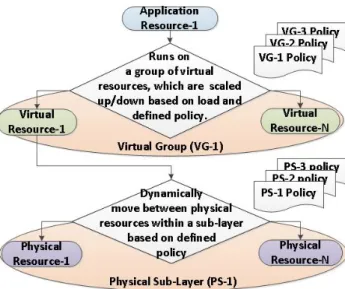
Vertical communication. This is where cloud re-sources communicate with other cloud rere-sources in the same layer or another layer following a pro-cess workflow in either an up-down or down-up direction. This would typically work as follows. First, an upper layer’s resource runs a process which generates sub-processes that must be run at lower layers. Then the lower layer processes the sub-processes and then sends the outcome to the upper layer. These steps represent an up-down communi-cation channel. Each layer in turn sends their re-sponse back in the opposite direction, which repre-sents the down-up communication channel. Cloud resources are dynamic and hierarchical (see Figure 2). By dynamic we mean the following: (a.) a specific virtual resource can be hosted at many differ-ent physical resources at differdiffer-ent times according to a policy; (b) similarly a specific application resource can run on multiple virtual resources that are increased or decreased based on load and a predefined policy control-ling such behaviour (i.e. elasticity property [1]); and (c.) from (a.) and (b.) we can conclude that a specific appli-cation can be hosted under different physical servers.
This is not to say that a cloud’s virtual or application resources can run anywhere. The opposite is true: as we discussed earlier cloud resources are well controlled and managed following policies controlling the limits of movement; i.e. an application resource can move within a specific group of virtual resource (e.g. horizontal
scal-ability [1, 2]), and similarly a virtual resource can move within a physical resource’s sub-layer boundary [1, 4] .
The dynamic nature of clouds has advantages such as resource consolidation, resilience, scalability and high availability [1, 2]. However, this results in new security, logging and auditing challenges. These need to be solved for a cloud-hosted system requiring provenance collec-tion, and the solutions may in turn improve the other uses for log and audit data. In the next section we identify and categorise cloud logging, auditing and historical data and then derive the challenges.
3
Cloud logging and auditing
Logging, auditing and historical data are of tremendous importance in a cloud. This is especially the case as a cloud is expected to support Internet-scale critical ap-plications. Logging, auditing and historical data have different usage, e.g. pro-active service delivery (inci-dents monitoring and security monitoring), error inves-tigation, billing, and forensic investigation. Almost all of a cloud’s resources generate this data in some way. The importance of such data and its usage is based on the following resource types.
Physical resources generate information related to physical resource status, security and incident re-porting. The generated data helps in the direction of finding the cause of incidents and for security mon-itoring. Cloud providers and forensic investigation teams are the main parties interested in this data. Virtual resources generate information related to
vir-tual resource status, security and incident report-ing. They also generate usage data, which are used for billing customers using IaaS clouds. Cloud providers, forensic investigators, auditors and IaaS cloud customer are the main parties interested in this data.
Application resources generate data related to applica-tion resource status, security and incident report-ing. They also generate usage data that are used for billing customers using PaaS and SaaS clouds. Cloud providers, forensic investigators, auditors, and cloud customers are the main parties interested in this data.
4
Challenges for cloud provenance
At present, the only way that provenance is provided on a cloud is through linking together log and audit data, col-lected from multiple resources, to provide the complete history of an event or result. This is no substitute for a
purpose-built provenance system, like those designed for grid systems [14], but is the approach used in practice by clouds for many of the same purposes.
As discussed, cloud systems are composed of dynam-ically interlinked resources. This means that building a logical sequence of events to investigate an incident for any one application requires data from many sources. These include the application itself, all logs for possible virtual resources that the application could have used, and logs of all physical resources that virtual resources could have used. Administrators must then combine this data correctly by identifying all time intervals when an application used a specific virtual resource, all possible time intervals when these virtual resources used physical resources and then all relevant log files from all related resources. Collecting and combining data from these re-sources is not easy or practical considering the potential scale of cloud systems.
Therefore, we propose that all layers, sub-layers and groups of a cloud system should incorporate a mecha-nism to support the collection of linkable data providing theprovenanceof events related to a specific activity.
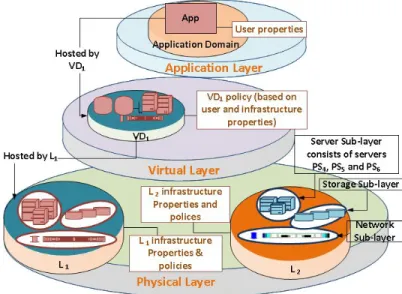
We now discuss the importance of provenance in a cloud using two simple example scenarios illustrated in Figure 3. We assume that a cloud provider has six physi-cal serversPS1toPS6, and two collaborating sub-layers L1andL2. L1 is allocated physical serversPS1toPS3,
andL2is allocated physical serversPS4toPS6. We also
assume that the cloud provider hosts an applicationApp. The cloud provider creates groupV D1in the virtual layer
to runApp. V D1 is initially allocated a one virtual
re-source,V R1, to hostApp.V D1is associated with a
pol-icy allowing it to scale its resources when there is an increase in demand using resources from physical sub-layerL1.
Our first example demonstrates how a simple increase in load, and the corresponding reaction from the cloud, can result in a loss of provenance data.
1. Assume the load on App has dramatically in-creased.
2. V D1 responds by instantiating a new virtual
re-sourceV R2replicatingV R1insideV D1.
3. Now both V R1 andV R2 process App, which are
hosted usingL1. Assume thatV R1is hosted byPS1
andV R2is hosted byPS2.
4. PS2has hardware problems, which results in
incor-rect results being generated byApp.
5. Load returns to normal and soV D1downscales by
removingV R2.
6. Cloud customers discover the problem and call the cloud provider.
Figure 3: Provenance Scenario
If the cloud provider only examines the logs of files generated byV R1 andPS1, then they will not find the root case of the problem or how to rectify it.
Our second scenario focus on forensic provenance in the cloud, as follow.
1. A system administrator reads the policy forV D1
and understands thatAppcan only be hosted using
L1resources.
2. The administrator updates theV D1policy to force
V D1to useL2resources
3. The administrator then connects toL2physical
re-sources and finds out thatV D1resources are
run-ning onPS4, meaning thatAppis hosted there. The
system administrator connects toPS4and indirectly
extracts important information fromApp.PS4logs
this activity.
4. The administrator restores the original policy, which forcesV D1resources to switch back toL1. If the cloud provider only examines log files gener-ated byL1 resources, then they will not discover who
performed the attack or, even worse, they might never discover that an attack has happened in the first place. This is one of the main challenges that shows the im-portance of provenance considering the complex cloud infrastructure and enormous distributed resources.
5
Discussion
We have aleady mentioned some use cases for prove-nance in cloud systems, such as billing, forensic and inci-dent investigation. Current mechanisms provided for this
purpose are associated with many shortcomings. Exam-ples of such shortcomings include the following.
• The methods followed by clouds to support prove-nance queries are basic and, in many cases, such methods are developed on an ad-hoc basis by cloud system administrators using customized scripts to address a specific event. If the event criteria changes then it is unlikely that the original script would work without modifications; it needs to be manually cus-tomized to adapt to new changes.
• Current mechanisms are object specific; i.e. they do not automate the process of managing different log and audit files and linking dependent log and audit records together. For example, investigating an in-cident would be likely to require going through dif-ferent log files, each of which may contain a great deal of detailed information. Only experts in the domain can identify the relationship between log files following a manual process supported by sim-ple scripts. This process is error prone, time con-suming and expensive. Such a manual process in-creases the mean time to discover an incident and the mean time to diagnose it. This in turn affects cloud service delivery (or operational trust), as dis-cussed in [3].
• The mechanisms are deployed and fully controlled by cloud providers; i.e. cloud users do not have con-trol over such mechanisms, and neither they can ac-cess logging and auditing records. Users have no option but to trust cloud providers. As a result, users cannot be certain that (for example) billing statements accurately reflect real use of resources, cannot be certain that their resources were up and running all the time, and cannot be certain about se-curity breaches or malfunctions affecting their out-sourced resources.
• Most importantly, current logging and auditing records are not reasonably protected, which in turn affects the creditability of provenance in the cloud. For example, any authorized system administrator can easily and without being detected update log-ging records related to physical resources, virtual resources, and even application resources.
There are several different types of cloud deploy-ments: private, public, and community models [10]. There are major differences between such models, including the number of users, supported services, adopted business models, and relationship between cloud providers and their users. Such differences affect the cloud providers’ urgency in implementing provenance systems. Abbadi [1] discusses and compares different
cloud models in terms of the services they support. He identified that public cloud models support limited ser-vices in comparison with the ones provided by private and community cloud models. This is related to many factors including technical limitations and the number of cloud users of each model. However, in the future we can expect many more usage scenarios, including critical infrastructure, which will cause public clouds to adopt all services currently provided by community and private cloud models. Many challenges still need to be addressed before this adoption can happen [2, 3, 4]. One of these is providing automated self-managed ser-vices [1, 2], which are software serser-vices that can auto-matically and with minimal human intervention manage cloud environment availability, resilience, adaptability, reliability and scalability to consider security and pri-vacy by design. One of the key challenges in building self-managed services is providing provenance mecha-nisms to support the management of complex cloud in-frastructures. Private and community cloud providers have limited customers, which makes it reasonable to rely on human resources (supported by simple scripts) to provide basic provenance in the cloud. However, mov-ing to public cloud that is expected to have significantly more users requires cloud-specific provenance mecha-nisms. For example, adaptability service on failure re-quires provenance mechanisms that would carefully pro-vide the records leading to understand the cause of in-cidents (e.g. DoS attack, application error, or physical incident). Fortunately, large cloud infrastructures have enormous processing and data storage facilities, making the implementation of such facilities much more reason-able.
Another important point which indirectly depends on cloud provenance is trust establishment. Trust establish-ment in cloud computing requires collaborative efforts from industry and academia. As discussed by Abbadi [3], establishing trust in cloud systems requires two mu-tually dependent elements: (a.) support infrastructures with trustworthy mechanisms and tools to help cloud providers automate the process of managing, maintain-ing, and securing their systems (this includes but is not limited to self-managed services as discussed earlier); and (b.) developing methods to help cloud users and providers establish trust in the operation of the infras-tructure by continually assessing its operational status. An important component in both elements is establish-ing trustworthy cloud provenance mechanisms [9]. By trustworthy we mean that both cloud users and cloud providers can attest to provenance mechanisms ensuring that they have performed their job as expected. One way to implement this is for cloud providers, who are inter-ested in providing trustworthy provenance mechanisms, to support automated management services with incident
provenance describing, for example, the root cause of an incident. Cloud users, on the other hand, would be inter-ested in this to assure them that the information provided by the cloud reflects the real operation of the cloud. For example, it would enable cloud users to ensure that the billing statements reflect real usage of resources. An-other example would be attesting the integrity and en-forcement of cloud resource policies, which would pre-vent the second scenario outlined in the previous section.
6
Conclusion and future work
We have discussed the need for cloud provenance, both for the applications a cloud infrastructure will support and for service provider requirements such as debugging, auditing and forensics. We have identified several key factors that make provenance more complicated in cloud systems and shown two examples of why it would be im-mediately useful in comparison to existing logging ap-proaches.
One of the key objectives of TClouds project1 is to
establish cloud trust models. Trust models have enor-mous advantages to both cloud users and providers [3]. As discussed earlier, establishing trustworthy cloud com-puting provenance is fundamental requirement to estab-lish such trust models. We intend to investigate in fur-ther detail the requirements for cloud computing prove-nance, particularly in scenarios under investigation in the TClouds project such as healthcare and public lighting. We would like to attempt both a top-down approach – specifying how a new provenance architecture could be created for clouds of varying complexity – and a bottom-up approach where existing logging systems are com-bined in order to satisfy requirements without disrupt-ing existdisrupt-ing systems. Furthermore, existdisrupt-ing grid work-flow provenance systems may be applicable for record-ing cloud vertical communication.
Acknowledgements
This research has been supported by the TCloud project, which is funded by the EU’s Seventh Framework Pro-gram ([FP7/2007-2013]) under grant agreement number ICT-257243.
References
[1] ABBADI, I. M. Clouds’ Infrastructure Taxonomy, Properties, and Management Services. InCloudComp ’11: in proceeding of the International workshop on Cloud Computing: Architecture, Algorithms and Applications (to appear) (July 2011), LNCS, Springer-Verlag.
1http://www.tclouds-project.eu
[2] ABBADI, I. M. Middleware Services at Cloud Virtual Layer. In DSOC 2011: Proceedings of the 2nd International Workshop on Dependable Service-Oriented and Cloud computing (to appear) (Aug. 2011), IEEE Computer Society.
[3] ABBADI, I. M. Operational trust in clouds’ environment. In MoCS 2011: Proceedings of the Workshop on Management of Cloud Systems (to appear)(June 2011), IEEE Computer Society. [4] ABBADI, I. M. Toward Trustworthy Clouds’ Internet Scale Crit-ical Infrastructure. InISPEC ’11: Proceedings of the 7th Infor-mation Security Practice and Experience Conference (to appear) (June 2011), LNCS, Springer-Verlag.
[5] BOSE, R.,ANDFREW, J. Lineage retrieval for scientific data processing: a survey.ACM Comput. Surv. 37, 1 (2005), 1–28. [6] CHENEY, J., Ed.First Workshop on the Theory and Practice of
Provenance, February 23, 2009, San Francisco, CA, USA, Pro-ceedings(2009), USENIX.
[7] CRAWL, D.,ANDALTINTAS, I. A Provenance-Based Fault Tol-erance Mechanism for Scientific Workflows. InProvenance and Annotation of Data and Processes, vol. 5272 ofLNCS. Springer, 2008, pp. 152–159.
[8] GIL, Y., DEELMAN, E., ELLISMAN, M., FAHRINGER, T., FOX, G., GANNON, D., GOBLE, C., LIVNY, M., MOREAU, L.,AND
MYERS, J. Examining the Challenges of Scientific Workflows. IEEE Computer 40, 12 (Dec. 2007), 26–34.
[9] LYLE, J.,ANDMARTIN, A. Trusted computing and provenance: Better together. InTaPP ’10: Proceedings of the 2nd Workshop on the Theory and Practice of Provenance(2010), Usenix. [10] MELL, P., AND GRANCE, T. The NIST Definition of
Cloud Computing, 2009. http://csrc.nist.gov/groups/SNS/cloud-computing/clouddefv15.doc.
[11] MUNISWAMY-REDDY, K.-K., MACKO, P.,ANDSELTZER, M. Provenance for the cloud. In FAST ’10: Proceedings of the 8th USENIX conference on File and storage technologies(2010), USENIX, pp. 15–14.
[12] MUNISWAMY-REDDY, K.-K., MACKO, P., AND SELTZER, M. I. Making a cloud provenance-aware. In Cheney [6]. [13] REILLY, C. F.,ANDNAUGHTON, J. F. Transparently Gathering
Provenance with Provenance Aware Condor. In Cheney [6]. [14] SIMMHAN, Y. L., PLALE, B.,ANDGANNON, D. A survey of
data provenance in e-science.SIGMOD Rec. 34, 3 (2005), 31–36. [15] V ´AZQUEZ-SALCEDA, J., ALVAREZ, S., KIFOR, T., VARGA, L. Z., MILES, S., MOREAU, L., ANDWILLMOTT, S. In R. Annicchiarico, U. Cort´es, C. Urdiales (eds.) Agent Technology and E-Health. Whitestein Series in Software Agent Technologies and Autonomic Computing. Birkh¨auser Verlag AG, Switzerland, Dec. 2007, ch. EU PROVENANCE Project: An Open Prove-nance Architecture for Distributed Applications.
[16] XU, J. Provenance-Aware Fault Tolerance for Grid Computing. http://spiderman-2.laas.fr/IFIPWG/ Workshops&Meetings/48/RR/03-Xu.pdf, 2005.
![Figure 1: Cloud Taxonomy: 3-D View (source [1])](https://thumb-us.123doks.com/thumbv2/123dok_us/9333696.2415354/2.918.472.822.110.304/figure-cloud-taxonomy-d-view-source.webp)