Vietnamese Voices: A Project for Activating
Student Autonomy
Nguyễn Ngọc Lưu Ly
Department of French, University of Languages and International Studies, Vietnam National University, Hanoi, Vietnam
Abstract—For foreign language education in Vietnam, passive teaching and learning with limited materials is thought to be associated with low achievement. This paper discusses the design and implementation of an innovative approach to guide students to build a Fun Reading Corner in foreign language using an autonomous-based approach in a Vietnam university. Survey data were collected before and after the project and from a focus group’s writing samples. The findings indicated that students’attitudes towards reading in French changed and their personal qualities and skills improved during the course. The paper concludes by explaining the significance of the results and implications for other Vietnamese foreign language programs.
Index Terms—reading corner, foreign language, autonomy, attitudes, qualities and skills
I. INTRODUCTION
The global education rankings, based on the test results of 15-year-old students in Math and Science, were released in May 2015 by the Organization for Economic Co-operation and Development (OECD). Surprisingly, Vietnam was ranked 12th, which was higher than developed countries such as the United Kingdom and the United States (Vnexpress, 2015). Despite this relatively high ranking, the International Labor Organization reported that labor productivity of Vietnam is the lowest in the Asia-Pacific region (ILO, 2014). Vietnam labor productivity is equal to 20% of Malaysia’s, 40% of Thailand’s, 6% of Singapore’s, 9% of Japan’s, and 10% of South Korea’s. Data from Vietnam’s General Department of Vocational Training show that 53% of graduates in Vietnam have low levels of analytic and problem-solving skills, 27% lack independent working skills, and 60% must be retrained due to a lack of leadership skills, creative skills, and somewhat negative attitudes towards work (A. B. Nguyen, 2016).
Vietnamese parents invest considerable financial resources to support their children’s education. Parents strive to create a professional learning environment, and to encourage achievements whereby children have the opportunity to achieve their full potential. It is common in Vietnam for parents to excuse children from helping with housework so that they have more time to focus on their studying. In Vietnam, parents are often seen lining up for school admissions, or picking up their children after graduation exams, or from extra classes. According to TriThucTre (2016) (The Youth Knowledge Magazine), this parental behaviour is viewed as overly protective of young people in Vietnam, like a velvet blanket. It has the effect of weakening young people’s independent thinking skills and creativity in the workplace. As a result, a generation of “thirty-year-old babies” has been created, as often mentioned in online forums about the current state of Vietnamese youth (Vietnamnet, 2016).
How do Vietnamese educational institutes educate students? M. T. Nguyen (Vnexpress, 2016), chief of the new K-12 Vietnamese curriculum 2017, argued that the Vietnamese educational approach expects students to be well-behaved in class and to give correct answers to questions from teachers. Educators endeavour to educate students so that they have with the same level of knowledge and skills. Vietnamese people are believed to be smart, good at studying for exams, yet they lack diligent practices in the work place. They especially lack imagination. There are few notable inventions in Vietnam. This is understandable because there is little opportunity to exercise freedom of thought. Under these circumstances it is understandable that imagination is limited. In terms of the consequences for students in higher education, T. M. Pham (2004, p.6) pointed out that a large number of students learn passively; they depend on instructors’ lectures. They want to learn from what they note down in their notebooks rather than from studying textbooks or reference books themselves. With these types of students, in addition to lectures some instructors help students to note important knowledge and only test this knowledge. This method helps students to learn; however, it promotes passivity and generates dependency on instructors. As a consequence, creativity is not promoted. During a lecture, students seldom speak out or participate in any discussions. Typically, they listen, make notes, and revise for exams.
of the National Foreign Languages 2020 project (MoET, 2014), most foreign language teachers are the products of the old educational system. They focus on content knowledge and each class follows a teacher-dominant format. Exercises mostly focus on memorization and reconstructing the transferred knowledge. Learners do not have opportunities to apply learned knowledge and skills in real life communication in foreign languages. The majority of the teachers do not spend time on teaching students how to engage in self-study, make portfolios, or identify suitable development plans for each individual. Testing and assessment systems do not promote foreign language as communication tools which can be used at work, and they do not create opportunities for learners to establish and develop autonomy, collaboration, and problem-solving (L. A. Pham, 2017). Core national foreign language exams like national junior high school graduation, and university entrance exams, comprise written tests, including grammar tests; they neglect listening and speaking tests.
In Vietnam, building a foreign language learning environment with appropriate learning materials requires considerable development. The main sources of in-class learning materials are text books and photocopied materials provided by teachers. These help students to revise their knowledge and practice foreign language skills. However, they may not engage learners’ interest or provide for the development of practical skills. Learning materials in the library are out-of-date, difficult, uninteresting, and not suitable for students’ competence levels. Therefore, students do not apply for library cards, or do not activate their cards if they receive them. Educational institutions, family and society do not work together in developing reading habits for the young generation (BVHTTDL, 2013).
One of the advantages of teaching foreign languages is that information technology skills can be productively utilised (learning software, Internet) (Karsenti & Collin, 2017; Mark & Meei-Ling, 2011; Reinders & Lazaro, 2007). Unfortunately, most teachers do not have these skills themselves or are not familiar with applying them in their teaching (N. H. Nguyen, 2011). As a result, learners are not provided with learning resources, and guidance on selecting and utilizing learning resource materials. Extra-curricular activities, including practicing learned knowledge and skills, are not common in regular foreign language instruction. There is no payment mechanism for teacher participation in extra-curricular activities to be counted as working time, and no policy for supporting and spreading innovative pedagogy practices. The current situation perhaps is best reflected in the summary of Nguyen Vinh Hien (TuoiTre, 2011), Vice Minister of Education and Training, at the implementation of the Foreign Language Project at higher education institution workshop:
We have both limitations, and success in the other subjects. Nevertheless, we have taught foreign language subjects from year to year, but students are not able to communicate in the foreign language. This is a failure.
II. LEARNER AUTONOMY
The concept of learner autonomy is very topical and has received special attention, studied, and applied by researchers around the world. Benson (2000, p.47) proposed the notion of learner autonomy in foreign language learning: “autonomy is defined as the capacity to take control of one’s own learning”. The word control is preferred to “take charge of” or “responsibility”. He explains that “control” over learning “may take a variety of forms in relation to different levels of the learning process”. Lennon (2012, p.9) reported on a study of learner autonomy involving students in 12 English classes from primary school to higher education. He noted that “all very successful language learners are, and always have been, to a greater or lesser extent, autonomous learners who have created their own opportunities for individualised language acquisition”. Nunan (1999, p.145) says: “learners who have reached a point where they are able to define their own goal and create their own learning opportunities have, by definition, become autonomous”. Seker (2016) pointed out that 94% of interviewed language teachers described a succesful language learner as someone who can study independently.
There has been a considerable amount of action research on how to improve learner autonomy and how to identify the advantages of this approach. Fowler (1997, p.115) used an action research approach to examine “autonomy development”. He reported that learner autonomy helps learners to improve their self-confidence and to attempt to use new learning strategies. Lennon (2012) wrote that successful teachers offer learners “freedom to learn in their own way”, regardless of rigid curricular and teaching methods. Yap (1998 as cited in Blidi, 2017), in a study involving senior high school English students in Hong Kong, noted that “teachers should create opportunities for students to share information about the strategies they use”. This is a useful suggestion and has been supported by action research. Creating “a sufficient level of interest” and “listening to learners” may help students to focus on their lessons and improve their learning outcomes.
Different models of learner autonomy have been considered. They are not necessarily mutually exclusive. Scharle and Szabo (2000, p.10) proposed a three-phase model that consists of raising awareness, changing attitudes and transferring roles. Nunan (1999, p.192) attempt remains a landmark that involves a model of five levels of “learner action”. These levels consist of “awareness”, “involvement”, “intervention”, “creation” and “transcendence”. Liu and Littlewood (1997, p.79) mentioned that teachers need to develop systematic strategies for furthering learners’ motivation, confidence, knowledge and skills in each domain of autonomy, included language learning. These models all emphasis learners’ awareness and attitudes as the first factor that teachers need to activate in autonomous language learning. Teaching should focus on each individual learner and allow him or her to choose appropriate learning tasks. Applying this approach during the implementation process, should facilitate development of the skills that are necessary for learners to complete assigned tasks.
Appropriate and modern learning environments, along with contemporary learning resources should play an important role in assisting the development of learner competencies that are considered essential for meeting the demands of the 21st century. As Benson (2000, p.40) points out, the teacher cannot teach students to become autonomous. But, the teacher may create the atmosphere and conditions in which they will be encouraged to develop the autonomy that they already have. Many studies have also discussed the positive effects of out-of-class learning (Mark & Meei-Ling, 2011; Maynard, 2011; Morrison, 2008; Palfreyman, 2011; Reinders & Lazaro, 2007; Yap, 1998). Learners said that it was more effective and fun to learn English out of the class. Teacher encouragement was less important in terms of motivation to learn. Yap concluded that:
…efforts to promote out-of-class learning should build upon the activities that students already value... Affective factors are an especially important factor in learner choices of, and attitudes to, the value of out-of-class activities.
Consistent with Yap’s findings, Benson (2000, p.203) argued that:
Out-of-class language learning is a new area of study of great importance to the theory and practice of autonomy. The dearth of studies in this area highlights the fact that research has tended to focus on the development of autonomy in institutional settings without establishing a firm knowledge base on the ways in which learners take control of their learning as a natural feature of the learning.
This may be a practical suggestion for teachers to engage learners in open learning spaces, rather than confining learning to the classroom. From our perspective, a vital important element that enables learners to apply foreign language in communication is to listen, read suitable materials by native speakers, then mimic, and rewrite continuously. As Krashen (1987) claimed, “acquisition differs from learning in two major ways: acquisition is slow and subtle, while learning is fast and, for some people, obvious. Acquisition takes time.” This is also applied to foreign language acquisition. Therefore learners must be autonomous in order to be successful, and if learners are not able to find appropriate out-of-class practices, perhaps it will be difficult for them to progress rapidly.
Along with an open learning space, learning materials must be designed appropriately to bring out optimal results for learners (Aston, 1993; Gardner & Miller, 2011; Littlejohn, 1997; Mark & Meei-Ling, 2011; Morrison, 2008; Reinders, 2010; Reinders & Lazaro, 2007; Yap, 1998). In his study about developing out-of-class learning materials for foreign language learning, Reinders (2011, p.189) concludes:
Creating and implementing materials for autonomy is challenging and, initially, time-consuming. Commercially available materials may not be suitable models to work from and for many teachers, this type of materials creation is a new experience. However, teachers can derive great satisfaction from knowing that the end result will help their students not only to improve their language, but also to improve their lifelong learning skills. In this way, the effect of one's efforts stretches well beyond the brief teaching moment and well beyond the language classroom. The skills they acquire in the process will stay with your students for the rest of their lives.
This is a hard, yet meaningful approach that a teacher can implement gradually with his or her class. The benefits of allowing students to participate in materials creation have been discussed by many researchers. Littlejohn (1997, p.190) believes that it can “transform learners from the role of consumers to the role of producers, exercising some level of control and influence over the centre facilities”. Aston (1993)’s evaluation shows that when students participate in materials creation, they are “more motivated and feel a sense of control, which is a key component in becoming autonomous”.
Within this context, we believe that action research can gradually change the current situation. Researchers and teaching staff work, observe certain classes, gain experience, scale-up, and gradually push back inappropriate, yet long-standing practices. Creating an open out-of-class learning space will bring about a favourable condition for producing learning tasks and activities in a creative manner, which will gradually leave the old practice of assigning exercises and facilitate learning tasks, as mentioned in the autonomous learner model.
With these points in mind, we undertook a case study in which we chose to organize an autonomous approach-based French language class and to help students build a learning environment through a French reading corner. We sought to parse out the change in their attitude about reading in French and their learning by examining the following questions:
Mastering a foreign language takes time. Therefore, we did not expect to have a quick solution that would enable learners to be fluent after a few weeks of working. However, we wished to design activities that helped learners to change their attitudes and to feel more independent in their learning.
III. DESCRIPTION OF THE CASE
We completed this study with a third-year university French language class of 44 students. Of the study participants, 32% have learnt French before university (n=14) and 68% started to learn French at university (n=30). During the first two years of studying at university, they participated in 950 periods of French language in class (1 period = 50 minutes), as follows: textbooks Alter Ego 1 with 224 periods, Alter Ego 2 with 252 periods, Alter Ego 3 with 252 periods, Alter Ego 4 and B2 in the European reference framework with 195 periods, plus 27 periods for intensive exam preparation. They need to reach B2 level in French in the Common European Framework of Reference for Languages (CEFR) (Verhelst, 2009) to graduate from college.
Before the start of the term we spent time discussing foreign language education in Vietnam, analysing actual trends and outcomes around the world in order to confirm the importance of autonomy in foreign language learning, as well as defining expectations for competencies development to effectively use foreign language at work in our courses.
Then together, we agreed to create and develop learning materials (Aston, 1993; Littlejohn, 1997; Reinders, 2011) by implementing the “Fun Reading Corner in French”, and other extensive reading support programs, to create friendly out-of-class environment for students to learn, increase interest for self-study and reading in foreign languages.
We developed a task framework, and analysed the links between these tasks and the common objective. We asked students to choose tasks, or to create other tasks consistent with the autonomous learning philosophy (Fowler, 1997; Lennon, 2012; Seker, 2016). Students were also required to choose their working groups (Blidi, 2017; Dam, 1995). We established 11 working groups. Each group had three to four members in the following task groups:
Project Support Group Fun Foreign Language Reading Corner Support Group
Reading Activity Support Group
Secretary group Financial group Communication group Evaluation group
Technical Group Decoration Group Book Management Group
Group 1 Group 2 Group 3 Group 4
(that later became Online Test Group, Game Group, Workshop Group, Report Group)
Figure 1. Task groups
Based on analysis of general tasks framework and list of tasks, we all required students to choose a task (Fowler, 1997, p. 115) and draw up their final products via their presentations in foreign language in class and correspondence out of class (Yap, 1998). We supported each group to define steps of procedure with “differentiated instruction” (Chapman, 2015), helped them adjust their plan to ensure it was realistic, and coordinate each other in and beyond the classroom by “autonomy with an appropriate dose” (Kirschner & van Merriënboer, 2013, p.178), based on factors determining the teacher’s role (Benson & Voller, 1997, p.101-106).
IV. METHOD
A. Surveys
We developed two surveys for administration before and after the development of the Fun reading corner in French. These surveys were designed to assess how students’ attitudes towards reading in French changed. After discussing with the students, and explaining the nature and purpose of the questionnaires, surveys were distributed to each individual in the class.
The first survey comprised 12 questions, and was administered before development of the French reading corner. Two questions sought information from the responding students, four questions asked respondents about their reading habits in French, three questions focused on attitudes towards reading in French, and three final questions sought expectations about building reading corner in French.
The second survey was conducted after 7 working weeks. At that time our first reading corner in French had been developed. This survey had 15 questions. In addition to the 12 questions that constituted the first survey, three additional questions were added regarding reading support activities.
B. Students’ Writing about Their Learning
approaches and assist in identifying strengths following the autonomous learning activity (Blidi, 2017, p.13). Then we interviewed some of our students outside the classroom in a more relaxed environment to further clarify information obtained from the narratives.
V. RESULTS
A. Surveys
For the first survey, 40 responses, which represents a response rate of 91%, were received. For the second survey, 41 responses, which represents a rate of 93%, were received. Specific questions were answered in full, whereas not all open-ended questions were completed.
Responses to reading habits resulted in a reversal of the before and after work process. Prior to the project, no student chose a response of freely regular reading in French outside the classroom. After the project, 68% reported engaging in regular French reading in their own time. In addition, 80% of students reported that they never read French in their own free time before the project; after the project this number dropped dramatically to 0.
Figure 2. Reading habit in French
Before the project, only 15% students had responses about their interested topics and genres of book; after the project, it increased substantially to 100%.
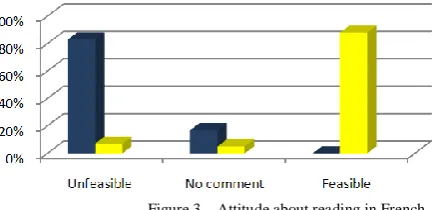
In response to the questions about attitude towards reading in French, prior to the project, 17% of students were not interested in reading in French outside the classroom; the remaining 83% shared the difficulties of dealing with extended reading in French (typical responses in this section "do not know where to start", "cannot find the right source of books", "lack of vocabulary", "cultural differences"), 23% of whom admitted that reading was useful but not practicable.
After the project, only 7% of the students were not ready to read in French, whereas 88% of students considered reading in French as a feasible activity. Examples in this section are as follows: "Have a more positive view on reading in foreign language", "See inspiration in reading in foreign language", "Help me recognize if there are appropriate books and preferred reading space, reading in foreign language is not as scary as I thought", "Approaching more useful reading materials, "Better understanding how to read properly in a foreign language", "Many members joined organized activities and created great atmosphere, that stimulated ourselves to read, learn a lot to discuss and play together", "To win in the Game, must understand the books given in Game, so need to read a lot".
Figure 3. Attitude about reading in French
About the concept of developing a French reading corner, before the project we only got 6 responses that mainly revolved around adding more materials for the reading corner, such as "Need funds to enter more books", "Find and photocopy more books to the library", "Who has books shares it. Can eat in the library".
After the project, 100% of the students answered and the content of the responses became more various. In addition to the content of adding more materials (17%), we also received a variety of comments such as scale-up (20%), Complete or add some more plentiful reading support activities (39%), Maintain and strengthen the current activities (24%), Modify some existing decorations (15%).
B. Students’ Writing
adjustment and improvement from situations through self-awareness, advice from teachers or comments from friends; 33% of the lessons was taken from the initiative of learning new things in diverse situations or during discussing with teachers and collaborating with peer groups; 14% of the lesson were derived from observing the teacher's work style, peers or project performance; in addition, 10% of lessons were learned from failure.
We divided these lessons into two types of qualities (46 lessons, 24%) and skills (142 lessons, 76%) that students appreciated as important and have been working through the process to help them prepare for the future. Although the experiences reflected in the narratives are different, the shared qualities and skills had many common points. For example, lessons about being active at work were described as follows:
After realizing that our group schedule was falling behind, we actively contacted the teacher via emails and arranged face-to-face meetings out of class. Thanks to the support from the teacher and the liveliness of group members, our work started getting on the right track and kept up with the pace of the project. In a collaborative project, it is of great importance to actively seek for help, to be active in our work, and not to procrastinate or rely on any one individual. It can lead to schedule delay of an individual as well as the whole team, affecting the progress rate.
(An evaluation group member)
When our teacher invited the expert to provide further advice on individual book-making project, each of us gained experience for ourselves, or had out-of-class discussions with the expert to ask questions as well as to find the most suitable and the best plan to complete individual products.
(A book management group member)
My group is in charge of scheduling a meeting with the director of documentary center, but group members failed to arrange work and did not actively contact the director. This time our teacher helped to take the appointment and the meeting with the class still was held as planned. After that, on behalf of the group I apologized to the director. I recognized that we needed to determine what to do before, what to do after and what is the most important.
(A secretary group member)
The reports and feedback of students about the project show trained personal qualities, that was patience (32%), working-under-pressure skills (23%), confidence (23%), being active at work (11%), sense of responsibility (11%), sense of respect and trust (5%).
Figure 4. Enhanced personal qualities after the project
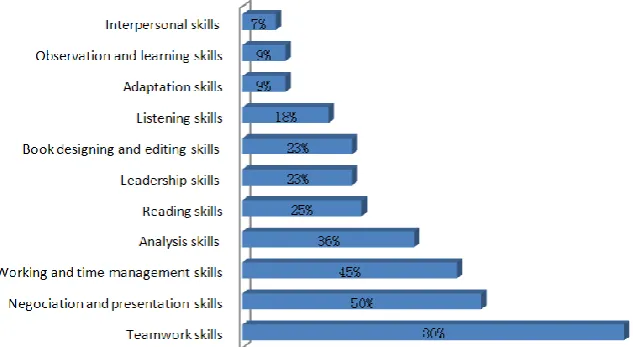
Compared to the number of qualities analysed by students in their writing, the number of skills mentioned is much greater. These skills are presented in Figure 5:
The participants said that they had learned most about teamwork skills (80%), with various stories about working, cooperating, helping each other, such as:
Initially, group members were working independently, no connections were established. Each person carried out the project on his/her own according to his/ her thinking and subjective evaluations, resulting in overlap and ineffective work. After that, our team found a sponsor group on Facebook, and members proposed ideas there. The team leader summarized and divided the work. The members were required to report on current situation, results, and plans for next week. Thanks to the experience, we came to the conclusion that it is necessary to have interactions, sharing and mutual supports in teamwork.
(A sponsor group member)
50% of students said their negotiation and presentation skills were enhanced after the project:
People were rather shy and lacked confidence in front of the class prior to the project. It was visible that people were all fingers and thumbs and nervous. Thanks to weekly report, people are more confident and better at communication.
(A decoration group member)
Apart from this, there are some specific stories of work group, such as:
Due to the nature of work of sponsor group, we had to communicate and present the project in the front of class. The experience improved our communicative and negotiation skills: What should we say? How should we deliver it? Who are we going to talk with? We also learned to choose appropriate communication methods for different sponsors. For example, during the first week, nobody contributed any items for the class, after the campaign many were convinced and contributed a lot.
(A sponsor group member)
In addition, 45% students believed that their working and time management skills were improved; 36% said that analytical skills and critical thinking were frequently practiced during the project. Besides, many students said that they also gained a great deal of experience, namely in literacy skills (skimming and scanning skill in particular) (25%), leadership skills (23%), book designing and editing skills (23%), listening skills (18%), adaptation skills (9%), observation, searching, and learning skills (9%), interpersonal skills (7%).
VI. DISCUSSION
A. Reading in French
After the seven-week implementation, the reading habits of students changed markedly. While students had never actively looked for reading material in French outside the classroom in the past, now they frequently do it. This is rather similar to the changes of student attitudes. A plausible reason is that students were placed in a context that activated their autonomy, and given solid support to build a friendly French reading corner. Therefore, the difficulties that students mentioned at the beginning stage like “I don’t know where to start”, “I can’t find a suitable source of reading material”, “lack of vocabulary”, “cultural differences”… were gradually overcome. Students were instructed to collect their favorite reading materials and add an index to explain high-level vocabularies for readers. Student groups were able to hold various reading supporting activities, such as online quizzes, to check students’ understanding about the reading material contents. Collective games like Hunting Treasure unobtrusively helped students to read, and extract information from different materials in a short period to participate and to win the game. Holding discussions, evaluating the collected reading materials, and honoring authors that had interesting books or effective product communications, also contributed to increase the attractiveness of the product collections. Apart from a friendly reading space with visual stimulation, such as slogans honoring reading, one hundred reasons for reading table, a feedback tree, a decorative layout also got students increasingly involved in reading French. More notably, students considered themselves project facilitators, since the number of answers on the ideas of building a reading corner in French increased from 15% prior to the project to 100% after the project. The proposed content also became more feasible, specific and diversified after serious working process.
The first good results helped students form a new reading habit. The more students worked on it, the more ideas were generated for the reading corner as pointed out in the survey results. However, this is just the beginning. To maintain a stable reading habit, autonomous-approach activities must be held by teachers so students can stay interested, active, and creative in new activities.
B. Self-development
Writing about self-study progress enabled students to reflect, gain valuable experience. After seven weeks of working, 118 lessons were thoroughly portrayed by students from their real-life experience with different levels of emotions, reflecting their levels of awareness, and work and life experiences. Each student had different strengths, weaknesses and interests, thus gained different valuable learned lessons, even they shared the same experience.
The numbers of lessons on qualities (24%) and skills (76%) analyzed by students are uneven. This can be explained by the fact that skills are easier to recognize. During the implementation process, when problems occurred, students were required to think, discuss, and so added up lacking skills to complete the task. 80% of participants said that they had learned a great number of teamwork skills, and 50% said their negotiation and presentation skills were enhanced after the project. This is understandable as assigned tasks and products required collaboration among individuals within a group and between groups. Individuals in particular, and groups in general, had opportunities to enhance their skills through activities like weekly oral reporting about the project operation in front of the class. Students must listen to reports and the presentations of other groups to learn and gain experience. Frequent practices and adjustment processes required students to learn more skills to meet the requirements of the work.
Qualities are summarized and generalized through a sequence of events or a process. The main qualities that students gained after the project are patience (32%), the ability to work under pressure (23%), and confidence (23%). These match their working experiences in the project. Many students wrote in their reflections that they recognized that a good product was not easy to make; that they had to go through many adjustments, learning processes, and then they gained lessons from this learning. This helped students to be more confident. Because the schedule was full of deadlines, students must work under pressure. In addition, students also referred to qualities such as activeness, responsibility, respect and trust. These qualities, leading to autonomy, seem to be lacking in traditional passive teaching methods. They are highly appreciated, interested, and practiced by students through this reading in the foreign language project.
VII. CONCLUSION AND IMPLICATIONS FOR PRACTICE
If autonomy in learning is properly implemented, it will become a practical for all majors at higher education levels in Vietnam. Further, through our understanding of relevant theory and our experience of the project, we developed the following reflections:
Reflections of students
Students were used to a theory-heavy educational model, passive learning style and attached great importance on achievements; therefore, the project was a real struggle for students. Many students were not ready, did not want to encounter difficulties, therefore, it took a while for the project to show positive progress. The progress rates were not even among different groups. Teachers and students had to spend a great deal of time and effort to talk over, support, and encourage others instead of simply focussing on creativity, and project improvement. In order to run project-based learning for this specific-type learner, it is important to establish good teamwork attitudes and culture. A student commented, “I have never seen my class working together so much. We worked together at lunchtime, after-class, and even during the evening. Obviously, we are more close-knit now”. Perhaps, for young people, the shared working process is just as important as the results, and working methods are just as important as the achievements. Reviewing, adjusting and editing processes help to increase product quality.
Reflections of teachers
Each action research offers a great deal of suggestions for each teacher on the path of guiding students to be autonomous. We believe that this experience will give teachers ideas on how to guide learners to be autonomous. We also believe that managers, parents, and learners, will see the benefits of autonomous learning methods for foreign language students. However, studying action research, Lennon (2012, p.9) said that “although young learners quickly take to the approach” in fact “teachers may be unwilling to abandon their traditional instructional role”. The notion “teach less, learn more” (Hargreaves & Shirley, 2012), is leading to many changes in Singaporean education. But this idea is not yet fully understood and appreciated in Vietnam. While teach less does not mean that students will work less, it requires lessons to be prepared more carefully and appropriately so that students can engage in autonomous learning, make progress, and be successful. To achieve this outcome, teachers also need to learn a great deal. Many Finnish teachers, for example, apply “teach less” to spend more time on drawing up teaching plans, holding private meetings with students, collaborating with colleagues to adjust, and giving suggestions for student learning outcomes. As long as there is resistance to such change among Vietnamese people, teachers will struggle to confidently engage in new teaching approaches.
From a management perspective the very first and necessary step to initiate innovation is to create a secure and exciting atmosphere from the teaching staff itself. As a result, colleagues who have the same thought about innovation in education can collaborate with one other in innovative projects. In addition, it allows "individual autonomy" turns into "collective autonomy" (Hargreaves & Shirley, 2012). By this way, teaching projects will be increase in the value gradually.
ACKNOWLEDGEMENTS
The author would like to acknowledge and thank Professor James Chapman for his support and advice in preparing the research write-up for publication.
REFERENCES
[1] Aston, G. (1993). The learner's contribution to the self-access centre. ELT journal 47.3, 219-227. [2] Benson, P. (2000). Teaching and researching autonomy in language learning. Harlow: Longman.
[3] Benson, P., & Voller, P. (1997). Autonomy and independence in language learning. New York: Longman.
[4] Blidi, S. (2017). Collaborative Learner Autonomy: A Mode of Learner Autonomy Development. Singapore: Springer Singapore.
[5] BVHTTDL (Ministry of Culture, Communication and Tourism) (2013). Books day and reading culture 2013. http://bvhttdl.gov.vn/ (accessed 22/12/2013).
[6] Chapman, J. W. (2015). Learner Autonomy: When Philosophy Meets Pedagogy. Paper presented at the 7th COTEFL Conference, Purwokerto, Indonesia.
[7] Dam, L. (1995). From theory to classroom practice: Learner Autonomy. Dublin: Authentik.
[8] Fowler, A. (1997). Developing independent learning. In A. Burns, S. Hood (eds.), Teacher’s voices (vol. 2), 115-123. [9] Gardner, D., & Miller, L. (2011). Managing self-access language learning: Principles and practice. System 39, 78-89. [10] Hargreaves, A., & Shirley, D. (2012). The global fourth way : the quest for educational excellence. California: Corwin Press. [11] ILO (International Labor Organization) (2014). The ILO's World of Work 2014 Report. International Labor Organization. [12] Karsenti, T., & Collin, S. (2017). Eduportfolio: a tool for second language teachers. Revista Diálogo Educacional 10.31,
581-592.
[13] Kirschner, P. A., & van Merriënboer, J. J. G. (2013). Do Learners Really Know Best? Urban Legends in Education.
Educational Psychologist 48.3, 169-183.
[14] Krashen, S. D. (1987). Principles and practice in second language acquisition. Englewood Cliffs, N.J.: Prentice-Hall International.
[15] Lennon, P. (2012). Learner Autonomy in the English Classroom. Empirical Studies and Ideas for Teachers: ERIC. [16] Littlejohn, A. (1997). Language learning tasks and education. MEXTESOL Journal 22.1, 41-44.
[17] Liu, N.-F., & Littlewood, W. (1997). Why do many students appear reluctant to participate in classroom learning discourse?
System 25.3, 371-384.
[18] Mark, W., & Meei-Ling, L. (2011). Emerging Technologies for Autonomous Language Learning. Studies in Self-Access
Learning Journal 2.3, 107-118.
[19] Maynard, J. (2011). Learning Environments That Facilitate Reflection on Language Learning. JALT CALL Journal 7.3, 293-306.
[20] MoET (Ministry of Education and Training). (2013). National Education Goals. Hanoi, Vietnam: Ministry of Education and Training.
[21] MoET (Ministry of Education and Training). (2014). List of International joint programs approved by the Ministry of Education and Training in 2014. Hanoi, Vietnam: Ministry of Education and Training.
[22] Morrison, B. (2008). The role of the self-access centre in the tertiary language learning process. System 36.1, 123-140
[23] Nguyen, A. B. (2016). Năng suất lao động ở Việt Nam hiện nay (Productivity in Vietnam today). Vietnamese Social Sciences 5.1, 24-25.
[24] Nguyen, N. H. (2011). Bao cao tong ket nam hoc 2015-2016 va trien khai nhiem vu nam hoc 2016-2017 (Expenditures for the school year 2015-2016 and plan for the school year 2016-2017). Ministry of Education and Training: Vietnam's National Foreign Language 2020 Project.
[25] Nunan, D. (1999). Second Language Teaching & Learning. Florence: Heinle & Heinle Publishers.
[26] Palfreyman, D. M. (2011). Family, Friends, and Learning Beyond the Classroom: Social Networks and Social Capital in Language Learning. In P. Benson & H. Reinders (Eds.), Beyond the Language Classroom, London: Palgrave Macmillan UK, 17-34.
[27] Pham, L. A. (2017). Innovation in assessment: The process of changes and challenges. Paper presented at the Conference of Vietnam's National Foreign Language 2020 Project, Ministry of Education and Training.
[28] Pham, T. M. (2004). Improving Learner Autonomy. Paper presented at the The yearbook of the 35th School of Urban and Regional Planning establishment, Hanoi Architectural University.
[29] Reinders, H. (2010). Towards a Classroom Pedagogy for Learner Autonomy: A Framework of Independent Language Learning Skills. Australian Journal of Teacher Education 35.5, 40-55.
[30] Reinders, H. (2011). Materials Development for Learning Beyond the Classroom. In P. Benson & H. Reinders (Eds.), Beyond
the Language Classroom, London: Palgrave Macmillan UK, 175-189.
[31] Reinders, H., & Lazaro, N. (2007). Innovation in Language Support: The Provision of Technology in Self-Access. Computer
Assisted Language Learning 20.2, 117-130.
[32] Scharle, A., & Szabo, A. (2000). Learner autonomy : a guide to developing learner responsibility. Cambridge: Cambridge University Press.
[33] Seker, M. (2016). The use of self-regulation strategies by foreign language learners and its role in language achievement.
Language Teaching Research 20.5, 600-618.
[35] TuoiTre. (2011). Ngoai ngu day mai sinh vien van kem (Failure in language teaching for students) https://tuoitre.vn/ngoai-ngu-day-mai-sinh-vien-van-kem-470754.htm (accessed 10/04/2017).
[36] Verhelst, N., Van Avermaet, P., Takala, S., Figueras, N., & North, B. (2009). Common European Framework of Reference for Languages: learning, teaching, assessment. Cambridge: Cambridge University Press.
[37] Vietnamnet. (2016). Vi sao ngay cang nhieu cac em be tuoi 30? (Why are there more and more 30-year-old babies?) http://vietnamnet.vn/vn/tuanvietnam/vi-sao-viet-nam-ngay-cang-nhieu-em-be-tuoi-30-300389.html (accessed 10/07/2016). [38] Vnexpress. (2015). Viet Nam vuot Anh My trong bang xep hang giao duc toan cau (Vietnam surpasses the United Kingdom,
the United States in the global education rankings). http://vnexpress.net/tin-tuc/giao-duc/vie-t-nam-vuo-t-anh-my-trong-ba-ng-xe-p-ha-ng-gia-o-du-c-toa-n-ca-u-3217885.html (accessed 18/03/2017).
[39] Vnexpress. (2016). Giao duc Viet Nam den luc phai lot xac (Vietnamese education comes to the point of being stripped). https://vnexpress.net/tin-tuc/thoi-su/giao-duc-viet-nam-den-luc-phai-lot-xac-2242819.html (accessed 22/03/2017).
[40] Yap, S.-l. (1998). Out-of-class use of English by secondary school students in a Hong Kong Anglo-Chinese school. Thesis of Hong Kong University.