SYNTHESIS AND ANTI-PROLIFERATIVE SCREENING OF
NEW THIAZOLE COMPOUNDS
J. P. Sonar,
[a]S. D. Pardeshi,
[a]S. A. Dokhe,
[a]K. R. Kharat,
[b]A. M. Zine,
[a]László Kótai,
[c]R. P. Pawar,
[d]*S. N. Thore
[d]*Keywords: Synthesis, anti-proliferative, thiazole, oxadiazole, pyrazole.
A new series of thiazole compounds are synthesized and theirs anticancer activity was tested against breast cancer cells MCF7. The starting ethyl 2-(4-hydroxyphenyl)-4-methylthiazole-5-carboxylate was alkylated by alkyl bromides in DMF. The resulted ethyl (alkyloxy)phenyl)thiazole-5-carboxylate compounds were refluxed with hydrazine hydrate in ethanol to afford 4-methyl-2-(4-(alkyloxy)phenyl)thiazole-5-carbohydrazide compounds. These hydrazides were reacted with various cyclizing reagents to give various 1,3,4-oxadiazole and pyrazole-ring containing thiazole compounds. The antiproliferative activity was calculated on the basis of IC50
values. The (5-amino-3-phenyl-1H-pyrazol-1-yl)(4-methyl-2-(4-(ethoxy)phenyl)thiazol-5-yl)methanone has comparable activity with standard Paclitaxel.
* Corresponding Authors
E-Mail: [email protected], [email protected] [a] Department of Chemistry, Vinayakrao Patil Mahavidyalaya,
Vaijapur, Aurangabad-423701, Maharashtra, India
[b] Department of Biotechnology, Deogiri College, Station Road, Aurangabad- 431 005, Maharashtra, India.
[c] Research Centre for Natural Sciences, Budapest, Hungary [d] Department of Chemistry, Deogiri College, Station Road,
Aurangabad- 431 005, Maharashtra, India.
INTRODUCTION
Heterocycles including 1,3,4-oxadiazoles and pyrazoles have always attracted the attention of researchers as they showed various biological activities. The 1,3,4-oxadiazole is a key core used against various fungi1 and bacteria-caused
diseases.2 It also reported to possess anti-viral,3
anti-inflammatory,4,5 anti-cancer6,7 andcentral nervous system
depressant8 activities. Some important drugs like Raltegravir
and Furamizole contain 1,3,4- oxadiazole cores9 (Fig. 1).
Figure 1. Important drugs containing 1,3,4-oxadiazole
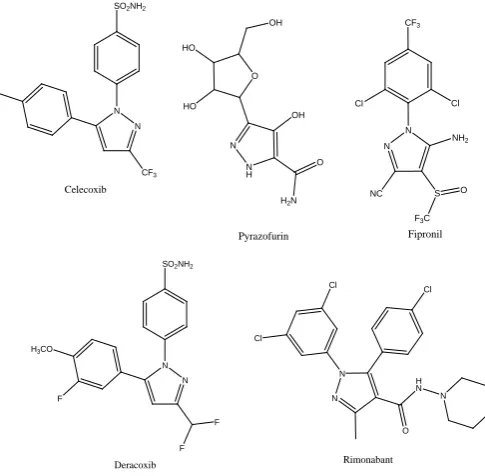
Pyrazoles are the important core of organic synthesis abundantly found in the naturally occurring compounds.10 It
is found in agrochemical products as herbicides, insecticides, fungicides, etc. In medicines was found to have a variety of activities; such as antiinflammatory, cancer,
convulsant, antifungal, antidiabetic, antiviral and anti-bacterial activities.11-14 Some of them are depicted as
bellow12 (Fig. 2).
On observing these various biological properties associated with five-membered heterocycles, inspired us for the synthesis of 5-substituted 4-methyl-2-(4-(alkyloxy) phenyl)thiazole.
SO2NH2
N N
F F H3CO
F
Deracoxib
Figure 2. Important drugs containing pyrazole
RESULTS AND DISCUSSION
The parent ethyl 2-(4-hydroxyphenyl)-4-methylthiazole-5-carboxylate (1) was synthesized by the reaction of 4-hydroxy benzothioamide with ethyl-2-chloroacetoacetate in ethanol. Then, the obtained compound 1 was purified by flash chromatography with n-hexane: ethyl acetate (1:1)
N O
N N H
O N
N HO
O N H
O
F
N N
O NH2
O
O O2N
Furamizole Raltegravir
O OH HO
HO
N N H
OH
O
H2N
Pyrazofurin
N CF3
Cl Cl
N NH2
S
NC O
F3C
Fipronil
N N
O H N
N Cl Cl
Cl
Rimonabant
SO2NH2
N N
CF3
system. The compound 1 was then treated with n-pentyl bromide or ethyl iodide in presence of tetrabutyl ammonium iodide (TBAI), catalytic amount of KI, potassium carbonate and DMF as solvent at reflux condition to give compound ethyl 4-methyl-2-(4-(alkyloxy)phenyl)thiazole-5-carboxy-lates (2a, 2b). Compound 2a and 2b were treated with hydrazine hydrate to give 4-methyl-2-(4-(alkyl-oxy)phenyl)thiazole-5-carbohydrazides (3a, 3b). Compound
3a and 3b were reacted with difference cyclizing reagents to give different azole scaffolds.
Scheme 1. Synthesis of hydrazide derivatives 3(a,b)
The key intermediate 3a was treated with carbon
disulphide and pyridine to afford 5-(4-methyl-2-(4- (pentyloxy)phenyl)thiazol-5-yl)-1,3,4-oxadiazole-2(3H)-thi-one (4a).
The hydrazide 3a was treated with triethyl orthoformate and triethylorthoacetate to give 2-(4-methyl-2-(4-(pentyloxy)phenyl)thiazol-5-yl)-1,3,4-oxadiazole (5a) and 2-methyl-5-(4-methyl-2-(4-(pentyloxy)phenyl)thiazol-5-yl)-1,3,4-oxadiazole (6a) respectively. The hydrazide 3a on treatment with CDI in dioxane gave 5-(4-methyl-2-(4-(pentyloxy)phenyl)thiazol-5-yl)-1,3,4-oxa-diazol-2(3H)-one (7a).
The intermediate 3a on treatment with cyanogen bromide and sodium hydrogen carbonate gave 5-(4-methyl-2-(4-(pentyloxy)phenyl)thiazol-5-yl)-1,3,4-oxadiazol-2-amine
(8a). The same compound was reacted with
3-oxo-3-phenylpropanenitrile and yielded (5-amino-3-phenyl-1H- pyrazol-1-yl)(4-methyl-2-(4-(pentyloxy)phenyl)thiazol-5-yl)methanone (9a). The compound 3a was treated with (E)-ethyl 2-cyano-3-ethoxypent-2-enoate and gave ((E)-ethyl-5- (ethyl-5- amino-1H-pyrazol-1-yl-4-carboxylate)(4-methyl-2-(4-(pen-tyloxy)phenyl)thiazol-5-yl)methanone 10(a
).
Scheme 2. Synthesis of various heterocycles 4(a,b) to 10(a,b) from hydrazide 3(a,b)
OH
N S
O O
O
N S
O O
K2CO3/DMF
R
N2H4/Ethanol
O
N S
O NHNH2
R
Reflux Reflux
1 2(a,b) 3(a,b)
R-X
O
N S
O NHNH2
R
Trie thyl
Orth ofor
mate
Triethyl Orthoacetate
O
N S R
N N
O
O
N S
R
N N
O
C
S2 / P
y
ri
d
in
e
O
N S R
N NH O
S
O
N S
R
CDI/ Dioxane
O
N S R
N NH O
O O
N N
NH2
COOEt
O N S
R O
N N
NH2
CN Br,
NaH CO3,
Dio xane
O
N S R
N N O
NH2
(E
)-et
hyl 2-c
yan
o-3-eth
oxypen
t-2-eno
ate
3-oxo-3-phenylpropanenitrile
4(a, b)
5(a, b)
6(a, b)
7(a, b)
8(a, b) 9(a, b)
10(a, b)
3(a, b)
In a similar way, hydrazide 3b was treated with various
cyclizing agents to obtained compounds 4b-10b and
screened for anti-proliferative activity against breast cancer cells MCF7.
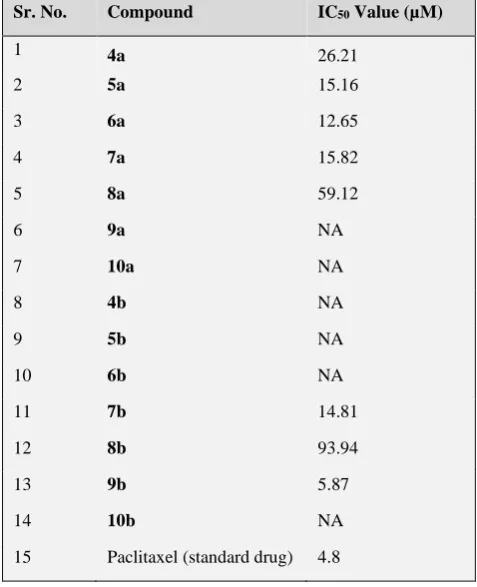
Table 1. Evaluation of IC50 values of
4-methyl-2-(4-(alkyloxy)phenyl)thiazole derivatives
Sr. No. Compound IC50 Value (µM)
1 4a 26.21
2 5a 15.16
3 6a 12.65
4 7a 15.82
5 8a 59.12
6 9a NA
7 10a NA
8 4b NA
9 5b NA
10 6b NA
11 7b 14.81
12 8b 93.94
13 9b 5.87
14 10b NA
15 Paclitaxel (standard drug) 4.8
The breast cancer cells MCF7 were treated with compounds and the anti-proliferative effect was evaluated by MTT assay.
Figure 3. Dose-dependent study of cell viability
As shown in (Fig. 3), a dose-dependent decrease in the growth of cancer cells was observed with increasing concentration of the compounds. Compounds 4a, 5a, 6a, 7a,
8a and 7b showed less to moderate anti-proliferative activity while compound 9b was found to show comparable activity (IC50) to standard anticancer drug Paclitaxel. Among the
cells, the IC50 value of 6a and 9b in MCF7 were found to be
low i.e. 12.65 ± 0.5 and 5.87± 1 µM, respectively. This suggested that treatment with compounds inhibited the growth and induced apoptosis in these cells.
Significantly decreased cell viability was found in compounds treated T-47D cells (p<0.0001 compared to untreated control).
EXPERIMENTALS
All the melting points were recorded by open capillary method and are uncorrected. IR spectra were recorded on Shimadzu IR Affinity 1 spectrophotometer in KBr disc. 1H
NMR were recorded on a BRUKER AVANCE II 400MHz spectrometer in CDCl3/ DMSO d6, chemical shifts are in
ppm relative to TMS. Mass spectra were taken on a Macro mass spectrometer by electron spray method (Es). The structures of various synthesized compounds were assigned on the basis of spectral studies and it has been reported in experimental protocols. The progress of reaction was monitored on Alumina coated TLC plates in ethyl acetate and n- hexane system.
The anti-cancer effect of compounds on the breast cancer cells MCF7 was evaluated by MTT Assay Kit (Thermo Inc. USA). The cells were plated at ~ 1×10³ cells in 96 well
plates containing 100 μL of DMEM and 0,1,2,4,8 µM
compounds were added to each well. In three different wells same concentration was used . Cell death was analysed after 24 hours at 37°C. 15 MTT reagent (5 mg/mL) was added
and kept for four hours incubation. The procedure was followed according to the manufacturer’s instructions. The absorbance was recorded at 490 nm using a 96 well Multiscan Ascent (Thermo Inc. USA). The inhibitory effect of compounds on cell growth was assessed as percent cell viability, where cells without treatment were considered 100% viable. The statistical differences were evaluated by Students two-tailed t-test.
Synthesis of ethyl 4-methyl-2-(4-(alkyloxy)phenyl)thiazole-5-carboxylates (13a and 13b)
Compound 1 (2.63 g, 0.01 mol) was mixed with powdered potassium carbonate (2.07 gm, 0.015 mol ) and DMF ( 25 mL). To this reaction mixture n-pentyl bromide or ethyl iodide (0.011 mol) with catalytic amount of TBAI and KI were added. The mixture was allowed to reflux for 8 h. The resulting mixture was cooled and poured ointo 100 g of ice. The precipitate obtained was filtered, dried at room temperature and purified by column chromatography using hexane: ethyl acetate system (9:1).
2a: Yield: 2.1 g (63 %); mp: 47-48 oC; IR: (KBr, cm-1):
2950, 1700, 1608, 1516, 1441, 1370, 1253, 1174, 1091;1H
NMR (DMSO-d6): 0.96 (t, 3H, -CH3), 1.33 (t, 3H, CH3),
1.36-1.45 (m, 4H, 2CH2), 1.75 (quintate, 2H, CH2), 2.67 (s,
3H, Ar-CH3), 4.02 (t, 2H, O-CH2), 4.29 (t, 2H, O-CH2), 7.87
(d, 2H, J= 8 Hz, 2Ar-H), 7.89 (d, 2H, J=8 Hz, 2Ar-H); M.W.= 333; Mass: (M+1) = 334.
2b: Yield: 1.8 gm (61 %); mp: 98-99 oC; IR (KBr, cm-1):
2984, 1695, 1602, 1522, 1446, 1394, 1370, 1322, 1253,
1181, 1121, 1045 ;1H NMR (DMSO-d
6): 1.32 (t, 3H, -CH3),
1.37 (t, 3H, CH3), 2.66 (s, 3H, Ar-CH3), 4.10 (q, 2H,
O-CH2), 4.28 (q, 2H, O-CH2), 7.01 (d, 2H, J= 8 Hz, 2Ar-H),
Synthesis of 4-methyl-2-(4-(alkyloxy)phenyl)thiazole-5-carbo-hydrazide (3a and 3b)
Compound 3a or 3b (0.006 mol) was dissolved in 15 mL of ethanol. To this mixture hydrazine hydrate (99 %) (0.5 mL, 0.009 mol) was added and refluxed for 3 hours. After the completion of reaction, the reaction mixture was cooled and poured over 50 gms of crushed ice and filtered off. The crude product was recrystallized using ethanol to afford fine yellow colored needle shaped crystals.
3a: Yield: 1.8 g (94 %); mp: 144-145 oC;IR: (KBr, cm-1):
3300, 3200, 2941, 1620, 1524, 14741258, 1178 ; 1H NMR
(DMSO-d6): 0.91 (t, 3H, -CH3), 1.33-1.44 (m, 4H, 2CH2),
1.75 (quintate, 2H, CH2), 2.58 (s, 3H, Ar-CH3), 4.02 (t, 2H,
O-CH2), 4.49 (s, 2H, NH2), 7.01 (d, 2H, J=8 Hz, 2Ar-H),
7.83 (d, 2H, J= 8 Hz, 2Ar-H), 9.48 (s, 1H, NH); M.W.= 319; (M+1) = 320.
3b: Yield: 1.6 g (96 %); mp: 161-162 oC; IR (KBr, cm-1):
3304, 2984, 1630, 1610, 1522, 1450, 1370, 1322, 1265,
1173, 1117, 1049;1H NMR (DMSO-d
6): 1.38 (t, 3H, -CH3),
2.59 (s, 3H, Ar-CH3), 4.08 (q, 2H, O-CH2), 4.46 (s, 2H,
NH2), 7.00 (d, 2H, J=8 Hz, 2Ar-H), 7.83 (d, 2H, J= 8 Hz,
2Ar-H), 9.46 (s, 1H, NH); M.W.= 277; (M+1) = 278.
5-(4-Methyl-2-(4-(alkyloxy)phenyl)thiazol-5-yl)-1,3,4-oxadi-azole-2(3H)-thione (4a and 4b)
A mixture of 3a or 3b (0.002 mole) and carbon disulfide (3 mL) in pyridine (10 mL) was refluxed for 6 h. After completion of the reaction, the solvent was removed using rotary evaporator and the residue obtained was triturated with ice-water mixture and neutralized using dilute HCl. The separated solid was filtered, washed and dried and recrystallized using ethanol to give 4a as pale yellow crystals.
4a: Yield: 0.580 g (80 %); mp: 186-187 oC; IR: (KBr, cm
-1): 3075, 2925, 1603, 1516, 1441, 1383, 1303, 1262,
1178;1H NMR (DMSO-d
6): 0.89 (t, 3H, -CH3), 1.31-1.42 (m,
4H, 2CH2), 1.71 (quintate, 2H, CH2), 2.65 (s, 3H, Ar-CH3),
4.00 (t, 2H, O-CH2), 7.02 (d, 2H, J=8 Hz, 2Ar-H), 7.88 (d,
2H, J= 8 Hz, 2Ar-H); M.W.= 361, (M+1) = 362.
4b: Yield: 0.560 g (87 %); mp: 231-232 oC; IR (KBr,
cm-1): 3088, 2935, 2752, 1602, 1510, 1442, 1382, 1305,
1261, 1173, 1081, 1045; 1H NMR (DMSO-d
6): 1.36 (t, 3H,
-CH3), 2.66 (s, 3H, Ar-CH3), 4.12 (q, 2H, O-CH2), 7.07 (d,
2H, J=8 Hz, 2Ar-H), 7.94 (d, 2H, J= 8 Hz, 2Ar-H), 9.29 (s, 1H, Ar-H); M.W.= 319; (M+1) = 320.
2-(4-Methyl-2-(4-(alkyloxy)phenyl)thiazol-5-yl)-1,3,4-oxadi-azole (5a, 5b)
Compound 3a or 3b (0.002 mol) was refluxed in triethyl orthoformate (10 mL) for 14 h. The extra solvent was removed under vacuum. Thus, the solid obtained was recrystallized by ethanol to afford yellowish crystals.
5a: Yield: 0.473 gm (72 %); mp: 81 oC; IR: (KBr, cm-1):
3133, 2958, 1603, 1516, 1449, 1379, 1316, 1258, 1174,
1091;1H NMR (DMSO-d
6): 0.91 (t, 3H, -CH3), 1.35-1.39
(m, 4H, 2CH2), 1.73-1.76 (quintate, 2H, CH2), 2.75 (s, 3H,
Ar-CH3), 4.06 (t, 2H, O-CH2), 7.08 (d, 2H, J=8 Hz, 2Ar-H),
7.96 (d, 2H, J= 8 Hz, 2Ar-H), 9.37 (s, 1H, Ar-H ); M.W.= 329;(M+1) = 330.
5b: Yield: 0.43 g (75 %); mp: 145-146 oC; IR (KBr,
cm-1): 3119, 2984, 1606, 1519, 1437, 1378, 1270, 1305,
1265, 1177, 1045; 1H NMR (DMSO-d
6): 1.38 (t, 3H, -CH3),
2.75 (s, 3H, Ar-CH3), 4.11 (q, 2H, O-CH2), 7.02 (d, 2H, J=8
Hz, 2Ar-H), 7.92 (d, 2H, J= 8 Hz, 2H), 9.29 (s, 1H, Ar-H); M.W.= 287; (M+1) = 288.
2-Methyl-5-(4-methyl-2-(4-(alkyloxy)phenyl)thiazol-5-yl)-1,3,4-oxadiazole (6a, 6b):
Compound 6a and 6b were prepared by refluxing 3a or
3b) (0.002 mol) in triethyl orthoacetate (10 mL) for 16 h. After the completion of reaction the extra solvent was removed under reduced pressure. The solid obtained was recrystallized by using ethanol to give yellow coloured crystals.
6a: Yield: 0.510 g (74 %); mp: 83-84 oC; IR: (KBr,
cm-1): 2958, 1603, 1574, 1445, 1420, 1399, 1303, 1258,
1178, 1020; 1H NMR (DMSO-d
6, δ ppm): 0.92 (t, 3H,
-CH3), 1.40 (m, 4H, 2CH2), 1.75 (quintate, 2H, CH2), 2.54 (s,
3H, Ar-CH3), 2.73 (s, 3H, Ar-CH3), 4.02 (t, 2H, O-CH2),
6.98 (d, 2H, J=8 Hz, 2Ar-H), 7.86 (d, 2H, J= 8 Hz, 2Ar-H); M.W.= 343, (M+1) = 344.
6b: Yield: 0.457 gm (76 %); mp: 147-148 oC; IR (KBr,
cm-1): 2991, 1596, 1571, 1474, 1441, 1375, 1312, 1258,
1170, 1120, 1041; 1H NMR (DMSO-d
6, δ ppm):1.38 (t, 3H,
-CH3), 2.52 (s, 3H, Ar-CH3), 2.73 (s, 3H, Ar-CH3), 4.11 (q,
2H, O-CH2), 7.04 (d, 2H, J=8 Hz, 2Ar-H), 7.91 (d, 2H, J= 8
Hz, 2Ar-H); M.W.= 301; (M+1) = 302.
5-(4-Methyl-2-(4-(alkyloxy)phenyl)thiazol-5-yl)-1,3,4-oxadi-azol-2(3H)-one (7a, 7b)
The mixture of 3a or 3b (0.002 mol) and N,N’- carbonyl diimidazole (CDI) (0.486 gm, 0.003 mol) in dioxane (20 mL) was refluxed for 6 hours. After completion of reaction the mixture was allowed to cool and solvent was removed under reduced pressure. The solid obtained was recrystallized from ethanol to give colorless crystals.
7a: Yield: 0.552 g (80 %); mp: 175-176 oC; IR: (KBr, cm -1): 3264, 2944, 2752, 1820, 1758, 1603, 1520, 1445, 1386,
1316, 1270, 1174, 1054; 1H NMR (DMSO-d
6, δ ppm): 0.91
(t, 3H, -CH3), 1.34-1.43 (m, 4H, 2CH2), 1.73 (quintate, 2H,
CH2), 2.62 (s, 3H, Ar-CH3), 4.01 (t, 2H, O-CH2), 7.00 (d,
2H, J=8 Hz, 2Ar-H), 7.86 (d, 2H, J= 8 Hz, 2Ar-H); M.W.= 345; (M+1) = 346.
7b: Yield: 0.51 g (84 %); mp: 229-230oC (Decomp.); IR:
(KBr, cm-1): 3292, 2978, 1635, 1523, 1445, 1389, 1322,
1260, 1171, 1115, 1078, 818;1H NMR (DMSO-d
6, δ ppm):
1.38 (t, 3H, -CH3), 2.59 (s, 3H, Ar-CH3), 4.10 (q, 2H,
O-CH2), 4.49 (s, 1H, NH), 7.01 (d, 2H, J=8 Hz, 2Ar-H), 7.84
5-(4-Methyl-2-(4-(alkyloxy)phenyl)thiazol-5-yl)-1,3,4-oxadiazol-2-amine (8a and 8b)
The solution of sodium bicarbonate (1.92 g, 0.0114 mol) in 10 mL of water was added to a solution of 3a or 3b
(0.002 mol) in 20 mL dioxane at room temperature. After 10 minutes of stirring cyanogens bromide (0.266 g, 0.0025 mol) was added with stirring. After 3 h of stirring, the solid precipitates out filtered, dried and recrystallized from isopropyl alcohol to afford brown-colored product.
8a: Yield: 0.62 g (90 %); mp: 176-177 oC; IR: (KBr, cm -1): 3417, 3334, 3108, 3050, 2950, 1679, 1603, 1571, 1516,
1449, 1375, 1325, 1241, 1178, 1012 ;1H NMR (DMSO-d 6, δ
ppm): 0.91 (t, 3H, -CH3), 1.39 (m, 4H, 2CH2), 1.75
(quintate, 2H, CH2), 2.67 (s, 3H, Ar-CH3), 4.02 (t, 2H,
O-CH2), 7.01 (d, 2H, J=8 Hz, 2Ar-H), 7.29 (s, 2H, NH2), 7.87
(d, 2H, J= 8 Hz, 2Ar-H); M.W.= 344; (M+1) = 345
8b: Yield: 0.58 g (96 %); mp: 230-231 oC;IR: 3416, 3336,
3101, 1686, 1602, 1569, 1518, 1445, 1389, 1322, 1255, 1176, 1115, 1036 (KBr, cm-1);1H NMR (DMSO-d
6, δ ppm):
1.38 (t, 3H, -CH3), 2.67 (s, 3H, Ar-CH3), 4.10 (q, 2H,
O-CH2), 4.46 (s, 2H, NH2), 7.01 (d, 2H, J=8 Hz, 2Ar-H), 7.28
(s, 2H, NH2), 7.87 (d, 2H, J= 8 Hz, 2Ar-H); M.W.= 302;
(M+1) = 303.
(5-Amino-3-phenyl-1H-pyrazol-1-yl)(4-methyl-2-(4-(alkyloxy)-phenyl) thiazol-5-yl)methanone (9a, 9b)
A mixture of 3a or 3b (0.001 mol) and
3-oxo-3-phenylpropanenitrile (0.145 g, 0.001 mol) in ethanol was refluxed for 6 h. After completion of reaction, the reaction mixture was allowed to cooled and solvent was removed under reduced pressure. Resulting solid was purified by column chromatography using n-hexane and ethyl acetate (9:1).
9a: Yield: 0.360 g (80 %); mp: 144-145 oC; IR: (KBr, cm -1): 3492, 3383, 2933, 1654, 1603, 1483, 1366, 1329, 1262,
1170, 945 ; 1H NMR (DMSO-d
6, δ ppm): 0.92 (t, 3H, -CH3),
1.34-1.49 (m, 4H, 2CH2), 1.79 (quintate, 2H, CH2), 2.84 (s,
3H, Ar-CH3), 4.05 (t, 2H, O-CH2), 5.87 (s, 1H, Ar-H), 6.84
(s, 2H, NH2), 7.01 (d, 2H, J=8 Hz, 2Ar-H), 7.41-7.50 (m,
3H, 3Ar-H), 7.88 (d, 2H, J= 8 Hz, 2Ar-H), 8.00 (d, 2H, J= 8 Hz, 2Ar-H); M.W.= 446;(M+1) = 447.
9b: Yield: 0.327 g (81 %); mp: 204-205oC; IR: (KBr,
cm-1): 3416, 3225, 2988, 1663, 1602, 1479, 1367, 1328,
1255, 1171, 1042 , 892; 1H NMR (DMSO-d
6, δ ppm): 1.41
(t, 3H, -CH3), 2.84 (s, 3H, Ar-CH3), 4.12 (q, 2H, O-CH2),
5.88 (s, 1H, Ar-H), 6.88 (s, 2H, NH2), 7.04 (d, 2H, J=8 Hz,
2Ar-H), 7.41-7.50 (m, 3H, 3Ar-H), 7.9 (d, 2H, J= 8 Hz, 2Ar-H), 8.00 (d, 2H, J= 8 Hz, 2Ar-H); M.W.= 404; (M+1) = 405.
(Ethyl 5-amino-1H-pyrazol-1-yl-4-carboxylate)(4-methyl-2-(4-(alkyloxy)phenyl)thiazol-5-yl)methanone (10a, 10b)
A mixture of 3a or 3b (0.001 mol) and ethyl
(ethoxymethylene)cyanoacetate (0.169 g, 0.001 mol) in ethanol (10 mL) was heated under reflux for 10 hours. After completion of reaction the reaction mixture was allowed to
cool and the solvent was reduced under reduced pressure. The resulting solid was purified by column chromatography using n-hexane and ethyl acetate (9:1).
10a: Yield: 0.360 g (81 %); mp: 173-174 oC; IR: (KBr,
cm-1) 3458, 3334, 2975, 1687, 1670, 1612, 1553, 1479, 1362,
1329, 1287, 1253, 1174, 1108, 1049, 887; 1H NMR (CDCl 3,
δ ppm): 0.94 (t, 3H, -CH3), 1.36 (t, 3H, -CH3), 1.40-1.48 (m,
4H, 2CH2), 1.81 (quintate, 2H, CH2), 2.89 (s, 3H, Ar-CH3),
4.02 (t, 2H, O-CH2), 4.31 (t, 2H, O-CH2), 6.91 (d, 2H, J=8
Hz, 2Ar-H), 7.24 (S, 2H, NH2, ), 7.75 (s, 1H, Ar-H), 8.00 (d,
2H, J= 8 Hz, 2Ar-H); M.W.= 442; (M+1) = 443.
10b: Yield: 0.345 g (86 %); mp: 205-206 oC; IR: (KBr,
cm-1): 3449, 3336, 2978, 1691, 1669, 1602, 1557, 1361,
1328, 1288, 1249, 1171, 1104, 886; 1H NMR (CDCl
3, δ
ppm):1.36 (t, 3H, -CH3), 1.44 (t, 3H, -CH3), 2.89 (s, 3H,
Ar-CH3), 4.10 (q, 2H, O-CH2), 4.31 (q, 2H, O-CH2), 6.95 (d,
2H, J=8 Hz, 2Ar-H), 7.24 (s, 2H, NH2), 7.75 (s, 1H, Ar-H),
8.00 (d, 2H, J= 8 Hz, 2Ar-H); M.W.= 400; (M+1) = 401.
CONCLUSION
A series of new thiazole derivatives was synthesized and screened for antiproliferative activity. Compounds 4a, 5a,
6a, 7a, 8a, 7b showed less activity while compound 9b was found to show moderate activity (IC50) as compare to
standard anticancer drug Paclitaxel.
ACKNOWLEDGEMENT
The authors are thankful to The Principal, V. P. Mahavidyalaya, Vaijapur and The Principal, Deogiri College, Aurangabad for providing laboratory facilities. The authors are also thankful to The Director, SAIF, Chandigarh for providing spectral analysis.
REFERENCES
1Wani, M. Y., Ahmad, A., Shiekh, R. A., Alghamdi, K. J., Sobral,
A. J., Imidazole clubbed 1,3,4-oxadiazole derivatives as potential antifungal agents, Biorg. Med. Chem., 2015, 23, 4172-4180.https://doi.org/10.1016/j.bmc.2015.06.053
2Farshori, N. N., Banday, M. R., Ahmad, A., Khan, A. U., Rauf,
A., Synthesis, characterization, and in vitro antimicrobial activities of 5-alkenyl/hydroxyalkenyl-2-phenylamine-1,3,4-oxadiazoles and thiadiazoles, ChemInform abstract:Bioorg.Med. Chem. Lett., 2010, 20, 1933-1938.https://doi.org/10.1016/j.bmcl.2010.01.126
3Li, Z., Zhan, P., Liu, X., 1,3,4-Oxadiazole: a privileged structure
in antiviral agents, Mini Rev. Med. Chem., 2011, 11(13), 1130-11342. https://doi.org/10.2174/138955711797655407
4Durgashivaprasad, E., Mathew, G., Sebastian, S., Reddy, S. A.,
Mudgal, J., Nampurath, G. K., Novel 2,5-disubstituted-1,3,4-oxadiazoles as anti-inflamatory drugs, Indian J. Pharmacol., 2014, 46, 521-526. https://doi.org/10.4103/0253-7613.140584
5Kumar, A., D’Souza, S. S., Nagaraj, S. R., Gaonkar, S. L.,
6Singh, P., Sharma, P. K., Sharma, J. K., Upadhyay, A., Kumar, N.,
Synthesis and evaluation of substituted diphenyl-1,3,4-oxadiazole derivatives for central nervous system depressant activity, Org. Med. Chem. Lett., 2012, 2, 28-36. https://doi.org/10.1186/2191-2858-2-8
7Bansal, S., Bala, M., Suthar, S. K., Choudhary, S., Bhattacharya,
S., Bhardwaj, V., Singla, S., Joseph, A., Design and synthesis of novel 2-phenyl-5-(1,3-diphenyl-1H-pyrazol-4-yl)-1,3,4-oxadiazoles as selective COX-2 inhibitors with potent anti-inflammatory activity, Eur. J. Med. Chem.,2014, 80, 167-174. https://doi.org/10.1016/j.ejmech.2014.04.045
8Khanam, R., Ahmad, K., Hejazi, I. I., Siddique, I. A., Kumar, V.,
Bhat, A. R., Azam, A., Athar, F., Inhibitory growth evaluation and apoptosis induction in MCF-7 cancer cells by new 5-aryl-2-butylthio-1,3,4-oxadiazole derivatives, Cancer Chemother. Pharmacol., 2017, 80, 1027-1042. https://doi.org/10.1007/s00280-017-3414-6
9Steigbigel, R. T., Cooper, D. A., Kumar, P. N., Eron, J. E.,
Schechter, M., Markowitz, M., Loutfy, M. R., Lennox, J. L., Gatell, J. M., Rockstroh, J. K., Katlama, C., Yeni, P., BENCHMRK Study Teams, Raltegravir with Optimized Background Therapy for Resistant HIV-1 Infection, New
Engl. J. Med., 2008, 359(4), 339-354.
https://doi.org/10.1056/nejmoa0708975
10Kumar, V., Kaur, K., Gupta, G. K., Sharma, A. K., Pyrazole
containing natural products: Synthetic preview and biological significance, Eur. J. Med. Chem., 2013, 69, 735-753. https://doi.org/10.1016/j.ejmech.2013.08.053
11Ju, Y., Varma, R. S.;Aqueous N-Heterocyclization of Primary
Amines and Hydrazines with Dihalides: Microwave-Assisted Syntheses of N-Azacycloalkanes, Isoindole, Pyrazole, Pyrazolidine, and Phthalazine Derivatives, J. Org. Chem., 2006, 71(1), 135-141.
https://doi.org/10.1021/jo051878h
12Küçükgüzel, Ş. G.; Şenkardeş, S.; Recent advances in bioactive
pyrazoles, Eur. J. Med. Chem., 2015, 97, 786-815. https://doi.org/10.1016/j.ejmech.2014.11.059
13Alam, O., Naim, Md. J., Nawaz, F., Alam, Md. J., Alam, P.,
Current status of pyrazole and its biological activities; J. Pharm. Bioallied. Sci., 2016, 8(1), 2-17. https://doi.org/10.4103/0975-7406.171694
14Faria, J. V., Vegi, P. F., Miguita, A. G. C., Santos, M. S. D.,
Boechat, N.; Bernardino, A. M. R.; Recently reported biological activities of pyrazole compounds, Bioorg. Med.
Chem., 2017, 25(21), 5891-5903.
https://doi.org/10.1016/j.bmc.2017.09.035
15Dake, S. A., Raut, D. S., Kharat, K. R., Mhaske, R. S.,
Deshmukh, S. U., Pawar, R. P., Ionic liquid promoted synthesis, antibacterial and in vitro antiproliferative activity of novel a-aminophosphonate derivatives, Bioorg. Med.
Chem. Lett., 2011, 21, 2527-2532.
https://doi.org/10.1016/j.bmcl.2011.02.039