Research Article
a
July
2019
Computer Science and Software Engineering
ISSN: 2277-128X (Volume-9, Issue-7)
The Implementation of Touchless Fingerprint Accreditation
System to Prevent Disenfranchisement in Global Election
Using Machine Learning
Asogwa Tochukwu Chijindu
Computer Science, Enugu State University of Science and Technology, Enugu, Nigeria
Email- [email protected]
Abstract: This work presents the implementation of Touchless fingerprint accreditation system to prevent disenfranchisement in global election. The aim of this work is to help accord every eligible citizen of a country the right to vote using the proposed system. The author was inspired as a result of the challenges experienced in the recently concluded Nigerian election, to the fact that most times the fingerprint scanning machine malfunctions. We present a system developed using image acquisition tools, image processing tools, and machine learning techniques respectively. The system was designed and implemented using mathlab programming tool, achieving high accuracy value of 96.6% using the finger print dataset provided by Mathworks and also the local dataset provided by the researcher.
Keywords:SURF,
I. INTRODUCTION
Sovereign nations today are governed by the democratic ideals where citizens express their civic right through the conduct of an election with the aim of choosing a leader whom they believe their nation’s destiny can be entrusted with [1]. True democracy is expressed in the electoral principles where the citizens were able to exercise their civic obligation in a free and fair manner during elections. Credit to the national orientation agencies, the telecom media and political parties for the public awareness they create on the importance of casting vote during election. This has helped enlightened the people especially in the rural areas on the fact that their vote can make the difference.
In the past political hooligans extort various means such as ballot box snatching, buying of votes, result sheet mutilation, softwares for result manipulations, alteration of result sheets to mention a few according to [1], to win election for their party, however technologies have bring this illegal activities to a minimum, but despite the success recorded so far, there is still a very big challenge on the success of elections in most countries (Nigeria, Gambia, Sierra-lone, Cameroun, Ghana, Pakistan, Oman to mention a few) especially. This is as a result of little investment by the government on automated online biometric voting systems.
Occasionally, there are certain cases of fingerprint scanner malfunctioning during election accreditation process, like the case of Sabongari polling unit (Kano state, Nigeria) during the recently concluded 2019 presidential election, thus denying certain number of people the right to vote.
Even during the voter’s card registration process, certain people were denied registry due to the inability of scanner to capture their finger print correctly, which might be due to hardware problem, wrinkled finger, fingerprint related diseases, wet finger, high level of pressure on the scanner, low quality of scanner design, or inexperience on the path of the officiating registry and this has been a major challenge, denting the integrity, credibility and reliability on the independent national electoral commission. This research paper presents a redundancy to the conventional system using a touch less finger print accreditation system.
Touchless finger print is a technology that captures the finger print of an individual and run the identity verification, using image acquisition tools, image processing and machine learning techniques. Unlike the conventional approach that requires finger print scanner, this new system will use a small HD camera (usb type) to capture the finger print without contact and still run accreditation accurately. Hence the challenges presented due to wet finger, wrinkled finger, scanner errors leading to civic right disenfranchisement will be solved.
Research Objectives
ISSN(E): 2277-128X, ISSN(P): 2277-6451, pp. 14-20
ii. To provide a redundancy for finger print accreditation iii. To ensure that every eligible citizen exercise their franchise iv. Provide a Touchless system for voters accreditation
Statement of the problem
a) In Sabongeri Kano state Nigeria according to [2], on the 16th February, 2019. Over 700 citizens were disenfranchised due to accreditation challenges which are likely due to fingerprint scanning error and malfunction during the presidential election.
b) Many existing fingerprint sensors acquire fingerprint images as the user’s fingerprint is contacted on a solid flat sensor. Because of this contact, input images from the same finger can be quite different and there are latent fingerprint issues that can lead to forgery and hygienic problems [7].
c) According to [6] the conventional approach users must apply enough pressure on scanners to achieve good quality image, however this pressure produce physical distortion in arbitrary directions of the fingerprint images captured, thus varying the relative position and minutiae of the fingerprint.
d) Logistics was the reasons for February 9th, 2019, election postponement in Nigeria [2], but investigation showed that the card reader and the fingerprint scanners were reconfigured during the week of postponement. That is to say that technicality issues were among the reasons for this change of election date.
e) Many fingers wrinkle when immersed in water and as a result the recognition rate degrades for the conventional finger print accreditation system [3].
Many fingers wrinkle or shrivel when immersed in wa- ter. When used for biometric identification, the recognition rate for wrinkled fingers degrades
Many fingers wrinkle or shrivel when immersed in wa- ter. When used for biometric identification, the recognition rate for wrinkled fingers degrades
II. LITERATURE REVIEW
In 2018 [4] presented a novel episteme on the vulnerabilities of fingerprint authentication systems and their securities. The research was able to highlight various challenges on fingerprint technology and security issues. However, they failed to present a template to enhance the security scheme. [3] Researched on wet fingerprint recognition and opportunities, they revealed that the recognition rate for wet fingerprint degrades. However, their work only determines if a fingerprint is wet but do not compare fingerprints for verification. In [5] a full 3D Touchless fingerprint recognition senor (image acquisition was proposed), the research database and performance baseline was presented, this is with the aim of addressing the challenges effecting fingerprint recognition validation. However, the performance accuracy was not specified. [6] presented a study of Touchless fingerprint recognition system using sensor. The work analyzed the performance evaluation of the conventional solid flat sensor and the novel new system presented. The work employed the illuminator structure and fingerprint wavelength analysis technique to solve the problem of 2D and 3D image mapping. However, this work succeeded in the image processing and analysis of the mapping fingerprint image but do not present any matching algorithm.
III. DESIGN APPROACH
In this section we will discuss the processes employed for the development of the new system, starting with the image acquisition process, image processing, machine learning and verification and also how the aforementioned processes will be implemented using mathlab.
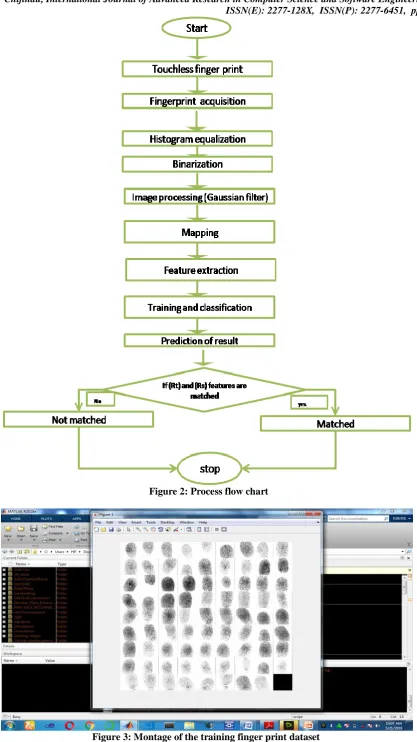
Fingerprint acquisition: this is the first process to acquire the fingerprint image using a HD web camera. This is implemented using image acquisition tools, a mathlab app with the capacity to access image capturing hardware of various specifications (industrial, scientific, genetic, machine vision, 3D depth, USB3 version) cameras respectively. Now that the finger print image has been captured, the next process is to perform a preliminary image processing step (histogram equalization), this is to reduce excess color effect on the image from the background.
Histogram equalization: this step first process the query fingerprint to get a better image quality, reducing the background noise and preparing the image for further pre-processing.
ISSN(E): 2277-128X, ISSN(P): 2277-6451, pp. 14-20
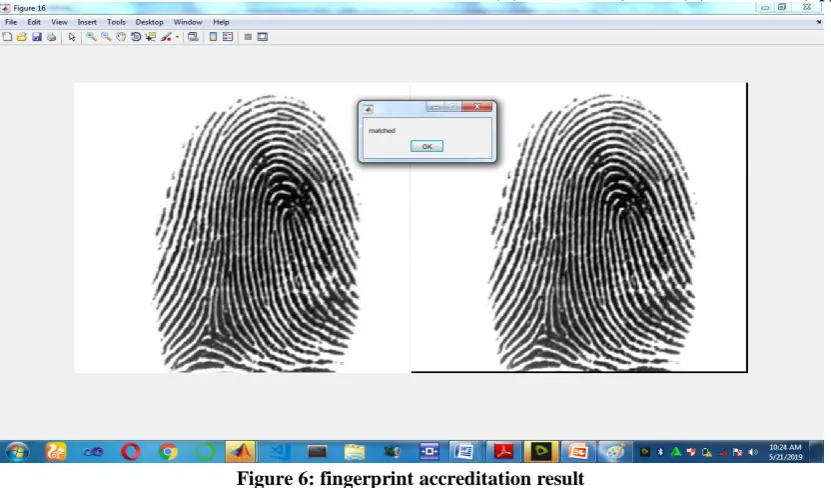
Image processing: the image processing technique employed for this work, processes the images in blocks using the linear filtering approach. The approach uses the Gaussian operator to process images in frequency and spatial domain respectively.
Mapping: this process is used for detecting and enhancing the finger print patters after filtrations. It segments the ridges from the finger prints acquired for feature extraction process. In order words, it simplifies and minimizes the image data to be processed and detects the boundary between two homogeneous regions of various features in a sketching format [8]. This is implemented using the canny edge detector operator in mathlab.
Feature extraction: there are many times of feature extraction processes like the histogram of oriented gradient, the speedup robust features (SURF) feature, the Hough transform and other techniques. However the choice of feature extraction to be adopted for a particular work must be decided by the nature of the statistical problem as hand. In this case rich feature variables are required as the accuracy of the training label is dependent on it. This work uses the SURF feature extraction technique due to its ability, speed and uniqueness in extracting interesting part of an input image in a compact feature vector (rs and rt).
Training and classification: this process computes the feature vectors extracted using an artificial intelligent means (machine learning). The machine learning technique used here is the supervised method (k-nearest neighbor classifier) that classifies data based on similarity measures as in equation (2 and 3), defined by the Spearman distance in equation (1) [8].
Spearman distance
Ds = 1− 𝑟𝑠−‾𝑟𝑠 (𝑟𝑡−‾𝑟𝑡)
′
𝑟𝑠−‾𝑟𝑠
(𝑟𝑡−‾𝑟𝑡)
′ 𝑟𝑠−‾𝑟𝑠
(𝑟𝑡−‾𝑟𝑡)
′ ….equation 1
Where:
rsj is the rank of xsj taken over x1j, x2j, ...xmx,j,.
rtj is the rank of ytj taken over y1j, y2j, ...ymy,j,
rsand rtare the coordinate-wise rank vectors of xs and yt, i.e., rs = (rs1, rs2, ... rsn) and rt = (rt1, rt2, ... rtn).
‾rs = n1 =(n+1)
2
𝑟𝑠𝑗 ……..equation 2 ‾rs = n1 =(n+1)
2
𝑟𝑡𝑗 …….equation 3
Prediction of result: The methodology here employs the approximate k-nearest neighbor technique that uses a matching point of the feature vector descriptor to predict the matched finger prints. The equation is presented according to [9];
𝑞 =𝑞=1,,,,,𝑘arg 𝑚𝑖𝑛 𝑇 𝑘
𝒓𝒕 𝐶 ( 𝒓𝒔
𝑘) 𝑘
𝑘 =1 ...equation (4) Where: q is the predicted classification. k is the number of classes.
𝑇 𝑘
𝒓𝒕 is the posterior probability of class k for observation rs.
𝐶 (𝒓𝒔
𝑘) is the cost of classifying an observation as rt when its true class is k
Implementing the function given a set ofnpoints and a distance in equation (1), (2) and (3) respectively, k nearest neighbor (K-NN) search finds the (k) closest points in rtto a query point or set of points rs or s and t as in spearman
distance equation.
IV. HARDWARE AND SOFTWARE SPECIFICATIONS
The following specifications define both the software and hardware standards necessary to serve as platform for the entire application.
Software Specification
Language: MATHTLAB
Operating System: Mac, Linux, Windows NT/95/98/2000
Hard ware Specification:
Processor: Core, Intel P-III based system Processor Speed: 250 MHz and above RAM: 64MB and above
Hard Disk: 2GB and above
ISSN(E): 2277-128X, ISSN(P): 2277-6451, pp. 14-20
V. SYSTEM ANALYSIS AND IMPLEMENTATION
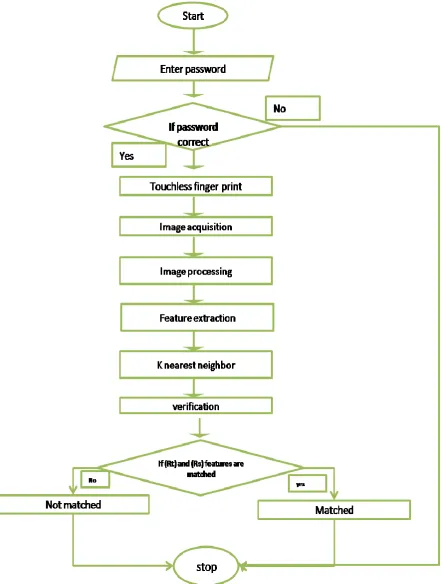
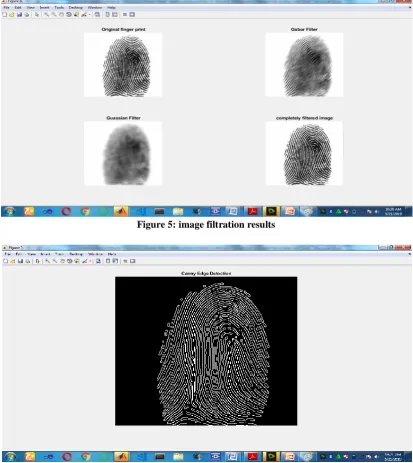
This section employs the process flow chart (figure 4) to explain the step by step procedures for the complete fingerprint verification process, while figure: 3 (system flow chart) models the system operability starting with the login authentication menu. The implementation results have been presented for the new system, starting with a dataset montage containing 80 fingerprint images (courtesy mathworks) as shown in figure 3; figure 4 presents the query fingerprint under preprocessing with graph of the histogram equalization process. The image processing result, revealing the effect of the Gaussian filter used; figure 5 presents the mapping (segmentation) result, other processes are internal operations like the feature extraction, classification and train processes. The training result is the label matched or not matched finger print images (see figure 6),
ISSN(E): 2277-128X, ISSN(P): 2277-6451, pp. 14-20
Figure 2: Process flow chart
ISSN(E): 2277-128X, ISSN(P): 2277-6451, pp. 14-20
Figure 4: model of the query fingerprint and histogram equalization
Figure 5: image filtration results
ISSN(E): 2277-128X, ISSN(P): 2277-6451, pp. 14-20
Figure 6: fingerprint accreditation result
VI. CONCLUSION
Democracy according to a former U.S president (Abraham L.) is the government of the people, by the people and for the people. The researcher believes that to implement this definition, every eligible citizen must participate one way or the order in the government of the day. Election is one of the main medium, the people can exercise their franchise, but there are many technical challenges hindering this effect as in the case of the recently concluded Nigerian election. During the cause of the election (16th February, 2019), many pulling units experienced many challenges of fingerprint scanner malfunctions or finger print scanning error, and as a result were disenfranchised. Some other citizens with finger print related diseases were discriminated. This work presents a contactless means for fingerprint verification which is a means for the election accreditation process. An intelligent means was adopted for this work using machine learning to train and predict the accreditation result with an accuracy level of 96.6%.
REFERENCE
[1] Tony P. A and Adebimpe O.E. (2018); the impact of ICT in the conduct of election in Nigeria; American journal of computer science and technology.
[2] http://www.vangurardngr.com
[3] Prasanna V. Serge B. David K. (2011); Wet fingerprint recognition; Challenges and opportunities; University of California, San Diego.
[4] Tanjaru M. and Mijanur R. (2018); Vulnerabilities of fingerprint authentication systems and their securities; International Journals of computer science and information security.
[5] Javier G., Gunnar B. and Laurent B (2017); Full 3D Touchless fingerprint recognition sensor, database and baseline performance. European commission, DG joint Research center, Italy.
[6] Chulhan Lee, Sanghoon Lee and Jaihie Kin (2006); A study of Touchless fingerprint recognition system. Yonsei Univeristy, Korea.
[7] T. Matsumoto, H. Matsumoto, K. Yamada, and S. Hoshino, ”Impact of artificial ”gummy” fingers on fingerprint systems”, In Proceedings of SPIE Vol. Num.4677, Jan 2002.
[8] Oleka C. (2018); the application of iris scan to improve the accuracy of existing face recognition system using computer vision and machine learning. Enugu state university of science and technology (Esut), Nigeria. [9] Muja, M., and D. G. Lowe (2009). "Fast Approximate Nearest Neighbors with Automatic Algorithm